
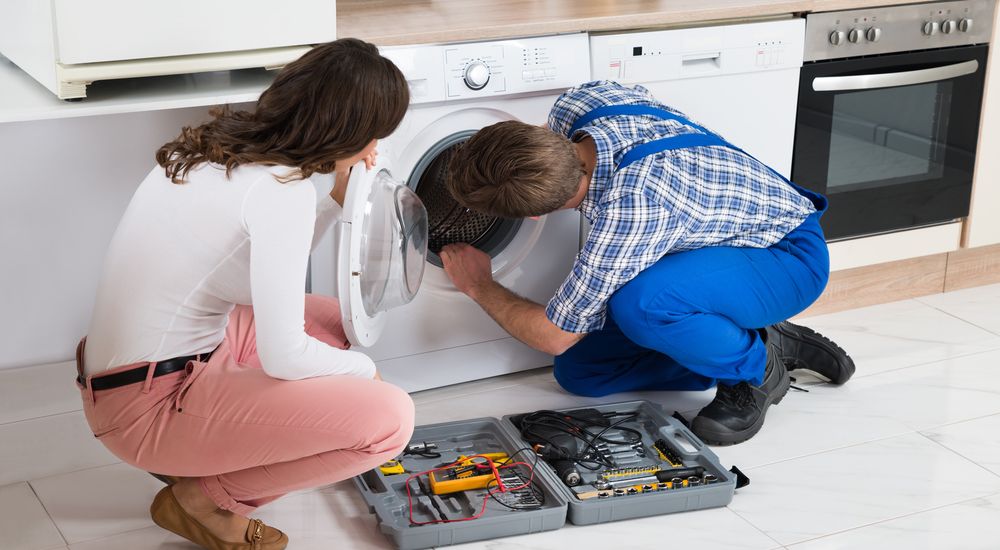

This page is a complete washing machine repair help page from Whitegoods Help – linking to over 50 free DIY repair guides covering every common fault, from a machine that won’t drain or spin, to leaks, error codes, noises and more. Find your symptom in the sections below and follow the relevant guide.
Free repair advice from the engineers at Whitegoods Help – helping UK households fix appliances since 2000.
When your washing machine develops a fault, it can feel daunting – but many of the most common problems can be diagnosed and fixed at home without calling an engineer. This page lists over 50 free fault guides, organised by symptom, to help you find the problem and understand your options.
Use the sections below to find your fault. If your machine is displaying a flashing light or an error code, jump straight to the washing machine error codes section – that is a separate guide.

Only attempt DIY repairs if you are competent and confident doing so. Working on electrical appliances is dangerous. Some washing machine components can deliver an electric shock even after the machine has been switched off and unplugged.
If you are in any doubt at all, do not attempt the repair yourself. Book a qualified engineer instead.
Read these before you start: DIY repair safety guide | 8 things you should never do
Is your machine showing an error code or flashing lights?
Error codes are covered in a separate dedicated section – the guides below are for specific physical symptoms only.
Before You Start – Useful Reading
These guides apply to almost every repair situation. Worth reading before you begin diagnosing or touching anything.
 8 things you should never do
Eight things you should never do when repairing a washing machine.
 3 pre-repair tips
Essential if you are considering calling an engineer.
 DIY repair safety
Do not skip this if attempting a repair yourself.
 Best way to pull a machine out
The correct way to move a washing machine for repair access.
 Avoid introducing new faults
Five things to watch out for when repairing or reconnecting a machine.
 Find your model number
Where to find your washing machine model number and serial number.
Washing Machine Won’t Work – Functioning Faults
The machine won’t start, the door won’t open, the drum isn’t turning, or it’s tripping your electrics. These guides cover the most common mechanical and electrical faults.
 Completely dead – won’t start
Washing machine won’t start – completely dead.
 Door jammed shut
Door jammed shut and won’t open.
 Door or hinge broken
Physical damage to the door or its hinge mechanism.
 Drum paddle loose or broken
How to remove and replace a loose or broken drum paddle.
 Fusing or tripping electrics
Washing machine fusing or tripping the electrics.
 Getting electric shocks
Getting electric shocks from the washing machine.
 Not heating the water
Washing machine not heating the water.
 Drum not turning
Drum not turning during wash, rinse or spin.
 Won’t do fast spin
Washes OK but won’t do the fast spin at the end.
 Belt keeps coming off
Drive belt keeps coming off the pulley.
 Machine is noisy
Washing machine making unusual noise during operation.
 Jumps and bangs on spin
Machine jumps and bangs during spin cycle.
 Metallic scraping noise
Making a metallic scraping noise during operation.
 Object stuck in the drum
Underwire or obstruction stuck in the drum.
Not confident doing this yourself?
Washing Machine Leaking, Not Filling or Not Draining
Water-related faults are among the most common washing machine problems. A blocked pump filter is often the first thing to check before assuming a more serious fault.
 Not filling with water
Washing machine not filling with water.
 Overfilling
Washing machine taking in too much water.
 Fills and drains together
Constantly fills and drains at the same time.
 Fills when switched off
Fills with water when switched off.
 Not enough water
Not taking in enough water.
 Machine leaking
Washing machine leaking water during operation.
 Won’t drain
Washing machine won’t drain at the end of the cycle.
 Won’t drain after being moved
Won’t drain properly after being moved to a new location.
 Clean the pump filter
How to clean the pump filter on a washing machine.
 Manually drain the machine
How to manually drain a washing machine.
Water Pressure, Limescale and Connection Issues
Low water pressure, limescale build-up and incorrect connections are frequently overlooked causes of washing machine faults – particularly in hard water areas of the UK.
 Low water pressure
Low water pressure and washing machines.
 Limescale build-up
Limescale in washing machines.
 Hot/cold fill to cold supply only
Hot and cold fill machines connecting to cold water only.
 Cold fill to hot tap
Connecting a cold fill machine to the hot tap.
Blank off an old hot tapBlanking off an old hot water tap.
Fabric Softener and Soap Drawer Problems
Soap drawer and fabric softener issues are easy to overlook but can indicate a partially blocked dispenser hose – a common fault that can be cleared without an engineer.
 Black jelly in the soap drawer
Black jelly substance in the soap drawer.
Softener not taken from drawerFabric softener not being taken out of the drawer.
Compartment full of waterFabric softener compartment full of water.
 Softener taken out too soon
Fabric softener being taken out too soon in the cycle.
Programme and Wash Cycle Faults
The machine starts but stops mid-cycle, the lights are flashing, or the display is showing something unexpected. These guides help you diagnose control and programme faults.
 Stops mid-cycle
Washing machine stops or sticks mid-cycle.
 Appliance error codes explained
Appliance error codes – what they mean.
 Full error code list
Full washing machine error codes list.
 Hotpoint “tESt” in display
Hotpoint machine showing “tESt” in the display.
Lights flashingWashing machine lights flashing to indicate a fault.
Dial keeps turning and clickingProgramme dial keeps turning and clicking.
 Time display inaccurate
Time remaining display is inaccurate.
Problems with Laundry Results
If the machine appears to be working but your laundry is coming out wrong – damaged, discoloured, still dirty or badly creased – the fault is often with the wash programme, detergent or load, rather than a mechanical failure.
Clothes coming out too hotClothes coming out of the machine too hot.
 Holes in clothes
Holes appearing in clothes after washing.
 Badly creased laundry
Laundry coming out badly creased.
 Whites grey, colours fading
Whites looking grey or colours fading.
 Grease marks on clothes
Grease marks appearing on clothes after washing.
Washing not getting cleanWashing not getting clean properly.
 Too much foam
Too much foam in the machine.
 White streaks on laundry
White streaks on laundry after washing.
Motor Faults
Motor faults often present as a drum that hums but won’t turn, or a machine that trips the electrics. Worn carbon brushes are a very common and relatively straightforward repair on many machines.
 Carbon brushes diagnostics
Washer Dryer Specific Faults
These faults apply to the drying function of a washer dryer only. For washing-related faults on a washer dryer, use the sections above – they apply equally.
 Hot and steamy after drying
Washing Machine Smells
Unpleasant odours from a washing machine are almost always caused by mould, bacteria or detergent build-up – and can usually be resolved without an engineer.
 Washing machine smells
After the Repair – Checks and Advice
 Post-repair checks
Should I Repair or Replace My Washing Machine?
This is one of the most common questions we are asked. As a general rule, if the repair cost is more than half the price of a comparable new machine, replacement is usually the better option – especially on machines over eight years old.
However, a simple fault like a blocked filter, worn carbon brushes or a faulty door seal can often be fixed quickly and cheaply. Our fault guides will help you understand how serious the problem actually is before you make that decision.
If you are unsure, book a diagnostic visit from a local engineer – most will give you a quote before proceeding.
Need Further Help?
 Shop spare parts
 Buying a new machine
Frequently Asked Questions
Why is my washing machine not draining?
The most common causes are a blocked pump filter, a kinked or blocked drain hose, or a faulty drain pump. Start by checking and cleaning the pump filter – on most machines this is found behind a small panel at the front bottom. If the filter is clear, check the drain hose for kinks or blockages. See the full guide: washing machine won’t drain.
Why is my washing machine not spinning?
If the machine washes but won’t spin, check first whether it is draining properly – if water remains in the drum, the machine will not progress to the spin cycle. Other common causes include a worn drive belt, worn carbon brushes, a faulty door interlock, or an unbalanced load. See the full guide: washing machine not spinning.
Why is my washing machine leaking?
Leaks most commonly come from a worn or damaged door seal, a loose or cracked fill hose, a blocked detergent drawer, or an overfull drum. Identify where the water is appearing from before assuming the worst – many leaks have a simple cause. See the full guide: washing machine leaking.
Why won’t my washing machine start?
Check the basics first – is the machine plugged in and switched on, and is the door properly closed? If the door interlock is faulty the machine will not start even if everything else is working. Other causes include a blown fuse, a tripped circuit breaker, or a failed control board. See the full guide: washing machine won’t start.
Why is my washing machine making a loud noise?
A rumbling or grinding noise on spin is often caused by worn drum bearings – a significant repair. A rattling noise is more likely to be a foreign object (coins, underwire) trapped in the drum or pump. A banging noise on spin is typically caused by an unbalanced load or worn shock absorbers. See the full guide: washing machine is noisy.
Is it safe to repair a washing machine myself?
Some basic repairs – such as cleaning the pump filter, replacing a door seal or fitting carbon brushes – are within the capability of a careful DIYer. However, working on electrical components is genuinely dangerous, and some parts can carry charge even after unplugging. Always read our DIY repair safety guide before starting, and if in doubt, call a professional.
How much does washing machine repair cost in the UK?
A typical washing machine repair by a qualified engineer costs between £80 and £180 including parts, depending on the fault and the engineer. Simple jobs such as a pump filter clean or door seal replacement sit at the lower end. Major faults such as drum bearings or a control board replacement sit at the higher end, and may not be economical on an older machine.