
Do Any Washing Machines Still Have a Hot Water Valve?
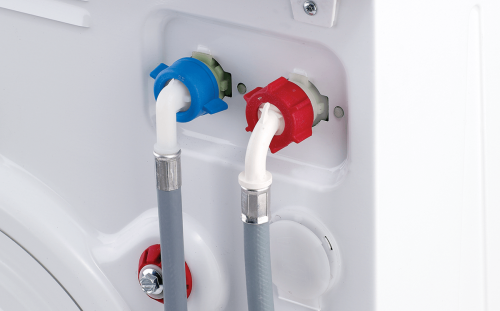

Hot and cold fill washing machines are extremely rare in 2025. Almost all modern washing machines are cold-fill only, heating water internally. A small number of specialist models – including some from Ebac – offer dual inlets, but even these only draw hot water on high-temperature programmes. For most households, a cold-fill machine is more efficient and more practical.
Many people – particularly those with solar thermal systems or an existing hot water supply – want a washing machine that can connect to hot water. Here is the honest picture of what is available, why hot-fill machines have largely disappeared, and whether they would benefit you in practice.
Why Did Hot and Cold Fill Washing Machines Disappear?
Older washing machines routinely had both hot and cold water connections, allowing them to draw pre-heated water from the household system. Over time, manufacturers moved almost universally to cold-fill only designs. This was not an arbitrary decision – there are several well-founded technical and practical reasons.
Contemporary washing machines use significantly less water per cycle than older models. Because the volumes involved are relatively small, heating that water internally using the machine’s own element is often more efficient than drawing it from a domestic hot water system – where much of the heat is lost through pipework before it even reaches the appliance.
Most everyday wash cycles now run at 30°C or 40°C, where precise temperature control is important for fabric care and detergent performance. When a machine draws hot water from an external supply, it has no reliable way to control the exact inlet temperature. Internal heaters allow the machine to reach and maintain the correct temperature accurately – improving both wash results and garment care.
Hot water stored in cylinders typically arrives at temperatures well above what most wash cycles require. Mixing this with cold water externally is inefficient and imprecise. With combi boilers – now the most common heating system in UK homes – drawing small volumes of hot water is particularly inefficient, as the boiler must fire up to deliver it.
A single cold water connection reduces plumbing complexity, lowers the risk of incorrect installation, and makes machines easier to install in a wider range of property types. It also allows manufacturers to produce appliances that work across multiple global markets, many of which do not use domestic hot water systems in the same way as the UK.
UK and EU energy labelling regulations measure and rate washing machine efficiency based on cold-fill operation. Manufacturers optimise their designs to perform well against these standards. Hot-fill capability sits outside this framework and offers no commercial benefit in terms of energy ratings.
Are There Any Hot and Cold Fill Machines Available?
Yes – but they are very rare. As of 2025, the options are limited:
 Ebac
EbacUK manufacturer Ebac produces washing machines with “intelligent hot fill” technology, specifically designed to draw hot water from a connected supply. These are among the very few mainstream options available with genuine dual-inlet support.
 Commercial machines
Some commercial or semi-commercial laundry machines offer hot and cold connections. However, these are designed for institutional use and are not practical for domestic installation in most homes.
 Budget or niche brands
Occasional models from budget or niche manufacturers have appeared with dual inlets, but availability is inconsistent and these models can be difficult to source or support with spare parts.
 Check before buying
The market changes frequently. If a hot-fill machine is important to you, check current availability carefully – and confirm whether the model genuinely uses the hot supply at the temperatures you regularly wash at.
Even machines with dual inlets typically only draw hot water on programmes running at 60°C or above. For everyday 30°C and 40°C washes, the machine will still rely almost entirely on its internal heater – meaning the hot-fill connection provides little or no practical benefit for most laundry.
Is a Hot Fill Machine More Energy Efficient?
This is the question most people are really asking – and the answer depends heavily on your specific hot water setup.
| Hot water source | Hot fill likely to help? |
|---|---|
| Solar thermal system with large, well-insulated cylinder | Possibly – particularly for high-temperature washes |
| Combi boiler (most common UK setup) | Unlikely – firing the boiler for small volumes is inefficient |
| Hot water cylinder (stored hot water) | Marginal – heat lost in pipework often negates the benefit |
| Heat pump hot water system | Potentially beneficial – worth investigating for high-use households |
For the majority of UK households with a combi boiler, a cold-fill machine heating water internally is likely to be more efficient – not less. The assumption that using existing hot water must be more efficient does not hold in most real-world setups.
Read our detailed comparison of cold fill vs hot fill washing machines for a full breakdown of the efficiency arguments.
Can You Connect Hot Water to a Cold-Fill Machine?

Modern cold-fill washing machines are engineered to receive a cold water supply. Connecting a hot water supply to a cold-fill inlet can damage internal components not rated for high inlet temperatures, interfere with temperature sensors and programme logic, void the manufacturer’s warranty, and in some cases create safety risks. Manufacturers explicitly advise against this practice.
If you previously had a hot and cold fill machine and are looking to replicate that setup with a modern appliance, the only safe approach is to select a machine specifically designed for dual-inlet use – such as those from Ebac.
When Does a Hot Fill Machine Actually Make Sense?
 Hot fill is worth considering if…
You have a solar thermal system generating low-cost hot water, your hot water is delivered instantly with minimal pipe heat loss, or you regularly run 60°C or higher wash cycles where the hot inlet would actually be used.
 Hot fill is unlikely to help if…
You have a combi boiler, you mainly wash at 30°C or 40°C, your hot water cylinder is some distance from the machine, or you are hoping for significant energy savings from everyday household laundry.
What About Hard Water Areas?
One argument sometimes made in favour of hot-fill machines is that they reduce limescale build-up, because pre-heated water from an external cylinder may have already deposited some of its scale elsewhere in the system.
In practice, limescale management in a cold-fill machine is more effectively handled through regular use of a quality descaler or water softener product. Read our guide on limescale in washing machines for practical advice on protecting your appliance in hard water areas.
Frequently Asked Questions
Can I still buy a washing machine with a hot and cold water connection?
Yes, but options are very limited. Ebac is the most notable UK manufacturer currently offering machines with genuine hot-fill capability. Some budget or niche brands occasionally offer dual inlets, but availability is inconsistent. Always confirm whether the machine uses the hot supply at the temperatures you actually wash at – many only draw hot water at 60°C or above.
Why don’t modern washing machines have a hot fill?
Modern machines use far less water than older models, making internal heating more efficient than drawing from a domestic supply in most cases. Precise temperature control at 30°C and 40°C also requires internal heating. Energy efficiency standards, global manufacturing, and simpler installation have all driven the shift to cold-fill only designs. Read more in our guide on cold fill washing machines.
Is it safe to connect hot water to a cold-fill washing machine?
No. Cold-fill machines are not designed to receive a hot water supply. Doing so can damage internal components, interfere with temperature sensors, void the warranty, and potentially create safety risks. Manufacturers explicitly advise against this. If you need a machine that connects to hot water, only use an appliance specifically designed for dual-inlet use.
I have solar panels – would a hot fill machine save me money?
Potentially, if you have a solar thermal system generating low-cost hot water that is stored efficiently and delivered to the machine with minimal heat loss. However, the benefit is limited to programmes running at 60°C or above – everyday 30°C and 40°C washes will still use the internal heater regardless. Whether the saving is meaningful depends on your specific setup and how often you run high-temperature cycles.
I had a hot and cold fill machine for years – why can’t I find a replacement?
The market has moved almost entirely to cold-fill only machines over the past two decades. Manufacturers phased out dual inlets as modern detergent chemistry, reduced water volumes, and energy efficiency standards made internal heating the more practical and efficient approach. Replacement options are genuinely limited – Ebac is currently the most practical choice for a like-for-like replacement in the UK. See our washing machine buying guide for broader advice on choosing a new machine.
Does a hot fill machine reduce limescale?
There is some argument that pre-heated water has already deposited scale elsewhere in the system, potentially reducing build-up in the machine. In practice, limescale management in a cold-fill machine is more reliably achieved through regular descaling. Read our guide on limescale in washing machines for practical advice.
Looking for a new washing machine?
Our independent buying guides cover reliability, energy ratings, and performance – helping you choose the right machine for your home and water supply.
Even dual-inlet machines typically only draw hot water at 60°C or above. Everyday 30-40°C washes still use the internal heater.
Ask the repair forum
Post the make, model and symptoms and get help from the Whitegoods Help community.
253 Comments
Grouped into 213 comment threads.
0 replies Hi, I have been on the website looking at the Miele commercial hot and cold fill washing machines only to find they are still "reduced water intake " Is it possible to get a commercial one with the old intake of water. I don't need a commercial but they seem to be the only machines with hot and cold fill. My reason for wanting hot and cold fill is to get a machine that gives more water. but it seems even these are reduced water, wrapped up as " economical,"
0 replies I'm in a hard water area. If any appliance has to heat up any water it uses, it will have limescale problems and therefore seriously deplete the the lifespan of the machine or cause extra expense and pollution by having to add water softeners. I was lucky to have a hot and cold intake machine that lasted 15 years. It eventually died (no parts available to replace) early this year. I managed to find a machine that has a ceramic coating on the heating element (clearance sale) but I seriously doubt the machine will last as long or that they are still available to buy. I agree with Paul Kirwan we want choice not swayed opinion; that's like forcing a democratic country to accept the ideology of a dictatorship. Result duel input or rebellion !!!!
I’m in a hard water area. If any appliance has to heat up any water it uses, it will have limescale problems and therefore seriously deplete the the lifespan of the machine or cause extra expense and pollution by having to add water softeners. I was lucky to have a hot and cold intake machine that lasted 15 years. It eventually died (no parts available to replace) early this year. I managed to find a machine that has a ceramic coating on the heating element (clearance sale) but I seriously doubt the machine will last as long or that they are still available to buy. I agree with Paul Kirwan we want choice not swayed opinion; that’s like forcing a democratic country to accept the ideology of a dictatorship. Result duel input or rebellion !!!!
0 replies Some people would like the option of being able to buy a dual input washing machine because it suits their particular home system / lifestyle choices / whatever. That these might not be of specific use or cost savings to many people is beside the point, dual input appliances are in the majority in Europe ( I worked in Belgium for 4 years where such machines are freely available). The arguments over wasted heat, wasted water, limited costs savings etc. would equally apply in mainland Europe, however at least there consumers have the option to make their own choices, rather than being limited by cartel-like decision of suppliers in the UK market. Meanwhile in mainland Europe the logic of the arguments magically falls tot the other side of the argument and dual feed machines are in the majority. Here in the UK, some of us use wood burning stoves or solar thermal water heating ( or both), some of us have spring water supplies, some water modern system designs exist that ensure that water is hot at the taps immediately, superior insulation allows water to stay hotter longer in more normal supply systems, while "wasted" heat contributes to the overall heating of the house. These of course are not a single mass market solution or requirement, but constitute the situation for a currently frustrated element of society who want to change their energy usage and general approach to services and usage within their own lives. We do not want to be told that WasherHelp knows best and have the error of our choices 'explained' to us, we simply want the option to choose. While the market makes such decisions difficult or punitively expensive by not supplying such items as dual feed washing machines in the UK without very high expense and only at top of the range products, such individuals are not able to make their own informed choices. It is not too much to ask that the option of hot supply is also available on a washing machine in the UK, since such machines are freely available 22 miles from Dover - within our free-trade single-market European Union. And yes, machines supplies to the rest of the EU do run at 220 volts AC, single phase is the majority, and all conforming to the same EU electrical safety directives that machines supplies to the UK market have to observe, they are supplied by the same companies who supply the UK market, and many likely built in the same Asian factories.
Some people would like the option of being able to buy a dual input washing machine because it suits their particular home system / lifestyle choices / whatever.
That these might not be of specific use or cost savings to many people is beside the point, dual input appliances are in the majority in Europe ( I worked in Belgium for 4 years where such machines are freely available).
The arguments over wasted heat, wasted water, limited costs savings etc. would equally apply in mainland Europe, however at least there consumers have the option to make their own choices, rather than being limited by cartel-like decision of suppliers in the UK market.
Meanwhile in mainland Europe the logic of the arguments magically falls tot the other side of the argument and dual feed machines are in the majority.
Here in the UK, some of us use wood burning stoves or solar thermal water heating ( or both), some of us have spring water supplies, some water modern system designs exist that ensure that water is hot at the taps immediately, superior insulation allows water to stay hotter longer in more normal supply systems, while “wasted” heat contributes to the overall heating of the house.
These of course are not a single mass market solution or requirement, but constitute the situation for a currently frustrated element of society who want to change their energy usage and general approach to services and usage within their own lives. We do not want to be told that WasherHelp knows best and have the error of our choices ‘explained’ to us, we simply want the option to choose.
While the market makes such decisions difficult or punitively expensive by not supplying such items as dual feed washing machines in the UK without very high expense and only at top of the range products, such individuals are not able to make their own informed choices.
It is not too much to ask that the option of hot supply is also available on a washing machine in the UK, since such machines are freely available 22 miles from Dover – within our free-trade single-market European Union.
And yes, machines supplies to the rest of the EU do run at 220 volts AC, single phase is the majority, and all conforming to the same EU electrical safety directives that machines supplies to the UK market have to observe, they are supplied by the same companies who supply the UK market, and many likely built in the same Asian factories.
0 replies Dave:"..that the intelligent controls that Washerhelp says are the way forward, and which many of us would at the very least be pleased to see, even if we are not quite as eager to lobby for them as Washerhelp.. I've lobbied many times during these comments that we need properly intelligent washing machines capable of adapting to all circumstances. At least 4 or 5 times I'm sure. However, the ones you refer to in Chris's post are anything but the "intelligent controls" we desire. As far as I can see he just mentions an option which turned off the heater on 60 and 90 degree washes, which sounds pretty crude - albeit desirable to you guys with the solar heated water supplies.
Dave:”..that the intelligent controls that Washerhelp says are the way forward, and which many of us would at the very least be pleased to see, even if we are not quite as eager to lobby for them as Washerhelp..
I’ve lobbied many times during these comments that we need properly intelligent washing machines capable of adapting to all circumstances. At least 4 or 5 times I’m sure.
However, the ones you refer to in Chris’s post are anything but the “intelligent controls” we desire. As far as I can see he just mentions an option which turned off the heater on 60 and 90 degree washes, which sounds pretty crude – albeit desirable to you guys with the solar heated water supplies.
0 replies Really interesting post from Chris H above which appears to tell us that the "intelligent controls" that Washerhelp says are the way forward, and which many of us would at the very least be pleased to see, even if we are not quite as eager to lobby for them as Washerhelp, have clearly been around since at least 1998 and, what is more, in a brand not known for being expensive. It's a shame that Candy today have a reputation for being very unreliable and appear not to sell any hot and cold fill machines, at least not in the UK, but it shows that the technology is there and it is not new or expensive. Annoyingly the Statesman machine that a few of us have commented on has a similar control to make it switch off the heater, but sadly when I asked statesman about this they told me (possibly wrongly but it was from the horse's mouth) that the washer would wash COLD with COLD FILL water using their selector. VClearly statesman need to talk to Candy about this!
Really interesting post from Chris H above which appears to tell us that the “intelligent controls” that Washerhelp says are the way forward, and which many of us would at the very least be pleased to see, even if we are not quite as eager to lobby for them as Washerhelp, have clearly been around since at least 1998 and, what is more, in a brand not known for being expensive. It’s a shame that Candy today have a reputation for being very unreliable and appear not to sell any hot and cold fill machines, at least not in the UK, but it shows that the technology is there and it is not new or expensive.
Annoyingly the Statesman machine that a few of us have commented on has a similar control to make it switch off the heater, but sadly when I asked statesman about this they told me (possibly wrongly but it was from the horse’s mouth) that the washer would wash COLD with COLD FILL water using their selector. VClearly statesman need to talk to Candy about this!
0 replies Yes I agree with your last points Dave although I fall short of agreeing it's a "perfect" solution. :-) It is low-tech version of my ideal genuinely intelligent hot and cold fill washing machine, which would be considerably cheaper though far less effective. Coincidentally I advised someone only yesterday to do exactly that via email when he said he also has a long pipe run and not much hot water gets to his machine. In fact this is exactly what the manufacturers have done. They've converted washing machines over to cold fill for us because they realised that just letting a hot and cold water valve draw in water simultaneously was no good - especially for the now most common 40 and even 30 degree wash programmes where too much hot water could get in for some people. They didn't want to go to the expense of making their machines sophisticated enough to properly utilise hot water. Just making them cold fill seemed like the best thing to do and I agree, back then it was. In a stroke they solved several issues and actually saved money on manufacturing costs. For the majority of people it either made little difference or even saved money and they claim produced better wash results for those using biological detergent. Things are different now though. Back then there wasn't a drive to reduce energy use on appliances. It wasn't an issue then and sales were driven only by extra features. Now, many people are getting environmentally friendly solar heated hot water. You can see solar panels on roofs all over the UK and it's growing. These people deserve to be able to use the hot water they've secured often at great investment cost. Also people are buying appliances based on energy usage . Energy saving washing machines are highly sought after by consumers. Bringing out a washing machine with sophisticated fuzzy logic and being able to adapt to its environment by configuring itself differently dependent on if the customer is using biological detergent or non-biological detergent could be seen as a great advantage to modern savvy consumers. Washing machines shouldn't be optimised for biological detergent usage until biological detergent is the only detergent. Possibly millions of people don't use biological detergent so do NOT need their washing machines to take longer to wash and to fill with stone cold water to help biological enzymes work more effectively! Being able to adapt according to the type of hot water supply being used would also be welcomed by the modern consumer. Being able to control the input of a mix of hot and cold water to give a gentle kick start to even 40 degree washes (especially in winter when the cold water temperature can be quite cold) and to start a 90 degree wash at 60 would make perfect sense to modern consumers. The time is right to bring back the hot water valve - not as it was before, which was crude, unsophisticated and wasteful at times but in a modern form for modern times.
Yes I agree with your last points Dave although I fall short of agreeing it’s a “perfect” solution. :-) It is low-tech version of my ideal genuinely intelligent hot and cold fill washing machine, which would be considerably cheaper though far less effective. Coincidentally I advised someone only yesterday to do exactly that via email when he said he also has a long pipe run and not much hot water gets to his machine.
In fact this is exactly what the manufacturers have done. They’ve converted washing machines over to cold fill for us because they realised that just letting a hot and cold water valve draw in water simultaneously was no good – especially for the now most common 40 and even 30 degree wash programmes where too much hot water could get in for some people.
They didn’t want to go to the expense of making their machines sophisticated enough to properly utilise hot water. Just making them cold fill seemed like the best thing to do and I agree, back then it was. In a stroke they solved several issues and actually saved money on manufacturing costs. For the majority of people it either made little difference or even saved money and they claim produced better wash results for those using biological detergent.
Things are different now though. Back then there wasn’t a drive to reduce energy use on appliances. It wasn’t an issue then and sales were driven only by extra features. Now, many people are getting environmentally friendly solar heated hot water. You can see solar panels on roofs all over the UK and it’s growing. These people deserve to be able to use the hot water they’ve secured often at great investment cost.
Also people are buying appliances based on energy usage . Energy saving washing machines are highly sought after by consumers. Bringing out a washing machine with sophisticated fuzzy logic and being able to adapt to its environment by configuring itself differently dependent on if the customer is using biological detergent or non-biological detergent could be seen as a great advantage to modern savvy consumers. Washing machines shouldn’t be optimised for biological detergent usage until biological detergent is the only detergent. Possibly millions of people don’t use biological detergent so do NOT need their washing machines to take longer to wash and to fill with stone cold water to help biological enzymes work more effectively!
Being able to adapt according to the type of hot water supply being used would also be welcomed by the modern consumer. Being able to control the input of a mix of hot and cold water to give a gentle kick start to even 40 degree washes (especially in winter when the cold water temperature can be quite cold) and to start a 90 degree wash at 60 would make perfect sense to modern consumers.
The time is right to bring back the hot water valve – not as it was before, which was crude, unsophisticated and wasteful at times but in a modern form for modern times.
0 replies Reading today's comments, and taking Washerhelp's point that we are going round in circles (with which I heartily agree) it sounds to me as though Washerhelp is describing, when he says in the post aimed at me at 11:30 a.m., that neither hot and cold fill nor cold fill only is ideal for everyone, the old design of washing machines with the "old style" hot and cold fill system and controls, and the instruction book like the one for my Hoover A3260 which explains that if you have no convenient hot water supply you should connect both the hot and cold inlets to the cold water using a "Y" connector. Surely, washerhelp, you would agree that all we need to do is make washing machines exactly like they always used to be made, but supply them with a "free" "Y" connector and clear instructions telling users that they should use cold only in the relevant circumstances? This would be dirt cheap to do, would allow people like you with a long pipe run (and no draw off spur as sensibly suggested by Phil) to connect to cold only and people like Richard and I and many others to connect to hot and cold to utilise our cheap or free hot water and short pipe runs? The instructions to the user would be no more complex than (and indeed probably more straightforward than) instructions on how to programme a so called "intelligent" machine to use the correct inlets for our installation and as the installation would not change on a regular basis there would be no difficulty at all in making a change in the event that you moved house or had a new plumbing system installed which changed your supply situation, when you'd have the washer disconnected for the move / work anyway? So, to me, that sounds like a perfect solution that meets all Washerhelp's criteria, as well as those of Richard, me, Phil, Sarah, Barbara, et al, and it is as chap and easy to manufacturer as it was in the 1970's and 1980's and uses technology that already exists so there are no R&D expenses. Simples? Or doesn't this meerkat understand Washerhelp's points again????
Reading today’s comments, and taking Washerhelp’s point that we are going round in circles (with which I heartily agree) it sounds to me as though Washerhelp is describing, when he says in the post aimed at me at 11:30 a.m., that neither hot and cold fill nor cold fill only is ideal for everyone, the old design of washing machines with the “old style” hot and cold fill system and controls, and the instruction book like the one for my Hoover A3260 which explains that if you have no convenient hot water supply you should connect both the hot and cold inlets to the cold water using a “Y” connector.
Surely, washerhelp, you would agree that all we need to do is make washing machines exactly like they always used to be made, but supply them with a “free” “Y” connector and clear instructions telling users that they should use cold only in the relevant circumstances?
This would be dirt cheap to do, would allow people like you with a long pipe run (and no draw off spur as sensibly suggested by Phil) to connect to cold only and people like Richard and I and many others to connect to hot and cold to utilise our cheap or free hot water and short pipe runs?
The instructions to the user would be no more complex than (and indeed probably more straightforward than) instructions on how to programme a so called “intelligent” machine to use the correct inlets for our installation and as the installation would not change on a regular basis there would be no difficulty at all in making a change in the event that you moved house or had a new plumbing system installed which changed your supply situation, when you’d have the washer disconnected for the move / work anyway?
So, to me, that sounds like a perfect solution that meets all Washerhelp’s criteria, as well as those of Richard, me, Phil, Sarah, Barbara, et al, and it is as chap and easy to manufacturer as it was in the 1970’s and 1980’s and uses technology that already exists so there are no R&D expenses.
Simples? Or doesn’t this meerkat understand Washerhelp’s points again????
0 replies Richard: As we've gone over plenty of times that's simply not true. You cannot say dual fill will save everyone money. I can prove it wont because I would get no hot water into my machine and many other people would find the same. Also if someone used biological detergent and does have a scenario where hot water gets in straight away the 60 degree + water kills the enzymes and the hotter water the machine started off with would impact on how well the biological detergent would work. There are lots of scenarios where a dual fill would not be better. We need to stop going round in circles and accept that we all agree that it's far more complicated than a simple dual fill or single fill policy, and that a complete new approach (with a hot valve installed) is the only real answer? :-)
Richard: As we’ve gone over plenty of times that’s simply not true. You cannot say dual fill will save everyone money. I can prove it wont because I would get no hot water into my machine and many other people would find the same. Also if someone used biological detergent and does have a scenario where hot water gets in straight away the 60 degree + water kills the enzymes and the hotter water the machine started off with would impact on how well the biological detergent would work. There are lots of scenarios where a dual fill would not be better.
We need to stop going round in circles and accept that we all agree that it’s far more complicated than a simple dual fill or single fill policy, and that a complete new approach (with a hot valve installed) is the only real answer? :-)
0 replies Which? made the point long ago when comparing dual-fill and cold-fill machines. Their very words were, "Choose a dual-fill machine as it will save you money unless your water is heated by full-price electricity" I wonder how many people there are nowadays who use full-price electricity for their water-heating. Even oil is cheaper.
Which? made the point long ago when comparing dual-fill and cold-fill machines. Their very words were, “Choose a dual-fill machine as it will save you money unless your water is heated by full-price electricity”
I wonder how many people there are nowadays who use full-price electricity for their water-heating. Even oil is cheaper.
0 replies Dave: I'm trying to see the issue from an objective point of view, not from any particular viewpoint. The argument that hot and cold fill is best is completely bogus - as is the argument that cold fill is best. They are both arguments that can only be "proved" if taking a blinkered view and quoting specific scenarios that are not applicable to everyone. There are good arguments on both sides and that's why sometimes I may say things that appear to agree with your point of view and sometimes they appear to not agree. The only point of view I stick rigidly to is that there is no single best method, both have their pros and cons dependent entirely on where the washer is situated, what detergent you use, which wash programmes you use and the method of supplying it with hot water. I've said many times that washing machines need to be completely redesigned in order to be able to configure themselves to the environment they are working in and for the customer they are working for. Part of that intelligent design requires a hot water valve for sure, but hot and cold fill washing machines without true fuzzy logic and customisation are only better for some people, just as cold fill only letting the washer heat up the water are better for others.
Dave: I’m trying to see the issue from an objective point of view, not from any particular viewpoint. The argument that hot and cold fill is best is completely bogus – as is the argument that cold fill is best. They are both arguments that can only be “proved” if taking a blinkered view and quoting specific scenarios that are not applicable to everyone.
There are good arguments on both sides and that’s why sometimes I may say things that appear to agree with your point of view and sometimes they appear to not agree. The only point of view I stick rigidly to is that there is no single best method, both have their pros and cons dependent entirely on where the washer is situated, what detergent you use, which wash programmes you use and the method of supplying it with hot water.
I’ve said many times that washing machines need to be completely redesigned in order to be able to configure themselves to the environment they are working in and for the customer they are working for. Part of that intelligent design requires a hot water valve for sure, but hot and cold fill washing machines without true fuzzy logic and customisation are only better for some people, just as cold fill only letting the washer heat up the water are better for others.
Leave a comment
0 replies Phil: Washerhelp, surely it's not beyond you to fit a spur piece of pipe near your washing machine to run off the cold water from the hot pipe? You don't have to pour it into a sump, just down a plughole somewhere convenient. Apologies if that sounds rude, but it only took me a couple of days to figure that out and ask a plumber to arrange it when he was next in. I don't think this is the 1st time it's been mentioned here either Hi Phil. Lots of things have been mentioned over and over again ;-) With some justification though as there are so many comments that any newcomer will not read them all and most likely jump to the last several. So having the points coming back again may not be as pointless as we might think (only for regular readers maybe). I'm perfectly happy to let my washing machine heat up exactly the amount of water it needs because 95% of all our washes are at 40 degrees. It's not necessarily less economical to do that instead of trying to inject hot water from my immersion heater which is miles away in the airing cupboard. I believe that running off a few litres of water every time we wash (daily), and throwing it down the drain, filling all the pipes with hot water, causing cold water to enter the immersion heater cooling the rest of it down and then having all the hot water in the pipes cold down and get wasted ready to be thrown down the drain the next day is definitely not going to save any money worth going to all that effort for. The only people I can imagine finding this worth while are people with lots of solar heated water. It's perfectly possible that it would cost more in reality than just having the washer heat the small amount of water it uses on wash to 40 degrees..
Phil:
Washerhelp, surely it’s not beyond you to fit a spur piece of pipe near your washing machine to run off the cold water from the hot pipe? You don’t have to pour it into a sump, just down a plughole somewhere convenient. Apologies if that sounds rude, but it only took me a couple of days to figure that out and ask a plumber to arrange it when he was next in. I don’t think this is the 1st time it’s been mentioned here either
Hi Phil. Lots of things have been mentioned over and over again ;-) With some justification though as there are so many comments that any newcomer will not read them all and most likely jump to the last several. So having the points coming back again may not be as pointless as we might think (only for regular readers maybe).
I’m perfectly happy to let my washing machine heat up exactly the amount of water it needs because 95% of all our washes are at 40 degrees. It’s not necessarily less economical to do that instead of trying to inject hot water from my immersion heater which is miles away in the airing cupboard.
I believe that running off a few litres of water every time we wash (daily), and throwing it down the drain, filling all the pipes with hot water, causing cold water to enter the immersion heater cooling the rest of it down and then having all the hot water in the pipes cold down and get wasted ready to be thrown down the drain the next day is definitely not going to save any money worth going to all that effort for. The only people I can imagine finding this worth while are people with lots of solar heated water. It’s perfectly possible that it would cost more in reality than just having the washer heat the small amount of water it uses on wash to 40 degrees..
0 replies I'm a Which? member and would be keen to support a campaign. Just let's get the issues straight and come at them with a consistent message... Give us the ammo and tell us where to send it!
I’m a Which? member and would be keen to support a campaign. Just let’s get the issues straight and come at them with a consistent message… Give us the ammo and tell us where to send it!
0 replies I fear that this argument as well as coming up with some very good points from time to time is also at times going round in circles. Hot water left in the pipes is not a major issue if you have a compact plumbing system. Some people do. Even if you do not, it is still cheaper to heat say five litres water off the sun or a CHP system and leave three in the pipe than heat two litres with electricity, and it is better for the environment, by emitting less CO2. Sometimes the water left in the pipes will stay warm enough to be useful to a later user - it all depends. The way for washing machines to reject the first flow of cold water and take in only hot water was existing technology in the 1970s, when a professor in Denmark suggested doing this. The notion that water is as scarce a resource as energy is ludicrous, in the region where I live (Welsh Water's supply area.) But the EU label treats water as if it were a more costly resource than energy. As I may have said before, I think the most productive way forward would be for someone "representing" this forum to put these points to a body that may listen, whether this be a Parliamentary Committee, Which? or the EU, since they usually take comments from "organisations" more seriously than comments from individuals.
I fear that this argument as well as coming up with some very good points from time to time is also at times going round in circles.
Hot water left in the pipes is not a major issue if you have a compact plumbing system. Some people do.
Even if you do not, it is still cheaper to heat say five litres water off the sun or a CHP system and leave three in the pipe than heat two litres with electricity, and it is better for the environment, by emitting less CO2. Sometimes the water left in the pipes will stay warm enough to be useful to a later user – it all depends.
The way for washing machines to reject the first flow of cold water and take in only hot water was existing technology in the 1970s, when a professor in Denmark suggested doing this.
The notion that water is as scarce a resource as energy is ludicrous, in the region where I live (Welsh Water’s supply area.) But the EU label treats water as if it were a more costly resource than energy.
As I may have said before, I think the most productive way forward would be for someone “representing” this forum to put these points to a body that may listen, whether this be a Parliamentary Committee, Which? or the EU, since they usually take comments from “organisations” more seriously than comments from individuals.
2 replies Dave: Water cooling in pipes is not nonsense. It affects my washing machine very much, as it does many other people. My washing machine is so far away from the hot water supply that no hot water would get in at all on a normal fill for wash. Therefore a hot water valve is completely pointless and would waste my already heated hot water for no reason or benefit. You can't argue with physics. In many cases the amount of water needed to run in before the water runs hot is a lot more than will fit in a sump hose though it's a good idea having it go into the sump hose and being sealed off by the ball floats as that would reduce a fair amount of the wasted cool water. Trouble is, if there isn't any wasted water because the water is instantly hot, such as because the machine's already recently just done a load, or maybe the hot supply is from a supply that provides hot water pretty fast, then hot water would enter the sump and be wasted in there. The only answer is genuinely intelligent systems able to cope with all scenarios. I don't follow your second analogy at all I'm afraid. If you had to wash your hands with a limited, set amount of water, which wasn't much, and that produced the same problem in that by the time the water ran hot enough the tap had already shut off before you could wash in hot water then it would be a similar issue. However, if that was the case then experts would surely advice that you would save money by washing with cold instead of drawing hot water into the pipework to be wasted :-)
Dave: Water cooling in pipes is not nonsense. It affects my washing machine very much, as it does many other people. My washing machine is so far away from the hot water supply that no hot water would get in at all on a normal fill for wash. Therefore a hot water valve is completely pointless and would waste my already heated hot water for no reason or benefit. You can’t argue with physics.
In many cases the amount of water needed to run in before the water runs hot is a lot more than will fit in a sump hose though it’s a good idea having it go into the sump hose and being sealed off by the ball floats as that would reduce a fair amount of the wasted cool water. Trouble is, if there isn’t any wasted water because the water is instantly hot, such as because the machine’s already recently just done a load, or maybe the hot supply is from a supply that provides hot water pretty fast, then hot water would enter the sump and be wasted in there. The only answer is genuinely intelligent systems able to cope with all scenarios.
I don’t follow your second analogy at all I’m afraid. If you had to wash your hands with a limited, set amount of water, which wasn’t much, and that produced the same problem in that by the time the water ran hot enough the tap had already shut off before you could wash in hot water then it would be a similar issue. However, if that was the case then experts would surely advice that you would save money by washing with cold instead of drawing hot water into the pipework to be wasted :-)
Likely replying to Washerhelp
Washerhelp, surely it’s not beyond you to fit a spur piece of pipe near your washing machine to run off the cold water from the hot pipe? You don’t have to pour it into a sump, just down a plughole somewhere convenient. Apologies if that sounds rude, but it only took me a couple of days to figure that out and ask a plumber to arrange it when he was next in. I don’t think this is the 1st time it’s been mentioned here either.
Likely replying to Washerhelp
@Washerhelp.
Not sure if I was unclear in what I meant or whether you are deliberately playing the “cold fill is good” card.
Either way here is what I hope will be some clarification of my previous post:
1). Water cooling in pipes is nonsense: not that it doesn’t actually cool: of course it does, but that the energy “wasted” by water cooling in the pipes is a minuscule fraction of the energy used by washers filling with cold water and heating it electrically. The argument that it is more energy efficient / more economical to fill cold and heat with the washer’s electric immersion heater is unmitigated rubbish and there is a gathering wealth of evidence to back this up.
2). Water wasted in sump when already hot: same argument applies as above: the energy “wasted” by hot water flowing direct to sump / drain is such a tiny fraction of the energy used to heat cold water in the machine that it is a nonsensical argument.
3). Hand washing analogy: again, the same argument about water wasted in pipes applies but my point is that no one suggests washing hands in mains cold water to save energy. You seem to suggest that “experts” might suggest this if they felt we used enough water to wash hands. If any so-called “expert” is stupid enough to make this recommendation then we really have lost the plot. Not only would hand washing in cold water be detrimental to everyone’s joints and muscles, and probably agonising beyond belief to sufferers of arthritis / rheumatism, but it would also be unhygienic. If any idiot did suggest that we wash hands in cold water to save energy I believe and hope that the medical profession would shout very loudly about the lunacy of the idea. Ergo, water cooling in pipes is a known and accepted necessary fact of everyday healthy living and using it as a reason not to fill washers with hot water is demonstrable nonsense.
I’m never quite sure whether you are an advocate of hot and cold fill washers (in any shape or form) or whether you are actually in agreement with the government / manufacturers on this. If you were just playing devil’s advocate then I apologise for the snotty corrections here.
0 replies I did write to Which? (twice) and received no answer. To be fair it was only responding to one of their regular requests for feedback, not a special letter to the Editor.
I did write to Which? (twice) and received no answer. To be fair it was only responding to one of their regular requests for feedback, not a special letter to the Editor.
0 replies Well said Barbara! It occurs to me that over a period of years this board has grown but that the nub of the issue boils down to two very simple things: 1) exactly what Barbara has just posted: users just want a washer that washes things properly, rinses them thoroughly and makes no fuss about doing it. 2) people want to use hot water effectively. Thinking about this on my way home tonight it occurred to me that there is a such a lot of old loblocks (as they say on the planet anagramania) put about over the use of the hot water. All this nonsense about needing it to be run through the pipes to run hot: firstly in all washers there is some water run into the sump at the start of the fill process. This may be more or less depending on the age and different novelty devices may be fitted to the machine to supposedly minimise the water that goes to the sump never to be seen again, but regardless, the cold water in the pipe before the hot gets there can just run into the sump like it always used to and it won't be "wasted" at all. Secondly, when you run a hot tap to wash your hands or whatever, you never hear anyone, least of all government ministers and so-called energy saving experts tell you to wash your hands in cold water because by the time the warm water reaches the tap you're done and the water then cools in the pipe, so why do we get this nonsense spouted at us over the washer filling up? The more I think about it the more I believe that this is just utter absolute unmitigated loblocks dreamt up by someone only slightly less daft than the body of the public stupid enough to believe it. Richard's idea sounds excellent: why don't you patent it Richard? It sounds to me like a superb solution for the gadget-hungy age in which we live, and with the mixer valve component it actually sounds like a quite sensible advance on old technology that could result in even better results than ancient machines like my Hoover. One last thought, and I know I've posted this before several times over the years: it's all fine and dandy trying to con us into thinking that modern washers are better for the environment and our bank balances, but not only is this proven untrue with the cold fill argument, also we need to factor in the ruining of our laundry by the over-lengthy and under-lubricated (by water) wash process, and the wear on the machines (as highlighted by washerhelp). We'd have to save a hell of a lot of money on electricity to make up for what we have to spend on new clothes and new machines and the economics of that simply doesn't stack up at all, irrespective of the fact that users like Barbara, Richard and I have found that actually the energy saving claims are simply untrue to start with. Are there any Which? subscribers on here apart from Richard and I? If so, how about a concerned effort from all Which? members who read this to lobby Which? to demand that they get some answers from the Government about why these untruths are peddled, from Miele about why they won't sell their hot and cold fill model in the UK (though they sell their commercial hot and cold fill range here) and from other European countries about why, if there was any truth in the cold fill argument, they've all turned their backs on it?
Well said Barbara!
It occurs to me that over a period of years this board has grown but that the nub of the issue boils down to two very simple things: 1) exactly what Barbara has just posted: users just want a washer that washes things properly, rinses them thoroughly and makes no fuss about doing it. 2) people want to use hot water effectively.
Thinking about this on my way home tonight it occurred to me that there is a such a lot of old loblocks (as they say on the planet anagramania) put about over the use of the hot water. All this nonsense about needing it to be run through the pipes to run hot: firstly in all washers there is some water run into the sump at the start of the fill process. This may be more or less depending on the age and different novelty devices may be fitted to the machine to supposedly minimise the water that goes to the sump never to be seen again, but regardless, the cold water in the pipe before the hot gets there can just run into the sump like it always used to and it won’t be “wasted” at all. Secondly, when you run a hot tap to wash your hands or whatever, you never hear anyone, least of all government ministers and so-called energy saving experts tell you to wash your hands in cold water because by the time the warm water reaches the tap you’re done and the water then cools in the pipe, so why do we get this nonsense spouted at us over the washer filling up?
The more I think about it the more I believe that this is just utter absolute unmitigated loblocks dreamt up by someone only slightly less daft than the body of the public stupid enough to believe it.
Richard’s idea sounds excellent: why don’t you patent it Richard? It sounds to me like a superb solution for the gadget-hungy age in which we live, and with the mixer valve component it actually sounds like a quite sensible advance on old technology that could result in even better results than ancient machines like my Hoover.
One last thought, and I know I’ve posted this before several times over the years: it’s all fine and dandy trying to con us into thinking that modern washers are better for the environment and our bank balances, but not only is this proven untrue with the cold fill argument, also we need to factor in the ruining of our laundry by the over-lengthy and under-lubricated (by water) wash process, and the wear on the machines (as highlighted by washerhelp). We’d have to save a hell of a lot of money on electricity to make up for what we have to spend on new clothes and new machines and the economics of that simply doesn’t stack up at all, irrespective of the fact that users like Barbara, Richard and I have found that actually the energy saving claims are simply untrue to start with.
Are there any Which? subscribers on here apart from Richard and I? If so, how about a concerned effort from all Which? members who read this to lobby Which? to demand that they get some answers from the Government about why these untruths are peddled, from Miele about why they won’t sell their hot and cold fill model in the UK (though they sell their commercial hot and cold fill range here) and from other European countries about why, if there was any truth in the cold fill argument, they’ve all turned their backs on it?
0 replies I believe washing machines should be designed to run as economically as the customer desires, and if desired (as per barbara's last comment) not economically at all. Running "economically" almost always has downsides such as compromises in rinsing ability, taking considerably longer to wash (therefore ironically decreasing the life and reliability of the appliance), not utilising a customers free or cheap plentiful supply of hot water etc. Another example is, if a customer never uses biological detergents they should be able select that as an option so the forced biological friendly processes which add time to the wash process and refuse to use hot water are by-passed..
I believe washing machines should be designed to run as economically as the customer desires, and if desired (as per barbara’s last comment) not economically at all. Running “economically” almost always has downsides such as compromises in rinsing ability, taking considerably longer to wash (therefore ironically decreasing the life and reliability of the appliance), not utilising a customers free or cheap plentiful supply of hot water etc. Another example is, if a customer never uses biological detergents they should be able select that as an option so the forced biological friendly processes which add time to the wash process and refuse to use hot water are by-passed..
0 replies HI, Thanks for all the helpful comments. It seems the statesman is definitely not for me and seems closer to a cold fill. (sorry washerhelp ) but it is exactly an "old school" washing machine that i want. I am not the slightest bit interested in economy in fact the cold fill machines use more electricity as they take so long. most of the extra programs on my machine i do not use and i do not suppose I am unique.. Thank you Adrian for your honest explanation, It is disappointing not to be able to buy the old type machine , but the option of reconditioned remains. (hopefully). Is all i want from a w.m. is clean , well rinsed clothes that do not take a long time spent in very little water with undiluted soap powder.
HI, Thanks for all the helpful comments. It seems the statesman is definitely not for me and seems
closer to a cold fill. (sorry washerhelp ) but it is exactly an “old school” washing machine that i want.
I am not the slightest bit interested in economy in fact the cold fill machines use more electricity as they take so long. most of the extra programs on my machine i do not use and i do not suppose I am unique..
Thank you Adrian for your honest explanation, It is disappointing not to be able to buy the old type machine , but the option of reconditioned remains. (hopefully). Is all i want from a w.m. is clean , well
rinsed clothes that do not take a long time spent in very little water with undiluted soap powder.
0 replies In fact, the "intelligent solution is so childishly simple that I have have a mind to patent it. All that is needed is this: 1. The hot and cold supply feed into a thermostatic valve similar to that used in thermostatoc showers. 2. The temperature required could be set by a control on the machine or, more sophisticatedly, by an instruction from the programmer according to the programme selected. 3. The output from the thermostatic valve feeds into a two-way valve controlled by a heat sensitive switch which bypasses the incoming water into the machine's normal waste outlet until it has reached the correct temperature, when it switches and feeds into the drum. 4. To allow for those occasions when there is insufficient hot water in the house supply to trigger the bypass, a simple timer will ensure that the two-way valve switches over after a pre-determeined time (which could be set by the owner in accordance with the needs of the house's plumbing). 5. If it is felt necessary to admit some cold water first (as Statesman suggest) then the same timer could be set to switch the flow to the drum for a few seconds prior to switching it to the outlet. Simple to contrive and using no more valves than are used in conventional dual-fill machines - albeit, I accept, slightly more complex valves.
In fact, the “intelligent solution is so childishly simple that I have have a mind to patent it. All that is needed is this:
1. The hot and cold supply feed into a thermostatic valve similar to that used in thermostatoc showers.
2. The temperature required could be set by a control on the machine or, more sophisticatedly, by an instruction from the programmer according to the programme selected.
3. The output from the thermostatic valve feeds into a two-way valve controlled by a heat sensitive switch which bypasses the incoming water into the machine’s normal waste outlet until it has reached the correct temperature, when it switches and feeds into the drum.
4. To allow for those occasions when there is insufficient hot water in the house supply to trigger the bypass, a simple timer will ensure that the two-way valve switches over after a pre-determeined time (which could be set by the owner in accordance with the needs of the house’s plumbing).
5. If it is felt necessary to admit some cold water first (as Statesman suggest) then the same timer could be set to switch the flow to the drum for a few seconds prior to switching it to the outlet.
Simple to contrive and using no more valves than are used in conventional dual-fill machines – albeit, I accept, slightly more complex valves.
0 replies Sorry to pour cool water on things: I mentioned the Statesman machine on here a year or so ago and I got in touch with Statesman at the time. to ask about how it compared to the utter sh1t LG that I had at the time. Statesman's technical people were very helpful but they said that like the LG it would only draw any hot on 60 and 90 degree washes and when I explained that my LG only took about a teaspoonful even on those temp's they said that they "could not promise that theirs would be any better". Subsequently the local shop which sold me the reconditioned August 1983 Hoover washer told me that they knew of statesman and rated them highly for reliability and build but "had a feeling the control boards were the same as LG use from the same factory". Obviously if this is the case then it's unlikely they'll use hot water properly any more than the LG did. Also, given that the LG blew up 4 times in 18 months and was utterly useless at washing and rinsing (and pretty damned poor at spinning), I'm afraid my experience also suggests poor reliability if they use common parts with LG, but that latter point is pure speculation on the part of the local shop, so let's hope Statesman don't actually use LG parts after all. As for other points raised today I'd just like to reiterate that (as Barbara and I know so well, and Richard et al keep backing us up at least in greater part) the old "low tech" solution of simply having two valves and no fancy control gear actually works far better than anything new and crucially (as well as using hot water) old machines do actually get the washing clean, rinsed and spun to a good standard and they do it in a fraction of the time of new machines. I'm all in favour of "intelligent" controls, IF IF IF IF IF they still get the job done, but it doesn't seem that this happens. (Maybe the Miele Allwater, which Miele refuse to import to the UK and refuse to explain why they don't, is a good and "intelligent" machine, but since Miele refuse to let us try one over here it's hard to tell.)
Sorry to pour cool water on things: I mentioned the Statesman machine on here a year or so ago and I got in touch with Statesman at the time. to ask about how it compared to the utter sh1t LG that I had at the time. Statesman’s technical people were very helpful but they said that like the LG it would only draw any hot on 60 and 90 degree washes and when I explained that my LG only took about a teaspoonful even on those temp’s they said that they “could not promise that theirs would be any better”.
Subsequently the local shop which sold me the reconditioned August 1983 Hoover washer told me that they knew of statesman and rated them highly for reliability and build but “had a feeling the control boards were the same as LG use from the same factory”. Obviously if this is the case then it’s unlikely they’ll use hot water properly any more than the LG did. Also, given that the LG blew up 4 times in 18 months and was utterly useless at washing and rinsing (and pretty damned poor at spinning), I’m afraid my experience also suggests poor reliability if they use common parts with LG, but that latter point is pure speculation on the part of the local shop, so let’s hope Statesman don’t actually use LG parts after all.
As for other points raised today I’d just like to reiterate that (as Barbara and I know so well, and Richard et al keep backing us up at least in greater part) the old “low tech” solution of simply having two valves and no fancy control gear actually works far better than anything new and crucially (as well as using hot water) old machines do actually get the washing clean, rinsed and spun to a good standard and they do it in a fraction of the time of new machines. I’m all in favour of “intelligent” controls, IF IF IF IF IF they still get the job done, but it doesn’t seem that this happens. (Maybe the Miele Allwater, which Miele refuse to import to the UK and refuse to explain why they don’t, is a good and “intelligent” machine, but since Miele refuse to let us try one over here it’s hard to tell.)
0 replies Thanks Adrian. Anyone determined to buy a washing machine with a hot and cold water valve now have another machine to consider. However, as I originally advise in my article it's not necessarily going to use any significant amounts of hot water unless you have very specific set up and is unlikely to use any hot water at all on the most commonly used 40 degree wash. Even on a 60 degree wash it's only going to use hot water if you have a short hot water run from the source otherwise much of the water drawn in from the hot water pipes is likely to be cold or only warm. The only true answer is to hope someone designs a washing machine that is truly intelligent, with a thermostatically controlled fill that and can properly adapt to all the different conditions a washing machine can find itself in as discussed several times in previous comments - and of course can get round the water cooling in pipes problem..
Thanks Adrian. Anyone determined to buy a washing machine with a hot and cold water valve now have another machine to consider. However, as I originally advise in my article it’s not necessarily going to use any significant amounts of hot water unless you have very specific set up and is unlikely to use any hot water at all on the most commonly used 40 degree wash. Even on a 60 degree wash it’s only going to use hot water if you have a short hot water run from the source otherwise much of the water drawn in from the hot water pipes is likely to be cold or only warm.
The only true answer is to hope someone designs a washing machine that is truly intelligent, with a thermostatically controlled fill that and can properly adapt to all the different conditions a washing machine can find itself in as discussed several times in previous comments – and of course can get round the water cooling in pipes problem..
0 replies Sara: The Hoover Ecologic was a good old-school good machine in the sense that it was very repairable. You could strip down the motor and replace the carbon brush ring or the armature or motor bearings as well as strip down the drum and backplate and replace the drum bearings. The repairability of Hoover washing machines and availability of decent priced parts and good technical information was the secret to their dominance of the market in the 70s. I don't think Hoover realise that. The most popular washing machine needs to be very repairable and people will buy them for ever and recommend them to their friends and family. Even if they aren't that greatly made - as long as they are decently made and can be repaired people will buy them and stick with them.
Sara: The Hoover Ecologic was a good old-school good machine in the sense that it was very repairable. You could strip down the motor and replace the carbon brush ring or the armature or motor bearings as well as strip down the drum and backplate and replace the drum bearings.
The repairability of Hoover washing machines and availability of decent priced parts and good technical information was the secret to their dominance of the market in the 70s. I don’t think Hoover realise that. The most popular washing machine needs to be very repairable and people will buy them for ever and recommend them to their friends and family. Even if they aren’t that greatly made – as long as they are decently made and can be repaired people will buy them and stick with them.
0 replies I live in a hard water area and have had a wonderful Hoover Ecologic 1300 washing machine for 20 years. The brushes have gone and this damaged the motor which I am now replacing with a reconditioned one. This maintainance is costing around £40. As it is a hot and cold fill machine, I consider this to be preferable than buying a new machine with a cold fill only; something that I am going to avoid doing for as long as possible. Even with my Hoover Ecologic machine I added a dose of soda crystals in every wash and I have never had a problem with the quality of wash or rinse. I collect the rinse water for my garden and use British made eco detergents. I know hot water enters the machine almost instantly because I checked when it was fitted by feeling the heat of the door when the water first entered the machine on a certain programme. This was to see if the water hoses were correctly fitted and that the machine was drawing water from the right source. I don't want my machine to be responsible for the heating of the water. Simple as that! I 'm writing because I just want it to be known that I too am disgusted that the manufacturers are not giving us the choice we are demanding and still expect us to pay up for a sub standard machine that, regardless of reported capability, we will not be truly happy with. If I ever failed to get parts I would rather rig the drum to my exercise bike than buy a cold intake only machine! Thanks for this site and the comment posting option. It's good to have a place where views can be shared. I only wish it could be guaranteed the manufacturers are reading this!
I live in a hard water area and have had a wonderful Hoover Ecologic 1300 washing machine for 20 years. The brushes have gone and this damaged the motor which I am now replacing with a reconditioned one. This maintainance is costing around £40. As it is a hot and cold fill machine, I consider this to be preferable than buying a new machine with a cold fill only; something that I am going to avoid doing for as long as possible. Even with my Hoover Ecologic machine I added a dose of soda crystals in every wash and I have never had a problem with the quality of wash or rinse. I collect the rinse water for my garden and use British made eco detergents. I know hot water enters the machine almost instantly because I checked when it was fitted by feeling the heat of the door when the water first entered the machine on a certain programme. This was to see if the water hoses were correctly fitted and that the machine was drawing water from the right source. I don’t want my machine to be responsible for the heating of the water. Simple as that!
I ‘m writing because I just want it to be known that I too am disgusted that the manufacturers are not giving us the choice we are demanding and still expect us to pay up for a sub standard machine that, regardless of reported capability, we will not be truly happy with. If I ever failed to get parts I would rather rig the drum to my exercise bike than buy a cold intake only machine!
Thanks for this site and the comment posting option. It’s good to have a place where views can be shared. I only wish it could be guaranteed the manufacturers are reading this!
0 replies Hi Thanks for the advice, I do , once a month, clean the machine on a hot wash, free of clothes , with a washing machine cleaner from the supermarket . In between I run soda crystals through it and also use calogen as we have very hard water. I am wondering if the force of the hot water hose is causing dirt to go into the wash thus causing the smell to my washing. It is certainly high maintenance with out the benefits. These problems did not exist in the old machines and the clothes were far cleaner, what idiot came up with this idea, the people that like them are even bigger idiots.
Hi Thanks for the advice, I do , once a month, clean the machine on a hot wash, free of clothes , with a washing machine cleaner from the supermarket . In between I run soda crystals through it and also use calogen as we have very hard water. I am wondering if the force of the hot water hose is causing dirt to go into the wash thus causing the smell to my washing. It is certainly high maintenance with out the benefits.
These problems did not exist in the old machines and the clothes were far cleaner, what idiot came up with this idea, the people that like them are even bigger idiots.
0 replies A lot about washing depends on your water. I live in a soft water area so I do not need so much detergent and the rinsing is likewise better. My mother has a quite old machine, a sim line with a drum like a front loader but loaded through an opening in the drum. She always rinses items like sheets and towels with an additional final rinse I am not keen on biological detergents and having solar hot water I am looking into a thermostatic valve so I can feed in hot water at teh corect temperature. If one times the use of the washer to when the run has already been used for washing hands or in the kitchen then many of the arguements go away. My washer is in a utility room near the kitchen and since there is a sink there I can run off some any cold water in the hot supply. I am loath to waste water but Scottish water want me to pay them over 500 quid to have a meter and a meter will not save me any money because of the high standing charge - I know how much I use from living for 10 years in a metered area. SO silly, these things should have a modest fiscal incentive. I Holland all domestic electricity is cheaper after 11pm so people just use a timer to start teh amchine. Here we only have the useless Economy 7 tariff which is only any good for an all electric house
A lot about washing depends on your water. I live in a soft water area so I do not need so much detergent and the rinsing is likewise better.
My mother has a quite old machine, a sim line with a drum like a front loader but loaded through an opening in the drum. She always rinses items like sheets and towels with an additional final rinse
I am not keen on biological detergents and having solar hot water I am looking into a thermostatic valve so I can feed in hot water at teh corect temperature. If one times the use of the washer to when the run has already been used for washing hands or in the kitchen then many of the arguements go away. My washer is in a utility room near the kitchen and since there is a sink there I can run off some any cold water in the hot supply.
I am loath to waste water but Scottish water want me to pay them over 500 quid to have a meter and a meter will not save me any money because of the high standing charge – I know how much I use from living for 10 years in a metered area. SO silly, these things should have a modest fiscal incentive.
I Holland all domestic electricity is cheaper after 11pm so people just use a timer to start teh amchine. Here we only have the useless Economy 7 tariff which is only any good for an all electric house
0 replies Indeed Richard. Washing machines should be capable of running at optimum efficiency regardless of the way it's used and what detergent is used. Customers should be able to tell the machine to run in hot and cold fill mode or cold fill mode depending on their circumstances. They should be able to tell it to do warm rinses or let it rinse in cold water and there should be a button that they can press to tell the machine what type of detergent they are using - biological or non biological. For all the modern technology they use they are still pretty thick.
Indeed Richard. Washing machines should be capable of running at optimum efficiency regardless of the way it’s used and what detergent is used. Customers should be able to tell the machine to run in hot and cold fill mode or cold fill mode depending on their circumstances. They should be able to tell it to do warm rinses or let it rinse in cold water and there should be a button that they can press to tell the machine what type of detergent they are using – biological or non biological.
For all the modern technology they use they are still pretty thick.
0 replies Barbara I cannot believe that the Commission are right. They issue Directives which legally definitely override UK law, even if the UK legislated on the matter the previous week. But I'm not a lawyer. Now is the time for you to contact the UK Market Transformation Program in DEFRA, the details were in a past e-mail. This needs to be done via your MP, then DEFRA are legally obliged to reply to your letter. If DEFRA do try to pass the buck back to the EU, we'll know that something fishy is going on. David
Barbara
I cannot believe that the Commission are right. They issue Directives which legally definitely override UK law, even if the UK legislated on the matter the previous week. But I’m not a lawyer.
Now is the time for you to contact the UK Market Transformation Program in DEFRA, the details were in a past e-mail. This needs to be done via your MP, then DEFRA are legally obliged to reply to your letter.
If DEFRA do try to pass the buck back to the EU, we’ll know that something fishy is going on.
David
0 replies I have received a reply from " THE EUROPEAN COMMISSION " stating the matter does not fall in the remit of DG INTEMAL MARKET. they say, it is more a a question for uk authorities. this is not very helpful. Barbara my cold water w.m. continues to gi ve poor results in spite of high cost . ( wm. cleaners calogen etc. )
I have received a reply from ” THE EUROPEAN COMMISSION ” stating the matter does not fall in the remit of DG INTEMAL MARKET.
they say, it is more a a question for uk authorities. this is not very helpful. Barbara
my cold water w.m. continues to gi ve poor results in spite of high cost . ( wm. cleaners calogen etc. )
1 reply "More comlicated" is what we want. Modern technology is quite sophisticated enough to contrive to mix two sources of water so that the combination is of the right temperature. It was possible back in June 2007 - when this thread started - and it's even easier now.
“More comlicated” is what we want. Modern technology is quite sophisticated enough to contrive to mix two sources of water so that the combination is of the right temperature. It was possible back in June 2007 – when this thread started – and it’s even easier now.
Likely replying to Richard English
Hi Richard. The manufacturer’s say starting with cold water and slowly raising the temperature gives the best results for biological detergents.
Also wouldn’t there still be the same problems with a thermostatic mixing valve that you have with a hot and cold fill washing machine? In most people’s homes the hot water would take too long to run hot through the hose. By the time there was enough hot water running through for the thermostatic valve to start mixing ready to supply water at the required temperature the washing machine will have already taken enough water in for many if not the majority of people’s circumstances.
I suspect the only way a thermostatically controlled mixer could supply the main wash with a predefined temperature for most people would be if the hot hose was disconnected and a bowlful or two run off until it ran hot, then reconnect and the mixer valve would be ready to supply a required temperature.
0 replies I agree with the author's opinion above but some machines would heat to 40oC and must be take in to consideration. Besides, system is a little more complicated than simply having an hot water inlet valve that's why we should think twice when deciding and choosing right material or products for you.
I agree with the author’s opinion above but some machines would heat to 40oC and must be take in to consideration. Besides, system is a little more complicated than simply having an hot water inlet valve that’s why we should think twice when deciding and choosing right material or products for you.
0 replies Now that the Commission has replied to someone's letter, it would be worth registering this Group's views/objections to the present washing machine energy label with DEFRA. On the whole, UK official bodies are quite good at noting views expressed to them, and a Group carries much more weight than a single individual. Who knows, the weight of opinion represented by this forum might even help to offset the contrary views of AMDEA.
Now that the Commission has replied to someone’s letter, it would be worth registering this Group’s views/objections to the present washing machine energy label with DEFRA. On the whole, UK official bodies are quite good at noting views expressed to them, and a Group carries much more weight than a single individual. Who knows, the weight of opinion represented by this forum might even help to offset the contrary views of AMDEA.
0 replies I have received a reply e.mail from the "EUROPEAN COMMISSION" they are directing my query to the relevant department , however i dont think "I" on my own will change anything.
0 replies Write to your MEP. He or she is probably obliged to send on a letter to the right dept in the Commission, just as MPs are obliged to help you. Official UK bodies aren't obliged to reply if you write directly to them, so the MEP route is probably the better one. Good iuck.
Write to your MEP. He or she is probably obliged to send on a letter to the right dept in the Commission, just as MPs are obliged to help you.
Official UK bodies aren’t obliged to reply if you write directly to them, so the MEP route is probably the better one.
Good iuck.
0 replies If you sent your letter to the correct address I believe you will get a response. Unlike private companies, I suspect official bodies are mandated to respond to public enquiries. Certainly I have always has a reply to any letter I write to an MP or Government body and, when they were nationalised, British Rail had a 100% record of responding to me. There will be a department of the EC whose job it is to deal with goods' availability, I feel sure. The challenge is to find it.
If you sent your letter to the correct address I believe you will get a response. Unlike private companies, I suspect official bodies are mandated to respond to public enquiries. Certainly I have always has a reply to any letter I write to an MP or Government body and, when they were nationalised, British Rail had a 100% record of responding to me.
There will be a department of the EC whose job it is to deal with goods’ availability, I feel sure. The challenge is to find it.
1 reply Brilliant to see Canadian posting his or her comment (574 above). It would be great if some other people from other countries where hot fill is not only available but is the norm, encouraged by government, or indeed, like Canada, all there is, could also post so that there is more evidence for us to use against the British suppliers. Best of all would be if users of machines like Miele's Allwater or Bosch's hot and cold fill models could quote to us the PR used by the manufacturers for why Hot and cold fill is normal / better - then we could send that back to the UK offices of the same and challenge them as to why they say one thing outside the UK and the opposite within the UK.
Brilliant to see Canadian posting his or her comment (574 above).
It would be great if some other people from other countries where hot fill is not only available but is the norm, encouraged by government, or indeed, like Canada, all there is, could also post so that there is more evidence for us to use against the British suppliers.
Best of all would be if users of machines like Miele’s Allwater or Bosch’s hot and cold fill models could quote to us the PR used by the manufacturers for why Hot and cold fill is normal / better – then we could send that back to the UK offices of the same and challenge them as to why they say one thing outside the UK and the opposite within the UK.
0 replies I did mention the fact that Maytag (and maybe other manufacturers as well) supply dual-fill washers in Canada, as I saw when I was there last September. I also made the point that this is rather ironic, since the cost of energy in Canada is so much cheaper than it is in the UK, that the savings afforded by dual fill must be very much smaller than they would be in the UK. This correspondent's advice is laudable - had it not been for the fact that we have all been complaining to the various manufacturers about this for years - and they either ignore us or lie to us. Maybe an email from Canada might get a response - although I'll not hold my breath.
I did mention the fact that Maytag (and maybe other manufacturers as well) supply dual-fill washers in Canada, as I saw when I was there last September.
I also made the point that this is rather ironic, since the cost of energy in Canada is so much cheaper than it is in the UK, that the savings afforded by dual fill must be very much smaller than they would be in the UK.
This correspondent’s advice is laudable – had it not been for the fact that we have all been complaining to the various manufacturers about this for years – and they either ignore us or lie to us. Maybe an email from Canada might get a response – although I’ll not hold my breath.
0 replies It looks good to me. The only attempt I made to broaden the debate was when I wrote to Which? They did not publish me letter nor did they make any comment then, or later, about dual fill machines.
It looks good to me. The only attempt I made to broaden the debate was when I wrote to Which? They did not publish me letter nor did they make any comment then, or later, about dual fill machines.
0 replies Worth a try I guess. I have today sent the following: There is a vast blog with articles like I want a washing machine with a hot water valve and a second at a sister site, stuffed full of concerns from people who, like me, have found that COLD ONLY washers are desperately UNeconomical in use, despite the manufacturer's claims to the contrary. Further many of us have discovered that the Uk seems to be the only EU country, possibly the only country in the world, where we CAN"T get hot and cold fill. Makers like Miele, Electrolux, Beko and many others make hot and cold fill machines and sell them everywhere from Russia to Australia and everywhere in between, but they refuse to sell in the UK. Many publish information on how much energy is saved using hot fill, but when their own literature is shown to their UK offices, they just flatly deny that hot fill is even possible, let alone better. Many of us have contacted Miele, AEG, Zanussi, Beko, etc. (details on the blog) but they either refuse to reply or just chant the same mantra, rather than explaining why the UK is being left out. Can You and Yours help us to find out why?? This is especially upsetting for those of us with Solar or district heating schemes, as we get "free" hot water but are forced to leave it standing and pay to heat washing water by electricity.
Worth a try I guess.
I have today sent the following:
There is a vast blog with articles like I want a washing machine with a hot water valve and a second at a sister site, stuffed full of concerns from people who, like me, have found that COLD ONLY washers are desperately UNeconomical in use, despite the manufacturer’s claims to the contrary.
Further many of us have discovered that the Uk seems to be the only EU country, possibly the only country in the world, where we CAN”T get hot and cold fill. Makers like Miele, Electrolux, Beko and many others make hot and cold fill machines and sell them everywhere from Russia to Australia and everywhere in between, but they refuse to sell in the UK. Many publish information on how much energy is saved using hot fill, but when their own literature is shown to their UK offices, they just flatly deny that hot fill is even possible, let alone better. Many of us have contacted Miele, AEG, Zanussi, Beko, etc. (details on the blog) but they either refuse to reply or just chant the same mantra, rather than explaining why the UK is being left out. Can You and Yours help us to find out why??
This is especially upsetting for those of us with Solar or district heating schemes, as we get “free” hot water but are forced to leave it standing and pay to heat washing water by electricity.
0 replies Can someone send an email to BBC R4's You and Yours programme on this? Preferably not me, as I sent one on another subject this morning. They cover consumer interests of all kinds, so should be prepapred to take this up. One would like to think it's illegal to refuse to sell to us, under EU single market law. But they can probably pick and choose to whom they sell.
Can someone send an email to BBC R4’s You and Yours programme on this? Preferably not me, as I sent one on another subject this morning.
They cover consumer interests of all kinds, so should be prepapred to take this up.
One would like to think it’s illegal to refuse to sell to us, under EU single market law. But they can probably pick and choose to whom they sell.
0 replies Re post 569. Yes, I think this debate needs widening a great deal further. Your instruction book further illustrates the point that Ricard and I in particular, and many others too, are sick of making but getting a poor response to: "Manufacturers DO make hot and cold fill machines, but just won't sell them in the UK. WHY NOT???" Any suggestions how / where / via whom or what we widen this debate?
Re post 569.
Yes, I think this debate needs widening a great deal further.
Your instruction book further illustrates the point that Ricard and I in particular, and many others too, are sick of making but getting a poor response to: “Manufacturers DO make hot and cold fill machines, but just won’t sell them in the UK. WHY NOT???”
Any suggestions how / where / via whom or what we widen this debate?
3 replies Hi I was interested to read the trials of getting a cold feed washing machine. As some will know I had to get one as well, A beko WM1501W. I have tried it with just cold water and again by adding hot from the adjacent tap through the soap draw. No problem thus far though I am not sure if I reached the full 25degress C that Beko said I could feed it with (in writing). I plan to get a mixer valve so that I feed with just 25deg and perhaps a little more we wash mainly at 30. In TWO PLACES IN THE BOOK it said Page 6 First use Ensure that ther Hot and Cold connections have been made correctly.... Otherwise your laundry may come out Hot at the end of the washing process and may wear out. Page 9 Modles with a single hose............ This raises the question Why the difference. Should the debate be widened across the net??
Hi
I was interested to read the trials of getting a cold feed washing machine. As some will know I had to get one as well, A beko WM1501W. I have tried it with just cold water and again by adding hot from the adjacent tap through the soap draw. No problem thus far though I am not sure if I reached the full 25degress C that Beko said I could feed it with (in writing). I plan to get a mixer valve so that I feed with just 25deg and perhaps a little more we wash mainly at 30. In TWO PLACES IN THE BOOK it said Page 6 First use Ensure that ther Hot and Cold connections have been made correctly…. Otherwise your laundry may come out Hot at the end of the washing process and may wear out. Page 9 Modles with a single hose………… This raises the question Why the difference.
Should the debate be widened across the net??
Likely replying to tim
Tim, i have been on your suggested website. I have left the subject to be put forward for debate? While there I also signed the NHS petition and posted it onto facebook.. Most people seem concerned with the temperature of machines, my big concern is insufficient water to wash and rinse clothes, is there supposed to be a visible water level because I don’t, have one. Thank you.
Likely replying to barbara flatts
@barbara flatts I’m glad to help others with ideas that I’ve thoroughly tried and tested. :)
Modern washing machines don’t do their job properly and need manual intervention to improve their lame performance, so AUTOMATIC goes straight out of the window!
Pouring jugfuls of warm water into the soap drawer will help and it only takes just a few minutes. You could add less water, start the machine again and if there’s enough water it won’t keep adding more cold water. I find it’s better to use extra warm water to cover the bottom door seal by 1 inch; this helps dilute the detergent more so it rinses off easier, it also keeps the door seal clean; I used to get white stuff on the door seal before adding the extra water and I would often notice a stray sock or something stuck on the door seal while the rest of the laundry was rotating in the drum.
I do NOT accept any of the arguments that cold fill only is better because… (list of reasons).
I DON’T want to pay extra for electricity when the washing machine has to heat stone cold water, despite having hot water available to mix. I DON’T want my clothes suffering more wear and tear in the washing machine while the water temperature is below 20C and the detergent is not even dissolved properly and not actually cleaning. I DON’T see why I should be heating cold water in 2 places at home (except using the kettle of course) and so on, and so on and so on!
Bring back the hot water valve!!
0 replies @Chris comment #566. I suggest you put the detergent tablets into the drum at the back, before loading the laundry. Your soap drawer (and its inside surrounding) will need cleaning with hot water and a small brush, as the incoming cold water makes the soap residue stick! Your washing is not as soft as it used to be because your new washing machine is using less water during the rinses and not rinsing out all the detergent. This is best addressed by reading the blog article Why can't modern washing machines rinse properly?. My comment #460 via that link (after the first paragraph in that comment) may be helpful to you. I'm very disappointed with today's washing machines, they are nowhere near as good as the old hot and cold fill ones! :(
@Chris comment #566.
I suggest you put the detergent tablets into the drum at the back, before loading the laundry. Your soap drawer (and its inside surrounding) will need cleaning with hot water and a small brush, as the incoming cold water makes the soap residue stick!
Your washing is not as soft as it used to be because your new washing machine is using less water during the rinses and not rinsing out all the detergent. This is best addressed by reading the blog article Why can’t modern washing machines rinse properly?.
My comment #460 via that link (after the first paragraph in that comment) may be helpful to you.
I’m very disappointed with today’s washing machines, they are nowhere near as good as the old hot and cold fill ones! :(
0 replies I think we all agree that it would be a very simple thing for manufacturers to make dual-fill machines that were intelligent enough to mix water so that it arrives in the machine at the correct temparature - after all, thermostatic showers have been doing this for years. What the real mystery is why manufacturers don't sell such machines in the UK even though it seems they do actually make them. The other mystery is why no manufacturer neither contributes to this discussion nor replies truthfully to enquiries. If it weren't for the fact that one can conceive of no reason for it, one would suspect a conspiracy.
I think we all agree that it would be a very simple thing for manufacturers to make dual-fill machines that were intelligent enough to mix water so that it arrives in the machine at the correct temparature – after all, thermostatic showers have been doing this for years.
What the real mystery is why manufacturers don’t sell such machines in the UK even though it seems they do actually make them. The other mystery is why no manufacturer neither contributes to this discussion nor replies truthfully to enquiries. If it weren’t for the fact that one can conceive of no reason for it, one would suspect a conspiracy.
0 replies Thanks for your input David. Large capacity washing machines do use more water and energy and are only more economical because they can wash a lot more. Therefore unless you are regularly filling one (and most people would struggle to properly load anything over 6Kg for most washes) they are not more economical. As you say David, they can be shown to be more economical per Kg but the average load size for the UK is no where near 7, 8, or 10 and 11 Kgs and more like 3Kgs according to a Which recent survey. I wrote some critical views on eco labels about 3 years ago - Are energy labels on Washing Machines misleading? | Eco-labels suggestion
Thanks for your input David. Large capacity washing machines do use more water and energy and are only more economical because they can wash a lot more. Therefore unless you are regularly filling one (and most people would struggle to properly load anything over 6Kg for most washes) they are not more economical. As you say David, they can be shown to be more economical per Kg but the average load size for the UK is no where near 7, 8, or 10 and 11 Kgs and more like 3Kgs according to a Which recent survey.
I wrote some critical views on eco labels about 3 years ago – Are energy labels on Washing Machines misleading? | Eco-labels suggestion
0 replies Whoever thought that it would save energy to have coldfill only clearly never did the weekly wash themselves. Yes, you can run the hot tap to get the hot water through to the machine and yes, it does waste hot water in the pipes. BUT - if you are going to take an extra hour for each washload (which effectively is what happens nowadays) this means that any chance of drying the whole weekly wash outside on a washing line is lost, thus making sure you have to use a tumbler dryer. How this is supposed to help the environment beats me, so I can only imagine that the EC decision-makers who are behind all the energy saving regulations live somewhere warmer than here. By the way, I am just scrapping a Beko machine, which is only 18 months old and cost £374 to buy. I shall be biting the bullet and buying ISE next, but wish I had kept my 14 year old Hotpoint which did a 40 deg wash in an hour and just kept repairing it.
Whoever thought that it would save energy to have coldfill only clearly never did the weekly wash themselves. Yes, you can run the hot tap to get the hot water through to the machine and yes, it does waste hot water in the pipes. BUT – if you are going to take an extra hour for each washload (which effectively is what happens nowadays) this means that any chance of drying the whole weekly wash outside on a washing line is lost, thus making sure you have to use a tumbler dryer. How this is supposed to help the environment beats me, so I can only imagine that the EC decision-makers who are behind all the energy saving regulations live somewhere warmer than here. By the way, I am just scrapping a Beko machine, which is only 18 months old and cost £374 to buy. I shall be biting the bullet and buying ISE next, but wish I had kept my 14 year old Hotpoint which did a 40 deg wash in an hour and just kept repairing it.
0 replies In response to comment #524 I totally agree. In the 21st century with technologically advanced washing machines, you need to stand there and pour in hot water for the main wash to raise the water temperature, also in the rinses I have to stand around pouring in hot water to get the clothes rinsed properly. It makes me *so* angry every time I use the washing machine that I have to waste my time doing this when the washing machine is supposed to be "automatic"!! In some cases, pouring in extra hot water may reduce the main wash time considerably, but people on this site are complaining that wash times are too long, so maybe it's not so bad if some washing machines reduce the main wash time? Surely it's better to have clothes last longer if they are washed and rinsed in more water for less time, than the current situation of washing them in barely any water for a long time and the clothes suffer more "wear and tear" (literally), so get thrown away sooner. The lack of a hot water inlet valve on modern washing machines raises another big question: are old washing machines better than new ones? I think Washerhelp could set up a new blog devoted to new versus old washing machines and see how many comments get added - probably many!
In response to comment #524
I totally agree. In the 21st century with technologically advanced washing machines, you need to stand there and pour in hot water for the main wash to raise the water temperature, also in the rinses I have to stand around pouring in hot water to get the clothes rinsed properly. It makes me *so* angry every time I use the washing machine that I have to waste my time doing this when the washing machine is supposed to be “automatic”!!
In some cases, pouring in extra hot water may reduce the main wash time considerably, but people on this site are complaining that wash times are too long, so maybe it’s not so bad if some washing machines reduce the main wash time? Surely it’s better to have clothes last longer if they are washed and rinsed in more water for less time, than the current situation of washing them in barely any water for a long time and the clothes suffer more “wear and tear” (literally), so get thrown away sooner.
The lack of a hot water inlet valve on modern washing machines raises another big question: are old washing machines better than new ones? I think Washerhelp could set up a new blog devoted to new versus old washing machines and see how many comments get added – probably many!
1 reply Are you suggesting that Canadians, Americas, Germans, Italians Australians and the residents of those other countries where we know dual -fill machines are sold, have them simply because they complain more tha we do? The British might not be a complaining race by nature - but I can't believe that all the countries cited above generate so many more complaints. After all, Canada (to cite just one country) has a far smaller population tha do we.
Are you suggesting that Canadians, Americas, Germans, Italians Australians and the residents of those other countries where we know dual -fill machines are sold, have them simply because they complain more tha we do?
The British might not be a complaining race by nature – but I can’t believe that all the countries cited above generate so many more complaints. After all, Canada (to cite just one country) has a far smaller population tha do we.
Likely replying to Richard English
Hello Richard: I was told that they have different hot water supplies to us, presumably most use combination boilers. I was told the UK is pretty unique in having the majority of households using gravity fed hot water from hot water tanks upstairs, which means hot water takes a long time to reach the washing machine.
1 reply WMUser's suggestion about adding hot water via the detergent drawer is obviouly sound - but why should we buy expensive, complex and supposedly state of the art machines that are supposed to work automatically - and then use a manual intervention to make them work properly? It would be very easy to design and machine that took a mixture of hot and cold water - and such machines exist. But nobody sells them in the UK for no good reason that anyone here has been able to determine.
WMUser’s suggestion about adding hot water via the detergent drawer is obviouly sound – but why should we buy expensive, complex and supposedly state of the art machines that are supposed to work automatically – and then use a manual intervention to make them work properly?
It would be very easy to design and machine that took a mixture of hot and cold water – and such machines exist. But nobody sells them in the UK for no good reason that anyone here has been able to determine.
0 replies I've not read every single one of the 520 comments above, but if you want to mix some hot water into the washing machine to save power, simply pour a few jugfuls of hot water into the soap drawer so the volume of water just comes over the bottom of the door seal. If you use biological detergent, I would suggest a mixture of hot and cold water being poured in, so the water in the washing machine is lukewarm instead of stone cold. However, for really dirty clothes, you can usually extend the wash time by adding some extra cold water - but this uses more electricity and that's why we are debating the use of a hot water valve! For a 40C wash, starting off with warmer water at, say, 28C instead of a low temperature e.g. 10C will keep running costs down and you still get the benefits of the biological detergent's enzymes. These enzymes only get decayed if the water is too warm i.e. 53C or above, as mentioned by Oliver in an earlier comment. It's probably gentler for the clothes if there's an extra volume of water in the main wash so they don't become coated in highly concentrated detergent and rub against other dry clothes until the water has been absorbed and the washing machine's "fuzzy logic" decides to add more water. A volume of water that just comes over the bottom of the door seal should be enough; I think any more than that would be superfluous. It's up to you if you want to pour extra hot water into the soap drawer after the washing machine has filled up for the wash.
I’ve not read every single one of the 520 comments above, but if you want to mix some hot water into the washing machine to save power, simply pour a few jugfuls of hot water into the soap drawer so the volume of water just comes over the bottom of the door seal.
If you use biological detergent, I would suggest a mixture of hot and cold water being poured in, so the water in the washing machine is lukewarm instead of stone cold. However, for really dirty clothes, you can usually extend the wash time by adding some extra cold water – but this uses more electricity and that’s why we are debating the use of a hot water valve!
For a 40C wash, starting off with warmer water at, say, 28C instead of a low temperature e.g. 10C will keep running costs down and you still get the benefits of the biological detergent’s enzymes. These enzymes only get decayed if the water is too warm i.e. 53C or above, as mentioned by Oliver in an earlier comment.
It’s probably gentler for the clothes if there’s an extra volume of water in the main wash so they don’t become coated in highly concentrated detergent and rub against other dry clothes until the water has been absorbed and the washing machine’s “fuzzy logic” decides to add more water. A volume of water that just comes over the bottom of the door seal should be enough; I think any more than that would be superfluous. It’s up to you if you want to pour extra hot water into the soap drawer after the washing machine has filled up for the wash.
0 replies Being an old fashioned silver surfer, in the market for a new washing machine with a hot and cold fill as I do a regular 95o wash i.e,once a week for towels flannels etc. Not having a dishwasher I use tea towels and feel these need a hot hot wash too, and in an old fashioned way I get some enjoyment from seeing them on the washing line, white, clean and free from stains unlike some of those seen at my friends and neighbours. I have read your blog, missing out quite a few entries - the first I have taken part in! I do feel after 2 goes and many hours spent gleaning the information I need to buy another machine is that perhaps there are better things to do in the days remaining to me! So my question is Washerhelp what machine do you use, or what machine would you recommend. We have an economical souce of water in winter,having a good old fashioned solid fuel heating system which produces hot hot water whilst heating the house. Something that hasn't been mentioned is that we are not connected to the mains drainage and cannot be, as we are allegedly too far from the nearest connection - so use a Klargester sewage system and thus cannot use a bio-detergent, as they kill the working bugs in the sewage system, (hard to believe but we only live 16 miles from the centre of London). This is quite common on the Continent and in the countryside we are not alone, yet this appears to have been ignored by washing machine manufacturers. Perhaps you could bring it to their attention!
Being an old fashioned silver surfer, in the market for a new washing machine with a hot and cold fill as I do a regular 95o wash i.e,once a week for towels flannels etc. Not having a dishwasher I use tea towels and feel these need a hot hot wash too, and in an old fashioned way I get some enjoyment from seeing them on the washing line, white, clean and free from stains unlike some of those seen at my friends and neighbours.
I have read your blog, missing out quite a few entries – the first I have taken part in! I do feel after 2 goes and many hours spent gleaning the information I need to buy another machine is that perhaps there are better things to do in the days remaining to me! So my question is Washerhelp what machine do you use, or what machine would you recommend.
We have an economical souce of water in winter,having a good old fashioned solid fuel heating system which produces hot hot water whilst heating the house.
Something that hasn’t been mentioned is that we are not connected to the mains drainage and cannot be, as we are allegedly too far from the nearest connection – so use a Klargester sewage system and thus cannot use a bio-detergent, as they kill the working bugs in the sewage system, (hard to believe but we only live 16 miles from the centre of London). This is quite common on the Continent and in the countryside we are not alone, yet this appears to have been ignored by washing machine manufacturers. Perhaps you could bring it to their attention!
0 replies I find it hard to believe that here in the 21st century, washing machine manufacturers cannot make washing machines that can mix incoming cold and hot water using 2 separate inlet valves. With all this modern technology around us, it can't be that difficult to monitor the temperate of the incoming hot water and if it's too hot i.e. hotter than the temperate selected by the user for the programme, mix the hot with cold and make this work regardless of low hot water pressure. They could keep everyone happy by including a hot water valve - but making it OPTIONAL i.e. the user can connect it to the hot water supply if they want, but if the hot water valve is NOT connected to a hot water supply, then just fill from the cold. As long as cold water can't leak out of an unconnected hot water valve, then everyone would be happy, surely? It could be argued that adding a hot water valve would make washing machines more expensive, but how come computers get better, more powerful and incorporate more new features and technology year after year, yet stay around the same price?? Surely the washing machine manufacturers could give the public what they want? It could also be argued that if the hot water is too hot, it's no use. But the point of adding hot water is to avoid starting off with water that is very cold in the first place. In the middle of winter, this could help keep running costs down by not heating very cold water. As for biological detergents, I have read that the "biological" part stops working when the water becomes too hot. The point I'm making now is not to make the water too hot before actually washing the clothes, but to start off with a water temperate of, say, 25C instead of something much lower e.g. 5C. Yes the hot water cools down in the pipes, so that brings back my point about monitoring the incoming hot water temperature and it won't be anywhere near as cold as incoming mains water supply during the winter months.
I find it hard to believe that here in the 21st century, washing machine manufacturers cannot make washing machines that can mix incoming cold and hot water using 2 separate inlet valves. With all this modern technology around us, it can’t be that difficult to monitor the temperate of the incoming hot water and if it’s too hot i.e. hotter than the temperate selected by the user for the programme, mix the hot with cold and make this work regardless of low hot water pressure.
They could keep everyone happy by including a hot water valve – but making it OPTIONAL i.e. the user can connect it to the hot water supply if they want, but if the hot water valve is NOT connected to a hot water supply, then just fill from the cold. As long as cold water can’t leak out of an unconnected hot water valve, then everyone would be happy, surely?
It could be argued that adding a hot water valve would make washing machines more expensive, but how come computers get better, more powerful and incorporate more new features and technology year after year, yet stay around the same price?? Surely the washing machine manufacturers could give the public what they want?
It could also be argued that if the hot water is too hot, it’s no use. But the point of adding hot water is to avoid starting off with water that is very cold in the first place. In the middle of winter, this could help keep running costs down by not heating very cold water. As for biological detergents, I have read that the “biological” part stops working when the water becomes too hot. The point I’m making now is not to make the water too hot before actually washing the clothes, but to start off with a water temperate of, say, 25C instead of something much lower e.g. 5C. Yes the hot water cools down in the pipes, so that brings back my point about monitoring the incoming hot water temperature and it won’t be anywhere near as cold as incoming mains water supply during the winter months.
1 reply Re post 515 (Vera): I could not agree more! (and I think most readers on here will say the same). It is interesting that if you speak to an independent retailer or service agent they usually agree too, whilst dealers with an "authorisation" to sell the big brands don't. I'm not so sure about keeping the price down though: most washers now cost far more than they have ever done, in proportional terms compared to household income, with only the very cheapest being, broadly speaking, "cheaper in real terms". I think it's more likely that they are in cahoots with the energy companies to keep consumption UP so that the energy companies make bigger and better profits.
Re post 515 (Vera): I could not agree more! (and I think most readers on here will say the same). It is interesting that if you speak to an independent retailer or service agent they usually agree too, whilst dealers with an “authorisation” to sell the big brands don’t. I’m not so sure about keeping the price down though: most washers now cost far more than they have ever done, in proportional terms compared to household income, with only the very cheapest being, broadly speaking, “cheaper in real terms”. I think it’s more likely that they are in cahoots with the energy companies to keep consumption UP so that the energy companies make bigger and better profits.
Likely replying to Dave
Hello Dave: I put the word “good” in speech marks to denote it wasn’t my opinion, but what the manufacturers say.
The “I was told” may have come across as though I was fobbed off by some minion but I asked a very high up source at Miele, the top man in charge of washing machines in the UK.
Your second point doesn’t make any sense to me. If they are removing the hot valve to make increased profit at our expense how come they only do it to us and not all the other places you quote? It seems a bit of a stretch and venturing into conspiracy territory to say they are only screwing us.
Also, the reasons I quoted from the manufacturers were from at least 10 years ago when they made the decision to go cold fill. As we’ve all discussed many times things have changed a lot since then, especially over the last few years so they may need a rethink but it doesn’t mean they weren’t valid reasons when they originally made them. The reasons I stated were the reasons why they changed to cold fill not necessarily why we still have them.
Also, the fact remains that the vast majority of people don’t complain about the lack of a hot valve so no matter how important it is to a few, manufacturers are not going to change anything unless it suits them or they think most of their customers would either benefit or are wanting the change.
There may be 530+ comments on this topic giving an impression it’s a hot one (excuse the pun) but if you count the contributors I bet there’s only half a dozen or so hard core people demanding a hot valve.
0 replies Why can't they give US the choice of purchasing what WE want. Make both cold fill machines for those who want them and hot fill for those who prefer them. I am fed up with being dictated to about what I can purchase. I think they are trying to keep the price of washing machines down. Thus - cut back on the hot fill parts. I am having my Hotpoint repaired each time. Waiting for a change of heart. BRING BACK THE HOT & COLD FILL
Why can’t they give US the choice of purchasing what WE want. Make both cold fill machines for those who want them and hot fill for those who prefer them. I am fed up with being dictated to about what I can purchase. I think they are trying to keep the price of washing machines down. Thus – cut back on the hot fill parts. I am having my Hotpoint repaired each time. Waiting for a change of heart. BRING BACK THE HOT & COLD FILL
0 replies Hi, We are in the position of having Solar heating and a combie boiler. But now only use the hot water for washing, washing up showers and cloths washing. The cloths washer is an Old Hoover that is getting to the end of its days. If what you say in you article is correct then our solar panel's are not working to their full potential and could be binned. How ever if I fitted a temperature control mixer to the cold feed of the new washing machines set to say 40 would that get round the problem. After all the Machine is only going to heat it to 40 any way. Incidentally I gather that our American cousins fit hot water circulation as standard and I suspect their washing machines can accept hot water as standard.
Hi, We are in the position of having Solar heating and a combie boiler. But now only use the hot water for washing, washing up showers and cloths washing. The cloths washer is an Old Hoover that is getting to the end of its days. If what you say in you article is correct then our solar panel’s are not working to their full potential and could be binned. How ever if I fitted a temperature control mixer to the cold feed of the new washing machines set to say 40 would that get round the problem. After all the Machine is only going to heat it to 40 any way. Incidentally I gather that our American cousins fit hot water circulation as standard and I suspect their washing machines can accept hot water as standard.
0 replies I bought a new machine a few years ago (a Tricity Bendix AW 1201 W) and was surprised to find it only had cold feed. I had recently built my house with solar/wood heated water so was tempted to use hot feed. The manufacturers said I shouldn't do that, but I took a chance and connected to the hot supply. It seems to have been no problem for the machine so far. There are some inconveniences though. We need to monitor the temperature of the hot cylinder before deciding what to wash. Our cylinder has a thermometer on it so that is easily done. In the winter the woodburner runs most of the time and the water is usually at around 40 degrees. No problems there. During sunny summer periods the water can get up to 60 degrees so we can't wash delicate stuff then. We just wait until some of the hot has been used for other things. Of course the rinsing takes a lot of hot water so, during moderately good weather, the washing uses more hot water than we'd like. That seems to be the biggest disadvantage so far - too much hot water used by the machine when some of the family also want showers. I'd like to switch to a dual fill machine if I can find a simple one for a good price, and can be convinced that it will use the hot and cold feeds in a worthwhile way. Perhaps the Statesman mentioned in post 501 above will fit the bill for me. Any more information or advice on that would be great.
I bought a new machine a few years ago (a Tricity Bendix AW 1201 W) and was surprised to find it only had cold feed. I had recently built my house with solar/wood heated water so was tempted to use hot feed. The manufacturers said I shouldn’t do that, but I took a chance and connected to the hot supply.
It seems to have been no problem for the machine so far. There are some inconveniences though.
We need to monitor the temperature of the hot cylinder before deciding what to wash. Our cylinder has a thermometer on it so that is easily done.
In the winter the woodburner runs most of the time and the water is usually at around 40 degrees. No problems there.
During sunny summer periods the water can get up to 60 degrees so we can’t wash delicate stuff then. We just wait until some of the hot has been used for other things.
Of course the rinsing takes a lot of hot water so, during moderately good weather, the washing uses more hot water than we’d like.
That seems to be the biggest disadvantage so far – too much hot water used by the machine when some of the family also want showers.
I’d like to switch to a dual fill machine if I can find a simple one for a good price, and can be convinced that it will use the hot and cold feeds in a worthwhile way. Perhaps the Statesman mentioned in post 501 above will fit the bill for me.
Any more information or advice on that would be great.
0 replies The cold fill argument is not just about getting enough hot water into the machine, they also claim you get better wash results starting from cold when using biological detergent. A lot has changed since they went over to cold fill and it's probably time for them to reassess this issue . With the advent of larger drum capacities using a lot more water, the fact that many people don't use biological detergents and the growing number of people with solar powered hot water there's a case to argue that washing machines should be more sophisticated in this area and not just cater for a majority.
The cold fill argument is not just about getting enough hot water into the machine, they also claim you get better wash results starting from cold when using biological detergent. A lot has changed since they went over to cold fill and it’s probably time for them to reassess this issue .
With the advent of larger drum capacities using a lot more water, the fact that many people don’t use biological detergents and the growing number of people with solar powered hot water there’s a case to argue that washing machines should be more sophisticated in this area and not just cater for a majority.
0 replies I don't mean to be rude but we are going round in circles again. a) Andy's point (post 493) is correct in so far as it's only the main wash water and, in a small number of machines, the final rinse water, that are going to use any hot water at all. b) The argument is still completely false as modern machines use so little water to rinse that a large proportion of the total consumption is actually on the wash phase. E.g. at least 6 machines that I can think of use so little on rinses (which is why they get diabolical Which? reviews for rinsing) that just over 40% of the total used is on washing. Siemens don't make any that I'm thinking of however if we take the example that Richard has posted in post 492, and assume that machine uses water in a similar way to the 6 I'm thinking of, then roughly 25 litres of water is used on the wash phase.....which IMHO is worth drawing hot for in anyone's money. For what it's worth, the cold fill only argument was probably dreamt up by some idiotic civil servant who didn't understand the first thing about washers, or by some washer designer who hoped the customers didn't know anything, back in the days when washers actually did rinse properly, thereby using probably 75% of the water on rinses. I still don't accept the argument because too many people, from all walks of life and with all levels of expertise, have the proof in their own homes that it just doesn't work, however I'll concede that when washers used maybe up to 70 litres to do a full cycle, but only about 15 of those were heated, then at least on paper the cold fill only idea may have looked like it had some merit.
I don’t mean to be rude but we are going round in circles again.
a) Andy’s point (post 493) is correct in so far as it’s only the main wash water and, in a small number of machines, the final rinse water, that are going to use any hot water at all.
b) The argument is still completely false as modern machines use so little water to rinse that a large proportion of the total consumption is actually on the wash phase. E.g. at least 6 machines that I can think of use so little on rinses (which is why they get diabolical Which? reviews for rinsing) that just over 40% of the total used is on washing. Siemens don’t make any that I’m thinking of however if we take the example that Richard has posted in post 492, and assume that machine uses water in a similar way to the 6 I’m thinking of, then roughly 25 litres of water is used on the wash phase…..which IMHO is worth drawing hot for in anyone’s money.
For what it’s worth, the cold fill only argument was probably dreamt up by some idiotic civil servant who didn’t understand the first thing about washers, or by some washer designer who hoped the customers didn’t know anything, back in the days when washers actually did rinse properly, thereby using probably 75% of the water on rinses. I still don’t accept the argument because too many people, from all walks of life and with all levels of expertise, have the proof in their own homes that it just doesn’t work, however I’ll concede that when washers used maybe up to 70 litres to do a full cycle, but only about 15 of those were heated, then at least on paper the cold fill only idea may have looked like it had some merit.
1 reply It seems that the main argument against a hot water feed is that the water getting to the machine is manly just the the cold water from the pipes, because they need "so little" e.g. 6 litres. So I was surprised to find that my 6-year-old Bosch uses 60 litres. Things must have improved in the last few years? Well, I checked Siemans website and the first machine I came across (WM12S383GB) uses 56 litres. This changes everything, doesn't it?
It seems that the main argument against a hot water feed is that the water getting to the machine is manly just the the cold water from the pipes, because they need “so little” e.g. 6 litres. So I was surprised to find that my 6-year-old Bosch uses 60 litres. Things must have improved in the last few years? Well, I checked Siemans website and the first machine I came across (WM12S383GB) uses 56 litres.
This changes everything, doesn’t it?
0 replies Does anyone benefit from enzyme detergents if they mostly wash cottons? Cottons benefit from a fairly hot wash using standard detergents and may be whiter after an occasional wash at 90 deg C. Also what is the cost and CO2 impact of extra or more expensive detergents compared to the CO2 impact of heating the water in the machine by CHP, solar or gas condensing boilers? Could the detergents be worse - has anyone come across reports? It's disturbing to see trends in design of washing machines which seem totally contrary to the spirit of A labelling. Over 30 years ago an expert in Denmark proposed that new washing machines should use more energy-efficient motors and controls and they should totally stop heating water in the machine. Instead they should have intelligent hot fill to enable the machine to take in water at up to 60 deg c (assuming the DHW tank contains water at 60 deg C) or if needed it could mix the hot and cold (assuming unvented plumbing) and take in water at 40 deg C. At the time, all UK washing had the cruder form of hot fill which we're lamenting the disappearance of. But here we are 30 years later, with it appears all the washing machines on sale only being suitable for people who wear synthetic fabrics and use enzyme detergents (which are damaged above 40 deg C). Some people are allergic to enzyme detergents and can't tolerate them. I think if anyone had the time to monitor their WM's elec. use and submit it to an independent organisation then quasi-government bodies like the EST would be forced to back down. It's not the first subject on which they're technically totally incorrect but are embarrassed to change (i.e. to reverse) their advice to the public. Cheers David
Does anyone benefit from enzyme detergents if they mostly wash cottons? Cottons benefit from a fairly hot wash using standard detergents and may be whiter after an occasional wash at 90 deg C.
Also what is the cost and CO2 impact of extra or more expensive detergents compared to the CO2 impact of heating the water in the machine by CHP, solar or gas condensing boilers? Could the detergents be worse – has anyone come across reports?
It’s disturbing to see trends in design of washing machines which seem totally contrary to the spirit of A labelling. Over 30 years ago an expert in Denmark proposed that new washing machines should use more energy-efficient motors and controls and they should totally stop heating water in the machine. Instead they should have intelligent hot fill to enable the machine to take in water at up to 60 deg c (assuming the DHW tank contains water at 60 deg C) or if needed it could mix the hot and cold (assuming unvented plumbing) and take in water at 40 deg C. At the time, all UK washing had the cruder form of hot fill which we’re lamenting the disappearance of.
But here we are 30 years later, with it appears all the washing machines on sale only being suitable for people who wear synthetic fabrics and use enzyme detergents (which are damaged above 40 deg C). Some people are allergic to enzyme detergents and can’t tolerate them.
I think if anyone had the time to monitor their WM’s elec. use and submit it to an independent organisation then quasi-government bodies like the EST would be forced to back down. It’s not the first subject on which they’re technically totally incorrect but are embarrassed to change (i.e. to reverse) their advice to the public.
Cheers
David
0 replies Quote from SteveB:Liz uses some very simplistic arguments for cold water fill, the same ones given by the machine makers. That by the time hot water reaches your machine it won't need much more to complete the fill. It's perfectly true that by the time the washing machine has stopped filling hardly any hot water will get to (probably) the majority of people's washing machines. There are plenty of people (including yourself) where this is not the case but the manufacturers claim it's the case for the "majority". It's certainly true for my own washing machine, which would hardly get a drop of hot water on a mixed fill wash because it's so far away from the hot water cylinder and the gravity fed water pressure is just too low. I'm not pro cold-fill washing machines, though I understand and have described at length the arguments manufactures gave for abandoning the hot water valve. Where I disagree with manufacturers is when they think it's best to design washing machines that are efficient in this area only for the "majority" and ignore the minority (which is likely to be be a significant percentage). I don't think in these environmental and energy-saving times it's good enough to design washing machines that are efficient for only the majority of customers. I believe they should all have a hot water valve, and be sophisticated enough to work efficiently according to the environment it's placed in and not according to a perceived majority set up. There should be an option to customise the washing machine for use with solar powered heating, combination boiler or gravity fed hot water cylinder. They should also be able to be told if the customer never uses biological detergent which is the case for a lot of people because optimum washing practice is different for both types of detergent. The argument about not taking in much water was made when the average drum size was only 5Kg, and these days it's 6Kg, with 7Kg and larger becoming more common with larger capacity drums. So it's fair to assume that if the larger capacity drum washing machines use more water there is more time for hot water to get to the machine. This does seem to weaken the argument about not getting enough water to the machine in time but I'm not sure it totally destroys the argument. But any heat lost by the water is still in the house, so not lost only transferred. And the water reaching the machine will be higher temp than cold, reducing electricity bills and time taken to heat up. Whilst it's technically true to say the heat from this water will be transferred into the floorboards and walls I think it's still wasted hot water. It won't make any noticeable difference to the warmth of the house, and in summer we definitely don't need extra heat in the house. I don't mean to be factious when I make this analogy, but I can't think of one involving a legitimate practice. If I draw a bowlful of water off and just leave it in the bowl until it goes cold that water was clearly wasted. I don't think I could argue that it wasn't wasted because the heat only transferred to the kitchen and contributed to heating the house. With the best will in the world when a washing machine draws hot water it fills the pipework with hot water which is effectively wasted - though why manufacturers would care about this has always been puzzling to me. No one would have thought about it until they brought it up as an argument for getting rid of the hot water valve.
Quote from SteveB:
Liz uses some very simplistic arguments for cold water fill, the same ones given by the machine makers. That by the time hot water reaches your machine it won’t need much more to complete the fill.
It’s perfectly true that by the time the washing machine has stopped filling hardly any hot water will get to (probably) the majority of people’s washing machines. There are plenty of people (including yourself) where this is not the case but the manufacturers claim it’s the case for the “majority”. It’s certainly true for my own washing machine, which would hardly get a drop of hot water on a mixed fill wash because it’s so far away from the hot water cylinder and the gravity fed water pressure is just too low.
I’m not pro cold-fill washing machines, though I understand and have described at length the arguments manufactures gave for abandoning the hot water valve. Where I disagree with manufacturers is when they think it’s best to design washing machines that are efficient in this area only for the “majority” and ignore the minority (which is likely to be be a significant percentage).
I don’t think in these environmental and energy-saving times it’s good enough to design washing machines that are efficient for only the majority of customers. I believe they should all have a hot water valve, and be sophisticated enough to work efficiently according to the environment it’s placed in and not according to a perceived majority set up. There should be an option to customise the washing machine for use with solar powered heating, combination boiler or gravity fed hot water cylinder. They should also be able to be told if the customer never uses biological detergent which is the case for a lot of people because optimum washing practice is different for both types of detergent.
The argument about not taking in much water was made when the average drum size was only 5Kg, and these days it’s 6Kg, with 7Kg and larger becoming more common with larger capacity drums. So it’s fair to assume that if the larger capacity drum washing machines use more water there is more time for hot water to get to the machine. This does seem to weaken the argument about not getting enough water to the machine in time but I’m not sure it totally destroys the argument.
But any heat lost by the water is still in the house, so not lost only transferred. And the water reaching the machine will be higher temp than cold, reducing electricity bills and time taken to heat up.
Whilst it’s technically true to say the heat from this water will be transferred into the floorboards and walls I think it’s still wasted hot water. It won’t make any noticeable difference to the warmth of the house, and in summer we definitely don’t need extra heat in the house.
I don’t mean to be factious when I make this analogy, but I can’t think of one involving a legitimate practice. If I draw a bowlful of water off and just leave it in the bowl until it goes cold that water was clearly wasted. I don’t think I could argue that it wasn’t wasted because the heat only transferred to the kitchen and contributed to heating the house. With the best will in the world when a washing machine draws hot water it fills the pipework with hot water which is effectively wasted – though why manufacturers would care about this has always been puzzling to me. No one would have thought about it until they brought it up as an argument for getting rid of the hot water valve.
0 replies Hi All I have solar hot water and even today between the snow showers, I was getting 47'C from my tubes. Liz uses some very simplistic arguments for cold water fill, the same ones given by the machine makers. That by the time hot water reaches your machine it won't need much more to complete the fill. But any heat lost by the water is still in the house, so not lost only transferred. And the water reaching the machine will be higher temp than cold, reducing electricity bills and time taken to heat up. My Ariston has been on hot water to cold feed all year but my domestic goddess wife complains about the state of her clothes that have had a hot final rinse. So, I need one that will take hot water for first rinse, hot until the selected temp is achieved in the drum for main wash and cold only for final rinse. The Electrolux (Rex) sunny sounds right but £500 + shipping is a bit steep. If I could get hold of a nearly new machine that had a dead controller, I would make my own controller to do as I want
Hi All
I have solar hot water and even today between the snow showers, I was getting 47’C from my tubes.
Liz uses some very simplistic arguments for cold water fill, the same ones given by the machine makers. That by the time hot water reaches your machine it won’t need much more to complete the fill.
But any heat lost by the water is still in the house, so not lost only transferred. And the water reaching the machine will be higher temp than cold, reducing electricity bills and time taken to heat up.
My Ariston has been on hot water to cold feed all year but my domestic goddess wife complains about the state of her clothes that have had a hot final rinse.
So, I need one that will take hot water for first rinse, hot until the selected temp is achieved in the drum for main wash and cold only for final rinse. The Electrolux (Rex) sunny sounds right but £500 + shipping is a bit steep.
If I could get hold of a nearly new machine that had a dead controller, I would make my own controller to do as I want
1 reply It's not to do with Hot fill washers directly, but if any of us needs any more evidence that Energy Saving Trust and Government advice is, shall we say politely, to be taken with a pinch of salt, listen to today's episode of "Money Box" on Radio 4, the last 3 or 4 minutes of the programme, about the Boiler Scrappage Scheme (which is as I'm sure you know a Government scheme and it's being managed by the EST). In a nutshell, it's not worth the paper it's written on and you'd have to be very well off to be able to afford to take part - rather like buying an EST recommended washer (or any cold fill washer) and having to pay more to run it than an old one!! If they ever announce a "washer scrappage scheme" (other than the "time to change" rubbish) I would love to hear Money Box's views on that!!!!!
It’s not to do with Hot fill washers directly, but if any of us needs any more evidence that Energy Saving Trust and Government advice is, shall we say politely, to be taken with a pinch of salt, listen to today’s episode of “Money Box” on Radio 4, the last 3 or 4 minutes of the programme, about the Boiler Scrappage Scheme (which is as I’m sure you know a Government scheme and it’s being managed by the EST).
In a nutshell, it’s not worth the paper it’s written on and you’d have to be very well off to be able to afford to take part – rather like buying an EST recommended washer (or any cold fill washer) and having to pay more to run it than an old one!!
If they ever announce a “washer scrappage scheme” (other than the “time to change” rubbish) I would love to hear Money Box’s views on that!!!!!
Likely replying to Dave
Hello Dave: I posted about that the other day on the Do we really need to dump our old inefficient appliances to save money and the world? comments.
Also you might be interested in the video on the Are all these environmental issues just a big money making con? article (at the bottom of the article).
0 replies The Rex Sunny does look like it ticks all the boxes, and the price is very attractive, even with shipping to the UK. I'm very tempted just to order one right now; my only concern is, I think, what Richard was hinting at: namely that if it's bought from overseas what happens if you need service or spares? Electrolux don't enjoy the best reliability reputation according to Which? (not that I completely trust Which? either but it's usually a good starting point). If you had one of these in the UK and it broke down would you be able to pop along and buy a spare locally? Would you be able to order stapes on line to fit yourself? Or would you find that like LG, getting parts is all but impossible unless the engineer brings and fits them - in which case how do you find an engineer for a non-standard machine? Is this another manufacturer that we should collectively be hounding and demanding that they import this model for UK sale, like Miele's AllWater?
The Rex Sunny does look like it ticks all the boxes, and the price is very attractive, even with shipping to the UK.
I’m very tempted just to order one right now; my only concern is, I think, what Richard was hinting at: namely that if it’s bought from overseas what happens if you need service or spares?
Electrolux don’t enjoy the best reliability reputation according to Which? (not that I completely trust Which? either but it’s usually a good starting point). If you had one of these in the UK and it broke down would you be able to pop along and buy a spare locally? Would you be able to order stapes on line to fit yourself? Or would you find that like LG, getting parts is all but impossible unless the engineer brings and fits them – in which case how do you find an engineer for a non-standard machine?
Is this another manufacturer that we should collectively be hounding and demanding that they import this model for UK sale, like Miele’s AllWater?
0 replies Hi again Liz, Well, we certainly agree on one thing straight off: the EST's statement is indeed extremely worrying. However, I came to get that statement from them in circumstances described in great detail further up this board but which I will summarise here. My 26 year old hot fill washer finally broke down 18 months ago. I conducted vast amounts of research before buying new and bought a EST recommended machine with hot fill - which the EST and the manufacturer state explicitly gets it's EST award because it uses hot fill. A year in and the machine takes around 3 hours to do a 40 degree cycle which the 26 year old machine did in barely 50 minutes and, much more worryingly, this new EST recommended machine uses about 4Kw of electricity to do the wash but the old machine used barely half a kW. If you want all the rest of the detail please trawl through the earlier posts. Because of this ludicrous situation I asked EST to let me see their test report for this machine (which the manufacturer's engineers have been to at my insistence and tested and declared to be operating exactly as intended - specifically allowing only a 10 second bust of hot water in on ANY cycle at all, and in effect being a cold fill machine). After a lot of battling with EST they finally stated plainly that the test results were not available due to "commercial sensitivity" but made the statement that it would be expected that a new machine uses more electricity because "all new washing machines will use more electricity than old models due to the extra features". I am sure that you will agree that the cycle time and electricity consumption are completely unacceptable and make the EST recommendation a laughing stock. When I pointed this out to EST and requested that they confirm that they really were telling me that all other current machines use even more electricity they replied saying that yes, that was correct, and adding that they only test machines which the manufacturers ask them to and so there may well be better machines out there, but they can't recommend them because they have never tested them. (The EST representative who wrote to me also added, again worryingly, that she didn't really understand the benefits of solar water heating properly so could not comment on that specific aspect of my enquiry.) Combine these two official statements with the knowledge that is shared extensively on this board by those of us who may have no official capacity but are intelligent enough to know that hot and cold fill connections simply follow the laws of physics and you can, I think, see where we are all coming from on here. It is especially frustrating for those of us with Solar water heating and those of us who have relatives or friends in other countries where the governments and whatever their equivalent of NGO's like EST are telling people that they must use hot fill as it is better for the environment. It is like being continually slapped in the face. As for the time for change website, personally I would trust that to a similar level as trusting a wild lion to wet nurse a new born baby and I have already read a number of newspaper reports and heard several consumer affairs programmes on Radio 4 which suggest, far more diplomatically, that my scorn for TFC is widely shared. At the end of the day the EST, or anyone else, can sit there and try to baffle us and justify their arguments for cold fill until the cows come home, but when people in the position that I am in, or Oliver or Richard or any of the other regulars here, who have taken out a very old hot and cold fill machine, added a new one to the same house and used it in the same way, and seen their wash times double, treble or quadruple and their electricity consumption do much the same, it's pretty obvious who is right as the facts speak for themselves. Even allowing for the very misleading A to G ratings, which quote energy and water use per Kg of load, it is still plain to see that new machines are not doing what they are claimed to do. As you will read further up the board, my old washer had a capacity of 5Kg, my new one has a capacity of 7Kg. That's not quite 1.5 times the capacity, so if it used 1.5 times the power (and water and time) it would be level pegging, but to use 4 times the power (never mind water and time) shows that it is very clearly not as economical as the old one. In the old washer I could do 3 loads at 40 degrees in the same time and for 0.75 of the cost that I can do one load in the new machine ....... now come on Liz, tell me how that is an improvement? The EST have admitted that they can't!
Hi again Liz,
Well, we certainly agree on one thing straight off: the EST’s statement is indeed extremely worrying. However, I came to get that statement from them in circumstances described in great detail further up this board but which I will summarise here.
My 26 year old hot fill washer finally broke down 18 months ago.
I conducted vast amounts of research before buying new and bought a EST recommended machine with hot fill – which the EST and the manufacturer state explicitly gets it’s EST award because it uses hot fill.
A year in and the machine takes around 3 hours to do a 40 degree cycle which the 26 year old machine did in barely 50 minutes and, much more worryingly, this new EST recommended machine uses about 4Kw of electricity to do the wash but the old machine used barely half a kW.
If you want all the rest of the detail please trawl through the earlier posts.
Because of this ludicrous situation I asked EST to let me see their test report for this machine (which the manufacturer’s engineers have been to at my insistence and tested and declared to be operating exactly as intended – specifically allowing only a 10 second bust of hot water in on ANY cycle at all, and in effect being a cold fill machine).
After a lot of battling with EST they finally stated plainly that the test results were not available due to “commercial sensitivity” but made the statement that it would be expected that a new machine uses more electricity because “all new washing machines will use more electricity than old models due to the extra features”.
I am sure that you will agree that the cycle time and electricity consumption are completely unacceptable and make the EST recommendation a laughing stock.
When I pointed this out to EST and requested that they confirm that they really were telling me that all other current machines use even more electricity they replied saying that yes, that was correct, and adding that they only test machines which the manufacturers ask them to and so there may well be better machines out there, but they can’t recommend them because they have never tested them. (The EST representative who wrote to me also added, again worryingly, that she didn’t really understand the benefits of solar water heating properly so could not comment on that specific aspect of my enquiry.)
Combine these two official statements with the knowledge that is shared extensively on this board by those of us who may have no official capacity but are intelligent enough to know that hot and cold fill connections simply follow the laws of physics and you can, I think, see where we are all coming from on here.
It is especially frustrating for those of us with Solar water heating and those of us who have relatives or friends in other countries where the governments and whatever their equivalent of NGO’s like EST are telling people that they must use hot fill as it is better for the environment. It is like being continually slapped in the face.
As for the time for change website, personally I would trust that to a similar level as trusting a wild lion to wet nurse a new born baby and I have already read a number of newspaper reports and heard several consumer affairs programmes on Radio 4 which suggest, far more diplomatically, that my scorn for TFC is widely shared.
At the end of the day the EST, or anyone else, can sit there and try to baffle us and justify their arguments for cold fill until the cows come home, but when people in the position that I am in, or Oliver or Richard or any of the other regulars here, who have taken out a very old hot and cold fill machine, added a new one to the same house and used it in the same way, and seen their wash times double, treble or quadruple and their electricity consumption do much the same, it’s pretty obvious who is right as the facts speak for themselves.
Even allowing for the very misleading A to G ratings, which quote energy and water use per Kg of load, it is still plain to see that new machines are not doing what they are claimed to do. As you will read further up the board, my old washer had a capacity of 5Kg, my new one has a capacity of 7Kg. That’s not quite 1.5 times the capacity, so if it used 1.5 times the power (and water and time) it would be level pegging, but to use 4 times the power (never mind water and time) shows that it is very clearly not as economical as the old one.
In the old washer I could do 3 loads at 40 degrees in the same time and for 0.75 of the cost that I can do one load in the new machine ……. now come on Liz, tell me how that is an improvement? The EST have admitted that they can’t!
1 reply Guys, Thanks for your comment - none of which I take personally and all of which I take on board. I took the opportunity to walk the 10 foot down the office to talk with my expert on washing machines and have confirmed with them that with one of the leading manufacturers who sells in the UK and has 3 major brands on the market the average washing machine sold is 7kg (with 60% of one of those brands being 8kg) in a standard machine. In addition, the energy usage on all of these machines is substantially reduced compared to any machine over 8-10 years old. Dave thank you so much for the information from the Energy Savings Trust - I'm particularily concerned with the statement from the Energy Savings Trust. The EST is a non government organisation with part funding from the government (I still don't see how a NGO can be funded by the government and be a NGO!) and I'm very, very worried by the statement. Time to Change's website says that a 10 year old washing machine changed now would save you at least 14% on energy. This is without going for a machine that is targeted as energy efficient. My understanding on how the EST award their logo is that an appliance must be AAA rated. This doesn't allow for the A-10% appliances out there etc which by definition, if they are -10% on energy they are 10% MORE efficient than an A rated on energy than other machines and must therefore be using less energy. In addition, the washing machine for EST should have a 1600rpm spin - for those of you who have had holes appear in your washing you will understand that 1600 spin is only for towels and bedding - not your tee-shirts and delicates. I can also think of one major manufacturer that has all of their washing machines washing in 20 - 30% less time than 10 years ago as standard and it's part of their advertising and marketing blurb. Also, my apologies for an error in my text - I wrote 15m and it was a typo - I meant 5 - 10m. My only excuse for not checking my writing was severe cold and coughing. BTW - as I'm on a water meter I don't run off the cold water when filling the bath (and I'm too lazy to collect it to water the garden - plus we've had the most terrible rain for 2 months so the garden doesn't need it). wow - this has been a stimulating reading. I'm going to have a coffee and wait for your reponses. This has really made me think and question what I thought I knew. Keep it up guys. L
Guys,
Thanks for your comment – none of which I take personally and all of which I take on board.
I took the opportunity to walk the 10 foot down the office to talk with my expert on washing machines and have confirmed with them that with one of the leading manufacturers who sells in the UK and has 3 major brands on the market the average washing machine sold is 7kg (with 60% of one of those brands being 8kg) in a standard machine.
In addition, the energy usage on all of these machines is substantially reduced compared to any machine over 8-10 years old.
Dave thank you so much for the information from the Energy Savings Trust – I’m particularily concerned with the statement from the Energy Savings Trust. The EST is a non government organisation with part funding from the government (I still don’t see how a NGO can be funded by the government and be a NGO!) and I’m very, very worried by the statement.
Time to Change’s website says that a 10 year old washing machine changed now would save you at least 14% on energy. This is without going for a machine that is targeted as energy efficient.
My understanding on how the EST award their logo is that an appliance must be AAA rated. This doesn’t allow for the A-10% appliances out there etc which by definition, if they are -10% on energy they are 10% MORE efficient than an A rated on energy than other machines and must therefore be using less energy.
In addition, the washing machine for EST should have a 1600rpm spin – for those of you who have had holes appear in your washing you will understand that 1600 spin is only for towels and bedding – not your tee-shirts and delicates.
I can also think of one major manufacturer that has all of their washing machines washing in 20 – 30% less time than 10 years ago as standard and it’s part of their advertising and marketing blurb.
Also, my apologies for an error in my text – I wrote 15m and it was a typo – I meant 5 – 10m. My only excuse for not checking my writing was severe cold and coughing.
BTW – as I’m on a water meter I don’t run off the cold water when filling the bath (and I’m too lazy to collect it to water the garden – plus we’ve had the most terrible rain for 2 months so the garden doesn’t need it).
wow – this has been a stimulating reading.
I’m going to have a coffee and wait for your reponses. This has really made me think and question what I thought I knew. Keep it up guys.
L
Likely replying to Liz B
Hi Liz,
The modern cold fill washing machines are just plain rubbish. They wash poorly due to low water levels and they cannot rinse properly either, I know I have eczema and dermatitis. I bought a Hotpoint back in 2005, It washed for well over 2 hours and its performance was abysmol. It didn’t take it long to heat up (about 20 minutes on a 60oC wash), but it kept on washing and washing, for sometimes over 1 hour. It faded my clothes and there was so little water in the rinses nothing was rinsed properly. luckily it packed up.
So I bought a reconditioned Bosch, about 16 years old or so. It has had to be connected to cold fill using a Y adaptor, not through choice and the plumbing was put in especially for the cold fill Hotpoint. I only do 60oC washes. It fills hot only on them so if it had a hot supply it would save alot of money letting the combi-boiler heat the water instead of expensive electricity.
You say you can wash twice as much laundry in half the water with a modern machine. Both myself and Dave can say thats rubbish, both our modern machines cannot clean as well as the older ones, which use sensible water levels. We are on a water meter as well and I do not care about extra water use from the washing machine, I’d rather pay a BIT more money out and have properly washed and rinsed laundry.
It is outragious that a modern washing machine takes up to 3 hours to complete one load, who has time to hang around for that? Unless you put it on when you go to work or go to bed (not likely the Bosch is in a bedroom). This is not safe practice though. The Bosch can do a normal 60oC cotton wash in about 1hour 15 minutes. Even the White Economy 60oC (a longer 60oC wash) is no longer than 1 hour 30 minutes. These times are from the machine being on cold fill as well, it would be less if I had a hot water supply.
Plus, what about a dishwasher, having that on a hot supply is most beneficial. Thanks to Daves experience with his Miele, I decided to put the Tecnik (Bosch made) on to a hot water supply and it performance has inproved greatly. For more information on this please see “CAN YOU CONNECT A DISHWASHER TO A HOT WATER SUPPLY?”.
It would seem to me that people such as EST are talking absolute bo11ocks, it stands to reason there should be choice (what everyone on this board has said all along), as like I have said before we have INDIVIDUAL requirements, we are not robots.
Cold fill may work for some but certainly not others.
All the Best,
Oliver.
PS. I have had to connect the Siltal to a cold only supply as I split the hot supply with a Y adaptor for the dishwasher and washing machine to share, but it kept on leaking (had a flood on new years day), so have given the hot supply to the dishwasher and connected the washing machine to the two cold pipes. It has hardly made a difference to the Siltal because it filled hot and cold at the same time even on the hot programmes. It still does a 70oC wash in 1 hour 10 minutes. So it would seem that it doesn’t use hot water properly either, we were paying to heat it with the boiler and the machine cooled it back down with cold water, seem stupid to me. The wash times have only gone up by about 5 minutes.
And a Happy New Year to everyone!
0 replies I confess I didn't initially spot Liz's 15 metres of pipe run statement. I have just checked and the pipe run from my cylinder to my washing machine tap is around 5 metres of 15 mil. This is probably less than some as I live in a bungalow, but I doubt that many normal houses have 15 metre pipe runs. 15 metres, after all, is nearly 50 feet! Normal ceiling height is about 8 feet (say 10 feet with floor and ceiling superstructure) so two floors would be about 20 feet and to reach 50 feet the run from the roof above the kitchen to the cylinder would have to be 30 feet. Possible, I accept, but unlikely since it would be a bad builder who deliberately sited the kitchen as far away from the cylinder as could be. When I have time I'll draw off some water to see how much comes out before it runs hot.
I confess I didn’t initially spot Liz’s 15 metres of pipe run statement. I have just checked and the pipe run from my cylinder to my washing machine tap is around 5 metres of 15 mil. This is probably less than some as I live in a bungalow, but I doubt that many normal houses have 15 metre pipe runs. 15 metres, after all, is nearly 50 feet! Normal ceiling height is about 8 feet (say 10 feet with floor and ceiling superstructure) so two floors would be about 20 feet and to reach 50 feet the run from the roof above the kitchen to the cylinder would have to be 30 feet. Possible, I accept, but unlikely since it would be a bad builder who deliberately sited the kitchen as far away from the cylinder as could be.
When I have time I’ll draw off some water to see how much comes out before it runs hot.
0 replies To Liz B: Don't make things more complicated than they are. You don't need FREE hot water to save energi and money; it's sufficient that you can generate the hot water with some coefficient of performance (COP) better than 1 (plain electrical heating), and that the losses on the way to the machine are smaller than the gain. A modern geothermic heat pump has a COP factor of ~5, so in this case, as long as you lose less than 80% of the heat in the pipes, you'll save energy! Another thing that many people forget is that there's a difference between cold and cold: Here, in the winter, the incoming cold water might be close to zero degrees. Now, let's assume that the hot water loses all of it's energi in the plumbing on the way to the washer, and ends up being just 20 degrees (the room temperature). In this case, you would still make a gain, since much less energi is required to raise the temp from 20 to 40 (or whatever), than from 0 to 40 (or whatever).
To Liz B: Don’t make things more complicated than they are. You don’t need FREE hot water to save energi and money; it’s sufficient that you can generate the hot water with some coefficient of performance (COP) better than 1 (plain electrical heating), and that the losses on the way to the machine are smaller than the gain.
A modern geothermic heat pump has a COP factor of ~5, so in this case, as long as you lose less than 80% of the heat in the pipes, you’ll save energy!
Another thing that many people forget is that there’s a difference between cold and cold: Here, in the winter, the incoming cold water might be close to zero degrees. Now, let’s assume that the hot water loses all of it’s energi in the plumbing on the way to the washer, and ends up being just 20 degrees (the room temperature). In this case, you would still make a gain, since much less energi is required to raise the temp from 20 to 40 (or whatever), than from 0 to 40 (or whatever).
1 reply This afternoon we went looking for a new washing machine to replace our H & C fill Zanussi, and were surprised to find that, in the stores we visited, only cold-fill were available, leaving us with Hobson's choice! An earlier comment (above) mentioned that he (or she) wouldn't buy a Hotpoint machine. Some years ago, as I was once informed, Hotpoint machines were actually manufactured by Bosch, (in the same way that Candy makes Hoover and Electrolux makes Zanussi), so it would follow that Bosch wouldn't be purchased either. When looking today we were trying to decide between these two makes (One is more attractive looking, and may be simpler to operate, whilst the other has an easily-accessed via front door filter - an important consideration for retrieving errant 5p pieces and detached buttons!) Friends' washing machines always seem to operate much more quietly than any we have had - maybe something to do with our kitchen having a suspended wooden floor instead of a solid one? Anyway, any comments /recommendations will be gratefully received over the next few days, as we won't make a purchase before Tuesday next.
This afternoon we went looking for a new washing machine to replace our H & C fill Zanussi, and were surprised to find that, in the stores we visited, only cold-fill were available, leaving us with Hobson’s choice! An earlier comment (above) mentioned that he (or she) wouldn’t buy a Hotpoint machine. Some years ago, as I was once informed, Hotpoint machines were actually manufactured by Bosch, (in the same way that Candy makes Hoover and Electrolux makes Zanussi), so it would follow that Bosch wouldn’t be purchased either. When looking today we were trying to decide between these two makes (One
is more attractive looking, and may be simpler to operate, whilst the other has an easily-accessed via front door filter – an important consideration for retrieving errant 5p pieces and detached buttons!) Friends’ washing machines always seem to operate much more quietly than any we have had – maybe something to do with our kitchen having a suspended wooden floor instead of a solid one? Anyway, any comments /recommendations will be gratefully received over the next few days, as we won’t make a purchase before Tuesday next.
Likely replying to jim
Hi Jim,
My contribution to your quest would be to say that Miele are undoubtedly built far better than any other brand that I have ever seen in any shops (leaving only ISE as a possible superior build) and that LG are built to a standard that surprised me greatly by being pretty much equal to Miele.
LG do still make at least one machine with hot fill BUT … (as you will see if you’ve read over this board) I bought one from LG with hot valve and the intake ofg hot water is so close to zero as to be not worth having, so please DO NOT buy LG just for the hot connection.
I was under the impression that Zanussi by Electrolux were supposed to be pretty good these days, however just 2 days ago my GP told me that her 3 year old Zanussi was “written off” by the Zanussi Electrolux engineer (it needed one new PCB which they claimed to be over £250 as a spare) and the engineers told her that Zanussi machines are designed to have an average life of 18 months before being discarded. If this is indeed the case I’d steer very clear of Zanussi. (Incidentally a member of staff at the John Lewis shop in Sheffield told me a long time ago that Zanussi and Bosch make the John LEwis range of white goods between them, so if you were looking at a John Lewis washer you could be buying Zanussi, but I don’t know for sure).
Bosch do not make Hotpoint any more as far as I understand it, and Andy (Washerhelp) has made a point about this relationship before. I think that of the two (Bosch / Hotpoint) Bosch are likely to be the better built, however in Hotpoint’s favour, parts are very very easily available for repair by independent service engineers and for DIY if you are competent. I’m not sure about Bosch parts – again Andy (Washerhelp) might be able to clarify this point for you.
I’m not sure what your budget is but if I was looking at spending up to £400 myself and had to choose between Bosch or Hotpoint only, I think on balance I would buy Hotpoint, but be aware that my opinion is swayed very greatly by the fact that I do most Domestic appliance repairs for myself once the guarantee has expired and I have 4 local Hotpoint dealerships very near to home so getting parts would be very easy. If you don’t do repairs yourself, or if Washerhelp replies to say that Bosch parts are also very easy to get, I’d go for Bosch for the reliability statistics.
1 reply I have given up with my old Hotpoint and am now waiting for an ISE machine to be delivered. I don't have the time to mollycoddle an aged machine. It still seems bizarre to not use already heated water - ours is solar heated or by wood, and the tank is a 1.5m pipe run from the machine. By the way, if the heating is free, what's the big deal with not using every litre, it's just part of living in a house! Maybe live in a smaller, more efficient house.
I have given up with my old Hotpoint and am now waiting for an ISE machine to be delivered. I don’t have the time to mollycoddle an aged machine.
It still seems bizarre to not use already heated water – ours is solar heated or by wood, and the tank is a 1.5m pipe run from the machine. By the way, if the heating is free, what’s the big deal with not using every litre, it’s just part of living in a house! Maybe live in a smaller, more efficient house.
Likely replying to Phil James
Hello Phil: Washing machines are designed to raise the temperature of the main wash slowly which they claim gives better results. In particular if you use biological detergents they say wash results are improved if starting from cold and slowly warming up.
Also, if washing on a 40 degree wash programme washing machines might be designed to move on once the temperature reaches 40 degrees so if the water is already 40 degrees from the start it could also reduce wash efficiency by shortening the wash regardless of whether you use biological detergent or not.
However, I don’t see anything wrong with using the mixer valve to warm the incoming water a little – especially in winter when the cold water is pretty cold indeed. I would guess something like 15 degrees would help but not hinder though that’s just a guess.
0 replies Liz's explanation echoes much of what has been written in the past and I have just two questions: 1. If cold fill is so much better than hot fill, how come some manufacturers make hot fill machines - but don't sell them in the UK? Do UK pipes always have much longer runs than pipes in other countries? 2. I mentioned a long time ago that one simple solution would be to for machines to use a pre-wash function (drawing water from the hot supply which would initially be cold) thus ensuring that, when the hot water is needed for the wash proper, it will be immediately available. Why has no manufacturer adopted this simple solution? And incidentally, I am one of the rapidly increasing band that has free solar-heated water for around 8 months of the year.
Liz’s explanation echoes much of what has been written in the past and I have just two questions:
1. If cold fill is so much better than hot fill, how come some manufacturers make hot fill machines – but don’t sell them in the UK? Do UK pipes always have much longer runs than pipes in other countries?
2. I mentioned a long time ago that one simple solution would be to for machines to use a pre-wash function (drawing water from the hot supply which would initially be cold) thus ensuring that, when the hot water is needed for the wash proper, it will be immediately available. Why has no manufacturer adopted this simple solution?
And incidentally, I am one of the rapidly increasing band that has free solar-heated water for around 8 months of the year.
3 replies I have just had the hot fill / cold fill discussion with my father. As I teach people about domestic appliances for a living I thought I was in a very good position to explain why cold fill has become the predominant machine on offer. If you have a hot water tank then cold fill becomes a no brainer. When you turn on the tap in the kitchen you will see that it takes a while for the heat of the water to come through from the tank. Every meter that your tank is away from the tap, you have to remove a litre of water to get to the hot water held in the tank. For most people, this is about 15l. Even the most efficient machine that takes around 55l will not take all of that in one go - so when you start to wash, only around 10 - 12 litres maximum will go in - and this is all the cold / luke warm water between your machine and the tank. And then you end up heating it up just as if it was a cold fill. Even if you have hot water almost on demant - say with a condensor boiler, you probably have your boiler set at around 70 degrees. If you wash at 40 or even 30 you can see that you won't be using soley hot water - you would be mixing again with the cold. Mixing takes more time that heating as you have to get the temperature right. Just to confuse you all more, for most manufacturers, the final rinse is always cold - so all that lovely hot water in your tank won't be used for that part. Roughly speaking - of the 55l I mentioned above - you would be lucky if you used hot water for more than a third of the wash and because your tank is hotter than the wash (after all we don't only wash towels at 70 - most washes are the quick wash at 30 or 40 - not for environmental reasons but to prevent damage to the clothes) - you would be lucky if you used more that 5 to 8l from your actual tank - and I'm being generous here. With any domestic appliance - you simply get what you pay for. There is a play off with electronic equipment of efficiency against age. If you have a washing machine that is 10 - 15 years old you are more likely using twice the water that my 3 month old machine does. I'm on a water meter and this less water is really important to me financially. Also, the average drum size for full load 10 years ago was 4 - 5kg - now we have standard 7 - 8kg; even on integrated. So, I'm washing twice the laundry in half the water. But I'm also using less energy. And, my quick wash is one third what a machine 10 years old would be - so I get more washed, in less energy and water and it's quicker. So it saves me time and money? I win all round - even if it is cold fill. the only arguement for a hot fill is Phil's above - he has solar panels and so his hot water is free. But again, unless your storage is next to the washing machine you will end up heating the water regardless because of the meter a litre rule. (By the way, my father who was arguing for hot fill, said that he would just run the tap until it came out hot then turn on the machine to get the hot water - I'm on a meter so I'd end up losing 15 litres of water - yes I could save it for the garden but now I'm having to do so much just to save the water when all I wanted was to turn on the machine and wash some clothes late at night ...) One other thing, the reason that the quantity of washing decreases as you go to more delicate functions on a machine is because the gentler the action you need, then the more water to weight is required to 'cuddle' the laundry. Washer dryers dry on half the load of washing machines because they need more space for the clothes to tumble through.
I have just had the hot fill / cold fill discussion with my father. As I teach people about domestic appliances for a living I thought I was in a very good position to explain why cold fill has become the predominant machine on offer.
If you have a hot water tank then cold fill becomes a no brainer. When you turn on the tap in the kitchen you will see that it takes a while for the heat of the water to come through from the tank. Every meter that your tank is away from the tap, you have to remove a litre of water to get to the hot water held in the tank. For most people, this is about 15l.
Even the most efficient machine that takes around 55l will not take all of that in one go – so when you start to wash, only around 10 – 12 litres maximum will go in – and this is all the cold / luke warm water between your machine and the tank. And then you end up heating it up just as if it was a cold fill.
Even if you have hot water almost on demant – say with a condensor boiler, you probably have your boiler set at around 70 degrees. If you wash at 40 or even 30 you can see that you won’t be using soley hot water – you would be mixing again with the cold.
Mixing takes more time that heating as you have to get the temperature right.
Just to confuse you all more, for most manufacturers, the final rinse is always cold – so all that lovely hot water in your tank won’t be used for that part. Roughly speaking – of the 55l I mentioned above – you would be lucky if you used hot water for more than a third of the wash and because your tank is hotter than the wash (after all we don’t only wash towels at 70 – most washes are the quick wash at 30 or 40 – not for environmental reasons but to prevent damage to the clothes) – you would be lucky if you used more that 5 to 8l from your actual tank – and I’m being generous here.
With any domestic appliance – you simply get what you pay for.
There is a play off with electronic equipment of efficiency against age.
If you have a washing machine that is 10 – 15 years old you are more likely using twice the water that my 3 month old machine does. I’m on a water meter and this less water is really important to me financially.
Also, the average drum size for full load 10 years ago was 4 – 5kg – now we have standard 7 – 8kg; even on integrated.
So, I’m washing twice the laundry in half the water.
But I’m also using less energy.
And, my quick wash is one third what a machine 10 years old would be – so I get more washed, in less energy and water and it’s quicker. So it saves me time and money?
I win all round – even if it is cold fill.
the only arguement for a hot fill is Phil’s above – he has solar panels and so his hot water is free. But again, unless your storage is next to the washing machine you will end up heating the water regardless because of the meter a litre rule.
(By the way, my father who was arguing for hot fill, said that he would just run the tap until it came out hot then turn on the machine to get the hot water – I’m on a meter so I’d end up losing 15 litres of water – yes I could save it for the garden but now I’m having to do so much just to save the water when all I wanted was to turn on the machine and wash some clothes late at night …)
One other thing, the reason that the quantity of washing decreases as you go to more delicate functions on a machine is because the gentler the action you need, then the more water to weight is required to ‘cuddle’ the laundry. Washer dryers dry on half the load of washing machines because they need more space for the clothes to tumble through.
Likely replying to Liz B
Hi Liz,
I don’t want to offend you but I’m afraid that some of your points are just plain incorrect:
Firstly, as Peter Astrand says above, using hot water to fill the machine almost always saves *some* energy and will save far more in the winter (when incoming mains water is colder) than in the summer, even in warmer countries this will always be true, but the amount of savings will vary slightly.
Secondly The Energy Saving Trust has recently told me in Writing (as I pointed out a few months ago on here) that ALL new washing machines use MORE energy that OLDER ones. They offered a very poor and hard to accept explanation for why this is, stating that it is because of the new features, however why it is the case is not important to us here: the fact that new machines use more than old (like new TV’s use more than old) means that your point regarding the 10 to 15 year old washer compared to the new one is factually flawed I’m afraid.
Thirdly, although it is true that there are a good few machines available with 7 to 10 KG capacity, I think you need to complete your points by pointing out that the majority of machines on offer these days hold between 5 and 7 Kg, and as far as I can tell, the best brands (e.g. Miele) don’t seem to make any machines that hold more than 6 kg. This has to do with many many factors but two which interest me here are the wear and tear on the machine and the wear and tear on our laundry. Unless we all buy sweat-shop-made clothes from disreputable retailers and throw them away after half a dozen or so washes we want our clothes to last a good while. Even if we don’t care, it is still environmentally unfriendly to throw away clothes and household fabrics after only a short time. In the same way we want our appliances to last a long time and not to need endless new parts; even if we say we don’t care and are happy to keep replacing, this again is environmentally unfriendly. In other words my third point is that even if the very very dubious cold fill argument works true for some users, it is not the only factor to consider in being economical and environmentally friendly. (You may save a few pennies on your metered water but you might spend far more than you save on water on repairs to the washer and new clothes).
Finally, your litre – per – meter fact is. I’m afraid, incorrect in most cases: you work on a rather crude assumption (stated in many plumbing manuals so I appreciate that it isn’t just a fiction of your own making) that all hot water pipes are 22mm in diameter all the way from the source to the point of use. Whilst it was common practice to use 22mm pipes from hot water cylinders to bath taps (in order to get a fast flow so that the bath filled quickly) this is no longer a normal state of affairs. Further more, 22mm pipes were only ever recommended (according to my very reliable local plumber who has worked for almost 40 years in the trade), for baths and, for a very brief period many years ago, for kitchen sink taps. It has always been the case that 15mm pipes were recommended for basins and the feed to dishwasher and washing machine taps (indeed I don’t believe that you can get appliance taps to fit 22mm pipes). The advent of Combi boilers and other “mains pressure” hot water systems has meant that 22mm hot water pipes are now all but unheard of. I don’t actually know the volume of a meter of 15mm pipe, but if a metre of 22mm holds roughly a liter of water, then fairly clearly a metre of 15mm holds considerably less.
Add to this that Combi Boilers are (very sadly) the most popular water heating system now, and these are commonly fitted in the kitchen or utility room, which is where most washers are, and it is easy to see that in most installations the washing machine will be very close to the source of heat, so there is a very short pipe run – much less than the 15 metres that you quote. (Indeed a big negative point for Combi boilers is the time lag in delivering hot water which is why they are generally situated as close as possible to the main point of use, to minimise this time lag.)
You also say that mixing takes more time than heating: this is, I’m afraid, patently untrue: mixing can be (and often is) done using a “TMV3 valve”. These are the devices used in almost all public buildings to regulate the maximum water temperature at a tap, for the safety of the user (especially elderly, infirm or children). These devices are very cheap to buy as stand alone devices and work utterly instantly (they’d be useless in their safety role if they did not). Variable ones are available for only slightly more cost than fixed output ones and in Germany an electronic variation(known by the brand name “Alfa mix”) on the same theme is not only available but recommended by their equivalent of The Energy Saving Trust as a retro-fit device to cold fill only washers in order to get hot water into the machines to save energy. If washer manufacturers wished to fit a mixing valve inside their machines they could do so very easily and cheaply using one of these products. However, this is not really necessary as a simple system, such as used to be universal in older machines, does the job to a very good approximation of the right temperature with no extra parts at all.
Lastly I’m afraid I must point out that your belief that you are washing twice the laundry in half the water and in less time is very very hard to swallow since not only is it the experience of most posters on here that modern machines take a stupidly long length of time to wash, but also professionals such as Washerhelp himself have pointed out times many that modern cold fill machines have to wash for much longer than old hot fill ones to get the clothes clean at lower temperatures. The saving on water is only accurate if the machine is used full to capacity at all times and if it is capable of washing and rinsing properly when full: this is not the case: even Which? state that they cannot find ANY machines which rinse “well” these days; their “best buy” machines (incidentally Miele with 5 or 6Kg capacity) only manage an “acceptable” rinse, and even that is in most cases only on the delicates cycles which, as you state yourself, use more water and less load. For most users this means that you have to either use the machine well under capacity or run extra rinse programmes after the cycle is over or both (especially for people with skin conditions).
However, although I have tried to point out factual issues in your post, I think perhaps the point that has most sway with most people is that the UK is now almost the only country left where there are no hot fill machines on the market: in the USA ALL washers are hot fill (and indeed the majority do not have their own built in heater, relying on hot water fill instead for the wash temperature). In all the mainland EU countries that I know about there are lots of hot fill washers on the market, and in some, such as Germany, it is now a requirement that houses have a hot water point for washing machines as standard; in Australia there are at least 3 brands of hot fill washer and it is encouraged by government backed incentives to use hot fill washers; in Russia there are hot fill washers available and it is “normal” to use them (perhaps the temperatures in Russia have something to do with this as incoming cold water will be so very cold there much of the time); in Norway and Sweden there are hot fill washers too (I know this is Europe and I’ve already mentioned the EU).
In order to save energy there needs to be a range of fill options so that householders can buy what works best with their hot water systems; this seems to be recognised and promoted in most parts of the world but over here we still have pseudo-scientists trying very hard to tell us that black is white and that one size fits all: I’m afraid one size does not fit all and never can do.
I’m not sure what, if any, scientific arguments each and every country has for using hot fill, but the fact that so many places do is a very strong indicator that it is worthwhile.
Your father is clearly right on this one!
Sorry Liz: I really don’t want to shoot everything you say down in flames for the sake of it, but I’m afraid that some of what you seem to be teaching to your clients is, to say the least, an incomplete picture with some grey areas.
Likely replying to Dave
Hi Dave and Jim,
Bosch and Hotpoint have never had anything to do with each other. The only relationship is many years ago Bosch made Hotpoint dishwashers and that is it. This was the 1980’s.
These days Bosch are not too bad for their money, not as good as my 16 year old WFF2000. The quality has some what been watered down since then.
Hotpoint is another story, they are Indesit based, electronic failures are very very common. Bearing failures are the other major problem. I had a Hotpoint and at 4 loads a week the timer and PCB went kaput after only 2 and a half years. Any Merloni made machine (Hotpoint, Indesit, Ariston and many more) are the worst machines available today, they are absolute rubbish, not the good solid machines of 10-15 years ago, just more British companies that are going to the wall.
Bosch are far far superior to any Hotpoint machine of today, even modern Bosch aren’t so bad.
So to Jim I would recommend Bosch, the German built machines not the cheaper Slovenian/Slovakian made ones. Bosch spares are fairly easy to obtain. Miele may be good but use restricted servicing practices, their spares prices are extortianate (sp). Although repairs may be few, when one comes up it could write the machine off, even if it was designed to last many more years. ISE are different, independants look after these and there is no mark up on spares, the ISE 10 will do 8000-12000 cycles before it starts to wear out.
HTH,
Oliver.
Likely replying to Liz B
Hi Liz,
Everyone is different there are circumstances where cold fill only would save money and others where hot and cold fill will save. No bodies house is designed the same, combi boilers supply hot water almost instantly so if it is 5 feet from the washer, why would cold only be cheaper, especially on 60, 70 and 90/95oC washes?
It just boils down to the fact we should have choice, we have our own requirements and do not need telling what we can and cannot have.
Many people (a growing number) have free solar heated hot water, so why use expensive electricity to heat water when it is free? Even if you have to run the cold off first it still makes sense.
Like Phil says you cannot use every litre of water. When you have a bath do you run the cold off before starting to fill it, of course you do, so why not for a washing machine or dishwasher. I do it every day for the dishwasher so it does a hot prewash and I have a Combi boiler. Its down to choice, I do not mind losing a few litres, I would rather my dishwasher washed properly with the hot water than having to stand in the sink cleaning the by hand because of a cold prewash and then the hot mainwash baking the food on to the dishes.
This blog is about peoples own personal chioce, no about what the masses (supposably) want.
All the best,
Oliver.
1 reply I have a 20 year old Hotpoint washer that is now getting almost impossible - it really needs a new loom and other bits which are unavailable. But we got lots of hot-fill use from it. We have solar panels which for 8 months of the year give us ample hot water, and we have wood for winter heating. So now I can't get a replacement hot-fill machine from what I read here - is this really true? What sort of nonsense is this?
I have a 20 year old Hotpoint washer that is now getting almost impossible – it really needs a new loom and other bits which are unavailable. But we got lots of hot-fill use from it. We have solar panels which for 8 months of the year give us ample hot water, and we have wood for winter heating. So now I can’t get a replacement hot-fill machine from what I read here – is this really true? What sort of nonsense is this?
Likely replying to Phil James
Hi Phil,
Welcome to the growing crowd of us that are forced into this ludicrous position by the manufacturers’ imbecilic practices.
A friend of mine has recently bought a 6 year old Hoover which has hot fill still and works quite well.
Hoover have terrible brand reliability these days (they are in fact Candy) however if you are between the rock and the hard place, as we on this board generally are, my only suggestion is that you also buy an older machine, accepting that in doing so you could be buying one that has a short life or which may end up needing more frequent repairs than your old Hotpoint has until now.
0 replies I have just mailed Miele with the following text, re their "pre-sales enquiry" form on their web site. If I receive a reply I will post it on here for anyone else interested to see. Dear Sir / Madam, Your washing tips leaflet shows (page 39) the AllWater machine which uses on site hot water and can also use alternative water supplies. The latest Which? washing machine report now states that "Heating water in your boiler is more efficient than heating it in a washing machine, so plumbing a hot water supply into a washing machine usually makes it cheaper to run." On the blog at I want a washing machine with a hot water valve there is extensive proof that a vast number of consumers want a hot fill machine but are being denied this option in the UK by the manufacturers many of whom, like Miele, make hot fill models for other parts of the world (at my last check Miele hot fill machines were available in every part of Mainland Europe, Russia, China, USA and Australia but not UK). In view of the latest advice from Which? an dthe fact that your l;eafl;et dated March 06 and still available at John Lewis and on line states that same, please will you tell me when the AllWater will be available in the UK and if there are no immediate plans to import it exactly why not? For those of us who have used old hot fill machines that were bought in the 1980's and which have only just become unserviceable it is extremely annoying that we now have to pay in excess of 4 times as much per cycle to use a modern so-called efficient machine which will not use out existing hot water - which is free for those of us with solar water heating. I look forward very much to hearing form you at your earliest convenience and remain, Yours sincerely,
I have just mailed Miele with the following text, re their “pre-sales enquiry” form on their web site. If I receive a reply I will post it on here for anyone else interested to see.
Dear Sir / Madam,
Your washing tips leaflet shows (page 39) the AllWater machine which uses on site hot water and can also use alternative water supplies. The latest Which? washing machine report now states that “Heating water in your boiler is more efficient than heating it in a washing machine, so plumbing a hot water supply into a washing machine usually makes it cheaper to run.”
On the blog at I want a washing machine with a hot water valve there is extensive proof that a vast number of consumers want a hot fill machine but are being denied this option in the UK by the manufacturers many of whom, like Miele, make hot fill models for other parts of the world (at my last check Miele hot fill machines were available in every part of Mainland Europe, Russia, China, USA and Australia but not UK).
In view of the latest advice from Which? an dthe fact that your l;eafl;et dated March 06 and still available at John Lewis and on line states that same, please will you tell me when the AllWater will be available in the UK and if there are no immediate plans to import it exactly why not?
For those of us who have used old hot fill machines that were bought in the 1980’s and which have only just become unserviceable it is extremely annoying that we now have to pay in excess of 4 times as much per cycle to use a modern so-called efficient machine which will not use out existing hot water – which is free for those of us with solar water heating.
I look forward very much to hearing form you at your earliest convenience and remain,
Yours sincerely,
0 replies Most Likely true Richard - especially since I noted elsewhere in the leaflet that I posted the link for that they mention being able to programme some of their machines to carry out rinses with hot water (when the hot connection is used) to improve the rinse results, so I am sure that they (and everyone else) has "statistics to prove everything" up their corporate (and not very well washed) sleeves. Having said that, in Miele's favour, John Lewis have been telling people that cold fill is better for at least 15 years to my knowledge and yet machines made by a large number of manufacturers, including Hotpoint, Hoover, Bosch and Whirlpool have still had hot fill as standard until as recently as 3 years ago, so some of the blagging has to land at John Lewis' feet I think.
Most Likely true Richard – especially since I noted elsewhere in the leaflet that I posted the link for that they mention being able to programme some of their machines to carry out rinses with hot water (when the hot connection is used) to improve the rinse results, so I am sure that they (and everyone else) has “statistics to prove everything” up their corporate (and not very well washed) sleeves.
Having said that, in Miele’s favour, John Lewis have been telling people that cold fill is better for at least 15 years to my knowledge and yet machines made by a large number of manufacturers, including Hotpoint, Hoover, Bosch and Whirlpool have still had hot fill as standard until as recently as 3 years ago, so some of the blagging has to land at John Lewis’ feet I think.
0 replies In a recent report, Which? stated, that Heating water in your boiler is more efficient than in a washing machine, so plumbing a hot water supply into a washing machine usually makes it cheaper to run I am sceptical about that, at least as a general rule of thumb statement. If you heat the exact same amount of water in a boiler and a washing machine maybe most boilers might be more efficient (although by how much I don't know - and I thought boilers wasted a lot of the heat they produce). However, the washing machine only needs to heat less than a bowlful of water and (usually) to only 40 degrees. In the average UK household the hot water is heated to 60 degrees and in a tank containing many gallons of hot water, which starts to cool straight away. The pipework to and from the boiler are often lengthy and rarely lagged so many litres of hot water are trapped there and get wasted. Heating only the exact amount of water required in a washing machine has surely got to be more efficient than having a boiler heat up water to 60 degrees only to be instantly cooled down by mixing with cold water in the machine. Solar powered heating may be different, but by far the majority of people don't use it.
In a recent report, Which? stated, that Heating water in your boiler is more efficient than in a washing machine, so plumbing a hot water supply into a washing machine usually makes it cheaper to run
I am sceptical about that, at least as a general rule of thumb statement.
If you heat the exact same amount of water in a boiler and a washing machine maybe most boilers might be more efficient (although by how much I don’t know – and I thought boilers wasted a lot of the heat they produce).
However, the washing machine only needs to heat less than a bowlful of water and (usually) to only 40 degrees. In the average UK household the hot water is heated to 60 degrees and in a tank containing many gallons of hot water, which starts to cool straight away. The pipework to and from the boiler are often lengthy and rarely lagged so many litres of hot water are trapped there and get wasted.
Heating only the exact amount of water required in a washing machine has surely got to be more efficient than having a boiler heat up water to 60 degrees only to be instantly cooled down by mixing with cold water in the machine. Solar powered heating may be different, but by far the majority of people don’t use it.
0 replies In a recent report, Which? stated, "...Heating water in your boiler is more efficient than in a washing machine, so plumbing a hot water supply into a washing machine usually makes it cheaper to run..." So I wrote to them saying "...I have solar water heating and for around nine months of the year pay nothing for my hot water and would therefore benefit from a hot-fill washer (or dishwasher for that matter). But none seem to be available in the UK and your tests never even mention the fill aspect. I do know that some manufacturers (Miele is one) do make hot-fill machines but do not sell them in the UK..." And they replied, "...I have checked with our Research team and they confirm that, as there are so few on the market these days, we do not gather information as to whether a product is hot-fill. We cannot advise you on how best to locate these items, however, the Research team have taken your feedback on-board as something to consider for a future report. > > For now, I can only recommend that you check directly with manufacturers, ask in store, or perhaps a local independent retailer..." I responded and wrote, "...Many thanks for this. I have done all the things you suggest and have found that, although several manufacturers make hot fill machines, none supply them to the UK. It's possible to get them in mainland Europe and in Australia - so why they can't be sold in the UK I really cannot conceive. > > I wondered whether you had some secret source of supply or possibly were able to bring some pressure to bear. The exhortations we constantly receive about saving energy ring rather hollow when those of us who have a supply of "free" hot water can't use it to wash our clothes or dishes..." And their reply to that was, "...Thank you for your reply email regarding your quest for hot-fill appliances. I am sorry to learn of your findings and confirm that I have passed forward your email to our Research team for their consideration with regard to a potential future report..." So, polite and with promises of further action but rather less than I had hoped from a powerful organisation like Which? Now that the summer's over I get only a small amount of free hot water, so I'm not going to rush - but come March when I top using my boiler, I will again start to pester the manufacturers.
In a recent report, Which? stated, “…Heating water in your boiler is more efficient than in a washing machine, so plumbing a hot water supply into a washing machine usually makes it cheaper to run…”
So I wrote to them saying “…I have solar water heating and for around nine months of the year pay nothing for my hot water and would therefore benefit from a hot-fill washer (or dishwasher for that matter). But none seem to be available in the UK and your tests never even mention the fill aspect. I do know that some manufacturers (Miele is one) do make hot-fill machines but do not sell them in the UK…”
And they replied, “…I have checked with our Research team and they confirm that, as there are so few on the market these days, we do not gather information as to whether a product is hot-fill. We cannot advise you on how best to locate these items, however, the Research team have taken your feedback on-board as something to consider for a future report.
>
> For now, I can only recommend that you check directly with manufacturers, ask in store, or perhaps a local independent retailer…”
I responded and wrote, “…Many thanks for this. I have done all the things you suggest and have found that, although several manufacturers make hot fill machines, none supply them to the UK. It’s possible to get them in mainland Europe and in Australia – so why they can’t be sold in the UK I really cannot conceive.
>
> I wondered whether you had some secret source of supply or possibly were able to bring some pressure to bear. The exhortations we constantly receive about saving energy ring rather hollow when those of us who have a supply of “free” hot water can’t use it to wash our clothes or dishes…”
And their reply to that was, “…Thank you for your reply email regarding your quest for hot-fill appliances. I am sorry to learn of your findings and confirm that I have passed forward your email to our Research team for their consideration with regard to a potential future report…”
So, polite and with promises of further action but rather less than I had hoped from a powerful organisation like Which?
Now that the summer’s over I get only a small amount of free hot water, so I’m not going to rush – but come March when I top using my boiler, I will again start to pester the manufacturers.
0 replies Nice work Dave. The main thing that strikes me is your confirmation of the Energy Savings Trusts opinion that modern washing machines use more energy than old washing machines because they have more features, which makes no sense because the only thing that uses any significant energy in a washing machine is the heater and that's used much less because it needs to heat a lot less water up than older washing machines did. It's also at odds with the current Time For Change campaign sponsored I believe by the government in which they claim modern washing machines are more energy efficient. So much so that they recommend dumping any washing machine over 10 years old. Quote: Our old fridges, freezers and washing machines are costing us the earth. Do we really need to dump our old inefficient appliances to save money and the world?
Nice work Dave. The main thing that strikes me is your confirmation of the Energy Savings Trusts opinion that modern washing machines use more energy than old washing machines because they have more features, which makes no sense because the only thing that uses any significant energy in a washing machine is the heater and that’s used much less because it needs to heat a lot less water up than older washing machines did.
It’s also at odds with the current Time For Change campaign sponsored I believe by the government in which they claim modern washing machines are more energy efficient. So much so that they recommend dumping any washing machine over 10 years old.
Quote:
Our old fridges, freezers and washing machines are costing us the earth.
Do we really need to dump our old inefficient appliances to save money and the world?
0 replies Dave: "We are given all sorts of reasons for why cold fill is the only option over here and it seems that none of them stand up to examination: on this board alone we have destroyed all the myths about hot fill being incompatible with bio detergents " I'm not so sure, I buy some of them. No one has said they are incompatible with bio detergents. They say that biological detergents work and perform better when slowly released by the water being gently heated from cold water. However I agree this is not an argument for removing the hot water valve, it is only an argument for not taking in hot water when a biological detergent is being used. Presumably the manufacturers decided that it would be much simpler to just dispense with a hot water valve but as we have shown on this blog, it is perfectly possible, nay desirable and probably essential for washing machines to start using the hot water valve in a sophisticated manner in order to be truly economical in all circumstances and be versatile enough to be as economical as possible under all the different circumstances of use. "..and we've also rendered laughable to say the least the crazy idea that it's more economical to use the washing machine's heater than gas boilers or solar heating systems. But as the vast majority of people in the UK are presumably still using hot water from a hot water storage cylinder upstairs it only proves that a certain percentage of users may not benefit from letting the washing machine heat up the small amount of water that that it uses. Presumably manufacturers always knew this and designed the washing machines to be more economical for the majority of people. There's nothing wrong with that per se. But again, as we have shown many times over through these comments there is a strong argument for saying this is not good enough now. There is a strong argument for saying if washing machine manufacturers seriously want to make more environmentally friendly washing machines they need to make them clever enough to be able to run optimally for all of their customers, and to take into account the growing number of people using environmentally friendly hot water supplies and all those people who will never use biological detergent etc. ..LG and Miele are two manufacturers that we have cast iron proof are building machines with hot valves in already." You've already shown that the LG washing machine does not properly utilise the hot water so it offers little if any benefit to 40 degree and below washes. Also the Miele All Water machine's claims to be more economical are based on specific figures such as washing for a family of four, around 250 times, at 55 Deg. I don't know for sure whether the 55 Deg figure refers to the inlet temperature or the wash temperature. My educated guess is that it is referring to the wash temperature and saying if you wash at 55 Degrees or above for a family of four around 250 times a year then it is cheaper to use a hot and cold fill machine. It may well be that washing at 40 Degrees, which is the most commonly used program in the UK by far is not more economical with the All Water model. I would be very surprised indeed if Miele believed that a hot and cold fill washing machine is cheaper to run for the majority of people in the UK and yet still provide only cold fill washing machines despite the clear and powerful advantage they would have over competitors if it were true.
Dave: “We are given all sorts of reasons for why cold fill is the only option over here and it seems that none of them stand up to examination: on this board alone we have destroyed all the myths about hot fill being incompatible with bio detergents “
I’m not so sure, I buy some of them. No one has said they are incompatible with bio detergents. They say that biological detergents work and perform better when slowly released by the water being gently heated from cold water. However I agree this is not an argument for removing the hot water valve, it is only an argument for not taking in hot water when a biological detergent is being used. Presumably the manufacturers decided that it would be much simpler to just dispense with a hot water valve but as we have shown on this blog, it is perfectly possible, nay desirable and probably essential for washing machines to start using the hot water valve in a sophisticated manner in order to be truly economical in all circumstances and be versatile enough to be as economical as possible under all the different circumstances of use.
“..and we’ve also rendered laughable to say the least the crazy idea that it’s more economical to use the washing machine’s heater than gas boilers or solar heating systems.
But as the vast majority of people in the UK are presumably still using hot water from a hot water storage cylinder upstairs it only proves that a certain percentage of users may not benefit from letting the washing machine heat up the small amount of water that that it uses. Presumably manufacturers always knew this and designed the washing machines to be more economical for the majority of people. There’s nothing wrong with that per se. But again, as we have shown many times over through these comments there is a strong argument for saying this is not good enough now. There is a strong argument for saying if washing machine manufacturers seriously want to make more environmentally friendly washing machines they need to make them clever enough to be able to run optimally for all of their customers, and to take into account the growing number of people using environmentally friendly hot water supplies and all those people who will never use biological detergent etc.
..LG and Miele are two manufacturers that we have cast iron proof are building machines with hot valves in already.”
You’ve already shown that the LG washing machine does not properly utilise the hot water so it offers little if any benefit to 40 degree and below washes. Also the Miele All Water machine’s claims to be more economical are based on specific figures such as washing for a family of four, around 250 times, at 55 Deg. I don’t know for sure whether the 55 Deg figure refers to the inlet temperature or the wash temperature. My educated guess is that it is referring to the wash temperature and saying if you wash at 55 Degrees or above for a family of four around 250 times a year then it is cheaper to use a hot and cold fill machine. It may well be that washing at 40 Degrees, which is the most commonly used program in the UK by far is not more economical with the All Water model.
I would be very surprised indeed if Miele believed that a hot and cold fill washing machine is cheaper to run for the majority of people in the UK and yet still provide only cold fill washing machines despite the clear and powerful advantage they would have over competitors if it were true.
1 reply Oliver and Andy are both quite right that the time taken to recoup the money on either new and working machines (such as my LG) or old machines with a short life such as Andy hypothesizes about will be overly long and indeed it may never pay back.
Oliver and Andy are both quite right that the time taken to recoup the money on either new and working machines (such as my LG) or old machines with a short life such as Andy hypothesizes about will be overly long and indeed it may never pay back.
Likely replying to Dave
Hi Dave,
That made very interesting reading.
Looks like LG use one hell of a flawed design. 15 seconds of hot water, it makes you wonder the point of them fitting a hot valve in the first place. I too have heard problems of getting spares for LG machines, from what I’ve heard you’ve done pretty well by the sounds of it. It would seem that a reconditioned machine is the way to go. I would NEVER have a modern machine again, until they make them work properly like the old ones.
0 replies Richard said: .. it is a fact that hot/cold fill machines are sold in Germany and I can see no reason why they are apparently a good idea in Germany and not in the UK. One thing I do know is that the take-up of solar water heating is greater in Germany than it is here simply because the German Government offer significant grants to householders You may have answered your own question there Richard. Maybe as take up increases in the UK as you described they will be introduced here too.
Richard said:
.. it is a fact that hot/cold fill machines are sold in Germany and I can see no reason why they are apparently a good idea in Germany and not in the UK.
One thing I do know is that the take-up of solar water heating is greater in Germany than it is here simply because the German Government offer significant grants to householders
You may have answered your own question there Richard. Maybe as take up increases in the UK as you described they will be introduced here too.
0 replies Dave said:Using Bio detergents in my LG would be a sheer waste of time and money because, Oliver points out, the enzymes are killed at once when hot water reaches them, and my LG starts to heat up as soon as the wash cycle starts. I have never used Bio detergents and don't plan to (for ecology reasons I use Ecover environmentally friendly non bio) so I don't read the packets, but I assume that by the time the water gets to 30 degrees the enzymes are killed off? If so, my LG would give the enzymes around 10 minutes to work at best in each wash." I understand that the biological enzymes are fine up to 40 Deg. The point you raised though is one of the arguments for cold fill washing machines. Although not everybody uses biological detergents a very significant percentage of a washing machine manufacturers customers do. The manufacturers maintain that the best wash results when using biological detergents are achieved when starting in cold water and gently raising the temperature. Of course I've said before, and I think we all agree, the perfect solution is to reintroduce the hot water valve but make the washing machines sophisticated enough to utilise it when appropriate such as when doing a hot maintenance wash, or when doing 60 Degree washes. They can have specific biological wash programmes or a simple option button to tell the washing machine which type of detergent is being used. They could even have a setup procedure which informs the washing machine what type of hot water supply it is connected to ie combination boiler, hot water cylinder, solar power heated so its fuzzy logic can take this into account when carrying out the wash programme.
Dave said:
Using Bio detergents in my LG would be a sheer waste of time and money because, Oliver points out, the enzymes are killed at once when hot water reaches them, and my LG starts to heat up as soon as the wash cycle starts. I have never used Bio detergents and don’t plan to (for ecology reasons I use Ecover environmentally friendly non bio) so I don’t read the packets, but I assume that by the time the water gets to 30 degrees the enzymes are killed off? If so, my LG would give the enzymes around 10 minutes to work at best in each wash.”
I understand that the biological enzymes are fine up to 40 Deg. The point you raised though is one of the arguments for cold fill washing machines. Although not everybody uses biological detergents a very significant percentage of a washing machine manufacturers customers do. The manufacturers maintain that the best wash results when using biological detergents are achieved when starting in cold water and gently raising the temperature.
Of course I’ve said before, and I think we all agree, the perfect solution is to reintroduce the hot water valve but make the washing machines sophisticated enough to utilise it when appropriate such as when doing a hot maintenance wash, or when doing 60 Degree washes. They can have specific biological wash programmes or a simple option button to tell the washing machine which type of detergent is being used.
They could even have a setup procedure which informs the washing machine what type of hot water supply it is connected to ie combination boiler, hot water cylinder, solar power heated so its fuzzy logic can take this into account when carrying out the wash programme.
0 replies I wasn't trying to be awkward. But it is a fact that hot/cold fill machines are sold in Germany - and I can see no reason why they are apparently a good idea in Germany and not in the UK. One comment I do recall reading was that of a manufacturer who claimed that hot and cold taps are common in Germany but not in the UK, which is why there is no demand in the UK. If I've ever heard a stupid bit of BS then that is surely one of the most stupid. What kind of research have they undertaken to make such a sweeping statement? One thing I do know is that the take-up of solar water heating is greater in Germany than it is here simply because the German Government offer significant grants to householders - but take-up is growing here and users of solar water-heating are a significant number now. And we all want hot-fill machines to use our free hot water. I haven't had to heat my water by gas or electrity since March.
I wasn’t trying to be awkward. But it is a fact that hot/cold fill machines are sold in Germany – and I can see no reason why they are apparently a good idea in Germany and not in the UK.
One comment I do recall reading was that of a manufacturer who claimed that hot and cold taps are common in Germany but not in the UK, which is why there is no demand in the UK. If I’ve ever heard a stupid bit of BS then that is surely one of the most stupid. What kind of research have they undertaken to make such a sweeping statement?
One thing I do know is that the take-up of solar water heating is greater in Germany than it is here simply because the German Government offer significant grants to householders – but take-up is growing here and users of solar water-heating are a significant number now. And we all want hot-fill machines to use our free hot water. I haven’t had to heat my water by gas or electrity since March.
0 replies Very interesting Dave. Your old Hoover electron 1100 had a 4.5 kg drum (or 5Kg if it was post 1990s). The chances are your new LG has a 6 or even 7 kg drum. This means it washes a lot more laundry, and even if it used more energy it is more efficient because it washes more laundry at a time. With a 7 kg drum it will be significantly more efficient as it can wash almost twice as much. Your old Hoover electron 1100 also used more water on wash. Therefore it would have used a lot more energy to heat it all up to 40 Degrees and to 60 Degrees. Even if a modern 7Kg capacity washing machine uses a similar amount as the old 4.5kg drum you are washing much more laundry at a time which is more efficient. Also, unless you can connect your old 1100 Hoover washing machine up to this new energy meter adapter you can't say it's a fair comparison because you are making assumptions about the energy usage of the old machine and only have figures for your new one. Therefore I suspect that your new washing machine is much more energy efficient and uses less water than your old Hoover 1100. Having said that I'm sure that your old Hoover 1100 rinsed the laundry much better and washed the laundry much quicker - possibly even better. Another point I was going to make regarding a previous recent comment is that no one has explained the following. If, as yourself and Oliver are convinced, it is more economical to use a hot water valve, then it doesn't make much sense that at a time when washing machines have never been under so much scrutiny regarding the energy they use, and there has never been such fierce competition amongst all manufacturers to be able to proudly boast that their washing machine uses the least energy - that they are all still cold fill? Why would it be that not a single manufacturer has fitted a hot valve if it would make their washing machine use less energy? Even if reintroducing the hot valve added extra cost to the washing machine I can't see this as being too much of a concern because the extra sales would be generated by being cheaper to use than all the competitors.
Very interesting Dave. Your old Hoover electron 1100 had a 4.5 kg drum (or 5Kg if it was post 1990s). The chances are your new LG has a 6 or even 7 kg drum. This means it washes a lot more laundry, and even if it used more energy it is more efficient because it washes more laundry at a time. With a 7 kg drum it will be significantly more efficient as it can wash almost twice as much.
Your old Hoover electron 1100 also used more water on wash. Therefore it would have used a lot more energy to heat it all up to 40 Degrees and to 60 Degrees. Even if a modern 7Kg capacity washing machine uses a similar amount as the old 4.5kg drum you are washing much more laundry at a time which is more efficient.
Also, unless you can connect your old 1100 Hoover washing machine up to this new energy meter adapter you can’t say it’s a fair comparison because you are making assumptions about the energy usage of the old machine and only have figures for your new one. Therefore I suspect that your new washing machine is much more energy efficient and uses less water than your old Hoover 1100.
Having said that I’m sure that your old Hoover 1100 rinsed the laundry much better and washed the laundry much quicker – possibly even better.
Another point I was going to make regarding a previous recent comment is that no one has explained the following. If, as yourself and Oliver are convinced, it is more economical to use a hot water valve, then it doesn’t make much sense that at a time when washing machines have never been under so much scrutiny regarding the energy they use, and there has never been such fierce competition amongst all manufacturers to be able to proudly boast that their washing machine uses the least energy – that they are all still cold fill?
Why would it be that not a single manufacturer has fitted a hot valve if it would make their washing machine use less energy? Even if reintroducing the hot valve added extra cost to the washing machine I can’t see this as being too much of a concern because the extra sales would be generated by being cheaper to use than all the competitors.
0 replies OK, so on Monday I went and got a £9.99 plug-in power meter from Maplin's as I said in post 285. This morning I have done two loads of washing in my LG hot and cold fill washer - which actually takes in so little hot that it should really be called cold fill. The first load was a 40 degree coloured synthetics wash and I left all the settings on default - specifically not the intensive was option, no steam, normal rinsing and 1400 spin. The washer filled with water over a period of just under 5 minutes (as it always does) continually taking in a little, spraying it with the pumped "rain" system, then checking teh water level and adding more until it was satisfied. The wash then commenced and in less than 2 minutes (according to the countdown on the machine) the energy meter shot up from a little under 400 watts / 12 watts (depending on whether the drum was turning or standing still) to 2750 watts / 3160 watts (again according to drum rotating or not) - so that'll be the heater (rated 2500 watts on the back of the machine) kicking in. The machine merrily continued to consume this high amount of electricity for a little over 30 minutes and then dropped back to the lower values. Pressing the "Temp" button on the control panel whilst the machine is running displays the current water temperature in teh drum, so I did this and the display told me 45 degrees C (this is a 40 degree wash remember!) The timer display showed 1 hour 16 minutes left at this stage (the washer started at 2 hours 12 and dropped to 1 hour 50 pretty much as soon as the filling process stopped). The wash continued for another 6 or 7 minutes, with a very short (less than 1 minute) burst of high power consumption again only a couple of minutes before the wash phases ended and then drained. I won't detail the rest of the cycle - it was just the usual 4 spins interspersed with 3 low level rinses. When the washer stopped after the final spin I looked at the total energy used on the plug in power meter: 2.424 kWh - so 2.5 units of electricity. I then started off teh Whites wash which I did on eth defualt settings for "rapid start" - on this machine when you first press the power button the machine defaults to a 60 degree cotton wash with "normal" rinses and 1400 spin. No steam and no intensive wash. I don't usually use this programme but as it's teh one that teh energy rating is tested on to get the A++ rating and the "energy saving trust recommended" sticker that is proudly displayed on the front of the machine, I thought it was a good one to use for this experiment too. The timer started at 2 hours 12 minutes again - as it did for the 40 degree wash - and the fill process again took about 5 minutes. Once the filling hd stopped there was a drop in time from 2 hours 12 (which did not change all through teh filling process) to 2 hours 2 minutes and more or less at the same moment the energy meter shot up to 2750 watts / 3160 watts again. The wash progressed and the high energy consumption continued for just over 35 minutes (so not that much longer than the 40 degree wash) and then dropped back to around 400 watts when the drum was turning. Pressing the Temp button revealed that the machine thought the water was now at 52 degrees (for a 60 degree wash?) the wash continued for about 16 minutes longer and then the energy meter showed the high consumption again (and pressing the temp button revealed that the water was now at 48 degrees). The machine heated for 7 minutes (bringing the water to 57 degrees) then the energy level fell to 400 watts, the drum turned round once, the drain pump kicked in and the washer emptied. Again, I won't detail the spins and rinses - pointless - but I left the washer to it's own devices and returned when I heard it stop after the last spin. This time the energy meter showed a total consumption of 2.67 kWh. Now, I'm not going to speculate or comment on the Energy Rating Labels again but slightly over 5 kWh to do 2 wash cycles on the most economical settings this machine has doesn't impress me much (with apologies to Shania Twain!) when compared to my old Hoover Electron 1100 which did the same two cycles in slightly under half the time and at a guess used about 2 thirds of the electricity (I base my guess on the fact that the Hoover did the same rinses and spins regardless of what the wash was and took about 1 hour and maybe 2 or 3 minutes for a hot "Whites economy" wash (which was actually 75 degrees) and about 50 minutes for a "non fast coloureds" (which was 40 degrees). I well appreciate the point that Andy has often made that newer machines hold more washing and I also accept the point that we discussed on here recently that the energy labels are based on kWh per kilo of load; however the fact remains that filling with hot water would have cut down on teh energy used on this wash significantly and, I presume, would also have shortened the wash time. The other thing that I have thought about this morning whilst doing this is that Andy has often said that newer machines heat the water slowly to allow Bio detergents to work: well my LG doesn't!! Switching the heater on within 2 or 3 minutes of filling and heating it at full power is as fast as it can go. A more powerful element would be the only way to heat the water faster and that would not be possible on a 13 amp plug as the load of heater and motor at once is already over kWh and the maximum load for a 13 Amp fuse / plug / socket is 3250 watts - so I don't quite know what's going on here but it seems pretty clear to me that the need for cold fill and slow heating to use Bio detergents is another fallacy that has been blown out of the water.
OK, so on Monday I went and got a £9.99 plug-in power meter from Maplin’s as I said in post 285.
This morning I have done two loads of washing in my LG hot and cold fill washer – which actually takes in so little hot that it should really be called cold fill.
The first load was a 40 degree coloured synthetics wash and I left all the settings on default – specifically not the intensive was option, no steam, normal rinsing and 1400 spin.
The washer filled with water over a period of just under 5 minutes (as it always does) continually taking in a little, spraying it with the pumped “rain” system, then checking teh water level and adding more until it was satisfied.
The wash then commenced and in less than 2 minutes (according to the countdown on the machine) the energy meter shot up from a little under 400 watts / 12 watts (depending on whether the drum was turning or standing still) to 2750 watts / 3160 watts (again according to drum rotating or not) – so that’ll be the heater (rated 2500 watts on the back of the machine) kicking in. The machine merrily continued to consume this high amount of electricity for a little over 30 minutes and then dropped back to the lower values. Pressing the “Temp” button on the control panel whilst the machine is running displays the current water temperature in teh drum, so I did this and the display told me 45 degrees C (this is a 40 degree wash remember!)
The timer display showed 1 hour 16 minutes left at this stage (the washer started at 2 hours 12 and dropped to 1 hour 50 pretty much as soon as the filling process stopped).
The wash continued for another 6 or 7 minutes, with a very short (less than 1 minute) burst of high power consumption again only a couple of minutes before the wash phases ended and then drained.
I won’t detail the rest of the cycle – it was just the usual 4 spins interspersed with 3 low level rinses.
When the washer stopped after the final spin I looked at the total energy used on the plug in power meter: 2.424 kWh – so 2.5 units of electricity.
I then started off teh Whites wash which I did on eth defualt settings for “rapid start” – on this machine when you first press the power button the machine defaults to a 60 degree cotton wash with “normal” rinses and 1400 spin. No steam and no intensive wash. I don’t usually use this programme but as it’s teh one that teh energy rating is tested on to get the A++ rating and the “energy saving trust recommended” sticker that is proudly displayed on the front of the machine, I thought it was a good one to use for this experiment too.
The timer started at 2 hours 12 minutes again – as it did for the 40 degree wash – and the fill process again took about 5 minutes. Once the filling hd stopped there was a drop in time from 2 hours 12 (which did not change all through teh filling process) to 2 hours 2 minutes and more or less at the same moment the energy meter shot up to 2750 watts / 3160 watts again.
The wash progressed and the high energy consumption continued for just over 35 minutes (so not that much longer than the 40 degree wash) and then dropped back to around 400 watts when the drum was turning. Pressing the Temp button revealed that the machine thought the water was now at 52 degrees (for a 60 degree wash?) the wash continued for about 16 minutes longer and then the energy meter showed the high consumption again (and pressing the temp button revealed that the water was now at 48 degrees). The machine heated for 7 minutes (bringing the water to 57 degrees) then the energy level fell to 400 watts, the drum turned round once, the drain pump kicked in and the washer emptied.
Again, I won’t detail the spins and rinses – pointless – but I left the washer to it’s own devices and returned when I heard it stop after the last spin.
This time the energy meter showed a total consumption of 2.67 kWh.
Now, I’m not going to speculate or comment on the Energy Rating Labels again but slightly over 5 kWh to do 2 wash cycles on the most economical settings this machine has doesn’t impress me much (with apologies to Shania Twain!) when compared to my old Hoover Electron 1100 which did the same two cycles in slightly under half the time and at a guess used about 2 thirds of the electricity (I base my guess on the fact that the Hoover did the same rinses and spins regardless of what the wash was and took about 1 hour and maybe 2 or 3 minutes for a hot “Whites economy” wash (which was actually 75 degrees) and about 50 minutes for a “non fast coloureds” (which was 40 degrees). I well appreciate the point that Andy has often made that newer machines hold more washing and I also accept the point that we discussed on here recently that the energy labels are based on kWh per kilo of load; however the fact remains that filling with hot water would have cut down on teh energy used on this wash significantly and, I presume, would also have shortened the wash time.
The other thing that I have thought about this morning whilst doing this is that Andy has often said that newer machines heat the water slowly to allow Bio detergents to work: well my LG doesn’t!! Switching the heater on within 2 or 3 minutes of filling and heating it at full power is as fast as it can go. A more powerful element would be the only way to heat the water faster and that would not be possible on a 13 amp plug as the load of heater and motor at once is already over kWh and the maximum load for a 13 Amp fuse / plug / socket is 3250 watts – so I don’t quite know what’s going on here but it seems pretty clear to me that the need for cold fill and slow heating to use Bio detergents is another fallacy that has been blown out of the water.
0 replies Richard: I was told by Miele that the UK was the only European country that used hot water and everyone else used cold fill only. They eventually got sick of supplying only us with hot valves and made us in line with the rest of Europe when they made them all cold fill some years back. Manufacturers cannot normally afford to make anything other than the same machines all over Europe for economies of scale. There would have to be some serious mad conspiracy if all the talk from government sites, from environmental eco sites, from water saving sites and so on about modern cold-fill washers using less energy and water is totally false. According to the calculator I used a modern A rated energy efficient washing machine uses 50% less water than one made 20 years ago.
Richard: I was told by Miele that the UK was the only European country that used hot water and everyone else used cold fill only. They eventually got sick of supplying only us with hot valves and made us in line with the rest of Europe when they made them all cold fill some years back.
Manufacturers cannot normally afford to make anything other than the same machines all over Europe for economies of scale.
There would have to be some serious mad conspiracy if all the talk from government sites, from environmental eco sites, from water saving sites and so on about modern cold-fill washers using less energy and water is totally false.
According to the calculator I used a modern A rated energy efficient washing machine uses 50% less water than one made 20 years ago.
0 replies Dave I've worked in retail for a little while and was told the same s...!! I absolutley DESPISE modern washing machines, where to start... poorly built ,don't wash and rinse like they used to spinning is bad, not hot and cold fill, The wash times are absolutley rediculous what about the wear and tear on your clothing let alone the machine, I could go on forever!!! I feel very passionate about this sort of thing, also a great interest of mine always keen to know how well my washer performs! The funny thing is my 15 year old Bosch is only 5 years younger than me, got it reconditioned from a specialist in Halifax!! Had a Hotpoint previous to this and it was terrible only lasted two and a half years and the computer and timer went kaputt, the long cycle times were stupid, the Bosch has very short cycles and still washes better. Also I believe you are from Yorkshire, I am as well....Brighouse W.Yorks, not too far from Crosslee (White Knight)!! All the best Oliver
Dave
I’ve worked in retail for a little while and was told the same s…!!
I absolutley DESPISE modern washing machines, where to start… poorly built ,don’t wash and rinse like they used to spinning is bad, not hot and cold fill, The wash times are absolutley rediculous what about the wear and tear on your clothing let alone the machine, I could go on forever!!!
I feel very passionate about this sort of thing, also a great interest of mine always keen to know how well my washer performs! The funny thing is my 15 year old Bosch is only 5 years younger than me, got it reconditioned from a specialist in Halifax!!
Had a Hotpoint previous to this and it was terrible only lasted two and a half years and the computer and timer went kaputt, the long cycle times were stupid, the Bosch has very short cycles and still washes better.
Also I believe you are from Yorkshire, I am as well….Brighouse W.Yorks, not too far from Crosslee (White Knight)!!
All the best
Oliver
0 replies Glad it doesn't apply any more Dave - it always was a pretty stupid rule. The only reason Miele wouldn't make it available is if they didn't think it would sell. A handful of customers saying they'd buy one isn't enough to justify launching a new model in the UK. However, it should be enough to at least make them think again and maybe they will. At the end of the day they will do what makes the most commercial sense.
Glad it doesn’t apply any more Dave – it always was a pretty stupid rule.
The only reason Miele wouldn’t make it available is if they didn’t think it would sell. A handful of customers saying they’d buy one isn’t enough to justify launching a new model in the UK. However, it should be enough to at least make them think again and maybe they will. At the end of the day they will do what makes the most commercial sense.
1 reply Got it in one! Manufacturers do think that they know better. Fuuny - when I used to work in retail we were always taught that "the customer knows best: even when they are misguided, ill-informed, or downright wrong the customer still knows best." Doesn't seem to apply anymore does it?
Got it in one! Manufacturers do think that they know better.
Fuuny – when I used to work in retail we were always taught that “the customer knows best: even when they are misguided, ill-informed, or downright wrong the customer still knows best.”
Doesn’t seem to apply anymore does it?
Likely replying to Dave
Hi Dave/Andy
You are quite right about the ratings game being a load of (put here what you like)!! I said in an earlier post that for a modern washer to achieve an A rating for wash performance it must remove only 3% of the stain under strict laboratory tests, in other words not how you will use it at home.
Now on to small loads-I like you Dave am washing for one and the only full load I do in a week is my coloured load -mainly underware and jeans and other stuff! I do 4 loads on average -Coloureds @ 40, whites @ economy 60, bedding @ economy 60 and overalls/work clothes @ 40. So the others are little over half loads, but I don’t want filthy washing hanging around longer than a week, its awful to do that!
The energy rating are a selling point as you rightly say Dave, people will not buy a washer with anything less than a A rating, except me as it will use more water as more has to be heated thus not getting the A!
It looks like people are sheep when reading the rating on a washer, folk just want the cheapest to run, lowest water user, fastest spin and the list goes on. Then you get complaints-long washes, poor rinsing, early break downs etc.
Dave, Richard and myself obviously have minds of our own, makes a refreshing change, but some people think we are just being awkward. I say not we want what we want any ain’t that what Britain is about choices. But as Dave said in an earlier post that we have less choice than ever!!
All the best
Oliver the true Yorkshireman through and through!!!
1 reply Oliver's comments (posts 264 &265) are very interesting: I'm pleased to hear that the Bosch machines actually have a simple to use facility to initiate the higher rinse level. Washerhelp (Andy) has explained several times that the long wash times are mainly to do with deliberately heating the water slowly to activate the bio enzymes and washing for a long time to compensate for the lack of water. The answer, which Oliver has hinted at pretty clearly, is to have very simple user selectable options, rather like my Miele dishwasher does, so that you can tell the machine if you are using bio or non bio detergents and adjust the speed of water heating and so on accordingly. I'm interested that Oliver says non-bio detergents are only sold in the UK: a relative who has lived in Germany for over 40 years uses non-bio washing powder in her Miele all-water (allewasser) (hot-fill) machine. As far as I know this is a German brand and not something that is imported. However, I agree that allergies to bio detergents specifically, rather than just to detergents full stop, are reported very rarely. I think the worries about the environmental impact of bio enzymes is probably a greater problem and that in itself is also very small (at least as yet). The bottom line is that (as Oliver says) there should be CHOICE. We live in a society where we are constantly being told that we have choice, but in fact we have less than ever. I'm only surprised that Miele don't import their Allewasser machine: they make a pretty big thing about saying that all of their dishwashers can be connected to hot fill and that this is highly recommended to save energy and time (and money) - of course we know as Andy has often pointed out that Dishwashers SHOULD use much less water than a modern washing machine, but the reality is that many washing machines still use far more than a dishwasher, even on the wash part of the cycle alone). I'm still convinced that it is only a matter of time before hot fill washers with high level rinses are back, but being hailed as "the latest" and "the best thing since sliced bread"........maybe someone will invent a square wheel soon :-)
Oliver’s comments (posts 264 &265) are very interesting: I’m pleased to hear that the Bosch machines actually have a simple to use facility to initiate the higher rinse level.
Washerhelp (Andy) has explained several times that the long wash times are mainly to do with deliberately heating the water slowly to activate the bio enzymes and washing for a long time to compensate for the lack of water.
The answer, which Oliver has hinted at pretty clearly, is to have very simple user selectable options, rather like my Miele dishwasher does, so that you can tell the machine if you are using bio or non bio detergents and adjust the speed of water heating and so on accordingly.
I’m interested that Oliver says non-bio detergents are only sold in the UK: a relative who has lived in Germany for over 40 years uses non-bio washing powder in her Miele all-water (allewasser) (hot-fill) machine. As far as I know this is a German brand and not something that is imported. However, I agree that allergies to bio detergents specifically, rather than just to detergents full stop, are reported very rarely. I think the worries about the environmental impact of bio enzymes is probably a greater problem and that in itself is also very small (at least as yet).
The bottom line is that (as Oliver says) there should be CHOICE. We live in a society where we are constantly being told that we have choice, but in fact we have less than ever.
I’m only surprised that Miele don’t import their Allewasser machine: they make a pretty big thing about saying that all of their dishwashers can be connected to hot fill and that this is highly recommended to save energy and time (and money) – of course we know as Andy has often pointed out that Dishwashers SHOULD use much less water than a modern washing machine, but the reality is that many washing machines still use far more than a dishwasher, even on the wash part of the cycle alone).
I’m still convinced that it is only a matter of time before hot fill washers with high level rinses are back, but being hailed as “the latest” and “the best thing since sliced bread”……..maybe someone will invent a square wheel soon :-)
Likely replying to Dave
Hi Dave
If you look in the blog at Why don’t modern washing machines rinse properly? for all comments with my name on you will see we think on the same lines!!! Especially comment 60!!
Hmmmm very interesting that Miele do not bring the All water to the UK. Its as if manufacturers think they know better than the consumer!!
HTH
Oliver.
0 replies Sorry forgot to add, Biological detergents only irritate about 1 in 1000000 it is a common myth the irritate everybody with sensitive skin. I have dermatitis and eczema and am irritated by non bio and bio if not properly rinsed out. There is evedence for this, the UK is the only country to sell non-bio detergents, so is it only people in the UK that are allergic to them? Hope that helps Oliver
Sorry forgot to add, Biological detergents only irritate about 1 in 1000000 it is a common myth the irritate everybody with sensitive skin. I have dermatitis and eczema and am irritated by non bio and bio if not properly rinsed out. There is evedence for this, the UK is the only country to sell non-bio detergents, so is it only people in the UK that are allergic to them?
Hope that helps
Oliver
1 reply There's been a lot of debate on this board and it's sister over the years, and I've countered the points made by Washerhelp in post 262 before: 1. Modern biological detergents may well be designed to work at lower temp's, but increasing numbers of people are highly allergic to these and don't use them and people genuinely worried about the environment often opt not to use them too. Non-Bio alternatives, such as Ecover non-bio (they make a bio too), actually recommend using water as hot as the fabric will stand in order to wash well with minimum detergent and therefore minimum environmental impact of any kind at all. 2. Washing machine manufacturers are indeed competing for the coveted (though increasingly seen as pointless and meaningless) A and A* ratings for energy, washing and spinning, but it's no surprise I am sure that the likes of Miele and LG put in the small print of their instructions notes explaining that to achieve the A or A* wash that their P.R. Material claims it is necessary to select options such as "Water Plus" which add huge amounts more water and, in the case of my LG machine, the A Wash is achieved on a programme that washes at 95 degrees, uses high water level, 5 rinses and lasts for almost 4 hours. (It's called "Baby care".) 3. Two manufacturers that I know of (again LG and Miele) do offer a small range of machines with Hot Fill (though in Miele's case only available on the continent) which they actively promote as saving money and energy by using hot fill. 4. Forget the ratings for energy; clean clothes and good hygiene matter far more (I know the manufacturers and some sectors of the industry regulators would not see it like this, at least not in public): if the machine gets A or A* for energy, but this can only be achieved by having dire wash results, it's pointless. The spread of bugs and so on in modern society doesn't need assistance from badly washed clothes and linens which harbor spores and eggs and so on, and few of us would wish to be seen wearing clothes that are uniformly grey and smell of stale sweat. Indeed, most people end up washing with their machines half full and putting things through again in order to get good results, and neither of those are remotely energy efficient or environmentally friendly. Most of all, though, and indisputable so hopefully not contentious, the claims are simply not true in some cases. As Ashlea has found, and I have done the same and I've read from other regular contributors, such as Richard English, switching to a machine with either cold fill only, or cold fill on low temperature programmes, has resulted in vast increases in electricity consumption. It is a plain fact that the number of units consumed by my new washer, which only admits hot water on washes of 60 degrees or higher (fortunately most that I do are in this group) is significantly greater than that used by my old Hoover Electron 1100. It costs more to wash in this machine than it did in the old one. Ashlea doesn't say which make her new one was but she has clearly found exactly the same and my own mother, with her Miele Prestige Plus has also found the same: I wish we could put a manufacturer or industry representative on the spot, in public, and demand that they explain how this can be energy efficiency. (And I'm pretty sure that if we'd had the ratings scheme back in 1983 my old Hoover would have scored higher than the new machines, which would have exposed the flaw in this argument.)
There’s been a lot of debate on this board and it’s sister over the years, and I’ve countered the points made by Washerhelp in post 262 before:
1. Modern biological detergents may well be designed to work at lower temp’s, but increasing numbers of people are highly allergic to these and don’t use them and people genuinely worried about the environment often opt not to use them too. Non-Bio alternatives, such as Ecover non-bio (they make a bio too), actually recommend using water as hot as the fabric will stand in order to wash well with minimum detergent and therefore minimum environmental impact of any kind at all.
2. Washing machine manufacturers are indeed competing for the coveted (though increasingly seen as pointless and meaningless) A and A* ratings for energy, washing and spinning, but it’s no surprise I am sure that the likes of Miele and LG put in the small print of their instructions notes explaining that to achieve the A or A* wash that their P.R. Material claims it is necessary to select options such as “Water Plus” which add huge amounts more water and, in the case of my LG machine, the A Wash is achieved on a programme that washes at 95 degrees, uses high water level, 5 rinses and lasts for almost 4 hours. (It’s called “Baby care”.)
3. Two manufacturers that I know of (again LG and Miele) do offer a small range of machines with Hot Fill (though in Miele’s case only available on the continent) which they actively promote as saving money and energy by using hot fill.
4. Forget the ratings for energy; clean clothes and good hygiene matter far more (I know the manufacturers and some sectors of the industry regulators would not see it like this, at least not in public): if the machine gets A or A* for energy, but this can only be achieved by having dire wash results, it’s pointless. The spread of bugs and so on in modern society doesn’t need assistance from badly washed clothes and linens which harbor spores and eggs and so on, and few of us would wish to be seen wearing clothes that are uniformly grey and smell of stale sweat. Indeed, most people end up washing with their machines half full and putting things through again in order to get good results, and neither of those are remotely energy efficient or environmentally friendly.
Most of all, though, and indisputable so hopefully not contentious, the claims are simply not true in some cases. As Ashlea has found, and I have done the same and I’ve read from other regular contributors, such as Richard English, switching to a machine with either cold fill only, or cold fill on low temperature programmes, has resulted in vast increases in electricity consumption. It is a plain fact that the number of units consumed by my new washer, which only admits hot water on washes of 60 degrees or higher (fortunately most that I do are in this group) is significantly greater than that used by my old Hoover Electron 1100. It costs more to wash in this machine than it did in the old one. Ashlea doesn’t say which make her new one was but she has clearly found exactly the same and my own mother, with her Miele Prestige Plus has also found the same: I wish we could put a manufacturer or industry representative on the spot, in public, and demand that they explain how this can be energy efficiency. (And I’m pretty sure that if we’d had the ratings scheme back in 1983 my old Hoover would have scored higher than the new machines, which would have exposed the flaw in this argument.)
Likely replying to Dave
Dave,
I have a very old Bosch (15 years) this machine is hot and cold fill, but it is installed in a third storey bedroom and there is NO hot water supply. It has to heat the water itself, now on to cycle times….60 Cotton wash with 4 high level rinses (1/3 up the door) and 800rpm final spin is 1H 25M maximum often less, Economy 60 Cotton same rinsing and spinning 1H 30M max as before often less. 40 washes are just over the hour. The wash part of the cycle is about 25-40 minutes dependant on temp., so it doesn’t take it very long at all to heat the water from stone cold to the required temperature!!
The long cycle times are a joke I had a new Hotpoint, over 2 hours for a 40 Cotton wash with 2 insufficient low level rinses and a 1300rpm final spin.
However you are correct in saying mechanical is best, the solid state machines are over designed and often unreliable. Also the high level rinsing is correct the more water the better! The Bosch has a Higher Water Level option which adds water to 1/3 up the door, without it pressed the rinse level is about 2″ at the bottom of the drum, so the user has the choice of good rinsing or water economy!
There should be a choice of Hot and cold fill or just cold only, people are not robots, we have INDIVIDUAL requirements, this also applies to whether the machine is mechanically timed or solid state and also how much water the machine uses!!
For goodness sake a washing machine should be a simple user friendly appliance, it is there to wash, rinse and spin you clothes not be some sort of fashion statement so the bells and whistles are a load of ……!! Also energy labelling is rubbish, it tells the consumer nothing, for a modern machine to get an A for wash efficiency it has to remove only 3% yes 3% of the test stains on a piece of cloth!!
HTH
Oliver
P.S Hello Andy, Hope you are OK!!!
1 reply Just had a thought.It would be an easy task by the washing machine manufacturers to introduce additional electronics into their design to control the hot/cold intake into a machine.For example for a required temperature of 40 C,temperature sensors on both cold and hot intakes would feed the temperature values to the machine's on board computer.(All washine machines are now computer controlled) and a simple PID software algorthm would be implemented to control the water input valves to get the set point of 40 C. So if initially the incoming hot water temperature is below 40 C,only the hot valve would be opened.....as the temperature just exceedes 40 C,then the cold valve would be opened.This would reduce the wash temperature,so the cold valve would close and the hot valve opened...this would be repeated till the water level sensor shows that there is sufficient water for the wash.This procedure could take several minutes dependent on the lenght of hot water travel.So the fill would not depend on some arbitary time value but would be exclusively dependant on the incoming water temperatures.Of course, if the hot water inlet does not reach 40 C say after 15 minutes,the computer will assume that not is available and so fill with cold and use machines heaters. So much for GREEN and global warning and recycling.They (Wimbledon) cannot be serious.!
Just had a thought.It would be an easy task by the washing machine manufacturers to introduce additional electronics into their design to control the hot/cold intake into a machine.For example for a required temperature of 40 C,temperature sensors on both cold and hot intakes would feed the temperature values to the machine’s on board computer.(All washine machines are now computer controlled) and a simple PID software algorthm would be implemented to control the water input valves to get the set point of 40 C. So if initially the incoming hot water temperature is below 40 C,only the hot valve would be opened…..as the temperature just exceedes 40 C,then the cold valve would be opened.This would reduce the wash temperature,so the cold valve would close and the hot valve opened…this would be repeated till the water level sensor shows that there is sufficient water for the wash.This procedure could take several minutes dependent on the lenght of hot water travel.So the fill would not depend on some arbitary time value but would be exclusively dependant on the incoming water temperatures.Of course, if the hot water inlet does not reach 40 C say after 15 minutes,the computer will assume that not is available and so fill with cold and use machines heaters.
So much for GREEN and global warning and recycling.They (Wimbledon) cannot be serious.!
Likely replying to richard grodzik
Thanks Richard: With a hot and cold fill washing machine I always used to turn down the cold water tap to try and match the pressure on the hot side which does help to let a little bit more hot water in on the old hot and cold fill machines.
The subject of manufacturers controlling the inlet of water via thermostatic controls on the valves and other methods have been discussed quite a bit in the comments although with over 250 comments now I expect most people will simply not read them. I bet it would take well over an hour to read them all. My understanding is that biological detergent works best when starting from cold. The enzymes are then released slowly as the temperature is slowly raised and die off after 40 Deg C. Therefore manufacturers do not want to have their washing machines start with the correct water temperature.
The issue with running the hot water tap for a few minutes prior to starting the washing machine is potentially counter-productive at least to some extent. This is because most people would just tip all of the drawn water down the sink and waste it, which is now considered un-environmentally friendly by many people and of course anyone on a water meter would be just tipping money down the sink. If the drawn water is genuinely used for something it’s not so bad.
0 replies I sometimes wonder what Which's agendum is. They sometimes choose to campaign vigorously for causes that are of little, or even no, benefit (such as their successful campaign to make sure that travel agents could only sell travel insurance if they were bonded by the FSA - which now means that many agents don't sell travel insurance and customers have to make other arrangements). But they choose to ignore other more important causes such as the very real consumer demand for hot-fill washers and dishwashers, to the extent of not even bothering to reply to enquirers.
I sometimes wonder what Which’s agendum is. They sometimes choose to campaign vigorously for causes that are of little, or even no, benefit (such as their successful campaign to make sure that travel agents could only sell travel insurance if they were bonded by the FSA – which now means that many agents don’t sell travel insurance and customers have to make other arrangements). But they choose to ignore other more important causes such as the very real consumer demand for hot-fill washers and dishwashers, to the extent of not even bothering to reply to enquirers.
0 replies I agree Richard. Of recent days I've had the whole cylinder at temperatures of between 75 and 90 degrees from the bottom sensor (about 2 inches off the floor of the cylinder) right to the top. This evening at just gone 8 p.m. the solar panel itself was still at 71 and after running the dishwasher and the washer on a hot whites wash I've still got water at 65 degrees in the middle of the cylinder and 43 at the base, with no boiler input at all. I spoke to a woman at Which? some while ago and asked how I could become a tester for them and if I did, would I get to influence what they tested at all, as part of a panel perhaps. She asked if I had anything in mind so I told her about the frustration of not getting any hot fill washers. Her reply was "oh, they're very old fashioned, I can't see many people wanting to read a report about them". Perhaps this attitude of "fashion" has a lot to answer for?
I agree Richard.
Of recent days I’ve had the whole cylinder at temperatures of between 75 and 90 degrees from the bottom sensor (about 2 inches off the floor of the cylinder) right to the top.
This evening at just gone 8 p.m. the solar panel itself was still at 71 and after running the dishwasher and the washer on a hot whites wash I’ve still got water at 65 degrees in the middle of the cylinder and 43 at the base, with no boiler input at all.
I spoke to a woman at Which? some while ago and asked how I could become a tester for them and if I did, would I get to influence what they tested at all, as part of a panel perhaps. She asked if I had anything in mind so I told her about the frustration of not getting any hot fill washers. Her reply was “oh, they’re very old fashioned, I can’t see many people wanting to read a report about them”. Perhaps this attitude of “fashion” has a lot to answer for?
0 replies The hot weather we have been having recently has meant that my cylinder temperature has never dropped below 60 degrees Centigrade (even in the morning before the sun is properly up) and this afternoon was at 91! It is really annoying, with this superfluity of hot water, that I am having to pay obscene amounts to my electricity supplier to heat up my cold water supply. Sadly none of the manufacturers I have written to, nor Which? magazine, have seen fit to answer my query about hot fill.
The hot weather we have been having recently has meant that my cylinder temperature has never dropped below 60 degrees Centigrade (even in the morning before the sun is properly up) and this afternoon was at 91!
It is really annoying, with this superfluity of hot water, that I am having to pay obscene amounts to my electricity supplier to heat up my cold water supply.
Sadly none of the manufacturers I have written to, nor Which? magazine, have seen fit to answer my query about hot fill.
0 replies Dave: The description of not much hot water getting into the machine before it's finished filling is based on the 5Kg and 5.5Kg drums, which are probably still the most common size as 6Kg drums have only replaced them in recent years. But as 6Kg is the most common size for new machines, and many people now have 7Kg drums and even larger this argument holds less water (pun fully intended). It's another reason why manufacturers should re-think the cold fill only option.
Dave: The description of not much hot water getting into the machine before it’s finished filling is based on the 5Kg and 5.5Kg drums, which are probably still the most common size as 6Kg drums have only replaced them in recent years. But as 6Kg is the most common size for new machines, and many people now have 7Kg drums and even larger this argument holds less water (pun fully intended). It’s another reason why manufacturers should re-think the cold fill only option.
0 replies Yes, I agree with Richard - and this LG claims to have such a system, however either it is insufficiently developed and doesn't react to the temperature properly (which I hope is the case) or else it is deliberately biased against the hot (if one is charitable one could say this would be to mimic the older machines with electro-mechanical arbitrary controls). I wouldn't mind betting that if you bought one of those Miele machines that they stubbornly refuse to make available to the UK market, you'd find taht it has very efficient intelligent controls.
Yes, I agree with Richard – and this LG claims to have such a system, however either it is insufficiently developed and doesn’t react to the temperature properly (which I hope is the case) or else it is deliberately biased against the hot (if one is charitable one could say this would be to mimic the older machines with electro-mechanical arbitrary controls).
I wouldn’t mind betting that if you bought one of those Miele machines that they stubbornly refuse to make available to the UK market, you’d find taht it has very efficient intelligent controls.
0 replies Oh dear, I have read this with dismay. I was looking to replace my 10 year old Bosch hot and cold fill machine with a new one but am finding it hard to find hot and cold fill. I too have a solar panel and lots of free hot water. I was excited to find that all the modern machines have a delay start feature so that I could time the machine to come on in the middle of the day when the sun is at its hotest. But I am horrified to find that I cannot buy a hot fill machine. I have wasted today surfing the net and I have actually found 1- a Whirlpool 10kg ( too big) 965 cms ( too tall) spin speed 1100 (too slow) at £714. Are there any 6kg ones at all??? I have e-mailed all the manufacturers to tell them I do not want a cold fill machine.
Oh dear, I have read this with dismay. I was looking to replace my 10 year old Bosch hot and cold fill machine with a new one but am finding it hard to find hot and cold fill. I too have a solar panel and lots of free hot water. I was excited to find that all the modern machines have a delay start feature so that I could time the machine to come on in the middle of the day when the sun is at its hotest. But I am horrified to find that I cannot buy a hot fill machine. I have wasted today surfing the net and I have actually found 1- a Whirlpool 10kg ( too big) 965 cms ( too tall) spin speed 1100 (too slow) at £714. Are there any 6kg ones at all??? I have e-mailed all the manufacturers to tell them I do not want a cold fill machine.
0 replies My solar heated water is presently at 65 degrees centigrade, having had no gas or electric heating at all this whole week. The water this morning was still piping hot from yesterday's sun (I do have a well-insulated loft, which helps) and now I am about to take a bath which, I know from past experience, will still leave plenty of hot water for tomorrow's ablutions. And the only cost to me is the water; the heat is free.
My solar heated water is presently at 65 degrees centigrade, having had no gas or electric heating at all this whole week. The water this morning was still piping hot from yesterday’s sun (I do have a well-insulated loft, which helps) and now I am about to take a bath which, I know from past experience, will still leave plenty of hot water for tomorrow’s ablutions. And the only cost to me is the water; the heat is free.
0 replies I think the reason that the AllWater model uses (or can use) rainwater, but the other model(s) with hot water inlets don't accept rainwater is probably (and this is a guess) that the AllWater has some sort of filter on the rainwater inlet to ensure that any bits in the water don't get into the valve? The only other possibility that I can see is that it handles very low pressures better? I know that the AllWater has 3 vales - Hot, Cold Mains and Rain - and that it uses only a mixture of mains cold and water from the hot cistern (which presumably came from Mains?) in the final rinse and Miele state that this is "for hygiene reasons". I must say that I agree totally with Washerhelp: it's astounding that Miele don't seem to want the publicity, kudos and profit of being at the pioneering leading edge with their machines in this country. If they didn't actually make the machines to start with I'd better understand but when they make them and simply stubbornly won't import them, not even as far as I can see for special order, I'm at a loss as to why they'd want to be seen as so awkward and unhelpful. It isn't in line with their normal standards and policies at all. Incidentally, it's a very grey and miserable day here in Sheffield, with quite a strong northerly breeze which is biting, and yet my solar panels are currently cheerfully delivering 22.1 degrees C of heat into my hot water cylinder, which is now sitting at 20 degrees C at the very base of the 180L of water and 60.1 degrees C at the top. The boiler was on from 05:40 until 07:00 this morning, so that heated the water from half way up the cylinder to the top to 65 degrees, then after 07:00 I have had a long PowerShower, run the (Miele hot fill) dishwasher on a 75 degree cycle, run my (LG with forced warm fill) washer on a 60 degree cotton cycle with 4 rinses (all accepting warm water from the mixer valve - see old posts if this doesn't make sense to new readers) and had a 2 gallon bucket of very hot water to wash the kitchen floor. I don't know how many liters of water my shower, Dishwasher, washing machine and bucket used in total, but I do know that in the days before the solar panel I'd have had stone cold water at the hot taps by now and would have been popping the boiler back on. Washing machine manufacturers please take note: warm / hot water really is easily and cheaply available even in dull northern UK!
I think the reason that the AllWater model uses (or can use) rainwater, but the other model(s) with hot water inlets don’t accept rainwater is probably (and this is a guess) that the AllWater has some sort of filter on the rainwater inlet to ensure that any bits in the water don’t get into the valve? The only other possibility that I can see is that it handles very low pressures better? I know that the AllWater has 3 vales – Hot, Cold Mains and Rain – and that it uses only a mixture of mains cold and water from the hot cistern (which presumably came from Mains?) in the final rinse and Miele state that this is “for hygiene reasons”.
I must say that I agree totally with Washerhelp: it’s astounding that Miele don’t seem to want the publicity, kudos and profit of being at the pioneering leading edge with their machines in this country. If they didn’t actually make the machines to start with I’d better understand but when they make them and simply stubbornly won’t import them, not even as far as I can see for special order, I’m at a loss as to why they’d want to be seen as so awkward and unhelpful. It isn’t in line with their normal standards and policies at all.
Incidentally, it’s a very grey and miserable day here in Sheffield, with quite a strong northerly breeze which is biting, and yet my solar panels are currently cheerfully delivering 22.1 degrees C of heat into my hot water cylinder, which is now sitting at 20 degrees C at the very base of the 180L of water and 60.1 degrees C at the top. The boiler was on from 05:40 until 07:00 this morning, so that heated the water from half way up the cylinder to the top to 65 degrees, then after 07:00 I have had a long PowerShower, run the (Miele hot fill) dishwasher on a 75 degree cycle, run my (LG with forced warm fill) washer on a 60 degree cotton cycle with 4 rinses (all accepting warm water from the mixer valve – see old posts if this doesn’t make sense to new readers) and had a 2 gallon bucket of very hot water to wash the kitchen floor. I don’t know how many liters of water my shower, Dishwasher, washing machine and bucket used in total, but I do know that in the days before the solar panel I’d have had stone cold water at the hot taps by now and would have been popping the boiler back on.
Washing machine manufacturers please take note: warm / hot water really is easily and cheaply available even in dull northern UK!
0 replies Richard: Regarding the W 3841 WPS Allwater. I don't normally like to publish e-mails sent to me as it seems like a potential breach of confidence. However I think it is very relevant to mention the reasons why the Allwater Miele was not seen to be viable in the UK market as told to me by the man in charge of washing machines at Miele UK around 18 months ago - As far as Miele were concerned, most of the households throughout Europe "usually only have a cold water tap. For those households with an additional hot water tap (e.g. in Germany) Miele offers the Allwater washing machine". The main issue with this explanation is that most households in the UK do still have a hot water supply for their washing machine which is blanked off because cold fill washers were forced upon them. It's possible that because of the recent trend for cold fill only washing machines all new houses may only be supplied with cold water plumbing though. However, any washing machine at the side of the sink can easily tap into the hot water supply. Do most new houses have laundry rooms these days though? It also has to be said that the only reason the hot water plumbing may have declined is because Miele along with all the other manufacturers said cold fill only washing machines were more economical and give better wash results. If it is cheaper and more economical to let the washing machine heat up the water then we need cold fill only washing machines. If it is more economical to use a mix of hot and cold supply then washing machines should have a hot and cold valve. The whole thing is riddled with contradictions but in reality, as with many things the answer is complex because of the different configurations of plumbing and washing styles and methods. I still think hot and cold fill washing machines should be available and that a hell of a lot of the public would buy them regardless of whether or not cold fill washing machines are supposedly more economical, which is clearly not even necessarily the case for many people. It's about time washing machines became much more sophisticated in regards to utilising readily available, and often cheaply supplied hot water. Now there's talk of washing machines rinsing much more efficiently using some hot water at least in the final rinse. If so, as Which? tests showed that most washing machines (including even some Miele Best Buys) are "poor" at rinsing isn't it about time we went back to using a hot water valve? ( Why can't modern washing machines rinse properly? ) Of all the washing machine manufacturers in the world I would expect Miele to be interested in being at the cutting edge of this. Things have moved on considerably in the last 18 months. I'll contact Miele again and see if they have any comment regarding the Miele Allwash and hot and cold fill washing machines versus cold fill washing machines. In reply to an earlier comment, the Miele Allwater does use rainwater if required. This is why it is named "all water". I can't imagine many people in the UK having access to rainwater plumbed to a washing machine though yet. The difference between rainwater and normal water presumably is that one is free?
Richard: Regarding the W 3841 WPS Allwater. I don’t normally like to publish e-mails sent to me as it seems like a potential breach of confidence. However I think it is very relevant to mention the reasons why the Allwater Miele was not seen to be viable in the UK market as told to me by the man in charge of washing machines at Miele UK around 18 months ago –
As far as Miele were concerned, most of the households throughout Europe “usually only have a cold water tap. For those households with an additional hot water tap (e.g. in Germany) Miele offers the Allwater washing machine”.
The main issue with this explanation is that most households in the UK do still have a hot water supply for their washing machine which is blanked off because cold fill washers were forced upon them. It’s possible that because of the recent trend for cold fill only washing machines all new houses may only be supplied with cold water plumbing though. However, any washing machine at the side of the sink can easily tap into the hot water supply. Do most new houses have laundry rooms these days though?
It also has to be said that the only reason the hot water plumbing may have declined is because Miele along with all the other manufacturers said cold fill only washing machines were more economical and give better wash results.
If it is cheaper and more economical to let the washing machine heat up the water then we need cold fill only washing machines. If it is more economical to use a mix of hot and cold supply then washing machines should have a hot and cold valve. The whole thing is riddled with contradictions but in reality, as with many things the answer is complex because of the different configurations of plumbing and washing styles and methods.
I still think hot and cold fill washing machines should be available and that a hell of a lot of the public would buy them regardless of whether or not cold fill washing machines are supposedly more economical, which is clearly not even necessarily the case for many people. It’s about time washing machines became much more sophisticated in regards to utilising readily available, and often cheaply supplied hot water.
Now there’s talk of washing machines rinsing much more efficiently using some hot water at least in the final rinse. If so, as Which? tests showed that most washing machines (including even some Miele Best Buys) are “poor” at rinsing isn’t it about time we went back to using a hot water valve? ( Why can’t modern washing machines rinse properly? )
Of all the washing machine manufacturers in the world I would expect Miele to be interested in being at the cutting edge of this.
Things have moved on considerably in the last 18 months. I’ll contact Miele again and see if they have any comment regarding the Miele Allwash and hot and cold fill washing machines versus cold fill washing machines.
In reply to an earlier comment, the Miele Allwater does use rainwater if required. This is why it is named “all water”. I can’t imagine many people in the UK having access to rainwater plumbed to a washing machine though yet. The difference between rainwater and normal water presumably is that one is free?
0 replies Quote "...The only thing that makes any sense is hot and cold fill washing machines intelligently controlled...." Which is what we have all been saying in these pages for at least two yeara. Sadly nobody in the washing (and dishwasher) manufacturing business seems to be listening.
Quote “…The only thing that makes any sense is hot and cold fill washing machines intelligently controlled….”
Which is what we have all been saying in these pages for at least two yeara. Sadly nobody in the washing (and dishwasher) manufacturing business seems to be listening.
0 replies Dave said: I disagree that using all hot water will draw off a cylinder full every cycle. It depends on the size of your cylinder. Most solar cylinders on sale in the UK are at least 180 Litres and many are bigger. If you have a decent sized cylinder like that and you use a modern machine which uses (far too) little water then it's going to be easy to use hot only fill.. Hello Dave. I didn't actually say it would draw off a cylinder full of water, I said it would virtually drain all the hot water. I accept your point about modern washing machines using much less water, so it won't be as bad as it used to be. I was referring to hot fill only washing machines which I thought had been mentioned. A washing machine typically uses between 40 and 50 L of water. So if you have a 180 L tank of piping hot water and drain up to 50 L away then 50 L of stone cold water from the header tank will take its place. I'm assuming that 50 L of stone cold water will cool down the hot water significantly and all this 50 L will need to be reheated. It could still be argued of course that it is cheaper to heat the water up in the hot water system instead of the washing machine but that depends on individual set-ups. In fact I'm starting to become confused with the entire issue. Did I imagine someone mentioned hot fill only washing machines? Surely they are no use? A hot and cold fill washing machine that uses hot water only on the main wash and last rinse wouldn't impact the hot water tank much though. I still can't imagine a hot fill only washing machine being viable in the UK. The only thing that makes any sense is hot and cold fill washing machines intelligently controlled.
Dave said: I disagree that using all hot water will draw off a cylinder full every cycle. It depends on the size of your cylinder. Most solar cylinders on sale in the UK are at least 180 Litres and many are bigger. If you have a decent sized cylinder like that and you use a modern machine which uses (far too) little water then it’s going to be easy to use hot only fill..
Hello Dave. I didn’t actually say it would draw off a cylinder full of water, I said it would virtually drain all the hot water. I accept your point about modern washing machines using much less water, so it won’t be as bad as it used to be.
I was referring to hot fill only washing machines which I thought had been mentioned. A washing machine typically uses between 40 and 50 L of water. So if you have a 180 L tank of piping hot water and drain up to 50 L away then 50 L of stone cold water from the header tank will take its place. I’m assuming that 50 L of stone cold water will cool down the hot water significantly and all this 50 L will need to be reheated. It could still be argued of course that it is cheaper to heat the water up in the hot water system instead of the washing machine but that depends on individual set-ups. In fact I’m starting to become confused with the entire issue. Did I imagine someone mentioned hot fill only washing machines? Surely they are no use?
A hot and cold fill washing machine that uses hot water only on the main wash and last rinse wouldn’t impact the hot water tank much though. I still can’t imagine a hot fill only washing machine being viable in the UK.
The only thing that makes any sense is hot and cold fill washing machines intelligently controlled.
0 replies Quote "...As I understand it, it does not accept rain water etc. Instead, the primary feature is the hot water inlet...." I find that hard to understand. What's the difference between rainwater and tapwater - apart from the added chlorine in the latter? I've not yet done it but I am considering diverting some of my rainwater (all of which I collect) into my cold water cistern which will save me quite a lot of money as my mains water is (expensively) metered.
Quote “…As I understand it, it does not accept rain water etc. Instead, the primary feature is the hot water inlet….”
I find that hard to understand. What’s the difference between rainwater and tapwater – apart from the added chlorine in the latter?
I’ve not yet done it but I am considering diverting some of my rainwater (all of which I collect) into my cold water cistern which will save me quite a lot of money as my mains water is (expensively) metered.
0 replies What nonsense from Miele! Sadly all too many people in customer relations departments seem to see their jobs as that of fending off customer queries and complaints with a load of flabby flannel. What market research have Miele done that enables them to suggest that "...the market potential is almost non-existent in the UK...."? Whereas it is true that the Germans are ahead of the UK insofar as solar water heating is concerned (the Government grants are higher and have been in place for longer, I understand) we in the UK are catching up. There are now grants available for solar water heating installations and I know of several households in my own village that have installed solar heating. And it works. My own installation is so efficient that I have only rarely had to use oil or electricity to heat most of my water since the beginning of March. The exception is, of course, my dishwasher and washing machine, which I am forced to fill with cold water and allow the machine to heat it.
What nonsense from Miele! Sadly all too many people in customer relations departments seem to see their jobs as that of fending off customer queries and complaints with a load of flabby flannel.
What market research have Miele done that enables them to suggest that “…the market potential is almost non-existent in the UK….”? Whereas it is true that the Germans are ahead of the UK insofar as solar water heating is concerned (the Government grants are higher and have been in place for longer, I understand) we in the UK are catching up. There are now grants available for solar water heating installations and I know of several households in my own village that have installed solar heating.
And it works. My own installation is so efficient that I have only rarely had to use oil or electricity to heat most of my water since the beginning of March. The exception is, of course, my dishwasher and washing machine, which I am forced to fill with cold water and allow the machine to heat it.
0 replies Ask about the Miele W 1747 WPS Eco Line instead. It's a newer machine, and it was introduced in Sweden this year. As I understand it, it does not accept rain water etc. Instead, the primary feature is the hot water inlet.
Ask about the Miele W 1747 WPS Eco Line instead. It’s a newer machine, and it was introduced in Sweden this year. As I understand it, it does not accept rain water etc. Instead, the primary feature is the hot water inlet.
0 replies Thanks for that TC. They will mean there isn't enough of a market potential to be able to make money. How they know that I don't know. But by the same token we can't assume that because you want one there must be enough of a demand. Your queries may make them think again. At the end of the day if the washing machine has genuine benefits they can be sold in the UK. They must presumably feel they couldn't market it in the UK because it won't have genuine benefits for the majority of customers? I still don't see how a washing machine connected to and filling only with hot water can be "very eco-friendly" at the same time as cold fill only washing machines which have been forced on us because they are more economical are. There must be some major difference in how the plumbing is in Europe or Germany at least and the UK. I'm led to believe the hot water cylinder is still very prominent in the UK but not in Germany. A washing machine connected to most UK homes with hot water tanks filling with hot water only would virtually drain all the hot water each time it was used. That can't be eco-friendly can it?
Thanks for that TC. They will mean there isn’t enough of a market potential to be able to make money. How they know that I don’t know. But by the same token we can’t assume that because you want one there must be enough of a demand.
Your queries may make them think again. At the end of the day if the washing machine has genuine benefits they can be sold in the UK. They must presumably feel they couldn’t market it in the UK because it won’t have genuine benefits for the majority of customers?
I still don’t see how a washing machine connected to and filling only with hot water can be “very eco-friendly” at the same time as cold fill only washing machines which have been forced on us because they are more economical are.
There must be some major difference in how the plumbing is in Europe or Germany at least and the UK. I’m led to believe the hot water cylinder is still very prominent in the UK but not in Germany. A washing machine connected to most UK homes with hot water tanks filling with hot water only would virtually drain all the hot water each time it was used. That can’t be eco-friendly can it?
1 reply I asked Miele again about the availability of the W 3841 WPS Allwater in the UK. This is what they said: Thank you for your email. The Allwater concept is beneficial if the washing machine is connected to hot water, rain water or well water. Whilst the concept is fantastic and very eco-friendly, the market potential is almost non-existent in the UK. This is turn means that Miele UK will not introduce the Allwater machine in the foreseeable future. I apologise for any inconvenience caused and please do not hesitate to contact me should you have any further queries. Kind regards, L**** Customer Support Advisor Miele I have responded requesting further clarification as to what is considered to be a sufficiently large "market potential" given that Miele is, almost by definition, a quality / "niche" brand that is not in the business of beating the likes of Hoover et al to the top of the volume shipment league.
I asked Miele again about the availability of the W 3841 WPS Allwater in the UK.
This is what they said:
Thank you for your email. The Allwater concept is beneficial if the washing machine is connected to hot water, rain water or well water. Whilst the concept is fantastic and very eco-friendly, the market potential is almost non-existent in the UK. This is turn means that Miele UK will not introduce the Allwater machine in the foreseeable future. I apologise for any inconvenience caused and please do not hesitate to contact me should you have any further queries.
Kind regards,
L****
Customer Support Advisor
Miele
I have responded requesting further clarification as to what is considered to be a sufficiently large “market potential” given that Miele is, almost by definition, a quality / “niche” brand that is not in the business of beating the likes of Hoover et al to the top of the volume shipment league.
Likely replying to TC
Thanks TC – great to see that several of us are pestering Miele for this.
I’m going to mail LAura again myself reminding her that her response to me last summer was rather similar and pointing out that I now have proof that she’s had other enquiries and ask her to elaborate a little more on the number of enquiries she (they) need to start considering the requests more seriously.
Regarding Washerhelp’s points above about hot water cylinders.
I am told by German pen-friends that in Germany at least Hot Water Cylinders have made a huge come back in the last decade or so with the massive incentives and investments in Solar water heating. Combi boiler systems are very difficult to add Solar heating to and the only way to do so involves adding a traditional hot water cylinder back into the system; Germany (and I think many other countries, the latest being USA under Obama) has really pushed for home owners to get Solar heating and so the necessity to have a HWC has come back with a vengeance.
I disagree that using all hot water will draw off a cylinder full every cycle. It depends on the size of your cylinder. Most solar cylinders on sale in the UK are at least 180 Litres and many are bigger. If you have a decent sized cylinder like that and you use a modern machine which uses (far too) little water then it’s going to be easy to use hot only fill.
However, more fundamentally, the Miele machine that TC enquired about doesn’t use only hot fill; it uses hot (and cold too if a cool wash is selected) to fill for wash, cold only for the intermediate rinses and hot & cold together for the last rinse which is warm. This makes it very similar indeed to “traditional” washers such as almost all Hoover and Hotpoint models until at most 10 years ago which used mixed H&C fill for wash and cold for all rinses.
I’ll let you know if I get anything out of Laura at Miele.
0 replies I'm with Peter (post 222) - on my LG "allergy" cycles use about 50% extra water on each rinse, do 4 rinses not the usual 3 and rinse for longer on each rinse, so overall water use is well and truly increased. The Allergy cycles also heat up the final rinse water to 30 degrees to release any remaining soap, so hot water fill is certainly very beneficial on this machine. My mum's Miele also has allergy options which also increase the water level of the rinses, so I'd guess that most manufacturers / machines with Allergy options are going to use more water and possibly more electricity to heat water than on "non-allergy" modes.
I’m with Peter (post 222) – on my LG “allergy” cycles use about 50% extra water on each rinse, do 4 rinses not the usual 3 and rinse for longer on each rinse, so overall water use is well and truly increased. The Allergy cycles also heat up the final rinse water to 30 degrees to release any remaining soap, so hot water fill is certainly very beneficial on this machine.
My mum’s Miele also has allergy options which also increase the water level of the rinses, so I’d guess that most manufacturers / machines with Allergy options are going to use more water and possibly more electricity to heat water than on “non-allergy” modes.
0 replies The concept of manufacturers conspiring to "prove" that hot water inlets are no good is certainly interesting. You'd think that they would not want to do this for fear of damage to their reputations, however I know that there is a Government Document available on the WWW which I read once a year or so ago in which the Government is proposing to "persuade" manufacturers top drop hot fill on the most scientifically dubious grounds I have ever seen. One does start to wonder who is pulling what strings here .........
The concept of manufacturers conspiring to “prove” that hot water inlets are no good is certainly interesting. You’d think that they would not want to do this for fear of damage to their reputations, however I know that there is a Government Document available on the WWW which I read once a year or so ago in which the Government is proposing to “persuade” manufacturers top drop hot fill on the most scientifically dubious grounds I have ever seen.
One does start to wonder who is pulling what strings here ………
0 replies I don't know if you are referring to my comment about negligible Peter, I think anyone who thinks that 0.4 of a cent is a significant saving must be pretty hard up or pretty a Scrooge like "cent" is not a very good measurement, since the energy cost differs a lot. One example with the Rex is comparing a 60 degree cotton wash in standard versus hot fill plus quick mode (which is only available with hot fill). In this case, the energy consumption goes from 1.4 kWh down to 0.55 kWh, thus this saves 0.85 kWh. With Swedish energy prices, this corresponds to roughly 0.1 Euro. This is significant. On a 40 Deg wash, if the washing machine filled with hot water only at first as you suggest it could damage laundry as most people's hot water is at least 60 Deg C. The idea is to use a temperature controlled fill; to measure the water temperature, and then activate the cold fill only when the incoming water is too hot. As pointed out on this page, the first litres are "cold" anyway. I would say that it is extremely uncommon that the hot water is more than 60 degrees, at least here in Sweden. If it was, people would get burned every now and then. Besides, you wouldn't be allowed to connect the Rex Sunny at all, since it requires that the hot water is 60 degrees or less. My new Bosch dishwasher has this same requirement. Hot water coming into contact with certain stains can also set them in and make them extremely difficult to remove. Sure, whatever. I don't really care, if that would happen, I'll just throw away this piece of clothing and buy a new one. Fashion changes anyway. And you can always disable the hot fill if you really want to heat the water slowly; if you know you have a bad stain.
I don’t know if you are referring to my comment about negligible Peter, I think anyone who thinks that 0.4 of a cent is a significant saving must be pretty hard up or pretty a Scrooge like
“cent” is not a very good measurement, since the energy cost differs a lot. One example with the Rex is comparing a 60 degree cotton wash in standard versus hot fill plus quick mode (which is only available with hot fill). In this case, the energy consumption goes from 1.4 kWh down to 0.55 kWh, thus this saves 0.85 kWh. With Swedish energy prices, this corresponds to roughly 0.1 Euro. This is significant.
On a 40 Deg wash, if the washing machine filled with hot water only at first as you suggest it could damage laundry as most people’s hot water is at least 60 Deg C.
The idea is to use a temperature controlled fill; to measure the water temperature, and then activate the cold fill only when the incoming water is too hot. As pointed out on this page, the first litres are “cold” anyway.
I would say that it is extremely uncommon that the hot water is more than 60 degrees, at least here in Sweden. If it was, people would get burned every now and then. Besides, you wouldn’t be allowed to connect the Rex Sunny at all, since it requires that the hot water is 60 degrees or less. My new Bosch dishwasher has this same requirement.
Hot water coming into contact with certain stains can also set them in and make them extremely difficult to remove.
Sure, whatever. I don’t really care, if that would happen, I’ll just throw away this piece of clothing and buy a new one. Fashion changes anyway. And you can always disable the hot fill if you really want to heat the water slowly; if you know you have a bad stain.
0 replies I don't know if you are referring to my comment about negligible Peter, I think anyone who thinks that 0.4 of a cent is a significant saving must be pretty hard up or pretty a Scrooge like :-) On a 40 Deg wash, if the washing machine filled with hot water only at first as you suggest it could damage laundry as most people's hot water is at least 60 Deg C. Hot water coming into contact with certain stains can also set them in and make them extremely difficult to remove. For that reason washing machines are never likely to fill with hot water only on a 40 Deg wash.
I don’t know if you are referring to my comment about negligible Peter, I think anyone who thinks that 0.4 of a cent is a significant saving must be pretty hard up or pretty a Scrooge like :-)
On a 40 Deg wash, if the washing machine filled with hot water only at first as you suggest it could damage laundry as most people’s hot water is at least 60 Deg C. Hot water coming into contact with certain stains can also set them in and make them extremely difficult to remove. For that reason washing machines are never likely to fill with hot water only on a 40 Deg wash.
0 replies Savings would increase on hotter washes but 10% of such a small amount is negligible to me. 0.4 cents saving per wash isn't worth pursuing, especially when you take into account the wasted hot water in the pipeworks.
Savings would increase on hotter washes but 10% of such a small amount is negligible to me. 0.4 cents saving per wash isn’t worth pursuing, especially when you take into account the wasted hot water in the pipeworks.
2 replies I would tend to agree, however I'd say a difference in the order of 10% is significant, particularly when taking into consideration that my hot water tariff is >>10% cheaper. I'd also suggest the difference (savings) would be greater on warm washes compared to hot, but the testing involved would take more time & energy than I'm prepared to spend ;).
I would tend to agree, however I’d say a difference in the order of 10% is significant, particularly when taking into consideration that my hot water tariff is >>10% cheaper. I’d also suggest the difference (savings) would be greater on warm washes compared to hot, but the testing involved would take more time & energy than I’m prepared to spend ;).
Likely replying to marcusbrutus
marcusbrutus, can you tell me how much energy, in kWh, that your machine consumes on average? The tiny gains that you are experiencing indicates that your machine (Fisher&Paykel WH80F60W1) just like LG does not use the hot intake very much. This is however a problem with these machines and not a inherit problem with hot fill machines. One conspiracy could even be that these manufacturers makes “poor” hot fill machines just to “demonstrate” that the concept as such is flawed…
I’ve done some measurements with a Kill-a-watt on my Rex Sunny now. It seems to work as advertised. For example, a synthetic 40 degree wash only consumed 0,45 kWh. I think this is great and not at all negligible.
It seems like there’s still room for improvement, however: The machine always fills using both the hot and cold intake at the same time, thus blends the hot water with cold. This problems gets worse at the winter, since the cold water is very cold, just a few degrees celsius. If the machine instead filled using only hot fill until the water was warm enough, by measuring the incoming water temperature, then the savings could be even larger.
Likely replying to Peter Strand
Peter,
I will hook up the power meter again and measure kWh/wash when it’s finished doing it’s current job.
My comment about 0.4 cents is by no means an average, and keep it mind it was on one of the warm cycles, as opposed to a hot one. I still view it as (in the order of) ~%10 percent. Considering what the machine actually does (spin+rotate+time, etc) I would regard this as significant, particularly as I would expect that the hot/cold mix during fill of that particular cycle means that the effect of the hot water is lower.
I’m now using “Allergy 40” as the most common cycle so I expect the percentage difference to be even lower … we’ll see.
0 replies Hello Marcus: Your experiment seems to confirm that in many cases, the hot water fill makes very little difference to energy costs used. When you factor in the fact that when hot water was drawn into the washing machine it usually draws litres of hot water into the pipework which gets wasted it probably costs more to use hot water.
Hello Marcus: Your experiment seems to confirm that in many cases, the hot water fill makes very little difference to energy costs used. When you factor in the fact that when hot water was drawn into the washing machine it usually draws litres of hot water into the pipework which gets wasted it probably costs more to use hot water.
0 replies Hi, further to my previous post regards power measurement I've had a power meter installed on my washing machine since then. I multiplied the (guess of) cost/kWh by 100 to make per-wash measurements "significant" and discovered that for an average wash (probably Cotton 40 or 60 iirc) with only cold connected that the cost was approx 6.4 cents. The exact same wash, on the exact same cycle (immediately afterward) but with the hot water connected was about 6.0 cents. The total used by the machine in ~7 weeks was about 45kWh. Marcus.
Hi, further to my previous post regards power measurement I’ve had a power meter installed on my washing machine since then. I multiplied the (guess of) cost/kWh by 100 to make per-wash measurements “significant” and discovered that for an average wash (probably Cotton 40 or 60 iirc) with only cold connected that the cost was approx 6.4 cents. The exact same wash, on the exact same cycle (immediately afterward) but with the hot water connected was about 6.0 cents. The total used by the machine in ~7 weeks was about 45kWh.
Marcus.
0 replies Hello tricia: Cold fill washing machines wash better than hot and cold fill. Having no hot valve can't account for poor wash results. Also, the extra long time washes take now is only partially to do with a lack of hot water valve Why are wash times so Long?
Hello tricia: Cold fill washing machines wash better than hot and cold fill. Having no hot valve can’t account for poor wash results. Also, the extra long time washes take now is only partially to do with a lack of hot water valve Why are wash times so Long?
0 replies Well I ended up getting a machine delivered today. Long story, but result was a Fisher&Paykel WH80F60W1 for AU$5 more than the cheapest WH70F60W2 I could find (delivered). Price also included removal of THREE old machines! (WAF++;)). Total=AU$820. Price quoted was more, but by the time {WOMAN} got off the phone (she waved her magic plastic card) the sale price had dropped AU$80!!... not sure how that happened, neither is she ;). Almost a shame we don't live about 5km further south, as we'd then be eligible for ~AU$105 rebate for having an efficient washing machine! (The 8kg is 4.5 stars vs 4 stars for the 7kg). Ah well. I've tested the following so far: Cotton 90 (initial cleaning), Cotton 40 [aka "standard test mode"] (11 towels), and Daily (approx. 7kg ... FULL!). AFAICT hot water was only used on the first two of those modes, although all were at least luke warm at some point, but it's extremely hard to tell if or how much hot water is being used. eg: 90 degrees is HOT and makes me wonder how much power it uses. At this stage I can only hope that the hot water inlet helps. I guess if I'm desperate to find out I'll either have to measure the temperature of the hoses, or perhaps see how good my (infra-red) modified webcams are. I could always try measuring an identical wash with & without the hot water connected, I suppose ... we'll see. Either way, I feel somewhat more comfortable that hot water is available and used when necessary(?), as I _feel_ that my hot water service will be cheaper than the machine's heater (alone) due to the lower hot-water tariff here. Totally subjective and hard to measure, I agree :| I'm particularly interested in the HOT aspect as we've got another baby due in a few months. From experience I know that washing cloth nappies (yes, I came from the ark;) in only cold or warm water can result in thrush/etc even with a white-vinegar soak (the Delta 10 had a faulty hot water solenoid!). Bottom line: she's happy to have upgraded from my ancient Simpson Delta 10, believes that it's going to be better/cheaper/quiter/easier/etc to use, and I'm happy not to have to work on the old monster. (Electrickery and water don't mix!) Thanks all for your help. M. ps: By "Newton's law of cooling" using 1KW to raise the temperature from 20 to 30 degrees does not mean that you will use 1KW to raise the temperature from 30 to 40 degrees. pps: yes, I'd think the timestamp was correct. I'm ~GMT+10, currently 2:55am. *yawn*
Well I ended up getting a machine delivered today.
Long story, but result was a Fisher&Paykel WH80F60W1 for AU$5 more than the cheapest WH70F60W2 I could find (delivered). Price also included removal of THREE old machines! (WAF++;)). Total=AU$820. Price quoted was more, but by the time {WOMAN} got off the phone (she waved her magic plastic card) the sale price had dropped AU$80!!… not sure how that happened, neither is she ;). Almost a shame we don’t live about 5km further south, as we’d then be eligible for ~AU$105 rebate for having an efficient washing machine! (The 8kg is 4.5 stars vs 4 stars for the 7kg). Ah well.
I’ve tested the following so far:
Cotton 90 (initial cleaning), Cotton 40 [aka “standard test mode”] (11 towels), and Daily (approx. 7kg … FULL!).
AFAICT hot water was only used on the first two of those modes, although all were at least luke warm at some point, but it’s extremely hard to tell if or how much hot water is being used. eg: 90 degrees is HOT and makes me wonder how much power it uses. At this stage I can only hope that the hot water inlet helps.
I guess if I’m desperate to find out I’ll either have to measure the temperature of the hoses, or perhaps see how good my (infra-red) modified webcams are.
I could always try measuring an identical wash with & without the hot water connected, I suppose … we’ll see.
Either way, I feel somewhat more comfortable that hot water is available and used when necessary(?), as I _feel_ that my hot water service will be cheaper than the machine’s heater (alone) due to the lower hot-water tariff here. Totally subjective and hard to measure, I agree :|
I’m particularly interested in the HOT aspect as we’ve got another baby due in a few months. From experience I know that washing cloth nappies (yes, I came from the ark;) in only cold or warm water can result in thrush/etc even with a white-vinegar soak (the Delta 10 had a faulty hot water solenoid!).
Bottom line: she’s happy to have upgraded from my ancient Simpson Delta 10, believes that it’s going to be better/cheaper/quiter/easier/etc to use, and I’m happy not to have to work on the old monster. (Electrickery and water don’t mix!)
Thanks all for your help.
M.
ps: By “Newton’s law of cooling” using 1KW to raise the temperature from 20 to 30 degrees does not mean that you will use 1KW to raise the temperature from 30 to 40 degrees.
pps: yes, I’d think the timestamp was correct. I’m ~GMT+10, currently 2:55am. *yawn*
1 reply I'm currently looking at buying a washing machine, and started reading this page with interest ... up to the point where it became obvious that a hot&cold washing machine still heats the water (yes, I had wondered how a 90 degree wash was possible without internal heating;)). So, if a cold-only washing machine heats water (all the time), and a hot-cold washing machine heats the water (as determined by some "rules" .. ie: sensors, time, etc) ... can we assume that both types of machines heat the water with equal efficiency? [ Keeping in mind that the hot-cold machine has some kind of a head start, regardless (to a point) of the distance from the hot-water cyclinder] If that's the case, then surely the hot-cold model has an advantage (in time/efficiency) due to the hot-water inlet. In my case, I live in a 1st world country where the laundry is one of the closest rooms to the hot-water cylinder (joke!), and also the hot-water tariff is cheaper than normal power. If not, then wouldn't it be just as feasible simply to disconnect the hot water from a hot-cold machine (where possible) and let it act as a cold-only machine? (According to the manual, the machine I'm looking at has a blanking plug included in the kit for this purpose). To my mind, this means a hot&cold machine is capable of being either, and with less time heating water (on a more expensive tarrif) I'd expect this to be an advantage in most cases. ie: more flexible, possibly cheaper, probably quicker. Forgive me for skipping 3/4 of the posts, but it's late and I don't like washing machines *that* much!. ps: Fisher & Paykel (.au) also make hot&cold washing machines [oops there goes my 1st-world joke ;) ], and the model I'm looking at is the WH70F60W2.
I’m currently looking at buying a washing machine, and started reading this page with interest … up to the point where it became obvious that a hot&cold washing machine still heats the water (yes, I had wondered how a 90 degree wash was possible without internal heating;)).
So, if a cold-only washing machine heats water (all the time), and a hot-cold washing machine heats the water (as determined by some “rules” .. ie: sensors, time, etc) … can we assume that both types of machines heat the water with equal efficiency?
[ Keeping in mind that the hot-cold machine has some kind of a head start, regardless (to a point) of the distance from the hot-water cyclinder]
If that’s the case, then surely the hot-cold model has an advantage (in time/efficiency) due to the hot-water inlet. In my case, I live in a 1st world country where the laundry is one of the closest rooms to the hot-water cylinder (joke!), and also the hot-water tariff is cheaper than normal power.
If not, then wouldn’t it be just as feasible simply to disconnect the hot water from a hot-cold machine (where possible) and let it act as a cold-only machine? (According to the manual, the machine I’m looking at has a blanking plug included in the kit for this purpose).
To my mind, this means a hot&cold machine is capable of being either, and with less time heating water (on a more expensive tarrif) I’d expect this to be an advantage in most cases.
ie: more flexible, possibly cheaper, probably quicker.
Forgive me for skipping 3/4 of the posts, but it’s late and I don’t like washing machines *that* much!.
ps: Fisher & Paykel (.au) also make hot&cold washing machines [oops there goes my 1st-world joke ;) ], and the model I’m looking at is the WH70F60W2.
Likely replying to marcusbrutus
Hello marcusbrutus: I was always surprised at how many people believed their washing machine didn’t have a heating element because it had a hot valve. It was a common misconception. Even in the days of hot and cold fill when washing machines took in enough water on wash to allow a reasonable amount of hot water into the machine most washing machines only ended up with tepid water and used the heater much more than people assumed.
I can understand you not wanting to read all the comments – especially if your time stamp is accurate.
The perfect situation would be for all washing machines to have a hot and a cold valve and to let consumers decide if they want to run it as a cold fill machine or not. The hot valve could be used on essential maintenance washes or for occasional hot washes. A perfect design would also allow consumers to properly utilise their hot water if they have a free or cheap supply using thermostatically controlled fill valves and a chamber to store and reuse the initial flush of cold water than inevitably comes out of the hot pipes first.
0 replies I have to comment on Richard's Rolls Royce comment. I reckon Miele would also do the same if they were able to charge the kind of prices Rolls Royce charge ;-) I know I've described Miele as the Rolls Royce of washing machines but they aren't in the same league when it comes to the wealth of their clients and the vast amount of money they can charge ;-)
I have to comment on Richard’s Rolls Royce comment. I reckon Miele would also do the same if they were able to charge the kind of prices Rolls Royce charge ;-)
I know I’ve described Miele as the Rolls Royce of washing machines but they aren’t in the same league when it comes to the wealth of their clients and the vast amount of money they can charge ;-)
0 replies And I believe that Germany offers greater incentives to householders to install solar heating. Mind you, I am surprised that Miele, an organisation that appears to pride itself on the quality of its goods, does not offer this hot fill machine in the UK. Another organisation whose products are revered for their quality is Rolls-Royce - and they will incorporate any modification any customer, anywhere in the world, wants in his Motor Car. (or they used to before BMW bought the Company - now I'm not sure, although, having visited the factory and talked to the people there, I get the feeling that Sir Henry Royce's beliefs and standards are still in place at Goodwood).
And I believe that Germany offers greater incentives to householders to install solar heating.
Mind you, I am surprised that Miele, an organisation that appears to pride itself on the quality of its goods, does not offer this hot fill machine in the UK. Another organisation whose products are revered for their quality is Rolls-Royce – and they will incorporate any modification any customer, anywhere in the world, wants in his Motor Car. (or they used to before BMW bought the Company – now I’m not sure, although, having visited the factory and talked to the people there, I get the feeling that Sir Henry Royce’s beliefs and standards are still in place at Goodwood).
0 replies I'm afraid I don't agree with Mark (post 174 above). He says, and on this I entirely agree, "provided it brings about the best washes at the least environmental impact and with due concern for any individuals particular requirements on reasonable issues such as skin complaints." but the fact is that all of the washing machines which I have seriously looked at and taken the trouble to research do not, in most cases by their maker's own admission, do this. I cite as an example my own new LG Washing Machine which has the (current) top A++ Energy rating and also A wash and A spin performance. However, in the instruction manual it quite plainly states that for people with sensitive skin or allergies the use of non-bio powder should be considered and goes on to instruct users to wash with the "rinse++" and / or "MedicRinse" options selected. Rinse++ introduces a 4th rinse, raises the water level of all 4 rinses to about 150% the water of a "normal" rinse and adds 5 minutes extra to each of the 4 rinse cycles. MedicRinse lengthens the last rinse cycle by 20 minutes and heats up the last rinse water to 30 degrees to help to release detergent. I cannot see how anyone, including Mark, would say that this is having due concern for either the energy efficiency or the user. The machine also features a "babycare" programme which is basically a boil wash with both "Rinse++" and "MedicRinse" automatically selected and takes almost 4 hours. The instruction manual advises the use of this for Baby clothes precisely because of the risk of damage to infants' skin through ineffectual rinsing otherwise. It would, I am quite certain, be better for the environment and the users' electricity bill if this machine accepted hot water, had a higher level rinse as "standard" and therefore was able to rinse out the detergent faster and without heating the last rinse water. A second example is Miele who are currently selling a machine in Germany (and probably elsewhere but not yet the UK) which does accept hot water, and also rainwater if you have a supply handy, and which, as I believe all Miele washers do, allows the user to select a "water plus" option which, depending on the consumer's configuration, adds water at the end of the wash before the first rinse, to dilute the detergent solution and assist in draining more of it away before rinsing commences and also increases the water level of each rinse to a more "old fashioned" level in the drum. This machine also boasts a warm last rinse if selected and again cites shifting the detergent as the reason, however a German friend of mine indicates that he instruction suggest using the warm last rinse option with lower levels of rinse water if hot fill is used, but using a higher level of rinse water and no warm rinse if you only use cold water. So far so good - this machine seems to tick all of Mark's boxes; but why the devil is it only available in mainland Europe and not over here in the UK? The only possibly explanation that I can come up with for that is that in Germany in particular there are now much tighter rules about energy use and houses must by law (I believe from my friend) be built with a hot water supply for the washing machine - and if the law says have hot water for the machine to use clearly manufacturers will make machines that use it.
I’m afraid I don’t agree with Mark (post 174 above). He says, and on this I entirely agree, “provided it brings about the best washes at the least environmental impact and with due concern for any individuals particular requirements on reasonable issues such as skin complaints.” but the fact is that all of the washing machines which I have seriously looked at and taken the trouble to research do not, in most cases by their maker’s own admission, do this.
I cite as an example my own new LG Washing Machine which has the (current) top A++ Energy rating and also A wash and A spin performance. However, in the instruction manual it quite plainly states that for people with sensitive skin or allergies the use of non-bio powder should be considered and goes on to instruct users to wash with the “rinse++” and / or “MedicRinse” options selected.
Rinse++ introduces a 4th rinse, raises the water level of all 4 rinses to about 150% the water of a “normal” rinse and adds 5 minutes extra to each of the 4 rinse cycles. MedicRinse lengthens the last rinse cycle by 20 minutes and heats up the last rinse water to 30 degrees to help to release detergent.
I cannot see how anyone, including Mark, would say that this is having due concern for either the energy efficiency or the user. The machine also features a “babycare” programme which is basically a boil wash with both “Rinse++” and “MedicRinse” automatically selected and takes almost 4 hours. The instruction manual advises the use of this for Baby clothes precisely because of the risk of damage to infants’ skin through ineffectual rinsing otherwise. It would, I am quite certain, be better for the environment and the users’ electricity bill if this machine accepted hot water, had a higher level rinse as “standard” and therefore was able to rinse out the detergent faster and without heating the last rinse water.
A second example is Miele who are currently selling a machine in Germany (and probably elsewhere but not yet the UK) which does accept hot water, and also rainwater if you have a supply handy, and which, as I believe all Miele washers do, allows the user to select a “water plus” option which, depending on the consumer’s configuration, adds water at the end of the wash before the first rinse, to dilute the detergent solution and assist in draining more of it away before rinsing commences and also increases the water level of each rinse to a more “old fashioned” level in the drum.
This machine also boasts a warm last rinse if selected and again cites shifting the detergent as the reason, however a German friend of mine indicates that he instruction suggest using the warm last rinse option with lower levels of rinse water if hot fill is used, but using a higher level of rinse water and no warm rinse if you only use cold water. So far so good – this machine seems to tick all of Mark’s boxes; but why the devil is it only available in mainland Europe and not over here in the UK? The only possibly explanation that I can come up with for that is that in Germany in particular there are now much tighter rules about energy use and houses must by law (I believe from my friend) be built with a hot water supply for the washing machine – and if the law says have hot water for the machine to use clearly manufacturers will make machines that use it.
0 replies Although it is presently only a minority who have access to solar-heated water, it is a minority that is increasing and will continue to increase. Once people have installed solar panels they are not going to remove them and, with the recently introduced grants (albeit modest ones) I would envisage this rate of increase becoming greater, not less.
Although it is presently only a minority who have access to solar-heated water, it is a minority that is increasing and will continue to increase. Once people have installed solar panels they are not going to remove them and, with the recently introduced grants (albeit modest ones) I would envisage this rate of increase becoming greater, not less.
1 reply The fact is that if a manufacturer gave you an absolute free choice; high/low levels and/or /hot/cold water they would not get their much coveted energy efficiency ratings. At a time when we are being encouraged to use as little and at least impact it is entirely correct that manufacturers enforce best practice provided it brings about the best washes at the least environmental impact and with due concern for any individuals particular requirements on reasonable issues such as skin complaints.
The fact is that if a manufacturer gave you an absolute free choice; high/low levels and/or /hot/cold water they would not get their much coveted energy efficiency ratings.
At a time when we are being encouraged to use as little and at least impact it is entirely correct that manufacturers enforce best practice provided it brings about the best washes at the least environmental impact and with due concern for any individuals particular requirements on reasonable issues such as skin complaints.
Thanks for your point Mark: I agree, and have said many times that most people are better off or at least no worse off with a cold fill. The problem is though that it’s only the “majority” of people, which leaves room for a significant amount of people who would be better off and use less energy if their washing machine had a hot valve (as I also keep mentioning). A way round the problem you raise would be for all the features you mention to be optional extras and the washing machine by default would not use them. Therefore it could still get the energy efficiency rating because that’s what it is capable of doing, and does by default. The same thing already happens to a point in that washing machine wash efficiency ratings are only awarded on the results of the 40 degree cottons wash. The rest of the washes could be not so efficient but the washer can still get an A rating.
The White Knight “worlds first A rated tumble dryer” was also only a C rated dryer and to actually get the dryer to run at A rated efficiency you had to use a special programme (which took 8 hours) as I highlighted in my article about How energy saving claims can be misleading
Having said all that there’s the problem that if the majority of people don’t need the hot valve then the addition of the hot valve, extra programming, hoses and option buttons would increase the cost for everyone when only a minority of people want or would benefit. I still feel on balance though that washing machines nowadays should be capable of operating at their lowest efficiency costs depending on the environment they are installed in and the washing habits of the user. As you say, these days there is a demand for, “best washes at the least environmental impact”. It would be nice if washing machines could achieve this for all users and not just for the majority.
0 replies The Miele Honeycomb Drum certainly seems to work well in my mum's washer. There are clearly some other links too, which Andy will certainly know far more about than me. For a start, now that mum's Miele regularly gets used with the "water plus" option - which fills up to the bottom of the door glass on wash and about a third up the door glass on rinse, she has noticed a huge reduction in wash time and also a significant change in what Miele call "wash rhythm" and the rest of us probably just know as how much agitation there is: the drum sits still for much longer in between bouts of turning when "water plus" is activated. I would venture to suggest that this means that when there is more water there is less need for vigorous agitation but greater need for "soak" time but when there is less water more agitation is needed to clean the laundry and so the Honeycomb drum comes into it's own and protects the fabrics. Does this sound right to you Andy? On Mark's points above, which echo much of what Andy has said many times, he fails to mention two things which I think are significant. Firstly customers are forever being told that we have more choice than ever, but in fact we have Hobson's choice and we should not. Now more than ever, with alternative fuels, solar heating, allergies to Biological powders at an all time high, pollution awareness and all the rest of the endless list we should have a genuine free choice of what sort of water we put into our washing machines, not least so that we can put in that which best complements our choice of detergent as well as that which we each heat (or don't) in our different ways. Secondly he mentions the detrimental effect on our washing machines of cool washing but fails to make any remark about how this is pandering to the throw away society that we have come to live in but may well shortly have to abruptly leave behind as we not only realise the enormity of the damage to the environment but also, with the global economy as it is, most people will shortly be unable to afford any more. It is therefore necessary to operate our machines in a way which increases their working life rather than decreases it.
The Miele Honeycomb Drum certainly seems to work well in my mum’s washer.
There are clearly some other links too, which Andy will certainly know far more about than me. For a start, now that mum’s Miele regularly gets used with the “water plus” option – which fills up to the bottom of the door glass on wash and about a third up the door glass on rinse, she has noticed a huge reduction in wash time and also a significant change in what Miele call “wash rhythm” and the rest of us probably just know as how much agitation there is: the drum sits still for much longer in between bouts of turning when “water plus” is activated. I would venture to suggest that this means that when there is more water there is less need for vigorous agitation but greater need for “soak” time but when there is less water more agitation is needed to clean the laundry and so the Honeycomb drum comes into it’s own and protects the fabrics. Does this sound right to you Andy?
On Mark’s points above, which echo much of what Andy has said many times, he fails to mention two things which I think are significant.
Firstly customers are forever being told that we have more choice than ever, but in fact we have Hobson’s choice and we should not. Now more than ever, with alternative fuels, solar heating, allergies to Biological powders at an all time high, pollution awareness and all the rest of the endless list we should have a genuine free choice of what sort of water we put into our washing machines, not least so that we can put in that which best complements our choice of detergent as well as that which we each heat (or don’t) in our different ways.
Secondly he mentions the detrimental effect on our washing machines of cool washing but fails to make any remark about how this is pandering to the throw away society that we have come to live in but may well shortly have to abruptly leave behind as we not only realise the enormity of the damage to the environment but also, with the global economy as it is, most people will shortly be unable to afford any more. It is therefore necessary to operate our machines in a way which increases their working life rather than decreases it.
0 replies Washing machines use very little water nowadays. Very few people have the hot water source next to the washing machine. It is therefore energy innefficient to pour hot water into a machine. It is also better for your wash results to start from cold and bring the temperature up as required. Any protein stains; (food, blood) are 'cooked in' by hot water. Cold washing is the enemy of your washing machine, resulting in a build up of undiluted detergents and greases which are organic, this results in the algae bloom that you see on the door seal and worse, it stinks. So a regular hot wash is of benefit.
Washing machines use very little water nowadays.
Very few people have the hot water source next to the washing machine.
It is therefore energy innefficient to pour hot water into a machine.
It is also better for your wash results to start from cold and bring the temperature up as required. Any protein stains; (food, blood) are ‘cooked in’ by hot water.
Cold washing is the enemy of your washing machine, resulting in a build up of undiluted detergents and greases which are organic, this results in the algae bloom that you see on the door seal and worse, it stinks.
So a regular hot wash is of benefit.
0 replies You make some good points Dave. Miele's honeycomb drum is supposed to create a thin film of water to cushion the laundry from the drum btw, however, that's just one make, and the most expensive too.
You make some good points Dave. Miele’s honeycomb drum is supposed to create a thin film of water to cushion the laundry from the drum btw, however, that’s just one make, and the most expensive too.
0 replies Yeah; it's the same principle but not he same object being washed!! Bashing your laundry about in a drum with hardly any water makes bobbles (I think the posh people call it "pilling") and fibres fray all over the fabrics and increases the wear and tear on the fabrics like the peoples in third world countries get by bashing the laundry on rocks; washing them in more water reduces or eliminates this damage (doubtless why "delicates" and "woollens" cycles even in the latest washers pour in 3 or 4 times as much water as cottons and so on). The human body doesn't get this kind of pummelling in a shower and would react differently from fabric if it did. I have found a personal solution to this, but it takes the "automatic" out of the washing machine: I start every wash on Woollens, which fills my LG almost half way up the door, then as soon as the water stops running in I switch back to what I wanted, usually cottons, for the benefit of gettingthe heat level I like and the fast spin. Miele have an automatic solution - they call it "water plus" - my mum's Miele, now that we have followed the instruction book to set the water levels manually, washes in just as much water as the old Hoover ever did, and if you read the Miele book they even recommend this as a way of making your clothes have a longer life, so it isn't just an old wives' tale. (Or if it is then Miele pander to it because it is such a popular old wives' tale!) I think we have grown used to this abhorrent throw away society in which clothes cost a fiver from Ascobury's and get ditched after two wearings - then it doesn't matter if the washer ruins them. Maybe the credit crunch will start to make people think more about long life again. For my part, and doubtless many other readers of this board, I won't buy cheap rubbish clothes made in sweat shops and I want what I do spend my money on to last a good while. Of course, it isn't just clothers either; when you spend £500 plus on custom made curtains for a large window and you pay for fabric that is machine washable so that you are not forever going to the dry cleaners, you don't want your washer to ruin them.
Yeah; it’s the same principle but not he same object being washed!! Bashing your laundry about in a drum with hardly any water makes bobbles (I think the posh people call it “pilling”) and fibres fray all over the fabrics and increases the wear and tear on the fabrics like the peoples in third world countries get by bashing the laundry on rocks; washing them in more water reduces or eliminates this damage (doubtless why “delicates” and “woollens” cycles even in the latest washers pour in 3 or 4 times as much water as cottons and so on). The human body doesn’t get this kind of pummelling in a shower and would react differently from fabric if it did.
I have found a personal solution to this, but it takes the “automatic” out of the washing machine: I start every wash on Woollens, which fills my LG almost half way up the door, then as soon as the water stops running in I switch back to what I wanted, usually cottons, for the benefit of gettingthe heat level I like and the fast spin.
Miele have an automatic solution – they call it “water plus” – my mum’s Miele, now that we have followed the instruction book to set the water levels manually, washes in just as much water as the old Hoover ever did, and if you read the Miele book they even recommend this as a way of making your clothes have a longer life, so it isn’t just an old wives’ tale. (Or if it is then Miele pander to it because it is such a popular old wives’ tale!)
I think we have grown used to this abhorrent throw away society in which clothes cost a fiver from Ascobury’s and get ditched after two wearings – then it doesn’t matter if the washer ruins them. Maybe the credit crunch will start to make people think more about long life again. For my part, and doubtless many other readers of this board, I won’t buy cheap rubbish clothes made in sweat shops and I want what I do spend my money on to last a good while. Of course, it isn’t just clothers either; when you spend £500 plus on custom made curtains for a large window and you pay for fabric that is machine washable so that you are not forever going to the dry cleaners, you don’t want your washer to ruin them.
0 replies Dave: Modern washing machines are supposed to wash just as well if not better using much less water. In the old days they just took in loads of water, enough for a full load of towels etc. to soak in. Over the last few decades manufacturers have used various methods such as spraying water over the laundry using a circulation pump (pioneered mostly by Zanussi I think) and designing the drum paddles so that they constantly scoop up water and sprinkle it all over the laundry. These methods mean laundry can be saturated effectively using far less water. It's the same principle as a shower versus bath.
Dave: Modern washing machines are supposed to wash just as well if not better using much less water. In the old days they just took in loads of water, enough for a full load of towels etc. to soak in. Over the last few decades manufacturers have used various methods such as spraying water over the laundry using a circulation pump (pioneered mostly by Zanussi I think) and designing the drum paddles so that they constantly scoop up water and sprinkle it all over the laundry.
These methods mean laundry can be saturated effectively using far less water. It’s the same principle as a shower versus bath.
0 replies dave: You have some very good questions. The issue is unsatisfactorily ambiguous at times. If you read my original article on Washerhelp you can see that I am balanced and at times even sceptical about the hot water valve issue despite understanding the arguments. But over the course of the comments on my blog articles I have found myself increasingly arguing the manufacturers case. I put this down mostly to the fact that many of the comments do not seem to have take into account these arguments so I found myself repeatedly explaining them. One difference between dishwashers and washing machines which hopefully explains the anomaly you point out is that the most common temperature for washing machines is 40 Deg whereas dishwashers usually wash at the least 60 Deg or even higher. This would explain why manufacturers recommend using a hot valve for dishwashers but not for washing machines. Some dishwasher settings are 75 Deg. I reckon that if the most common temperature a washing machine washed at was 60 Deg then cold fill washing machines would have never been produced. At the end of the day I suspect manufacturers are picking and choosing facts in order to justify marketing decisions they've made. When they say it is cheaper to use cold fill they are talking mostly if not exclusively about 40 Deg washes. When they say it is cheaper to use hot and cold fill they are talking mostly if not exclusively about 60 Deg and above washes. The figures I have seen showing that a hot and cold fill washing machine uses less energy than a cold fill washing machine on 40 Deg show that the energy-saving is very small and relatively insignificant. In the UK, manufacturers claim that the majority of people have hot water systems where hot water is not utilised effectively i.e. gravity fed hot water cylinders. They also claim that in the UK most people wash at 40 Deg or even less. In these situations they are saying that cold fill only is best. On top of this they are also claiming that wash results are improved when using biological detergents if the initial wash water is slowly heated to temperature from cold. I can accept all these arguments and fully understand all the logic but have also always said that they are not necessarily true for everyone. One of the main reasons their argument has credibility is, why it would washing machine manufacturers care if hot water gets wasted in our plumbing when drawing hot water? As far as I'm aware this wastage would not be counted in the energy usage figures on the labels, so if using a hot water valve genuinely saved energy - but at the expense of wasting litres of hot water which cooled in the pipework - I would still expect them to use a hot water valve because the figures would show their washing machines used less energy and would not show that a percentage of this energy was offset (and therefore pointless) by wasted hot water cooling in the pipework or by the extra energy needed to reheat the water used by the washing machine in the hot water tank. My personal suspicion has always been that losing the hot water valve may have been as much to do with saving on production costs by reducing parts required and improving washing and efficiency label ratings as energy-saving. Wash care labels On the wash care labels issue I think the 60 Deg label refers to the maximum safe temperature rather than an instruction to wash at that temperature. Also, modern detergents claim to wash efficiently at 40 Deg even on fabrics that used to need 60 Deg which is why most people are reported to wash at 40 Deg for most items these days. Whilst on the subject, it is a good idea to wash underwear and bedding (if the wash care labels permit) at 60 Deg for hygienic reasons and as bedbugs (or their eggs) are claimed to survive washing at 40 Degrees. The fad (as you put it) for 40 Deg and even 30 Deg washing is driven entirely by detergent companies. However, it is now also driven by the climate change issue and now the credit crunch. Some years back leading detergent manufacturers started advertising detergents that could get excellent wash results at 40 Deg instead of 60 Deg. This is clearly an advantage because using their detergent meant you would save on energy charges and even wear and tear of the washing machine. It wasn't long before everyone followed suit and then detergent claimed to wash well at 30 Deg started to be marketed. I've even seen an advert recently claiming it washes at 15 Deg. I've said it before and I'll say it again, this is surely all leading to cold washes? The whole market, environmental issues, and now credit crunch concerns all point to the holy grail of washing our clothes in cold water. This is another reason why I have not been overly concerned about the disappearance of a hot water valve. However, time will tell. I also believe that even if we did end up washing most laundry in cold water we would still need to do piping hot maintenance washes to prevent the build up of grease and grime and so having a hot water valve available would still always make sense. Electricity charges The point about the 50% savings on the Rexs machine is that they were on 60 degree washes. If the family in question washes mostly at 60 degrees then they could save a reasonable amount providing their hot water system can deliver hot water quickly enough and with a short pipe run. If they wash mostly at 40 degrees then the savings will only be (according to their figures) 0.02 KWh per wash. Thanks very much for your contributions and have a happy new year too - as I hope everyone else will.
dave: You have some very good questions. The issue is unsatisfactorily ambiguous at times. If you read my original article on Washerhelp you can see that I am balanced and at times even sceptical about the hot water valve issue despite understanding the arguments. But over the course of the comments on my blog articles I have found myself increasingly arguing the manufacturers case. I put this down mostly to the fact that many of the comments do not seem to have take into account these arguments so I found myself repeatedly explaining them.
One difference between dishwashers and washing machines which hopefully explains the anomaly you point out is that the most common temperature for washing machines is 40 Deg whereas dishwashers usually wash at the least 60 Deg or even higher. This would explain why manufacturers recommend using a hot valve for dishwashers but not for washing machines. Some dishwasher settings are 75 Deg. I reckon that if the most common temperature a washing machine washed at was 60 Deg then cold fill washing machines would have never been produced.
At the end of the day I suspect manufacturers are picking and choosing facts in order to justify marketing decisions they’ve made. When they say it is cheaper to use cold fill they are talking mostly if not exclusively about 40 Deg washes. When they say it is cheaper to use hot and cold fill they are talking mostly if not exclusively about 60 Deg and above washes. The figures I have seen showing that a hot and cold fill washing machine uses less energy than a cold fill washing machine on 40 Deg show that the energy-saving is very small and relatively insignificant.
In the UK, manufacturers claim that the majority of people have hot water systems where hot water is not utilised effectively i.e. gravity fed hot water cylinders. They also claim that in the UK most people wash at 40 Deg or even less. In these situations they are saying that cold fill only is best. On top of this they are also claiming that wash results are improved when using biological detergents if the initial wash water is slowly heated to temperature from cold. I can accept all these arguments and fully understand all the logic but have also always said that they are not necessarily true for everyone.
One of the main reasons their argument has credibility is, why it would washing machine manufacturers care if hot water gets wasted in our plumbing when drawing hot water? As far as I’m aware this wastage would not be counted in the energy usage figures on the labels, so if using a hot water valve genuinely saved energy – but at the expense of wasting litres of hot water which cooled in the pipework – I would still expect them to use a hot water valve because the figures would show their washing machines used less energy and would not show that a percentage of this energy was offset (and therefore pointless) by wasted hot water cooling in the pipework or by the extra energy needed to reheat the water used by the washing machine in the hot water tank.
My personal suspicion has always been that losing the hot water valve may have been as much to do with saving on production costs by reducing parts required and improving washing and efficiency label ratings as energy-saving.
Wash care labels
On the wash care labels issue I think the 60 Deg label refers to the maximum safe temperature rather than an instruction to wash at that temperature. Also, modern detergents claim to wash efficiently at 40 Deg even on fabrics that used to need 60 Deg which is why most people are reported to wash at 40 Deg for most items these days. Whilst on the subject, it is a good idea to wash underwear and bedding (if the wash care labels permit) at 60 Deg for hygienic reasons and as bedbugs (or their eggs) are claimed to survive washing at 40 Degrees.
The fad (as you put it) for 40 Deg and even 30 Deg washing is driven entirely by detergent companies. However, it is now also driven by the climate change issue and now the credit crunch. Some years back leading detergent manufacturers started advertising detergents that could get excellent wash results at 40 Deg instead of 60 Deg. This is clearly an advantage because using their detergent meant you would save on energy charges and even wear and tear of the washing machine. It wasn’t long before everyone followed suit and then detergent claimed to wash well at 30 Deg started to be marketed. I’ve even seen an advert recently claiming it washes at 15 Deg. I’ve said it before and I’ll say it again, this is surely all leading to cold washes? The whole market, environmental issues, and now credit crunch concerns all point to the holy grail of washing our clothes in cold water. This is another reason why I have not been overly concerned about the disappearance of a hot water valve. However, time will tell. I also believe that even if we did end up washing most laundry in cold water we would still need to do piping hot maintenance washes to prevent the build up of grease and grime and so having a hot water valve available would still always make sense.
Electricity charges
The point about the 50% savings on the Rexs machine is that they were on 60 degree washes. If the family in question washes mostly at 60 degrees then they could save a reasonable amount providing their hot water system can deliver hot water quickly enough and with a short pipe run. If they wash mostly at 40 degrees then the savings will only be (according to their figures) 0.02 KWh per wash.
Thanks very much for your contributions and have a happy new year too – as I hope everyone else will.
0 replies Astrand: I take your point about the exposed pipes contributing to heating the house but I was thinking of all the pipes under floorboards and in the walls when I said that. Also, what if you don't want to heat the house because it's plenty hot enough? When washing in summer the water in exposed pipework that cools down is wasted because the heat it gave out was not wanted. Of course I'm talking from a UK point of view with UK conditions and houses in mind which may be at times different to how things are in Sweden.
Astrand: I take your point about the exposed pipes contributing to heating the house but I was thinking of all the pipes under floorboards and in the walls when I said that. Also, what if you don’t want to heat the house because it’s plenty hot enough? When washing in summer the water in exposed pipework that cools down is wasted because the heat it gave out was not wanted.
Of course I’m talking from a UK point of view with UK conditions and houses in mind which may be at times different to how things are in Sweden.
0 replies Whereas it is certainly true that the heat from pipes will heat its surroundings, there are two things to bear in mind. Firstly, what are the surroundings? In my bungalow the hot water pipes are all in the attic and thus only the drop from the attic to the washer will provide any useful heat (I do not use the attic and heat provided there is watsed). Secondly, and in context of this thread which relates to solar hearing, when the solar panels are working at their best it is sunny and warm and there is no requirement for house heating. Thus the hot water in the pipes is not then of any use ans is wasted. I think we must accept that hot water that lies long in the pipes is, effectively, water that is of no use.
Whereas it is certainly true that the heat from pipes will heat its surroundings, there are two things to bear in mind.
Firstly, what are the surroundings? In my bungalow the hot water pipes are all in the attic and thus only the drop from the attic to the washer will provide any useful heat (I do not use the attic and heat provided there is watsed).
Secondly, and in context of this thread which relates to solar hearing, when the solar panels are working at their best it is sunny and warm and there is no requirement for house heating. Thus the hot water in the pipes is not then of any use ans is wasted.
I think we must accept that hot water that lies long in the pipes is, effectively, water that is of no use.
0 replies "Saying it will heat the house is wishful thinking indeed" Not at all. It's a well known fact that energy, like heat, cannot "disappear". This has been discussed in the context of legacy light bulbs vs low energy light-bulbs. It has been argued that it really doesn't matter if legacy light bulbs use more electricity, since this will heat the house anyway. This is true in principle, but lights are often located in bad locations, such as in the ceiling. And of course, 100% of the heat will come from the electricity. That's why low energy bulbs are much better. But for heat pipes, at least in a typical Swedish house, these arguments does not apply. The pipes are typically located in the same locations as the radiators, and with a heat pump system, the heat is generated exactly the same for the radiator water and the "fill" water (don't know the term in english). So I don't see how heat from a cooling pipe could be wasted in any way; not for room visible indoor pipes. If you think that the heat is "lost", please tell me where it goes.
“Saying it will heat the house is wishful thinking indeed”
Not at all. It’s a well known fact that energy, like heat, cannot “disappear”. This has been discussed in the context of legacy light bulbs vs low energy light-bulbs. It has been argued that it really doesn’t matter if legacy light bulbs use more electricity, since this will heat the house anyway. This is true in principle, but lights are often located in bad locations, such as in the ceiling. And of course, 100% of the heat will come from the electricity. That’s why low energy bulbs are much better.
But for heat pipes, at least in a typical Swedish house, these arguments does not apply. The pipes are typically located in the same locations as the radiators, and with a heat pump system, the heat is generated exactly the same for the radiator water and the “fill” water (don’t know the term in english).
So I don’t see how heat from a cooling pipe could be wasted in any way; not for room visible indoor pipes. If you think that the heat is “lost”, please tell me where it goes.
0 replies Wow! This one really is running hot ... if only we could harness the heat of the debate and use it to warm our homes / water / washers!! What I don't understand and simply cannot get my head around at all is why, according to several web sites including that of Alfa-Mix, it is now a building regulation requirement that new build homes in some parts of mainland Europe (including, to my certain knowledge, Germany) have provision for supplying hot water to Washing Machines and Dishwashers made when the house is built, unless all of our debating and all manufacturers' publicity which concludes that cold fill is best is, in a word, wrong ?!?!?!?! How come Miele (amongst others) recommend that hot fill only is used for dishwashers where-ever possible, yet dishwashers also claim to use less water now than ever before and they were traditionally cold fill when Washing Machines had both? How come Alfa-Mix and other devices like it are sold in such high numbers on the continent? How come Miele themselves indicate that using their hot and cold fill machines (available in Europe) will save significant sums of money (they do quote numbers of kWh rather than percentages and they are not insignificant numbers)? Something just doesn't add up. Can it really be that in the UK our water heating and distribution arrangements are so diabolical that everyone except us can get hot water into their machines if they wish? Or are we lagging behind countries that have been through the "coolest wash with least water is best" phase and come out the other side realising that actually it wasn't so? I don't have the answers to any of these questions - if I did I would be writing to my MP and MEP and demanding questions in The House and in Brussels - but I really cannot fathom this massive discrepancy. Incidentally, on the wash temp issue, a quick survey of the care labels in this week's laundry has been very revealing to me - I have always washed white items plus towels, bed linen and table linen on 60 degrees (in my new LG: it was "whites economy" which was 75 degrees in my old Hoover) and all coloured items on 40 degrees ("non fast coloureds" at 45 degrees in the old Hoover) without really bothering with the labels. I now see that out of a dozen pairs of H&M undies (recently bought and all brightly coloured very fashionable patterns) 11 are clearly marked "machine wash hot 60 degrees" (one pair says "machine wash warm" but doesn't have a temperature). Also several Diesel brand fashion shirts and tee-shirts - again all darkish colours or bright patterns with deep reds and blues in them) have the little wash tub and a "60" in it. All of my towels (some of which are very dark green) state clearly "machine wash hot 60 degrees" and, somewhat to my surprise, the Next brand bedding, which is all deep red or a bright apricot, also has the wash tub with "60" in it (and I thought that although I always wash it hot for hygene reasons it would probably say that due to the colours cool was recommended). Even my socks and my partners' socks, all either H&M or Next and all either plan black or black with some sort of design woven in, reccommend a 50 (next) or 60 (H&M) degree wash temperature. If so much of today's clothing and household linen is supposed to be washed at these temperatures (incidentally the only item in the whole wash that recommends 30 degrees is one pair of black Calvin Klein undies and these have been though a "non fast coloureds" wash hundreds of times and are fine) then I really cannot see the "fad" for 30 degree and cold washing lasting that long - especially as the credit crunch really bites and poeple won't be able to discard and replace clothes and so on so readily if they fail to wash clean. Of course I appreciate the environmental benefit of cooler washing, but that just brings us back full circle to the ridiculous waste of energy running 60 degree or hotter (my LG does 95 degree) "maintenance washes" to clean the machine after continual use of cool wash cycles and, in turn, this comes back to needing hot fill, even if only for maintenance and very hot washes. (And that's before we consider that LG and Miele, to my knowledge, already have machines that heat the last rinse water a little to help get rid of the soap that is left by cr*p rinsing due to low water levels ....so the trend for using so little water may be short-lived too????) It's all much too complicated and frankly I believe that manufacturers, probably in cahoots with governments the world over, have deliberatly made things over complicated in order to mask the realities that we probably discover for ourselves only after extensive use of these machines. Finally, for those of us who are really determined to be environmentally sound even if it costs us a little more at times, I would like, with the greatest of respect, to comment on the cost of electricity as quoted by Andy. I have spent a little time looking at the Uswitch web site and I am unable to find a single tariff from any of the suppliers which makes any reference to or pretence of being "green" and which is priced as low as the unit costs that Andy has mentioned. Sure, you can get electricity (especially on dual fuel deals) as cheap as 10p per unit, but not if you wish to be environmentally friendly about it (as far as I can see). (Not to mention people on Token Meters which are notoriously in the news for massively inflated tariffs.) Given that many of us want hot fill appliances to use environmentally produced hot water, it's a bit silly if we end up paying energy companies for electricity that is produced in an environmentally hostile way, so I imagine that like me there will be other readers who buy electricity from companies who clearly show how they use the profits to invest in green energy. This in turn makes the use of our "free" - or at least low cost - hot water all the more important how ever little electricity is saved. Andy's figures suggest a washer might only use around £26 of electricity per year; one family I know (who has a cold fill Miele machine) uses about 18 units per week to power their washer (which is on about 5 times a day as they are a big family) - even on a low tariff that's uncomfortably near to £100 a year. They're not especially environmentally conscious, but if they bought electricity from a "green tariff" supplier the 50% saving on that Rex machine would start to look very attractive indeed!! As Andy has rightly said time and time again, there is far more to this matter than just whether a machine has a hot valve or not; for starters there is the desire for good wash results, clothes and household linen makers' recommendadtions, quality of rinse, quality of build of the machine, Manufacturer's (free) guarantee period, shipping costs of importing the machine from the country of origin, and what tariff your electricity is on .........and I'm sure the list goes on a lot further. Have a safe New Year all - and best wishes for a peaceful 2009.
Wow! This one really is running hot … if only we could harness the heat of the debate and use it to warm our homes / water / washers!!
What I don’t understand and simply cannot get my head around at all is why, according to several web sites including that of Alfa-Mix, it is now a building regulation requirement that new build homes in some parts of mainland Europe (including, to my certain knowledge, Germany) have provision for supplying hot water to Washing Machines and Dishwashers made when the house is built, unless all of our debating and all manufacturers’ publicity which concludes that cold fill is best is, in a word, wrong ?!?!?!?!
How come Miele (amongst others) recommend that hot fill only is used for dishwashers where-ever possible, yet dishwashers also claim to use less water now than ever before and they were traditionally cold fill when Washing Machines had both?
How come Alfa-Mix and other devices like it are sold in such high numbers on the continent?
How come Miele themselves indicate that using their hot and cold fill machines (available in Europe) will save significant sums of money (they do quote numbers of kWh rather than percentages and they are not insignificant numbers)?
Something just doesn’t add up. Can it really be that in the UK our water heating and distribution arrangements are so diabolical that everyone except us can get hot water into their machines if they wish? Or are we lagging behind countries that have been through the “coolest wash with least water is best” phase and come out the other side realising that actually it wasn’t so?
I don’t have the answers to any of these questions – if I did I would be writing to my MP and MEP and demanding questions in The House and in Brussels – but I really cannot fathom this massive discrepancy.
Incidentally, on the wash temp issue, a quick survey of the care labels in this week’s laundry has been very revealing to me – I have always washed white items plus towels, bed linen and table linen on 60 degrees (in my new LG: it was “whites economy” which was 75 degrees in my old Hoover) and all coloured items on 40 degrees (“non fast coloureds” at 45 degrees in the old Hoover) without really bothering with the labels.
I now see that out of a dozen pairs of H&M undies (recently bought and all brightly coloured very fashionable patterns) 11 are clearly marked “machine wash hot 60 degrees” (one pair says “machine wash warm” but doesn’t have a temperature). Also several Diesel brand fashion shirts and tee-shirts – again all darkish colours or bright patterns with deep reds and blues in them) have the little wash tub and a “60” in it. All of my towels (some of which are very dark green) state clearly “machine wash hot 60 degrees” and, somewhat to my surprise, the Next brand bedding, which is all deep red or a bright apricot, also has the wash tub with “60” in it (and I thought that although I always wash it hot for hygene reasons it would probably say that due to the colours cool was recommended).
Even my socks and my partners’ socks, all either H&M or Next and all either plan black or black with some sort of design woven in, reccommend a 50 (next) or 60 (H&M) degree wash temperature.
If so much of today’s clothing and household linen is supposed to be washed at these temperatures (incidentally the only item in the whole wash that recommends 30 degrees is one pair of black Calvin Klein undies and these have been though a “non fast coloureds” wash hundreds of times and are fine) then I really cannot see the “fad” for 30 degree and cold washing lasting that long – especially as the credit crunch really bites and poeple won’t be able to discard and replace clothes and so on so readily if they fail to wash clean.
Of course I appreciate the environmental benefit of cooler washing, but that just brings us back full circle to the ridiculous waste of energy running 60 degree or hotter (my LG does 95 degree) “maintenance washes” to clean the machine after continual use of cool wash cycles and, in turn, this comes back to needing hot fill, even if only for maintenance and very hot washes. (And that’s before we consider that LG and Miele, to my knowledge, already have machines that heat the last rinse water a little to help get rid of the soap that is left by cr*p rinsing due to low water levels ….so the trend for using so little water may be short-lived too????)
It’s all much too complicated and frankly I believe that manufacturers, probably in cahoots with governments the world over, have deliberatly made things over complicated in order to mask the realities that we probably discover for ourselves only after extensive use of these machines.
Finally, for those of us who are really determined to be environmentally sound even if it costs us a little more at times, I would like, with the greatest of respect, to comment on the cost of electricity as quoted by Andy. I have spent a little time looking at the Uswitch web site and I am unable to find a single tariff from any of the suppliers which makes any reference to or pretence of being “green” and which is priced as low as the unit costs that Andy has mentioned. Sure, you can get electricity (especially on dual fuel deals) as cheap as 10p per unit, but not if you wish to be environmentally friendly about it (as far as I can see). (Not to mention people on Token Meters which are notoriously in the news for massively inflated tariffs.) Given that many of us want hot fill appliances to use environmentally produced hot water, it’s a bit silly if we end up paying energy companies for electricity that is produced in an environmentally hostile way, so I imagine that like me there will be other readers who buy electricity from companies who clearly show how they use the profits to invest in green energy. This in turn makes the use of our “free” – or at least low cost – hot water all the more important how ever little electricity is saved. Andy’s figures suggest a washer might only use around £26 of electricity per year; one family I know (who has a cold fill Miele machine) uses about 18 units per week to power their washer (which is on about 5 times a day as they are a big family) – even on a low tariff that’s uncomfortably near to £100 a year. They’re not especially environmentally conscious, but if they bought electricity from a “green tariff” supplier the 50% saving on that Rex machine would start to look very attractive indeed!!
As Andy has rightly said time and time again, there is far more to this matter than just whether a machine has a hot valve or not; for starters there is the desire for good wash results, clothes and household linen makers’ recommendadtions, quality of rinse, quality of build of the machine, Manufacturer’s (free) guarantee period, shipping costs of importing the machine from the country of origin, and what tariff your electricity is on ………and I’m sure the list goes on a lot further.
Have a safe New Year all – and best wishes for a peaceful 2009.
0 replies Point taken - if such a machine were only useable by those who had cheap hot water. But such a machine would not be useable only by those who wanted to use dual fill - it would be equally useable by those with cold fill only without any modification apart from blanking of one of the intakes. So the one re-design would suit all classes of customer - a wonderful sales opportunity I'd have thought.
Point taken – if such a machine were only useable by those who had cheap hot water. But such a machine would not be useable only by those who wanted to use dual fill – it would be equally useable by those with cold fill only without any modification apart from blanking of one of the intakes.
So the one re-design would suit all classes of customer – a wonderful sales opportunity I’d have thought.
0 replies And as I mentioned in my last-but-one comment, if such a machine was designed to cater for the minority it would inevitably cost more and wipe out much or all of the potential savings anyway.
And as I mentioned in my last-but-one comment, if such a machine was designed to cater for the minority it would inevitably cost more and wipe out much or all of the potential savings anyway.
0 replies It would probably only be of major benefit to those of us who get our hot water free - although most would probably save a certain amount providing their hot water isn't derived from full-price electricity.
It would probably only be of major benefit to those of us who get our hot water free – although most would probably save a certain amount providing their hot water isn’t derived from full-price electricity.
0 replies Richard: This "hot" topic is split over two separate articles so it may have been on the other article. I agree it could probably be done. The water could then be used on the rinses so it wouldn't be wasted. You would still have the issue though of hot water being drawn into the plumbing system and laying in the pipework between the boiler or tank and the washing machine. This hot water would definitely be wasted unless a second wash was initiated to use it before it cooled down but as soon as you stop washing there will be potentially several litres of hot water drawn into the pipework which is guaranteed to go cold.
Richard: This “hot” topic is split over two separate articles so it may have been on the other article.
I agree it could probably be done. The water could then be used on the rinses so it wouldn’t be wasted. You would still have the issue though of hot water being drawn into the plumbing system and laying in the pipework between the boiler or tank and the washing machine. This hot water would definitely be wasted unless a second wash was initiated to use it before it cooled down but as soon as you stop washing there will be potentially several litres of hot water drawn into the pipework which is guaranteed to go cold.
0 replies The difference between A+ and A may only be several pounds a year, which is nothing to get excited about - especially if the A+ washing machine costs more to buy. I also don't believe it takes into account the money wasted by cooling in the pipes which for many people will outweigh these savings as a hidden cost. You can't compare 50% savings on gasoline which could save someone many hundreds of pounds a year to 50% savings on washing machine energy used by A+ instead of A in a year which only works out at £2.60 a year. That was my point, "50% savings" is meaningless without context and the context of 50% savings on something only costing £5 means that the apparently impressive percentage amounts to a very unimpressive amount. When I said, "what if the hot and cold fill washer is rubbish?" I was being more general than the phrasing implied. It was a point taken from my general advice about guarding against focussing so much on getting a washing machine with a hot valve that you take your eye off the ball and end up with an inferior washing machine in other ways that can cancel out any potential savings. The rest of your comments I'm afraid I disagree with. Hot water pulled into plumbing pipework only to cool down is definitely wasted water. Saying it will heat the house is wishful thinking indeed :-) Also, it doesn't matter if thousands of people would be better off with a hot valve while ever hundreds of thousands of people wouldn't. Things are designed for the majority as that's where the sales and economies of scale are. In many cases a few companies can carve a little niche for themselves by supplying products for the minority, but these products always cost much more because of the vastly reduced sales. The problem with the hot water issue is that cold fill washing machines currently can function using only £26 of electricity in an entire year, so most - if not all of the savings will be wiped out by the inevitable extra cost of designing a hot fill washing machine that truly utilised a customers hot water in a truly economical way. Current washing machines do not utilise hot water effectively or efficiently including the Rex machine. They are still based on the times when washing machines drew in much more water for the main wash by which time some hot water had time to run in and actually make a difference. Now that washing machines hardly use any water on the main wash just energising a hot and cold valve simultaneously does not get much if any hot water into the machione before it's finished filling for most people. This has been discussed at length and proved beyond doubt by the figures you quoted from the Rex where a cold fill machine is quoted as using 0.77 KWh but with a hot & cold fill it's quoted as 0.50 kWh. The savings there are just 0.2 of a kWh which is neglegable. To utilise water effectively would need a total redesign. If water is available to you freely at around 60 degrees how come the Rex machine only saves 0.2kWh which is a pathetically small amount? It's because it needs a completely different approach to drawing water in to use the hot water you have available than simply just switching the hot and cold valve on for a minute.
The difference between A+ and A may only be several pounds a year, which is nothing to get excited about – especially if the A+ washing machine costs more to buy. I also don’t believe it takes into account the money wasted by cooling in the pipes which for many people will outweigh these savings as a hidden cost.
You can’t compare 50% savings on gasoline which could save someone many hundreds of pounds a year to 50% savings on washing machine energy used by A+ instead of A in a year which only works out at £2.60 a year. That was my point, “50% savings” is meaningless without context and the context of 50% savings on something only costing £5 means that the apparently impressive percentage amounts to a very unimpressive amount.
When I said, “what if the hot and cold fill washer is rubbish?” I was being more general than the phrasing implied. It was a point taken from my general advice about guarding against focussing so much on getting a washing machine with a hot valve that you take your eye off the ball and end up with an inferior washing machine in other ways that can cancel out any potential savings.
The rest of your comments I’m afraid I disagree with. Hot water pulled into plumbing pipework only to cool down is definitely wasted water. Saying it will heat the house is wishful thinking indeed :-) Also, it doesn’t matter if thousands of people would be better off with a hot valve while ever hundreds of thousands of people wouldn’t. Things are designed for the majority as that’s where the sales and economies of scale are. In many cases a few companies can carve a little niche for themselves by supplying products for the minority, but these products always cost much more because of the vastly reduced sales. The problem with the hot water issue is that cold fill washing machines currently can function using only £26 of electricity in an entire year, so most – if not all of the savings will be wiped out by the inevitable extra cost of designing a hot fill washing machine that truly utilised a customers hot water in a truly economical way.
Current washing machines do not utilise hot water effectively or efficiently including the Rex machine. They are still based on the times when washing machines drew in much more water for the main wash by which time some hot water had time to run in and actually make a difference. Now that washing machines hardly use any water on the main wash just energising a hot and cold valve simultaneously does not get much if any hot water into the machione before it’s finished filling for most people.
This has been discussed at length and proved beyond doubt by the figures you quoted from the Rex where a cold fill machine is quoted as using 0.77 KWh but with a hot & cold fill it’s quoted as 0.50 kWh. The savings there are just 0.2 of a kWh which is neglegable.
To utilise water effectively would need a total redesign. If water is available to you freely at around 60 degrees how come the Rex machine only saves 0.2kWh which is a pathetically small amount? It’s because it needs a completely different approach to drawing water in to use the hot water you have available than simply just switching the hot and cold valve on for a minute.
0 replies I thought I'd already made this comment - but as I can't spot it I'll make it again. It is true that the old technology of simply drawing hot and cold water simultaneously in the hope that the result will be about right will not work when modern machines use so little water. I don't know the typical water consumption figures although I am sure they've been cited. But if machines now use so little water, then one of the objections for having a pre-mix chamber, into which water could be drawn selectively so as to get the right temperature prior to its being pumped into the washing drum must no longer be valid. Although there isn't a great deal of spare space in a washing machine there is some - and probably enough for a mixing chamber that needs only to hold a few pints.
I thought I’d already made this comment – but as I can’t spot it I’ll make it again.
It is true that the old technology of simply drawing hot and cold water simultaneously in the hope that the result will be about right will not work when modern machines use so little water. I don’t know the typical water consumption figures although I am sure they’ve been cited.
But if machines now use so little water, then one of the objections for having a pre-mix chamber, into which water could be drawn selectively so as to get the right temperature prior to its being pumped into the washing drum must no longer be valid. Although there isn’t a great deal of spare space in a washing machine there is some – and probably enough for a mixing chamber that needs only to hold a few pints.
0 replies Remember that 50% of not a lot is not impressive. The savings are only likely to be relevant if you do a lot of hot washes and don't have a gravity fed hot water supply. Savings of 0.7 kWh is roughly about .05p to me at the moment. As we only do about one 60 degree wash a week, these 50% savings only amount to £2.60 a year. Most people only wash at 40 degrees so the difference there is even less. A cottons wash at 40 degrees is quoted as using .77 KWh but with a hot & cold fill it's quoted as 0.5 kWh. The savings there (assuming you actually get much hot water into the machine) are just 0.2 of a kWh, which if you paid 20 pence a unit would be 4 pence. So if you did 10 loads a week it would save 40 pence a week - £20.80 in a year. £20 a year is still a saving, but what if the hot and cold fill washer is rubbish? Or not very reliable and breaks down several times? What if it isn't as economical as better designed washing machines that are cold fill and A+ rated? Also, what if every time the washing machine draws in hot water, all it draws in is cold water because all the water from last time that is left in the pipework and the fill hoses right up to the hot water tank is stone cold? Because modern washing machines hardly take any water in on wash by the time most people's hot water actually gets to the washing machine the washer has taken enough water in and stops filling meaning most of the water drawn by the hot valve is not hot. The result of this is that you have just drawn several litres of hot water into the pipework between the hot water tank and the washer of which the majority will just sit there and quickly cool down and be totally wasted. This would presumably cancel out the small quoted savings. If you have a combination boiler the gas would have come on full belt to try and heat the water up but unless it's right above or next to your washing machine you will still get the majority of water running through the hot water valve is cold or just luke warm. Just when the water starts to run nice and hot the washer has finished filling and shuts off leaving piping hot water in the pipework and fill hoses completely wasted and destined to go stone cold. When figures are quoted comparing the energy used by a hot and cold fill over a cold fill they do not take into account any wasted hot water that gets drawn into the pipework. I'm sure if they did the savings would be wiped out. I don't believe the majority of people in the UK would be better off with a hot and cold fill washing machine and that any savings will be so small it's pointless pursuing one. This is because current washing machine designs do not utilise hot water effectively since washing machines started to use such little water on wash and consumers switched to washing at 40 degrees and even 30 degrees. There's even an advert now for detergent claiming to wash at 10 degrees and I suspect we'll end up washing in cold water eventually.
Remember that 50% of not a lot is not impressive. The savings are only likely to be relevant if you do a lot of hot washes and don’t have a gravity fed hot water supply. Savings of 0.7 kWh is roughly about .05p to me at the moment. As we only do about one 60 degree wash a week, these 50% savings only amount to £2.60 a year.
Most people only wash at 40 degrees so the difference there is even less. A cottons wash at 40 degrees is quoted as using .77 KWh but with a hot & cold fill it’s quoted as 0.5 kWh. The savings there (assuming you actually get much hot water into the machine) are just 0.2 of a kWh, which if you paid 20 pence a unit would be 4 pence. So if you did 10 loads a week it would save 40 pence a week – £20.80 in a year.
£20 a year is still a saving, but what if the hot and cold fill washer is rubbish? Or not very reliable and breaks down several times? What if it isn’t as economical as better designed washing machines that are cold fill and A+ rated?
Also, what if every time the washing machine draws in hot water, all it draws in is cold water because all the water from last time that is left in the pipework and the fill hoses right up to the hot water tank is stone cold? Because modern washing machines hardly take any water in on wash by the time most people’s hot water actually gets to the washing machine the washer has taken enough water in and stops filling meaning most of the water drawn by the hot valve is not hot.
The result of this is that you have just drawn several litres of hot water into the pipework between the hot water tank and the washer of which the majority will just sit there and quickly cool down and be totally wasted. This would presumably cancel out the small quoted savings.
If you have a combination boiler the gas would have come on full belt to try and heat the water up but unless it’s right above or next to your washing machine you will still get the majority of water running through the hot water valve is cold or just luke warm. Just when the water starts to run nice and hot the washer has finished filling and shuts off leaving piping hot water in the pipework and fill hoses completely wasted and destined to go stone cold.
When figures are quoted comparing the energy used by a hot and cold fill over a cold fill they do not take into account any wasted hot water that gets drawn into the pipework. I’m sure if they did the savings would be wiped out.
I don’t believe the majority of people in the UK would be better off with a hot and cold fill washing machine and that any savings will be so small it’s pointless pursuing one. This is because current washing machine designs do not utilise hot water effectively since washing machines started to use such little water on wash and consumers switched to washing at 40 degrees and even 30 degrees. There’s even an advert now for detergent claiming to wash at 10 degrees and I suspect we’ll end up washing in cold water eventually.
0 replies Astrand: Thanks. This machine isn't necessarily going to use the hot water any more than the LG hot & cold fill machine though. Utilising a cheap or free hot water supply needs a complete rethink and redesign by manufacturers. Any machine still with a hot valve is unlikely to utilise it except maybe on very hot washes which few people use any more. Dave: If it uses 1kW to heat the water 10 degrees from 30 to 40 you could expect it to use another kW to get from 40 to 50 and then another to get from 50 to 60 so wouldn't you expect it would use 3Kw? (at 1Kw per 10 degrees) I would expect virtually all washing machine heating elements to be roughly the same. I'm not sure how efficiency would vary much between any washing machine's heating element. I would expect them all to reach virtually the same temperatures if they have the same wattage rating. If one heating element is twice as powerful it would heat water in half the time but cost the same. Likewise if one heating element was only half the wattage it would take twice as long to heat the water but as it uses half the electricity the cost should presumably be the same. In other words the cost of heating water to a set temperature shouldn't vary that much, it's more the time it would take that should vary, which is dependent on how powerful it was. It's the same principle as having a 2Kw electric fire and a cold room. Switching 1 bar on would use half the electricity that switching both on would, but it would also give out half the heat so take twice as long to heat the room. I don't claim these to be facts, it's just how I assume it works. Are you on the best tariff? I pay only 10.4p (for secondary units anyway) The energy ratings are only given on 40 degree washes. Also bear in mind different drum sizes will produce different costs. A 7Kg drum washing machine will cost more to run than a 6kg or 5kg washer. The only way it's more economical is if you wash more items and therefore reduce the amount of washes done in a larger drum capacity washer.
Astrand: Thanks. This machine isn’t necessarily going to use the hot water any more than the LG hot & cold fill machine though. Utilising a cheap or free hot water supply needs a complete rethink and redesign by manufacturers. Any machine still with a hot valve is unlikely to utilise it except maybe on very hot washes which few people use any more.
Dave: If it uses 1kW to heat the water 10 degrees from 30 to 40 you could expect it to use another kW to get from 40 to 50 and then another to get from 50 to 60 so wouldn’t you expect it would use 3Kw? (at 1Kw per 10 degrees)
I would expect virtually all washing machine heating elements to be roughly the same. I’m not sure how efficiency would vary much between any washing machine’s heating element. I would expect them all to reach virtually the same temperatures if they have the same wattage rating. If one heating element is twice as powerful it would heat water in half the time but cost the same.
Likewise if one heating element was only half the wattage it would take twice as long to heat the water but as it uses half the electricity the cost should presumably be the same. In other words the cost of heating water to a set temperature shouldn’t vary that much, it’s more the time it would take that should vary, which is dependent on how powerful it was.
It’s the same principle as having a 2Kw electric fire and a cold room. Switching 1 bar on would use half the electricity that switching both on would, but it would also give out half the heat so take twice as long to heat the room.
I don’t claim these to be facts, it’s just how I assume it works.
Are you on the best tariff? I pay only 10.4p (for secondary units anyway)
The energy ratings are only given on 40 degree washes. Also bear in mind different drum sizes will produce different costs. A 7Kg drum washing machine will cost more to run than a 6kg or 5kg washer. The only way it’s more economical is if you wash more items and therefore reduce the amount of washes done in a larger drum capacity washer.
0 replies I'm interested in the posts around 137 onwards above, mentioning the cost of electricity and the potential savings with hot water fill. My new LG with the A++ energy efficiency rating uses around 2.6 kWh of electricity to do a cottons 60 degree wash, even now I have it filling with 30 degree water from a customised domestic plumbing arrangement. It uses pretty much bang on 1kWh for a 40 degrees cottons wash. (incidentally, to me this suggests that the LG's heater isn't very efficient if it can raise incoming water at 30 degrees to 40 degrees for just a unit of power but needs almost 3 times as much power to raise the temperature by another 20 degrees......) I'm in a 2 person household and generally do 1 of each of the above cycles per week. To me that sounds like around 50 x 2.6 kWh plus 50 x 1 kWh = 180 kWh per year. I may not be on the best Electricity Price deal ever, but my supplier currently charges 14.2p per unit (and slightly more for the first 800 per year) - so that's a shade over £25 a year to run. Now, Miele washers are, I believe, the "Rolls Royce" of washers and also pioneers of economy and ecology, so, how come (as far as I can see) Miele machines use more than an LG (based on post 135 by Washerhelp, above) but still get A++ energy ratings? This is not, of course, so much a comment on the fill method (and indeed, if I was using cold tap water the cost of the washes would of course be higher and may bring the consumption more into line with that of a Miele), however LG claim that using the hot fill saves money and Miele claim that Hot Fill is no advantage (in the UK!!!). So, my question is, how come A++ (for energy) can be awarded to machines that clearly use different amounts of power and are not equal in the efficiency stakes? As Andy and I debated several months back, this casts a whole load of doubt over how much value there is in the A to G energy rating scheme. The more I look at it the more I distrust this scheme. I'll stick to a more basic way to measure efficiency: which machine has the longest life and uses the most efficient source of water possible?
I’m interested in the posts around 137 onwards above, mentioning the cost of electricity and the potential savings with hot water fill.
My new LG with the A++ energy efficiency rating uses around 2.6 kWh of electricity to do a cottons 60 degree wash, even now I have it filling with 30 degree water from a customised domestic plumbing arrangement.
It uses pretty much bang on 1kWh for a 40 degrees cottons wash.
(incidentally, to me this suggests that the LG’s heater isn’t very efficient if it can raise incoming water at 30 degrees to 40 degrees for just a unit of power but needs almost 3 times as much power to raise the temperature by another 20 degrees……)
I’m in a 2 person household and generally do 1 of each of the above cycles per week. To me that sounds like around 50 x 2.6 kWh plus 50 x 1 kWh = 180 kWh per year. I may not be on the best Electricity Price deal ever, but my supplier currently charges 14.2p per unit (and slightly more for the first 800 per year) – so that’s a shade over £25 a year to run.
Now, Miele washers are, I believe, the “Rolls Royce” of washers and also pioneers of economy and ecology, so, how come (as far as I can see) Miele machines use more than an LG (based on post 135 by Washerhelp, above) but still get A++ energy ratings?
This is not, of course, so much a comment on the fill method (and indeed, if I was using cold tap water the cost of the washes would of course be higher and may bring the consumption more into line with that of a Miele), however LG claim that using the hot fill saves money and Miele claim that Hot Fill is no advantage (in the UK!!!).
So, my question is, how come A++ (for energy) can be awarded to machines that clearly use different amounts of power and are not equal in the efficiency stakes?
As Andy and I debated several months back, this casts a whole load of doubt over how much value there is in the A to G energy rating scheme. The more I look at it the more I distrust this scheme.
I’ll stick to a more basic way to measure efficiency: which machine has the longest life and uses the most efficient source of water possible?
0 replies Actually, Miele produces two different machines with hot water intake: The Allwater one (W 3841) and the EcoLine (W 1747). It's understandable that the Allwater model is expensive, since it's so special, being able to use rainwater etc. The price for the W 1747 model seems to be in line with most other Miele models; somewhere in the middle. According to idealo.de, the price for the W 1747 model is 1139 EUR. Other Miele models costs between 749 and 2259 EUR. The cheapest Softtronic model in the W 1000 series (W 1714) costs 899 EUR. So although the machine is still expensive, the difference is not that large: 240 EUR between the cheapest "similar" machine and the hot fill one.
Actually, Miele produces two different machines with hot water intake: The Allwater one (W 3841) and the EcoLine (W 1747). It’s understandable that the Allwater model is expensive, since it’s so special, being able to use rainwater etc.
The price for the W 1747 model seems to be in line with most other Miele models; somewhere in the middle. According to idealo.de, the price for the W 1747 model is 1139 EUR. Other Miele models costs between 749 and 2259 EUR. The cheapest Softtronic model in the W 1000 series (W 1714) costs 899 EUR. So although the machine is still expensive, the difference is not that large: 240 EUR between the cheapest “similar” machine and the hot fill one.
0 replies This goes back to my point of anything that is better for the environment and energy efficiency being priced way too high which prevents people who aren't loaded from being involved in this green conscious market. Whether this is a cynically purposeful design on behalf of policy makers or simply manufacturers charging 'as high a price as the market will take' is debatable. Although I suspect that both probably apply. Whatever the reasons, the result is the same in that it discourages most people from being able to afford to reduce their environmental impact on the planet. I agree that the Miele machines being discussed are way too expensive and can't possibly be that way due to much higher manufacturing costs. It will simply be that the sort of people who feel the need to 'green up' their lives are identified as having more disposable income and therefore are able to pay more. I think that in the light of current fast deteriorating environmental and financial conditions and the exponential growth in awareness of the necessity to reduce our negative impacts on the planet there must be a huge gap on the market to produce lower priced machines that is just waiting to be filled. My situation is that I am planning to live off the grid. This means that reducing electricity usage has many more cost implications than simply the price per unit of electricity generated using fossil fuels. The less electricity I use, the less batteries and methods of charging them I have to pay for (and, therefore, the less imbodied energy used to produce what I need) and , of course, the cost of these is generally high. In an ideal world I would love it if there was a UK based manufacturing company making environmentally friendly washing machines (I also think that it would be great if people in other countries also had manufacturers of these products in their own countries). It is however very noticeable that the number of people employed in manufacturing and the number of manufacturing companies that are based in the UK has massively reduced over the years. This is largely due to the companies moving abroad to countries where the wages are much much less than they are in the UK and the employment standards regulations are much reduced in number and effectiveness (if they have any at all). This massively reduced labour cost in the manufacturing process has the effect of massively increasing the value added to the finished products as the profits are increased due to the reduced overheads, at the expense of peoples welfare. It also means that the benefits of the whole process are concentrated in fewer and fewer peoples hands. It is a mistake to see profit as value. Therefore, the manufacturing value added league table is misleading as a measure of the value/benefit that the manufacturing industry brings to the UK population. As you say statistics can be misleading. I am still waiting for a reply from Miele UK. Has anyone else had any better luck out there? Mike.
This goes back to my point of anything that is better for the environment and energy efficiency being priced way too high which prevents people who aren’t loaded from being involved in this green conscious market. Whether this is a cynically purposeful design on behalf of policy makers or simply manufacturers charging ‘as high a price as the market will take’ is debatable. Although I suspect that both probably apply. Whatever the reasons, the result is the same in that it discourages most people from being able to afford to reduce their environmental impact on the planet. I agree that the Miele machines being discussed are way too expensive and can’t possibly be that way due to much higher manufacturing costs. It will simply be that the sort of people who feel the need to ‘green up’ their lives are identified as having more disposable income and therefore are able to pay more.
I think that in the light of current fast deteriorating environmental and financial conditions and the exponential growth in awareness of the necessity to reduce our negative impacts on the planet there must be a huge gap on the market to produce lower priced machines that is just waiting to be filled.
My situation is that I am planning to live off the grid. This means that reducing electricity usage has many more cost implications than simply the price per unit of electricity generated using fossil fuels. The less electricity I use, the less batteries and methods of charging them I have to pay for (and, therefore, the less imbodied energy used to produce what I need) and , of course, the cost of these is generally high.
In an ideal world I would love it if there was a UK based manufacturing company making environmentally friendly washing machines (I also think that it would be great if people in other countries also had manufacturers of these products in their own countries). It is however very noticeable that the number of people employed in manufacturing and the number of manufacturing companies that are based in the UK has massively reduced over the years. This is largely due to the companies moving abroad to countries where the wages are much much less than they are in the UK and the employment standards regulations are much reduced in number and effectiveness (if they have any at all). This massively reduced labour cost in the manufacturing process has the effect of massively increasing the value added to the finished products as the profits are increased due to the reduced overheads, at the expense of peoples welfare. It also means that the benefits of the whole process are concentrated in fewer and fewer peoples hands. It is a mistake to see profit as value. Therefore, the manufacturing value added league table is misleading as a measure of the value/benefit that the manufacturing industry brings to the UK population. As you say statistics can be misleading.
I am still waiting for a reply from Miele UK. Has anyone else had any better luck out there?
Mike.
0 replies Astrand: Thanks, 47% savings on £26 per year is £12.22. Even doubling the cost of electricity to 20p per unit only means savings of about £24.50 per year. If you bought a washing machine that costs an extra £700 in order to save 24 pence (or even 47p) a week it's a poor economical solution. It would take 20 years to "save" £490. Clearly energy prices will go up a lot in the next 20 years so I understand someone taking proactive decisions to become as energy efficient as possible, and it's quite possible for it to prove a worthwhile investment in the end. It could even prove an invaluable investment if energy prices were to rise to frightening levels which is a possibility. I'm not sure how many people are so dedicated and so prepared, even able, to invest so much though. I would assume Miele believe there's isn't a decent demand for the machine in question and I can understand if they don't think it's commercially viable. Also, bear in mind that the "up to" 47% savings claimed are based on washing at higher temperatures than 40 degrees and most people only wash at 40 most of the time.
Astrand: Thanks, 47% savings on £26 per year is £12.22. Even doubling the cost of electricity to 20p per unit only means savings of about £24.50 per year. If you bought a washing machine that costs an extra £700 in order to save 24 pence (or even 47p) a week it’s a poor economical solution. It would take 20 years to “save” £490.
Clearly energy prices will go up a lot in the next 20 years so I understand someone taking proactive decisions to become as energy efficient as possible, and it’s quite possible for it to prove a worthwhile investment in the end. It could even prove an invaluable investment if energy prices were to rise to frightening levels which is a possibility.
I’m not sure how many people are so dedicated and so prepared, even able, to invest so much though. I would assume Miele believe there’s isn’t a decent demand for the machine in question and I can understand if they don’t think it’s commercially viable.
Also, bear in mind that the “up to” 47% savings claimed are based on washing at higher temperatures than 40 degrees and most people only wash at 40 most of the time.
0 replies Hans Christian: Thanks for your contribution. What puzzles me though is why it would be worth going to all the trouble of getting one imported and paying approx £1200 (at todays exchange rates) to get a hot valve. The energy costs of using a normal cold fill Miele washing machine are no where near as high as they used to be. According to the specs, a mid range Miele cold fill washing machine only uses 265.2kW in a year of washing (figures based on a "typical 4 person family"). This is currently around £26 per year (based on 10p per unit) Even if we doubled the cost to 20p per unit it's only £52 a year. Even if having a hot valve halved the costs (which is a very generous hope) it will only save £13 a year in electricity or if using 20 pence figure it would save £26 per year. Would the £1200 investment ever pay for itself? Assuming electricity costs are only going to rise and the Miele should last 20 years it may be possible eventually, but I wouldn't see it as an essential investment when you can get a cold fill Miele washer for £585. I wouldn't be worried and angered that my cold fill washer isn't using hot water because they hardly use any water at all on wash, which costs relatively very little to heat and maybe they are right that cold fill on balance is much better. This whole issue is caused by Miele claiming their special hot and cold fill is cheaper to run which is direct opposition to their claim that cold fill washing machines (shared by most other manufacturers) is cheaper to run. This causes total confusion.
Hans Christian: Thanks for your contribution. What puzzles me though is why it would be worth going to all the trouble of getting one imported and paying approx £1200 (at todays exchange rates) to get a hot valve.
The energy costs of using a normal cold fill Miele washing machine are no where near as high as they used to be. According to the specs, a mid range Miele cold fill washing machine only uses 265.2kW in a year of washing (figures based on a “typical 4 person family”). This is currently around £26 per year (based on 10p per unit) Even if we doubled the cost to 20p per unit it’s only £52 a year. Even if having a hot valve halved the costs (which is a very generous hope) it will only save £13 a year in electricity or if using 20 pence figure it would save £26 per year. Would the £1200 investment ever pay for itself?
Assuming electricity costs are only going to rise and the Miele should last 20 years it may be possible eventually, but I wouldn’t see it as an essential investment when you can get a cold fill Miele washer for £585. I wouldn’t be worried and angered that my cold fill washer isn’t using hot water because they hardly use any water at all on wash, which costs relatively very little to heat and maybe they are right that cold fill on balance is much better.
This whole issue is caused by Miele claiming their special hot and cold fill is cheaper to run which is direct opposition to their claim that cold fill washing machines (shared by most other manufacturers) is cheaper to run. This causes total confusion.
0 replies Miele clearly don't think anyone in the UK wants a washing machine with a hot valve. Or at least that only a few do. I can't imagine it being worth their while introducing it in the UK unless either enough people want one or they know that it is cheaper to wash in the UK using a hot and cold fill washer. If the latter is true it makes no sense that any company, never mind Miele, would not reintroduce the hot valve and have an advantage over their competitors. On the contrary, it seems more logical to me that in the past, when all washers were hot and cold and the higher quality washing machines introduced cold fill only washers claiming better wash results they were perceived to have a competitive advantage, and one by one most other manufacturers followed suit. I still cannot be 100% certain if the demise of the hot valve was due to genuine advantage to consumers or a cynical ploy to save production costs. I'm currently giving them the benefit of the doubt. I'm confident that if you surveyed 10,000 people and asked them a simple question, would you prefer a cold fill washing machine or a hot and cold fill washing machine? that they would virtually all say they think a washing machine should have a hot valve. Even if having a hot valve is a waste of time for most people because of all the reasons I mention in my main articles I would still expect savy manufacturers to give people what they want. The idea that they refuse to give customers a hot valve because they know it's better for them to have cold fill only isn't too credible to me, especially when the extra costs to customers in lost hot water through cooling in pipework are totally hidden. The only costs directly attributed to the washing machine are the costs for running the machine and heating the water. Even if a small amount of hot water were to be added to a wash it would help reduce the energy used by the machine itself. The fact that the customer might be worse off because they also drew in many litres of water through their pipework which rapidly cools and is wasted may be true, but it's hard to see how manufactures would care because the energy usage figures on the Eco labels only show the energy used by the washing machine itself.
Miele clearly don’t think anyone in the UK wants a washing machine with a hot valve. Or at least that only a few do. I can’t imagine it being worth their while introducing it in the UK unless either enough people want one or they know that it is cheaper to wash in the UK using a hot and cold fill washer. If the latter is true it makes no sense that any company, never mind Miele, would not reintroduce the hot valve and have an advantage over their competitors.
On the contrary, it seems more logical to me that in the past, when all washers were hot and cold and the higher quality washing machines introduced cold fill only washers claiming better wash results they were perceived to have a competitive advantage, and one by one most other manufacturers followed suit.
I still cannot be 100% certain if the demise of the hot valve was due to genuine advantage to consumers or a cynical ploy to save production costs. I’m currently giving them the benefit of the doubt.
I’m confident that if you surveyed 10,000 people and asked them a simple question, would you prefer a cold fill washing machine or a hot and cold fill washing machine? that they would virtually all say they think a washing machine should have a hot valve.
Even if having a hot valve is a waste of time for most people because of all the reasons I mention in my main articles I would still expect savy manufacturers to give people what they want. The idea that they refuse to give customers a hot valve because they know it’s better for them to have cold fill only isn’t too credible to me, especially when the extra costs to customers in lost hot water through cooling in pipework are totally hidden.
The only costs directly attributed to the washing machine are the costs for running the machine and heating the water. Even if a small amount of hot water were to be added to a wash it would help reduce the energy used by the machine itself. The fact that the customer might be worse off because they also drew in many litres of water through their pipework which rapidly cools and is wasted may be true, but it’s hard to see how manufactures would care because the energy usage figures on the Eco labels only show the energy used by the washing machine itself.
0 replies Further contact with Miele from me: "Thanks for your last email. Can you please confirm that the Miele W 1747 WPS Eco Line is a hot and cold fill machine, and where in Europe I would be able to get one? Thank you." Miele UK response: "You will be able to purchase this from Miele Germany. You will need to make sure with them that it is a hot and cold fill and what electrical supply is needed for the UK. Machines coming from Europe usually need to be single phase." Hmmm!!
Further contact with Miele from me:
“Thanks for your last email.
Can you please confirm that the Miele W 1747 WPS Eco Line is a hot and cold fill machine, and where in Europe I would be able to get one? Thank you.”
Miele UK response:
“You will be able to purchase this from Miele Germany. You will need to make sure with them that it is a hot and cold fill and what electrical supply is needed for the UK. Machines coming from Europe usually need to be single phase.”
Hmmm!!
0 replies "I don't believe they are that much more economical, especially at 40 degrees. I think the hot machine they do have in Germany only claims to be more economical on hot washes" I'm quite convinced that these machines are more economical. The different existing mixing devices such as Alfamix claims a huge energy save and there must be something to this. A computer controlled washing machine should be able to utilize hot water even better than an external device. Faster washes is another advantage. It would be interesting to hear from anyone using the W 1747 WPS Eco Line. It's a little bit sad that the machine is so expensive and, in my opinion, ugly... It's slighly cheaper than Softtronic W 3841 WPS Allwater though.
“I don’t believe they are that much more economical, especially at 40 degrees. I think the hot machine they do have in Germany only claims to be more economical on hot washes”
I’m quite convinced that these machines are more economical. The different existing mixing devices such as Alfamix claims a huge energy save and there must be something to this. A computer controlled washing machine should be able to utilize hot water even better than an external device. Faster washes is another advantage.
It would be interesting to hear from anyone using the
W 1747 WPS Eco Line. It’s a little bit sad that the machine is so expensive and, in my opinion, ugly… It’s slighly cheaper than
Softtronic W 3841 WPS Allwater though.
0 replies Ref: Miele Allwater In Denmark the Miele allwater W3841 is no longer imported and have not been for almost 10 years - however one dealer still sell them simply because he pre-order enough so that it is worth while for Miele. Off course you can buy the all-water model in Gernany and have it shipped and still be covered by the EU 2 year gurantee - for many years you could not but the combined washer and dryer from Miele in Denmark so I bought one in UK and had it shipped. You can find the best price in germany - as we speak the best price today is £1,349.00 Hope this was of help.
Ref: Miele Allwater
In Denmark the Miele allwater W3841 is no longer imported and have not been for almost 10 years – however one dealer still sell them simply because he pre-order enough so that it is worth while for Miele.
Off course you can buy the all-water model in Gernany and have it shipped and still be covered by the EU 2 year gurantee – for many years you could not but the combined washer and dryer from Miele in Denmark so I bought one in UK and had it shipped. You can find the best price in germany – as we speak the best price today is £1,349.00
Hope this was of help.
0 replies Hi guys, It sounds as though the wheels of 'belief in people power' are starting to turn out there. I agree with the comments made so far. The reply by Emma Bevan from Miele UK that they don't have any plans to supply hot and cold fill machines in the UK in the near future are deplorable considering the potential benefits they offer to both the customer's pocket and security as well as the environment. It does make me wonder what the real reasons are for this stance whether it really is just laziness or if there is a general secret campaign in this country to resist true ideas of sustainability. If you think about it, the reasons can usually be found if you follow the money trail and this won't be the money trail of companies like Miele because presumably they would make money by supplying an untapped market in the UK with goods that they are already making abroad. I think the money trail to follow might possibly be the one/s that help to inform/influence government policy: In this country manufacturing has shrunk so much that we don't actually create nearly as many real and tangible items as before. Also we import about 70% of the food that we eat. Our country's books are only balanced each year (or used to be balanced) by dealings in so called 'invisibles' (e.g. stocks, shares, dealings in world currencies and interest on bank loans) which is why the current worldwide financial crisis is hitting the UK harder than other countries that are more self-sufficient. This means that currently we are fast losing some of the main things that we trade with, with the outside world to supply us with things that we don't produce. This reduction in trade also means that there is also a reduction in taxes to the Treasury compounded even more by the reduction in house purchases and the massive amount of money that it used to generate for the government by the charging of stamp duty. What stamp duty they do manage to collect is further reduced by the slump in house prices that serves to further reduce stamp duty payments (as they are collected as a percentage of house prices). If you look also at the tax that is collected on fossil fuel usage you can see that there is no real incentive from the government to reduce this energy consumption, especially in these trying times. In fact, call me cynical, but I don't think that there ever have been any worthwhile moves towards encouraging the use of renewable power, especially home generated methods. This is because it reduces the amount of tax the government can collect apart from the one-off payment of VAT charged on the initial cost of the technology (mostly manufactured in other countries) which again encourages the government to keep the prices of these technologies high. I believe that any moves made by the powers that be towards encouraging the reduction in use of fossil fuels by hiking the prices of them has largely been a cynical one that means they collect more taxes (as a percentage of price charged) whilst at the same time scoring Green 'Brownie' points (no reference to Gordon Brown by the way) for appearing to discourage their use. The reality is that it is really hard for the individual household to even contemplate, let alone afford, to enter the home energy generation world. That is unless you are highly motivated, educated and well off as well as being able to see through 'The Matrix' (and how many people fit this description as a percentage of the overall population?). Most green ideas and products are cleverly being niched by marketing spin creating the illusion of a debate over their necessity and their relevance to the average person and if that hasn't put you off then they have been made unaffordable to most people. This is no accident but is part of the design of the system we live in. In Germany, however, the Green movements have been extremely effective in pressurising their government for change and in educating their public to change their behaviour. This has been the norm. for many years now. As a result their public have long been demanding sustainable solutions and it's probably this difference in demand that has encouraged companies like Miele to make washing machines that are more environmentally and 'running cost' friendly. So in conclusion I agree with Dave that if all people on this discussion forum can email/write to Miele UK and/or Miele Germany then we might be able to encourage them to supply the UK market sooner rather than later because, after all, they are in the business of making money. Below is a copy of an email I sent the other day to Emma Bevan regarding this. I have yet to receive a reply: "Dear Emma, I am trying to get hold of a hot and cold fill washing machine here in the UK. I understand that your company has them for sale in Germany (i.e.: the "W1747 WPS Ecoline" and the "W3841 WPS Allwater"). I also understand that your company has no plans to supply any hot and cold fill machines to the uk. I am not sure if you are aware of the massive swing away from fossil fuel dependance in the UK towards the use of renewables (e.g. heating hot water with the sun and efficient wood burning stoves). The momentum of this public swing movement has been fanned by the recent and current financial crisis and the insecurity around fossil fuel costs (and therefore electricity costs). So whereas before these choices were being made purely for lifestyle and environmental reasons they are now being used to ensure future security, thereby serving to insulate people from the unstable events in the world. This is why the movement is expanding exponentially at the moment. Bearing this in mind I was wondering if your company might reconsider it's future plans and consider starting to supply this fast expanding UK market. I understand that there is the potential to reprogramme the software with the W3841 WPS Allwater so translation into English might not be such a big hurdle for machines that are already being made in Germany. Failing this, can you let me know whether I can order one of your machines from Germany and it would be electrically compatible for use in the UK. I look forward to your reply. Yours Faithfully, Mike." Looking forward to seeing whether we can actually use this discussion forum to actually change something. Mike.
Hi guys,
It sounds as though the wheels of ‘belief in people power’ are starting to turn out there.
I agree with the comments made so far. The reply by Emma Bevan from Miele UK that they don’t have any plans to supply hot and cold fill machines in the UK in the near future are deplorable considering the potential benefits they offer to both the customer’s pocket and security as well as the environment. It does make me wonder what the real reasons are for this stance whether it really is just laziness or if there is a general secret campaign in this country to resist true ideas of sustainability.
If you think about it, the reasons can usually be found if you follow the money trail and this won’t be the money trail of companies like Miele because presumably they would make money by supplying an untapped market in the UK with goods that they are already making abroad. I think the money trail to follow might possibly be the one/s that help to inform/influence government policy:
In this country manufacturing has shrunk so much that we don’t actually create nearly as many real and tangible items as before. Also we import about 70% of the food that we eat. Our country’s books are only balanced each year (or used to be balanced) by dealings in so called ‘invisibles’ (e.g. stocks, shares, dealings in world currencies and interest on bank loans) which is why the current worldwide financial crisis is hitting the UK harder than other countries that are more self-sufficient. This means that currently we are fast losing some of the main things that we trade with, with the outside world to supply us with things that we don’t produce. This reduction in trade also means that there is also a reduction in taxes to the Treasury compounded even more by the reduction in house purchases and the massive amount of money that it used to generate for the government by the charging of stamp duty. What stamp duty they do manage to collect is further reduced by the slump in house prices that serves to further reduce stamp duty payments (as they are collected as a percentage of house prices).
If you look also at the tax that is collected on fossil fuel usage you can see that there is no real incentive from the government to reduce this energy consumption, especially in these trying times. In fact, call me cynical, but I don’t think that there ever have been any worthwhile moves towards encouraging the use of renewable power, especially home generated methods. This is because it reduces the amount of tax the government can collect apart from the one-off payment of VAT charged on the initial cost of the technology (mostly manufactured in other countries) which again encourages the government to keep the prices of these technologies high.
I believe that any moves made by the powers that be towards encouraging the reduction in use of fossil fuels by hiking the prices of them has largely been a cynical one that means they collect more taxes (as a percentage of price charged) whilst at the same time scoring Green ‘Brownie’ points (no reference to Gordon Brown by the way) for appearing to discourage their use. The reality is that it is really hard for the individual household to even contemplate, let alone afford, to enter the home energy generation world. That is unless you are highly motivated, educated and well off as well as being able to see through ‘The Matrix’ (and how many people fit this description as a percentage of the overall population?). Most green ideas and products are cleverly being niched by marketing spin creating the illusion of a debate over their necessity and their relevance to the average person and if that hasn’t put you off then they have been made unaffordable to most people. This is no accident but is part of the design of the system we live in.
In Germany, however, the Green movements have been extremely effective in pressurising their government for change and in educating their public to change their behaviour. This has been the norm. for many years now. As a result their public have long been demanding sustainable solutions and it’s probably this difference in demand that has encouraged companies like Miele to make washing machines that are more environmentally and ‘running cost’ friendly. So in conclusion I agree with Dave that if all people on this discussion forum can email/write to Miele UK and/or Miele Germany then we might be able to encourage them to supply the UK market sooner rather than later because, after all, they are in the business of making money. Below is a copy of an email I sent the other day to Emma Bevan regarding this. I have yet to receive a reply:
“Dear Emma,
I am trying to get hold of a hot and cold fill washing machine here in the UK. I understand that your company has them for sale in Germany (i.e.: the “W1747 WPS Ecoline” and the “W3841 WPS Allwater”). I also understand that your company has no plans to supply any hot and cold fill machines to the uk.
I am not sure if you are aware of the massive swing away from fossil fuel dependance in the UK towards the use of renewables (e.g. heating hot water with the sun and efficient wood burning stoves). The momentum of this public swing movement has been fanned by the recent and current financial crisis and the insecurity around fossil fuel costs (and therefore electricity costs). So whereas before these choices were being made purely for lifestyle and environmental reasons they are now being used to ensure future security, thereby serving to insulate people from the unstable events in the world. This is why the movement is expanding exponentially at the moment. Bearing this in mind I was wondering if your company might reconsider it’s future plans and consider starting to supply this fast expanding UK market. I understand that there is the potential to reprogramme the software with the W3841 WPS Allwater so translation into English might not be such a big hurdle for machines that are already being made in Germany.
Failing this, can you let me know whether I can order one of your machines from Germany and it would be electrically compatible for use in the UK.
I look forward to your reply.
Yours Faithfully,
Mike.”
Looking forward to seeing whether we can actually use this discussion forum to actually change something.
Mike.
1 reply More inaccurate PR spin, I reckon. Their statement "...most of the households throughout Europe usually only have a cold water tap - but in the UK we've virtually all got a hot tap next to the cold for our washing machines... actually directly contradicts their reasoning. If households throughout Europe have only cold taps, then the last thing they need is a dual fill machine. And vice versa in the UK. It might be worthwhile pointing out to them the complete illogicality of their claim.
More inaccurate PR spin, I reckon. Their statement “…most of the households throughout Europe usually only have a cold water tap – but in the UK we’ve virtually all got a hot tap next to the cold for our washing machines… actually directly contradicts their reasoning.
If households throughout Europe have only cold taps, then the last thing they need is a dual fill machine. And vice versa in the UK.
It might be worthwhile pointing out to them the complete illogicality of their claim.
Likely replying to Richard English
Hi Richard: In answer to your “Why should a washing machine cost £700 extra? It’s certainly little to do with the extra manufacturing costs, that’s for sure”
The Allwater model is a premium model. It’s not just the same as the £600 model but with a hot water valve.
It’s a very different top spec machine so it’s not a fair comparison. I mentioned it’s £700 more because it’s the only one they do that uses hot water and you can get a normal model (lower spec in many ways but still a Miele) for £700 less than importing the Allwater one. The way I talked about it not being worth £700 more for the potential savings may have given the impression the £700 extra was just for the hot water valve abilities.
0 replies Hi all, No, I never got a further reply form Miele (Germany) and must admit that periodically the thought that they have not replied briefly appears in the porthole of the washing machine of my mind, rather like the proverbial red sock in the whites wash. I'm interested in Sarah's research and Miele's response and I am also in total agreement that this is PR bulls*it (let's hope their washing cycles have a special "Bulls*it removal programme"!). Grammatically is doesn't make sense, also as pointed out by Richard, but I think Andy's right: what she meant was they don't have any in the UK: the UK's Education system (trust me, I'm a lecturer!) is, like our range of washing machines, a poor relation of our German counter-part's and no doubt her sloppy use of English, typical of so many people in the UK these days, was well intentioned. I've never counted how many individual contributors there are on this board, but if every single contributor individually contacted Miele UK (and indeed Miele Germany if they so wish) to demand an explanation as to why they don't import one of the TWO models that are now available in Europe that have hot and cold fill, it is just conceivable that Miele may start to recognise the demand. Meanwhile, I gather, from extensive Internet research, that Miele are expanding (slowly??) the number of mainland European countries that they supply Hot and Cold fill models to, so maybe there is some hope yet. Anyone wishing to contact Miele and pull one rug from under their feet by showing them their own sales pitch for how much better the hot fill system is can easily get the sales leaflets, in English, from Miele and Electrical supplier web sites in Germany, Norway, Sweden, Denmark, .......... Would be interesting to see what Emma Bevan's colleagues had to say when confronted with their own company's materials! Keep the hunt / lobby going folks!
Hi all,
No, I never got a further reply form Miele (Germany) and must admit that periodically the thought that they have not replied briefly appears in the porthole of the washing machine of my mind, rather like the proverbial red sock in the whites wash.
I’m interested in Sarah’s research and Miele’s response and I am also in total agreement that this is PR bulls*it (let’s hope their washing cycles have a special “Bulls*it removal programme”!). Grammatically is doesn’t make sense, also as pointed out by Richard, but I think Andy’s right: what she meant was they don’t have any in the UK: the UK’s Education system (trust me, I’m a lecturer!) is, like our range of washing machines, a poor relation of our German counter-part’s and no doubt her sloppy use of English, typical of so many people in the UK these days, was well intentioned.
I’ve never counted how many individual contributors there are on this board, but if every single contributor individually contacted Miele UK (and indeed Miele Germany if they so wish) to demand an explanation as to why they don’t import one of the TWO models that are now available in Europe that have hot and cold fill, it is just conceivable that Miele may start to recognise the demand.
Meanwhile, I gather, from extensive Internet research, that Miele are expanding (slowly??) the number of mainland European countries that they supply Hot and Cold fill models to, so maybe there is some hope yet.
Anyone wishing to contact Miele and pull one rug from under their feet by showing them their own sales pitch for how much better the hot fill system is can easily get the sales leaflets, in English, from Miele and Electrical supplier web sites in Germany, Norway, Sweden, Denmark, ………. Would be interesting to see what Emma Bevan’s colleagues had to say when confronted with their own company’s materials!
Keep the hunt / lobby going folks!
1 reply That sounds like a typical bit of manufacturer's PR rubbish to me. People are employed to write these kinds of bland comments so as to get rid of troublesome customers, to avoid their having to do any work. If you read the response it doesn't even make sense: "Currently we don't have any models that use both hot and cold fills. We only supply cold fill machines here in the U.K. I have spoken with my colleague in purchasing and we have no plans in the near future to introduce a hot fill machine here in the U.K." The first sentence contradicts the second since theh firstly say that don't make hota and cold fill machines (at all) and then they say that they "don't supply them to the UK" - which implies that they do make them but don't import them. But of course, as we are now in the EU, they can't refuse to supply any EU customer with any machine - although it would be up to the customer to arrange import and transport. I would imagine that there would be no trouble running a 220v machine on 240v - but if that were a worry, transformers are cheap enough to buy. If you're sure that the W 1747 WPS Eco Line is hot and cold fil, it should be any easy matter to order one from an online supplier and request delivery to your home address. Or even order one from a dealer in France or Belgium and simply drive over and collect it.
That sounds like a typical bit of manufacturer’s PR rubbish to me. People are employed to write these kinds of bland comments so as to get rid of troublesome customers, to avoid their having to do any work.
If you read the response it doesn’t even make sense:
“Currently we don’t have any models that use both hot and cold fills. We only supply cold fill machines here in the U.K. I have spoken with my colleague in purchasing and we have no plans in the near future to introduce a hot fill machine here in the U.K.”
The first sentence contradicts the second since theh firstly say that don’t make hota and cold fill machines (at all) and then they say that they “don’t supply them to the UK” – which implies that they do make them but don’t import them.
But of course, as we are now in the EU, they can’t refuse to supply any EU customer with any machine – although it would be up to the customer to arrange import and transport. I would imagine that there would be no trouble running a 220v machine on 240v – but if that were a worry, transformers are cheap enough to buy.
If you’re sure that the W 1747 WPS Eco Line is hot and cold fil, it should be any easy matter to order one from an online supplier and request delivery to your home address. Or even order one from a dealer in France or Belgium and simply drive over and collect it.
Likely replying to Richard English
Hi Richard: When she said we don’t have any models, I think she probably meant Miele UK, we in the UK don’t.
We have 230 volts in the UK, have done since the mid 1990s although I’m sure most people didn’t notice the change.
I don’t believe they are that much more economical, especially at 40 degrees. I think the hot machine they do have in Germany only claims to be more economical on hot washes. The extra costs in getting one imported would take so long to recoup I’m not sure having one imported would save any money.
As far as Miele is concerned there is no demand for a hot and cold fill machine so there’s no way they’d consider introducing one unless hundreds of people were asking about it.
I can’t help thinking if it was genuinely more economical to use a hot and cold valve they would bring it in and claim it’s much cheaper than everyone else’s.
One of the reasons Miele gave me for not selling it here in the UK was that “most of the households throughout Europe usually only have a cold water tap” but in the UK we’ve virtually all got a hot tap next to the cold for our washing machines.
0 replies For information i contacted Miele about the machines they do in Germany: My Question: Please can you tell me if I can get a Miele washing machine that uses both hot and cold water to fill in the UK? I have free solar hot water and so do not want to waste energy heating cold water to wash. I believe you do this sort of machine in Germany now.W 1747 WPS Eco Line ? Can you advise please? Miele UK answer: Good morning, Thank you for your email regarding Miele washing machines. Currently we don't have any models that use both hot and cold fills. We only supply cold fill machines here in the U.K. I have spoken with my colleague in purchasing and we have no plans in the near future to introduce a hot fill machine here in the U.K. Kind regards Emma Bevan Sales Advice Miele Company Ltd
For information i contacted Miele about the machines they do in Germany:
My Question: Please can you tell me if I can get a Miele washing machine that uses both hot and cold water to fill in the UK? I have free solar hot water and so do not want to waste energy heating cold water to wash.
I believe you do this sort of machine in Germany now.W 1747 WPS Eco Line ?
Can you advise please?
Miele UK answer:
Good morning,
Thank you for your email regarding Miele washing machines.
Currently we don’t have any models that use both hot and cold fills. We only supply cold fill machines here in the U.K. I have spoken with my colleague in purchasing and we have no plans in the near future to introduce a hot fill machine here in the U.K.
Kind regards
Emma Bevan
Sales Advice
Miele Company Ltd
0 replies Lets not get too fixated on the solar water heating option as the only source of low cost hot water as it can be an expensive one as has already been discussed. Hot water from burning wood very efficiently can be a heck of a lot cheaper financially. Although, cost should not be considered in simply financial terms, especially in the present economically unstable conditions that we find ourselves in at the moment (and more than likely will for some considerable time to come). It has been shown recently that money could suddenly become relatively worthless (i.e in the event of banking collapses that happen worldwide). We could all feasibly find that our money savings held simply as figures on computers around the world might suddenly mean nothing. The present slowing down of the collapse has only been as a result of the restoration of confidence in the money markets by even more artificial figures being borrowed from even bigger banks computers and this has temporarily propped up confidence. That is all! The whole thing will soon fall apart as it is based on misplaced confidence. Confidence that economic growth will continue forever and of course this is a nonsense as we live in a finite world with finite resources. This means that the basic premise on which confidence in the banking system is based is an unsustainable illusion. Added to that the cost of fossil fuel energy doesn't take into account the real cost of cleaning up the legacy of the mess it leaves for future generations to have to clean up (it they can!). In this sense there is a good arguement to be made that people who have enough money at the moment to invest their money in sustainably powered heating systems almost have a moral duty to do so. Also they had better do it sooner rather than later as this buying power could feasibly get wiped off a computer in the not too distant future. So from a future security point of view investing in renewables makes more sense than ever now. Not just for moral and environmental reasons but from a security point of view as well. With this in mind, I can very confidently say that the future of washing machine sales must be in using as much sustainably heated water as possible. Have you seen how much the sale of wood burners in the Western world has shot up recently and continues to climb despite the drop in oil prices? People know that governments, banks and fossil fuel companies can't be trusted with their future security at all any more. All the cards in the world are now on the table and everyone knows what the hands are and what the players' motives are and they are selfishly purely profit motivated. The manufacture that starts to make truely hot/cold fill washing machines will inevitably steal the show if they market their product with these points in mind. In fact you could say that they'll CLEAN UP (to follow the recent zest for puns!). Just look at the massive success of the most watched and repeated Grand Designs programme on the TV. It was about a guy Ben Law builiding his own house largely out of the materials to be found around him. This obviously appealed to many people's imaginations not just out of idle curiosity but because what it demonstrated was that people can potentially take control of their life's security and source their home and energy needs from their own locality in a sustainable way. The challenge is how to marry this more naturally based life with the benefits that modern technology bring like washing machines. So, in my opinion, the hot and cold filled washing machine is the inevitable future. Does anyone out there have any real influence on particular manufacturers out there? Mike.
Lets not get too fixated on the solar water heating option as the only source of low cost hot water as it can be an expensive one as has already been discussed. Hot water from burning wood very efficiently can be a heck of a lot cheaper financially.
Although, cost should not be considered in simply financial terms, especially in the present economically unstable conditions that we find ourselves in at the moment (and more than likely will for some considerable time to come). It has been shown recently that money could suddenly become relatively worthless (i.e in the event of banking collapses that happen worldwide). We could all feasibly find that our money savings held simply as figures on computers around the world might suddenly mean nothing. The present slowing down of the collapse has only been as a result of the restoration of confidence in the money markets by even more artificial figures being borrowed from even bigger banks computers and this has temporarily propped up confidence. That is all! The whole thing will soon fall apart as it is based on misplaced confidence. Confidence that economic growth will continue forever and of course this is a nonsense as we live in a finite world with finite resources. This means that the basic premise on which confidence in the banking system is based is an unsustainable illusion.
Added to that the cost of fossil fuel energy doesn’t take into account the real cost of cleaning up the legacy of the mess it leaves for future generations to have to clean up (it they can!). In this sense there is a good arguement to be made that people who have enough money at the moment to invest their money in sustainably powered heating systems almost have a moral duty to do so. Also they had better do it sooner rather than later as this buying power could feasibly get wiped off a computer in the not too distant future. So from a future security point of view investing in renewables makes more sense than ever now. Not just for moral and environmental reasons but from a security point of view as well.
With this in mind, I can very confidently say that the future of washing machine sales must be in using as much sustainably heated water as possible. Have you seen how much the sale of wood burners in the Western world has shot up recently and continues to climb despite the drop in oil prices? People know that governments, banks and fossil fuel companies can’t be trusted with their future security at all any more. All the cards in the world are now on the table and everyone knows what the hands are and what the players’ motives are and they are selfishly purely profit motivated. The manufacture that starts to make truely hot/cold fill washing machines will inevitably steal the show if they market their product with these points in mind.
In fact you could say that they’ll CLEAN UP (to follow the recent zest for puns!). Just look at the massive success of the most watched and repeated Grand Designs programme on the TV. It was about a guy Ben Law builiding his own house largely out of the materials to be found around him. This obviously appealed to many people’s imaginations not just out of idle curiosity but because what it demonstrated was that people can potentially take control of their life’s security and source their home and energy needs from their own locality in a sustainable way. The challenge is how to marry this more naturally based life with the benefits that modern technology bring like washing machines.
So, in my opinion, the hot and cold filled washing machine is the inevitable future. Does anyone out there have any real influence on particular manufacturers out there?
Mike.
0 replies The fixed cost apportionment has to be considered with solar heating and that is difficult to establish precisely since it depends on how long the installation lasts. But regardless of how much that is, the variable costs of the system (the hot water used) are very low, being simply the cost of the electricity used to run the pumps. In that sense the water is free, regardless of how much is used. I try to consider the installation costs (which I am paying over 3 years on an interest-free loan) in much the same way as I consider the standing charges for my other utilities.
The fixed cost apportionment has to be considered with solar heating and that is difficult to establish precisely since it depends on how long the installation lasts.
But regardless of how much that is, the variable costs of the system (the hot water used) are very low, being simply the cost of the electricity used to run the pumps. In that sense the water is free, regardless of how much is used. I try to consider the installation costs (which I am paying over 3 years on an interest-free loan) in much the same way as I consider the standing charges for my other utilities.
2 replies Hullo again everyone, This one is destoned to be the hottest (pardon the pun) topic of 2008 at the rate we are all going! Washerhelp's points above are great (as always) - and prompt me to add a couple in reply. My solar hot water is indeed "free" in my eyes, but Andy (Washerhelp) is right, there is of course the initial installation cost. However, it really does pay to shop around. I won't post huge detail because it's not the right topic for this board, but if anyone wishes to know more about my experience please feel free to mail me (Andy, is it OK for me to post my e-mail address later for anyone who wishes to use it?). Suffice to say that a year or more of research on my part resulted in me getting a 180 litre cylinder, pre-lagged to 2" thickness, and the rest of the solar stuff for well under £2.5k (as a package deal) and I had it fitted by my local plumber for significantly less than £500, making the grand total cost significantly under £3k.. The factory lagged cyclinder as an upgrade to my previous one which held less than a quarter of the volume of water and did not retain the heat anywhere near as well has already saved me, by very rough estimation, about £200 in gas at today's prices in the year since it went in, and that's without the actual solar heat input - in other words just in the winter months when the solar input is at it's lowest. In summer I get 180 litres of water that is too hot for safety really without the boiler coming on at all. Compared to my gas bills previously (around £540 per year and I am a low user!) I am seeing about a 50% reduction in actual payments but allowing for the huge price hikes I must be saving a considerable percentage more. My very rough calculations at the time of installation (October 07) were that at the prices then the solar system should have paid for itself in under 5 years. I'll say no more on that now as it really isn't the right board to be posting on. Turning to dishwashers, my old Bosch that I had in the late 80's (and which was pretty rubbish and I ditched it and went back to hand washing) would accept hot water even though cold was "recommended". It dried with residual heat, i.e. it heated the final rinse water to about 70 degrees then drained and sat for 30 minutes or so whilst the dishes drained and dried from the heat in the pots. In 2002 I bought a Hoover triple A rated Dishwasher (HD97) which had fan assisted drying, but this involved no heat at all in the drying phase; it again heated the last rinse water to 70 plus degrees then simply blew room temperature air through wide flat ducts wrapped around the cabinet (presumably to pre-warm the air from the residual heat inside?) and then into the wash cabinet though a vent near the bottom and out through a vent under the door catch. It dried very well indeed and didn't use that much electriicity. It was also a hot fill model with hot fill "recommended" and cold fill acceptable if no hot available. However it was a very unreliable machine and although it had a 5 years parts only warranty the call out fees to get Gias to repair it (any one else doing repairs invalidated the warranty on the parts I was told) came to over £300 in the first 4 years I had it so when it packed up again before it's 5th birthday I got rid of it and bought a Miele which also recommends hot fill and which also has fan assisted drying. Again, the machine heats the rinse water (in fact it heats on ALL rinses but heats the last one to a high temperature) and then circulates air using a fan. It also has some sort of condensing system because during drying it runs the drain pump much of the time and there is a steady trickle of water pumped away for much of the 32 minutes drying phase. It's very energy efficient (it's AAA rated) and uses only around 0.75 kWh of electricity for a 75 degree wash which lasts about 1 hour and 15 minutes using hot fill. Miele advised via their web support service that all of their dishwashers should be connected to hot water where possible and they even state that doing so will save energy costs over using cold even if your water is heated by gas or oil. Going back to the washing machine debate, the TMV3 valve does, as Andy correctly states, mean that I am rinsing in warm water, but as the LG washer warms up the final rinse water anyway (claiming that this gives "a higher purity of rinse") I am only really adding warm water to 2 rinses that would not cost money to warm up anyway. Although the amount of water used for rinsing is quite high, at leastin the summer months when my hot water is heated for free by solar, I don't regard this as a cost, and even in winter, there is so much water in the cylinder, which I could never possibly use in one day, that I don't think it makes too much difference. Miele also make a machine (infuriatingly only avalable in Germany at present) which will draw hot water and they state that blended hot and cold (i.e. warm) water is used for rinsing on that machine to achieve better rinse results. Having high regard for Miele I feel that if they make this claim then I can believe LG when they state the same reasoning. He he - this was suppose dto be a short response ....and just look at it!!!!!!
Hullo again everyone,
This one is destoned to be the hottest (pardon the pun) topic of 2008 at the rate we are all going!
Washerhelp’s points above are great (as always) – and prompt me to add a couple in reply.
My solar hot water is indeed “free” in my eyes, but Andy (Washerhelp) is right, there is of course the initial installation cost. However, it really does pay to shop around. I won’t post huge detail because it’s not the right topic for this board, but if anyone wishes to know more about my experience please feel free to mail me (Andy, is it OK for me to post my e-mail address later for anyone who wishes to use it?). Suffice to say that a year or more of research on my part resulted in me getting a 180 litre cylinder, pre-lagged to 2″ thickness, and the rest of the solar stuff for well under £2.5k (as a package deal) and I had it fitted by my local plumber for significantly less than £500, making the grand total cost significantly under £3k.. The factory lagged cyclinder as an upgrade to my previous one which held less than a quarter of the volume of water and did not retain the heat anywhere near as well has already saved me, by very rough estimation, about £200 in gas at today’s prices in the year since it went in, and that’s without the actual solar heat input – in other words just in the winter months when the solar input is at it’s lowest. In summer I get 180 litres of water that is too hot for safety really without the boiler coming on at all. Compared to my gas bills previously (around £540 per year and I am a low user!) I am seeing about a 50% reduction in actual payments but allowing for the huge price hikes I must be saving a considerable percentage more. My very rough calculations at the time of installation (October 07) were that at the prices then the solar system should have paid for itself in under 5 years.
I’ll say no more on that now as it really isn’t the right board to be posting on.
Turning to dishwashers, my old Bosch that I had in the late 80’s (and which was pretty rubbish and I ditched it and went back to hand washing) would accept hot water even though cold was “recommended”. It dried with residual heat, i.e. it heated the final rinse water to about 70 degrees then drained and sat for 30 minutes or so whilst the dishes drained and dried from the heat in the pots.
In 2002 I bought a Hoover triple A rated Dishwasher (HD97) which had fan assisted drying, but this involved no heat at all in the drying phase; it again heated the last rinse water to 70 plus degrees then simply blew room temperature air through wide flat ducts wrapped around the cabinet (presumably to pre-warm the air from the residual heat inside?) and then into the wash cabinet though a vent near the bottom and out through a vent under the door catch. It dried very well indeed and didn’t use that much electriicity. It was also a hot fill model with hot fill “recommended” and cold fill acceptable if no hot available. However it was a very unreliable machine and although it had a 5 years parts only warranty the call out fees to get Gias to repair it (any one else doing repairs invalidated the warranty on the parts I was told) came to over £300 in the first 4 years I had it so when it packed up again before it’s 5th birthday I got rid of it and bought a Miele which also recommends hot fill and which also has fan assisted drying. Again, the machine heats the rinse water (in fact it heats on ALL rinses but heats the last one to a high temperature) and then circulates air using a fan. It also has some sort of condensing system because during drying it runs the drain pump much of the time and there is a steady trickle of water pumped away for much of the 32 minutes drying phase. It’s very energy efficient (it’s AAA rated) and uses only around 0.75 kWh of electricity for a 75 degree wash which lasts about 1 hour and 15 minutes using hot fill. Miele advised via their web support service that all of their dishwashers should be connected to hot water where possible and they even state that doing so will save energy costs over using cold even if your water is heated by gas or oil.
Going back to the washing machine debate, the TMV3 valve does, as Andy correctly states, mean that I am rinsing in warm water, but as the LG washer warms up the final rinse water anyway (claiming that this gives “a higher purity of rinse”) I am only really adding warm water to 2 rinses that would not cost money to warm up anyway. Although the amount of water used for rinsing is quite high, at leastin the summer months when my hot water is heated for free by solar, I don’t regard this as a cost, and even in winter, there is so much water in the cylinder, which I could never possibly use in one day, that I don’t think it makes too much difference.
Miele also make a machine (infuriatingly only avalable in Germany at present) which will draw hot water and they state that blended hot and cold (i.e. warm) water is used for rinsing on that machine to achieve better rinse results. Having high regard for Miele I feel that if they make this claim then I can believe LG when they state the same reasoning.
He he – this was suppose dto be a short response ….and just look at it!!!!!!
Likely replying to Dave
Hello Dave: Nice pun, did you notice my pun about the hot water spiel looking like spin? It wasn’t as good as yours though.
I can see that you are very similar to how I used to be in that you put a hell of a lot of research in before buying anything. However, I don’t know how old you are but as I’ve got older I do find I am less inclined to spend the amount of time I used to and no longer enjoy it as I used to. I tend to just use Which? online these days.
If you are happy to put the e-mail address up that’s fine. Thank you for your respect for the blog and trying to keep on topic.
Thanks for giving details about the solar heating costs. It confirms my point that although I can understand people seeing hot water heated by solar panels as free, in truth it is more expensive for several years at least until the investment is repaid. At that point you need to trust that it continues to work for several years longer in order to prove as good an investment as first expected.
Having invested so much money in solar powered water heating I can really understand people’s anger and frustration when realising their white goods appliances are not using any hot water. Having invested in an LG hot and cold fill washing machine I can equally imagine the frustration at realising that even it hardly takes in any hot water. I’ve said it before and I’ll say it again, I think the time has come for white goods manufacturers to rethink this cold fill decision unless they know that the future is in cold water washing. But as they all advise to do a regular maintenance wash on at least 60 Deg C it is highly desirable for anyone with solar powered hot water to fill with hot only on such a wash.
If LG & Miele are already using warm water rinses and claiming it is better I wouldn’t be surprised if the next thing is warm water rinsing anyway in which case a solar powered hot water supply would be ideal.
Likely replying to Dave
Hi Dave,
Did you ever get a reply from Miele in Germany who were going to look into the possible availability of their W3841 WPS Allwater washing machine in the UK?
Does anyone know if one can simply order one from Germany and simply plug it in over here in the UK? Is it 220V over there?
Mike.
0 replies Dave: Thanks for pointing out that LG do claim that by connecting the hot water supply electricity is saved. This shows that LG were actively saying that their washing machine's hot valve saves energy. This is in direct contradiction to all other washing machine manufacturers who say that cold fill only saves energy. This whole issue has spawned two articles and hundreds of comments on my blog. It's clearly complex and there are clearly many opportunities for misunderstanding and confusion. Your experiences appear to show that hardly any hot water is used in the model you have purchased so if purchasing this model specifically because of the so-called advantages of having a hot valve there may well be a case that you have been misled. Your experience appears to show that it is virtually a cold fill washing machine anyway, specifically on the most common 40 Deg wash programmes because the overwhelming majority of water taken in is cold. We've already established that the hot water valve needs to be energised for several to 30 seconds before any proper hot water starts to run in for the majority of people because of the cooling in the pipes problem. Even with a combination boiler it takes a while before truly hot water gets to the washing machine. The odd squirt or so from the hot water valve during fill in is not likely to make much of a difference as I'm sure you'll agree. If it appears (as reported by either you or Albert) that LG have now removed their hot valves and joined everyone else in making cold fill only then it makes the rhetoric about hot valves before look a little like a bit of spin. The TMV3 Valve The thing that puzzles me about your set up here is that by connecting the single cold water valve via a third party valve which mixes your hot and cold water to 25 Deg C it may boost the initial wash water a little but surely this is at the expense of wasting gallons of hot water on all of the rinses? If a washing machine uses about 40 L of water on a full wash it means almost half of that will be your hot water. As only a small amount of this 40 L is used on the wash and heated up I'm not sure how much if any savings you can be making with this method. Each time you wash you are using potentially up to 20 L of hot water. However, if I remember right you have solar powered hot water which you see as being free. Therefore this may not be a worry. On a side note, is solar powered hot water truly free? Doesn't it cost a lot of money to install and therefore take quite some time before you start to get "free" hot water?
Dave:
Thanks for pointing out that LG do claim that by connecting the hot water supply electricity is saved. This shows that LG were actively saying that their washing machine’s hot valve saves energy. This is in direct contradiction to all other washing machine manufacturers who say that cold fill only saves energy.
This whole issue has spawned two articles and hundreds of comments on my blog. It’s clearly complex and there are clearly many opportunities for misunderstanding and confusion. Your experiences appear to show that hardly any hot water is used in the model you have purchased so if purchasing this model specifically because of the so-called advantages of having a hot valve there may well be a case that you have been misled.
Your experience appears to show that it is virtually a cold fill washing machine anyway, specifically on the most common 40 Deg wash programmes because the overwhelming majority of water taken in is cold. We’ve already established that the hot water valve needs to be energised for several to 30 seconds before any proper hot water starts to run in for the majority of people because of the cooling in the pipes problem. Even with a combination boiler it takes a while before truly hot water gets to the washing machine. The odd squirt or so from the hot water valve during fill in is not likely to make much of a difference as I’m sure you’ll agree.
If it appears (as reported by either you or Albert) that LG have now removed their hot valves and joined everyone else in making cold fill only then it makes the rhetoric about hot valves before look a little like a bit of spin.
The TMV3 Valve
The thing that puzzles me about your set up here is that by connecting the single cold water valve via a third party valve which mixes your hot and cold water to 25 Deg C it may boost the initial wash water a little but surely this is at the expense of wasting gallons of hot water on all of the rinses? If a washing machine uses about 40 L of water on a full wash it means almost half of that will be your hot water. As only a small amount of this 40 L is used on the wash and heated up I’m not sure how much if any savings you can be making with this method. Each time you wash you are using potentially up to 20 L of hot water. However, if I remember right you have solar powered hot water which you see as being free. Therefore this may not be a worry.
On a side note, is solar powered hot water truly free? Doesn’t it cost a lot of money to install and therefore take quite some time before you start to get “free” hot water?
0 replies A few interesting posts lately. I'm especially interested in Albert's post (#106) and Washerhelp's response (#107) (and thanks to Albert for saying that my posts are a joy!). I don't know which model Albert has bought but my LG washing machine (WD(M)14440TDS) is advertsied with the phrase "by connecting a hot water supply to the hot water inlet electricty is saved" and in the instruction manual, which also covers models WD(M)12440TDS, 12445TDS, 14445TDS, 16440TDS & 16445TDS, on page 7 it is stated (and I quote verbatim) "When your washer has two valves. The inlet hose which has red connector is for the hot water tap. If the washer has two valves, the energy is saved by using hot valve." Personally I would say that this is a matter for trades descriptions on the basis that I have now tried every single programme that the machine offers (most of which I shall never have any need to use again and a number of which I have run empty or with dusters, etc., in just to see what they do!) and the only ones which use any hot water are cottons set to 60 or 95 degrees. In both cases there are 5 initial short bursts of cold water (less than 1 second each), followed by a similar sub-1 sec burst of hot water. There is then a longer burst of cold (around 2 to 3 seconds) followed by about 5 seconds of hot. At this point the drum starts to rotate after which the cold comes on again and runs continuously until the pressure switch activates and the cycle is underway. The cold comes on again many times over the first 5 minutes of the programme until the machine is happy with the amount of water in the sump, even after the laundry has absorbed all that it can. (By which time the amount of water drawn is more than my old Hoover drew on Woolens - a 'half-way-up-the-door fill - even when I have just a single polycotton duvet cover in the machine.) I don't see how anyone can say that drawing hot water for at the very most a total of less than ten seconds can help to save energy (even with my plumbing arrangements which regular readers will recall are extremely favourable for hot water supply.) The water pressure to my hot and cold feeds is now identical as both are drawn from teh same header tank via 22mm pipes, so this is nothing to do with low hot water pressure or imbalanced pressures. However, what I have done with some significant success is connect a TMV3 valve (set to 25 degrees C) between the hot and cold water feeds and connected the washer cold to this. The washer hot is still directly connected to the hot water draw off from the cylinder (around 75 degrees C). This means that the washer fills with water at about 25 degrees for the main wash and the rinses, but it does save the electricity from heating the water (and shortens the wash time!). I'd like to know whether I can adjust the pressure switch to allow more water in, especially for rinses (I know this would invalidate the warranty) because the rinsing isn't as good as it might be. However the main reason I'd like to make this change is because socks, handkerchiefs and even flannels get trapped in the door seal and stick there until the cycle is over and I open the door. This is easily remedied by adding anough water to the rinse (manually via the soap drawer) to bring the level up to the door seal which very quickly gets the offending article back into the drum. Otherwise I'm quite happy with this machine (it eats soap though!!). (Anyone got any ideas about re-programming the software for the hot water valve????)
A few interesting posts lately.
I’m especially interested in Albert’s post (#106) and Washerhelp’s response (#107) (and thanks to Albert for saying that my posts are a joy!).
I don’t know which model Albert has bought but my LG washing machine (WD(M)14440TDS) is advertsied with the phrase “by connecting a hot water supply to the hot water inlet electricty is saved” and in the instruction manual, which also covers models WD(M)12440TDS, 12445TDS, 14445TDS, 16440TDS & 16445TDS, on page 7 it is stated (and I quote verbatim) “When your washer has two valves. The inlet hose which has red connector is for the hot water tap. If the washer has two valves, the energy is saved by using hot valve.”
Personally I would say that this is a matter for trades descriptions on the basis that I have now tried every single programme that the machine offers (most of which I shall never have any need to use again and a number of which I have run empty or with dusters, etc., in just to see what they do!) and the only ones which use any hot water are cottons set to 60 or 95 degrees. In both cases there are 5 initial short bursts of cold water (less than 1 second each), followed by a similar sub-1 sec burst of hot water. There is then a longer burst of cold (around 2 to 3 seconds) followed by about 5 seconds of hot. At this point the drum starts to rotate after which the cold comes on again and runs continuously until the pressure switch activates and the cycle is underway.
The cold comes on again many times over the first 5 minutes of the programme until the machine is happy with the amount of water in the sump, even after the laundry has absorbed all that it can. (By which time the amount of water drawn is more than my old Hoover drew on Woolens – a ‘half-way-up-the-door fill – even when I have just a single polycotton duvet cover in the machine.)
I don’t see how anyone can say that drawing hot water for at the very most a total of less than ten seconds can help to save energy (even with my plumbing arrangements which regular readers will recall are extremely favourable for hot water supply.)
The water pressure to my hot and cold feeds is now identical as both are drawn from teh same header tank via 22mm pipes, so this is nothing to do with low hot water pressure or imbalanced pressures.
However, what I have done with some significant success is connect a TMV3 valve (set to 25 degrees C) between the hot and cold water feeds and connected the washer cold to this. The washer hot is still directly connected to the hot water draw off from the cylinder (around 75 degrees C). This means that the washer fills with water at about 25 degrees for the main wash and the rinses, but it does save the electricity from heating the water (and shortens the wash time!).
I’d like to know whether I can adjust the pressure switch to allow more water in, especially for rinses (I know this would invalidate the warranty) because the rinsing isn’t as good as it might be. However the main reason I’d like to make this change is because socks, handkerchiefs and even flannels get trapped in the door seal and stick there until the cycle is over and I open the door. This is easily remedied by adding anough water to the rinse (manually via the soap drawer) to bring the level up to the door seal which very quickly gets the offending article back into the drum.
Otherwise I’m quite happy with this machine (it eats soap though!!).
(Anyone got any ideas about re-programming the software for the hot water valve????)
0 replies This is similar to my own suggestion #97 since this is similar to what a thermostatic valve would do, with the enhancement that you suggest an electronic valve, rather than my purely mechanical idea. You idea of letting cold water "wash through" the machine until the supply is hot enough would be a good one - although there would need to be some kind of clever override to make sure that the water didn't run for days if there happened to be no hot supply. My own suggestion would do that automatically, if less accurately, by simply using the pressure switch already extant in all machines.
This is similar to my own suggestion #97 since this is similar to what a thermostatic valve would do, with the enhancement that you suggest an electronic valve, rather than my purely mechanical idea.
You idea of letting cold water “wash through” the machine until the supply is hot enough would be a good one – although there would need to be some kind of clever override to make sure that the water didn’t run for days if there happened to be no hot supply. My own suggestion would do that automatically, if less accurately, by simply using the pressure switch already extant in all machines.
0 replies Sounds like typical electrical goods manufacturers mumbo jumbo to me. The fact is that they all don't make them with a hot fill because for some reason they have all decided not to and that is why the public don't have much of a range to choose from. All that would be needed is for a heat sensor to detect when the hot water feed runs hot enough (i.e. all the hot water that has cooled in the pipe is allowed to wash through the machine). When it detects that the hot feed is hot enough for the cycle temperature selected then it should not be beyond the realms of posibility that in this day and age of highly technological and engineering breakthroughs that the electronic plug is put into the preverbial plug hole and the machine can warn you that now is the time to load your machine. That the machine is primed and ready. The end result of this obviously possible addition to washing machines would be that less Electrical Kilowatts would be used to heat the washing water, whatever the temperature of the cycle since the correct water cycle temperature could simply be achieved by the electronically turning on and off the hot and cold feeds as appropriate, until the water in the bottom of the machine is monitored to be at the right temperature (an electrical heater could still be used as a backup heat top up but it would only be needed to add heat to make up for the colder temperature of the clothes). Thus encouraging the use of the hottest water from the hottest sustainably powered water tank. If the water from the hot tank has been heated for free by the sun or a wood/biomass burner for example then the savings on not having to pay for electricity to heat up your washing machine water as much would be quite great over even a short period of time. Whatever they were they would be savings, both financially for the individual and physically for reducing the amount of CO2 that is subsequently released into our earths atmosphere. It seems that there is not the will to encourage the savings on electricity that could be made not just with washing machines but with most electrical items. Although, without doubt washing machines (and other electrical goods) have been made more efficient they are only more efficient in regards to the amount of electricity that they use to heat water compared to the old machines which were even more hungry for fossil fuel powered electricity. As markets grow worldwide, white goods companies can afford to reduce the amount of electricity that each appliance is using because overall the number of machines in service worldwide is increasing much more dramatically and overall more and more electricity is being used despite the efficiency increases. So they get brownie points for pretending to do their bit for the environment and also still manage to keep fossil fuel companies that power power stations very much in business and the public very much dependent. If you think this is just a bit too synical then why are all TVs still made with a standby button? Mike.
Sounds like typical electrical goods manufacturers mumbo jumbo to me. The fact is that they all don’t make them with a hot fill because for some reason they have all decided not to and that is why the public don’t have much of a range to choose from. All that would be needed is for a heat sensor to detect when the hot water feed runs hot enough (i.e. all the hot water that has cooled in the pipe is allowed to wash through the machine).
When it detects that the hot feed is hot enough for the cycle temperature selected then it should not be beyond the realms of posibility that in this day and age of highly technological and engineering breakthroughs that the electronic plug is put into the preverbial plug hole and the machine can warn you that now is the time to load your machine. That the machine is primed and ready. The end result of this obviously possible addition to washing machines would be that less Electrical Kilowatts would be used to heat the washing water, whatever the temperature of the cycle since the correct water cycle temperature could simply be achieved by the electronically turning on and off the hot and cold feeds as appropriate, until the water in the bottom of the machine is monitored to be at the right temperature (an electrical heater could still be used as a backup heat top up but it would only be needed to add heat to make up for the colder temperature of the clothes). Thus encouraging the use of the hottest water from the hottest sustainably powered water tank.
If the water from the hot tank has been heated for free by the sun or a wood/biomass burner for example then the savings on not having to pay for electricity to heat up your washing machine water as much would be quite great over even a short period of time. Whatever they were they would be savings, both financially for the individual and physically for reducing the amount of CO2 that is subsequently released into our earths atmosphere. It seems that there is not the will to encourage the savings on electricity that could be made not just with washing machines but with most electrical items. Although, without doubt washing machines (and other electrical goods) have been made more efficient they are only more efficient in regards to the amount of electricity that they use to heat water compared to the old machines which were even more hungry for fossil fuel powered electricity.
As markets grow worldwide, white goods companies can afford to reduce the amount of electricity that each appliance is using because overall the number of machines in service worldwide is increasing much more dramatically and overall more and more electricity is being used despite the efficiency increases. So they get brownie points for pretending to do their bit for the environment and also still manage to keep fossil fuel companies that power power stations very much in business and the public very much dependent.
If you think this is just a bit too synical then why are all TVs still made with a standby button?
Mike.
0 replies I have lived in Asia for over 40 years and almost nobody uses hot water washing machines. Back 50 years or so we were all slapping our clothes on rocks in the local river and I imagine the clothes were just as clean as ever. Why all this need to heat up (and throw away) vast amounts of expensively heated water? Wash in your clothes in cold water and see what you think - there really is no difference. Also - do not forget to use environmentally friendly wash balls instead of all that soap.
I have lived in Asia for over 40 years and almost nobody uses hot water washing machines. Back 50 years or so we were all slapping our clothes
on rocks in the local river and I imagine the clothes were just as clean as
ever. Why all this need to heat up (and throw away) vast amounts of
expensively heated water? Wash in your clothes in cold water and see
what you think – there really is no difference.
Also – do not forget to use environmentally friendly wash balls instead of
all that soap.
2 replies berlin: All washing machines are controlled by thermostats so if the water was already 30 Deg for a 40 degree wash it would just heat up the extra 10 Deg. If the water was already above 40 Deg on a 40 Deg wash it would not heat up any further. The main problem with doing this, apart from the inconvenience, is that wash efficiency could be affected. Wash cycles are designed to take a specific amount of time in order to allow the washing detergent to work properly. This is particularly the case for cold fill washing machines where the wash cycle programme is designed to work with cold water and heat it slowly up to the correct temperature. If the water is already quite warm or hot to start with then it could affect how long it takes to complete a wash. There is every chance it would shorten the wash programme enough to affect wash efficiency because machines are usually designed to wash until the relevant temperature has been reached and then to move on. At the end of the day, washing laundry, especially to the standard is required by the energy labels (all washing machines now want to have an A rating for wash efficiency) needs time. Biological detergents in particular work best when starting in cold water with water temperature increasing slowly. By all means experiment, but don't forget that the hot water you introduce from a shower will probably cost more than letting the washing machine heat it up.
berlin: All washing machines are controlled by thermostats so if the water was already 30 Deg for a 40 degree wash it would just heat up the extra 10 Deg. If the water was already above 40 Deg on a 40 Deg wash it would not heat up any further.
The main problem with doing this, apart from the inconvenience, is that wash efficiency could be affected. Wash cycles are designed to take a specific amount of time in order to allow the washing detergent to work properly. This is particularly the case for cold fill washing machines where the wash cycle programme is designed to work with cold water and heat it slowly up to the correct temperature. If the water is already quite warm or hot to start with then it could affect how long it takes to complete a wash. There is every chance it would shorten the wash programme enough to affect wash efficiency because machines are usually designed to wash until the relevant temperature has been reached and then to move on.
At the end of the day, washing laundry, especially to the standard is required by the energy labels (all washing machines now want to have an A rating for wash efficiency) needs time. Biological detergents in particular work best when starting in cold water with water temperature increasing slowly.
By all means experiment, but don’t forget that the hot water you introduce from a shower will probably cost more than letting the washing machine heat it up.
Likely replying to Washerhelp
Hi washerhelp thanks for the really informative site, Dave’s postings are a joy though i note even he still can’t get the LG to draw Hot water.
You may recall i posted re LG H&C fill in July. Despite considerable correspondance LG are still unable to advise how much Hot water their machine should draw for different loads. The second engineer that called told me that he wouild get the info from their technical people and then had to say he couldn’t.
I am now at an impass with LG and will need to take this misselling to Trading Standards. Their last reply follows here … ‘We believe the machine works to specification, however if the customer feels that it does not, please can he provide documented evidence showing this, this must also be accompanied with a qualified independent engineers report. At this stage we can not comment further and our technical engineer can not assist this customer further as we have not established any manufacturers fault relating to this product’.
Know doubt my getting an independant engineer would invalidate the guarantee if he were to examine the machines workings … perhaps that’s what they want!
My advice hasn’t changed … if you are looking for an H&C fill machine don’t waste your money on an LG, it’s really just a cold fill machine. I also note that all the current LG machines are cold fill so a H&C fill is old stock.
If i get anything more i’ll keep you informed.
Likely replying to Albert
Cheers Albert and thanks for your further contribution:
I think the problem you have is that you are looking at this from a misselling point of view and are rightly very disappointed, but it’s not necessarily fair to call it miss-selling unless they’ve advertised the advantages of a hot valve.
You bought the LG because it had a hot valve whereas virtually all other washing machines don’t. However, do LG actually advertise that their machines are better because they have a hot valve? Or that if you buy an LG washing machine you can utilise your hot water? If they do then you definitely have a case.
The problem you are likely to have is showing they’ve misled. Unless they advertise the advantages of a hot valve somewhere the advantages of a hot valve are only assumed advantages. Most other manufacturers have decided there’s no advantage to having a hot valve at all and removed it as discussed at length in my articles. LG just seem to have not got round to removing theirs but they hardly mention it. If you bought one after consulting LG about the hot valve though then you have much more of a complaint.
I think you made a fair assumption (as would others) that having the hot valve would enable you to use a reasonable amount of your hot water but it seems in reality it doesn’t use much although Dave’s experience shows that it does occasionally use a small amount.
0 replies I accept what you say about the ideal situation of having a separate mixing chamber and it may well be that manufacturers might eventually go down this road. But a thermostatic admission valve would be a cheap enough thing to fit and would certainly be better than no provision for hot water admission at all. As I see it, the programming would be such that, for any cycle that needed hot water the valve would admit water from the hot supply (only) until such time as it ran hot enough to operate the thermostat, when it would draw hot and cold as needed to deliver water at the programmed temperature. Then it would admit as much water as needed to fill the machine. If final fill were not hot enough, then the machine's heater would warm it up. Careful programming could ensure that water was always drawn from the hot supply, even for a cold pre-wash, thus ensuring that hot water was available as soon as needed for subsequent cycles. To minimise the amount of heating requires, it would be sensible for the programming to be such that the themostatic valve were set just slightly higher than needed thus allowing for the inevitable cooling of the water as it heated up the drum and the washing.
I accept what you say about the ideal situation of having a separate mixing chamber and it may well be that manufacturers might eventually go down this road. But a thermostatic admission valve would be a cheap enough thing to fit and would certainly be better than no provision for hot water admission at all.
As I see it, the programming would be such that, for any cycle that needed hot water the valve would admit water from the hot supply (only) until such time as it ran hot enough to operate the thermostat, when it would draw hot and cold as needed to deliver water at the programmed temperature. Then it would admit as much water as needed to fill the machine. If final fill were not hot enough, then the machine’s heater would warm it up. Careful programming could ensure that water was always drawn from the hot supply, even for a cold pre-wash, thus ensuring that hot water was available as soon as needed for subsequent cycles.
To minimise the amount of heating requires, it would be sensible for the programming to be such that the themostatic valve were set just slightly higher than needed thus allowing for the inevitable cooling of the water as it heated up the drum and the washing.
0 replies I've come up with a low(ish)-tech solution to get a reasonably satisfactory solution to the hot water fill. As anyone who has followed my experiments since the sad demise of my Electron 1100 will know, I now have 22mm feed pipes from the cold water header tank and also the hot water cylinder, to the inlet valves on my nice new LG washer. The washer is clearly programmed to allow only the tiniest amount of hot water in via the hot valve. I'm aware that Miele make a washer (not available in the UK as far as I can see) that uses hot water fill and also rinses in warm water as that is supposed to give better rinsing results. My LG also has a "Medic rinse" option which warms up the water to 35 degrees on the last rinse, again supposedly to rinse more effectively. I've also read that many washing machine manufacturers work on the basis that "cold" water is about 23 degrees C (which I believe it is in many European countries). So....... I've got a TMV3 valve (those under-sink mixing valves that are used in hospitals and schools and so on to limit the hot water temperature by mixing in cold to a pre-set temperature -usually about 43 degrees) and I'm going to fit this next weekend so that the cold feed to the washer actually gets water at about 37/38 degrees - as I don't wash anything at less than 40 degrees I figure that this means that no matter what the washer tries to do it will get water that is at least warm, and if it really does take in hot water it will get water at full cyclinder temp (which on a sunny day is about 75 degrees from solar alone) in the hot feed mixed with the water at 30-odd degrees from the "cold" feed. As this new washer (supposedly) uses less water than the old ones, and as a warm rinse should be efficient enough to mean I no longer need to use the Rinse++ option (thus removing two of the 5 rinses and only doing 3) I reckon that the amount of hot water drawn for rinsing will be minimal and not worry me at all in terms of how much I have left for other things, but the amount of time and electricity saved by feeding warm or hot water into the washer should be very noticeable. All that technicality aside, another plus point in favour of the new LG is that I washed 2 pairs of curtains at the weekend, which to be honest had not been washed for over a year, and on the "Duvet" programme they washed very well and spun pretty dry without a pre-wash or intensive option. (Not, I hasten to add, that I ever had any complaint about the Hoover washing the curtains in the past, but it could only do one pair at once.) Keep you posted!
I’ve come up with a low(ish)-tech solution to get a reasonably satisfactory solution to the hot water fill.
As anyone who has followed my experiments since the sad demise of my Electron 1100 will know, I now have 22mm feed pipes from the cold water header tank and also the hot water cylinder, to the inlet valves on my nice new LG washer.
The washer is clearly programmed to allow only the tiniest amount of hot water in via the hot valve.
I’m aware that Miele make a washer (not available in the UK as far as I can see) that uses hot water fill and also rinses in warm water as that is supposed to give better rinsing results. My LG also has a “Medic rinse” option which warms up the water to 35 degrees on the last rinse, again supposedly to rinse more effectively.
I’ve also read that many washing machine manufacturers work on the basis that “cold” water is about 23 degrees C (which I believe it is in many European countries).
So…….
I’ve got a TMV3 valve (those under-sink mixing valves that are used in hospitals and schools and so on to limit the hot water temperature by mixing in cold to a pre-set temperature -usually about 43 degrees) and I’m going to fit this next weekend so that the cold feed to the washer actually gets water at about 37/38 degrees – as I don’t wash anything at less than 40 degrees I figure that this means that no matter what the washer tries to do it will get water that is at least warm, and if it really does take in hot water it will get water at full cyclinder temp (which on a sunny day is about 75 degrees from solar alone) in the hot feed mixed with the water at 30-odd degrees from the “cold” feed.
As this new washer (supposedly) uses less water than the old ones, and as a warm rinse should be efficient enough to mean I no longer need to use the Rinse++ option (thus removing two of the 5 rinses and only doing 3) I reckon that the amount of hot water drawn for rinsing will be minimal and not worry me at all in terms of how much I have left for other things, but the amount of time and electricity saved by feeding warm or hot water into the washer should be very noticeable.
All that technicality aside, another plus point in favour of the new LG is that I washed 2 pairs of curtains at the weekend, which to be honest had not been washed for over a year, and on the “Duvet” programme they washed very well and spun pretty dry without a pre-wash or intensive option. (Not, I hasten to add, that I ever had any complaint about the Hoover washing the curtains in the past, but it could only do one pair at once.)
Keep you posted!
0 replies Richard: It is difficult for manufacturers to fit an arrangement to their machines to allow hot, cold or mixed water only in the sense that it will add costs when things are so competitive that they even cut down the length of the mains cable and the size of the fill hoses is in order to shave pennies off the price. Clearly if someone designs a washing machine that can properly utilise all forms of hot water you could argue they would have a competitive edge. However, the truth of the matter is that the vast majority of people do not need a hot water valve and it is unlikely that a washing machine manufacturer would increase the cost of all their washing machines in order that they can boast they are better if you have solar powered heating. There are simply nowhere near enough people with solar powered hot water supplies at this current time. At the end of the day it is relatively complex to utilise hot water supplies because if they just simply fitted thermostatic valve and energised it on wash it would not receive enough quality hot water in time to be able to mix it with the cold to get a required temperature. As I've pointed out many times in this discussion and on the original articles, it is the fact that hot water cools rapidly in the household pipework combined with the fact that modern washing machines take in very little water for the initial wash that means when you first switch a washing machine on, regardless of the source of the hot water, the majority of people will not get hot water into the washing machine. By the time the hot water actually runs through the washing machine it has stopped filling. This means in order to utilise any hot water on a 40 degree wash, the only possible way is to allow the washing machine to fill with hot water, monitor the temperature of this water and to stop filling when it starts to run properly hot. The washing machine is now ready to mix hot water with cold using a thermostatic valve. The problem is that the washing machine detergent has just been washed into the machine and there is likely to be virtually enough water inside the washing machine to begin washing although most of this water will be just cold or at best slightly lukewarm. In this situation you will need to pump away all this water and start again with a properly controlled fill. This will waste this water and more importantly waste the detergent. Therefore a method would also have to be designed to stop the detergent going into the machine on this initial fill. The ideal solution would be to draw this initial water into a separate chamber and then release it later in the wash when it comes to rinsing so as not to waste it. The problem there is there isn't room for a separate chamber, or if room could be found it would need a separate chamber, hoses to run into it, hoses to run out of it and a valve to control when the water is released plus changes to the software to control the release. The upshot is that although it is perfectly possible to design a washing machine to run at maximum efficiency using all sources of hot water it is relatively complex. Not complex in the sense that it's difficult to do but it will add a lot of cost. So far virtually every manufacturer in the world has taken the decision that it is more efficient to use cold water and heat it up as required. I do believe (and have said so before) that the time has come for them to start looking into this issue as clearly more and more people are going to be using solar powered heating and the cold fill option is a blunt instrument in that it works for the majority of people but there will be significant exceptions where people have very short pipe runs, pretty instant hot water or very cheap hot water and people who do not use biological detergents as well as people will do quite a lot of hot washes. A domestic appliance manufacturer needs to believe they will get a competitive advantage by making their washing machines more sophisticated in this area before anything is likely to change.
Richard: It is difficult for manufacturers to fit an arrangement to their machines to allow hot, cold or mixed water only in the sense that it will add costs when things are so competitive that they even cut down the length of the mains cable and the size of the fill hoses is in order to shave pennies off the price.
Clearly if someone designs a washing machine that can properly utilise all forms of hot water you could argue they would have a competitive edge. However, the truth of the matter is that the vast majority of people do not need a hot water valve and it is unlikely that a washing machine manufacturer would increase the cost of all their washing machines in order that they can boast they are better if you have solar powered heating. There are simply nowhere near enough people with solar powered hot water supplies at this current time.
At the end of the day it is relatively complex to utilise hot water supplies because if they just simply fitted thermostatic valve and energised it on wash it would not receive enough quality hot water in time to be able to mix it with the cold to get a required temperature.
As I’ve pointed out many times in this discussion and on the original articles, it is the fact that hot water cools rapidly in the household pipework combined with the fact that modern washing machines take in very little water for the initial wash that means when you first switch a washing machine on, regardless of the source of the hot water, the majority of people will not get hot water into the washing machine. By the time the hot water actually runs through the washing machine it has stopped filling.
This means in order to utilise any hot water on a 40 degree wash, the only possible way is to allow the washing machine to fill with hot water, monitor the temperature of this water and to stop filling when it starts to run properly hot. The washing machine is now ready to mix hot water with cold using a thermostatic valve. The problem is that the washing machine detergent has just been washed into the machine and there is likely to be virtually enough water inside the washing machine to begin washing although most of this water will be just cold or at best slightly lukewarm. In this situation you will need to pump away all this water and start again with a properly controlled fill. This will waste this water and more importantly waste the detergent. Therefore a method would also have to be designed to stop the detergent going into the machine on this initial fill.
The ideal solution would be to draw this initial water into a separate chamber and then release it later in the wash when it comes to rinsing so as not to waste it. The problem there is there isn’t room for a separate chamber, or if room could be found it would need a separate chamber, hoses to run into it, hoses to run out of it and a valve to control when the water is released plus changes to the software to control the release.
The upshot is that although it is perfectly possible to design a washing machine to run at maximum efficiency using all sources of hot water it is relatively complex. Not complex in the sense that it’s difficult to do but it will add a lot of cost. So far virtually every manufacturer in the world has taken the decision that it is more efficient to use cold water and heat it up as required.
I do believe (and have said so before) that the time has come for them to start looking into this issue as clearly more and more people are going to be using solar powered heating and the cold fill option is a blunt instrument in that it works for the majority of people but there will be significant exceptions where people have very short pipe runs, pretty instant hot water or very cheap hot water and people who do not use biological detergents as well as people will do quite a lot of hot washes. A domestic appliance manufacturer needs to believe they will get a competitive advantage by making their washing machines more sophisticated in this area before anything is likely to change.
0 replies DAVE: The old washing machines always had a set level of water which was determined by the pressure switch that you mention. When washing cottons you would often get several extra burst of water when the water soaked up by the laundry would cause a drop in air pressure. The difference between this system and modern systems is that the old washing machines filled up to a predefined level that was exactly the same regardless of the size of the Lord and the type of load whereas many sophisticated modern washing machines adjust the amount of water according to the size and type of load. I speculated that the energy saving website would not care how much water the washing machine used, only how much energy it used. I don't know this for a fact but if they are recommending washing machines based on the least energy usage I doubt they would be overly bothered if it used more water as long as the water didn't affect the energy used, which on rinsing it wouldn't. Likewise I would expect a website listing washing machines that use the least amount of water to not be overly concerned if such a washing machine used a bit more energy. They are claiming to list washing machines with specific criteria as opposed to listing the most over all efficient washing machine. Energy ratings I've written extensively about appliance energy labels ratings and have criticised how poor they are at helping people make informed decisions. One of the points I make is that as you point out, they do not specify what the difference is between something rated A something rated B or even C. We all naturally know that an A is better than a B but we need to know how much better it is to decide if it's worth paying (for example) £30 more for. I hate any figures or tables quoted that have no proper context. By the way, what size drum does this LG washing machine have? Many of them are 6 or 7 kg. Your old Hoover was probably only 4 and a half kilograms so naturally there is going to be a big difference in the amount of water used even accounting for the fact that modern washing machines use less. The only way a 7 kg drum is more economical is if you use it to wash bigger loads than before.
DAVE: The old washing machines always had a set level of water which was determined by the pressure switch that you mention. When washing cottons you would often get several extra burst of water when the water soaked up by the laundry would cause a drop in air pressure. The difference between this system and modern systems is that the old washing machines filled up to a predefined level that was exactly the same regardless of the size of the Lord and the type of load whereas many sophisticated modern washing machines adjust the amount of water according to the size and type of load.
I speculated that the energy saving website would not care how much water the washing machine used, only how much energy it used. I don’t know this for a fact but if they are recommending washing machines based on the least energy usage I doubt they would be overly bothered if it used more water as long as the water didn’t affect the energy used, which on rinsing it wouldn’t. Likewise I would expect a website listing washing machines that use the least amount of water to not be overly concerned if such a washing machine used a bit more energy. They are claiming to list washing machines with specific criteria as opposed to listing the most over all efficient washing machine.
Energy ratings
I’ve written extensively about appliance energy labels ratings and have criticised how poor they are at helping people make informed decisions. One of the points I make is that as you point out, they do not specify what the difference is between something rated A something rated B or even C. We all naturally know that an A is better than a B but we need to know how much better it is to decide if it’s worth paying (for example) £30 more for. I hate any figures or tables quoted that have no proper context.
By the way, what size drum does this LG washing machine have? Many of them are 6 or 7 kg. Your old Hoover was probably only 4 and a half kilograms so naturally there is going to be a big difference in the amount of water used even accounting for the fact that modern washing machines use less. The only way a 7 kg drum is more economical is if you use it to wash bigger loads than before.
0 replies One thing that has surprised me when reading the comments is the inference that is is somehow difficult or complex for manufacturers to fit some kind of metering arrangement to their machines to allow hot, cold or mixed water as required. But no complex engineering is needed and a simple thermostatic demand valve would to the trick. As I have solar water heating the temperature of my hot supply varies hugely and therefore I have a Mira thermostatic shower. The control is simply a helical element which takes in as much hot or cold water as is needed to keep the output temperature constant. The choice of temperature is determined by a control wheel that simply changes the effective length of the helix and this adjustment allows for a constant output temperature of between cold and scalding. It would be a simply thing to have such a valve in a washing machine, acccepting hot and cold water which would be mixed to the temperature required. Different temperatures needed at different times could be selected by a simple servo motor whose position was set by the programme controller (as it sets all the other parameters as and when it needs them). Of course, this is quite old technology and I am sure that modern computer-controlled machines could do better than a servo-motor - but the job could be done, quickly and easily. No need for special mixing chambers, just a valve and a control unit.
One thing that has surprised me when reading the comments is the inference that is is somehow difficult or complex for manufacturers to fit some kind of metering arrangement to their machines to allow hot, cold or mixed water as required. But no complex engineering is needed and a simple thermostatic demand valve would to the trick.
As I have solar water heating the temperature of my hot supply varies hugely and therefore I have a Mira thermostatic shower. The control is simply a helical element which takes in as much hot or cold water as is needed to keep the output temperature constant. The choice of temperature is determined by a control wheel that simply changes the effective length of the helix and this adjustment allows for a constant output temperature of between cold and scalding.
It would be a simply thing to have such a valve in a washing machine, acccepting hot and cold water which would be mixed to the temperature required. Different temperatures needed at different times could be selected by a simple servo motor whose position was set by the programme controller (as it sets all the other parameters as and when it needs them).
Of course, this is quite old technology and I am sure that modern computer-controlled machines could do better than a servo-motor – but the job could be done, quickly and easily. No need for special mixing chambers, just a valve and a control unit.
0 replies Dave: Thanks for that update. You've certainly gone into this with dogged determination. Filling on cottons I think the cotton cycle has the strange filling routine because cottons are the absorbent fabric. Everything else doesn't tend to soak up too much water. The machine will be filling to a certain level, allowing a little time to soak up water and then topping it up. Either that or it fills incrementally in order to be able to sense the amount of water accurately. If it filled up the same as a normal wash it would end up with too little water in when after 30 seconds or so much of the water may have been absorbed by thick towels or sheets. This behaviour is likely to be replicated on many other modern washing machines where they have more sophisticated water level sensors. Time display Again with the display showing one-time Port ending up washing faster or slower is par for the course for modern washing machines in general. The display is always approximate and subject to change. Like you say one thing that can add a fair bit of time is if the washing machine has difficulty balancing the load. This can be particularly problematic with large 7 kg drums because it takes much more laundry to balance the drum and many people carry on putting the same amount of laundry they did in 5 kg drum. [Related: Loading washing machine. How do I avoid out of balanced loads?] Adding hot water manually Filling the washing machine with a hose pipe from the hot tap will reduce the wash time. The chances are that the initial one hour 30 minute display is simply the pre-programmed time for that wash. Factors such as water pressure and temperature of water as well as the time spent attempting to balance the loads before spins will all affect this time. The main problem with doing this, apart from the obvious messing about involved is that wash results can be adversely affected, particularly with heavily soiled laundry. At the end of the day the machine (and detergent) need to take a certain amount of time washing for best results, but adding too much hot water can speed it up too much. Energy trust recommendation This is presumably based purely on its energy use and A++ is currently the highest award. They won't care how much water it uses as long as the energy use is low. A cottons wash with six Bath towels in will need a hell of a lot of water for rinsing. All modern washing machines are supposed to use a lot less water than the old washing machines. However, they also sometimes have the ability to sense how clear the water is on rinses. I don't know if yours does are not but if it did it would use as much water as needed until the rinse water became clear. You can hardly get a more absorbent wash load and six bath towels so it's not surprising it would use a lot of water there. I'm glad you like the build quality of the LG, which is pretty decent. However your experience has shown that a hot water valve on the LG is not utilised anywhere near as much as you would expect and hope.
Dave: Thanks for that update. You’ve certainly gone into this with dogged determination.
Filling on cottons
I think the cotton cycle has the strange filling routine because cottons are the absorbent fabric. Everything else doesn’t tend to soak up too much water. The machine will be filling to a certain level, allowing a little time to soak up water and then topping it up. Either that or it fills incrementally in order to be able to sense the amount of water accurately. If it filled up the same as a normal wash it would end up with too little water in when after 30 seconds or so much of the water may have been absorbed by thick towels or sheets. This behaviour is likely to be replicated on many other modern washing machines where they have more sophisticated water level sensors.
Time display
Again with the display showing one-time Port ending up washing faster or slower is par for the course for modern washing machines in general. The display is always approximate and subject to change. Like you say one thing that can add a fair bit of time is if the washing machine has difficulty balancing the load. This can be particularly problematic with large 7 kg drums because it takes much more laundry to balance the drum and many people carry on putting the same amount of laundry they did in 5 kg drum.
[Related: Loading washing machine. How do I avoid out of balanced loads?]
Adding hot water manually
Filling the washing machine with a hose pipe from the hot tap will reduce the wash time. The chances are that the initial one hour 30 minute display is simply the pre-programmed time for that wash. Factors such as water pressure and temperature of water as well as the time spent attempting to balance the loads before spins will all affect this time. The main problem with doing this, apart from the obvious messing about involved is that wash results can be adversely affected, particularly with heavily soiled laundry. At the end of the day the machine (and detergent) need to take a certain amount of time washing for best results, but adding too much hot water can speed it up too much.
Energy trust recommendation
This is presumably based purely on its energy use and A++ is currently the highest award. They won’t care how much water it uses as long as the energy use is low. A cottons wash with six Bath towels in will need a hell of a lot of water for rinsing. All modern washing machines are supposed to use a lot less water than the old washing machines. However, they also sometimes have the ability to sense how clear the water is on rinses. I don’t know if yours does are not but if it did it would use as much water as needed until the rinse water became clear. You can hardly get a more absorbent wash load and six bath towels so it’s not surprising it would use a lot of water there.
I’m glad you like the build quality of the LG, which is pretty decent. However your experience has shown that a hot water valve on the LG is not utilised anywhere near as much as you would expect and hope.
0 replies Dinosaur: back in the day, a cold fill washing machine would have been much less economical because washing machines used a lot more water and most people washed at 60 Deg centigrade. Cotton nappies were very common too and were routinely washed at 90 Deg C. These days most people wash at 40 or even 30 Deg, and washing machines take in so little water that most people won't get hot water into their machine before it's finished filling. Also these days washing machines need to pass certain tests on washing efficiency to be able to be "A" rated for washing efficiency. Filling with cold water and heating it slowly helps them to wash more efficiently, particularly when using biological detergent. However, as discussed at length on this article and these comments the time has now come for washing machines to be able to utilise hot water more effectively especially for people with solar powered heating. The cold fill option was probably a reasonable progression several to 10 years ago that has now outgrown its usefulness due to the fundamental change in the way people view energy efficiency. It makes no sense to have a free environmentally friendly supply of hot water and not be able to use it inside washing machines and even dishwashers. Particularly when most washing machine manufacturers now say you should do a boil wash once a week to help keep the washing machine free from gunge and black mould.
Dinosaur: back in the day, a cold fill washing machine would have been much less economical because washing machines used a lot more water and most people washed at 60 Deg centigrade. Cotton nappies were very common too and were routinely washed at 90 Deg C.
These days most people wash at 40 or even 30 Deg, and washing machines take in so little water that most people won’t get hot water into their machine before it’s finished filling. Also these days washing machines need to pass certain tests on washing efficiency to be able to be “A” rated for washing efficiency. Filling with cold water and heating it slowly helps them to wash more efficiently, particularly when using biological detergent.
However, as discussed at length on this article and these comments the time has now come for washing machines to be able to utilise hot water more effectively especially for people with solar powered heating. The cold fill option was probably a reasonable progression several to 10 years ago that has now outgrown its usefulness due to the fundamental change in the way people view energy efficiency. It makes no sense to have a free environmentally friendly supply of hot water and not be able to use it inside washing machines and even dishwashers. Particularly when most washing machine manufacturers now say you should do a boil wash once a week to help keep the washing machine free from gunge and black mould.
0 replies Just started to look for a new washing machine, dismayed at not being able to get a hot/cold fill. Having read all the advice, comments, pros and cons etc., it looks as though I shall have to compromise. I remember when I bought my first automatic when my Hotpoint twin tub eventually died, and was told not to economise by buying a cold fill only as it would be less efficient than a hot/cold fill...........!!!!! However I am glad I still have my Baby Burco boiler I used for nappies over 40 years ago. It will give me an excellent boil wash, admittedly with a bit of extra work, but I have the time. I can put in already hot water from my combi boiler and it will REALLY BOIL. Bliss.
Just started to look for a new washing machine, dismayed at not being able to get a hot/cold fill. Having read all the advice, comments, pros and cons etc., it looks as though I shall have to compromise. I remember when I bought my first automatic when my Hotpoint twin tub eventually died, and was told not to economise by buying a cold fill only as it would be less efficient than a hot/cold fill………..!!!!! However I am glad I still have my Baby Burco boiler I used for nappies over 40 years ago. It will give me an excellent boil wash, admittedly with a bit of extra work, but I have the time. I can put in already hot water from my combi boiler and it will REALLY BOIL. Bliss.
0 replies A bit more of an update on the LGWM14440TDS washer that I bought recently. I've now got hot and cold water supplies from the same header tank and so at the same pressure. No more banging pipes. That's the first good point. The washer still makes as good a s zero effort to allow any hot water in; the software is very obviously programmed (whther intentionally or in error) to allow about 95% cold water and maybe, if I am generous, up to 5% hot water in on a 95 or 69 degree wash, and non at all on cooler washes. HOwever..... the cottons cycle has this stupid business of weighing the load and then allowing in what it thinks is the right amount of water for the load. Some cycles, such as delicates, duvet, woollens, hand wash and so on don't use this mad-cap system and just fill up a straight forward fixed amount of water, and on the ones of these that allow a water temp of 60 or 95 to be selected, the hot fill is very successful. Accordingly cottons cycles take around 2 and a half hours (the display says 1:51 at the start, but in reality you can add at least 30 minutes to that for the extensive load balancing before each spin) but duvet, for example, starts at about 1:45 but with hot fill takes about 1:10 (the display counts down from 1:45 until about 1:20, then suddenly jumps to 40 minutes and the rinses start) (it doesn't load balance - it just gets on with the job). Experimentation with the cottons programme has revealed that if I fill the machine with a hose pipe from the hot tap into the soap drawer the countdown starts at once (rather than sticking on 1:51 for at least 5 minutes whilst the machine takes in water a drip at a time, and fails to wash all the soap in because there is not enough water in any one burst) and the wash lasts about 20 minutes (rather than over 50 minutes) before the rinses kick in and the clock jumps from around 1:30 to 52. The load balancing still means that 52 mins for the 3 rinses and intermediate spins and the final spin is rather a conservative estimate, but it's a vast improvement on letting it do it's own thing. One thing that does interest me though; this machine gets A++ for energy and A for everything else, it's energy saving trust recommended, but it doesn't half use a lot of water!!! A cottons wash with 6 bath towels in, left entirely to it's own devices to weigh the load and fill as it thinks fit, dispatches more than 2 and a half 2 gallon buckets worth of water out of the drain after the main wash - that's a whole bucket more than my old Hoover, yet the water level in the LG is not visible through the door and on the Hoover it came up to the bottom of the door glass. I'm not complaining; I prefer more water rather than less in the wash, I have plentiful hot water from solar and I don't have a water meter, but I'm intrigued as to the rating achieved with this consumption. So there's the negatives, here's some positives: The machine washes VERY well once you've persuaded the soap to wash in to the drum. The noise level is so low that it's as good as silent. The rinses, even on "normal" seem to be pretty effective (which surprised me given how little water appears to be in the drum) and on "medic rinse" it's really good. The spin is almost silent on the cycles that prat about balancing (so if you have endless time but want a quiet spin, this machine is highly recommended) and even when it's very out of balance on cycles that don't spend ages balancing it's no noisier than the old Hoover Electron 1100. (I would note, though, that for a 1400 spin that takes 9 minutes the washing isn't noticeably drier than the 1100 spin that took 6 minutes on the Hoover.) The water temperature gets considerably higher than the setting chosen (which is really a fault I guess, but I'm quite happy that a 60 degree whites wash is actually about 66 degrees - much nearer the 70 degrees I've had for 25 years on the old machine!) The build quality is really super; much better than I expected form anyone except Miele. I'd certainly recommend this machine to anyone who *isn't* mad keen to use the hot feed (i.e. doesn't have cheap or free hot water) but for anyone wanting to use "green" hot water I suggest you continue to lobby Miele to import the AllWasser model. If anyone knows about changing the software (firmware) of an LG washer, do tell - I'd love to get this set up so that it really does use the hot supply properly, but in the meantime I'll stick with my hose from the hot tap!
A bit more of an update on the LGWM14440TDS washer that I bought recently.
I’ve now got hot and cold water supplies from the same header tank and so at the same pressure.
No more banging pipes. That’s the first good point.
The washer still makes as good a s zero effort to allow any hot water in; the software is very obviously programmed (whther intentionally or in error) to allow about 95% cold water and maybe, if I am generous, up to 5% hot water in on a 95 or 69 degree wash, and non at all on cooler washes.
HOwever….. the cottons cycle has this stupid business of weighing the load and then allowing in what it thinks is the right amount of water for the load. Some cycles, such as delicates, duvet, woollens, hand wash and so on don’t use this mad-cap system and just fill up a straight forward fixed amount of water, and on the ones of these that allow a water temp of 60 or 95 to be selected, the hot fill is very successful.
Accordingly cottons cycles take around 2 and a half hours (the display says 1:51 at the start, but in reality you can add at least 30 minutes to that for the extensive load balancing before each spin) but duvet, for example, starts at about 1:45 but with hot fill takes about 1:10 (the display counts down from 1:45 until about 1:20, then suddenly jumps to 40 minutes and the rinses start) (it doesn’t load balance – it just gets on with the job).
Experimentation with the cottons programme has revealed that if I fill the machine with a hose pipe from the hot tap into the soap drawer the countdown starts at once (rather than sticking on 1:51 for at least 5 minutes whilst the machine takes in water a drip at a time, and fails to wash all the soap in because there is not enough water in any one burst) and the wash lasts about 20 minutes (rather than over 50 minutes) before the rinses kick in and the clock jumps from around 1:30 to 52. The load balancing still means that 52 mins for the 3 rinses and intermediate spins and the final spin is rather a conservative estimate, but it’s a vast improvement on letting it do it’s own thing.
One thing that does interest me though; this machine gets A++ for energy and A for everything else, it’s energy saving trust recommended, but it doesn’t half use a lot of water!!! A cottons wash with 6 bath towels in, left entirely to it’s own devices to weigh the load and fill as it thinks fit, dispatches more than 2 and a half 2 gallon buckets worth of water out of the drain after the main wash – that’s a whole bucket more than my old Hoover, yet the water level in the LG is not visible through the door and on the Hoover it came up to the bottom of the door glass. I’m not complaining; I prefer more water rather than less in the wash, I have plentiful hot water from solar and I don’t have a water meter, but I’m intrigued as to the rating achieved with this consumption.
So there’s the negatives, here’s some positives:
The machine washes VERY well once you’ve persuaded the soap to wash in to the drum.
The noise level is so low that it’s as good as silent.
The rinses, even on “normal” seem to be pretty effective (which surprised me given how little water appears to be in the drum) and on “medic rinse” it’s really good.
The spin is almost silent on the cycles that prat about balancing (so if you have endless time but want a quiet spin, this machine is highly recommended) and even when it’s very out of balance on cycles that don’t spend ages balancing it’s no noisier than the old Hoover Electron 1100. (I would note, though, that for a 1400 spin that takes 9 minutes the washing isn’t noticeably drier than the 1100 spin that took 6 minutes on the Hoover.)
The water temperature gets considerably higher than the setting chosen (which is really a fault I guess, but I’m quite happy that a 60 degree whites wash is actually about 66 degrees – much nearer the 70 degrees I’ve had for 25 years on the old machine!)
The build quality is really super; much better than I expected form anyone except Miele.
I’d certainly recommend this machine to anyone who *isn’t* mad keen to use the hot feed (i.e. doesn’t have cheap or free hot water) but for anyone wanting to use “green” hot water I suggest you continue to lobby Miele to import the AllWasser model.
If anyone knows about changing the software (firmware) of an LG washer, do tell – I’d love to get this set up so that it really does use the hot supply properly, but in the meantime I’ll stick with my hose from the hot tap!
1 reply Little update for you on the LG hot water fill situation. Andy's remarks about the amount of hassle needed to fit a 22mm pipe for the cold suppply got me thinking: the washer is in the workshop. There is a "sluice" type sink out there with hot and cold taps over it which have hose unions and 22mm supply pipes. So, I connected the washer cold hose to the *hot* sink tap, meaning that now both the hot and cold supplies to the machine are from the same header tank (and indeed the same cylinder of hot water temporarily, though via different draw off connections) and I tried a 60 degree wash again. Interestingly the washer *did* try to draw a little "hot" (i.e. through the hot valve) this time. It drew in several short burts of "cold" then attempted some "hot". It kept doing this, alternating two or three burts of cold with a single burst of hot. After a short while it drew enough "cold" to pull warm water through the sluice sink tap, even though there is a considerable pipe run on that one, so it's clearly biased to draw far more cold than hot, even when it's using the hot connection. Probably more significantly though, using the lower water pressure the soap washed in much better and the machine seemed to draw water in slightly longer bursts than with the high pressure mains cold connected, so I'm going to go ahead and fit the reduced pressure cold connection in the hope that it makes a big difference. I'm not dead impressed by teh thermostat though: my 60 degree wash started at about 54 degrees according to the display, quickly cooled to only 36 whe the circulating pump started to spray the water over the washing and then heated up to 73 degrees. For a 60 degree wash this seems rather a big "margin of error" to me. Washing came out very clean though, and even though it was a double sheet, king size duvet cover, 2 pillow cases, 2 bath towels, a face cloth and 3 dishcloths, which contrived to form a huge football with evertyhing else insod ethe duvet cover, it still spun OK (if a little noisily) and came out quite dry. Will keep you posted!
Little update for you on the LG hot water fill situation.
Andy’s remarks about the amount of hassle needed to fit a 22mm pipe for the cold suppply got me thinking: the washer is in the workshop. There is a “sluice” type sink out there with hot and cold taps over it which have hose unions and 22mm supply pipes.
So, I connected the washer cold hose to the *hot* sink tap, meaning that now both the hot and cold supplies to the machine are from the same header tank (and indeed the same cylinder of hot water temporarily, though via different draw off connections) and I tried a 60 degree wash again.
Interestingly the washer *did* try to draw a little “hot” (i.e. through the hot valve) this time. It drew in several short burts of “cold” then attempted some “hot”. It kept doing this, alternating two or three burts of cold with a single burst of hot. After a short while it drew enough “cold” to pull warm water through the sluice sink tap, even though there is a considerable pipe run on that one, so it’s clearly biased to draw far more cold than hot, even when it’s using the hot connection.
Probably more significantly though, using the lower water pressure the soap washed in much better and the machine seemed to draw water in slightly longer bursts than with the high pressure mains cold connected, so I’m going to go ahead and fit the reduced pressure cold connection in the hope that it makes a big difference.
I’m not dead impressed by teh thermostat though: my 60 degree wash started at about 54 degrees according to the display, quickly cooled to only 36 whe the circulating pump started to spray the water over the washing and then heated up to 73 degrees. For a 60 degree wash this seems rather a big “margin of error” to me.
Washing came out very clean though, and even though it was a double sheet, king size duvet cover, 2 pillow cases, 2 bath towels, a face cloth and 3 dishcloths, which contrived to form a huge football with evertyhing else insod ethe duvet cover, it still spun OK (if a little noisily) and came out quite dry.
Will keep you posted!
Likely replying to Dave
Cheers Dave: It will be interesting to see how much genuinely hot water gets into the machine when you have it back connected to the cold suply at reduced pressure. Your experiment shows that with a lower cold water pressure the hot valve gets more of a look in but it will be interesting to see how much actual hot water will get drawn in after the cooled water in the pipe run has got through. I wouldn’t be surprised if you only get a token amount of genuinely hot water in although maybe even a pint or so is better than none.
I still feel that for most people, it’s not worth bothering with a hot water valve until they improve the way washing machines use a hot valve.
0 replies All very interesting. Now that the autumn's here, my supply of unlimited free hot water will soon be failing (my panels need around two hours of bright sunlight to warm the cylinder from cold to piping hot) so I won't be investing in a new machine just yet. Indeed, all the time my present Zanussi keeps going I'll probably hang onto it, since any electricity savings will take a long time to pay for a new machine.
All very interesting. Now that the autumn’s here, my supply of unlimited free hot water will soon be failing (my panels need around two hours of bright sunlight to warm the cylinder from cold to piping hot) so I won’t be investing in a new machine just yet. Indeed, all the time my present Zanussi keeps going I’ll probably hang onto it, since any electricity savings will take a long time to pay for a new machine.
0 replies Andy B: As far as limescale is concerned it is better to heat the water in the washing machine because washing machine detergent guards against the effects of hard water and limescale. As long as you use a good quality detergent and use the proper amount for the hardness of the water and the soiling level of the laundry ther eshould be no limescale problems - Should I use Calgon anti limescale tablets or other such products? I agree 100% with your second point. I've spent the last 9 years on Washerhelp lamenting about about the quality of most washing machines.
Andy B: As far as limescale is concerned it is better to heat the water in the washing machine because washing machine detergent guards against the effects of hard water and limescale. As long as you use a good quality detergent and use the proper amount for the hardness of the water and the soiling level of the laundry ther eshould be no limescale problems – Should I use Calgon anti limescale tablets or other such products?
I agree 100% with your second point. I’ve spent the last 9 years on Washerhelp lamenting about about the quality of most washing machines.
2 replies No mention has been made of how the water is heated in the washing machine and how well they cope with hard water. We live in an area with v.hard water and electric kettles can be rendered useless in months. I suspect the same would happen with a washing machine? Yes I know you can fit inline water filters but this is assuming you have the space & besides we already have a filter on the inlet to our combi. I might sound like an old fart here but it just seems that making applicances that last for years & years doesn't do the manufacturers bottom line any good.
No mention has been made of how the water is heated in the washing machine and how well they cope with hard water. We live in an area with v.hard water and electric kettles can be rendered useless in months. I suspect the same would happen with a washing machine?
Yes I know you can fit inline water filters but this is assuming you have the space & besides we already have a filter on the inlet to our combi.
I might sound like an old fart here but it just seems that making applicances that last for years & years doesn’t do the manufacturers bottom line any good.
Likely replying to Andy B
Hi Andy / all,
Good to get your professional feedback (above).
The incemental filling happens on Cottons, Synthetics, Baby Care and one other cycle – I forget which – according to the instruction books. These are all cycles on which the weighing of the load happens at the start of the programme and are also the ones that you can choose the steam wash option on. I’ve not used the steam option at all yet and I’ve not used baby care (posh name for a 95 degree boil wash with 15 minutes holding temp at 95 degrees and 5 rinses, last one in warm water). I started synthetics once but when the time display started at 3h15m I aborted and used “duvet” instead. What you say about the absorbency of cotton is of course a very good point (even the Hoover used to take in 3 or 4 extra bursts of water after it started a whites economy, but on that you heard the pressure switch clunk and the timer stopped whilst water was drawn, so it was clearly making up for absorbed water and nothing fancy).
I didn’t realise that the ratings took no account of water consumption; I assumed that with everyone banging on about saving water (whilst Yorkshire Water merrily leave burst mains and leaking fire hydrants for 6 weeks plus round here – apparently they are “not high priority”) the ratings would also look at this.
Does anyone know exactly what the ratings mean in real terms? Does the energy rating, for example, actually relate to specific amounts of electricity consumed, or it is purely comparantive? Can an appliance get an A wash rating just because it is 10% better than one with a B, or is there a defined standard to be reached? Frankly I take not the slightest bit of notice of these ratings; I read the actual rating plate of the appliance (and think of it in terms of how many 3 bar fires for how long it is!!!!!) and look for the estimated number of kW used per cycle then make my own judgement. For Wash rating and spin rating I just go for A on the grounds that I assume it’s the best there is.
Is there a web site or reference document that actually details the specifics of these ratings at all?
Lastly, on the water issue again, the amount it spits out after the wash part of the cycle was what really astounded me: 5 gallons plus (before it’s spun out the water in the fabric) seemed like a hell of a lot even for a load of towels and it’s far more than the rinses appear to use (around 4 gallons each as far as I can see). That makes a whites wash something like 17 gallons with te default 3 rinses, or 25 gallons with the “rinse ++” option that adds an extra rinse and a dilution rinse (i.e. what the Hoover used to do). Still, as I said before, I have no complaints over water use and if anything would happily see it use more in some instances.
One other good point: the badly translated instruction book (it’s a real comedy actually!!) fails to mention that the motor carries a 10 year parts and labour warranty – but a small and insignificant sticker on the back of the machine points this out. How long the rest of the machine will last is anyone’s guess, but a ten year motor warranty doesn’t seem too bad to me. Any thoughts anyone?
Likely replying to Andy B
Thanks Andy.
You’re probably right about the 1kw Vs 2Kw argument and so on; and I’m not on the cheapest tariff, I know that. I am on Ecotricity’s “New Energy” tariff where they guarantee that 100% of their profits from my tariff are invested into building wind and wave generators, but it’s more expensive than their other tariffs which simply promise to match the price ofthe “leading supplier in your area”. (It’s about 0.6p per unit more than npower’s standard rate and they are the leading supplier in Sheffield.)
One thing I do wonder about on the heater business though is the position of the heater within the tub. My new LG’s heater is in a sort of valley or well moulded into the very bottom of the tub, so it’s heating vitually every drop of water (rather like in old Hoover single tub washers), but in the Hoover Electron 1100 I had the heater was part way up the side of the tub, barely below the water level. Since heat rises this surely means that, like an immersion heater in your hot water cylinder, the old Hoover heated only the water that the laundry actually sat in and not that in the sump but the new LG heats all in the sump as well as that in which the laundry sploshes about.
I suspect the real key to the economy business is, as Andy states clearly, that you need to have your washer running completely full to make it economical at all; and with a 7kg drum I will never ever have mine properly full unless I either keep my coloureds in the wash basket for about a month before I wash them or wash my towels about once every 10 days. Even the double bedding is only about 2/3 of a load in this washer.
Now, I really don’t want to set us all off at yet another tangent, but to me this suggests that all manufacturers a and all test institutions are really only interested in family sized machines, not small households.
0 replies Dave: Thanks for the update. To properly utilise all the different hot water supplies and systems in an as environmentally efficient way as possible needs a sophisticated washing machine and Miele should be able to do it. It's not as simple as just reintroducing the hot valve (as my articles and comments have described)
Dave: Thanks for the update. To properly utilise all the different hot water supplies and systems in an as environmentally efficient way as possible needs a sophisticated washing machine and Miele should be able to do it. It’s not as simple as just reintroducing the hot valve (as my articles and comments have described)
0 replies An extremely useful journal that I have found on the internet can be read at [link no longer works so removed] It seems to indicate, pretty clearly, that in Europe hot fill is a high priority and "the future". There is some interesting content about types of connctions and hot water supplies that will maximise benefits.
An extremely useful journal that I have found on the internet can be read at [link no longer works so removed]
It seems to indicate, pretty clearly, that in Europe hot fill is a high priority and “the future”.
There is some interesting content about types of connctions and hot water supplies that will maximise benefits.
0 replies Miele in German have replied to my enquiry about the hot and cold fill model by sending me the following press release and a request that I "be patient" whilst they "make further enquiries about availability in the UK". I am very interested in the technical information given and am persuing Miele further as a matter of urgency! Press Release: Miele's AllWater reduces water and energy consumption Environmentally friendly washing With a view to climate change, the signs of which are becoming increasingly apparent, good husbandry of natural resources is a matter of prime importance. As long as 14 years ago, Miele's launch of the AllWater washing machine represented a major initial step in the right direction. Since its introduction, this machine, designed to run on various types of water, has been constantly updated to incorporate changes to current model ranges. The current W 3841 WPS Allwater is not only characterised by its low water consumption but also by intelligent wash programmes. The main difference on the outside are the two water inlet hoses at the rear of the unit. These hoses can be connected to hot and cold tap water or, optionally, cold water and an alternative water supply. But that is not where the differences stop: more important still is the modern appliance technology and electronic intelligence behind the scenes, together with two separate water inlet systems offering users numerous options. On a hot-water fill, oil, gas or solar energy can be used to preheat the water supply to the machine - whatever is cheapest! If the water heating system is in the direct vicinity of the machine, electricity costs can be cut noticeably. In the 'Cottons' programme, electricity consumption can be cut by 40%. This equates to a reduction in primary energy consumption of around 21% and energy cost savings of 28%. A further reduction to 43 l in the 60 Deg C standard 'Cottons' programme is possible by selecting the 'Warm Rinse' option as residual detergent is more reliably removed by warmer water. Other machine control options allow the use of alternative water supplies such as rain or well water. For reasons of hygiene, however, tap water is always used for the last rinse cycle. The use of rain or well water results in considerable savings in expensive drinking water. If, for example, rain water is softer than water from the tap, reduced detergent consumption can be an added benefit. But the environment is not the only beneficiary: the patented honeycomb drum also goes gentle on laundry, perfectly uniting gentle laundry care with protection of the environment. The special honeycomb structure protects garments by creating a thin film of water between the drum and the laundry, allowing the load to slide effortlessly and thereby reducing friction. During spinning, hole penetration and therefore laddering is greatly reduced, thanks to the reduced diameter of the drum perforations. And Miele even has an official endorsement to prove it issued by Germany's leading 'wfk' laundry-research institute. Miele's W 3841 WPS Allwater with its 6 kg load capacity boasts a wide range of programmes and additional functions. Special programmes include 'Automatic', 'Cottons', 'Minimum iron', 'Synthetics', 'Shirts', 'Jeans', 'Outdoor', 'Express', a programme for dark laundry and Miele's tried-and-tested hand-wash programmes for woollens and silks. These programmes are all selected via the main rotary selector switch. Like all Miele machines, the W 3841 WPS Allwater is tested to last a minimum of 20 years. Longevity and build quality, in itself, represents a much underestimated contribution towards an appliance's environmental credentials. And to ensure that a long-lasting machine can participate in technological progress, Miele's has equipped this model with the Update function, allowing new programmes and programme versions to be downloaded at a later date.
Miele in German have replied to my enquiry about the hot and cold fill model by sending me the following press release and a request that I “be patient” whilst they “make further enquiries about availability in the UK”.
I am very interested in the technical information given and am persuing Miele further as a matter of urgency!
Press Release:
Miele’s AllWater reduces water and energy consumption
Environmentally friendly washing
With a view to climate change, the signs of which are becoming increasingly apparent, good husbandry of natural resources is a matter of prime importance. As long as 14 years ago, Miele’s launch of the AllWater washing machine represented a major initial step in the right direction. Since its introduction, this machine, designed to run on various types of water, has been constantly updated to incorporate changes to current model ranges. The current W 3841 WPS Allwater is not only characterised by its low water consumption but also by intelligent wash programmes.
The main difference on the outside are the two water inlet hoses at the rear of the unit. These hoses can be connected to hot and cold tap water or, optionally, cold water and an alternative water supply. But that is not where the differences stop: more important still is the modern appliance technology and electronic intelligence behind the scenes, together with two separate water inlet systems offering users numerous options.
On a hot-water fill, oil, gas or solar energy can be used to preheat the water supply to the machine – whatever is cheapest! If the water heating system is in the direct vicinity of the machine, electricity costs can be cut noticeably. In the ‘Cottons’ programme, electricity consumption can be cut by 40%. This equates to a reduction in primary energy consumption of around 21% and energy cost savings of 28%. A further reduction to 43 l in the 60 Deg C standard ‘Cottons’ programme is possible by selecting the ‘Warm Rinse’ option as residual detergent is more reliably removed by warmer water.
Other machine control options allow the use of alternative water supplies such as rain or well water. For reasons of hygiene, however, tap water is always used for the last rinse cycle. The use of rain or well water results in considerable savings in expensive drinking water. If, for example, rain water is softer than water from the tap, reduced detergent consumption can be an added benefit.
But the environment is not the only beneficiary: the patented honeycomb drum also goes gentle on laundry, perfectly uniting gentle laundry care with protection of the environment. The special honeycomb structure protects garments by creating a thin film of water between the drum and the laundry, allowing the load to slide effortlessly and thereby reducing friction. During spinning, hole penetration and therefore laddering is greatly reduced, thanks to the reduced diameter of the drum perforations. And Miele even has an official endorsement to prove it issued by Germany’s leading ‘wfk’ laundry-research institute.
Miele’s W 3841 WPS Allwater with its 6 kg load capacity boasts a wide range of programmes and additional functions. Special programmes include ‘Automatic’, ‘Cottons’, ‘Minimum iron’, ‘Synthetics’, ‘Shirts’, ‘Jeans’, ‘Outdoor’, ‘Express’, a programme for dark laundry and Miele’s tried-and-tested hand-wash programmes for woollens and silks. These programmes are all selected via the main rotary selector switch.
Like all Miele machines, the W 3841 WPS Allwater is tested to last a minimum of 20 years. Longevity and build quality, in itself, represents a much underestimated contribution towards an appliance’s environmental credentials. And to ensure that a long-lasting machine can participate in technological progress, Miele’s has equipped this model with the Update function, allowing new programmes and programme versions to be downloaded at a later date.
0 replies I mention this on another article (What to do with the old hot water tap)
I mention this on another article (What to do with the old hot water tap)
0 replies The plumbing worries me. If the hot hose is taken off for the new cold fill washing machine, I can imagine the old (hot) pipe which now has nothing on the end of it, could well leak, and I hate leaks. Why can't the people with hot and cold plumbing still buy a Candy washing machine with hot and cold fill??
The plumbing worries me. If the hot hose is taken off for the new cold fill washing machine, I can imagine the old (hot) pipe which now has nothing on the end of it, could well leak, and I hate leaks. Why can’t the people with hot and cold plumbing still buy a Candy washing machine with hot and cold fill??
0 replies Anne: Thanks for your information. This is in line with what has been said before. Basically, if you do a lot of 90 ° washes you will be better off with a hot & cold fill machine but if you do mostly 40 ° washes the hot valve will be of no use. Even if you do 60 ° washes there's no guarantee the hot valve will be used because it will already be 60 ° or higher when running hot.
Anne: Thanks for your information. This is in line with what has been said before. Basically, if you do a lot of 90 ° washes you will be better off with a hot & cold fill machine but if you do mostly 40 ° washes the hot valve will be of no use. Even if you do 60 ° washes there’s no guarantee the hot valve will be used because it will already be 60 ° or higher when running hot.
0 replies Just received this reply from LG - When a unit has both hot and cold fill connect it will perform these functions: The unit will only take in water from the hot tank if its temperature is lower than the programme selected "Usually water in hot tanks is around 60 °C, so if a 95°C programme is selected, then it will take the water directly from the hot tank. When the temperature selected is 40 °C or lower, only the cold valve works. The unit lets in cold water and heats it to the required temperature." So that's pretty clear - it will take the direct hot water and use it to attain the higher temperature on a hot wash but it will not use water from the hot intake on a wash of 40 degrees or less. My son has suggested to me that with the way I am using the washing machine at present, I'd probably be better, though to buy a really cheap one with only a cold fill meantime, run it into the ground and when we have solved our problem with unwelcome visitors, then to buy a more expensive LG one. I'm thinking about that idea because I still will want a hot wash for bedding and towels once this is all over. Thanks for your help.
Just received this reply from LG –
When a unit has both hot and cold fill connect it will perform these functions:
The unit will only take in water from the hot tank if its temperature is lower than the programme selected
“Usually water in hot tanks is around 60 °C, so if a 95°C programme is selected, then it will take the water directly from the hot tank.
When the temperature selected is 40 °C or lower, only the cold valve works. The unit lets in cold water and heats it to the required temperature.”
So that’s pretty clear – it will take the direct hot water and use it to attain the higher temperature on a hot wash but it will not use water from the hot intake on a wash of 40 degrees or less.
My son has suggested to me that with the way I am using the washing machine at present, I’d probably be better, though to buy a really cheap one with only a cold fill meantime, run it into the ground and when we have solved our problem with unwelcome visitors, then to buy a more expensive LG one. I’m thinking about that idea because I still will want a hot wash for bedding and towels once this is all over.
Thanks for your help.
0 replies Dave: Your experience of the advice from the local Hoover shop shows how untrustworthy advice from people selling washing machines can be. Their advice is very often based on a vested interest or sometimes even mild brainwashing by the manufacturers they are selling convincing them they are the best. I once had an experience where I went into a local electricity board shop before they were privatised. There was a smartly dressed saleswoman who I approached and asked about Hoover washer dryer. This was in the days when washer dryers were pretty new. I was interested in what she thought of the Hoover washer dryer as I was trading as a Hoover sales dealer at the time and specialised in Hoover washing machines. She immediately steered me away from the Hoover, and walked me over to an Ariston washer dryer where she continued to "sell" it to me, dismissing the Hoover. I eventually let her know I was actually in the trade and wasn't actually buying, and she then told me she didn't even work for the electricity board and that she was a visiting rep from Ariston. The point you make about Alberts combi boiler should be equally applicable to any hot water supply. So if you are right then the problem should occur regardless of the type of boiler you use. All water coming into a washing machine is usually cold for a good 30 seconds or more before any hot starts to run in. This is precisely one of the reasons why manufacturers say it is pointless trying to get hot water in. It didn't matter before, when they took in gallons, because when the hot water did eventually start to run in it could still contribute a reasonable percentage of the over all water intake. But now they only take in about a bowl full of water it's all over bar the shouting before most people will get any really hot water into the machine.
Dave: Your experience of the advice from the local Hoover shop shows how untrustworthy advice from people selling washing machines can be. Their advice is very often based on a vested interest or sometimes even mild brainwashing by the manufacturers they are selling convincing them they are the best.
I once had an experience where I went into a local electricity board shop before they were privatised. There was a smartly dressed saleswoman who I approached and asked about Hoover washer dryer. This was in the days when washer dryers were pretty new. I was interested in what she thought of the Hoover washer dryer as I was trading as a Hoover sales dealer at the time and specialised in Hoover washing machines. She immediately steered me away from the Hoover, and walked me over to an Ariston washer dryer where she continued to “sell” it to me, dismissing the Hoover. I eventually let her know I was actually in the trade and wasn’t actually buying, and she then told me she didn’t even work for the electricity board and that she was a visiting rep from Ariston.
The point you make about Alberts combi boiler should be equally applicable to any hot water supply. So if you are right then the problem should occur regardless of the type of boiler you use. All water coming into a washing machine is usually cold for a good 30 seconds or more before any hot starts to run in. This is precisely one of the reasons why manufacturers say it is pointless trying to get hot water in. It didn’t matter before, when they took in gallons, because when the hot water did eventually start to run in it could still contribute a reasonable percentage of the over all water intake. But now they only take in about a bowl full of water it’s all over bar the shouting before most people will get any really hot water into the machine.
0 replies Just an afterthought from my previous post.....Albert - you say you have a combi boiler......my (very limited) experience of those contraptions suggests that they take a significant length of time to deliver any warm water after opening the tap (the time for the boiler to trigger the ignition device, light the gas, then the flames actually get to work and finally some warm water). Something that Washerhelp said a while back is lurking in the back of my mind: I seem to recall a suggestion from an LG employee that their machines detect the temp. of the incoming water and if it's not "to their liking" they cut off the hot and just use the cold. It's only a thought, but could your "hot" water actually be too cold for the LG to recognise it and does it herefore assume that there is no hot in the hot supply and ignore it? Washerhalp - any ideas? or am I just barking up totally the wrong tree?
Just an afterthought from my previous post…..Albert – you say you have a combi boiler……my (very limited) experience of those contraptions suggests that they take a significant length of time to deliver any warm water after opening the tap (the time for the boiler to trigger the ignition device, light the gas, then the flames actually get to work and finally some warm water). Something that Washerhelp said a while back is lurking in the back of my mind: I seem to recall a suggestion from an LG employee that their machines detect the temp. of the incoming water and if it’s not “to their liking” they cut off the hot and just use the cold. It’s only a thought, but could your “hot” water actually be too cold for the LG to recognise it and does it herefore assume that there is no hot in the hot supply and ignore it? Washerhalp – any ideas? or am I just barking up totally the wrong tree?
0 replies Very interesting experience Albert. I woudl very much like to hear anything else that you find out, from whatever source. I was on the point of buying an LG, precisely for H&C fill, a few weeks ago, then I cancelled the order when the local Hoover shop (who use dto service my Hoover washer) said they woudl never recommend LG. However, when I asked them *why* they don't recommend they could only say "it's not a brand we stock". Not very helpful or informative; but your experience is most enlightening. Going off at a tangent, I notice that LG launched their steam washer a while ago and that 2 other brands (stocked by Curry's) now offer steam wash too. How long, I wonder, before everything comes full circle and other manufacturers start to do extra rinse water, higher level wash water, H&C fill, etc., etc., so that they can keep competing!!!! Before long someone will re-invent the wheel and we'll have sensible washers again..............I hope anyway!!!
Very interesting experience Albert. I woudl very much like to hear anything else that you find out, from whatever source. I was on the point of buying an LG, precisely for H&C fill, a few weeks ago, then I cancelled the order when the local Hoover shop (who use dto service my Hoover washer) said they woudl never recommend LG. However, when I asked them *why* they don’t recommend they could only say “it’s not a brand we stock”. Not very helpful or informative; but your experience is most enlightening.
Going off at a tangent, I notice that LG launched their steam washer a while ago and that 2 other brands (stocked by Curry’s) now offer steam wash too. How long, I wonder, before everything comes full circle and other manufacturers start to do extra rinse water, higher level wash water, H&C fill, etc., etc., so that they can keep competing!!!! Before long someone will re-invent the wheel and we’ll have sensible washers again…………..I hope anyway!!!
1 reply Hi, i have a new LGWD(M)-16331 H&C fill. Unfortunately on 60 and 90 degree washes it only draws a cup of hot from the combi and completes the wash using cold. If the hoses are reversed it still only draws the cup full and then washes in hot (thinking it is cold) if the cold is turned off it only draws the cup full then spends the rest of the cycle trying to draw cold!! I've written to L&G 3 times to try and find out how much hot it should draw on 60 and 90 washes for 4, 6 and 8kg loads without success. They give poor and misleading replies (as you suspected in an earlier post) and have directed me to a Government energy saving website!!! Basically LG customer service is useless so i think my next step is to go to trading standards, or are you aware of a better option? Readers should not touch an LG machine with a barge pole if you are considering it for it's supposed H&C properties.
Hi, i have a new LGWD(M)-16331 H&C fill. Unfortunately on 60 and 90 degree washes it only draws a cup of hot from the combi and completes the wash using cold. If the hoses are reversed it still only draws the cup full and then washes in hot (thinking it is cold) if the cold is turned off it only draws the cup full then spends the rest of the cycle trying to draw cold!! I’ve written to L&G 3 times to try and find out how much hot it should draw on 60 and 90 washes for 4, 6 and 8kg loads without success. They give poor and misleading replies (as you suspected in an earlier post) and have directed me to a Government energy saving website!!! Basically LG customer service is useless so i think my next step is to go to trading standards, or are you aware of a better option? Readers should not touch an LG machine with a barge pole if you are considering it for it’s supposed H&C properties.
Likely replying to Albert
Hello Albert:
Yes, I said in a previous comment I had an explanation (quoted below) but I felt he wasn’t confident that what he was saying was accurate and could not accept his explanation with any confidence –
(Paraphrased) “If you select a 60 degree wash the washing machine takes in hot water a bit at a time. It has a sensor in the drum that checks the temperature. If the water coming in is over 60 degrees it will take in cold instead. If it is below 60 degrees it will take it in.”
Your quest for an explanation of how much hot water the LG washing machine should take in is very important for people trying to decide if LG offers the answer to cold fill washing machines.
According to the explanation I received it should take in a combination of hot and cold water as long as this combination doesn’t exceed 60 Degrees but only on hot washes. If there is a thermostatic sensor in the drum checking the temperature as described by the LG helpline operator it’s not an ideal place to put it. Surely it should be at the point of entry of the water.
It’s a bit harsh to say people shouldn’t touch them with a barge pole, at least they do have a hot water valve. But I do agree that unless the washing machine uses this hot valve it would be fair to say it’s pretty pointless.
LG washing machines don’t use the hot water valve on most washes, but they do say they should use it on 60 and 90 Degree washes. However if your hot water is already 60 Degrees or higher then it is unlikely it will use much if they are actually sensing the temperature of the incoming water. Most people’s hot water should be set at 60 Degrees.
The problem is that if it took in hot water alone on a 60 Degree wash the water would be already at the correct wash temperature. This is not ideal because if using biological detergents the 60 Degree water temperature kills off the enzymes which are responsible for the biological cleaning.
Basically washing machine manufacturers currently believe (or have discovered) that the best wash results come from washing in initially cold water. As this water is gently heated up, slowly activating the enzymes, the laundry is washed much more thoroughly and is more likely to get an A or A+ wash efficiency rating. This is as likely an explanation as to why hot valves were removed as the fact that it is supposed to be more economical to heat up only a small amount of water needed.
To be honest I can’t help thinking that the hot water valve on and LG washing machine is of little advantage especially to the vast majority of people. It could simply be that LG have just not got round to redesigning their machines to be cold fill only. It is quite an anomaly for LG to be the only washing machine manufacturer (as far as I know) still fitting a hot valve when all other manufacturers including ones making the best washing machines in the world are now cold fill.
If LG believe a hot valve offers advantages they should use it properly and let customers know what the advantages are. As far as I’m aware LG are not boasting that they are the only manufacturer still fitting a hot water valve. They are not taking advantage of this fact, and don’t appear to be trying to appeal to customers who are unhappy with cold fill only washing machines. This is strange to me. Either they think it is better to stick with a hot valve and should give reasons why and use it efficiently. Or they might as well move over to cold fill only like most other manufacturers.
0 replies I've spoken to LG customer services and according to the adviser i spoke to this is how LG washing machines currently utilise hot water. (Paraphrased) "If you select a 60 degree wash the washing machine takes in hot water a bit at a time. It has a sensor in the drum that checks the temperature. If the water coming in is over 60 degrees it will take in cold instead. If it is below 60 degrees it will take it in". I must say that all through the conversation he sounded unsure and didn't convince me that he was confident he was describing accurately how this works. He did confirm this is how it works but he didn't sound sure to me. Also, don't forget that even if this is how they work, there is still every chance that most people would get very little hot water into the washing machine because of small amount drawn in combined with the long pipe runs and cooling in the pipework described in the main article. Anyone who is interested in this should contact LG UK themselves to clarify
I’ve spoken to LG customer services and according to the adviser i spoke to this is how LG washing machines currently utilise hot water.
(Paraphrased) “If you select a 60 degree wash the washing machine takes in hot water a bit at a time. It has a sensor in the drum that checks the temperature. If the water coming in is over 60 degrees it will take in cold instead. If it is below 60 degrees it will take it in”.
I must say that all through the conversation he sounded unsure and didn’t convince me that he was confident he was describing accurately how this works. He did confirm this is how it works but he didn’t sound sure to me.
Also, don’t forget that even if this is how they work, there is still every chance that most people would get very little hot water into the washing machine because of small amount drawn in combined with the long pipe runs and cooling in the pipework described in the main article.
Anyone who is interested in this should contact LG UK themselves to clarify
0 replies Very interestingreading here all round. I have a 25 year old Hoover Electron 1100. Sadly the drum bearings are about shot and I guess I'll have to buy new soon. My hot water comes from solar panels and the gas boiler as backup. It's gravity fed and the cylinder is less than 3 feet away from the washer. Since long before having solar the hot water pipe to the washer tap has been 22mm to get a good flow. Each week I wash, on average, 3 loads - 2 "whites economy" which is hot fill ONLY (60 degree wash) and 1 "non fast coloureds" which is hot and cold fill and washes at 40 degrees. I use ecover non bio automatic powder and enjoy excellent results. The whites washes last barely 90 minutes from start to end of last spin and the non fast coloureds are generally done in under an hour. Two questions: 1) does anyone know if the LG machines (which I have researched a lot but still can't find an answer to this question) fill with ONLY Hot on the 60 degree washes and mixed hot and cold on the 40 degree 2) can any manufacturer or government agency give a really believable explanation as to how a solar water heated hoursehold doing lots of hot washes and few cool ones can possibly be better off with cold fill only? Incidentally my Miele dishwasher will accept hot water fill which it gets from the solar heated cylinder and the standard wash time on that went down from 2 hours nd 25 minutes when it was on the cold feed only that my old dishwasher had to 1 hour 36 minutes on hot fill - nd I saw a difference in the electricity bill straight away. IMHO this issue is nothing at all to do with energy saving but is simply a way to avoid addressing the issue of badly thought out plumbing arrangements leading to new, low water consumption machines, failing to draw hot water from older, ill-planned, hot water supplies and silly combi boilers that take so long to fire up that they don't supply the hot soon enough. Look forward to any info re the LG's please.
Very interestingreading here all round.
I have a 25 year old Hoover Electron 1100. Sadly the drum bearings are about shot and I guess I’ll have to buy new soon.
My hot water comes from solar panels and the gas boiler as backup. It’s gravity fed and the cylinder is less than 3 feet away from the washer. Since long before having solar the hot water pipe to the washer tap has been 22mm to get a good flow.
Each week I wash, on average, 3 loads – 2 “whites economy” which is hot fill ONLY (60 degree wash) and 1 “non fast coloureds” which is hot and cold fill and washes at 40 degrees. I use ecover non bio automatic powder and enjoy excellent results. The whites washes last barely 90 minutes from start to end of last spin and the non fast coloureds are generally done in under an hour. Two questions:
1) does anyone know if the LG machines (which I have researched a lot but still can’t find an answer to this question) fill with ONLY Hot on the 60 degree washes and mixed hot and cold on the 40 degree
2) can any manufacturer or government agency give a really believable explanation as to how a solar water heated hoursehold doing lots of hot washes and few cool ones can possibly be better off with cold fill only?
Incidentally my Miele dishwasher will accept hot water fill which it gets from the solar heated cylinder and the standard wash time on that went down from 2 hours nd 25 minutes when it was on the cold feed only that my old dishwasher had to 1 hour 36 minutes on hot fill – nd I saw a difference in the electricity bill straight away.
IMHO this issue is nothing at all to do with energy saving but is simply a way to avoid addressing the issue of badly thought out plumbing arrangements leading to new, low water consumption machines, failing to draw hot water from older, ill-planned, hot water supplies and silly combi boilers that take so long to fire up that they don’t supply the hot soon enough.
Look forward to any info re the LG’s please.
0 replies I've been running off the cold water in the hot water pipes (into watering cans etc for use elsewhere) until it gets warm before putting on the washing machine for years. I also switch off the cold water for the first 5 minutes, so the higher pressure doesn't swamp the machine with cold. We have solar heated water. However, it looks like my 24 year old machine is finally giving up the ghost. I'm quite depressed to think its not worth using the free hot water if I get a new one, though I suppose the good news is that most people use much less energy to wash their clothes these days.
I’ve been running off the cold water in the hot water pipes (into watering cans etc for use elsewhere) until it gets warm before putting on the washing machine for years. I also switch off the cold water for the first 5 minutes, so the higher pressure doesn’t swamp the machine with cold. We have solar heated water. However, it looks like my 24 year old machine is finally giving up the ghost. I’m quite depressed to think its not worth using the free hot water if I get a new one, though I suppose the good news is that most people use much less energy to wash their clothes these days.
0 replies Mark: Modern washing machines use very little water these days. However rinsing needs to be done in cold water, I would guess the colder the better. Warm water may cause soapsuds to be reactivated apart from it being a waste. A common misconception is that washing machines take much longer to wash these days because they are cold fill, whereas the truth is that this adds very little wash time to most washes which are commonly only 40 %deg; or less. The main reason washing machines take so long to wash is so that they achieve A wash efficiency ratings - especially as they need to use less electricity. Manufacturers need the wash water to be cold to start with because this has been proven to give much better wash results when using biological detergents. You have to remember that any hot water drawn into a washing machine also causes a load of hot water to be drawn into the pipework between the washing machine valve and the boiler or hot water tank. In other words if a washing machine needs to take in 4 L of hot water it could result in at least double that amount been drawn into the pipework. At least the first few litres would probably be cold because they have cooled down after being left in the pipework after the last time will hot water was drawn. Also, in the majority of houses in the UK hot water is supplied through a hot water storage tank. This means all the water that runs out of the tank into the pipes and the washing machine is replaced by stone cold water from a header tank which then needs to be heated up. The result is that due to the very small amounts of water needed in most washing machines for the wash fill it is generally much more efficient to use cold water and heat up only the amount of water the washing machine needs. Drawing it from most hot water systems is much less efficient and more wasteful in most cases. Related links: Why do modern washing machines take so long to wash? Economy wash programmes take much longer - why?
Mark: Modern washing machines use very little water these days. However rinsing needs to be done in cold water, I would guess the colder the better. Warm water may cause soapsuds to be reactivated apart from it being a waste.
A common misconception is that washing machines take much longer to wash these days because they are cold fill, whereas the truth is that this adds very little wash time to most washes which are commonly only 40 %deg; or less. The main reason washing machines take so long to wash is so that they achieve A wash efficiency ratings – especially as they need to use less electricity. Manufacturers need the wash water to be cold to start with because this has been proven to give much better wash results when using biological detergents.
You have to remember that any hot water drawn into a washing machine also causes a load of hot water to be drawn into the pipework between the washing machine valve and the boiler or hot water tank. In other words if a washing machine needs to take in 4 L of hot water it could result in at least double that amount been drawn into the pipework. At least the first few litres would probably be cold because they have cooled down after being left in the pipework after the last time will hot water was drawn.
Also, in the majority of houses in the UK hot water is supplied through a hot water storage tank. This means all the water that runs out of the tank into the pipes and the washing machine is replaced by stone cold water from a header tank which then needs to be heated up. The result is that due to the very small amounts of water needed in most washing machines for the wash fill it is generally much more efficient to use cold water and heat up only the amount of water the washing machine needs. Drawing it from most hot water systems is much less efficient and more wasteful in most cases.
Related links:
0 replies Hi. I have a mains pressure hot water system that gives MORE pressure from the hot taps in my house than the cold mains water. The tank is in the garage and it is quite a short run to the washing machine. A hot and cold fill machine might be a good idea in this scenario; it would almost certainly allow hot water in before filling completely. But that got me thinking, what about fitting a thermostatic mixer valve behind a cold fill only machine, set to say 25 degrees C. Thus on a 30 degree program, the machine would only top up the temp by the necessary 5 degrees, thus using considerably less electricity and speeding up wash times? Unless the flaw in my theory is that the machines use HUGE quantities of rinsing waterand would waste gallons of stored hot water whilst rinsing at 25C? Anyone know roughly how much is used for rinsing?
Hi. I have a mains pressure hot water system that gives MORE pressure from the hot taps in my house than the cold mains water. The tank is in the garage and it is quite a short run to the washing machine. A hot and cold fill machine might be a good idea in this scenario; it would almost certainly allow hot water in before filling completely.
But that got me thinking, what about fitting a thermostatic mixer valve behind a cold fill only machine, set to say 25 degrees C. Thus on a 30 degree program, the machine would only top up the temp by the necessary 5 degrees, thus using considerably less electricity and speeding up wash times?
Unless the flaw in my theory is that the machines use HUGE quantities of rinsing waterand would waste gallons of stored hot water whilst rinsing at 25C? Anyone know roughly how much is used for rinsing?
0 replies Suzie: If you have a hot and cold fill machine you should leave the hot valve turned on as most programmes fill with hot and cold at the same time. Some programmes may not work without the hot water supply.
Suzie: If you have a hot and cold fill machine you should leave the hot valve turned on as most programmes fill with hot and cold at the same time. Some programmes may not work without the hot water supply.
0 replies Hi. I have a machine with hot and cold fill but I rarely, if ever, use a cycle hotter than 40 degrees. I usually turn off the red and blue taps after a washing session but I would like to know if I need to turn the red one on at all as I probably don't use any hot water fill, just cold?
Hi. I have a machine with hot and cold fill but I rarely, if ever, use a cycle hotter than 40 degrees. I usually turn off the red and blue taps after a washing session but I would like to know if I need to turn the red one on at all as I probably don’t use any hot water fill, just cold?
0 replies This lack of hot fill is crazy. My old Bosch H & C fill uses the hot water on a 40C wash - the pipes and soap dispenser are hot. I plugged in a kwh meter and a 40 and 60C wash only used 0.25kwh - a fifth of the power quoted in the showrooms for a 60C wash. It has nothing to do with the detergents - the manufacturers just want to save money by eliminating components. H & C fill machines can always be used as cold fill - perhaps even with a switch for low temp/bio powders. People on boast who get hot water from the engine, or those with solar panels have masses of hot water. I do not need to pay to heat up more. Where is the address of the wm manufacturers association.
This lack of hot fill is crazy. My old Bosch H & C fill uses the hot water on a 40C wash – the pipes and soap dispenser are hot. I plugged in a kwh meter and a 40 and 60C wash only used 0.25kwh – a fifth of the power quoted in the showrooms for a 60C wash. It has nothing to do with the detergents – the manufacturers just want to save money by eliminating components. H & C fill machines can always be used as cold fill – perhaps even with a switch for low temp/bio powders. People on boast who get hot water from the engine, or those with solar panels have masses of hot water. I do not need to pay to heat up more. Where is the address of the wm manufacturers association.
0 replies Wookey: You make some good points. When UK washing machines went over to cold fill I was told it was to bring them inline with European washing machines which had been cold fill for many years. At the end of the day, even a free hot water supply would not be used in a modern washing machine for most people. The main argument that washing machines don't need hot water valves any more is based on the very small amount that they take in these days and the fact that most people only use 40 and 30 degree washes. I agree with many of the comments here that washing machines could be a bit more sophisticated in this area. As washing machines are trying to be as environmentally friendly as possible, heating water from cold when free hot water is available doesn't seem to achieve that. The problem is that this scenario (at least for now) is relatively very rare so it's unlikely they will develop the machines to deal with it until it starts becoming much more common. However, as environmental issues are very popular and sells products these days it might not be a bad idea for at least one pioneering manufacturer look into it. As you say, combination boilers are becoming very common which reduces the argument about gravity fed supplies from water tanks but cooling in the pipes is still a potential problem (this brings up another question - why aren't hot water pipes inside our houses properly insulated to reduce the effects of hot water cooling and being wasted? ) I do believe that the very small amount of water used in modern machines makes it mostly pointless trying to get hot water in even if there is a free supply. However, if doing 60 degree and 90 degree washes a free supply of hot water should be used even if it meant pumping some of the first lot of cool water away and wasting it (I'm assuming the energy savings on hot washes would cancel out the water wastage).
Wookey:
You make some good points. When UK washing machines went over to cold fill I was told it was to bring them inline with European washing machines which had been cold fill for many years.
At the end of the day, even a free hot water supply would not be used in a modern washing machine for most people. The main argument that washing machines don’t need hot water valves any more is based on the very small amount that they take in these days and the fact that most people only use 40 and 30 degree washes.
I agree with many of the comments here that washing machines could be a bit more sophisticated in this area. As washing machines are trying to be as environmentally friendly as possible, heating water from cold when free hot water is available doesn’t seem to achieve that. The problem is that this scenario (at least for now) is relatively very rare so it’s unlikely they will develop the machines to deal with it until it starts becoming much more common. However, as environmental issues are very popular and sells products these days it might not be a bad idea for at least one pioneering manufacturer look into it.
As you say, combination boilers are becoming very common which reduces the argument about gravity fed supplies from water tanks but cooling in the pipes is still a potential problem (this brings up another question – why aren’t hot water pipes inside our houses properly insulated to reduce the effects of hot water cooling and being wasted? )
I do believe that the very small amount of water used in modern machines makes it mostly pointless trying to get hot water in even if there is a free supply. However, if doing 60 degree and 90 degree washes a free supply of hot water should be used even if it meant pumping some of the first lot of cool water away and wasting it (I’m assuming the energy savings on hot washes would cancel out the water wastage).
0 replies You mention the fact that given a low-pressure hot water feed and mains-pressure cold feed very litle hot water gets into the machine. However This would imply that machines are designed for the UK only, as most European countries have mains hot water and have had for a long time. Also mains hot water is becoming much more common over here, usually via mains pressure hot water tanks, but also via thermal stores/heat abnks where people are combining heat sources (wood-burner, solar, boilers). I am in the process of fitting solar, will have mains hot water and have a short pipe run. It is madness that a machine can get an 'A' efficiency rating whilst heating up stone-cold water with expensive high-carbon electricity when there is a big tank full of low-carbon hot water available. It seems odd that so much effort has gone into reducing water use, whilst these opportunities for energy-use reduction have been ignored. The market for solar-friendy machines is growing rapidly. I wonder which manufacturer will do something about it first?
You mention the fact that given a low-pressure hot water feed and mains-pressure cold feed very litle hot water gets into the machine. However This would imply that machines are designed for the UK only, as most European countries have mains hot water and have had for a long time. Also mains hot water is becoming much more common over here, usually via mains pressure hot water tanks, but also via thermal stores/heat abnks where people are combining heat sources (wood-burner, solar, boilers).
I am in the process of fitting solar, will have mains hot water and have a short pipe run. It is madness that a machine can get an ‘A’ efficiency rating whilst heating up stone-cold water with expensive high-carbon electricity when there is a big tank full of low-carbon hot water available.
It seems odd that so much effort has gone into reducing water use, whilst these opportunities for energy-use reduction have been ignored. The market for solar-friendy machines is growing rapidly. I wonder which manufacturer will do something about it first?
0 replies Cheryl: 3 hours is still very long. The cheaper the washing machine the more likely they will make their washes last for a ridiculous amount of time in order to get the "A" wash efficiency award. More sophisticated washing machines can achieve better results by better design. This could explain the 3 hour 40 degree wash. Not having a hot valve shouldn't increase wash times that much. "A" wash efficiency ratings and more economical energy and water usage account for most of the extra wash times that modern washing machines take. Related: Wash Times Too Long? (Reasons why)
Cheryl:
3 hours is still very long. The cheaper the washing machine the more likely they will make their washes last for a ridiculous amount of time in order to get the “A” wash efficiency award. More sophisticated washing machines can achieve better results by better design. This could explain the 3 hour 40 degree wash.
Not having a hot valve shouldn’t increase wash times that much. “A” wash efficiency ratings and more economical energy and water usage account for most of the extra wash times that modern washing machines take.
Related: Wash Times Too Long? (Reasons why)
0 replies when we purchased a service washing for my mum she was very worried that it took 3 hours to do a 40 degree wash. If the instruction book had explained all of what you have said then my mum, who has had to phone service for them to explain all this would not have been worried. And I would not have needed to look on the this sight about the cold water fill but glad I did explains everything
when we purchased a service washing for my mum she was very worried that it took 3 hours to do a 40 degree wash. If the instruction book had explained all of what you have said then my mum, who has had to phone service for them to explain all this would not have been worried. And I would not have needed to look on the this sight about the cold water fill but glad I did explains everything
0 replies Asian: Thanks. I haven't seen under the lid of a Hotpoint washer with the y-piece arrangement so I'm not sure how they've done it. The whole system is strange. I can only assume they have both valves connected together inside otherwise it wouldn't be cold fill. If this is the case and you connected both hoses up it would waste gallons of hot water on each wash and affect rinsing efficiency by allowing hot water to go in on rinses. You can use the y-connector to connect your old hoses instead as long as they are both in good condition and the y-piece is connected to the cold supply. Just fit your longer hoses to the y-piece and connect the y-piece to the cold tap. Then cap off the old hot tap (try a DIY store for a screw cap to close off the hot tap) to prevent leaks or even floods in the future if the hot tap starts to let water seep past or even gets accidentally knocked. Alternatively if you bought a separate connector you could keep your original cold hose connected to the cold tap and connect the base of the y-piece to it using the small connector. Then connect the two new hoses to the Y bit and connect to the washing machine. This would work OK and extend the length of the hose reach much further. However, I wouldn't do it unless you really need the extra length because it makes the hoses awkward to fit behind the washer neatly and without kinking. It also introduces an extra potential source of leaks because of the extra hose and connections.
Asian:
Thanks. I haven’t seen under the lid of a Hotpoint washer with the y-piece arrangement so I’m not sure how they’ve done it. The whole system is strange. I can only assume they have both valves connected together inside otherwise it wouldn’t be cold fill. If this is the case and you connected both hoses up it would waste gallons of hot water on each wash and affect rinsing efficiency by allowing hot water to go in on rinses.
You can use the y-connector to connect your old hoses instead as long as they are both in good condition and the y-piece is connected to the cold supply. Just fit your longer hoses to the y-piece and connect the y-piece to the cold tap. Then cap off the old hot tap (try a DIY store for a screw cap to close off the hot tap) to prevent leaks or even floods in the future if the hot tap starts to let water seep past or even gets accidentally knocked.
Alternatively if you bought a separate connector you could keep your original cold hose connected to the cold tap and connect the base of the y-piece to it using the small connector. Then connect the two new hoses to the Y bit and connect to the washing machine. This would work OK and extend the length of the hose reach much further. However, I wouldn’t do it unless you really need the extra length because it makes the hoses awkward to fit behind the washer neatly and without kinking. It also introduces an extra potential source of leaks because of the extra hose and connections.
0 replies Hi, Interesting and enlightening reading. I have a new Hotpoint machine, and on reading the above am a little concerned about how it will perform! Anyway, it is a cold fill only machine according to the manual, but has both hot and cold inlets on the back. It's been supplied with a Y-connector hose to connect to a cold supply. The question I have is the hose is not long enough, and the old hoses I have (which are long enough) are separate for my old hot and cold inlet machine. Can I connect these two to the hot and cold inlets on the new machine despite it being a 'cold only'. Will this damage the machine/thermostat in any way? Many thanks
Hi,
Interesting and enlightening reading.
I have a new Hotpoint machine, and on reading the above am a little concerned about how it will perform!
Anyway, it is a cold fill only machine according to the manual, but has both hot and cold inlets on the back. It’s been supplied with a Y-connector hose to connect to a cold supply.
The question I have is the hose is not long enough, and the old hoses I have (which are long enough) are separate for my old hot and cold inlet machine. Can I connect these two to the hot and cold inlets on the new machine despite it being a ‘cold only’.
Will this damage the machine/thermostat in any way?
Many thanks
0 replies G. Bruce: (21. January 4th, 2008) I remember such a washing machine in the 1980s (I think it was by a German company like Bekay Bauknecht). They used to have a sensor on the hot water intake side which allowed a controlled mix of hot and cold water. It never caught on though. The reason such a system is impractical now is the same reason washing machine manufacturers give for abandoning the hot valve. In the majority of cases, it takes too long for proper hot water to start running into a washing machine (due to long pipe runs and the ubiquitous hot water cylinder in most UK homes which causes rapid cooling of the water and low water pressure) By the time proper hot water starts to run (in most cases) the washer has stopped filling because there's enough water already in. They would say it's too complex a system for something that in most cases would not utilise any hot water. They could design a system to work optimally in any situation but they currently see it as too complex for little gain. They all seem to have decided that it's much simpler to just fill with cold and heat up only the exact amount required. They would say that overall, cold water fill washing machines save more energy when all energy used is taken as a whole throughout the country - even if there are a minority of people who would be better off with a hot valve fitted. The reasons for this are (hopefully) explained in my articles.
G. Bruce: (21. January 4th, 2008)
I remember such a washing machine in the 1980s (I think it was by a German company like Bekay Bauknecht). They used to have a sensor on the hot water intake side which allowed a controlled mix of hot and cold water. It never caught on though.
The reason such a system is impractical now is the same reason washing machine manufacturers give for abandoning the hot valve. In the majority of cases, it takes too long for proper hot water to start running into a washing machine (due to long pipe runs and the ubiquitous hot water cylinder in most UK homes which causes rapid cooling of the water and low water pressure) By the time proper hot water starts to run (in most cases) the washer has stopped filling because there’s enough water already in.
They would say it’s too complex a system for something that in most cases would not utilise any hot water. They could design a system to work optimally in any situation but they currently see it as too complex for little gain. They all seem to have decided that it’s much simpler to just fill with cold and heat up only the exact amount required. They would say that overall, cold water fill washing machines save more energy when all energy used is taken as a whole throughout the country – even if there are a minority of people who would be better off with a hot valve fitted. The reasons for this are (hopefully) explained in my articles.
0 replies Interesting article on just cold fill inlet on modern machines. I was thinking that hot fill could still be useful if somehow the incoming water temperature could be sensed with the appropriate program. Also the temperature of the initial incoming water flow via the hot intake, is a lot warmer than the outside temperature of incoming cold flow, especially in the winter when it could be as low as two degrees if the intake is near the stop cock. I would think that the two above combinations would save even more energy more energy, of course there is the extra cost of manufacture involved.
Interesting article on just cold fill inlet on modern machines. I was thinking that hot fill could still be useful if somehow the incoming water temperature could be sensed with the appropriate program.
Also the temperature of the initial incoming water flow via the hot intake, is a lot warmer than the outside temperature of incoming cold flow, especially in the winter when it could be as low as two degrees if the intake is near the stop cock.
I would think that the two above combinations would save even more energy more energy, of course there is the extra cost of manufacture involved.
1 reply I absolutely hate my cold fill Hotpoint which has been nothing but trouble, even though I've alsways used Hotpoint in the past, this will be the last, unless they greatly improve. It won't rinse soapowder away other than with water boiled from the kettle, so I've had to reluctantly switch to liquid or tablets and it has a horrible black sludge inside the top of the soap dispenser drawer housing and on the inside of the rubber seal around the drum. The engineer, on one of his countless visits tells me that this is a problem which is common with Hotpoint machines since they changed to cold fill. The washing never smells clean and certainly never seems as clean. I ahave had it 2 years and although it still works I am currently looking for a new HOT FILL model.
I absolutely hate my cold fill Hotpoint which has been nothing but trouble, even though I’ve alsways used Hotpoint in the past, this will be the last, unless they greatly improve. It won’t rinse soapowder away other than with water boiled from the kettle, so I’ve had to reluctantly switch to liquid or tablets and it has a horrible black sludge inside the top of the soap dispenser drawer housing and on the inside of the rubber seal around the drum. The engineer, on one of his countless visits tells me that this is a problem which is common with Hotpoint machines since they changed to cold fill. The washing never smells clean and certainly never seems as clean. I ahave had it 2 years and although it still works I am currently looking for a new HOT FILL model.
Likely replying to Maxine
Hello Maxine: The problems you describe shouldn’t be caused by a lack of a hot water valve. I’m not trying to defend Hotpoint, personally I wouldn’t buy one, but the problems you describe sound like they could occur even with a different washing machine. Not having a hot valve shouldn’t make any difference. In fact you should be better off because cold water pressure is almost always a lot greater than hot water pressure – therefore a cold fill washing machine should flush the detergent into the drum better than one that uses hot water.
Almost all washing machines are cold fill only now including ones costing over a thousand pounds by people who make the best washing machines available. Your problem is more likely to be caused by low water pressure as it clearly isn’t strong enough to wash the detergent down properly. Low water pressure can also cause the water valve to not shut off 100% and a very small amount of water can seep through constantly if the tap is left on all the time. This can cause the black sludgy mess you describe.
Make sure that the tap is turned on fully for the washing machine and make sure the fill hose hasn’t been kinked somehow. You could also try removing the soap dispenser and observing where the water comes in over a few minutes. If there is a small drop of water that occasionally drips it could be that the water valve isn’t shutting off properly. If so it may need replacing or at least you should turn the tap off when you’ve finished washing (if it is accessible of course)
Finally you may find the following article of use where I describe causes of black slime, grease and mould on washing machines which is caused by using low temperature washes all the time and using detergent that doesn’t contain any bleaching agents – Washing machine smells – causes of grease, slime and black mould inside washing machines
0 replies Thanks for the advice on this. Whilst my current machine does use the hot water valve (and because all of the washing is undertaken in quick succession, the hot pipe does actually get hot and used) your advice on the demise of the hot water valve is far better understood than the "Why have all the machines only a cold water inlet?" "Dunno" "Do you have any machines with a hot water inlet?" "Dunno" "Can you still get machines with a hot inlet?" "Dunno" conversation I had with the salesperson at my local electrical store earlier this evening! Rob
Thanks for the advice on this. Whilst my current machine does use the hot water valve (and because all of the washing is undertaken in quick succession, the hot pipe does actually get hot and used) your advice on the demise of the hot water valve is far better understood than the
“Why have all the machines only a cold water inlet?” “Dunno”
“Do you have any machines with a hot water inlet?” “Dunno”
“Can you still get machines with a hot inlet?” “Dunno”
conversation I had with the salesperson at my local electrical store earlier this evening!
Rob
0 replies Thanks for your comments Andrew. Drawing off hot water from a nearby tap would introduce hot water into the washing machine quicker. There's the potential that many people would waste this water by just letting it run down the sink, and I would think only a small minority of people are likely to be happy to do that too. You also need a hot tap close by. My washing machine for example is in the garage and there's no way any hot water is going to get into it. There are many examples like yourself where you are keen to use hot water and have an environmentally friendly hot water supply that you want to utilise - which is why I wrote the article. The problem is that manufacturers design for the masses and the majority of people in the UK aren't affected by a lack of hot water valve. Buying a hot and cold fill washing machine specifically because you either use a lot of hot washes or you have a free or cheap supply of hot water is definitely an option albeit a restricted one. To my knowledge, LG are the most viable hot and cold fill washing machine to go for. I'm instinctively cautious about choosing a product based on one criteria that only a minority of manufacturers make because it means that you could be compromising elsewhere. These other compromises could end up wiping out the advantages you were seeking. An example of this would be buying a budget washing machine, or one with a poor reliability reputation just because it's one of the only washing machines with a hot valve - but the washing machine is more expensive to run, or uses much more water, or breaks down too often, doesn't last very long etc. - all of which end up costing more than if you'd just bought a cold fill washing machine that's cheap to run and reliable. My point is that if you think it's a good idea, consider going for one but make sure it doesn't let you down elsewhere. LG are reasonably reliable with average reliability according to Which?
Thanks for your comments Andrew. Drawing off hot water from a nearby tap would introduce hot water into the washing machine quicker. There’s the potential that many people would waste this water by just letting it run down the sink, and I would think only a small minority of people are likely to be happy to do that too. You also need a hot tap close by. My washing machine for example is in the garage and there’s no way any hot water is going to get into it.
There are many examples like yourself where you are keen to use hot water and have an environmentally friendly hot water supply that you want to utilise – which is why I wrote the article. The problem is that manufacturers design for the masses and the majority of people in the UK aren’t affected by a lack of hot water valve.
Buying a hot and cold fill washing machine specifically because you either use a lot of hot washes or you have a free or cheap supply of hot water is definitely an option albeit a restricted one. To my knowledge, LG are the most viable hot and cold fill washing machine to go for.
I’m instinctively cautious about choosing a product based on one criteria that only a minority of manufacturers make because it means that you could be compromising elsewhere. These other compromises could end up wiping out the advantages you were seeking. An example of this would be buying a budget washing machine, or one with a poor reliability reputation just because it’s one of the only washing machines with a hot valve – but the washing machine is more expensive to run, or uses much more water, or breaks down too often, doesn’t last very long etc. – all of which end up costing more than if you’d just bought a cold fill washing machine that’s cheap to run and reliable. My point is that if you think it’s a good idea, consider going for one but make sure it doesn’t let you down elsewhere. LG are reasonably reliable with average reliability according to Which?
0 replies Why has nobody mentioned the fact that if you "draw off" hot water using a tap beside the washing machine you can get "instant" hot water to your hot-fill. I have been doing this for years - now that all my hot water is heated by a crabon-neutral energy source (either wood or solar) I feel it is even more energy efficient. As for water consumption, my house has a secondary return pipe on the hot water circuit with a temperature sensor fitted to the pump so that it only switches on when you turn a hot water tap on - you than turn the tap off, wait 5-10 minutes while the water circulates, then turn it on again, by which time the hot water only has ashort distance to travel and you don't waster much down the drain. However, I have been interested to read about the pros of cold fill only, especially the arguments about such a small volume of water being used anyway and the possibly improved wash performance? Also, I was dismayed to read that washing machines with hot and cold fill don't use the hot wate very efficiently. So would I be better off going for a hot and cold machine while they're still available or going for a high-efficiency cold fill only machine? I am still minded to get an LG with hot and cold fill... comments please?
Why has nobody mentioned the fact that if you “draw off” hot water using a tap beside the washing machine you can get “instant” hot water to your hot-fill. I have been doing this for years – now that all my hot water is heated by a crabon-neutral energy source (either wood or solar) I feel it is even more energy efficient.
As for water consumption, my house has a secondary return pipe on the hot water circuit with a temperature sensor fitted to the pump so that it only switches on when you turn a hot water tap on – you than turn the tap off, wait 5-10 minutes while the water circulates, then turn it on again, by which time the hot water only has ashort distance to travel and you don’t waster much down the drain.
However, I have been interested to read about the pros of cold fill only, especially the arguments about such a small volume of water being used anyway and the possibly improved wash performance? Also, I was dismayed to read that washing machines with hot and cold fill don’t use the hot wate very efficiently.
So would I be better off going for a hot and cold machine while they’re still available or going for a high-efficiency cold fill only machine? I am still minded to get an LG with hot and cold fill… comments please?
0 replies Really good advice from someone who wants it made simple! We are a family who can't use biological poweder for allergy reasons. Therefore the use of a cold fill only machine will be less of a benefit. However, as is pointed out, there arn't many hot/cold fill about. also our washing machine is position a good distance away from the hot water tank, so I suspect that hot water rarely makes it to the machine during a fill.
Really good advice from someone who wants it made simple!
We are a family who can’t use biological poweder for allergy reasons. Therefore the use of a cold fill only machine will be less of a benefit. However, as is pointed out, there arn’t many hot/cold fill about. also our washing machine is position a good distance away from the hot water tank, so I suspect that hot water rarely makes it to the machine during a fill.
0 replies You make an interesting point Richard although I doubt it's not done like that because they can't, it's more likely that it's been looked into and decided it isn't viable because of potential problems. One problem is that modern washing machines only use about a bowlful of water on wash. By the time many gravity-fed hot water systems actually send hot water through to the washing machine the washer would have taken in 2 or 3 times more water than it needed. For example in my own kitchen, if I turn on the hot water tap it takes over a minute for proper hot water to start running out due to the long run and low pressure. A washing machine would have to fill with hot water and keep it running until it detects hot water, it would then need to pump out all the water drawn in so far which would be wasteful. Then it would have to use sophisticated electronics and sensors to allow in a perfect combination of hot and cold. However, washing machines don't normally want to start at the right temperature, washing with biological detergents for example is better when the temperature starts cold and gradually heats up. Some programs for example don't heat the water up at first, or heat it up only a little before washing for a set time in just warm water to allow the detergent to work. Finally, biological enzymes are killed off when the water reaches over 40 degrees so starting at 60 degrees by letting in the correct mix of hot and cold water would affect the efficiency of washing using biological detergents.
You make an interesting point Richard although I doubt it’s not done like that because they can’t, it’s more likely that it’s been looked into and decided it isn’t viable because of potential problems.
One problem is that modern washing machines only use about a bowlful of water on wash. By the time many gravity-fed hot water systems actually send hot water through to the washing machine the washer would have taken in 2 or 3 times more water than it needed. For example in my own kitchen, if I turn on the hot water tap it takes over a minute for proper hot water to start running out due to the long run and low pressure.
A washing machine would have to fill with hot water and keep it running until it detects hot water, it would then need to pump out all the water drawn in so far which would be wasteful. Then it would have to use sophisticated electronics and sensors to allow in a perfect combination of hot and cold. However, washing machines don’t normally want to start at the right temperature, washing with biological detergents for example is better when the temperature starts cold and gradually heats up. Some programs for example don’t heat the water up at first, or heat it up only a little before washing for a set time in just warm water to allow the detergent to work. Finally, biological enzymes are killed off when the water reaches over 40 degrees so starting at 60 degrees by letting in the correct mix of hot and cold water would affect the efficiency of washing using biological detergents.
0 replies Reading the article on whether there is any benefit to getting a washing machine with both hot and cold valves I conclude that there isn't currently much benefit , but that is largely because the models with both hot and cold valves have not been properrly designed to take full advantage of the hot supply. The article explains that both valves come on and because of the greater pressure in the cold line the machine fills up with mostly cold water. This is nothing more than sloppy design. with the benefit of modern microprocessor controls it should be easy to design a machine which runs to hot for a short while (to get hot water to come through) and then measures the temperature of the hot supply, before putting in the right mix of hot and cold to get the desired wash temperature. If the manufacturers aren't capable of designing a machine which can do that, it is a pathetic state of affairs. In these days of environmental awareness failure to do such a simple thing to save energy in millions of homes should be unthinkable. I suggest there should be a top efficiency rating which can only be awarded to machines which can do this.
Reading the article on whether there is any benefit to getting a washing machine with both hot and cold valves I conclude that there isn’t currently much benefit , but that is largely because the models with both hot and cold valves have not been properrly designed to take full advantage of the hot supply. The article explains that both valves come on and because of the greater pressure in the cold line the machine fills up with mostly cold water. This is nothing more than sloppy design. with the benefit of modern microprocessor controls it should be easy to design a machine which runs to hot for a short while (to get hot water to come through) and then measures the temperature of the hot supply, before putting in the right mix of hot and cold to get the desired wash temperature. If the manufacturers aren’t capable of designing a machine which can do that, it is a pathetic state of affairs. In these days of environmental awareness failure to do such a simple thing to save energy in millions of homes should be unthinkable. I suggest there should be a top efficiency rating which can only be awarded to machines which can do this.
0 replies Very helpful article. Have just purchased a Bosch washing maching and lamenting the change ie cold fill only, much longer wash time and frankly no better/not as good result as my old zanussi. However am now clearer on the benefits of a cold fill only and heartened to know that not much hot water was used direct from hot fill anyway
Very helpful article. Have just purchased a Bosch washing maching and lamenting the change ie cold fill only, much longer wash time and frankly no better/not as good result as my old zanussi. However am now clearer on the benefits of a cold fill only and heartened to know that not much hot water was used direct from hot fill anyway
Hi, I have been on the website looking at the Miele commercial hot and cold fill washing machines only to find they are still “reduced water intake ” Is it possible to get a commercial one with the old intake of water. I don’t need a commercial but they seem to be the only machines with hot and cold fill. My reason for wanting hot and cold fill is to get a machine that gives more water. but it seems even these are reduced water, wrapped up as ” economical,”