
What’s the best way to pull a washing machine out?
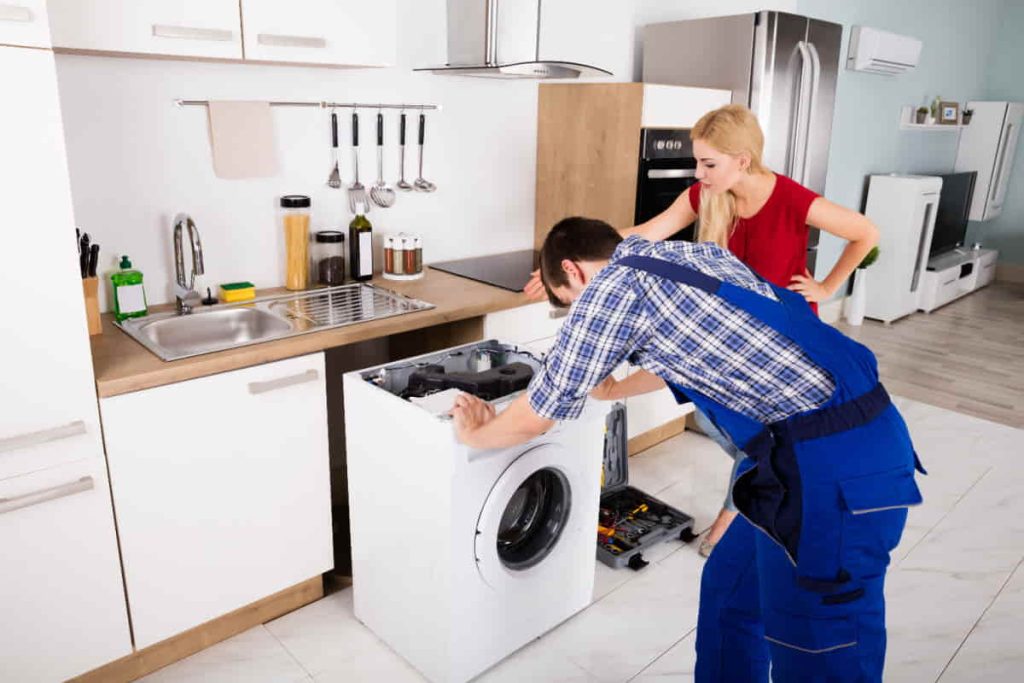

Open the door, grip the top of the door seal opening, lift the front of the machine slightly, and walk it forward on its back feet. Before pulling, always unplug the machine, turn off the water supply, and check whether the hoses and drain have enough slack – or disconnect them first. Protecting your flooring before you start will save a lot of trouble.

Washing machines are heavy – typically 60 to 90kg. Do not attempt to move one alone if you have any back or joint problems. Always unplug the machine from the mains before moving it. Never pull a washing machine that is still connected to live water or power.
Pulling a washing machine out from under a kitchen worktop is straightforward if done in the right order. The most common mistakes – overstretching a hose, catching the flooring, or damaging the plug socket – are all avoidable with a few minutes of preparation before you start.
Before You Pull: Disconnection Checklist
A washing machine is connected to at least three things that can stop it coming out, damage themselves, or cause a flood if not dealt with correctly. Work through these before moving the machine at all.
Step 1: Unplug the Mains Cable
Unplug the machine at the wall socket before doing anything else. If the socket is behind the machine and you cannot reach it, the cable will need to be fed slack as the machine comes forward – but the machine must be unplugged before it leaves the room or comes into a position where you might pull the plug from the socket under load.
If the cable has been routed through a small hole in a cabinet, you may need to remove the plug to pull the cable back through. Keep the plug and any fixings safe for reassembly.
Step 2: Turn Off the Water Supply
Locate the isolation taps on the water inlet hoses – usually behind or to the side of the machine – and turn them off. If the taps are stiff, use the minimum force needed and support the tap body firmly. Twisting a tap too hard can loosen it from the copper pipe behind.
If the fill hoses are short or under tension, disconnect them before pulling the machine forward. An overstretched fill hose can snap at the point where it connects to the machine. If the water supply is still on when this happens, the result is an immediate flood with no warning.

If either fill hose is at full stretch before the machine has moved, stop and disconnect it before continuing. A snapped fill hose with the water still running will flood the kitchen in seconds.
Step 3: Disconnect the Drain Hose
The drain hose is commonly connected to the U-bend under the kitchen sink. Unscrew the plastic connector and pull the hose free – this is usually straightforward by hand. Once disconnected, feed the hose back through any cabinet holes and towards the machine so it has enough slack to come forward.
If the plastic connector is too wide to pull back through a cabinet hole, twist the hose off the connector and reattach it securely when reconnecting. Make sure the hose is pushed on tightly at both ends after reassembly to prevent leaks.
Once the drain hose is disconnected from the U-bend, any water poured into the sink will flow out through the open connection into the cabinet below. Block the hole with a cloth until the machine is back in position and reconnected.
How to Pull the Washing Machine Out
With everything disconnected and slack, the machine is ready to move.
-
Open the washing machine door fully. Grip the top of the door opening with both hands, at the point where the door seal meets the cabinet. This gives a solid, central hold on the machine.
-
Lift the front of the machine slightly – at least a centimetre – to free the front feet from the floor and tilt the weight onto the back feet.
-
Walk the machine forward by pulling it towards you while keeping the front slightly lifted. The machine should move smoothly on its back feet.
-
Once the machine is far enough out to work on, lower it down carefully onto all four feet.
Protecting the Flooring
Washing machine feet can cause serious damage to vinyl, lino, and cushion flooring if the machine is dragged rather than lifted and walked. Before moving the machine, check that the feet are not stuck to the floor – they often bond to soft flooring over time.
Lift the front first to free the front feet, then tip the machine slightly forward to check and free the rear feet. Placing a folded towel or piece of cardboard under the feet before moving gives some protection and helps the machine slide more easily on hard floors.
What If the Flooring Does Not Go All the Way Under?
In many kitchens, the floor covering stops just underneath the washing machine rather than running all the way to the back wall. When the machine is pulled forward, the rear feet drop off the edge of the flooring and catch on the bare floor underneath – which can stop the machine moving entirely, or gouge badly into vinyl or laminate.
If this happens, push the machine as far back as possible, then tilt it forward to lift the rear feet clear of the flooring edge, and walk it forward on the front feet. This requires enough clearance between the top of the machine and the worktop above – if there is no room to tilt, see our guide on appliances stuck behind a tiled or raised floor for further options.
What If the Door Will Not Open?
If the door is locked due to a fault, there are two alternatives for getting purchase on the machine. Removing the soap drawer and gripping through the drawer opening works but is awkward. Lifting from underneath the front of the machine is harder still. With two people, a combination of both can work.
If the machine is also full of water, deal with that first – it adds significant weight and makes the machine much harder to move safely. See our guide on how to drain a washing machine full of water before attempting to move it.
Pushing the Machine Back In
Walk the machine back by pushing one side a little, then the other – this is easier and more controlled than pushing straight back. Push as low down the front panel as possible. Many washing machine front panels are thin and will dent easily under pressure from knees or hands pushing near the middle.
If the machine is hard to push back, it is tempting to use lubricant under the feet – but this can cause the machine to move around during spin cycles. If you do use any lubricant, use the smallest amount possible and only as a last resort.
Once back in position, reconnect the drain hose, fill hoses, and mains plug – then run a short cycle and check everything for leaks before pushing the machine fully back under the worktop. For a full reconnection checklist, see our guide on checks to carry out after installing a washing machine.
Need a Repair or Spare Parts?
If you have pulled your machine out to investigate a fault, Whitegoods Help can help with the next step.
Related Guides
 Appliance Stuck Behind a Tiled Floor
What to do when a washing machine or dishwasher cannot come forward due to tiles or raised flooring at the front.
 How to Drain a Washing Machine Full of Water
Step-by-step guide to draining a machine that has stopped mid-cycle before attempting to move or repair it.
 5 Checks After Installing a Washing Machine
The checks to run after pushing a machine back into position to confirm everything is correctly reconnected.
 Transporting a Washing Machine Safely
How to prepare a washing machine for transport, including the transit bolt requirement and what to do if you no longer have them.
Frequently Asked Questions
What is the best way to pull a washing machine out from under a worktop?
Open the door and grip the top of the door seal opening with both hands. Lift the front of the machine slightly to tilt it onto the rear feet, then walk it forward. Always disconnect the mains plug, turn off the water supply, and check the hoses and drain have enough slack before you start moving the machine.
Do I need to disconnect the hoses before pulling the machine out?
Not always, but check them first. If the fill hoses or drain hose are short or at full stretch, disconnect them before pulling the machine forward. An overstretched fill hose can snap at the connection point, causing an immediate flood if the water supply is still on.
How do I stop the feet from damaging my flooring?
Lift the front feet free from the floor before pulling, and check the rear feet too – they often bond to soft flooring over time. Placing a folded towel or piece of cardboard under the feet before moving gives protection and makes sliding easier. Never drag the machine without lifting the feet first.
What if the washing machine is stuck and will not come forward?
The most common cause is the rear feet catching on the edge of flooring that does not run all the way to the back wall. Tilt the machine forward to lift the rear feet over the edge and walk it out on the front feet. If there is not enough clearance under the worktop to tilt, see our guide on appliances stuck behind a tiled or raised floor.
How do I pull a washing machine out if the door will not open?
Try gripping through the soap drawer opening as an alternative to the door. If the machine is full of water, drain it first to reduce the weight before attempting to move it. With no door access and no drawer, two people working together – one lifting from each side – is the safest approach.
What should I check when pushing the machine back in?
Reconnect the drain hose, fill hoses, and mains plug before pushing the machine fully back. Run a short cycle and check all connections for leaks while the machine is still accessible. Only push it fully back once you are satisfied everything is tight and leak-free.
Ask the repair forum
Post the make, model and symptoms and get help from the Whitegoods Help community.
18 Comments
Grouped into 11 comment threads.
1 reply I have opposite problem, machine in but won't come out, won't budge. Back feet seem to be sticking and cant reach to adjust.
2 replies I have a washing machine in a very tight cupboard. Even though it is on an anti vibration pad it has worked its way forward and I am unable to push it back as it is very heavy and it will not slide on the anti vibration pad and this pad will not move either. It's getting to the point where I can barely close the cupboard door. Who should I contact to help me with this? Would a washing machine repair man be able to do this or maybe a removalist?
I have a washing machine in a very tight cupboard. Even though it is on an anti vibration pad it has worked its way forward and I am unable to push it back as it is very heavy and it will not slide on the anti vibration pad and this pad will not move either. It’s getting to the point where I can barely close the cupboard door. Who should I contact to help me with this? Would a washing machine repair man be able to do this or maybe a removalist?
It’s a difficult one because it’s not a big enough job for a professional, but if you can’t do it you need help from someone. A local washing machine or handy man would be best if you can’t get a friend or relative to help, but unless you find a nice local man it could cost a ridiculous amount.
You have to push the washer low down. I’ve sometimes had to sit in my backside and use my feet. Ideally push one side back and then the other. Or if there is room to tilt it forwards or back and try to move it that can sometimes work. If it can be tilted forwards onto someone’s knees it can be moved back using the knees and legs.
Thanks for your suggestions. There isn’t much room to tilt it forwards or back. I looked at trying to take the shelf above it off but it is built in to the cupboard so I was thwarted there. I’ll keep trying to find someone to help me before I resort to looking for outside help. Once again, thanks for your help.
0 replies This is a good article because it gives food for thought. We have a situation where the clothes washing door seal needs to be replaced, which means removing the machine casing front panel, the counterweights, and the lid. Dragging the machine out is not an option because of the hose and power connections. There also needs to be more room for manoeuvre. Therefore, removing the worktop and disconnecting the power cable and the hoses will be the order of the day. Besides, I have a dodgy back that needs nurturing, not abuse. The job will be much simpler with the worktop out of the way. Now all that I have is to convince the lady of the house to move all the gubbins off the worktop...yeah, right.
This is a good article because it gives food for thought. We have a situation where the clothes washing door seal needs to be replaced, which means removing the machine casing front panel, the counterweights, and the lid. Dragging the machine out is not an option because of the hose and power connections. There also needs to be more room for manoeuvre. Therefore, removing the worktop and disconnecting the power cable and the hoses will be the order of the day. Besides, I have a dodgy back that needs nurturing, not abuse.
The job will be much simpler with the worktop out of the way.
Now all that I have is to convince the lady of the house to move all the gubbins off the worktop…yeah, right.
1 reply hello, I have a related problem. My mum's washing machine I think just needs me to clean out the pump as it is not draining or spinning properly. I know how to do this but want to disconnect the electricity first but I can't find the plug anywhere and believe it is probably behind the machine which is in a very narrow gap under the worktop. Is it safe to pull it out using the open door method and pulling from the top of the door opening? I don't want to electrocute myself. Thanks
hello, I have a related problem. My mum’s washing machine I think just needs me to clean out the pump as it is not draining or spinning properly. I know how to do this but want to disconnect the electricity first but I can’t find the plug anywhere and believe it is probably behind the machine which is in a very narrow gap under the worktop. Is it safe to pull it out using the open door method and pulling from the top of the door opening? I don’t want to electrocute myself.
Thanks
Yes that is the best way to do it. Don’t pull the door obviously, but just open the door, and lift the machine up by the top of the opening about an inch and pull backwards. You need to make sure you know where the drain hose and fill hoses are though. It may well be that the washing machine will only pull out so far before one or more of the hoses attached to it at the back run out of length. Many washing machines need the fill hose and drain hose disconnecting before they will come out.
1 reply I can’t pull my washing machine out as there’s only a little bit of room from the top of the work top , it’s stuck so with the room I have and being stuck to the floor how on earth can you move it
I can’t pull my washing machine out as there’s only a little bit of room from the top of the work top , it’s stuck so with the room I have and being stuck to the floor how on earth can you move it
Likely replying to Linda Godfrey
Hello Linda. If the washing machine has a worktop right above it with no gap you won’t be able to lift it up to try and free the feet if they are a little stuck but you should be able to open the door and pull it forward. If there is any flooring in front of the washing machine meaning that the washing machine is trapped and will only come out of it can be lifted over the flooring – then it is well and truly stuck. There is no way it will come out without removing the flooring or removing the worktop. This is exactly what happened to my daughters dishwasher which is discussed here appliance stuck behind floor
1 reply I needed to remove the washer for a repair to the suspension mountings and found the tiles stopped it . It made removal very difficult indeed but we did get it out eventually. Getting it out was a huge problem compared to the actual simply fixed fault with the shock absorber. To prevent this happening again, I tiled the area under the washer completely so that it wouldn't get stuck again. It slid easily into place when the tiles' cement was cleaned off and dry. It's now become necessary to remove it again and the machine will not budge - it seems to be stuck at the side this time! Any advice welcomed - the feet are not stuck to the floor. The repair man told us he wouldn't have an integrated washing machine given and this sort of thing happens all the time!
I needed to remove the washer for a repair to the suspension mountings and found the tiles stopped it . It made removal very difficult indeed but we did get it out eventually. Getting it out was a huge problem compared to the actual simply fixed fault with the shock absorber. To prevent this happening again, I tiled the area under the washer completely so that it wouldn’t get stuck again. It slid easily into place when the tiles’ cement was cleaned off and dry. It’s now become necessary to remove it again and the machine will not budge – it seems to be stuck at the side this time! Any advice welcomed – the feet are not stuck to the floor. The repair man told us he wouldn’t have an integrated washing machine given and this sort of thing happens all the time!
Likely replying to Christopher Davies
Hi Christopher. Yes it’s a problem people don’t foresee and I have 2 articles about it, Appliance stuck behind a tiled floor | Fitting floor tiles in front of appliances
I also don’t like built in washing machines much and have advice about them here – Integrated appliance or not
0 replies Thanks Brendon. Just bear in mind that anything that makes the washing machine slide nicely into place will cause the washing machine to slide around if left in position. You could try a smaller section that just fits under the front feet and slightly tip the washing machine forward whilst sliding it in (as long as there's a small gap at the top of machine when sliding under). Then you can lift the front feet up and remove it when it's in place.
Thanks Brendon. Just bear in mind that anything that makes the washing machine slide nicely into place will cause the washing machine to slide around if left in position. You could try a smaller section that just fits under the front feet and slightly tip the washing machine forward whilst sliding it in (as long as there’s a small gap at the top of machine when sliding under). Then you can lift the front feet up and remove it when it’s in place.
0 replies Just an idea for anyone with vinyl flooring in the kitchen or utility room where the washing machine is. Place a 60 cm x 60 cm square of the same vinyl flooring, only upside down. Position the machine square on top of the said piece of vinyl. This allows the vinyl to slide into the appropriate space where the washer goes. This works best for tight width kitchen work tops and side panels.
Just an idea for anyone with vinyl flooring in the kitchen or utility room where the washing machine is. Place a 60 cm x 60 cm square of the same vinyl flooring, only upside down. Position the machine square on top of the said piece of vinyl. This allows the vinyl to slide into the appropriate space where the washer goes. This works best for tight width kitchen work tops and side panels.
0 replies Had to get my Bosch washing machine back in position and even though it is on tiles, because there is so little space either side to 'walk' it in, it would not budge. Eventually after trying different ways without success, I came up with this method. I got two pieces of hardboard about 6" wide and about 6" longer than the washer is deep, lifted the washer slightly each side and put the pieces of hardboard under the feet going front to back, polished side down. Once the washer was standing on the hardboard, I got a spade with the edge covered in a towel and placed it under the washer at the front so that when I pressed down on the handle it lifted the washer off the ground at the front very slightly. I then sat down opposite the washer with my feet on the bottom corners and using my hands to press down on the spade I lifted the washer and pushed it back into place with my feet. It was then easy enough to lift each side of the washer to pull the hardboard out from under the machine. However, levelling it using only the two front feet is a different story.
Had to get my Bosch washing machine back in position and even though it is on tiles, because there is so little space either side to ‘walk’ it in, it would not budge. Eventually after trying different ways without success, I came up with this method. I got two pieces of hardboard about 6″ wide and about 6″ longer than the washer is deep, lifted the washer slightly each side and put the pieces of hardboard under the feet going front to back, polished side down. Once the washer was standing on the hardboard, I got a spade with the edge covered in a towel and placed it under the washer at the front so that when I pressed down on the handle it lifted the washer off the ground at the front very slightly. I then sat down opposite the washer with my feet on the bottom corners and using my hands to press down on the spade I lifted the washer and pushed it back into place with my feet. It was then easy enough to lift each side of the washer to pull the hardboard out from under the machine. However, levelling it using only the two front feet is a different story.
0 replies Hi, if I have to move mine I tilt the front up clear of the carpet and slide a thin plastic chopping board under each front foot. I can then simply open the door and pull from the top of the opening - the boards glide on the carpet and the washing machine slides out nicely I also made sure I fitted a long water inlet hose so the machine will come all the way out from under the worktop without disconnecting anything :-)
Hi, if I have to move mine I tilt the front up clear of the carpet and slide a thin plastic chopping board under each front foot. I can then simply open the door and pull from the top of the opening – the boards glide on the carpet and the washing machine slides out nicely
I also made sure I fitted a long water inlet hose so the machine will come all the way out from under the worktop without disconnecting anything :-)
Leave a comment
1 reply Mine seems stucked despite having moved fairly easily. Before pulling harder I was wondering whether the plug or pipes might actually be on the short side... I cannot see the back as it's inserted in the kitchen cabinet. I'd like to avoid flooding the kitchen... is there any risk of breaking pipes or so? Thanks!
Mine seems stucked despite having moved fairly easily. Before pulling harder I was wondering whether the plug or pipes might actually be on the short side… I cannot see the back as it’s inserted in the kitchen cabinet.
I’d like to avoid flooding the kitchen… is there any risk of breaking pipes or so?
Thanks!
Likely replying to Fred
Hello Fred. Sorry for a late reply. Yes the main cause of a washing machine only pulling out so far then stopping is the pipes. The hoses and drain hose supplied are normally only just long enough to reach the taps and drain connection. There’s usually no way to pull a washing machine out without totally disconnecting all the hoses. If pulled hard the connection on the fill hoses could break and cause a flood. It can be very tricky to do and even trickier to get them back if the washing machine is under a worktop and you can’t get behind the washing machine.
I have opposite problem, machine in but won’t come out, won’t budge. Back feet seem to be sticking and cant reach to adjust.
Hello Kay, you don’t have the opposite problem, you have the exact same problem. This article is about pulling the washing machine out. There is a specific section in the article dedicated to when the back feet seem to be catching on something. Please read the article carefully. The answer is there.