
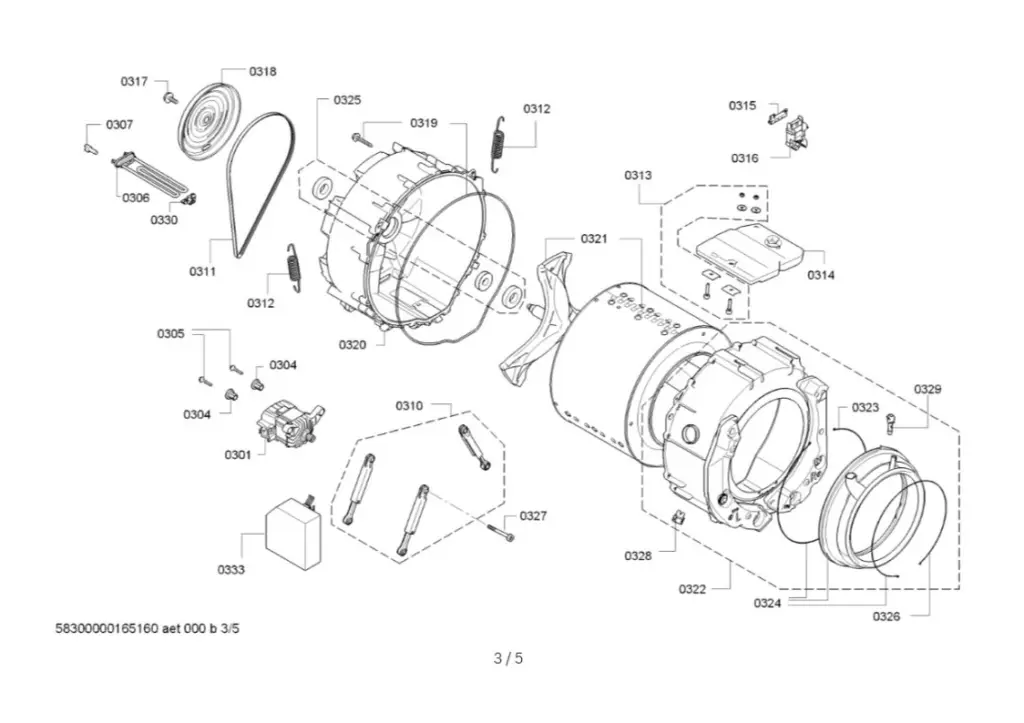

Many appliance faults can be resolved by replacing a single worn part – often far cheaper than a full engineer visit. The most important step is getting your appliance’s full model number before searching for a part. Even small differences between model numbers can mean parts are not interchangeable, and ordering the wrong component is the most common and costly mistake.
Spare parts guidance from Whitegoods Help – practical advice from engineers with over 40 years of appliance repair experience.
Ready to find your part?
Search by model number for a guaranteed compatible match.
Which parts are most commonly replaced – and what symptom points to which part?
Before spending time searching, use this table to narrow down which component is most likely at fault based on what your appliance is doing. This is the same diagnostic approach used by qualified appliance engineers.
| Symptom | Most likely part(s) to check | DIY difficulty |
|---|---|---|
| Won’t drain / water in drum | Pump filter (blockage), drain pump, drain hose | Easy – filter cleaning is a beginner task |
| Won’t spin | Drive belt, carbon brushes, door interlock | Moderate – carbon brushes are a common DIY fix |
| Leaking from door | Door seal (drum gasket) | Moderate – requires removing the door trim |
| Not heating water | Heating element, thermostat, NTC thermistor | Moderate – requires access to rear or front panel |
| Loud rumbling / grinding on spin | Drum bearings | Difficult – a major strip-down; consider engineer |
| Door won’t open | Door interlock / latch | Easy to moderate |
| Drum not turning (motor hums) | Carbon brushes, drive belt | Easy to moderate – very common DIY repair |
| Tripping the electrics | Heating element (earthing fault), motor | Stop using – get engineer to diagnose first |
| Soap drawer problems | Dispenser drawer, dispenser hose | Easy |
| Tumble dryer not heating | Heating element, thermostat, thermal cut-out | Moderate |
| Tumble dryer drum not turning | Drive belt | Easy to moderate – one of the most common DIY fixes |
| Fridge not cooling | Thermostat, evaporator fan, door seal | Moderate – thermostat is straightforward; compressor is not |
| Dishwasher not draining | Drain pump, filter, check valve | Easy to moderate |
| Oven not heating | Heating element, thermostat, fan element | Easy – oven elements are among the most replaced parts in the UK |
Before ordering any part, use the relevant fault guide to confirm your diagnosis. Ordering based on a guess – even an educated one – is the most common reason people end up with the wrong part.

If your appliance is tripping the electrics, producing burning smells, or showing any signs of electrical fault – do not attempt a DIY repair. These symptoms may indicate a serious electrical fault and require a qualified engineer to diagnose safely before any parts are touched.
Always unplug the appliance before working on it. Some components can carry charge even after switching off. Read our DIY repair safety guide before starting any repair.
How to find your appliance model number – the most critical step
Your model number is the single most important piece of information when ordering spare parts. Without the correct and complete model number, there is a significant risk of ordering a component that looks identical but is not compatible with your specific machine.
Even small differences in a model number – a letter, a digit – can mean a completely different internal specification. Many manufacturers produce the same appliance in multiple variants with different components. Always check the full number on the rating plate, not just what is printed on the front of the machine or in your original receipt.
 Washing machine
Inside the door frame – there is usually a sticker on the door rim or the recess around it. Also check the rear panel.
 Tumble dryer
Inside the door rim or on the rear panel. Some models have it behind the lint filter panel.
 Dishwasher
Inside the door on the top edge or left-hand side edge when the door is open.
 Fridge freezer
Inside the fridge compartment, usually on the rear wall or side panel. Sometimes behind the salad drawer.
 Oven / cooker
Inside the oven door frame, on the back of the appliance, or under the hob lid on range cookers.
 Hob
HobUnderneath the hob (requires tilting the unit) or on the rear of the appliance.

Many appliances have variants within the same model number, identified only by the serial number or production code. On some brands – particularly Bosch, Siemens, Miele and Hotpoint – the serial number is essential to confirm you are ordering the exact right component. Always record both numbers before searching.
Read more: How to find the full washing machine model number | Where is the model number on a fridge freezer?
Genuine parts vs compatible parts – which should you choose?
When ordering spare parts you will often have a choice between genuine (OEM) parts from the original manufacturer, and compatible (pattern) parts made by a third-party supplier. Both have their place – understanding the difference helps you make the right choice for your situation.
| Genuine (OEM) parts | Compatible (pattern) parts |
|---|---|
| Manufactured to the exact specification of your appliance | Made by a third party to a similar specification |
| Guaranteed compatibility with your model | Quality varies between suppliers – buy from a reputable source |
| Generally more expensive | Generally cheaper – often significantly so |
| The safest choice for critical components (heating elements, control boards, door interlocks) | Often a good choice for wear items (belts, brushes, door seals, filters) |
| May be required to maintain manufacturer warranty on newer machines | May void remaining warranty – check before fitting |
For safety-critical components such as heating elements, thermostats and door interlocks, genuine parts are always the safer choice. For wear items like drive belts, carbon brushes and pump filters, a high-quality compatible part from a reputable supplier is often perfectly acceptable and much more affordable.
Read more: Genuine vs non-genuine washing machine spare parts – what you need to know
Five things to know before ordering a spare part
Ordering the wrong part is the single most common and frustrating mistake in DIY appliance repair – and it happens even to experienced engineers. Before you order anything, read this:
-
Confirm the fault first, then buy the part. Ordering based on a guess wastes money and time. Use our fault guides or error code pages to confirm the likely cause before searching for a component.
-
The model number is not always enough. Many appliances have sub-variants with different internal components, all sharing the same model number. The serial number or production code is often needed to confirm exact compatibility. Read: 5 things you need to know before ordering spares.
-
Take a photo of the rating plate. Before you start your search, photograph the rating plate so you have the full model and serial number to hand at all times – including when speaking to a supplier.
-
Check whether the repair is within your ability. Some parts are straightforward to replace (filters, belts, carbon brushes, door seals). Others – particularly anything involving drum bearings, sealed refrigeration systems or control boards – require experience and in some cases specialist tools.
-
Consider whether repair is cost-effective. For older appliances, it is worth checking whether the repair cost (parts plus your time) is justified. Our guidance: if the part costs more than around 30-40% of the appliance’s replacement value, it is worth pausing to consider replacement.
When a DIY repair may not be appropriate
Not every fault is suitable for a DIY fix, even if the part is available. If any of the following apply, booking a qualified engineer is the safer and often more cost-effective route:
 The fault involves electrical components you are not confident working with
- The appliance is tripping the fuse board or showing signs of electrical fault
- The repair requires disassembly of major structural components (e.g. drum bearings)
- The appliance involves a sealed refrigeration system
- You have attempted the repair and the problem has not been resolved
In these cases, understanding the fault and knowing what part is likely at fault will still help the engineer work more efficiently – and could save money on diagnostic time.
Find spare parts for your appliance
Whitegoods Help works with Spares4Appliances, a UK-based specialist spare parts supplier covering a wide range of domestic appliance brands and models – including washing machines, tumble dryers, dishwashers, ovens, fridge freezers and more.
Search by your full model number to confirm compatibility before ordering.
Search thousands of spare parts by model number.
Fast dispatch on in-stock items. Wide range of brands and appliance types.
Related guides from Whitegoods Help
Before you order – essential reading
 5 things you need to know before ordering spare parts
 How to find the correct model number on a washing machine Where to find the model number on a fridge freezer
 Genuine vs non-genuine spare parts – what’s the difference? DIY repair safety – essential reading before you start
Fault diagnosis – find the problem before you buy
 Washing machine fault guides – 50+ common faults
 Washing machine error codes – full list
Frequently asked questions
Where do I find my appliance model number?
For washing machines and dishwashers, check the inside of the door frame – there is usually a sticker on the door rim or the surrounding recess. For fridge freezers, look inside on the rear wall or side panel, or behind the salad drawer. For ovens and cookers, check inside the door frame or on the rear panel. Always record the full model number and serial number before searching for a part.
Is the model number always enough to order the right part?
Not always. Many appliances share a model number across several production variants, which may use different internal components. On some brands – particularly Bosch, Siemens, Miele and Hotpoint/Indesit – the serial number or production code is needed to confirm exact compatibility. Always check with the supplier if you are unsure. Read our full guide: 5 things you need to know before ordering spares.
Should I buy genuine or compatible spare parts?
For safety-critical components – heating elements, thermostats, door interlocks and control boards – genuine parts are always the safer choice. For wear items such as drive belts, carbon brushes, pump filters and door seals, a high-quality compatible part from a reputable supplier is often a cost-effective and perfectly acceptable alternative. Always check your remaining warranty before fitting non-genuine parts.
What are the most commonly replaced washing machine parts?
Based on the volume of parts ordered, the most common are: drain pump filters (the most frequent maintenance item), door seals (particularly on front-loading machines over 5 years old), drive belts, carbon brushes (the most common cause of a drum that hums but won’t turn), heating elements, and door interlocks. For tumble dryers, drive belts and heating elements top the list.
When is it not worth replacing a part?
If the part costs more than around 30-40% of the appliance’s replacement value, it is worth pausing. This is especially true for older appliances where one failing part may indicate general wear – further faults are likely to follow. Our broader guidance on this is covered in our repair or replace guidance.