
Can You Lay a Fridge or Freezer on Its Side or Back When Moving It?
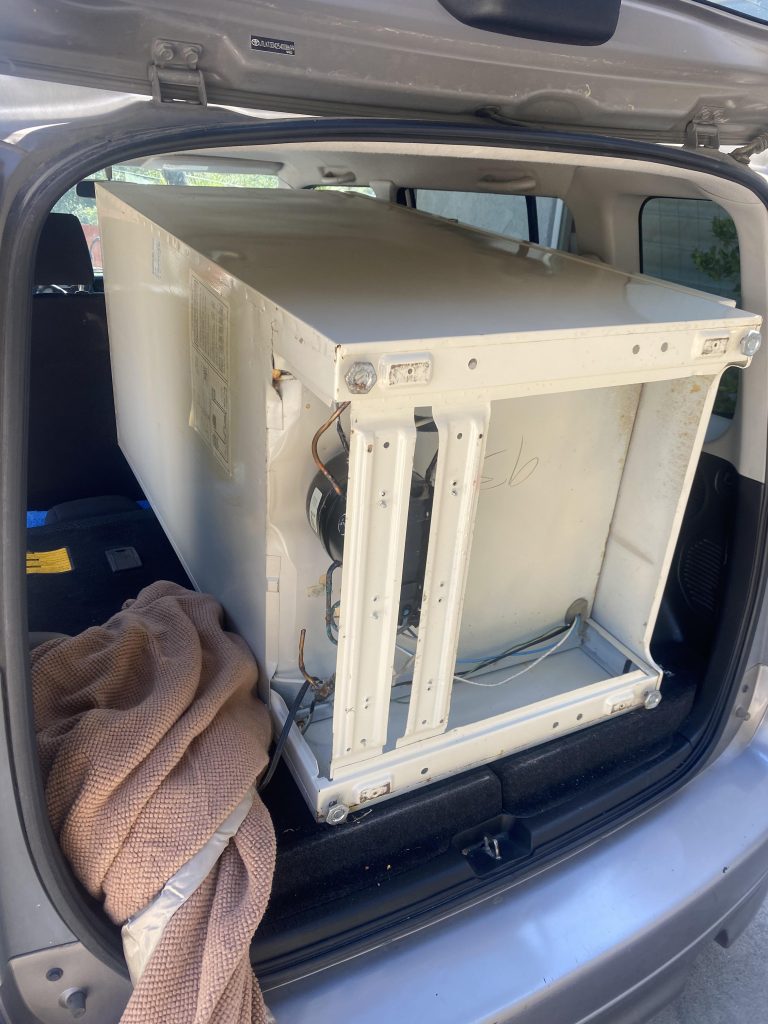

Fridges and freezers should always be transported upright. If this is genuinely impossible, they can be laid on one specific side, but never on their back or front. After laying one down, you must leave it standing upright for several hours before switching it on. Failure to do so can cause permanent compressor damage.

Moving a fridge or freezer requires more care than most other household appliances. The short answer is: always keep it upright if you possibly can. If you must lay it down, there is a right way and a wrong way, and getting it wrong can permanently damage the appliance. This guide covers the safe way to move, lay down, and bring back into service a fridge or freezer.
Why does the position matter when moving a fridge?
The risk is not to the outer casing – it is to the sealed refrigeration system inside. Every fridge and freezer has a compressor that contains oil and refrigerant. When the appliance is kept upright, the oil stays exactly where it should be.
When it is laid down incorrectly, compressor oil can flow into the cooling pipes. Switching the appliance on before this oil has drained back can cause serious damage.

Restricted or blocked refrigerant flow, poor cooling performance, compressor damage due to lack of lubrication, and in some cases permanent failure of the appliance.
What is the safest way to transport a fridge or freezer?

This is the only method that carries no risk to the refrigeration system.
In practical terms:
- Use a sack truck or appliance trolley to move and transport it vertically.
- Secure it properly in the vehicle so it cannot tip or fall during transit.
- Avoid rough roads, sharp braking, or unnecessary vibration where possible.
- Empty the contents and defrost the appliance before moving.
- Secure internal shelves and drawers so they do not shift during transit.
What if you have no choice but to lay it down?
In some situations such as limited vehicle height, it may not be possible to transport the appliance upright. If this is unavoidable, there are strict rules about how to do it safely.
You can lay it on its side
But only on the correct side, determined by the position of the compressor pipes at the back of the appliance (see below).
 Never lay it on its back or front
Laying it on its back or front forces oil directly into critical parts of the system and significantly increases the risk of permanent damage.
Which side should a fridge or freezer be laid on?
The correct side depends on the position of the compressor pipes at the back of the appliance. Look at the rear panel – you will see pipes connected to the compressor. One pipe is usually larger and carries refrigerant into the cabinet.

The pipe that leaves the compressor and runs into the cabinet must face upwards during transport. This helps prevent oil from flowing into the cooling system where it can cause blockages.
In simple terms: look at the back of the appliance, identify which side the main compressor pipe runs up towards the cabinet, and lay the appliance down so that pipe faces the ceiling, not the floor.
If the appliance is laid on the wrong side, oil can enter the pipework and remain there even after the appliance is stood upright again, which is why the waiting period before switching on is so important.
What should you do before and after the move?
Before moving
-
Unplug the appliance well in advance, ideally several hours before moving, to allow it to reach room temperature.
-
Empty all contents completely. Do not attempt to move a fridge or freezer with food or drink inside.
-
Defrost if necessary. Ice build-up adds weight and can cause water damage during transit.
-
Secure internal components. Remove or tape down shelves, drawers, and door compartments so they cannot shift.
After moving: how long before you switch it on?
This is one of the most important steps and the one most commonly overlooked.
| How it was transported | Recommended waiting time |
|---|---|
| Upright throughout | 30 minutes to 1 hour is sufficient in most cases |
| Tilted briefly during moving | At least 1 to 2 hours standing upright before switching on |
| Laid on its side for transport | At least 4 hours, ideally up to 24 hours, standing upright |
When in doubt, wait longer rather than shorter. The waiting time allows displaced oil and refrigerant to drain back into their correct positions within the compressor. Switching on too early is the most common cause of post-move compressor damage.
Why is manufacturer guidance so inconsistent?
Many manufacturer manuals provide vague or limited guidance on this topic. Some simply advise “leave the appliance to stand before switching on” without clearly explaining why, or how long is needed.
This variation reflects different appliance designs and different risk tolerances between manufacturers. Unfortunately, it can give the impression that any transport position is acceptable, which is not the case. When in doubt, always treat the appliance as if it has been laid down and wait the full recommended period before switching on.
Frequently asked questions about moving a fridge or freezer
Can I transport a fridge freezer on its back?
No. Laying a fridge or freezer on its back is one of the most damaging things you can do during transport. It forces compressor oil into the cooling pipes, significantly increasing the risk of compressor failure. If you cannot transport it upright, it must be laid on the correct side only, never on its back or front.
How do I find which side to lay my fridge on?
Look at the back of the appliance. You will see pipes connected to the compressor at the bottom rear. Identify the pipe that runs from the compressor up into the cabinet – this pipe must face upwards when the appliance is laid down. If you are unsure, it is safer to keep the appliance upright or wait and seek advice before transporting it.
I laid my fridge on its back by mistake. What should I do?
Stand the appliance upright immediately and leave it for at least 24 hours before switching it on. The longer you leave it, the better the chance that the oil will drain back into the compressor correctly. Do not be tempted to switch it on early to check if it is working – this is the most common cause of permanent post-move damage.
How long should I leave a fridge before turning it on after moving?
If transported upright: 30 minutes to 1 hour is usually sufficient. If it was tilted during moving: wait at least 1 to 2 hours. If it was laid on its side: wait at least 4 hours, and ideally up to 24 hours. When in doubt, always err on the side of waiting longer.
My fridge is not cooling properly after being moved. What should I do?
First, check how long you left it before switching on. If it was less than the recommended time, switch it off again and leave it standing for the full period before trying again. If it still does not cool correctly after the full waiting period, the compressor may have been damaged during transit. See our fridge freezer help section for further fault guidance, or book a qualified engineer.
Does the same apply to American-style fridge freezers?
Yes. The same principles apply to all fridge freezers, including American-style models. These are often larger and heavier, which can make upright transport more difficult. However, the risk of oil contamination is the same, and the correct side and waiting time rules must still be followed. Read our guide to delivering American-style fridge freezers for more specific advice.
Does the manufacturer guarantee cover compressor damage from moving?
Generally no. Manufacturer guarantees and warranties cover faults caused by manufacturing defects, not damage caused by transport, installation, or handling by the customer. If compressor failure occurs after a move and the appliance was previously working correctly, the cause is usually attributed to transport handling rather than a manufacturing fault. For best protection, use a professional appliance delivery or moving service that includes transit cover, particularly for large or expensive appliances.
Need help with a fridge freezer fault after moving?
If your appliance is not cooling correctly after being moved, our engineers can help diagnose the problem and arrange a repair.
After laying a fridge or freezer on its side, always leave it standing upright for at least 4 hours, ideally 24 hours, before switching on.
Ask the repair forum
Post the make, model and symptoms and get help from the Whitegoods Help community.
3 Comments
Grouped into 3 comment threads.
0 replies This has been a lovely read. I have my answer, explanation, and understanding. This is an example of knowledge that I would not have traditionally gained myself without happening to watch a TechnologyConnections video on mini fridges. These are the types of sites and articles we so critically need to support and maintain. Zero sifting through riff raff to get knowledge
0 replies Your explanation and the other in the video have slain another mystery. Many Thanks !
Your explanation and the other in the video have slain another mystery. Many Thanks !
0 replies I have been moving household furniture and appliances for 40 years, and finally I get to read definitively which side a tall freezer can be laid on and then transported, if a suitable vehicle is not available, and that video explains things really well. Thank you. G, Birmingham.
I have been moving household furniture and appliances for 40 years, and finally I get to read definitively which side a tall freezer can be laid on and then transported, if a suitable vehicle is not available, and that video explains things really well.
Thank you.
G, Birmingham.
This has been a lovely read. I have my answer, explanation, and understanding. This is an example of knowledge that I would not have traditionally gained myself without happening to watch a TechnologyConnections video on mini fridges.
These are the types of sites and articles we so critically need to support and maintain. Zero sifting through riff raff to get knowledge