
White streaks on laundry after washing
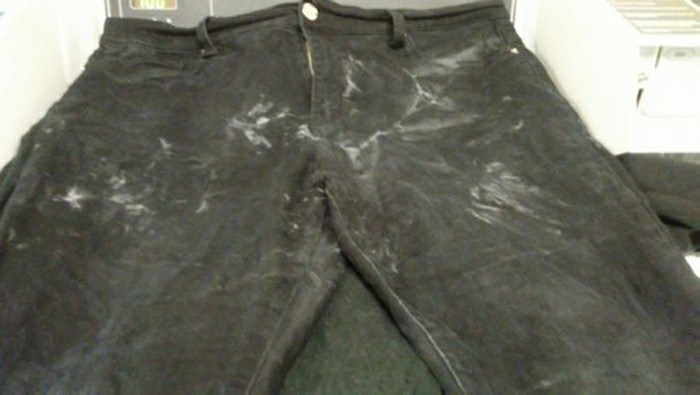

White streaks or powder residue on laundry after washing are most commonly caused by undissolved detergent – but can also be caused by gunge and limescale from a dirty door seal. To remove existing marks, try sponging the fabric, running a rinse-only cycle, or re-washing without detergent. To prevent recurrence, identify and fix the cause from the list below.
Common Causes and What to Do

Overloading the drum
Too much laundry prevents water and detergent from circulating freely. Powder can become trapped in folds of fabric and never fully dissolve. Reduce the load size and ensure there is room for items to tumble freely. If using a dosing ball or net in the drum, place it at the very top of the load and towards the back so water can reach it from the start. See our guide on how to load a washing machine correctly.

Not using enough detergent
Counter-intuitively, too little detergent can cause a whitish film on laundry. Detergents contain water-softening agents that need to be present in sufficient concentration to neutralise the minerals in hard water. If the dose is too low for the water hardness, these minerals can deposit on fabric as a pale residue that looks similar to undissolved powder. Always use the dose specified for the water hardness in the area – not the minimum dose.

Low water pressure – detergent not flushed from drawer
Low inlet water pressure can mean not all the detergent in the dispenser drawer is flushed into the drum at the start of the cycle. The remaining detergent then drips or falls onto laundry during rinsing when it can no longer dissolve fully. If water pressure cannot be improved, switch to placing detergent directly in the drum using a dosing container rather than the drawer. See our guide on low water pressure and washing machines.

Detergent placed in the wrong drawer compartment
The soap dispenser drawer has separate sections – typically a pre-wash compartment and a main wash compartment. The pre-wash compartment is flushed with cold water during pre-wash and rinsing phases, not the hot main wash cycle. Powder placed here may not dissolve properly and can be deposited onto laundry during the rinse. Always place detergent in the main wash compartment unless deliberately using a pre-wash programme. Check the instruction manual if the compartments are not clearly labelled.

Dirty or blocked dispenser drawer
A drawer with old detergent or fabric softener residue built up inside can restrict the flow of water through it, leaving powder partially undissolved. Remove the drawer and clean it thoroughly. Check the recess it sits in as well – the inlet jets above the drawer can also become blocked with residue and reduce the water flow that flushes detergent into the drum.

Gunge and limescale from the door seal
Marks that appear streaky rather than powdery, particularly on dark clothing, may not be undissolved detergent at all. Accumulated limescale and grease inside the door seal fold can loosen during a wash and deposit onto laundry. Lift the door seal fold and inspect for thick dark or grey residue. If present, a thorough machine clean – including the seal fold – is needed. Prolonged under-dosing in hard water areas is a common cause of this build-up. See our guide on washing machine grease, mould and smells.
Switching to liquid detergent eliminates undissolved powder entirely – liquid disperses immediately and does not suffer from the low-temperature dissolution issues that powder can. However, liquid detergents do not contain bleaching agents, which means white laundry may gradually grey over time, and the machine is more prone to grease and mould build-up without periodic powder or hot maintenance washes. Liquid detergent alone on cool programmes long-term is one of the leading causes of smelly and gunged-up washing machines.
Related Guides
Dispenser Drawer or Drum?Whether to put detergent in the drawer or directly in the drum – and when each approach works better.
 Washing Machine Smells
How grease, limescale, and mould build up inside a washing machine – and how to clean and prevent it.
 Which Type of Detergent Is Best?
Powder, liquid, and tablet detergents compared – including the trade-offs that affect wash results and machine hygiene.
Washing Not Getting CleanDiagnosing poor wash results from temperature, overloading, detergent, and machine maintenance factors.
Frequently Asked Questions
How do I remove white powder marks from clothes after washing?
First try sponging the affected area with clean water. If the marks persist, run a rinse-only cycle without adding any detergent. If that does not clear them, put the items through a short wash cycle on their own without any detergent. Once the marks are gone, identify and address the underlying cause to prevent recurrence.
Why is there white residue on dark clothes after washing?
On dark clothing, white residue is most visible and is most commonly caused by undissolved powder detergent, but it can also be limescale or gunge from a build-up inside the door seal fold. Inspect the door seal – if there is thick grey or dark residue built up inside the fold, this is likely the source. The door seal requires thorough cleaning. Also check detergent dose, drawer cleanliness, and load size.
Can too little detergent cause white marks?
Yes. In hard water areas, detergent contains water-softening agents that must be present in sufficient concentration to prevent mineral deposits. An insufficient dose leaves these minerals free to settle on fabric as a pale whitish film. This can easily be mistaken for undissolved powder residue. Always use the dose recommended for the water hardness in the area – not the minimum on the packet.
Ask the repair forum
Post the make, model and symptoms and get help from the Whitegoods Help community.
6 Comments
Grouped into 6 comment threads.
0 replies I too have had a problem with detergent scum showing on dark clothing. It's a new machine and I bought it because 'Which' said it washed well. I'll never listen to them again. Even after TWO extra rinses, it's still there. I have to rinse all washes by hand to properly clean all clothes. Ridiculous.
0 replies I am getting increasingly itchy skin fro left in detergent. How is using less water environmentally friendly when it means we have to re-wash? Detergent left in clothes ruins them. How environmentally friendly is having to discard clothes that otherwise would have been good for much longer? Think of growing, processing, dying, and assembly costs to the environment. Another example of short term thinking. Someone should see the competitive advantage of catering for people who need an excellent wash and a proper rinse. And realise that people see the environmental and economic cost of re-washing and wasting clothes. Not everyone in the UK is short of water either.
I am getting increasingly itchy skin fro left in detergent. How is using less water environmentally friendly when it means we have to re-wash? Detergent left in clothes ruins them. How environmentally friendly is having to discard clothes that otherwise would have been good for much longer? Think of growing, processing, dying, and assembly costs to the environment. Another example of short term thinking. Someone should see the competitive advantage of catering for people who need an excellent wash and a proper rinse. And realise that people see the environmental and economic cost of re-washing and wasting clothes. Not everyone in the UK is short of water either.
0 replies It seems on reading the blogs that over foaming is a common problem which engineers are reluctant to admit. there surely has to be one predominant cause, my guess being " lack of water " It is very frustrating having the problem, which is made worse by not knowing the cause or solution, I have been waiting for manufactures (or hoping ) to realize consumers want more water in the washing machines only to learn that they are actually now putting less in. so my hopes of seeing a machine or detergent that states "will not over foam " are futile.
It seems on reading the blogs that over foaming is a common problem which engineers are reluctant to admit. there surely has to be one predominant cause, my guess being ” lack of water ” It is very frustrating having the problem, which is made worse by not knowing the cause or solution, I have been waiting for manufactures (or hoping ) to realize consumers want more water in the washing machines only to learn that they are actually now putting less in. so my hopes of seeing a machine or detergent that states “will not over foam ” are futile.
0 replies I have a 8 year old Hotpoint WD640P washing machine and have an insurance costing £120 - repair men have been out twice and can't find a problem with the machine and say it must be the powder (which I haven't changed for 8 years) but my clothes are streaked with white powder - doesn't matter if I put a few items in or a whole load, the drum frothes up as if I have put huge amounts of powder in. I have tried changing from Daz, to Persil and now Ariel - same result. I am using twice the electric, twice the time and twice the water and feel like I am paying insurance for nothing
I have a 8 year old Hotpoint WD640P washing machine and have an insurance costing £120 – repair men have been out twice and can’t find a problem with the machine and say it must be the powder (which I haven’t changed for 8 years) but my clothes are streaked with white powder – doesn’t matter if I put a few items in or a whole load, the drum frothes up as if I have put huge amounts of powder in. I have tried changing from Daz, to Persil and now Ariel – same result. I am using twice the electric, twice the time and twice the water and feel like I am paying insurance for nothing
0 replies KV: If poor washing results can be shown to be caused by a fault then of course you have an issue that needs resolving. Are you sure the white streaks aren't caused by any of the things mentioned in my article? None of the causes I list are the washing machines fault. I can't think of any cause related to a fault on the washing machine other than if the drum wasn't turning on wash maybe.
KV: If poor washing results can be shown to be caused by a fault then of course you have an issue that needs resolving. Are you sure the white streaks aren’t caused by any of the things mentioned in my article? None of the causes I list are the washing machines fault. I can’t think of any cause related to a fault on the washing machine other than if the drum wasn’t turning on wash maybe.
0 replies Can we claim a refund from the seller of the washing machine (Hotpoint) if it is leaveing detergent after the clothes have been washed. They (sellers of the machine) are saying because their engineer is saying it is mecahnically okay we can not claim anything - surely this cannot not be correct as the clothes are not been washed properly one of the main reason why you purchase a washing na=machine for.
Can we claim a refund from the seller of the washing machine (Hotpoint) if it is leaveing detergent after the clothes have been washed. They (sellers of the machine) are saying because their engineer is saying it is mecahnically okay we can not claim anything – surely this cannot not be correct as the clothes are not been washed properly one of the main reason why you purchase a washing na=machine for.
I too have had a problem with detergent scum showing on dark clothing. It’s a new machine and I bought it because ‘Which’ said it washed well. I’ll never listen to them again. Even after TWO extra rinses, it’s still there. I have to rinse all washes by hand to properly clean all clothes. Ridiculous.