
Do I need to change washing machine carbon brushes?
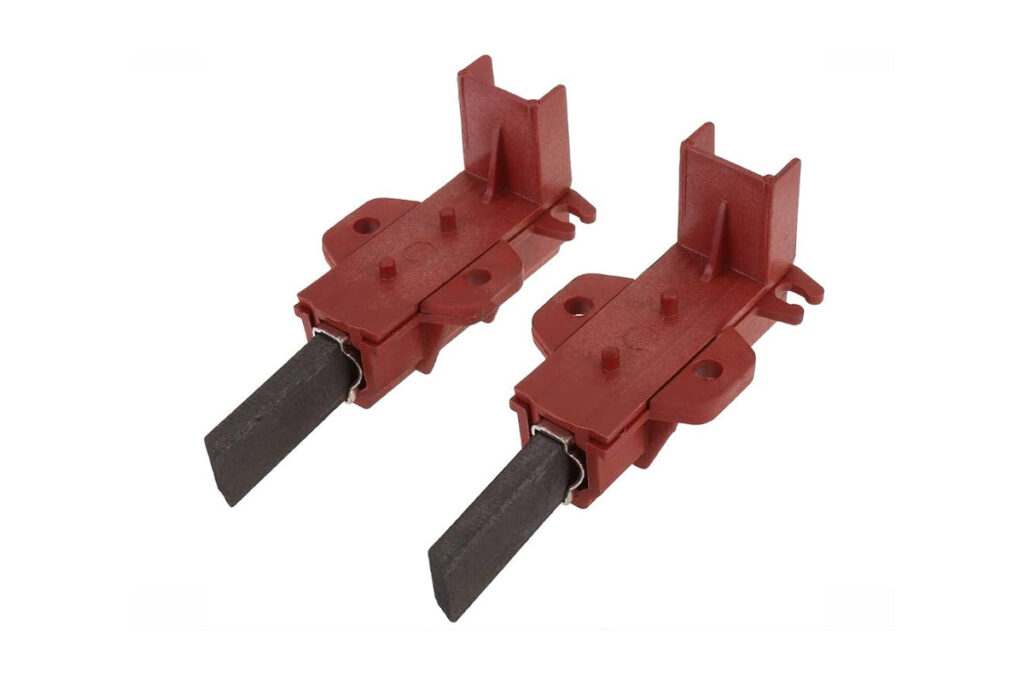

Do not fit new carbon brushes speculatively. Worn brushes are common, but a motor that has stopped running can have many other causes. Remove the brushes first and inspect them. A shiny, smooth tip means the brush is still making good contact. A charred, sooty, or damaged tip indicates a problem – but the underlying cause still needs to be identified before replacing.
Carbon brushes are one of the most commonly worn parts in a washing machine motor. This guide covers how to diagnose whether carbon brushes need replacing, how to identify brushes that are still serviceable, and what complications to watch for before starting a repair.

Always test motor insulation with an insulation test meter at 500V DC before working on any motor. Low insulation on a motor can blow electronic components on the PCB. Not all modern washing machines have carbon brushes – confirm the motor type before proceeding.
How to Tell If Carbon Brushes Need Replacing
The most reliable way is to remove the brushes from the motor and inspect them. Do not fit new brushes without first confirming the fault is actually caused by worn or damaged brushes. A motor that has stopped running can be caused by many other faults – fitting new brushes speculatively wastes time and money if the brushes are not the cause.
Heavy sparking from inside the motor can indicate worn brushes, but very small sparks during normal operation are common and not necessarily a fault. If sparking is excessive – particularly with flashing or arcing – the motor should be stopped and investigated before further use.
Worn Carbon Brushes – Identifying Good and Faulty

Left brush: good contact – smooth and shiny tip. Right brush: faulty – charred and sooty tip with evidence of burning.
Both brushes shown above are approximately 80% worn. The brush on the left is still making good contact with the armature – its tip is smooth and shiny, with no evidence of sparking. The brush on the right is faulty – the tip is charred and sooty with a charcoal-like appearance indicating burning.
If both brushes are smooth and shiny, they are still making good contact and are unlikely to be causing the fault – even if they are heavily worn and will soon need replacing. In this case, the cause of any motor problem lies elsewhere.
A Brush That Is Still Serviceable

Approximately 20% worn – smooth, shiny tip with no evidence of burning. This brush is still serviceable.
This brush is around 20% worn. The tip is shiny and smooth with no evidence of burning – it is making good contact with the armature and does not need replacing.
A brush can stick inside its spring-loaded holder even when not significantly worn. If this happens, the brush surface wears normally but the brush stops advancing to maintain contact with the armature. The result is a charred tip despite the brush not being heavily used – which can look similar to a heavily worn and failing brush. Always check that each brush moves freely in its holder.
Serious Brush Damage – Complications
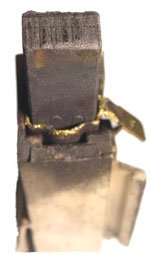
Approximately 50% worn but with severe arcing damage to the brass holder – this indicates a more serious motor fault.
This brush is around 50% worn but shows serious arcing damage to the brass holder caused by excessive sparking inside the motor. This level of damage indicates problems beyond worn brushes.
- Chunk broken from the brush tip – this often indicates a raised commutator bar on the armature. A raised or loose bar can be felt by placing a finger on the copper segments and slowly turning the armature. This type of fault requires a new motor.
- Machine has also blown a fuse – this indicates electrical shorting inside the motor. Diagnosing this requires an insulation test meter and electrical knowledge. Simply fitting new brushes will not resolve the fault.
- Damage to the brass holder combined with a blown fuse – the TOC (thermal overload cut-out) inside the motor may also have blown. This is no longer a straightforward brush replacement job and requires further investigation before proceeding.
When to Call an Engineer Instead
Fitting new carbon brushes in a motor is physically straightforward. However, without proper test equipment and experience working with motors, there is a real risk of misdiagnosis – and fitting new brushes into a motor with a more serious underlying fault will not solve the problem. If the brushes show signs of serious damage, or if the machine has also fused or blown components, a qualified repair engineer should assess the motor before any parts are ordered.
Buy carbon brushes
Frequently Asked Questions
How do I know if my washing machine carbon brushes need replacing?
Remove the brushes and inspect the tips. A shiny, smooth tip means the brush is still making good contact and may not be causing the fault. A charred, sooty, or damaged tip indicates the brush has been arcing. However, worn brushes alone do not confirm they are the cause of a motor fault – other causes should be ruled out first before replacing them.
Can I just fit new carbon brushes if the motor isn’t running?
Not without first confirming the brushes are the cause. A motor can stop running due to many other faults – a blown TOC, wiring fault, faulty winding, or armature damage. If brushes are fitted speculatively and are not the cause, the motor will still not run and money has been wasted. Inspect the brushes first and check for other causes. See: motor not running – main diagnostic guide.
What does it mean if the carbon brush holder is also damaged?
Arcing damage to the brass brush holder indicates excessive sparking inside the motor, which points to a more serious fault than worn brushes. If the machine has also blown a fuse, this suggests electrical shorting inside the motor. The TOC may also have blown. This is not a straightforward brush replacement job – further diagnosis with proper test equipment is needed before proceeding.
Ask the repair forum
Post the make, model and symptoms and get help from the Whitegoods Help community.
29 Comments
Grouped into 23 comment threads.
0 replies Hello Stephen. I have 2 other articles which might help - Fitted new carbon brushes but the motor still doesn’t work Fitted brushes now motor sparking a lot
0 replies my drum wasnt spinning at all, i changed the carbon brushes an the machine starts spinning an keeps cutting out after aprrox 5 seconds, what could this be?
my drum wasnt spinning at all, i changed the carbon brushes an the machine starts spinning an keeps cutting out after aprrox 5 seconds, what could this be?
1 reply Hi my machine is currently making a clicking noise when drum turns and giving off a burning smell when on spin does that mean the brushes need replacing. Thanks.
Hi my machine is currently making a clicking noise when drum turns and giving off a burning smell when on spin does that mean the brushes need replacing.
Thanks.
Likely replying to Debbie
Hello Debbie. If the clicking noises present when you turn the drum by hand it could be more serious than worn carbon brushes. One carbon brushes don’t normally cause burning smells and clicking noises. More often than not they just quietly stop making contact and people are puzzled as to why their washing machine drum has stopped turning. It is possible for brushes to carry on working when making only partial contact if the contact is strong enough. In such cases the motor may continue to run but flash and spark excessively and this can cause a burning smell. In such cases it could indicate that the main armature is also worn.
If you take off the drive belt and turn the motor by hand and it clicks once per revolution there could be a raised com bar which is described in my article above. This is serious and would require a new motor. Other than that the motor would need to be removed and the brushes checked as described in my article to see if they are badly charred.
1 reply I've have 3 year old candy grando. Whilst my washing was on I noticed it had stopped spinning and the lights on the programme was randomly flashing. I drained and check filter and some coins came out. Now my washer fills and empties but wont spin at all. I've just tried another wash and it's trying to spin but only managed 1/4 or a turn and stops and I've just noticed small sparks coming underneath the washing machine. Not sure what it could be Thanks.
I’ve have 3 year old candy grando. Whilst my washing was on I noticed it had stopped spinning and the lights on the programme was randomly flashing. I drained and check filter and some coins came out. Now my washer fills and empties but wont spin at all. I’ve just tried another wash and it’s trying to spin but only managed 1/4 or a turn and stops and I’ve just noticed small sparks coming underneath the washing machine. Not sure what it could be
Thanks.
Likely replying to sarah
Hello Sarah. Carbon brushes could cause this, so the article above would be helpful in checking the brushes out. However other faults could also cause it so if the brushes are okay check out this article washing machine drum not turning
0 replies Yes bizarrely, some Hotpoint and Indesit washing machines can go completely dead with lights on and door locked if the motor or some other parts go open circuit. If fitting the brushes got it running again make sure they aren't excessively sparking - problems after fitting carbon brushes
Yes bizarrely, some Hotpoint and Indesit washing machines can go completely dead with lights on and door locked if the motor or some other parts go open circuit. If fitting the brushes got it running again make sure they aren’t excessively sparking – problems after fitting carbon brushes
0 replies My hotpoint washing machine stopped working ,display said door,and the door switch clicked in out continuosly for quite a few attempts,i googled this problem and being an electrician,i have a little knowledge of fixing them but someone said it was an open circuit due to the brushes.i checked the brushes and they were worn right down and had no more left to spring out.i orderednew brushes to suit the model and have just fitted the new ones,it washes and rinses perfectly but as soon as it goes into a high spin in any mode it stops and the door display comes back on,any ideas please
My hotpoint washing machine stopped working ,display said door,and the door switch clicked in out continuosly for quite a few attempts,i googled this problem and being an electrician,i have a little knowledge of fixing them but someone said it was an open circuit due to the brushes.i checked the brushes and they were worn right down and had no more left to spring out.i orderednew brushes to suit the model and have just fitted the new ones,it washes and rinses perfectly but as soon as it goes into a high spin in any mode it stops and the door display comes back on,any ideas please
1 reply Hi, I don't think we have semi automatic washing machines here, it doesn't sound like a UKfront loading machine which is what I deal with. On a front loading machine if the motor is running and the belt is on the drum must turn unless the belt is so loose it's slipping. If there are some gears they could be an issue there.
Hi, I don’t think we have semi automatic washing machines here, it doesn’t sound like a UKfront loading machine which is what I deal with. On a front loading machine if the motor is running and the belt is on the drum must turn unless the belt is so loose it’s slipping. If there are some gears they could be an issue there.
1 reply If the motor is definitely running but the drum isn't going round the most likely explanation is the belt is broken or come off.
0 replies Hello Please help me, i have 7KG Semi Automatic washing machine from last week my washing machine is not working, issue i am facing here is i can hear the motor sound but the washer drum is not rotating, please help me in this issue what might have gone wrong Regards Karthik
Hello Please help me, i have 7KG Semi Automatic washing machine from last week my washing machine is not working, issue i am facing here is i can hear the motor sound but the washer drum is not rotating, please help me in this issue what might have gone wrong
Regards
Karthik
1 reply hello please help. I have a indesit washer dryer that is only 12 month old and as my partner tuned off the light in the utility room he noticed blue white sparks under the washing machine. Is it possible to be the brushes and can this cause an explosion?
hello please help. I have a indesit washer dryer that is only 12 month old and as my partner tuned off the light in the utility room he noticed blue white sparks under the washing machine. Is it possible to be the brushes and can this cause an explosion?
Likely replying to Laura
Hello Laura. This isn’t necessarily anything to worry about. I’ve seen it lots of times on shiny reflective tiles. It depends on how big the sparks are and if there is any noise with them like a crackling or grating sound. It’s not unusual for a motor to have minute sparks when turning but if they get larger, are making a noise or they actually flash and change in intensity I’d get them checked out. If they are very small and uniform in size just keep an eye on them to make sure they don;t get any worse which would indicate one or both of them may be sticking or worn out but at 12 months old that would be unusual.
1 reply Indesit Washing-Machine IWC6105UK Motor help when its spins white and blue sparks comes from the motor is this the carbon brushes need replaceing as not sure then the washing machine stops mid spin and go on pause thanks
Indesit Washing-Machine IWC6105UK Motor help
when its spins white and blue sparks comes from the motor is this the carbon brushes need replaceing as not sure then the washing machine stops mid spin and go on pause
thanks
Likely replying to chris
Hello Chris. Apologies for such a late reply. You’ve probably got it sorted by now but please post back your experience for others to see. White and blue sparks coming from the motor sound fairly serious. Worn carbon brushes will cause sparking but they usually cause the motor to run slower than usual or erratically because it’s not getting full power. So if the water is coughing and spluttering at the same time it could just be one brushes.
However, if it appears to be running at full speed unabated with lots of flashing and sparking this implies that the brushes are making reasonable contact but there may be something wrong with the armature which would usually require a replacement motor these days.
A motor that has flashed so much that the washing machine stops spinning (presumably because the electronics have detected something wrong) would ideally need testing with a proper insulation test meter to make sure there is no leakage to earth which can happen when carbon dust builds up and the power tracks down to the casing.
0 replies It would be unusual for them to be worn out so soon Terry even washing once a day. It's possible for one to stick though. If you are checking the brushes you will be able to tell from my article above if there is a problem with them. However, the motor not running can be caused by many things so also check out my main article here for further possible causes of motor not running or as it appears to users washing machine drum not turning
It would be unusual for them to be worn out so soon Terry even washing once a day. It’s possible for one to stick though. If you are checking the brushes you will be able to tell from my article above if there is a problem with them. However, the motor not running can be caused by many things so also check out my main article here for further possible causes of motor not running or as it appears to users washing machine drum not turning
0 replies My machine stops and starts and goes through cycle water coming in and draining but not much happening with drum rotating.Seems stuck on wash light- It it possible its the bushes or it more likely to be the module Only had it 15 mth but used every days... its indesit IWD 61450 model washing machine .
My machine stops and starts and goes through cycle water coming in and draining but not much happening with drum rotating.Seems stuck on wash light- It it possible its the bushes or it more likely to be the module Only had it 15 mth but used every days… its indesit IWD 61450 model washing machine .
0 replies Kim: worn carbon brushes which are sparking heavily can give off a smell of burning. They also make a grating noise or slight crackling noise which is the noise of the sparks.
Kim: worn carbon brushes which are sparking heavily can give off a smell of burning. They also make a grating noise or slight crackling noise which is the noise of the sparks.
0 replies Would worn carbon brushes be giving off a smell and slight noise, sort of rubbing?
Would worn carbon brushes be giving off a smell and slight noise, sort of rubbing?
0 replies No it doesn't Amanda unless when you say sometimes it doesn't rinse or go through its cycle properly that you just mean the motor stops running. Carbon brushes can cause intermittent symptoms but they usually just mean the motor works sometimes and not others. The wash cycle would normally complete with just the drum not turning although these days most washers should report a motor error code. A few (like some Hotpoint and Indesit models) can go completely dead if the brushes stop making contact. The lights work but everything else is completely dead. If you suspect brushes, this article shows you how to check them although it doesn't give instructions on how to take them out. You need to know what you are doing. This article here looks at some reasons why one might stick mid-cycle Washing machine sticks or stops mid-cycle
No it doesn’t Amanda unless when you say sometimes it doesn’t rinse or go through its cycle properly that you just mean the motor stops running. Carbon brushes can cause intermittent symptoms but they usually just mean the motor works sometimes and not others. The wash cycle would normally complete with just the drum not turning although these days most washers should report a motor error code. A few (like some Hotpoint and Indesit models) can go completely dead if the brushes stop making contact. The lights work but everything else is completely dead.
If you suspect brushes, this article shows you how to check them although it doesn’t give instructions on how to take them out. You need to know what you are doing. This article here looks at some reasons why one might stick mid-cycle Washing machine sticks or stops mid-cycle
0 replies My hotpoint washing machine is not going through its cycle correctly. Sometimes doesn't rinse & at others won't spin. Can go back & do these individually on machine. Does this sound like the brushes need replacing?
My hotpoint washing machine is not going through its cycle correctly. Sometimes doesn’t rinse & at others won’t spin. Can go back & do these individually on machine. Does this sound like the brushes need replacing?
0 replies Sounds fine.
Sounds fine.
0 replies Its small sparking whiteblue in colour,it appearsduring spin,and it is noticible only extremely dark room.is it normal?asking regarding front loading washer.there is no smell at all.
Its small sparking whiteblue in colour,it appearsduring spin,and it is noticible only extremely dark room.is it normal?asking regarding front loading washer.there is no smell at all.
0 replies Yes small sparking (blue coloured) is usually nothing to worry about. It's "flashes" which are not good. Any motor sparking enough to cause flashes of light to reflect in the floor underneath it or that are going all around the armature or creating noise should be investigated.
Yes small sparking (blue coloured) is usually nothing to worry about. It’s “flashes” which are not good. Any motor sparking enough to cause flashes of light to reflect in the floor underneath it or that are going all around the armature or creating noise should be investigated.
0 replies Some tell its normal for a carbon motor to produce little light while it spins.is it true? IM using front load washer
Some tell its normal for a carbon motor to produce little light while it spins.is it true? IM using front load washer
0 replies One of the symptoms of worn carbon brushes that may need replacing is flashing and sparking when running. However, it could also be a symptom of the main armature being worn too.
One of the symptoms of worn carbon brushes that may need replacing is flashing and sparking when running. However, it could also be a symptom of the main armature being worn too.
0 replies During spin cycle some flasing lights are coming from near motor.what is that?im using front loading washing machine
During spin cycle some flasing lights are coming from near motor.what is that?im using front loading washing machine
Hello Stephen. I have 2 other articles which might help –
Fitted new carbon brushes but the motor still doesn’t work
Fitted brushes now motor sparking a lot