
Washing Machine Pump Filter
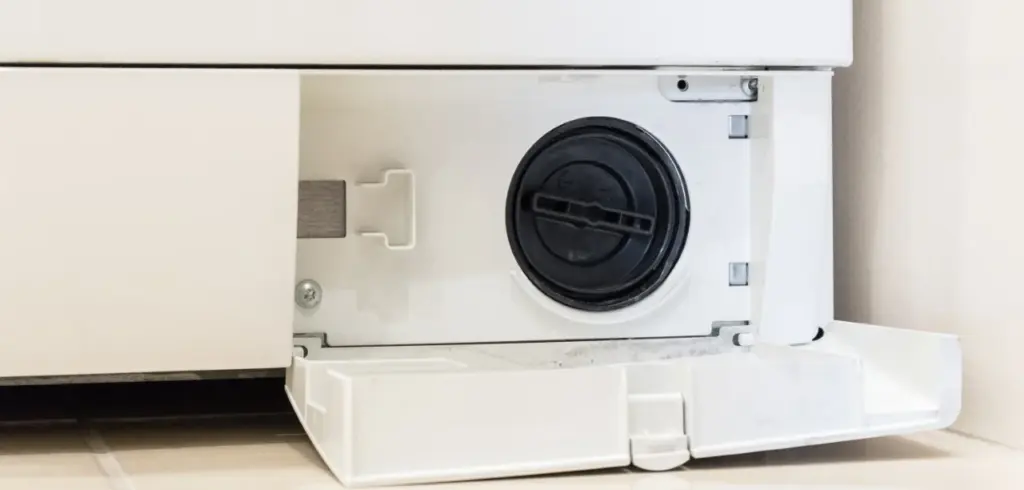

The pump filter is usually found at the front bottom of the washing machine – look for a square or round access flap on the lower fascia, left or right side. Always drain any remaining water before opening it. The filter unscrews anti-clockwise. If the machine is stuck full of water, see our guide on how to drain a washing machine first.
Most modern washing machines have a pump filter designed to catch lint, coins, and small objects before they reach and jam the pump impeller. Cleaning it regularly – and knowing how to access it – is one of the most useful maintenance tasks an owner can carry out.
Where Is the Pump Filter?
On most machines the filter is behind an access flap at the front, positioned low down on the left or right side. It is usually obvious – a square or round panel that clips or screws open. Some machines have a small retractable drain hose alongside the filter, which allows water to be drained into a bowl before the filter is removed.
If there is no obvious access panel, check the instruction manual for your machine. If you do not have the manual, download a copy from our appliance instruction book resource. If the manual makes no mention of a pump filter, the machine may not have one – see the section at the bottom of this guide.
Filter Behind the Kick-Strip
On some machines the filter is hidden behind the kick-strip – the lower panel that runs across the front of the machine at floor level. If there is no obvious filter panel but the kick-strip appears to be built up rather than a thin cosmetic strip, the filter may be behind it.
Kick-strips are typically held in place by three or four clips along the top edge and can be brittle. To remove one, gently work a flat-bladed screwdriver between the top edge of the strip and the cabinet, levering forward carefully while pulling the strip towards you. Do not force it – check first whether it might be screwed in from the bottom rather than clipped at the top.

Plastic kick-strips become brittle with age and often crack if levered too aggressively. Work slowly and gently, feeling for any resistance that suggests a fixings point before applying more force.
Hidden Filters in the Sump Hose
Some older Hotpoint, Indesit, Candy, and Hoover models had the filter hidden inside the sump hose – the hose running from the base of the drum to the pump – rather than in an accessible front panel. When blocked, this type of filter is inaccessible without removing the sump hose, which on most machines requires an engineer. If you have an older machine from one of these brands and cannot locate any external filter, this may be the reason.
Draining Before Removing the Filter
If the machine has water in the drum, it must be drained before the filter is removed – otherwise water will flood out when the filter is opened. If the machine has a small drain hose next to the filter, pull this out and empty it into a bowl or towel before unscrewing the filter itself.
If there is no drain hose and the machine is full of water, see the draining section in our guide on washing machine won’t drain water before proceeding.
Do not lay the machine on its side to access anything while it still has water inside. Water can seep onto electrical components. If access from underneath is needed, have a second person tip the machine back and hold it at an angle while remaining upright.
How to Remove and Clean the Filter
-
Place a large towel or shallow tray under the filter access area to catch any residual water.
-
If a small drain hose is present, pull it out and drain it into a bowl. Replace it in its clip before unscrewing the filter.
-
Turn the filter anti-clockwise. Some filters unscrew completely; others only turn a quarter turn before pulling straight out.
-
Remove any debris – lint, coins, buttons, or other objects – and rinse the filter under running water.
-
Shine a torch into the pump housing and check for any object that may have passed through the filter and jammed the impeller. Try turning the impeller gently with a finger or screwdriver – it should rotate relatively freely, though some have a slight magnetic resistance that causes them to jump in steps rather than rotating smoothly.
-
Refit the filter securely, turning clockwise until it is firmly seated. Run a short cycle and check around the filter for any leaks.
If the filter area leaks after refitting, the filter seal may be damaged or not seated correctly. See our guide on cleaned pump filter now it leaks.
Pump Filter Stuck and Won’t Unscrew
If the filter is jammed and will not turn, the most likely cause is a bra underwire or other obstruction that has become tangled around it, locking it in place. Forcing the filter in this situation risks breaking it.
The best approach is to remove the main sump hose – the large black hose that leads into the pump from the drum – and retrieve the obstruction from there. Once the obstruction is removed, the filter can usually be unscrewed normally.
Testing the Impeller Without the Filter
With the filter removed, the machine can be put onto a drain or spin programme to check whether the impeller is turning. Shine a torch into the filter housing while the machine is running to observe whether the impeller is revolving. Note that with the filter removed, any water added to the machine will run straight out onto the floor – only run a dry drum check or use the drain programme only, not a wash cycle.
Machine With No Pump Filter
Some machines – particularly older models – have no accessible pump filter. If yours has no filter, any blockage will be located in the sump hose, inside the pump body itself, or in the drain hose. Common causes are coins, screws, rubber bands, and bra wire reaching the impeller directly. See our guide on pump running but not draining for diagnostic steps in this situation.
Need a Repair or Replacement Part?
If cleaning the filter does not resolve the drain fault, the pump itself may need replacing.
Related Guides
 Washing Machine Won’t Drain Water
The main drain fault guide covering all common causes – including how to drain a machine stuck full of water.
 Cleaned Pump Filter – Now It Leaks
What to do if the filter area develops a leak after cleaning and refitting.
 Pump Running But Still Not Draining
Less obvious causes when the pump is running and the filter is clear but the machine still won’t drain.
 Washing Machine Pump Guide
How the drain pump works, how to tell if it has failed, and what replacing one involves.
Frequently Asked Questions
Where is the pump filter on a washing machine?
Most machines have the filter behind an access flap at the front, positioned low down on the left or right side. If there is no obvious flap, check behind the kick-strip at the base of the machine – it may be hidden there. The instruction manual will confirm whether your machine has a filter and where it is located.
How do I remove the pump filter without flooding the floor?
Place a large towel or shallow tray under the filter area before opening it. If the machine has a small drain hose next to the filter, pull it out and empty it into a bowl first. If the drum still has a significant amount of water, drain it via the drain hose or by putting the machine on a spin programme before removing the filter.
Which way does the pump filter unscrew?
Anti-clockwise. Some filters unscrew until they pull free; others only rotate a quarter turn and then pull straight out. Do not force it – if it will not turn, there may be an obstruction such as a bra underwire tangled around it that is preventing rotation.
What if the pump filter is stuck and won’t move?
The most likely cause is a bra underwire or similar object tangled around the filter. Remove the main sump hose that leads into the pump and retrieve the obstruction from there. Once the obstruction is cleared, the filter should unscrew normally.
How often should the pump filter be cleaned?
Most manufacturers recommend cleaning the pump filter every one to three months, or whenever the machine develops a drain fault or takes longer than usual to empty. Households that wash pet bedding, heavily soiled items, or items that shed a lot of fibre should clean it more frequently.
Ask the repair forum
Post the make, model and symptoms and get help from the Whitegoods Help community.
44 Comments
Grouped into 31 comment threads.
0 replies This seems to be a very common problem. It's not possible to know if anything was damaged so all I can advise is to take it out again and thoroughly clean the rubber seal and around where the rubber seal will sit when it's back in place and refit it carefully.
0 replies Hi I've got a John Lewis 1201 machine and recently took out the filter to clean it. I found a few coins and a bra wire in there which made it difficult to get the filter out but it did eventually pull out. However since replacing the filter the machine leaks all over the floor. Can you advise if there is anything I can do. It wasn't leaking before I cleaned the filter but as it was difficult to get out I wonder if I've broken something. Please help
Hi I’ve got a John Lewis 1201 machine and recently took out the filter to clean it. I found a few coins and a bra wire in there which made it difficult to get the filter out but it did eventually pull out. However since replacing the filter the machine leaks all over the floor. Can you advise if there is anything I can do. It wasn’t leaking before I cleaned the filter but as it was difficult to get out I wonder if I’ve broken something. Please help
0 replies Brilliant website! Washer stopped working cleaned filter out still wouldn't work. Came on here, checked the pump filter thingymabob and lo and behold there was a rubber band! As someone that usually calls her dad to fix stuff, I actually did it myself! Yay me! Thankyou!!!
Brilliant website! Washer stopped working cleaned filter out still wouldn’t work. Came on here, checked the pump filter thingymabob and lo and behold there was a rubber band! As someone that usually calls her dad to fix stuff, I actually did it myself! Yay me! Thankyou!!!
0 replies If E3 error means it's timed out on empty but the washer isn't full of water and the pump seems to be working ok then suspect a pressure system fault. If a washing machine times out on empty it can only be because it hasn't emptied the water, or is has - but it just doesn't realise it has - faults on pressure system
If E3 error means it’s timed out on empty but the washer isn’t full of water and the pump seems to be working ok then suspect a pressure system fault. If a washing machine times out on empty it can only be because it hasn’t emptied the water, or is has – but it just doesn’t realise it has – faults on pressure system
0 replies Hi, we have a hoover dyn9164dpg and periodically get the e3 fault which is now getting worse. I have drained the machine each time and checked the filter thoroughly and have had the machine run on the pump out cycle to observe the impeller is running(all looks fine). I then refit the filter and run the machine on the spin cycle and it pumps out fine, then try washing a load the fault returns. I have repeated the process incase I've missed something. Is the pump on the way out or another problem? PS. I have checked the drains and all"s good and have observed water flowing freely from the machine drain pipe.
Hi, we have a hoover dyn9164dpg and periodically get the e3 fault which is now getting worse. I have drained the machine each time and checked the filter thoroughly and have had the machine run on the pump out cycle to observe the impeller is running(all looks fine). I then refit the filter and run the machine on the spin cycle and it pumps out fine, then try washing a load the fault returns. I have repeated the process incase I’ve missed something. Is the pump on the way out or another problem?
PS. I have checked the drains and all”s good and have observed water flowing freely from the machine drain pipe.
0 replies I haven't heard of one Terry but if there is anything that needs regular attention it will definitely be in the instruction book.
I haven’t heard of one Terry but if there is anything that needs regular attention it will definitely be in the instruction book.
0 replies The instructions on my Calypso washer says the washer filters 100 % of the wash and rinse water, with a force filter system, but does not say anything about it. I want to know if there is a filter that I need to clean out.
The instructions on my Calypso washer says the washer filters 100 % of the wash and rinse water, with a force filter system, but does not say anything about it. I want to know if there is a filter that I need to clean out.
1 reply Took out the filter to clean as clothes were coming out of the machine smelling if not removed immediately. It's now leaking since I put filter back in. What should I do?
Took out the filter to clean as clothes were coming out of the machine smelling if not removed immediately. It’s now leaking since I put filter back in. What should I do?
Likely replying to Laura
Hello Laura. If you remove the pump filter and then replaced it but it now leaks the only explanation is something has got damaged or it hasn’t been refitted properly. The first thing to do is to remove it again, check that it is all nice and clean and any seal is clean and in place and then re-fit it making sure it is fitted properly and properly tightened up.
1 reply Hi. My whirlpool machine has twice made a horrendous noise, the last time it actually stopped and the red light came on saying clean pump. The floor was awash when I tried to open the thing at the bottom, but eventualły I got the filter out and it was fine, no blockage that I could find. Screwed it all back, turned on machine, dreadful noise again, so I called an engineer, switched on the machine for them to hear over the phone, and......nothing! Completed the cycle no problem! Any ideas would be greatly appreciated, thanks,
Hi. My whirlpool machine has twice made a horrendous noise, the last time it actually stopped and the red light came on saying clean pump. The floor was awash when I tried to open the thing at the bottom, but eventualÅ‚y I got the filter out and it was fine, no blockage that I could find. Screwed it all back, turned on machine, dreadful noise again, so I called an engineer, switched on the machine for them to hear over the phone, and……nothing! Completed the cycle no problem! Any ideas would be greatly appreciated, thanks,
Likely replying to Sue fox
Hello Sue. It sounds like something could be stuck inside the washing machine, commonly plastic, and if so this obstruction can get sucked into the pump and then tossed back out again which causes an intermittent noise and of course interferes with the pump. The only thing to suggest is to recording the next time you hear the sound so you at least have something to playback to an engineer if it does the same trick.
1 reply My machine (John Lewis 1404) wasn't spinning properly. Checked the filter and it had a couple of dye catcher sheets in it - must be more careful in future that they are accounted for when I empty machine. Cleaned out filter and rinsed it, checked impeller was turning freely and no other items in there, then put the filter back in place. Machine is not working, no water seems to be going into the machine. All the lights are coming on, no error codes, but it is just making a sort of humming noise. Do you have any idea what could be causing this please? I've taken the filter out again and refitted it just in case it was not in correctly, but it seems to be OK and can only fit in one way.
My machine (John Lewis 1404) wasn’t spinning properly. Checked the filter and it had a couple of dye catcher sheets in it – must be more careful in future that they are accounted for when I empty machine. Cleaned out filter and rinsed it, checked impeller was turning freely and no other items in there, then put the filter back in place. Machine is not working, no water seems to be going into the machine. All the lights are coming on, no error codes, but it is just making a sort of humming noise. Do you have any idea what could be causing this please? I’ve taken the filter out again and refitted it just in case it was not in correctly, but it seems to be OK and can only fit in one way.
Likely replying to Rose
Hello Rose, were they Dr Beckmann dye catcher sheets by any chance? My experience of that brand is that they are way too small and too easily get sucked down into the washing machine via the gap in the door seal on some machines.
If the washing machine is making a humming sound and nothing is happening the main causes are the pump jammed, or the water supply has been cut off due to a kinked fill hose or the tap not turned on properly (or has gone faulty inside). If the pump is running check the water, if it’s not running but humming, that’s usually something jamming the impeller.
Leave a comment
1 reply Hi my beko machine needs a new water pump but after replacing it's now leaking water can you help. Thanks
Hi my beko machine needs a new water pump but after replacing it’s now leaking water can you help. Thanks
Likely replying to Andrena
Hello Andrena. It’s unlikely that the new pump is faulty so the leak must be caused by it not been fitted properly. It could be coming from either of the hoses connected to the pump, or even the pump filter not being fitted properly. It is even possible for the leak to coming from somewhere else entirely or even from the plumbing if it was disturbed. Finding a leak should be simple, it’s just a question of observing where the water is coming from. Check out this article for some tips help fixing a leaking washing machine
1 reply Hi there, I have a LG washing machine Model F1256QD only a few years old. Today it would not drain, I drained the machine manually, removed the filter which wasn't very dirty at all. There was a white rubber band wrapped around the 'impeller' as you mentioned in your article. I have puled it out and the machine seems to be running fine. Is this rubber band from the machine itself? or been in the drum when I have loaded the machine? Your advice would be greatly received. Thanks Jerri
Hi there,
I have a LG washing machine Model F1256QD only a few years old. Today it would not drain, I drained the machine manually, removed the filter which wasn’t very dirty at all. There was a white rubber band wrapped around the ‘impeller’ as you mentioned in your article. I have puled it out and the machine seems to be running fine. Is this rubber band from the machine itself? or been in the drum when I have loaded the machine?
Your advice would be greatly received.
Thanks
Jerri
0 replies There is always some water left inside the pump and sump hose. The pump cannot move the last dregs of water. This is normal. No need to drain this water at all. If it is a lot of water, say over a pint, then there could be a partial blockage preventing efficient draining but if the machine is functioning ok and there's just a few cupfuls of water there id you remove the pump filter it's nothing to worry about.
There is always some water left inside the pump and sump hose. The pump cannot move the last dregs of water. This is normal. No need to drain this water at all. If it is a lot of water, say over a pint, then there could be a partial blockage preventing efficient draining but if the machine is functioning ok and there’s just a few cupfuls of water there id you remove the pump filter it’s nothing to worry about.
1 reply No Michelle. If it isn't pumping the water out see here - Washing Machine Won’t Drain Water
No Michelle. If it isn’t pumping the water out see here – Washing Machine Won’t Drain Water
0 replies Hi, I have unscrewed the pump cap and the water came out, but after every wash it needs to be drained is this right? Thank you
Hi, I have unscrewed the pump cap and the water came out, but after every wash it needs to be drained is this right?
Thank you
0 replies No, the washing machine will need to come out to be repaired. The only thing you could do without moving it is to clean the pump filter but not if it won't come out. If the filter is jammed it may have something stuck inside as mentioned in my article but to deal with that you need to get inside the machine.
No, the washing machine will need to come out to be repaired. The only thing you could do without moving it is to clean the pump filter but not if it won’t come out. If the filter is jammed it may have something stuck inside as mentioned in my article but to deal with that you need to get inside the machine.
0 replies Hi, our washing machine won't drain and the pump filter won't unscrew. As the washing machine is tighly fixed under our countertops bringing it forward is impossible so I don't think I can get to the sump hose to remove the blockage from there. Is there a way to safely cut off the pump filter from the front before putting a new one in? Thanks! :)
Hi, our washing machine won’t drain and the pump filter won’t unscrew. As the washing machine is tighly fixed under our countertops bringing it forward is impossible so I don’t think I can get to the sump hose to remove the blockage from there. Is there a way to safely cut off the pump filter from the front before putting a new one in?
Thanks! :)
0 replies Some pump filters have a round rubber seal. When you push in the filter you usually screw the filter clockwise which squashes up the seal and holds it in place. It's possible the rubber seal has become hard and un-pliable and is fixed in the squashed position. Make sure you have unscrewed any part of the filter in front of the seal to release any pressure from any plate at the back of the rubber. If the rubber has just set in the squashed formation it needs to hold in place you may need to replace it. The only other thing I would suggest is placing it for several minutes in hot water to try and soften it up before trying to force it in place. I would be wary of using any lubricant in case it slipped out during the wash which would flood the kitchen.
Some pump filters have a round rubber seal. When you push in the filter you usually screw the filter clockwise which squashes up the seal and holds it in place. It’s possible the rubber seal has become hard and un-pliable and is fixed in the squashed position. Make sure you have unscrewed any part of the filter in front of the seal to release any pressure from any plate at the back of the rubber. If the rubber has just set in the squashed formation it needs to hold in place you may need to replace it. The only other thing I would suggest is placing it for several minutes in hot water to try and soften it up before trying to force it in place. I would be wary of using any lubricant in case it slipped out during the wash which would flood the kitchen.
0 replies Hi, I've done all the above for my washing machine that wouldn't drain. The filter hose bit at the front was clogged full of hair grips and tissue etc so insure that was the problem. All drained and cleaned now but I can't get the hose back in! The rubber seal seems too thick to pop back in???? Help!!!!
Hi, I’ve done all the above for my washing machine that wouldn’t drain. The filter hose bit at the front was clogged full of hair grips and tissue etc so insure that was the problem. All drained and cleaned now but I can’t get the hose back in! The rubber seal seems too thick to pop back in???? Help!!!!
1 reply Hi my bush washing machine is 12months old and today it wouldn't rinse the lifts kept flashing on the "start and door button" so my friend said I should check the filter. So much water leaked out and now the machine is working but the filter is leaking. Iv never opened the filter before until today have I broken it?
Hi my bush washing machine is 12months old and today it wouldn’t rinse the lifts kept flashing on the “start and door button” so my friend said I should check the filter. So much water leaked out and now the machine is working but the filter is leaking. Iv never opened the filter before until today have I broken it?
Likely replying to Shree
Hello Shree. It’s more likely that you just haven’t refitted it properly or maybe some grit or something is preventing a proper seal. It’s possible something could have been stuck inside which floated out when all the water came out. Just drain all the water away, place a large bath towel down and then take the filter off again. Carefully clean around the rubber seal and the actual opening of the filter compartment. Then carefully replace everything and make sure it is nice and tight. You should be able to open filter many times to clean it and then refit it without any leaks.
1 reply Hi Can you help My Bosh washing machine will not spin I have drained it via the drainage hose I then unscrewed the pump cover and found a few hair clips but nothing else. Put the machine on drain and wheel at back is turning. What else could be the problem?. Many Thanks
Hi
Can you help
My Bosh washing machine will not spin
I have drained it via the drainage hose I then unscrewed the pump cover and found a few hair clips but nothing else.
Put the machine on drain and wheel at back is turning.
What else could be the problem?.
Many Thanks
Likely replying to Belinda
Hello Belinda. You need to work out if the problem is anything to do with not draining the water or not. If it isn’t spinning because it isn’t emptying the water you need to follow the link at the bottom of my article titled washing machine isn’t pumping out water. But if you’ve got all the water out and it still isn’t spinning follow this article – washing machine not spinning. Unfortunately there are multiple possible causes for both problems.
1 reply Hi, I had an error message during my wash cycle indicating the machine (Gorentje 7kg) filter needed cleaning. I attempted to clean the filter. I first drained the excess water using the small hose behind the filter door (next to the filter). Then attempted to remove the filter by turning it anti-clockwise. It turned for a bit and then it seemed enough but would not come free. I guess something was jammed inside. Unfortunately, the filter cap broke off in my attempts to remove the filter. Can you recommend how I could remove the filter in this case? Thanks. Cheers.
Hi,
I had an error message during my wash cycle indicating the machine (Gorentje 7kg) filter needed cleaning.
I attempted to clean the filter. I first drained the excess water using the small hose behind the filter door (next to the filter). Then attempted to remove the filter by turning it anti-clockwise. It turned for a bit and then it seemed enough but would not come free. I guess something was jammed inside. Unfortunately, the filter cap broke off in my attempts to remove the filter. Can you recommend how I could remove the filter in this case? Thanks. Cheers.
0 replies Opening it could be more likely to cause a leak than never disturbing it although they are designed to be disturbed. If the leak is coming from the pump filter it needs removing and cleaning and making sure the rubber seal is ok. If it's not coming from the filter it could be coming from anywhere Finding a leak on washing machine
Opening it could be more likely to cause a leak than never disturbing it although they are designed to be disturbed. If the leak is coming from the pump filter it needs removing and cleaning and making sure the rubber seal is ok. If it’s not coming from the filter it could be coming from anywhere Finding a leak on washing machine
0 replies Hi, could my failure to ever have opened the pump filter cover be a possible cause for slight water leakage in my 7 year old washer? Thanks.
Hi, could my failure to ever have opened the pump filter cover be a possible cause for slight water leakage in my 7 year old washer? Thanks.
1 reply how do you remove the filter cover from a bush N146CA2. Is a special tool required?
how do you remove the filter cover from a bush N146CA2. Is a special tool required?
Likely replying to tony folkard
Tony, I’m not familiar with that particular model but it they normally either completely unscrew screw, or you turn it to the left and then pull it out. It’s possible something could be jamming it from inside if it won’t unscrew. There’s mention of this possibility and possible solutions in this article at the section, “Washing machine pump filter stuck?”
0 replies Thanks a million for the advice! I have one of those stupid "filter in the sump hose" hotpoint machines...but thanks to you, net yield from the filter was nearly €6 in change! Machine working perfectly now :)
Thanks a million for the advice!
I have one of those stupid “filter in the sump hose” hotpoint machines…but thanks to you, net yield from the filter was nearly €6 in change! Machine working perfectly now :)
1 reply Hi My Indesit is leaking from the top of the black hose leading from the tub to the pump, is there a way I can check for a blockage without having to call an engineer out?
Hi
My Indesit is leaking from the top of the black hose leading from the tub to the pump, is there a way I can check for a blockage without having to call an engineer out?
Likely replying to Kelly
Kelly, that’s the sump hose, water could leak from there but it could also leak from somewhere above and run down the side of the outer drum.. Checking for a blockage involves checking the pump filter as described in the article but if there isn’t a filter you have to take off that hose and check.
1 reply Thank you so much for your advice via this web page. I have just fixed my washing machine and it is running perfect!!! I cant believe it!!!!!!!!!!!! I was dreading the call out charge and the fact that i would be at the repair mans mercy. Thanks again
Thank you so much for your advice via this web page. I have just fixed my washing machine and it is running perfect!!! I cant believe it!!!!!!!!!!!! I was dreading the call out charge and the fact that i would be at the repair mans mercy. Thanks again
1 reply Thank you so much! Our machine had no filter. But as you were pretty thorough in taking care of every possible cause, we found a small coin in the pump and much to our delight, she is operational once more. Just goes to show, a woman can do it, with help like yours. Thank You!!
Thank you so much!
Our machine had no filter. But as you were pretty thorough in taking care of every possible cause, we found a small coin in the pump and much to our delight, she is operational once more. Just goes to show, a woman can do it, with help like yours.
Thank You!!
0 replies Thank you so much for this article. Our Hotpoint stopped draining and I was considering calling out a plumber cos we know next to nothing about plumbing. But lo and behold, the pump filter was lurking behind that panel near the ground, it got cleaned (with a few towels in attendance) and now it's working again :)
Thank you so much for this article. Our Hotpoint stopped draining and I was considering calling out a plumber cos we know next to nothing about plumbing. But lo and behold, the pump filter was lurking behind that panel near the ground, it got cleaned (with a few towels in attendance) and now it’s working again :)
0 replies Hi, I removed my washing machine filter but now when I put it back in it just spins round and round, and leaks all over the place, which it previously did not do. Does this mean the thread has gone? I want to avoid getting a repair man out if poss as too expensive. Thanks in advance.
Hi, I removed my washing machine filter but now when I put it back in it just spins round and round, and leaks all over the place, which it previously did not do. Does this mean the thread has gone? I want to avoid getting a repair man out if poss as too expensive.
Thanks in advance.
This seems to be a very common problem. It’s not possible to know if anything was damaged so all I can advise is to take it out again and thoroughly clean the rubber seal and around where the rubber seal will sit when it’s back in place and refit it carefully.