
Washing Machine Door Hinge Broken
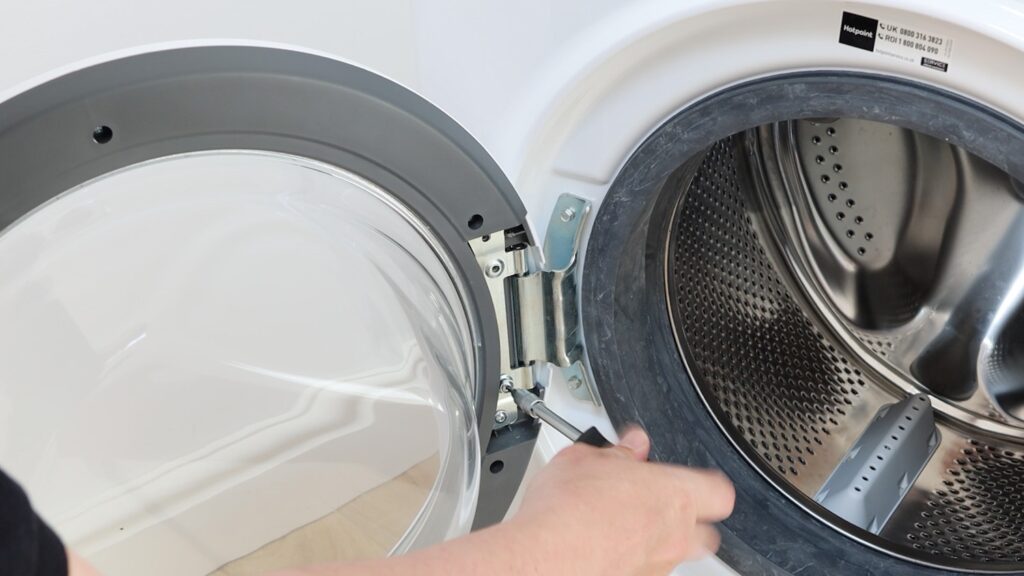

A broken washing machine door hinge is straightforward to replace – the hinge is usually held by two screws or bolts and can be swapped without specialist tools. The main risk is losing a backing plate or nut inside the machine when the screws are undone. Remove the lid first and check what is behind the hinge before unscrewing anything.

Unplug the machine before removing the lid, door seal, or any fixings. See our DIY repair safety guide before beginning.
Door hinges that break were almost unheard of on older machines. Lower-quality materials in modern appliances have made hinge failure increasingly common. The repair itself is not complicated, but a few specific risks are worth understanding before starting.
How to Replace a Washing Machine Door Hinge
Most door hinges are secured to the machine’s front casing with two fixings – typically large self-tapping screws, bolts, or in some cases rivets. Some hinges hang on lugs or hooks moulded into the casing, with the screws serving only as additional securing.

Many hinges have a loose backing plate, washer, or nut behind the casing that the screws thread into. When the screws are removed, this backing piece can fall into the machine’s chassis – where it is very difficult to retrieve. Always check what is behind the hinge before undoing anything.
-
Unplug the machine from the mains. Do not begin any disassembly with the machine connected to power.
-
Remove the lid. Most lids are secured by two screws at the back and slide off. With the lid off, look down through the top of the machine to see the rear of the hinge fixing point. If you can see and reach the backing plate, hold it in place while undoing the screws.
-
Try peeling back the door seal for easier access to the hinge area. The seal is usually held to the front of the machine by a spring or plastic retaining band. It does not need to be fully removed – peeling it back a short way around the hinge area gives good access to the back of the fixings.
-
Undo the fixings carefully while holding or supporting any loose backing piece. If you can catch the backing plate as the last screw comes out, you avoid the most common problem with this job.
-
Fit the new hinge in reverse order. Refit the door seal retaining band if removed, and confirm the door opens and closes smoothly before running any cycle.
If Something Has Dropped Inside the Machine
If a fixing, backing plate, or nut has fallen inside the machine during the repair, it needs to be retrieved before the machine is used again. A loose metal component inside a washing machine can cause serious damage to the drum, tub, or pump if it enters the wash cycle.
Try the following methods in order of how invasive they are, stopping as soon as the part is retrieved.
Check the floor first. Pull the machine forward slightly and look underneath – the part may have fallen through and onto the floor rather than landing inside the machine.
Tilt the machine back. With the machine unplugged and hoses disconnected, carefully tilt it backwards against a wall or worktop with a second person holding it. Try to reach under and inside from below with a torch. Washing machines are very heavy – do not attempt this alone and do not let the machine fall.
Peel back the door seal further. Remove the retaining band completely and peel the door seal away from the front of the machine. This opens up access to the area immediately inside the front panel where parts often fall.
Lay the machine on its front. Disconnect both hoses, move the machine clear of the wall, and lay it face-down on a blanket or cardboard. This gives direct access to the underside and any chassis channels where the part may have come to rest.
Remove the front panel. As a last resort, remove the door seal and kick-strip, then undo the screws securing the front panel. The panel removal process varies by model – check for hidden screws behind the soap drawer or under the door seal. With the front panel off, the interior is fully accessible.
Use a torch and a telescopic magnetic pickup tool where possible – most backing plates and fixing hardware are steel and can be retrieved magnetically without having to reach in directly.
Need a Replacement Part or a Qualified Engineer?
Related Guides
 Can a Washing Machine Door Be Hinged on the Right?
Whether washing machine doors can be reversed and what to do if the current hinge position does not suit your kitchen layout.
 Washing Machine Door Will Not Open
Causes of a stuck or locked washing machine door and how to safely release it.
 How a Washing Machine Door Lock Works
How the door interlock mechanism functions and how to diagnose a door lock fault.
 Washing Machine Door Glass Danger
Safety information about washing machine door glass – including exploding glass incidents.
Frequently Asked Questions
How do I replace a broken washing machine door hinge?
Unplug the machine, remove the lid, and check what is behind the hinge fixing before undoing any screws. Most hinges are held by two fixings. If there is a loose backing plate behind the casing, hold it while removing the last screw to prevent it dropping inside the machine. Peeling the door seal back slightly gives easier access to the rear of the fixings.
Something dropped inside the machine when I was removing the hinge – what do I do?
Do not use the machine until the part has been retrieved – a loose metal component inside can seriously damage the drum, tub, or pump. Try tilting the machine back to access the underside, then peeling back the door seal for access inside the front panel area, then laying the machine on its front for direct access from below. A magnetic pickup tool is useful for retrieving steel hardware without having to reach in blindly.
Do I need to remove the door seal to replace the hinge?
Not always – but peeling it back a short way around the hinge area makes it much easier to see and catch any backing plate or nut behind the casing. The seal does not need to be fully removed; just loosen the retaining band in the hinge area and pull the seal back enough to see what you are working with.
Why do washing machine door hinges break when they never used to?
Lower-quality materials in modern appliances – particularly lighter plastic and thinner metal components – have made hinge failure more common than it was in previous decades. Hinges on older machines were typically made from heavier-gauge metal and rarely failed. Many modern machines also have doors that are proportionally heavier relative to the hinge specification.
Ask the repair forum
Post the make, model and symptoms and get help from the Whitegoods Help community.
9 Comments
Grouped into 8 comment threads.
1 reply Hi my Bosch washing machine door has no screws holding the front and back of it together...where the screw holes are there is white plastic plugs...any idea how these can be removed?
0 replies Hello Erika. If you mean that when you unscrewed the door hinge that something fell down at the back of the front panel now it won't screw back in this is described in my article. If there is a plate at the back of the front panel that the screws screw into it will need to be retrieved. Help on how to do this is in my article above.
Hello Erika. If you mean that when you unscrewed the door hinge that something fell down at the back of the front panel now it won’t screw back in this is described in my article. If there is a plate at the back of the front panel that the screws screw into it will need to be retrieved. Help on how to do this is in my article above.
0 replies I have the same issue as Charlotte, only both holes seem to be loose now that I have just bought a new replacement door for my beko washer. I just can't screw the door onto the washing machine now! Both holes for the door hinge screws are too loose. What do I do?? Please help!
I have the same issue as Charlotte, only both holes seem to be loose now that I have just bought a new replacement door for my beko washer. I just can’t screw the door onto the washing machine now! Both holes for the door hinge screws are too loose. What do I do?? Please help!
0 replies Hi - Replaced the Beko door handle easily, but the base plate for the door fell into the washer !! - tried to remove panels but could not see screws. All was lost till I read your advice. luckily the base plate had fallen onto the floor. I was able to reach in and put it back in place and secure the door !! Phew.. ta :)
Hi – Replaced the Beko door handle easily, but the base plate for the door fell into the washer !! – tried to remove panels but could not see screws. All was lost till I read your advice. luckily the base plate had fallen onto the floor. I was able to reach in and put it back in place and secure the door !! Phew.. ta :)
0 replies Is the screw damaged Charlotte? If you don't fix it the door is likely to eventually drop off altogether if you aren't careful to support it when it's open. Unfortunately the screw might not be available and the part it screws into may be part of the casing and unavailable too. You could try looking for them on Spares4Appliances and/or send a parts query into them if you can't see it
Is the screw damaged Charlotte? If you don’t fix it the door is likely to eventually drop off altogether if you aren’t careful to support it when it’s open. Unfortunately the screw might not be available and the part it screws into may be part of the casing and unavailable too. You could try looking for them on Spares4Appliances and/or send a parts query into them if you can’t see it
0 replies I have a loose screw on the hinge of the door that won't 'bite' when I try and screw it back in, so the door is only being held on by one screw. What is a good fix for this?
I have a loose screw on the hinge of the door that won’t ‘bite’ when I try and screw it back in, so the door is only being held on by one screw. What is a good fix for this?
0 replies If there are no visible screws on the inner half it's likely something has broken and it may not be possible to tighten anything up. To investigate you'd need to take the door off the hinge and try to take it apart. It's not always easy to split them these days depending on how it's been designed, you need to be careful you don't break anything trying to get the two halves apart. You could try entering the proper model number into appliance spare parts to see if it shows the door as a spare part and if you can buy either half separately or if the door comes only as a complete door or not (which wouldn't surprise me these days).
If there are no visible screws on the inner half it’s likely something has broken and it may not be possible to tighten anything up. To investigate you’d need to take the door off the hinge and try to take it apart. It’s not always easy to split them these days depending on how it’s been designed, you need to be careful you don’t break anything trying to get the two halves apart.
You could try entering the proper model number into appliance spare parts to see if it shows the door as a spare part and if you can buy either half separately or if the door comes only as a complete door or not (which wouldn’t surprise me these days).
0 replies The door on my Bosch Excel 7 (Vario Perfect) washing machine appears to be made of a inner half that fits to the hinge on the machine and an outer part that is coming away from the inner section. There doesn't appear to be any way of tightening the loose part of the door together. The door is still closing but there is quite a lot of play. Has anyone else experienced the same problem? Thanks.
The door on my Bosch Excel 7 (Vario Perfect) washing machine appears to be made of a inner half that fits to the hinge on the machine and an outer part that is coming away from the inner section. There doesn’t appear to be any way of tightening the loose part of the door together. The door is still closing but there is quite a lot of play. Has anyone else experienced the same problem?
Thanks.
Hi my Bosch washing machine door has no screws holding the front and back of it together…where the screw holes are there is white plastic plugs…any idea how these can be removed?
Likely replying to Jim
Hello Jim. I would guess the plastic plugs may prize out and could be hiding the screws or maybe they have designed it so that it can’t be taken apart. Check somewhere like Spares4Appliances to see if they sell the individual parts for the door or only a complete door.