
Time remaining display not accurate
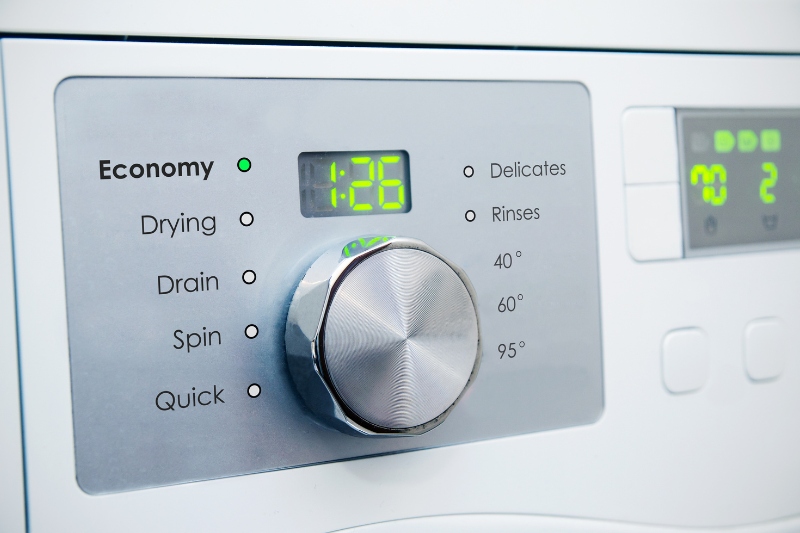

The time remaining display is a real-time estimate based on how the cycle is progressing, not a fixed countdown. Several normal variables can extend or shorten a cycle during operation: incoming water pressure, water temperature, limescale on the heating element, and how long the machine takes to balance the load before spinning. A display that jumps or adjusts is doing its job correctly. A display stuck on one minute may indicate a fault.
Why is the display an estimate and not a countdown?
Cycle times are measured by manufacturers under controlled laboratory conditions – a standard load, controlled water temperature, standard water pressure, and an evenly distributed load. In the real world, none of these conditions are fixed.
Modern appliances monitor what is actually happening during a cycle and adjust the displayed time accordingly. If filling takes longer than expected, the display extends. If the load balances quickly before a spin, it may shorten. This is the display working as designed, not a fault.

The same logic applies to dishwashers and tumble dryers, though washing machines have the most variables due to their filling, heating, and load-balancing processes. The examples below focus on washing machines, but the principles are the same across all three appliance types.
What causes the time remaining to change during a cycle?
 Water pressure
How quickly the machine fills depends entirely on incoming water pressure. Pressure varies between homes and can even vary at different times of day, lower during peak usage periods for example. Lower pressure means slower filling, which adds minutes to the fill stage and causes the display to extend. This is particularly noticeable on longer washes that involve multiple rinse fills.
 Water temperature
The time needed to heat water depends on how cold it is when it enters the machine. In winter, incoming cold water can be significantly colder than in summer. A colder starting point means the heating element has to work longer to reach the target temperature, extending the wash stage. This is a genuine seasonal variable that can add several minutes to heated cycles.
 Limescale on the heating element
Limescale deposits on the heating element act as insulation, reducing its efficiency. A scaled element takes longer to heat the same volume of water than a clean one. This gradually worsens over time in hard water areas, causing cycles to run progressively longer. See our guide: limescale in washing machines.
 Load balancing before the spin
Modern washing machines detect whether the load is evenly distributed before spinning. If the load is unbalanced, the machine will pause, redistribute the laundry with slow drum movements, and try again. This can happen multiple times. In difficult cases such as a single heavy item or a very small load of dense fabrics, this process can add 15 minutes or more to the cycle. If balance cannot be achieved, the machine may reduce the spin speed or skip the final spin entirely.
An unevenly distributed load is the most common cause of unexpected cycle extensions. Loading the machine correctly, distributing items evenly and not washing a single heavy item alone, significantly reduces how often the machine needs to rebalance. See our guide: loading a washing machine drum properly.
Time remaining stuck on 1 minute: is this a fault?
A display that adjusts throughout a cycle is normal. A display that gets stuck on the final minute and stays there for an extended period without the cycle completing is a different situation and can indicate a fault.
 Normal: the display hovers briefly near the end
It is common for the displayed time to slow significantly in the final few minutes of a cycle. The machine may be completing a final spin, allowing the drum to coast to a stop, or running a cooling phase. A short pause at “1 minute” before the cycle ends is not unusual and is not a fault.
 Possible fault: stuck at 1 minute for many minutes
If the display has shown “1 minute” for 15 minutes or more with no sign of progress, there may be a fault preventing the cycle from completing. A common cause in washing machines is a heating element fault (open circuit or poor connection) where the machine waits for a temperature target that the element cannot reach. This is brand-specific and usually requires an engineer to diagnose.

If cycles consistently overrun the stated time by a wide margin, this may indicate limescale on the heating element, a water pressure issue, or a more significant fault. See our guide: why does my washing machine take so long?
Machine not completing cycles or taking much longer than expected?
If the cycle will not finish or consistently overruns, a qualified engineer can diagnose whether there is an underlying fault with the heating element, pressure system, or control board.
Frequently asked questions about washing machine time remaining
Why does my washing machine’s time remaining display keep changing?
The display is a live estimate based on how the cycle is progressing, not a fixed countdown. It adjusts in response to real conditions: how long filling takes, how long heating takes, and whether the machine needs extra time to balance the load before spinning. A display that changes during a cycle is behaving correctly, not malfunctioning.
Why is my washing machine cycle taking much longer than the display said?
The most common causes are low water pressure (slower filling), cold incoming water in winter (longer heating time), limescale on the heating element (reduced heating efficiency), or the machine repeatedly attempting to balance an uneven load before the spin. All of these are normal variables. If cycles are consistently far longer than expected, limescale or a heating element issue may be worth investigating. See our guide: why does my washing machine take so long?
Why does the time remaining go up during a cycle?
If the machine detects that a stage is taking longer than the laboratory estimate, for example because the water pressure is low and filling is slow, or because the load is unbalanced and needs rebalancing, it will increase the displayed time remaining to reflect the new projected end time. This is the estimate updating to reflect reality, not a fault.
My washing machine is stuck on 1 minute and not finishing. Is it broken?
It depends on how long it has been stuck. A brief pause near the end of a cycle is normal. If the display has shown “1 minute” for 15 minutes or more without the cycle ending, this is more likely to indicate a fault, often a heating element issue that prevents the machine from reaching a temperature target. This is brand-specific behaviour and usually requires an engineer to diagnose. See our guide: book a repair engineer.
Does limescale affect how long a wash takes?
Yes. Limescale deposits on the heating element act as insulation and reduce its efficiency. A scaled element takes longer to heat the water, which extends the heating stage of every cycle. Over time in hard water areas this effect compounds, causing noticeably longer cycles. Regular descaling helps prevent this. See our guide: limescale in washing machines.
Why did my machine skip the spin at the end?
If the machine could not balance the load after multiple attempts, it may have reduced the spin speed or skipped the final spin entirely to avoid the vibration that an unbalanced high-speed spin would cause. This is a safety feature rather than a fault. The laundry will be left wetter than usual. Re-running a spin-only cycle after redistributing the load manually should resolve it. See our guide: loading a washing machine drum properly.
Why is the display sometimes accurate and sometimes very inaccurate?
The display will be most accurate when conditions match the laboratory settings the manufacturer used to calibrate it, which is broadly: normal mains water pressure, mild incoming water temperature, a clean heating element, and an evenly loaded drum. The further your real-world conditions vary from those baseline assumptions, the more the display will need to adjust mid-cycle. Cycles in winter with an unbalanced load on a scaled machine are likely to overrun significantly. Cycles in summer with a balanced load on a recently descaled machine should run close to the stated time.
Ask the repair forum
Post the make, model and symptoms and get help from the Whitegoods Help community.
4 Comments
Grouped into 2 comment threads.
1 reply Time remaining stuck on 1 minute: Very helpful site - thank you. Neff machine does not rinse and spin and remains full of soap suds and programme sticks with just 1 minute left (for hours). We have had 2 unsuccessful engineer visits (nearly £200) and no success. First engineer removed 2 x 50p pieces that must have been in there for about 2 years and the second re-routed the appliance drain hose. Between first and second engineer visits it stuck again. I left it on 1 minute full of suds but I went back to it after 2 hours and it had started a rinse cycle and then finished OK. Since then (a week ago) it has been fine - but this evening it has stuck again so I have to stop the machine, operate a spin cycle and rinse cycles manually. I note that drawer compartment II seems to be holding water behind the flap but presume this is OK. Advice appreciated - thank you.
1 reply My beko machine brand new adds 2 hours onto a 1 hr 15 minute wash. I sent a machine back last week and got this replacement but it is doing the same thing. Do you think this is a batch fault or normal operating?
My beko machine brand new adds 2 hours onto a 1 hr 15 minute wash. I sent a machine back last week and got this replacement but it is doing the same thing. Do you think this is a batch fault or normal operating?
Likely replying to Andrew Ive
Hello Andrew. Whilst it’s not possible to rule it out completely I would think it highly unlikely for two new washing machines to have the exact same fault. It is much more likely that there is an issue with your plumbing. When it seems to spend a long time you need to observe if it seems to be stuck doing the same thing over and over again. That is, does it seem to spend a lot of time filling up with water? Or does it seem to spend a lot of time with all the water pumped away and the drum just turning around and around, maybe stopping and starting again?
The former can be caused if it is losing water through siphoning down the drain. If you suspect this, read this following article very carefully to understand the issue if filling and losing water down the drain
The latter is mentioned in my article above and can be caused if the washing machine is struggling to balance the load, which is explained in more detail above. Other than that if there is a kink in the fill hose or a fault in the water supply it could slow washing machine down but to slow it down that much I would expect it to timeout on fill and produce an error code.
At the end of the day taking an extra two hours to do a wash is unusual. If you can’t find anything try putting it on the same wash cycle but without any laundry inside and see how long it takes then.
Time remaining stuck on 1 minute:
Very helpful site – thank you.
Neff machine does not rinse and spin and remains full of soap suds and programme sticks with just 1 minute left (for hours).
We have had 2 unsuccessful engineer visits (nearly £200) and no success. First engineer removed 2 x 50p pieces that must have been in there for about 2 years and the second re-routed the appliance drain hose.
Between first and second engineer visits it stuck again. I left it on 1 minute full of suds but I went back to it after 2 hours and it had started a rinse cycle and then finished OK. Since then (a week ago) it has been fine – but this evening it has stuck again so I have to stop the machine, operate a spin cycle and rinse cycles manually.
I note that drawer compartment II seems to be holding water behind the flap but presume this is OK. Advice appreciated – thank you.
Likely replying to Stephen Offley
Hello Stephen. Yes this issue is not really related to the time display being inaccurate, it’s an actual malfunction, though technically I can see where you are coming from in that the time display when the fault occurs is definitely inaccurate. It sounds like it’s very much an intermittent fault, which can be very difficult to track down. But if it is sticking with soapy water inside it sounds very much like it is not emptying the water out properly. If this is intermittent, it is very difficult to fix.
One thing I would definitely check is if it is pumping out into a U bend under the sink I would make sure that there is nothing jammed inside the spigot that the drain hose attaches to as you can get obstructions in there like a very small button, or bits of lint that can partially block the water from draining.