
Washing machine jumps and bangs on spin
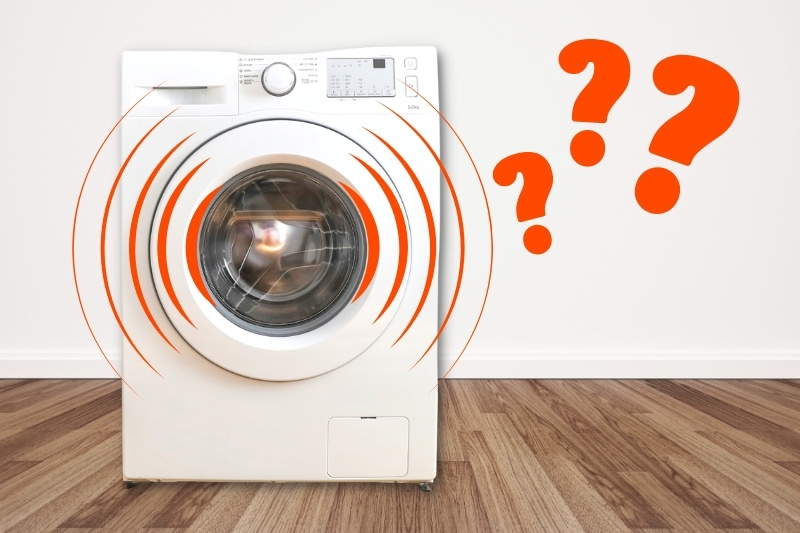

The most common cause of a washing machine jumping and banging on spin is an unbalanced load – either too little laundry, too much, or items that settle unevenly. On a new machine, check the transit packaging has been removed. Regular severe banging that is not load-related can cause expensive damage and needs an engineer to diagnose.
Occasional slight movement on spin is normal, particularly on tiled or smooth floors where rubber feet can slide. Severe or regular banging is not – and ignoring it risks progressive damage to the drum, suspension, and bearings that becomes increasingly expensive the longer it continues.
Step 1: When Does the Banging Occur?
The timing of the banging is the most useful first diagnostic clue.
| When it occurs | What it suggests | Action |
|---|---|---|
| At random points during washing – not on spin | Motor surge fault – drum spinning when it should be tumbling slowly | Stop using the machine – engineer required |
| As soon as the motor starts at any speed | Motor has lost control of slow wash speeds – possible tacho coil or PCB fault | Engineer required – see our guide on tacho coil faults |
| Only during proper spin – especially starting up or slowing down | Most likely an unbalanced load or suspension fault | Check loading, machine level, and suspension |
| Any spin since newly installed | Transit packaging may not have been removed | Check and remove all transit bolts before using again |
New Machine? Check the Transit Packaging First
All new washing machines are shipped with internal transit packaging – metal bolts and foam blocks that hold the drum completely rigid during transport. If not removed before first use, the drum cannot move on its suspension and all the movement generated on spin is transferred directly into the machine casing, causing violent side-to-side banging.

Running on spin with transit packaging in place can cause serious damage to drum bearings and suspension very quickly. Instructions for finding and removing the transit bolts are in the machine’s manual or on a label on the rear panel. See our washing machine installation guide.
Check the Load
An unbalanced drum is the most common cause of spin banging when the machine itself is working correctly. Watch the drum during the slow distribution phase that runs for a minute or two before fast spin begins.

Signs of an unbalanced load before spin
During the pre-spin distribution phase, an unbalanced drum lurches from side to side rather than rotating smoothly. Large flashes of bare drum on each revolution indicate laundry has settled on one side with the other side empty. The machine may thump the casing gently at this stage while trying to redistribute the load – if it cannot balance it, it may refuse to spin entirely rather than proceed and cause damage.

Under-loading causes more problems than over-loading
Surprisingly, too little laundry is more likely to cause an unbalanced spin than too much. A small number of heavy items – towels, jeans, a single duvet – tend to clump together on one side rather than distributing evenly. A well-mixed, moderately full load distributes most reliably. See our guide on how to load a washing machine correctly.

Check the machine is level
An unlevel machine rocks more readily and amplifies any imbalance. Check the machine is level front-to-back and side-to-side and that all four feet are in firm contact with the floor. On smooth or tiled floors, an anti-vibration mat provides grip and damping that can significantly reduce movement. On shiny floors, rubber feet may simply slide rather than grip – a mat resolves this too.
Still Banging With a Correctly Loaded Machine?
If the machine is level, transit packaging has been removed, loading is correct, and it still bangs severely on spin, there is an underlying mechanical or electrical fault. These are not load-related and will not resolve without investigation.
 Possible mechanical causes
Worn or failed shock absorbers that can no longer damp drum movement on spin. Worn drum bearings allowing the drum to move beyond its normal range. These faults typically worsen progressively – the earlier they are addressed the less expensive the repair.
 Possible electrical causes
A motor control fault causing the motor to surge or lose the correct speed profile during spin. A component that overheats, cuts out, and cuts back in – causing a sudden uncontrolled speed change. These faults can be intermittent and harder to reproduce for an engineer.
A drum that is repeatedly thrown against the casing wears out bearings, bends suspension components, and can eventually damage the outer drum. A fault that is inexpensive to fix early becomes much more expensive if ignored. If load-related causes have been ruled out, stop using the machine on high spin speeds and arrange an engineer visit.
Need an Engineer?
Non-load-related spin banging requires a proper diagnosis. A qualified engineer can identify and repair the fault before it becomes more expensive.
Related Guides
 Washing Machine Is Noisy
Bearing noise, belt noise, and other causes of a noisy washing machine during wash or spin.
How to Load a Washing Machine CorrectlyThe right technique for loading to avoid unbalanced spins and get the best wash results.
 Washing Machine Not Spinning
When the machine won’t reach spin speed or refuses to spin – causes and how to diagnose them.
How to Pull a Washing Machine Out SafelyHow to move the machine for investigation or repair without damaging floors or hoses.
Frequently Asked Questions
Why does my washing machine bang on spin?
The most common cause is an unbalanced load – particularly a small number of heavy items that settle on one side of the drum. Check the machine is level and that transit packaging has been removed on a new machine. If loading, levelling, and transit packaging have all been checked and the banging continues, an underlying mechanical fault such as worn shock absorbers or bearings is likely.
Is it dangerous to keep using a washing machine that bangs on spin?
If the banging is caused by an unbalanced load it is generally not damaging in the short term, though it is hard on the suspension. If the banging is severe, regular, and not load-related, continued use will progressively damage bearings, suspension components, and potentially the outer drum. A fault that is straightforward to repair early can become uneconomical to fix if left. Reduce spin speed or stop using high-speed spin until the cause is identified.
Why does a small load cause more banging than a full load?
A small number of items – especially heavy ones – tend to clump together on one side of the drum as it spins. The asymmetric weight creates a significant imbalance that the machine struggles to correct during the pre-spin distribution phase. A well-mixed, moderately full load distributes much more evenly around the drum, giving the machine the best chance of balancing successfully before it accelerates to full spin speed.
My new washing machine bangs on every spin – what is wrong?
Check that all transit packaging has been removed. This is the most common cause of a brand new machine banging severely on spin. The transit bolts hold the drum completely rigid – without them removed the suspension cannot work and the drum movement on spin transfers directly into the casing. The transit bolts are usually on the rear panel of the machine. Instructions for removing them are in the manual.
Ask the repair forum
Post the make, model and symptoms and get help from the Whitegoods Help community.
45 Comments
Grouped into 31 comment threads.
0 replies Continuing to use anything that is making a lot of noise is likely to eventually lead to it breaking down altogether with a more expensive repair. I can only really point you to the advice already in my article at the bottom under "I’m loading the washing machine correctly but it still bangs and jumps on spin".
0 replies My husband purchased our washer brand new from our local home improvement store. The washer is approximately 2 1/2 - 3 yrs old. Just a few months ago it started doing the violent shaking thing when it is in the high speed end part of the wash cycle & the high speed spin end part of the rinse. The machine rocks so much that it moves forward a few inches. We live on a very limited income & have very little cash on hand to fix the machine. Will it damage the washer very much if we continue using it as is?
My husband purchased our washer brand new from our local home improvement store. The washer is approximately 2 1/2 – 3 yrs old. Just a few months ago it started doing the violent shaking thing when it is in the high speed end part of the wash cycle & the high speed spin end part of the rinse. The machine rocks so much that it moves forward a few inches. We live on a very limited income & have very little cash on hand to fix the machine. Will it damage the washer very much if we continue using it as is?
0 replies i have recently purchased front loader samsung and it jumped so violently on spinning that i thought it is going to fall from my kitchen balcony. I tried both with less and lighter load as well as full packed.Now really afraid to go near.Can someone help me.
i have recently purchased front loader samsung and it jumped so violently on spinning that i thought it is going to fall from my kitchen balcony. I tried both with less and lighter load as well as full packed.Now really afraid to go near.Can someone help me.
1 reply We have a Zanussi ZWG710P that "bangs" when in use. I took the lid off and found that part of the concrete balance weight had broken off. I presume this is the cause of the problem but cannot find where to buy a spare. Cheers
We have a Zanussi ZWG710P that “bangs” when in use. I took the lid off and found that part of the concrete balance weight had broken off.
I presume this is the cause of the problem but cannot find where to buy a spare.
Cheers
Likely replying to James Cox
Hello James, you can buy spare parts from Spares4Appliances who are a family run company promising the best prices guaranteed.
0 replies Hi, I've got a beko 5kg load washing machine, it's only about 3 months old. It's been absolutely fine up until this morning. I put a load of washing in and when it goes around slowly to balance the drum it started banging and the drum was swaying violently as it turned. I naturally thought my sons jacket that was also in the load was a little heavy. As soon as it emptied it settled down and carried on as normal until the end of the cycle. I put a second load in which had a large bath towel and a couple of t shirts but it did the same thing again. I'm always careful not to overload the machine when I use it. I usually use the quick wash setting but I've put a load of the longer wash to see if there's any difference. Any ideas if there could be a fault or if I'm loading the machine wrong?
Hi,
I’ve got a beko 5kg load washing machine, it’s only about 3 months old. It’s been absolutely fine up until this morning.
I put a load of washing in and when it goes around slowly to balance the drum it started banging and the drum was swaying violently as it turned. I naturally thought my sons jacket that was also in the load was a little heavy. As soon as it emptied it settled down and carried on as normal until the end of the cycle.
I put a second load in which had a large bath towel and a couple of t shirts but it did the same thing again. I’m always careful not to overload the machine when I use it. I usually use the quick wash setting but I’ve put a load of the longer wash to see if there’s any difference. Any ideas if there could be a fault or if I’m loading the machine wrong?
1 reply Hi, we own a fairly new washer and have had no problems with it up until yesterday. I had one blanket in the machine which I've washed by itself plenty of times before and once it got to the spin cycle it started banging violently. It would pause then when it would go back to spin the banging would continue. We stopped the cycle. Let it rest then set it back to drain and spin and the banging still continued. The lid locks during motion so I can't see what's going on inside while it's on but everything looks leveled on the inside. I took the blanket out and just air dried but now I'm too nervous to use my washer again. Any help?
Hi, we own a fairly new washer and have had no problems with it up until yesterday. I had one blanket in the machine which I’ve washed by itself plenty of times before and once it got to the spin cycle it started banging violently. It would pause then when it would go back to spin the banging would continue. We stopped the cycle. Let it rest then set it back to drain and spin and the banging still continued. The lid locks during motion so I can’t see what’s going on inside while it’s on but everything looks leveled on the inside. I took the blanket out and just air dried but now I’m too nervous to use my washer again. Any help?
Likely replying to Jacklyn
Hello Jacklyn, a single blanket is a very bad load and likely to get out of balance, it sounds like that’s what happened. There’s a decent chance no harm was done, but try it again with a normal load in and keep a close eye on it. It may be that the washing machine managed it ok in the past but a single heavy item is very difficult for it to balance equally around the drum so every so often this could happen again. Ideally you need to wash more items together.
1 reply Hi We recently had our 2 year old Beko go violently out of control on a spin cycle. I was forced to kill the power to it after hearing the sound of broken glass. When the spin slowed and gravity took over the whole glass door completely shattered. It was a modest load of baby clothes, underwear and pyjamas. I have since teplaced with a brand new Bosch machine only to encounter the same violent and noisy spin on the first load. Could something external be responsible for the issue like a fault in the power socket used to supply the machine? Or is it more likely an issue with load balancing or levelling? It worries me that the built in safeguards you mention in modern machines seem to be absent here in both models. Many thanks
Hi
We recently had our 2 year old Beko go violently out of control on a spin cycle. I was forced to kill the power to it after hearing the sound of broken glass. When the spin slowed and gravity took over the whole glass door completely shattered. It was a modest load of baby clothes, underwear and pyjamas.
I have since teplaced with a brand new Bosch machine only to encounter the same violent and noisy spin on the first load.
Could something external be responsible for the issue like a fault in the power socket used to supply the machine?
Or is it more likely an issue with load balancing or levelling? It worries me that the built in safeguards you mention in modern machines seem to be absent here in both models.
Many thanks
Likely replying to Steve
Hello Steve. If 2 different machines have similar problems the main suspect would have to be the loading. Loading is also the main cause of out of balance spins. There are faults that can develop which can cause a washing machine to go out of control but these aren’t to common and for 2 consecutive machines to do the same that’s some coincidence. I can’t think of any faults in sockets that could cause any issues.
As you mention, modern washing machines have built-in out of balance protection so they are not supposed to allow any violent loads. It might be possible that a load could jump about for a few seconds before cutting out but none should allow a lengthy out of balance spin anymore. Some of the cheaper models, and beko are one of the cheapest, may not have the most sophisticated out of balance systems.
Levelling of the washing machine is important to prevent them moving and rattling about during spin but this is very different to an out of balance load. Unless the washing machine was ridiculously unlevel and unlevel washing machine just physically moves around and makes noise. This is very different to an unbalanced load, which is where the inner drum bangs constantly against the main casing. The only thing I can suggest is to make sure you are not under loading, especially if you have a large drum capacity. New washing machine is commonly have quite big drums these days and most people struggle to fill them. If you only have half load they can get out of balance. So contrary to instinctive assumptions putting too much in is not the main cause of out of balance loads, it’s not having enough, which is getting more common as drum capacities increase.
Research claims that the average wash load is only about 4 kg but many people are buying 7 and even 8 kg drums which they just never fill.
1 reply Hi there, Been reading all the questions and comments about washing machines going crazy on a spin, I have tried doing what has been advised but my washer is still moving vigorously when it is spinning. It is new and got it yesterday, I did look underneath and there was polystyrene inside but after hoping it would correct its self, it still hasn't. I have tried balancing it with the legs and took them off but still no luck. Would you say I need to get it replaced?? It's a 7k front load
Hi there,
Been reading all the questions and comments about washing machines going crazy on a spin,
I have tried doing what has been advised but my washer is still moving vigorously when it is spinning.
It is new and got it yesterday,
I did look underneath and there was polystyrene inside but after hoping it would correct its self, it still hasn’t.
I have tried balancing it with the legs and took them off but still no luck.
Would you say I need to get it replaced??
It’s a 7k front load
0 replies My washing machine is fine although sometimes during the spin cycle, slow or fast the insides of the machine bang side to side which is causing the motor on top of the outer drum to hit the side of the machine causing a horrendous noise. The bearings are new and this prob;em happened with the old bearings as well. I have checked the suspension, when I push the inside of the machine down (outer drum), it pops back up immediately, is this a good thing? The only explanation i can think of is the suspension is going.
My washing machine is fine although sometimes during the spin cycle, slow or fast the insides of the machine bang side to side which is causing the motor on top of the outer drum to hit the side of the machine causing a horrendous noise. The bearings are new and this prob;em happened with the old bearings as well. I have checked the suspension, when I push the inside of the machine down (outer drum), it pops back up immediately, is this a good thing? The only explanation i can think of is the suspension is going.
1 reply i was wondering. I just had my pump replaced in my front load LG because it stopped draining. It now drains but the drum is hitting the side of the machine. This did not happen before. What if anything could have the repair person broken or done during their work to cause this.?
i was wondering. I just had my pump replaced in my front load LG because it stopped draining. It now drains but the drum is hitting the side of the machine. This did not happen before. What if anything could have the repair person broken or done during their work to cause this.?
Likely replying to Andrea
Hello Andrea. When the drum hits the side of the washing machine it is usually caused by out of balance loads as described in my article. If it is doing it on most washes, and it only started after the machine had been repaired then I understand why you think something might’ve gone wrong. It is unlikely that a repair man could do any damage to the suspension but it is possible for one of the small springs holding the drum central to have broken or come away. This could be spotted by removing the lid. The outer drum is suspended on suspension legs but there should be some springs clipped to the top of the tub and secured to the casing that hold the main outer drum in the centre and keep it away from the sides. On some washing machines there could be as many as four large springs holding the drum in place but on other washing machines they can be held in place with just two relatively cheap and thin springs which can come away or break. So just unplug the machine from the mains, and take the lid off to make sure the main drum is not leaning either to the front, back or to either side and that the springs are holding it in place.
The other thing to consider is to make sure the washing machine is level, and not rocking back or forward. If it is none of the above and you are sure it is nothing to do with any of the causes mentioned in my article you should get the engineer back.
Leave a comment
1 reply Hi, I put an unbalanced load in my machine, and when I noticed it banging against the side I stopped the load and tried to drain it. The machine will no longer drain/spin, and the cycles seem to be mixed up. Help! Thanks, Hannah
Hi,
I put an unbalanced load in my machine, and when I noticed it banging against the side I stopped the load and tried to drain it. The machine will no longer drain/spin, and the cycles seem to be mixed up. Help!
Thanks,
Hannah
Likely replying to Hannah
Hello Hannah. Unfortunately it could be various things so it’s not possible to advise what to do other than get an engineer in. There’s a slight possibility that a fault has developed which contributed to the banging about or it could be that the banging about has caused the other symptoms. In other words the motor could be playing up and struggling to balance the load, or everything could have been perfectly all right and an unbalanced load has damaged something. There could be connection faults, partial blockages and so on.
0 replies My washing machine, a Zanussi ZWF1441, has given me a good few years of service without any trouble. However on Sunday 25 January the machine started to jump violently and move across the floor on the spin cycle. The machine is situated on a flat surface so it gave me a start, as I have an open plan kitchen/living room area, so jumped up straight away to look when it happened. The real mystery is that the rubber door seal is now twisted, as if something like one of the towels I was washing has jammed under it, but other than the seal being twisted it’s not torn or damaged. Any ideas on what has happened and what can be done to fix it? I haven’t used the machine since in case it makes the problem worse. Should I try use the machine once more before calling out an engineer? All advice/input welcome.
My washing machine, a Zanussi ZWF1441, has given me a good few years of service without any trouble. However on Sunday 25 January the machine started to jump violently and move across the floor on the spin cycle. The machine is situated on a flat surface so it gave me a start, as I have an open plan kitchen/living room area, so jumped up straight away to look when it happened.
The real mystery is that the rubber door seal is now twisted, as if something like one of the towels I was washing has jammed under it, but other than the seal being twisted it’s not torn or damaged.
Any ideas on what has happened and what can be done to fix it? I haven’t used the machine since in case it makes the problem worse. Should I try use the machine once more before calling out an engineer?
All advice/input welcome.
0 replies Very useful article, thanks. I have a built in Electrolux probably nine years old that vibrates violently on spinning. I can feel a modest "clunk" on lifting and releasing the drum, over and above the 'springy' suspension movement so assumed the bearings were shot (there were also some black spots on some of the washed items). Does that sound like a reasonable diagnosis (which writes off the machine!)? Thanks
Very useful article, thanks. I have a built in Electrolux probably nine years old that vibrates violently on spinning. I can feel a modest “clunk” on lifting and releasing the drum, over and above the ‘springy’ suspension movement so assumed the bearings were shot (there were also some black spots on some of the washed items). Does that sound like a reasonable diagnosis (which writes off the machine!)?
Thanks
0 replies I have had some strange banging noises coming from my washing machine (BEKO), after reading through the other statements I checked the filter at the bottom of the washing machine and found several hair clips and a large piece of plastic stuck in the filter. I must say since these have been removed the washing machine sounds like a new one again. I can't thank you enough for the tips given. Many thanks and regards :) Merry Christmas Gregg :)
I have had some strange banging noises coming from my washing machine (BEKO), after reading through the other statements I checked the filter at the bottom of the washing machine and found several hair clips and a large piece of plastic stuck in the filter. I must say since these have been removed the washing machine sounds like a new one again. I can’t thank you enough for the tips given. Many thanks and regards :) Merry Christmas Gregg :)
1 reply My washing machine works fine with a small load, about an hour for full cycle. When I add a few more pieces of clothing the washer gets stuck in the spin cycle taking several times longer to complete the spin cycle. The clothes are balanced and relatively light, no towels. Is the spin cycle that sensitive to a few more pieces of laundry or is there something else I can do? Thanks Greg
My washing machine works fine with a small load, about an hour for full cycle. When I add a few more pieces of clothing the washer gets stuck in the spin cycle taking several times longer to complete the spin cycle. The clothes are balanced and relatively light, no towels. Is the spin cycle that sensitive to a few more pieces of laundry or is there something else I can do?
Thanks Greg
Likely replying to Greg
Hi Greg. Under-loading causes unbalanced loads but there is a point where the load is so under weight that it doesn’t cause out of balance because the laundry just isn’t heavy enough. As you add more laundry it’s possible for it to become heavy enough to cause out of balance issues but still “under-loaded”. Try adding even more laundry to see if it then becomes an optimal load. As long as there is a reasonable amount of space at the top of the laundry as described in my article loading a washing machine you should be ok.
0 replies Hi. I have a one year old 8kg load LG washing machine. It jumps all over the place on a 1000 spin. It is so heavy that I have trouble pushing it back into place. I have tried the little squares which you stick to the floor which came with the machine but it has just broken those up. I have a wooden floor and wonder if this is part of the problem.
Hi. I have a one year old 8kg load LG washing machine. It jumps all over the place on a 1000 spin. It is so heavy that I have trouble pushing it back into place. I have tried the little squares which you stick to the floor which came with the machine but it has just broken those up. I have a wooden floor and wonder if this is part of the problem.
1 reply Hello, I have a Whirlpool Oasis washer that bangs very violently when in spin, i have just leveled it again, didn't help. I have rebalanced and redistributed the load 4-5 times now. I bought these machines used, at first when they were in spin they would just make a loud spinning noise, i thought maybe the bearings were going bad, now almost everytime i do a load wether its heavy or lite, full or half-full it bangs violently. The suspension is all in good order, however, if i push the top of the drum down against the bottom it makes the same sound that it would when it spins. Any Ideas?
Hello, I have a Whirlpool Oasis washer that bangs very violently when in spin, i have just leveled it again, didn’t help. I have rebalanced and redistributed the load 4-5 times now. I bought these machines used, at first when they were in spin they would just make a loud spinning noise, i thought maybe the bearings were going bad, now almost everytime i do a load wether its heavy or lite, full or half-full it bangs violently. The suspension is all in good order, however, if i push the top of the drum down against the bottom it makes the same sound that it would when it spins. Any Ideas?
Likely replying to Jacob M Dyer
Hello Jacob. When it bangs, if you can see that the drum is swaying about violently and the outer drum is hitting the sides of the casing then the fault you are troubleshooting is related to suspension or load balancing faults. If not, and it just makes a loud knocking noise on spin try reading this article carefully to try and work out the most likely cause – washing machine is noisy
Another possibility is a faulty suspension leg, if when you bounce the drum up and down you can hear the noise try to see where it’s coming from with the back panel off. Loose tub weights can cause a loud knocking noise and this is explained in my noise washing machines article.
1 reply Hi I recently brought a new washer well Anyway its in a little space where washers go in my kitchen when its spins its so violent the whole washer moves banging on both sides of the cupboards and moved bk so iv panicked and stop it iv only used it twice and this is what its doing any idea ??
Hi I recently brought a new washer well Anyway its in a little space where washers go in my kitchen when its spins its so violent the whole washer moves banging on both sides of the cupboards and moved bk so iv panicked and stop it iv only used it twice and this is what its doing any idea ??
Likely replying to natasha
Hi Natasha, have you taken all the transit packing out? That would account for a new washing machine jumping around on spin and shaking about a lot because the transit packaging stops the suspension from working. Otherwise a new washing machine just shouldn’t do it because they have out of balance protection which should stop the washer spinning if it goes out of balance.
1 reply Hi washing machine drum is banging against the side even thou we have no clothes and just fill it with water to see if it has been corrected after leveling its feet have taken top off springs suspension s look fine! What could it be ? Thanks for any info !
Hi washing machine drum is banging against the side even thou we have no clothes and just fill it with water to see if it has been corrected after leveling its feet have taken top off springs suspension s look fine! What could it be ? Thanks for any info !
Likely replying to darleen
Hi darleen, it shouldn’t be possible for the drum to bang on the sides without any laundry inside as it’s only the weight of laundry that can cause the outer drum to swing over to hit the sides. Even if the outer drum was leaning on one side there’s normally no movement in the drum without anything inside. Is there by any chance a drum weight that’s broken off? They can be fitted at the front of the drum and or underneath the drum as well as on the top.
The only thing I can think of is if the washer has lost control of the motor and it is spinning instead of turning at wash speed. That could cause the drum to move around when it has water inside. Is the outer drum definitely swinging and hitting the casing or is there just a horrible noise coming from it? Is the drum turning normally on wash or is it doing a short fast spin?
0 replies Thanks a ton!! This article has been a great help. Good to know that i wasn't the only one struggling with the violent spins :)
Thanks a ton!!
This article has been a great help.
Good to know that i wasn’t the only one struggling with the violent spins :)
1 reply I ordered a new tacho magnet from Amazon - costing 10 euros + 10 euros P&P. It was the correct size except that it was a little loose on the motor spindle spline, so I used superglue to secure it. The Hoover CA230 works fine now, no jumping of the machine at all and very smooth running NB. The magnet had come off completely, but on this particular machine - the motor continued to run without it!
I ordered a new tacho magnet from Amazon – costing 10 euros + 10 euros P&P. It was the correct size except that it was a little loose on the motor spindle spline, so I used superglue to secure it. The Hoover CA230 works fine now, no jumping of the machine at all and very smooth running NB. The magnet had come off completely, but on this particular machine – the motor continued to run without it!
1 reply Very good article. Very useful. One problem that causes a machine to jump violently is: A broken Motor Speed Sensor Magnet. It fits onto the spindle at the back of the motor and rotates within the centre of the Motor Speed Sensor, which has two leads connected to it. The Ring Magnet pushes onto the spline of the motor spindle. You may find that the broken Ring Magnet is on the kitchen floor under the machine. The magnet is an essential part of the Motor Speed Sensor, and if it isn't in one piece - it will cause the machine to jump!
Very good article. Very useful.
One problem that causes a machine to jump violently is:
A broken Motor Speed Sensor Magnet. It fits onto the spindle at the back of the motor and rotates within the centre of the Motor Speed Sensor, which has two leads connected to it. The Ring Magnet pushes onto the spline of the motor spindle.
You may find that the broken Ring Magnet is on the kitchen floor under the machine.
The magnet is an essential part of the Motor Speed Sensor, and if it isn’t in one piece – it will cause the machine to jump!
Likely replying to Mike Stuckey
Thanks Mike. The tacho magnet breaking or dropping off used to cause instant loss of speed control and a washer would freak out jumping all over the place. Fortunately manufacturers seem to have redesigned the circuitry so that the motor actually stops running if the magnet comes off. Not sure how many still allow a dangerous spin but it’s possible some might though there will undoubtedly be some old washers still out there that go crazy. The symptoms in such a case would be that the machine would appear to act normally, except that when the drum turns to wash it would spin constantly, pause for several seconds and then spin again. Each time the machine would thump about violently.
0 replies Just wanna say THANK YOU! My machine had too many heavy items in it (towels etc) which caused an imbalance during the spin cycle. Took some things out and it works perfectly again :)
Just wanna say THANK YOU! My machine had too many heavy items in it (towels etc) which caused an imbalance during the spin cycle. Took some things out and it works perfectly again :)
0 replies No It's fine, although I know why she might say that. A long time ago there were problems associated with just using the spin cycle even though washers were and are clearly designed with programmes to allow that. The problem was that they often had difficulty balancing hand washed loads and sometimes could start to spin an unbalanced load which caused it to bang about very violently. Sometimes it would be so violent it could damage the washing machine - sometimes seriously. These days though (and for many years) washing machines have built in out of balance protection, which means if you try to spin a load that it can't balance it should just refuse to spin instead of going violently out of control. So hand-washed items can be spun, it's just that they may not spin if the washer can't balance them properly - washer won't spin just one item or very small loads
No It’s fine, although I know why she might say that. A long time ago there were problems associated with just using the spin cycle even though washers were and are clearly designed with programmes to allow that. The problem was that they often had difficulty balancing hand washed loads and sometimes could start to spin an unbalanced load which caused it to bang about very violently.
Sometimes it would be so violent it could damage the washing machine – sometimes seriously. These days though (and for many years) washing machines have built in out of balance protection, which means if you try to spin a load that it can’t balance it should just refuse to spin instead of going violently out of control.
So hand-washed items can be spun, it’s just that they may not spin if the washer can’t balance them properly – washer won’t spin just one item or very small loads
1 reply Are you meaning using it separately, without going through a wash cycle first?
0 replies does using a spin clcle on the washing machine weck it ?
does using a spin clcle on the washing machine weck it
?
0 replies Washing machine suspension always used to be just a greased metal rod set on big springs so free bouncing worked fine. If the load is balanced properly the movement should be turned into up and down bouncing on the suspension instead of side to side and banging on the casing. Banging on first part of spin which soon settles down is often caused by an unbalanced load - but if you haven't changed anything and it's banging on every spin it's possible the suspension is worn. Without knowing how new suspension feels in comparison though it's hard to tell.
Washing machine suspension always used to be just a greased metal rod set on big springs so free bouncing worked fine. If the load is balanced properly the movement should be turned into up and down bouncing on the suspension instead of side to side and banging on the casing. Banging on first part of spin which soon settles down is often caused by an unbalanced load – but if you haven’t changed anything and it’s banging on every spin it’s possible the suspension is worn. Without knowing how new suspension feels in comparison though it’s hard to tell.
1 reply Donna: The tub should be held centrally in the machine with the suspension legs and top tub springs. If it's leaning forward or to one side the suspension or top springs may have a problem.
Donna: The tub should be held centrally in the machine with the suspension legs and top tub springs. If it’s leaning forward or to one side the suspension or top springs may have a problem.
Likely replying to Andy Trigg
Hi Andy,
I have a similar problem to those above. The machine is a Siemens of 10 years vintage and the drum has recently started banging when starting the spin cycles. I had the back off yesterday and found that drum bounces on the shocks and that the shocks feel oily/greasy. Could it be that the shocks have stopped damping that is causing the “bounce”.
Thanks
Tony
0 replies My problem its that my washing machine is leveled, but my tub isn't.
My problem its that my washing machine is leveled, but my tub isn’t.
0 replies Thanks for that WMUser. I hadn't mentioned that because I was thinking of proper out of balance loads, but I've now added an extra sentence advising about levelling at the beginning of the "Recognising an out of balance load" paragraph because a lot of people may only be experiencing excess shaking and movement, which as you say can sometimes be down to something as simple as making sure the floor and washer are properly level.
Thanks for that WMUser. I hadn’t mentioned that because I was thinking of proper out of balance loads, but I’ve now added an extra sentence advising about levelling at the beginning of the “Recognising an out of balance load” paragraph because a lot of people may only be experiencing excess shaking and movement, which as you say can sometimes be down to something as simple as making sure the floor and washer are properly level.
0 replies It's a good idea to check the levelling feet are not loose and making the machine wobble when spinning.
It’s a good idea to check the levelling feet are not loose and making the machine wobble when spinning.
Continuing to use anything that is making a lot of noise is likely to eventually lead to it breaking down altogether with a more expensive repair. I can only really point you to the advice already in my article at the bottom under “I’m loading the washing machine correctly but it still bangs and jumps on spin”.