
Why is My Washing Machine Leaking Water?
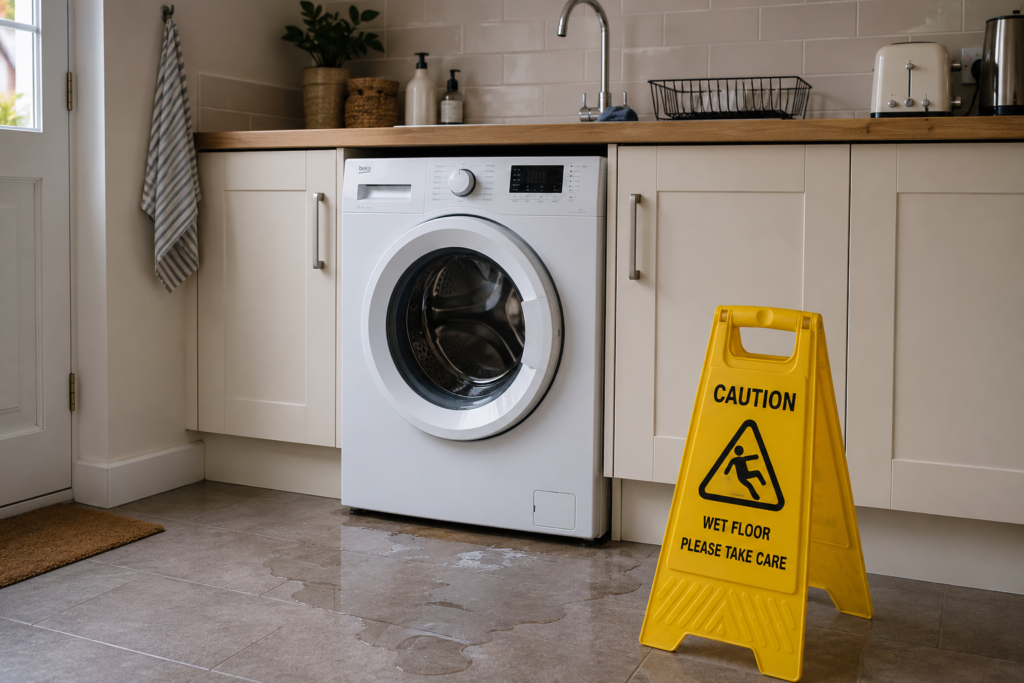

A leaking washing machine almost always has one of seven causes: a perished or damaged door seal, a blocked or overflowing dispenser drawer, a loose or cracked fill hose, a blocked or cracked drain hose, a failing drain pump, a torn tub-to-pump hose inside the machine, or a leak from the outer tub itself (usually a drum bearing seal or a stress crack on older machines). The location of the water on the floor tells you which is most likely. Water pooling at the front usually means the door seal or the dispenser. Water at the back usually means a hose. Water only during spin usually means the pump or drum seal. This guide covers every common cause, how to identify which one you have, and what to do about it.
First: stop using the machine and isolate the water
Before doing any diagnostic work, if your washing machine is actively leaking, take three immediate steps to stop the situation getting worse.

Switch off at the wall and unplug
Water and electricity together are a serious safety risk. Water on the kitchen floor around a plugged-in appliance can find its way to the plug, the socket, or internal electrical components. Switch the washing machine off at the wall socket and unplug it before doing anything else. If water is spreading toward the socket itself, turn off the power at the household consumer unit before approaching the appliance.

Turn off the water supply
Behind or under the machine, there is one or two isolator valves on the water supply pipes. Turn these clockwise to shut them off completely. This stops any further water flowing into the machine while you diagnose. If the isolator valves are missing, stuck, or you cannot find them, turn off the kitchen mains stopcock instead. Isolating the water supply is essential before working on the machine and prevents a diagnostic mistake from turning into a flood.

Mop up and note where the water was
Before mopping up the water on the floor, take a mental note (or a phone photo) of where the water was pooling. The location gives the single biggest clue to the cause. Water at the front of the machine, water at the back, water underneath in the middle, water only after a specific point in the cycle: each of these narrows the diagnosis significantly. Once noted, mop up the water and put down towels around the machine while you work.
Where is the water? A location-based diagnostic guide
The location of the water on the floor is the fastest route to identifying the likely cause. The table below maps water location to the most probable source.
| Water location | Most likely cause | When the leak appears |
|---|---|---|
| Front of the machine, on the floor | Door seal (bellows) perished or damaged, or overflowing dispenser drawer | During wash or spin |
| Under the front, from the base panel | Internal tub or pump leak reaching the floor via gravity | During any water phase |
| Back of the machine, on the floor behind | Fill hose or drain hose leak or loose connection | During fill (fill hose) or drain (drain hose) |
| From the dispenser drawer itself | Blocked dispenser drawer or blocked fill jets | During detergent dispense phase |
| Only during spin | Drum bearing seal failure, or cracked outer tub | Only during high-speed spin |
| Only during drain | Drain pump seal, drain hose connection at the pump end, or tub-to-pump hose | Only when the machine pumps out |
| Continuously, even when off | Failed water inlet valve stuck open, or leaking fill hose connection at the tap | Independent of the cycle |
Cause 1: Door seal (bellows) leak — the most common cause
The rubber door seal at the front of a front-loading washing machine is by far the most common source of leaks. The seal creates a watertight closure around the drum opening, and any damage to it (cracks, tears, holes, or perished rubber) lets water escape onto the floor at the front of the machine during the wash cycle.

How to diagnose
With the machine unplugged and the water off, open the door and inspect the entire circumference of the rubber seal. Pull the seal back gently and check the inner fold. Look for visible tears, cracks, perished rubber, holes, or trapped foreign objects (coins, hair grips, bra wires) that could have punctured the seal. The most common damage is at the bottom of the seal (where wear from constant water contact concentrates) and where sharp items have been washed and torn the rubber. Also check the front panel and glass door itself for damage. Small tears may only leak during specific parts of the cycle when the water is high or the drum is moving.

What to do about it
A damaged door seal needs replacement. Seals are model-specific and available for most current UK machines via our spare parts service, typically costing £40 to £80. Fitting is a moderately complex DIY job that requires removing the front panel, releasing the outer spring clip on the drum, refitting the new seal, and then reversing the process. For a confident home DIYer with the right instructions and about two hours, it is achievable. For anyone unsure, our appliance repair booking covers seal replacement across all major UK brands. Combined labour and part costs are typically £120 to £220, which is worthwhile on machines under seven years old.

Prevention
Wipe out the door seal after every wash to remove trapped water, debris, and detergent residue. Check pockets before loading to remove coins, hair grips, and other small items that damage the rubber. Avoid overloading, which stresses the seal during high spin speeds. Leave the door slightly open between washes so the seal dries out properly. See our related piece on why does my washing machine smell, which covers the same maintenance routine from a different angle.
Cause 2: Dispenser drawer — leaks from the front top
If water is dripping from the dispenser drawer itself, or pooling at the front of the machine only during the detergent dispensing phase early in the cycle, the cause is almost always in the dispenser drawer or its water inlet path.
How to diagnose
Remove the dispenser drawer completely (there is usually a release tab or a small lever at the back of the drawer opening). Inspect the drawer for detergent residue, dried fabric softener, or limescale buildup that could be blocking the drawer or the flow channels. Look inside the drawer housing at the top and back for the fill jets that spray water into the drawer, and check whether these are blocked. A blocked drawer causes water to back up and overflow, appearing as a leak from the front of the machine even though the drawer itself is not damaged. See our piece on fabric softener compartment full of water for the specific version of this problem.
What to do about it
Wash the drawer thoroughly in hot soapy water, using an old toothbrush to clean the corners and the softener siphon. Scrub the drawer housing (particularly the underside of the top) where mould and residue often build up. Use a soft brush or a wooden toothpick to gently unblock the fill jets if they are clogged with limescale. Replace the drawer and run a hot maintenance cycle with no clothes and no detergent to flush the system. If the drawer itself has visible cracks or damage, replacement drawers are inexpensive (typically £15 to £30) and available via our spare parts service.
Cause 3: Fill hose — leaks at the back of the machine
The fill hose (or hoses, on machines with separate hot and cold fills) runs from the water supply isolator valve on the wall to the water inlet valve on the back of the machine. Any leak on this run shows up as water pooling at the back of the machine and appears specifically when the machine is filling with water.
How to diagnose
Pull the machine out gently and inspect both ends of the fill hose. Check where the hose connects to the wall isolator valve for wet or damp signs. Check where the hose connects to the machine’s water inlet valve on the back. Look for perished rubber, splits, or cracks along the length of the hose. Confirm the connections are tight (finger tight plus a quarter turn with a spanner). Old fill hoses (10+ years) can rupture without warning, and even where they have not visibly failed, they may have loose fittings or perished washers behind the plastic connectors.
What to do about it
Tighten loose connections first (finger tight then a quarter turn with a spanner, not overtightened). If the hose is visibly damaged or the connections still leak, replace the hose. Standard washing machine fill hoses are inexpensive (£8 to £20 for a good-quality hose) and easy to replace. Universal fittings work across most UK machines. Turn off the water supply, unscrew the old hose from both ends, fit the new hose making sure the small rubber washer is in place inside each connector, and re-tighten. Available via our spare parts service.

Consider a self-shutoff fill hose
Fill hoses with integrated automatic shutoff valves (sometimes called anti-flood or aqua-stop hoses) cost slightly more (£15 to £30) but shut off the water supply automatically if the hose ruptures. For households worried about catastrophic flood damage while away from home, these are worth the small additional cost. Some machines from Bosch and other brands come with proprietary aqua-stop hoses that must be replaced with the same specific type.
Cause 4: Drain hose — leaks specifically during drain
The drain hose carries water from the pump out to the household waste plumbing. A leak here shows up as water at the back or underneath the machine, and importantly, appears specifically during the drain phase of the cycle rather than during fill or wash.
How to diagnose
Pull the machine out and inspect the corrugated drain hose along its full length. Look for splits, cracks, or holes, particularly at points where the hose has been kinked or bent tightly. Check the two ends: the connection to the pump inside the machine (accessed from the back), and the end that plugs into the household waste. Waste-end connections that are pushed too far into a rigid waste pipe or clamped too tightly can crack the hose over time. Some drain hoses degrade internally, becoming brittle after 10+ years even where the outside still looks intact.
What to do about it
Replacement drain hoses are inexpensive (£10 to £25) and moderately straightforward to fit. The pump-end connection usually requires a jubilee clip loosening from behind the machine. Some machines require partial removal of the back panel to access the pump end. If the hose is only cracked at one end, occasionally the fix is to trim off the damaged section and refit with a new clip, but this only works if the hose is long enough after trimming. Machines that leak from the pump-to-hose connection (rather than the hose itself) may need pump attention: see cause 5.
Cause 5: Drain pump — leaks under the front during drain
The drain pump is a small motorised pump at the front bottom of the washing machine that pumps water out during the drain cycle. Pumps can develop leaks from failed seals, cracked casings, or debris jamming the impeller and forcing water back through the seal.
How to diagnose
A pump leak shows up as water pooling under the front of the machine specifically during the drain phase, and often with a change in the pump’s sound (a strained buzzing or a louder-than-normal running noise as the pump struggles). Start by cleaning the pump filter thoroughly: debris trapped there is the single most common cause of pump strain and can also cause water to escape past the pump seal. See our piece on cleaned pump filter — now it leaks for the specific gotcha where a filter is not seated properly after cleaning. If the filter is clean and the machine still leaks during drain, the pump itself likely needs replacement.
What to do about it
Pump replacement is a moderate DIY job requiring access to the front bottom of the machine (usually via the front kick panel and, on some models, the front panel). Replacement pumps typically cost £25 to £60 for the part, with labour on a professional repair adding £80 to £150. Total cost typically £100 to £200. Pumps are model-specific and available via our spare parts service. For anyone not confident with the disassembly, our appliance repair booking covers pump replacement across all major UK brands.
Cause 6: Tub-to-pump hose — internal leak from underneath
Inside the machine, a large diameter rubber hose (sometimes called the tub-to-pump hose or the sump hose) carries water from the bottom of the outer tub down to the drain pump. This hose is under significant flexing during every cycle as the tub moves on its suspension, and it can develop cracks or splits over time. A tub-to-pump hose leak shows up as water pooling under the middle of the machine during any water phase, and is one of the trickier faults to diagnose because the leak is invisible from the outside.
How to diagnose
If external inspection shows no visible leak from the door seal, hoses, pump, or dispenser, but water is still appearing on the floor under the middle of the machine during use, the tub-to-pump hose is the likely culprit. Diagnosis requires removing the back or bottom panel of the machine (depending on the model) to inspect the hose. Foreign objects (coins, hair grips) can also lodge inside this hose and eventually cause splits from the inside out. This is usually where a diagnostic call to a qualified engineer becomes worthwhile.
What to do about it
Tub-to-pump hose replacement is a genuine repair job rather than a simple maintenance task. The hose is typically £15 to £30 for the part, with labour adding £100 to £180 depending on access difficulty for the specific model. Total cost typically £120 to £220. Book via our appliance repair service.
Cause 7: Drum bearing seal — leaks only during spin
The drum bearing seal sits between the inner drum shaft and the outer tub. Its job is to keep water in the tub while allowing the drum to rotate freely. Over years of use, the seal wears and eventually starts to leak, particularly during the high-speed spin cycle when the water in the tub is thrown against the seal with force.
How to diagnose
The signature symptom of drum bearing seal failure is water leaking underneath the machine specifically during the spin cycle, with little or no leak during fill, wash, or drain. Often accompanied by a rumbling or grinding noise on spin (as the bearings themselves also start to fail), and by rust-coloured water staining underneath the machine (where water has dripped through worn bearings and picked up rust from the metal drum shaft). See our related pieces on washing machine drum bearings and the broader editorial on sealed drums versus split tubs for the wider context.
What to do about it
On a split-tub machine (typically older or premium models), drum bearing seal replacement is a significant but achievable repair, typically £180 to £350 total including parts and labour. On a sealed-tub machine (the majority of modern budget and mid-range machines), the bearing seal cannot be replaced separately from the entire outer tub, which typically renders the repair uneconomical. This is often a write-off decision on a machine older than 7 or 8 years. See our repair or replace guide and what a washing machine should really cost for the decision framework.
Rare but real: leaks that are not what they seem
Not every “leaking washing machine” is actually a machine fault. A few genuinely common situations look like a leak but have different causes worth checking before opening the appliance up.
Backed-up household drain
If the household waste pipe that receives the drain hose is partially blocked, water pumped out by the machine backs up and overflows around the drain hose entry point. This looks exactly like a machine leak but is actually a plumbing problem. The clue is that the “leak” appears only during the drain phase, and the water often has a slightly grey-brown colour from waste residue. Check the household waste pipe for blockage before assuming the machine is at fault. See our piece on smells caused by plumbing faults for the related plumbing-side diagnostic.
Too much detergent creating overflowing suds
Using significantly more detergent than the load size requires produces excessive suds that overflow the drum during the wash and appear as water leaking from the dispenser drawer, the door seal, or the base of the machine. The fix is to reduce the detergent dose (most UK households use twice as much as they need) and to run a maintenance cycle to flush the excess residue. See our piece on which is the best type of washing machine detergent.

Condensation from a nearby appliance
Occasionally, water on the floor around a washing machine is actually condensation running down from a nearby appliance — typically a fridge, freezer, or tumble dryer — rather than from the washing machine itself. Check the surrounding appliances if the washing machine diagnosis draws a blank. This is more common in tight kitchen installations where two appliances share a small footprint.

Machine not level
A washing machine that is not properly level can vibrate excessively during spin, which stresses seals and hoses and can produce intermittent leaks that only appear at high spin speeds. Check the level of the machine with a spirit level on top; adjust the front feet by turning anti-clockwise to extend, clockwise to retract. See our related pieces on the best way to pull a washing machine out and how much space a washing machine needs around the sides.
When to repair, when to replace
The decision between repairing a leaking washing machine and replacing it comes down to the specific cause of the leak, the age of the machine, and the wider economics.
Worth repairing
Door seal replacement on machines under 8 years old (£120 to £220 all in). Fill hose or drain hose replacement at any age (£15 to £50 all in). Dispenser drawer cleaning or replacement at any age (free to £50). Pump replacement on machines under 8 years old (£100 to £200 all in). Tub-to-pump hose on machines under 6 years old (£120 to £220 all in). Drum bearing seal replacement on split-tub machines under 6 years old (£180 to £350 all in). Any leak on a premium machine (Miele, AEG premium, Bosch top tier) that is still within its expected 15-20 year service life.
 Usually not worth repairing
Drum bearing seal failure on a sealed-tub budget or mid-range machine (repair typically involves complete outer tub replacement and is often uneconomical). Multiple simultaneous faults on a machine over 10 years old. Any significant repair on a machine already showing other end-of-life symptoms (excessive vibration, control board faults, motor brush wear). Repair estimates that approach or exceed 50% of the cost of a comparable new machine. See our repair or replace guide for the detailed framework and what a washing machine should really cost for the wider economic context.
How to prevent washing machine leaks
Most washing machine leaks are the result of wear, damage, or maintenance neglect over years of use. A small amount of ongoing attention prevents most of the common causes.
| Frequency | Task |
|---|---|
| Every wash | Check pockets for coins, hair grips, and other small items before loading. These are the single biggest cause of physical damage to the door seal. |
| Every wash | Wipe the door seal after unloading to remove trapped water, debris, and detergent residue. |
| Weekly | Use appropriate detergent doses. Excessive detergent creates overflow and stresses seals. Most UK households use around double what is needed. |
| Monthly | Run a hot maintenance wash (90°C, no clothes, no detergent, plus a cup of white vinegar or a commercial cleaner) to keep the internal system flushed. |
| Every 2-3 months | Clean the pump filter behind the front access panel. Debris here is the most common cause of pump strain and pump seal damage. |
| Annually | Pull the machine out. Inspect fill and drain hoses for damage, kinks, and loose connections. Check the machine is level. Confirm the drain hose is at the correct height and not being siphoned. |
| Every 5-7 years | Consider replacing fill hoses as a precaution. Rubber degrades over time and old hoses can rupture without warning. Modern anti-flood hoses give additional safety for households worried about flood damage. |
The Whitegoods Help view
Most washing machine leaks are fixable and rarely a reason to write off an otherwise working machine. The seven common causes above cover the vast majority of leaks, and five of the seven are inexpensive repairs relative to the cost of replacing the appliance. Only drum bearing seal failure on a sealed-tub design and multiple simultaneous end-of-life faults typically push the economics toward replacement.
The most important intervention for most households is diagnosing correctly before spending money. A £15 fill hose replacement is a very different cost picture from a £350 drum bearing repair, and the diagnosis needs to be right before the wallet comes out. The location-based diagnostic guide earlier in this article covers the vast majority of home diagnoses; where the answer is not obvious, a proper qualified engineer callout for diagnosis is money well spent and often turns up a fix that is much cheaper than the household feared.
The one broader observation worth making is that the shift to sealed-tub construction across the mid-range and budget segments of the UK washing machine market has genuinely reduced the repairability of one specific fault (drum bearing seal failure). See our editorial on sealed drums versus split tubs for the wider argument. For every other type of leak, modern machines are as repairable as they ever were, and the fixes are within reach of any household willing to either DIY carefully or spend the modest cost of a qualified callout.
Need help with a leaking washing machine?
Whether you have identified the cause and need the right replacement part, or you want a qualified engineer to diagnose and fix the leak, our nationwide services cover every UK washing machine brand and model. Get the fix right the first time.
Frequently asked questions
Why is my washing machine leaking water from underneath?
Water underneath the machine most commonly indicates one of three causes: a drain pump leak (usually during drain), a tub-to-pump hose split (during any water phase), or a drum bearing seal failure (only during spin). The timing of the leak in the cycle narrows the diagnosis. Water under the front during drain typically means the pump. Water under the middle at any phase typically means the tub-to-pump hose. Water under the machine only during spin typically means the drum bearing seal.
Why is my washing machine leaking from the door?
Almost always a damaged or perished door seal. Open the door and inspect the entire rubber seal for tears, holes, cracks, or trapped foreign objects (coins, hair grips, bra wires). The most common damage is at the bottom of the seal where water and debris collect. Seal replacement typically costs £120 to £220 all in on a qualified repair, and is worthwhile on machines under 7-8 years old.
Why is my washing machine leaking from the dispenser drawer?
Usually a blocked dispenser drawer, blocked fill jets in the drawer housing, or excessive detergent creating suds overflow. Remove the drawer, wash it thoroughly in hot soapy water, clean the drawer housing with a toothbrush, and unblock the fill jets if clogged. Also review your detergent dose — most UK households use around double what is needed for typical loads.
My washing machine only leaks during spin. What does that mean?
Leaking specifically during high-speed spin usually indicates drum bearing seal failure. The seal between the drum shaft and the outer tub has worn to the point where water thrown against it by the spinning drum escapes past the seal. This is often accompanied by a rumbling or grinding noise during spin (worn bearings) and rust-coloured water staining underneath. On split-tub machines, repair is achievable (£180 to £350 all in). On sealed-tub machines, the repair typically requires complete outer tub replacement and is often uneconomical.
My washing machine only leaks during drain. What does that mean?
Leaking specifically during the drain phase typically indicates a drain pump seal failure, a drain hose leak or loose connection, or occasionally a backed-up household waste pipe overflowing at the connection point. Check the pump filter first (debris there is the most common cause of pump strain), then inspect the drain hose along its length, then confirm the household waste pipe is not blocked.
Can I still use my washing machine if it is leaking?
Not safely. Water and electricity together are a serious safety risk, and even a minor leak can cause damage to flooring, cabinets, and neighbouring appliances if left unaddressed. Turn off the machine at the wall, unplug it, isolate the water supply, and diagnose the cause before running any further cycles. For urgent laundry needs, most launderettes and some laundry services provide short-term alternatives while the repair is arranged.
How much does it cost to fix a leaking washing machine?
Depends entirely on the cause. Fill hose or drain hose replacement typically £15 to £50 all in. Door seal replacement £120 to £220 all in. Pump replacement £100 to £200 all in. Tub-to-pump hose £120 to £220 all in. Drum bearing seal replacement (split-tub machines only) £180 to £350 all in. Most common leaks are repaired for well under £200, which is a small fraction of the £300 to £700+ cost of replacing the machine.
How can I tell if the leak is from the machine or from the household plumbing?
Household plumbing leaks appear even when the machine is not running, or specifically when water is being pumped out during drain (backed-up waste pipe). Machine leaks correlate with specific parts of the cycle: fill leaks during water inlet, wash leaks during agitation, drain leaks during pump-out, spin leaks during high-speed rotation. If the leak timing does not match a specific cycle phase, or appears when the machine is off, the plumbing is worth checking first.
Should I use an anti-flood or aqua-stop fill hose?
For households worried about catastrophic flood damage — particularly if the washing machine is on an upper floor, if the household is often away from home during cycles, or if buildings insurance excess is high — yes, they are worth the small additional cost (£15 to £30 versus £8 to £20 for standard hoses). The self-shutoff mechanism cuts off the water supply automatically if the hose ruptures, limiting damage to a few litres rather than potentially hundreds.
Are washing machine leaks covered by the manufacturer warranty?
New washing machines typically come with a 1-2 year manufacturer warranty covering manufacturing defects, which would include leaks caused by faulty seals, valves, hoses, or pumps present from delivery. Warranty does not typically cover leaks caused by user damage (foreign objects tearing the door seal), external factors (household plumbing issues), or wear-and-tear on machines beyond the warranty period. See our guides to consumer rights when buying appliances and your rights with faulty appliances under the Consumer Rights Act.
Ask the repair forum
Post the make, model and symptoms and get help from the Whitegoods Help community.
0 Comments