
Oven fan not working?
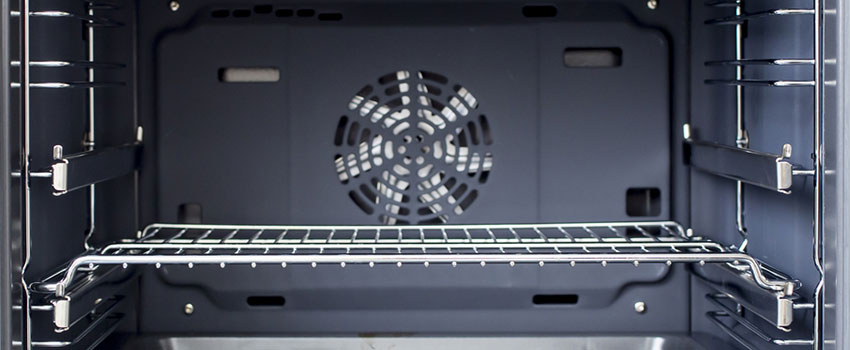

“Oven fan not working” can mean two completely different fans. The cavity fan circulates hot air around the food on a fan-assisted oven and is usually behind a metal plate at the rear of the oven cavity. The cooling fan is a separate, smaller fan that cools the controls and electronics during cooking – normally heard but rarely seen. Common causes for either are a failed motor, a seized bearing, a broken blade, a wiring fault, or a failed switch. On a fan-assisted oven, a failed fan oven element is often mistaken for a fan fault. The diagnosis steps below cover both.
Which oven fan has stopped working?
Before anything else, work out which of the two fans is the problem. The fix, the cost, and the safety implications are different for each.
 The cavity fan
The fan inside the oven cavity, behind the metal back plate, that circulates hot air around the food in a fan-assisted or convection oven. If your food cooks unevenly, only browns on one side, or takes much longer than the recipe says, the cavity fan is the suspect. You can see whether it is spinning by selecting a fan-only programme and looking through the door glass.
 The cooling fan
A smaller fan, usually at the top or rear of the oven, that cools the controls and surrounding cabinetry during and after cooking. You typically hear it as a quiet whirring during cooking and for a short period after the oven turns off. If the controls are getting hot, the surrounding kitchen units are warming up, or the fascia is discolouring, the cooling fan needs investigating immediately.

If the cooling fan has stopped working, do not continue using the oven for normal cooking. The controls and electronics can overheat, the fascia plastic can distort or melt, surrounding kitchen cabinetry can be damaged, and in worst cases there is a fire risk. Isolate the oven at the wall or consumer unit and arrange a repair before further use.
Why is the main oven fan (cavity fan) not working?
The cavity fan on a fan-assisted oven has only a handful of common failure modes. Working through them in order usually identifies the cause.
-
Check whether the fan is being commanded to run. Select the fan oven programme on the control. On older models the fan should run as soon as that programme is selected, even if the oven has not yet heated. On newer electronic-controlled models the fan may only run once heat is being called. If selecting any fan-only programme does not produce fan noise, the fan is either not receiving power or has failed mechanically.
-
Listen for noise before assuming the fan is dead. A worn bearing often produces a rumbling or grinding noise before the fan stops altogether. A scraping sound usually means a damaged or off-centre fan blade. A high-pitched buzzing with no rotation typically means the motor is receiving power but cannot start – the bearings have seized.
-
Check the fan oven element first, not the fan. On fan-assisted ovens the fan oven element is a ring-shaped element around the fan blade. If the element has failed open-circuit, on most ovens the fan will still run but the oven will not heat. People often misdiagnose this as a fan fault. See our oven not heating up guide for the diagnostic steps on the element itself.
-
Check the selector switch or PCB. If the fan does not run on any programme and there is no noise or buzzing at all, the selector switch may not be sending power to the fan motor circuit. On electronic-controlled ovens, the control PCB itself can fail in a way that disables the fan output while other functions still appear to work.
-
Check the motor and wiring. With the oven isolated at the wall and tested for dead, the rear back plate inside the cavity can be removed to expose the fan motor. The motor terminals can be tested for continuity, the windings for resistance, and the wiring back to the control checked for breaks or burnt connectors. A clearly burnt motor or a snapped blade is usually visible without test equipment.
Why has the cooling fan stopped working?
The cooling fan has fewer failure modes than the cavity fan, but the consequences of leaving it unrepaired are more serious because of the heat buildup at the controls.

Cooling fan motors are simple low-power components but they run hot. Over years of cooking cycles the bearings dry out, the windings degrade, and the motor either stalls or seizes. Replacement is straightforward for a qualified engineer once the rear or top panel is off.

Many ovens use a small thermostat to switch the cooling fan on once the cavity temperature rises and off once it has cooled. If the thermostat sticks open, the fan never runs. If it sticks closed, the fan runs continuously even when the oven is cold.

Cooling fans sit in some of the hottest parts of the oven. The wiring loom, terminals, and connectors can degrade in this environment – particularly on older appliances. A burnt connector at the fan or the control board is a common find.

On modern electronic ovens, the cooling fan output is driven by the main control board. A failed relay or output stage on the PCB can disable the fan even when the motor itself is fine. Diagnosis requires bench testing the motor independently of the PCB.
What does each symptom usually mean?
The table below covers the patterns we see most often when diagnosing oven fan faults in the field. Use it as a quick orientation rather than a definitive diagnosis – confirmation always needs a multimeter test on the relevant component.
| Symptom | Most likely cause | Typical part cost |
|---|---|---|
| Fan does not spin, oven heats normally | Fan motor failed; bearings seized; broken blade | £25-£70 motor |
| Fan spins, oven does not heat | Fan oven element failed (not a fan fault) | £20-£50 element |
| Rumbling or grinding from the fan area | Worn fan motor bearings or off-centre blade | £25-£70 motor |
| High-pitched buzzing, fan not turning | Seized motor receiving power but unable to start | £25-£70 motor |
| Fan works on some programmes, not others | Selector switch or control PCB fault | £30-£150 part |
| Controls getting hot, kitchen units warming | Cooling fan failed (different fan) | £30-£80 motor |
| Cooling fan runs constantly even when oven is cold | Cooling fan thermostat stuck closed | £15-£40 thermostat |
Not confident with electrical diagnosis?
If the multimeter steps are beyond what you want to take on, a qualified engineer can confirm the fault, source the correct part, and complete the repair safely. For gas or dual-fuel ovens, the work must be done by a Gas Safe registered engineer regardless.
Should you attempt this repair yourself?
Oven fan replacement is technically a parts swap, but the appliance involves mains-voltage components, often runs on a dedicated high-current circuit, and on gas or dual-fuel models can affect the gas safety case. The DIY decision depends on your appliance type and your confidence with electrical work.
 DIY may be reasonable if
- The oven is fully electric (not gas or dual-fuel)
- You can isolate the appliance at the consumer unit and verify it is dead
- You are competent with a multimeter and basic electrical work
- The fault is clearly the cavity fan motor or fan oven element
- You have the correct replacement part for your exact model number
- You have followed our DIY repair safety advice
 Always call an engineer if
- The oven is a gas or dual-fuel model
- The cooling fan has failed and the controls have been getting hot
- There is any sign of burnt wiring, smoke, or scorching
- The diagnosis points to the control PCB rather than a simple motor swap
- You cannot identify a clear cause from the steps above
- The appliance is subject to an active safety recall – check the OPSS product safety database
How do you find the right replacement fan motor?
The fan motor in an oven is rarely a universal part. Even within the same brand range, motors vary between models in mounting, shaft length, spindle direction, and electrical specification. Ordering the wrong part is one of the most common reasons for a DIY repair to stall halfway.

The rating plate is usually inside the oven door frame or behind the storage drawer. The brand and model name on the front of the oven is not enough. See our guide to finding an appliance model number if you cannot locate it.

Two motors that look identical can have different mounting bolts or shaft lengths. Always cross-reference the part against the exact model number on a parts diagram for your appliance.

On older appliances, manufacturer parts can become unavailable. Aftermarket equivalents may exist but their fit and electrical specification should be verified before purchase. UK Right to Repair regulations require certain parts to remain available for 7 to 10 years.
Safety notice

Ovens are connected to a high-current dedicated circuit, typically 30 amps or more. Mains voltage in this kind of appliance is unforgiving. Any internal work must only be carried out with the appliance isolated at the consumer unit, verified dead with a tested-known-live test, and reassembled to the manufacturer’s specification before being re-energised.
For any gas or dual-fuel oven, the work must be carried out by a Gas Safe registered engineer. It is illegal as well as dangerous to work on gas appliances without registration. The cooling fan and cavity fan are electrical components, but accessing them on a gas oven may affect the gas safety case.
A failed cooling fan should be treated as a safety issue, not a convenience issue – isolate the oven at the wall until it has been inspected. Always check the OPSS product safety database for any active recall on your appliance, and read our full DIY repair safety advice before any hands-on work.
Want to learn appliance fault diagnosis properly?
Oven fan diagnosis is one of dozens of skills covered in formal appliance repair training. For anyone wanting to develop the full skill set – whether for a career, a side business, or just to repair their own appliances confidently – the NAC National Training Centre offers practical hands-on courses and online training delivered by working engineers.
Frequently asked questions
Why is my oven fan not working but the oven still heats?
If the fan motor has failed but the conventional or grill elements are working, the oven can still heat – it just cannot circulate the hot air the way a fan-assisted programme requires. Food will cook unevenly, take longer, and may not brown as expected. The fix is to replace the fan motor itself, or in some cases the selector switch or PCB if the fan is not being commanded to run.
The fan is spinning but my oven is not getting hot – what is wrong?
This is almost always the fan oven element rather than the fan itself. On fan-assisted ovens the fan oven element is a ring-shaped heating element behind the fan. When it fails open-circuit, the fan still runs (because the motor is a separate component) but the oven cannot heat. See our oven not heating up guide for the diagnostic steps.
What is the difference between the cavity fan and the cooling fan?
The cavity fan is inside the oven, behind the rear back plate, and circulates hot air around the food during fan-assisted cooking. The cooling fan is a separate, smaller fan usually mounted at the top or rear of the oven that cools the controls and electronics during and after cooking. Both can fail, both produce different symptoms, and both must be diagnosed separately.
Is it safe to keep using my oven if the cooling fan has stopped working?
No. A failed cooling fan allows the controls and electronics to overheat during cooking. Possible consequences include damaged plastic on the fascia, melted control knobs, scorched or failed electronics, damage to surrounding kitchen cabinetry, and in worst cases a fire risk. Isolate the oven at the wall or consumer unit and arrange a repair before further use.
How much does it cost to replace an oven fan motor?
The motor itself typically costs £25 to £70 for a cavity fan motor and £30 to £80 for a cooling fan motor, depending on brand and model. Engineer labour for the replacement is usually a single service visit. On budget ovens where the motor cost approaches half the price of a replacement appliance, weighing repair against replacement is worthwhile.
Can I replace the oven fan motor myself?
If the oven is fully electric (not gas or dual-fuel), you are confident with mains electrical work, you can isolate the appliance at the consumer unit and verify it is dead, and you have the correct replacement part, the swap is achievable as a DIY job. For gas or dual-fuel ovens, the work must be carried out by a Gas Safe registered engineer. Either way, read our DIY repair safety advice first.
How long should an oven fan motor last?
Oven fan motors typically last 10 to 15 years in normal household use. Heavy use, frequent high-temperature cooking, and a failed cooling fan that allows the surrounding electronics to overheat will all shorten that lifespan. A fan motor failing in the first few years of ownership may give rise to a consumer rights claim under the Consumer Rights Act 2015.
Ask the repair forum
Post the make, model and symptoms and get help from the Whitegoods Help community.
0 Comments