
Oven Not Heating Up: Causes and How to Fix It
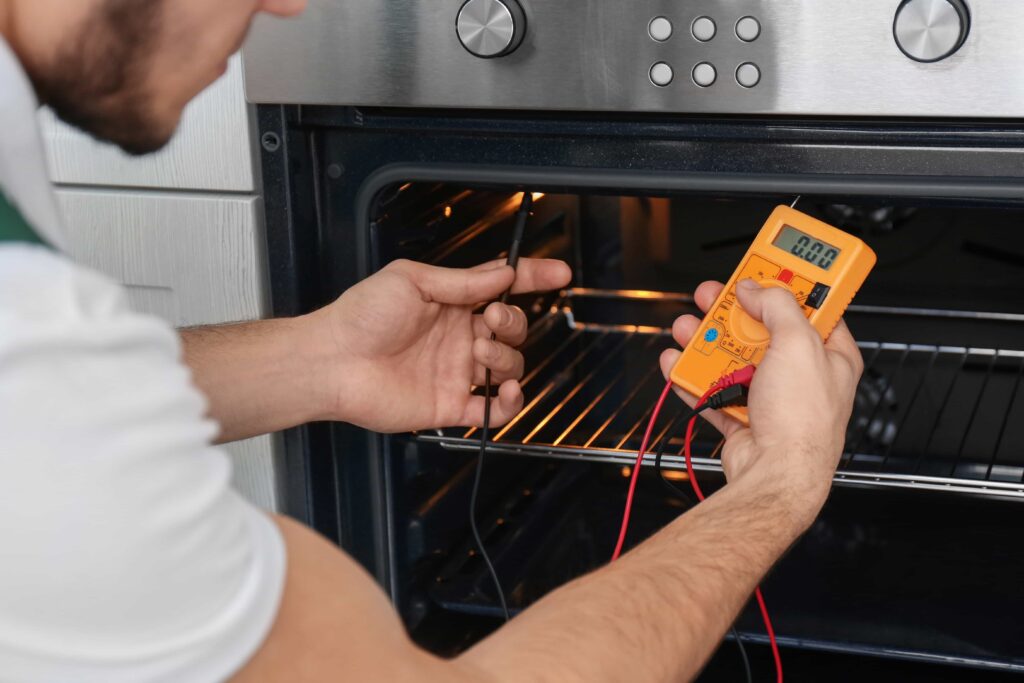

An oven that is not heating up is most commonly caused by a failed heating element, a faulty thermostat, a blown fuse or tripped circuit breaker, or a temperature sensor fault. On electric ovens, a failed element is by far the most frequent cause and is visible as a break or burn mark on the element itself. Gas oven faults usually involve the igniter, thermocouple, or gas valve and must always be diagnosed and repaired by a Gas Safe registered engineer.
What should you check before investigating the oven?
Before investigating the oven itself, rule out a simple power supply issue. Check your consumer unit for a tripped circuit breaker or blown fuse on the cooker or oven circuit. A power surge, a fault elsewhere on the circuit, or an internal oven fault can all cause the MCB to trip without any visible sign at the oven itself.
Reset any tripped breaker and attempt to use the oven again. If the breaker trips again immediately or repeatedly, there is an electrical fault within the oven or its wiring that requires an engineer. Do not keep resetting a breaker that continues to trip.

If your oven is connected via a dedicated cooker switch on the wall, check that it has not been accidentally switched off before investigating further. This is a surprisingly common cause of an oven appearing completely dead.
What are the common causes on an electric oven?
Failed heating element
The heating element is the most common single cause of an electric oven not heating up. Most electric ovens contain at least two elements: a lower bake element in the base of the oven and an upper grill element beneath the roof. Fan ovens also have a circular fan element at the rear surrounding the fan. Any of these can fail independently.
A failed element often shows visible signs of damage. Open the oven door and inspect each element carefully for any of the following:
 A visible break, crack, or hole in the element coil
- A blistered, swollen, or bubbled section along the element
- Black scorching or burn marks on or around the element
- An element that does not glow red when the oven is switched on and given time to start heating
If only one element has failed, the oven may still produce some heat from the remaining working element but will not reach the correct temperature or heat evenly. A fan oven with a failed fan element will typically not heat at all in fan mode, though the grill or conventional settings may still work if those elements remain intact.
Replacement heating elements for most major oven brands are available through our appliance spare parts section. Element replacement is a repair that a confident DIY repairer can carry out, provided the oven is fully disconnected from the mains and the correct safety precautions are followed. See our DIY appliance repair safety guide before attempting any internal work.
Faulty oven thermostat
The thermostat regulates the oven temperature by switching the heating elements on and off to maintain the selected setting. A faulty thermostat may cause the oven to heat to the wrong temperature, cut out too early, or fail to instruct the elements to activate at all.
A thermostat fault is harder to diagnose visually than a failed element. The most common symptom is an oven that heats but consistently underperforms or cannot maintain temperature, rather than one that produces no heat at all. If the elements appear intact and the oven receives power but still does not reach or maintain the correct temperature, the thermostat is a likely cause.
Faulty temperature sensor
Many modern electric ovens use an NTC thermistor (a temperature sensor) to monitor the internal temperature and relay readings to the control system. If this sensor develops a fault or becomes detached from its mounting point on the oven wall, the control board receives inaccurate temperature readings and may prevent the elements from activating correctly.
A temperature sensor fault often triggers an error code on ovens with a digital display. If your oven is displaying a code alongside the heating fault, identifying that code is the most useful diagnostic step. See our appliance error codes guide for help identifying what your specific code means.
Faulty selector switch or function dial
The function selector switch determines which heating mode the oven operates in – such as fan, conventional, grill, or base heat. If this switch develops a fault or the contacts inside it wear, the oven may receive power but fail to route it correctly to the appropriate elements, causing some or all heating functions to stop working.
A selector switch fault is more common on older ovens where the switch has been turned frequently over many years. The symptom is often that one or more functions stop working while others continue to operate correctly.
Control board fault
On electronically controlled ovens, the main control board manages all oven functions including the heating cycle. A control board fault can cause a range of symptoms including the oven not heating, not responding to controls, or displaying error codes. Control board faults are generally at the more expensive end of oven repairs and are typically diagnosed only after other components have been ruled out.
What are the common causes on a gas oven?

All gas oven repairs, including diagnosis, component replacement, and any work involving the gas supply, must be carried out by a Gas Safe registered engineer. It is illegal in the UK for anyone who is not Gas Safe registered to carry out gas appliance repairs. Do not attempt to diagnose or repair gas oven faults beyond the basic checks listed below. If you smell gas at any point, do not attempt to use the oven, ventilate the room immediately, and contact the National Gas Emergency Service on 0800 111 999.

If the oven burner is not lighting, the igniter may have failed or the spark electrode may be dirty or misaligned. On some gas ovens, the oven burner uses a separate ignition system to the hob burners, and the two can fail independently. A Gas Safe engineer can test and replace the igniter.

The thermocouple is a safety device that detects whether the oven burner is lit. If it fails, it cuts off the gas supply as a safety precaution even when the burner should be running. A failed thermocouple is a common cause of a gas oven that ignites briefly and then goes out, or that cannot be kept lit. This is a repair for a Gas Safe registered engineer.

The gas valve controls the flow of gas to the oven burner. A faulty valve may restrict or prevent gas flow entirely, causing the oven to fail to heat. This is not a user-serviceable component and must be replaced by a Gas Safe registered engineer.

Before concluding the oven has a fault, check whether other gas appliances in the home are working correctly. If the hob burners, boiler, and other gas appliances are also not working, the problem may be with the gas supply to the property rather than the oven itself. Contact your gas supplier or National Grid if you suspect a supply interruption.
Is it the oven, or is it the settings?
Before booking a repair visit, work through these basic checks. A significant proportion of oven faults reported to engineers turn out to have a simple explanation that does not require any technical work.
-
Check the clock and timer settings. Many ovens will not heat if the timer or programmer is set to automatic mode and the clock has not been set correctly. This is the most commonly overlooked cause of an oven appearing completely dead. On ovens with a digital clock, a power cut will reset the timer to a flashing state, locking the oven out of manual operation until the clock is reset. Consult your oven’s manual for how to reset the timer or switch between auto and manual mode.
-
Check the function selector is set correctly. Ensure the dial or electronic setting is selecting an active heating function rather than a light-only or clock mode. Some ovens have positions on the selector dial that do not activate any heating element.
-
Check the consumer unit. Inspect the circuit breaker or fuse for the oven circuit in your consumer unit. A tripped MCB or blown fuse will cut power completely. Reset or replace as appropriate, and monitor whether it trips again.
-
Check the thermostat setting. Confirm the oven temperature dial has been turned to an active temperature setting rather than to zero or off.
-
Check whether specific functions are affected. Test grill, fan, and conventional settings separately if available. If one function works and others do not, this narrows the fault to a specific element or the selector switch rather than a power or thermostat issue.
How can you diagnose an oven fault by symptom?
| Symptom | Most likely cause |
|---|---|
| Oven completely dead, no lights or response | Tripped MCB, blown fuse, timer lockout, or failed control board |
| Oven lights work but no heat at all | Failed element, thermostat fault, or selector switch fault |
| Fan oven mode not heating, other functions work | Failed fan element specifically |
| Grill works but oven does not heat | Failed lower bake element or thermostat |
| Oven heats but cannot reach or maintain correct temperature | Failing thermostat, temperature sensor fault, or partially failed element |
| Oven heats unevenly | Failed element on one side, fan fault, or blocked fan |
| Error code displayed alongside heating fault | Temperature sensor, control board, or specific component identified by the code |
| Gas oven not lighting or goes out after ignition | Igniter or thermocouple fault, Gas Safe engineer required |
How can you tell which element has failed?
If you suspect a failed element but want to confirm which one before ordering a replacement, this simple process will help you identify it. Only attempt this check on an electric oven and only after confirming the oven is switched off at the wall.
Never touch or probe any element or internal wiring while the oven is connected to the mains supply. All internal inspection must be carried out with the oven fully isolated at the consumer unit or cooker switch. If you are not confident working with electrical appliances, do not attempt this check and call an engineer instead.
With the oven isolated, visually inspect each element in turn. The lower bake element runs along the base of the oven, the upper grill element is visible beneath the oven roof, and on fan ovens the fan element is the circular coil at the back of the oven surrounding the fan.
Look for the signs of failure described earlier in this guide. A break, burn mark, or blister on the element coil is a reliable visual confirmation of failure. If no visual damage is apparent but the element is suspected, a trained engineer can confirm the fault using a multimeter to test the element’s resistance.
What can you fix yourself, and what needs an engineer?
You can check and resolve yourself
- Resetting the oven timer or clock after a power cut
- Resetting a tripped MCB in the consumer unit
- Confirming the function selector and temperature dial are set correctly
- Visually inspecting elements for obvious failure signs
- Replacing a failed heating element on an electric oven, if confident with the process and with the appliance fully isolated from the mains
 Requires a professional engineer
- All gas oven faults without exception
- Thermostat replacement
- Temperature sensor replacement if not confident with internal oven components
- Selector switch replacement
- Control board diagnosis and replacement
- Any fault where the MCB trips repeatedly on reset
- Any burning smell, scorch marks on the exterior, or signs of electrical damage
Always isolate an electric oven from the mains at the consumer unit or cooker switch before inspecting or replacing any internal component. Never work inside an oven that is connected to the power supply. For gas ovens, do not attempt any repair or internal inspection yourself – all gas appliance work must be carried out by a Gas Safe registered engineer. If you smell gas, do not use the oven, open windows, and call the National Gas Emergency Service immediately on 0800 111 999. If your oven is producing burning smells, sparking, or showing signs of electrical damage, do not use it. Read our full DIY appliance repair safety guide before attempting any work.
Need help diagnosing or repairing your oven?
If you have worked through the checks above and your oven is still not heating, an engineer visit is the next step. We can diagnose and repair electric and gas oven faults across all major brands, and we stock a wide range of genuine oven spare parts including heating elements, thermostats, and temperature sensors.
Frequently asked questions about an oven not heating up
Why is my electric oven not heating up?
The most common cause of an electric oven not heating is a failed heating element. Inspect the elements inside the oven for visible signs of damage including breaks, burn marks, or blistering. If the elements appear intact, the fault is likely with the thermostat, temperature sensor, selector switch, or in some cases the control board. Always check the consumer unit for a tripped breaker and confirm the oven timer is set to manual mode before investigating further.
Why has my oven stopped working after a power cut?
Many ovens will not operate after a power cut until the built-in clock or programmer has been reset. When power is restored, the clock display typically flashes to indicate it needs resetting. Until the clock is set correctly and the oven is returned to manual mode, the oven will appear unresponsive. Consult your oven’s manual for the specific clock reset procedure for your model. This is one of the most common causes of an oven apparently developing a fault overnight for no obvious reason.
Can I replace an oven heating element myself?
On many electric ovens, heating element replacement is a straightforward repair that a confident DIY repairer can carry out safely. The process involves isolating the oven from the mains supply, removing any retaining screws or brackets securing the element, disconnecting the two spade connectors from the element terminals, fitting the replacement element, and reconnecting. The oven must be fully isolated from the mains at the consumer unit before starting. If you are not confident working with electrical appliances, or if the element is in a difficult location, an engineer visit is the safer choice.
My fan oven is not heating but the grill works. What is wrong?
If the grill function works but the fan oven setting produces no heat, the most likely cause is a failed fan element. The fan element is a circular heating coil at the rear of the oven surrounding the fan blade. It is a separate component to the grill and bake elements and can fail independently. Inspect the fan element visually for breaks or burn marks with the oven fully isolated from the mains. A replacement fan element for your specific oven model can be found through our spare parts section.
Is it worth repairing an oven that is not heating?
In most cases, yes. A failed heating element is one of the least expensive oven repairs, and even a thermostat or temperature sensor replacement is generally cost-effective relative to the cost of a replacement oven. An oven is a longer-lived appliance than a washing machine, with a typical lifespan of 10 to 15 years or more, so repair is usually a good investment unless the appliance is very old and the repair is extensive. For a full framework for making the decision, see our guide to whether to repair or replace an appliance.
My gas oven is not heating. Can I fix it myself?
No. All gas oven faults must be diagnosed and repaired by a Gas Safe registered engineer. It is a legal requirement in the UK. A gas oven that is not heating may have a failed thermocouple, a faulty igniter, a gas valve fault, or another issue that requires specialist gas qualification to work on safely. Do not attempt to disassemble or repair any component connected to the gas supply. Book a visit from a Gas Safe registered engineer and provide them with as much detail as possible about the symptom.
How long should an oven heating element last?
A typical oven heating element should last between 5 and 10 years in normal household use, though some last considerably longer. Element life depends on how frequently the oven is used, the temperatures at which it is regularly run, and whether food deposits or cleaning chemicals have come into contact with the element over time. Spilled food that bakes onto an element can shorten its life significantly, as can repeated use at very high temperatures. An element that has failed once will not damage the rest of the oven, and replacement is usually inexpensive relative to the cost of the appliance.
Ask the repair forum
Post the make, model and symptoms and get help from the Whitegoods Help community.
0 Comments