
Sealed Drums vs Split Tubs in Washing Machines
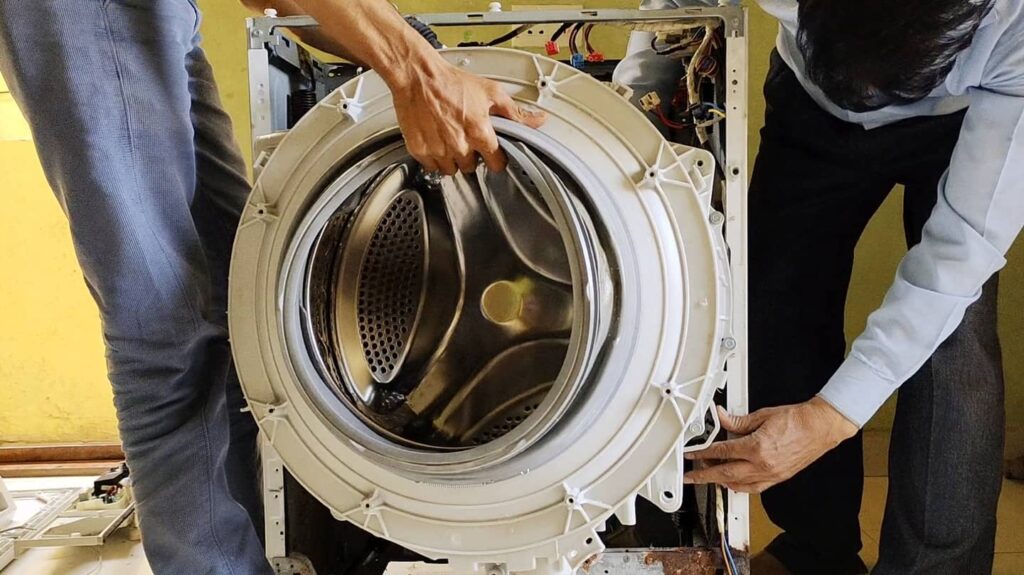

Most washing machines sold in the UK today have a sealed plastic outer tub – the two halves are welded or ultrasonically bonded together at the factory, so the drum bearings, shaft seal, and drum spider cannot be accessed once the machine leaves the production line. When the bearings fail, the entire tub-and-drum assembly must be replaced as a single unit, and the cost of that part is usually higher than the residual value of the machine. This is a deliberate departure from the older split-tub design, where bearings and seals were straightforwardly serviceable.
What is the difference between a sealed drum and a split tub?
The outer tub of a washing machine is the large, fixed plastic container that holds the spinning drum and the wash water. The drum bearings sit at the rear of this tub, supporting the shaft that the rotating inner drum spins on.
Whether those bearings can be replaced when they eventually wear out depends entirely on how the outer tub is constructed – and there are only two designs in mainstream use.
 Split tub (older traditional design)
The outer tub is made in two halves that bolt together around a central seal. Once the tub is removed from the machine, the two halves can be separated to expose the bearings, the shaft seal, the drum spider, and the inner stainless steel drum. Each of these components can be replaced individually – typically at a modest parts cost – and the work is well within the capability of a qualified appliance engineer.
 Sealed tub (modern dominant design)
The outer tub is made in two halves that are permanently joined at the factory by ultrasonic welding, hot-plate welding, adhesive bonding, or a combination of these methods. Once joined, the two halves cannot be separated without destroying the tub. The bearings and seals are sealed inside permanently, and when they fail, the entire tub-and-drum assembly must be discarded and replaced as one part.
Which washing machine brands use sealed drums and which still have replaceable bearings?
The sealed-tub design is now the dominant approach across the UK market. The list of brands that have moved to sealed tubs covers almost every name a typical buyer would recognise.
 Sealed tub – bearings not replaceable
Hotpoint, Indesit, Bosch, Siemens, Neff, Beko, Blomberg, Zanussi, AEG, Electrolux, Whirlpool, Samsung, Haier, Hoover, Candy, Hisense, and most own-brand machines. If the brand is mainstream and the model is from the last 10 to 15 years, assume the tub is sealed unless a parts diagram proves otherwise.
 Part-serviceable – bearings often replaceable
LG Direct Drive models typically retain a part-serviceable tub design with replaceable bearings, although the job is more involved than on the older bolted designs. Some Miele models also retain serviceable internals, though Miele has been moving toward sealed-tub variants on newer ranges. Always verify the design on the specific model before buying.

Tub design can change between generations of the same model range. A Miele or LG model that had replaceable bearings five years ago may have a sealed tub today. The only reliable way to confirm is to check the official parts diagram for that exact model number, or ask a qualified engineer who works on the brand regularly.
How long do washing machine bearings last – and why does it matter?
Drum bearings are a wear component. They support the entire weight of a fully loaded drum spinning at speeds up to 1,600 rpm, thousands of times over the life of the machine.
Eventually they wear out. On a well-maintained machine in normal household use, bearing failure typically begins to show after 7 to 10 years – sometimes earlier, sometimes later. It is one of the most common and predictable late-life faults on any washing machine of any age, in any design.
Typical age at first bearing wear
Maximum spin speed bearings support
Sealed tub assembly part cost
Split-tub bearing pair part cost
The difference between those last two figures is the entire story of this article. On a split-tub machine, a bearing failure was once a routine, affordable repair. On a sealed-tub machine, the same wear event becomes a write-off decision.
For the noise signature of failing bearings, see our guide to what noisy washing machine drum bearings sound like.
How can you tell which design your washing machine has?
Most consumers never need to know which design their washing machine uses until something goes wrong. By that point, the answer to “is this repairable?” is already determined by a design choice the manufacturer made years before the machine reached the home.
-
Look at the tub seam. If the tub is split, there will be a visible band of bolt heads or clips running around the circumference of the tub where the two halves are held together. If the tub is sealed, there will be no bolts or clips – only a faint join line where the two halves were welded or bonded at the factory. On most modern machines this can be seen by removing the rear panel and looking at the back of the tub.
-
Check the service manual or parts list. If the parts diagram shows individual bearings, a shaft seal, and a drum spider as separate orderable parts, the tub is split and serviceable. If the only available part in that section of the diagram is a complete tub-and-drum assembly, the tub is sealed. The parts list is the definitive answer for any model – see our guidance on buying washing machine spares.
-
Ask a qualified engineer. An appliance engineer who works on your brand regularly will know whether the specific model has a serviceable tub or not. Getting a qualified diagnosis is worthwhile before committing to any bearing repair – it confirms the fault, identifies the design, and prices the available options. Book an appliance repair if you’re not sure.
Why do manufacturers use sealed tubs?
Manufacturers offer several justifications for the move to sealed tubs. Some have technical merit. Others read more as commercial convenience dressed up as engineering progress. An honest assessment of both sides matters for any consumer trying to understand what they are actually buying.
Genuine technical advantages
- Fewer potential leak paths than a bolted tub with a circumferential seal that degrades over time
- Modern bonded joins are genuinely strong and reliable
- Plastic tubs are lighter than the part-metal designs they replaced, reducing transport weight and shipping emissions
- Faster manufacturing reduces production cost
- Lower parts count simplifies assembly and reduces the chance of factory faults at build
The honest drawback
- The bearings cannot be replaced when they wear out, even though wear is inevitable
- The economic life of the machine is now bounded by bearing life
- A repair that used to cost roughly £100 (parts plus labour) now starts at £200+ for parts alone
- The cost saving in manufacturing is captured by the manufacturer; the cost of failure falls on the consumer
- More working machines reach landfill earlier than they otherwise would
Is sealed-drum design a form of planned obsolescence?
This is the question that matters most, and it deserves a careful answer rather than a slogan.
Strictly speaking, “planned obsolescence” describes a deliberate engineering decision to limit a product’s lifespan in order to drive replacement sales. Manufacturers will not – and probably cannot – openly accept that label. The defence offered is that sealed tubs are an engineering simplification with multiple legitimate benefits, and that bearing failure is a normal end-of-life event that happens whether the tub is sealed or not.
That defence has some truth to it. Bearings do wear out on every washing machine. Many older split-tub machines failed for reasons unrelated to bearings and were scrapped long before the bearings became a problem. A sealed-tub design does not cause bearings to fail any sooner.
But the design choice does change what a bearing failure means. On a serviceable tub, bearing wear was a repair. On a sealed tub, bearing wear is a write-off. The point at which a household decides to dispose of a working appliance – simply because the economically rational repair has been engineered out – is brought forward as a direct result of the design.
The sealed-tub design is a genuine technical change with both pros and cons. The most important con – the inability to replace a known-wearing component without scrapping the appliance – is significant, is rarely disclosed at the point of sale, and should be one of the factors weighed when buying a new washing machine. For broader context, see why washing machines don’t last as long as they used to and how France has criminalised planned obsolescence under the AGEC law.
Worried your washing machine bearings are failing?
A rumbling or grinding noise during spin is the early warning sign. A qualified diagnosis will confirm whether it’s bearings, motor bracket, drum spider, or something else – and tell you whether your specific model is repairable before you commit to any cost.
What should you do if your bearings have failed?
The honest practical position for households whose washing machine develops bearing noise – a rumbling sound during spin, growing louder over weeks or months – is to work through these four steps before making any decision.

Bearing noise can be confused with motor bracket damage, drum spider corrosion, foreign objects between the drum and tub, or worn shock absorbers. A qualified engineer can identify the actual cause and confirm whether the tub is sealed or serviceable on your specific model.

If the tub is split and bearings are individually available, the parts cost is typically modest. If the tub is sealed and the entire assembly must be replaced, the bare part is usually £150 to £300+ before fitting. Our spare parts service can identify the price for your specific model.

For a sealed-tub machine, repair cost plus labour can approach the price of a new mid-range washing machine. Our repair or replace guide covers age, energy efficiency of likely replacements, and the environmental footprint of disposal.

UK Right to Repair regulations require manufacturers to make certain spare parts (including drums and motors) available for 7 to 10 years after a product was last sold. The rules don’t require the tub to be split, but they do require that the assembly remain available as a part. See your rights under the Consumer Rights Act.
How does this compare across machine designs and price ranges?
The table below shows how bearing repair economics typically work out across the main design and price tiers in the UK market.
| Machine type | Tub design | Bearing repair part cost | Typical outcome at failure |
|---|---|---|---|
| Budget mainstream (£200-£350) | Sealed | £150-£250+ (full assembly) | Almost always replaced rather than repaired |
| Mid-range mainstream (£350-£600) | Sealed | £180-£300+ (full assembly) | Usually replaced; repair only if machine is otherwise pristine |
| LG Direct Drive (most ranges) | Part-serviceable | £20-£80 (bearings + seal) | Repair is often economically viable |
| Premium (Miele older / select ranges) | Split or part-serviceable | £40-£120 (bearings + seal) | Repair worthwhile given remaining service life |
| Premium (Miele newer sealed variants) | Sealed | £200-£400+ (full assembly) | Repair viable only because base machine value is high |

Which? publishes reliability data and Best Buy recommendations for washing machines based on member surveys and independent testing. Full access requires a paid subscription. Visit which.co.uk for details.
How should sealed-tub design influence which washing machine you buy?
Sealed-tub design is now so dominant in the UK market that avoiding it altogether is difficult. But it remains worth considering, especially for households who want to maximise the useful life of their next washing machine.

Retailers rarely volunteer information about tub construction, but most appliance service technicians and parts suppliers know which current models still have serviceable tubs. Asking the question directly is unusual but legitimate – and signals to retailers that consumers care.

LG Direct Drive machines typically retain replaceable bearings, although the job is more involved than the old bolted designs. Some Miele models retain serviceable internals – though the position should be checked on a model-by-model basis at the time of purchase, since Miele has been moving toward sealed-tub variants on newer ranges.

A £350 sealed-tub machine that becomes a write-off at year 8 is not necessarily worse value than a £800 serviceable machine that gets new bearings at year 10 and runs to year 18. Lifetime cost depends on purchase price, repair availability, energy efficiency, and household usage. Our how long a washing machine should last guide covers the maths.

Under the Consumer Rights Act 2015, goods must be durable – which in case law means a reasonable lifespan for the type and price of product. A premium machine that becomes economically unrepairable after a short period may give rise to a consumer rights claim against the retailer. See consumer rights when buying appliances. This is general guidance, not legal advice.
Can sealed-tub bearing replacement be done DIY?
Technically, a sealed tub can be cut open with a hacksaw or rotary tool, the bearings replaced, and the tub bolted back together with new fixings and silicone sealant. Some YouTube channels demonstrate this as a DIY approach.
In practice, Whitegoods Help does not recommend it for most households. The cut-and-rejoin route relies on creating a watertight seal where the manufacturer designed none, and any leak that develops later can damage the floor, the electrics, and the motor. The work involves stripping the machine almost completely, which is well beyond a typical first-time DIY repair. It also voids any remaining warranty and can fall foul of safety standards on rejoining.
If you’re determined to attempt it, do so on a machine you are otherwise prepared to scrap if the repair fails – and read our repairing a plastic outer drum guidance and DIY repair safety advice first. For anyone wanting to develop the skills properly rather than learn through trial and error on a kitchen floor, professional training is a far better route.
Learn appliance repair the professional way
Our engineers regularly recommend the NAC National Training Centre for anyone serious about appliance repair – whether building a career, joining a network, or simply wanting to repair appliances confidently and safely at home. Hands-on practical training is delivered at the centre, and online courses are also available for distance learning.
Safety notice
A washing machine combines mains electricity with mains water – the two least forgiving things in a domestic setting. Always unplug a machine from the wall socket before removing any panel, and isolate the water supply before touching any hose, pipe, or seal.
Drum bearing diagnosis and replacement involves dismantling the machine almost completely, lifting and supporting heavy components, and reassembling water-bearing joints to a standard that will not leak. Whitegoods Help recommends that bearing replacement on any machine – sealed or split – is carried out by a qualified appliance engineer or by someone who has completed formal training. If you are in any doubt, book a qualified engineer rather than attempt the repair yourself.
Always check the OPSS product safety database for any active recall on your appliance before continuing to use it. See also: DIY repair safety advice.
More guidance from Whitegoods Help
Not sure what to do next? Our guides cover the full picture – from diagnosing a noisy drum to deciding whether your machine is worth keeping.
Frequently asked questions
What is a sealed drum or sealed tub on a washing machine?
A sealed tub is an outer drum housing made in two halves that are permanently welded, ultrasonically bonded, or glued together at the factory. The bearings, shaft seal, and drum spider are sealed permanently inside. When the bearings wear out, the entire tub-and-drum assembly must be replaced as a single unit because the housing cannot be opened without destroying it.
What is a split tub on a washing machine?
A split tub is an outer drum housing made in two halves that bolt together with a circumferential seal. The two halves can be separated when needed, allowing the bearings, shaft seal, drum spider, and inner drum to be individually accessed and replaced. This was the standard design on washing machines for several decades and remains in use on some LG Direct Drive and selected premium European models.
Why can’t washing machine bearings be replaced on modern machines?
On most modern washing machines, the outer tub is sealed at the factory using ultrasonic welding, hot-plate welding, or adhesive bonding. The two halves of the tub cannot be separated without destroying the assembly. The only option when bearings fail is to replace the entire tub-and-drum assembly as a single part, which is typically expensive enough that replacing the whole machine becomes the more economical choice. See our guide on why you can’t get drum bearings out.
Which washing machine brands still have replaceable bearings?
In the UK market, LG Direct Drive washing machines typically retain a part-serviceable tub design with replaceable bearings, although the job is more involved than on older bolted tubs. Some Miele models also retain serviceable internals, although Miele has been moving toward sealed-tub designs on newer ranges – verify the position on the specific model at the time of purchase. The mainstream brands including Hotpoint, Indesit, Bosch, Siemens, Neff, Beko, Blomberg, Zanussi, AEG, Electrolux, Whirlpool, Samsung, Haier, Hoover, Candy, and Hisense use sealed-tub designs on the vast majority of their current ranges.
How long do washing machine bearings typically last?
On a well-maintained machine in normal household use, drum bearings typically begin to show wear after 7 to 10 years, with some machines lasting considerably longer and others failing earlier. Heavy use, frequent maximum-capacity loads, persistent overloading, and high spin speeds all accelerate bearing wear. A rumbling or grinding sound during spin is the early warning sign – the machine can usually continue working for some time after the noise first appears before catastrophic failure. Read more in our guide to what noisy drum bearings sound like.
Is sealed-tub design a form of planned obsolescence?
This is contested. Strictly speaking, planned obsolescence describes a deliberate decision to limit product lifespan to drive replacement sales. Manufacturers defend sealed tubs as an engineering simplification with legitimate benefits including leak elimination, lighter weight, and lower manufacturing cost. The honest answer is that sealed tubs do have real benefits, but they also remove the ability to replace a known wearing component, which significantly shortens the useful economic life of the appliance. Whether that meets the strict definition of planned obsolescence is a matter for debate – but the practical effect on appliance lifespan is real. See our context piece on why washing machines don’t last as long as they used to.
Is it worth replacing the tub assembly on a sealed-tub machine?
It depends on the age of the machine, the cost of the part, the cost of fitting, and the cost of a comparable replacement washing machine. As a general guide, if the cost of the tub assembly plus labour approaches or exceeds half the price of a comparable new machine, replacement is usually the more economical choice. Our repair or replace guide covers age, energy efficiency, and environmental factors in full.
Can I cut a sealed tub open to replace the bearings myself?
It is technically possible, and some DIY guides demonstrate the approach, but Whitegoods Help does not recommend it for most households. Cutting and rejoining a sealed tub creates a watertight join where the manufacturer designed none, and any later leak can damage the floor, the electrics, and the motor. The work also involves stripping the machine almost completely. If you want to develop the skills properly, formal training at the NAC training centre is a far better route than learning on your own appliance.
Ask the repair forum
Post the make, model and symptoms and get help from the Whitegoods Help community.
0 Comments