
Ice in base of freezer
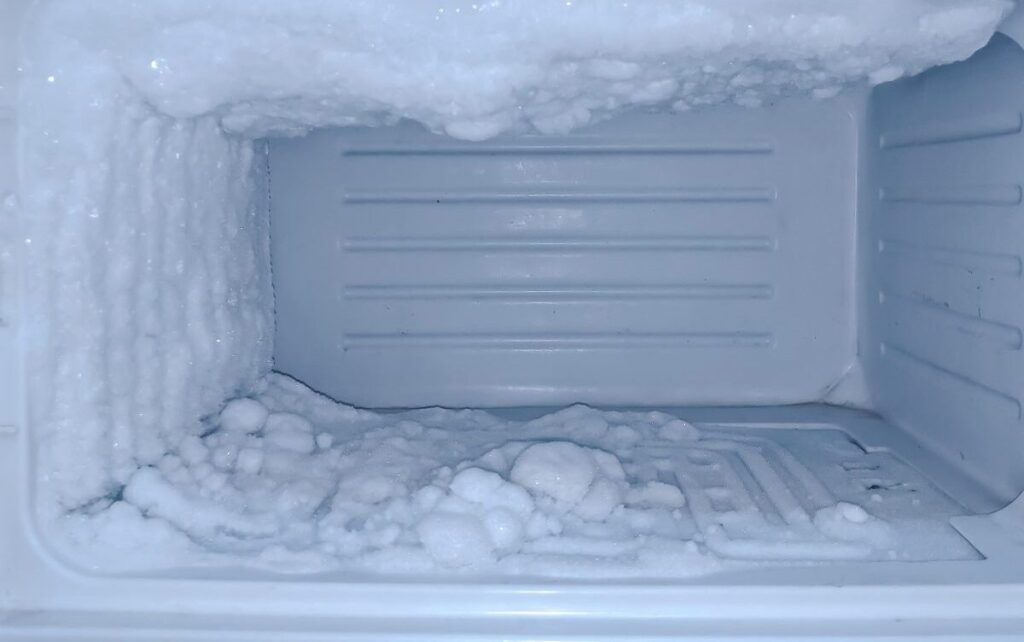
Ice building up in the base of a freezer is a common fault affecting both standalone freezers and the freezer compartment of fridge-freezers. In most cases it is caused by a blocked drain channel – a straightforward problem to diagnose and fix if defrosted correctly. This guide explains the cause, how to clear the blockage properly, and how to prevent it recurring.

Ice in the base of a freezer is usually caused by a blocked drain hole behind the back panel. Defrost water that cannot drain away spills into the base where it freezes. A partial defrost will not fix it – the ice behind the back panel must be fully cleared and the drain hole confirmed unblocked. If the problem quickly returns, an underlying fault requires investigation.
What Causes Ice in the Base of a Freezer?
Inside the back of the freezer compartment, behind a removable plastic panel, is an evaporator. Frost and ice naturally build up on this during normal operation. Periodically, the freezer melts this ice during a defrost cycle. The resulting water is meant to run down a sloped channel and out through a drain hole, into an evaporation tray at the back of the appliance near the compressor, where the heat from the compressor evaporates it.
If the drain hole becomes blocked – usually by a plug of ice that has formed inside it – the defrost water cannot escape. Instead it spills over the channel and runs into the base of the freezer where it freezes into the characteristic sheet of ice at the bottom.

This can happen without being visible in the base. It can restrict airflow and cause the freezer to stop cooling to the correct temperature, or cause a high-pitched noise if the circulating fan catches on the encroaching ice. Eventually a severe ice buildup can jam the fan completely, causing significant loss of cooling.
A side effect of ice building up in the base is that the bottom drawer may become difficult to open and close. Forcing a jammed drawer can break it – if the drawer is sticking, ice in the base is the likely cause and should be addressed before damage occurs.
Why a Normal Defrost Is Usually Not Enough
Defrosting the visible ice in the base of the freezer is often only a temporary fix. The ice that has blocked the drain hole is located behind the back panel, which is insulated. A standard defrost – leaving the door open for an hour or two – will clear the visible ice in the base but usually leaves the ice blockage behind the panel intact.
When the freezer is turned back on, the defrost cycle runs again, the drain hole is still blocked, and water spills into the base again. The problem recurs within days or weeks.
To fix the fault properly, the ice behind the back panel must be cleared and the drain hole confirmed as unblocked.
How to Defrost and Clear the Drain Properly
There are two approaches. Either unplug the freezer and leave the door open for at least 24 hours – which allows the insulated back panel to defrost fully without intervention – or remove the back panel and defrost it directly, which is faster.
Removing the Back Panel
-
Unplug the freezer from the mains before removing any panels or working inside the compartment.
-
Remove the screws securing the plastic back panel inside the freezer. On most models there are four screws. Keep them safe as they will be needed to refit the panel.
-
If the panel is frozen to the freezer walls and will not lift away freely after the screws are removed, do not force it. Allow it to thaw further naturally, or use a hairdryer on a low setting to gently warm the edges. See the hairdryer warning below.
-
With the panel removed, the evaporator, fan, and drain channel will be visible. Look for the sloped channel running down to the drain hole in the corner. This is where ice blockages typically form.
-
Allow the ice to melt naturally, or carefully assist with a hairdryer on a low setting directed at the ice – not at any plastic components or sensors. Pouring a small amount of warm water into the drain hole can help melt through an ice plug blocking it.
-
Once the drain hole is clear, push a thin piece of plastic or a pipe cleaner through it to confirm the passage is open all the way through.
-
Refit the back panel securely, plug the freezer back in, and use the fast freeze function if available to bring it back to temperature more quickly.

If using a hairdryer to assist defrosting, use it on the lowest heat setting only. Never use anything more powerful than a standard hairdryer. Keep the airflow moving – do not direct heat at any single spot for more than a few seconds at a time. Prolonged or excessive heat can warp the plastic channel inside the freezer. A warped channel cannot be repaired and will cause the drain to misalign, making the problem recur permanently. When in doubt, defrost naturally rather than using heat.
What Causes the Drain Hole to Block in the First Place?
Ice should not build up to the point of blocking the drain hole under normal operation. If it does, there may be an underlying fault causing excessive frosting.
A fault in the control board or a temperature sensor can cause the freezer to over-freeze, generating more ice than normal. This saturates the evaporator and drain channel faster than the defrost cycle can manage.
Frost-free freezers have an automatic defrost heater that periodically melts ice off the evaporator. If this heater, its thermostat, or its timer fails, ice accumulates unchecked. See: frost-free automatic defrosting.
Excessive frosting that looks more like hard packed snow than clear ice is often caused by warm, moist air being drawn into the appliance – typically through a damaged door seal or a door that is not closing fully. See: icing up in fridge or freezer.

An underlying problem is causing excessive ice formation and the drain cannot keep up. An engineer will be needed to diagnose and repair the root cause.
Fridge freezer help and repairs
Frequently Asked Questions
Why is ice building up in the base of my freezer?
Ice in the base is almost always caused by a blocked drain hole behind the back panel of the freezer. During normal operation, frost on the evaporator melts and drains through a channel and hole into an external evaporation tray. If the drain hole is blocked by ice, defrost water spills into the base of the freezer where it re-freezes. Clearing the blockage and unblocking the drain hole is the fix.
Why does the ice keep coming back after I defrost the freezer?
A standard defrost that removes visible ice from the base typically leaves ice still in place behind the insulated back panel. The drain hole remains blocked, so when the freezer runs again, water spills into the base again. To fix the fault properly, the back panel must be removed and the drain hole confirmed as fully clear before the freezer is switched back on.
Is it safe to use a hairdryer to defrost the inside of a freezer?
With care, yes – but only on the lowest heat setting. Keep the airflow moving and do not direct heat at any single spot for more than a few seconds. Prolonged heat can warp the plastic drain channel, causing a permanent misalignment that makes the fault recur. If in any doubt, defrost naturally by leaving the freezer unplugged with the door open for 24 hours.
Can I push something through the drain hole to unblock it?
Yes – once the ice has been melted away from around the drain hole, pushing a thin piece of plastic or a pipe cleaner through the hole confirms it is fully clear. Pouring a small amount of warm water into the hole first can help melt any remaining ice plug before the drain hole is physically checked.
What if the problem comes back quickly after a full defrost?
If ice returns within a few weeks of a thorough defrost that cleared the back panel completely, an underlying fault is causing excessive ice formation. Possible causes include a failed auto-defrost heater, a faulty PCB or sensor causing over-freezing, or a damaged door seal allowing warm moist air in. An engineer will be needed to diagnose the root cause. See also: icing up in fridge or freezer.
Ask the repair forum
Post the make, model and symptoms and get help from the Whitegoods Help community.
26 Comments
Grouped into 10 comment threads.
1 reply I have a stand up deep freeze that’s almost the size of a regular fridge. It keeps getting frozen over on the back bottom (the back, not the inside back). Two of the lines get really frozen over and end up with 2 large white balls of ice. I have a photo if that would help. I currently have too much in it to unplug it and let everything melt and start from scratch.
1 reply Hi, Thanks a really helpful article. I have a 4 year old Beko frost free fridge freezer that the bottom of the freezer is now icing up. Have followed the advice and 2 weeks ago took everything out to put in the garage fridge freezer then defrosted it and left the doors open for 24 hours. It has now got another sheet of ice in the bottom! Just to clarify I can’t see a drain hole inside the freezer or a removable panel either inside to check for ice?
Hi,
Thanks a really helpful article. I have a 4 year old Beko frost free fridge freezer that the bottom of the freezer is now icing up. Have followed the advice and 2 weeks ago took everything out to put in the garage fridge freezer then defrosted it and left the doors open for 24 hours.
It has now got another sheet of ice in the bottom! Just to clarify I can’t see a drain hole inside the freezer or a removable panel either inside to check for ice?
Hi Sue. If your freezer has auto defrost function, it must have a drain hole. Otherwise it can’t auto defrost. If you have to manually defrost it, then it probably has a spout thing at the bottom front, so when you defrost it the water runs through into a tray or container that you place on the floor?
3 replies Hi Great article. Thanks. We have a Hotpoint frost free under counter freezer which has repeatedly had this problem for some years now. I have managed to fix it several times using the method you describe, though for speed, to avoid losing any frozen food, I’ve found the most efficient method to thaw out the drainage hole is to repeatedly heat up a 5mm Allen key in boiling water, and using pliers, carefully push it into the hole to gradually melt the ice. The excess ice in the drainage trough is best cleared with a cloth dipped in hot water. I didn’t use a hair dryer because as you say, it could warp the plastic shape. Once the internal rear panel is removed, the thawing out takes about 15 minutes. In the longer term, I have no idea why this keeps happening; it didn’t start till the freezer was about 4 years old. To aid heat dissipation from the condensing coils behind, I cut a ventilation slot in the rear of the worktop, with a grill over it, and moved the freezer forward slightly. Seems to help, as it didn’t happen again for 9 months. But it is a pain to keep doing this. I notice that Hotpoint stopped making frost free under counter freezers. Perhaps they know something I don’t! PS. I found some blogs from the USA which suggested hanging a short length of copper wire, hooked over the defrost heater element, and inserted into the drain hole. The theory is to conduct heat down into the hole to prevent ice forming there. I tried it: didn’t work! Regards, Steve W.
Hi
Great article. Thanks.
We have a Hotpoint frost free under counter freezer which has repeatedly had this problem for some years now. I have managed to fix it several times using the method you describe, though for speed, to avoid losing any frozen food, I’ve found the most efficient method to thaw out the drainage hole is to repeatedly heat up a 5mm Allen key in boiling water, and using pliers, carefully push it into the hole to gradually melt the ice. The excess ice in the drainage trough is best cleared with a cloth dipped in hot water. I didn’t use a hair dryer because as you say, it could warp the plastic shape. Once the internal rear panel is removed, the thawing out takes about 15 minutes.
In the longer term, I have no idea why this keeps happening; it didn’t start till the freezer was about 4 years old. To aid heat dissipation from the condensing coils behind, I cut a ventilation slot in the rear of the worktop, with a grill over it, and moved the freezer forward slightly. Seems to help, as it didn’t happen again for 9 months.
But it is a pain to keep doing this. I notice that Hotpoint stopped making frost free under counter freezers. Perhaps they know something I don’t!
PS. I found some blogs from the USA which suggested hanging a short length of copper wire, hooked over the defrost heater element, and inserted into the drain hole. The theory is to conduct heat down into the hole to prevent ice forming there. I tried it: didn’t work!
Regards, Steve W.
Hi Steve. Yes my own freezer ended up doing the same. That is it kept freezing up with solid ice in the drain hole. I ended up having to carry out the full defrost several times until I eventually tired of it and bought a new one. One thing that I considered in my case was that it could have been related to the freezer being installed in our garage. However, I can’t remember whether it only ever did this in the cold weather.
I could not work out how it was possible for ice to form inside a drain hole, which has no bottom. The drain hole leads to a drop into the evaporator tray on top of the compressor. So it should be impossible for any water getting into that drain hole to freeze up because it should just drop down into the evaporator tray and it is impossible for any water to back up.
Then I noticed that this water that runs into the drain hole does run firstly into a bit of rubber attached to the bottom. This rubber had a flat end. Presumably to reduce the water flow. In other words, when it went into an auto defrost, the water had to run down the drain hole and through this sort of flow restrictor to prevent too much water running into the tray and over spilling.
So I suspect that this was what may be allowed about a bit of a backup of water. The problem could be related to a fault in the auto defrost system that maybe just doesn’t defrost the water enough and for long enough. So maybe only very cold icy water, possibly quite thick ran into the draining hole and clogged up.
Well Andy, what can I say? I also noted that bit of flattened rubber. You’ve convinced me that the time has come to admit defeat and replace the freezer. Do you mind if I ask you if you bought another frost free model, and if so, has the problem ever re-occurred, and which make did you buy?
Thanks
Steve Waldman
3 replies I have a Zanussi integrated fridge freezer which ices up in the base - a lot and often and the bottom drawer is broken because it got iced in so much and wouldn’t shift . . . have to say I don’t use the freezer regularly so probably went unnoticed with the lack of use. Because it’s built in I can’t get to the back and there’s no access inside, so would you think if I just emptied it and let it defrost it would work or do I need to actually see the drain hole to clear it. Thanks
I have a Zanussi integrated fridge freezer which ices up in the base – a lot and often and the bottom drawer is broken because it got iced in so much and wouldn’t shift . . . have to say I don’t use the freezer regularly so probably went unnoticed with the lack of use.
Because it’s built in I can’t get to the back and there’s no access inside, so would you think if I just emptied it and let it defrost it would work or do I need to actually see the drain hole to clear it.
Thanks
Many thanks for getting back to me, I’ve finally been able to empty freezer and remove the back panel but encountered a couple of problems:
I can’t completely remove the panel as wires are attached to the reverse – they feed the fan which is an integral part of the panel and I’m loathe to mess around and disconnect them incase I can’t reattach.
Secondly there isn’t a waste hole anywhere in sight just the freezing element and several frozen pipes.
I guess I’ll somehow prop the panel up so the wires don’t come adrift and leave it to defrost – unfortunately because there’s not a visible waste hole I’ll have no idea if there’s any debris causing it to ice up so will just have to keep my fingers crossed that all will be resolved.
1 reply I have an A.E.G. Frost free freezer and during the heatwave I started to find that when I opened the bottom draw there were thin slivers of ice which I had to remove. Eventually, freezer started to beep and flash red so I’ve left it unplugged ever since, cleaned it thoroughly and found at the back there’s a plastic container full of water. Should I empty this and will the freezer work O.k. now ? It’s only just out of its 2 year warranty and I feel loath to pay for engineer after such a short time of ownership as well as being a 75 year old pensioner times are hard. Hope you can help.
I have an A.E.G. Frost free freezer and during the heatwave I started to find that when I opened the bottom draw there were thin slivers of ice which I had to remove. Eventually, freezer started to beep and flash red so I’ve left it unplugged ever since, cleaned it thoroughly and found at the back there’s a plastic container full of water. Should I empty this and will the freezer work O.k. now ? It’s only just out of its 2 year warranty and I feel loath to pay for engineer after such a short time of ownership as well as being a 75 year old pensioner times are hard. Hope you can help.
Yes empty the water, and plug it back in. Just totally defrosting it could have fixed it if the problem was just a build up of ice. A flashing red light often means the temperature has got too high and warning you that food could be defrosted. Check the instruction manual to see what warning you get when temperature get too high.
0 replies Thanks for the tips. Had the same issue so did the defrost. In my case some fluff had somehow blocked the exit point. But needed the defrost to shift.
Thanks for the tips. Had the same issue so did the defrost. In my case some fluff had somehow blocked the exit point. But needed the defrost to shift.
7 replies My fridge doesn't have any screws showing on the back of the freezer, I don't know how to get them out. And crm consul model 38. Someone help me!!
My fridge doesn’t have any screws showing on the back of the freezer, I don’t know how to get them out. And crm consul model 38. Someone help me!!
Likely replying to Jéssica
Hello Jéssica. If there are no screws in the back wall then I can only advise that it is not possible to remove it. If you think that your freezer has iced up internally then the best thing to do is to defrost it with the door open for at least 12 hours. That should clear it.
Likely replying to Andy Trigg (Whitegoodshelp)
Hi Andy thanks for your reply. It’s supposed to defrost itself but by doing it manually we thought might cure the sheet of ice in the bottom of the freezer but it has returned. Do we have to pull the freezer out to get at the back of it or is there something inside the freezer?
Regards, Sue
Likely replying to Andy Trigg (Whitegoodshelp)
Hello Andy,
I have attempted to address the problem with your very helpful post.
I could not remove the internal plate after removing the screws. The bottom had movement but the top would not give, even after a little hair drying.
Its a Hotpoint.
I applied heat blind under the bottom area and got some water out.
I’m waiting to see if this worked, but wondered about the issue with the top.
Many thanks
Paul
Likely replying to Andy Trigg (Whitegoodshelp)
Dear Andy
I have just attempted to remove the back panel of my Liebherr Fridge Freezer due to ice build up. I am unable to do so due to the use by Liebherr of non standard screws (they appear to have six ‘grooves’ in the head instead of four). Did you have the same problem or were the screws retaining the panel in your freezer standard. Thanks for a very clear and enlightening article.
0 replies Many thanks Nigel.
Many thanks Nigel.
0 replies Many thanks for the articles on the icing up of fridge freezers. I searched high and low for a solution to why my 5 year Neff integrated fridge freezer had stopped working and your common sense explanations and pictures saved me £1000 for a new one. Brilliant. 24 hour defrost and fully functional once more.
Many thanks for the articles on the icing up of fridge freezers. I searched high and low for a solution to why my 5 year Neff integrated fridge freezer had stopped working and your common sense explanations and pictures saved me £1000 for a new one. Brilliant. 24 hour defrost and fully functional once more.
0 replies Checked your recommendations on what I had already done as my american fridge freezer had iced up on the bottom. Have left it defrosting already 30 hrs so will leave it another night and try again. Thanks for comments
Checked your recommendations on what I had already done as my american fridge freezer had iced up on the bottom. Have left it defrosting already 30 hrs so will leave it another night and try again. Thanks for comments
I have a stand up deep freeze that’s almost the size of a regular fridge. It keeps getting frozen over on the back bottom (the back, not the inside back). Two of the lines get really frozen over and end up with 2 large white balls of ice. I have a photo if that would help. I currently have too much in it to unplug it and let everything melt and start from scratch.
Hello Danielle. Send a quick email to me using my contact form at the bottom of this page. I can then reply to you and you can reply with your attached photo.