
How Does a Heat Pump Tumble Dryer Actually Work?
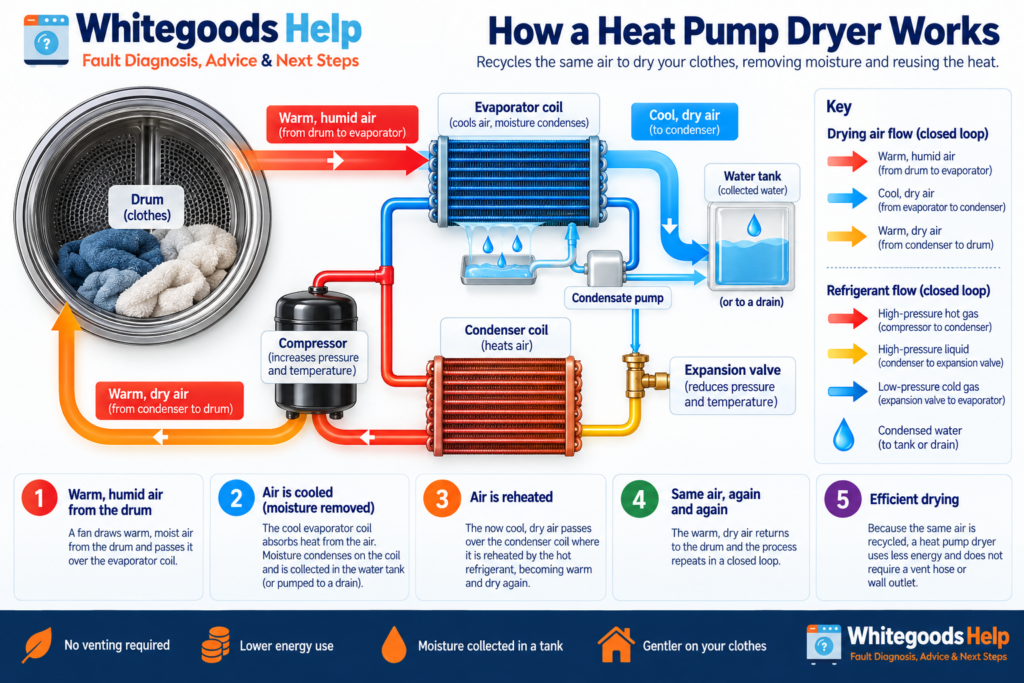

A heat pump tumble dryer is essentially a small fridge running in reverse, dedicated to drying your clothes efficiently. Instead of heating fresh air to high temperatures like a conventional dryer, it uses a refrigerant loop to gently warm air, extract moisture from the clothes, condense that moisture out of the air, and then reuse the same air over and over. The result is a dryer that uses roughly half the electricity of a conventional model, dries at a much lower temperature (around 50°C instead of 70-80°C), takes 30 to 60 minutes longer per cycle, and produces clothes that feel cool rather than hot at the end. This guide explains exactly how the technology works, why it behaves the way it does, and how to get the best from it.
The short version: it’s a fridge for your clothes
The single most useful mental model for a heat pump tumble dryer is that it is essentially a small fridge running in reverse. Every domestic fridge and freezer uses the same underlying technology to move heat from the inside of the appliance to the outside, keeping the food cold. A heat pump dryer uses the same technology to move heat and moisture out of the clothes and into a water collection tank, keeping the internal air continuously warm and dry.
This is fundamentally different from how a conventional vented or condenser dryer works. A conventional dryer heats fresh air with a large electric heating element, blows the hot air over the clothes to evaporate moisture, and then either vents the hot damp air outside (vented dryer) or cools it enough to condense some of the moisture out and reheat the rest (condenser dryer). Both approaches waste an enormous amount of energy because they are constantly heating fresh air from cold. A heat pump dryer, by contrast, keeps the same warm air circulating around the closed loop, only removing the moisture as it goes.
The efficiency difference is significant. A conventional dryer uses around 3.5 to 4.5 kWh per load. A heat pump dryer uses around 1.5 to 2.0 kWh per load for the same amount of clothes. That is why heat pump dryers are the only tumble dryer type that will remain legal to sell in the UK from 2027 onwards under the incoming energy efficiency regulations. See our companion piece on the 2027 UK tumble dryer ban for the regulatory context.
The four parts working together
Inside every heat pump tumble dryer, four components work together in a continuous loop. Understanding what each does explains why the dryer behaves the way it does.

The compressor
A small electrical pump identical in principle to the compressor in your fridge or freezer, mounted at the base of the dryer. It compresses a refrigerant gas, which raises its temperature significantly. The compressor is the only part of the system that consumes meaningful electricity, and it is far more energy-efficient at moving heat than a resistive heating element is at generating heat from scratch. This is the single biggest reason heat pump dryers use so much less energy than conventional ones.

The condenser coil (hot side)
The compressed hot refrigerant gas passes through a series of coils inside the appliance. Air from the drum is blown across these coils, picking up the heat and warming to around 40-50°C. This is the heat source for drying the clothes. Unlike a conventional dryer’s heating element (which uses electricity directly to make heat), the condenser coil is simply transferring heat that the compressor has already moved from elsewhere in the loop.

The evaporator coil (cold side)
After passing through the drum and picking up moisture from the clothes, the warm damp air needs to have that moisture removed before it can be recycled. It does this by passing over the evaporator coil, which is very cold. The moisture in the air condenses out onto the cold coil, drips down, and is collected in the water tank at the top of the machine (or drained away if the dryer is plumbed in). This is the same principle as morning dew forming on grass — warm damp air meeting a cold surface releases its moisture.

The expansion valve and refrigerant loop
The refrigerant that carried heat to the condenser coil now needs to be cooled and ready to absorb heat again on the next cycle around the loop. It passes through an expansion valve which drops its pressure and temperature dramatically, then through the evaporator coil where it absorbs heat from the air (making that air cold, which is what condenses the moisture out). The now-warmed refrigerant returns to the compressor to start the cycle again. This closed loop runs continuously throughout the drying cycle.
The elegance of the system is that the same air is used over and over. Warm dry air enters the drum, picks up moisture from the clothes, exits the drum as warm damp air, gets cooled to release its moisture, and is then reheated to become warm dry air again. The clothes gradually lose their water content to the collection tank without the dryer ever needing to heat fresh air from cold.
Why heat pump dryers behave the way they do
Consumers new to heat pump dryers frequently complain about behaviours that are entirely normal for the technology. Once you understand how the system works, these behaviours make sense.

Why they take longer than conventional dryers
A conventional vented or condenser dryer heats fresh air to 70-80°C, which drives water out of clothes quickly through sheer thermal force. A heat pump dryer operates at around 40-50°C, which is much gentler but takes longer to achieve the same moisture removal. A typical 7kg cotton load takes 90-130 minutes in a conventional dryer, 120-180 minutes in a heat pump dryer. The longer cycle time is a feature of the low-temperature approach, not a fault. It is also the reason heat pump dryers are far gentler on clothing — less heat stress means less shrinkage, less fabric wear, and longer garment life.

Why clothes come out cool, not hot
Consumers used to conventional dryers often assume “the dryer is broken” when clothes come out of a heat pump dryer feeling only slightly warm rather than piping hot. This is entirely normal. The internal drying temperature is much lower (40-50°C rather than 70-80°C), so at the end of the cycle the clothes are around body temperature rather than uncomfortably hot. If the clothes are properly dry (test by touch), the dryer is working correctly. The gentler heat is one of the main reasons heat pump dryers extend clothing life.
Why they collect water rather than venting steam
A vented dryer expels hot damp air through a hose to the outside. A conventional condenser dryer cools the damp air to condense some moisture, releases the rest as slightly-drier warm air into the room, and collects the condensed moisture in a tank. A heat pump dryer captures all the moisture as liquid water in the collection tank (or drains it away via a plumbed connection) and expels only slightly-warm dry air into the room. This is why heat pump dryers do not need external venting and can be installed anywhere with a mains socket. It is also why the collection tank fills faster than on a conventional condenser dryer.

Why the room does not get hot and steamy
Vented dryers push hot damp air outside. Conventional condenser dryers release warm slightly-damp air into the room. Both make the room noticeably warmer and often more humid during a cycle. Heat pump dryers do neither: the moisture stays inside the appliance as liquid water, and only a small amount of gently-warm dry air is released. Rooms with heat pump dryers running feel almost unchanged, which is a major advantage for open-plan kitchens, small utility rooms, and homes where the dryer runs regularly.

Why they have a different sound profile
Instead of the constant roar of a conventional dryer’s fan and heating element, a heat pump dryer produces a lower, quieter hum from the compressor plus a softer whoosh from the internal air circulation. The overall noise is lower but different in character — more like a fridge running than a hairdryer running. Some consumers initially perceive this as the dryer “not doing anything” because they are listening for the wrong sound.

Why they cost more to buy but less to run
Heat pump dryers cost more upfront (£400-£900 versus £200-£450 for conventional dryers) because the technology is more complex — a compressor, refrigerant loop, evaporator coil, and expansion valve add manufacturing cost that a simple heating element does not. The running cost difference more than pays this back over the appliance’s life: typically £60-£95 per year for a heat pump dryer versus £155-£210 per year for a conventional dryer at UK electricity rates. See our detailed piece on appliance running costs.
Where the water goes
One of the most common consumer questions about heat pump dryers is what happens to the water that comes out of the clothes. The answer is straightforward: it collects as liquid water inside the appliance and needs to be dealt with in one of two ways.
The collection tank
Most heat pump dryers have a removable water collection tank at the top of the machine (occasionally at the bottom on some models). During a cycle, moisture condensed out of the drying air drips into this tank as liquid water. A typical 7kg cotton load produces around 1.5 to 2 litres of water in the tank. The tank needs emptying every 1 to 3 cycles for most household use. Most machines have a full-tank warning light or indicator that appears when emptying is due. The water is clean condensate and can be poured down any drain safely.
The plumbed drain option
Most heat pump dryers have a plumbed drain option: a small drain hose can be connected from the back of the appliance to the household waste plumbing (usually shared with the washing machine drain). Once plumbed in, the water drains away continuously during the cycle and the collection tank never needs emptying. This is worthwhile for households who use the dryer frequently. Fitting is usually a 15-minute job with the right connector kit, available via our spare parts service.

What happens if you do not empty the tank
Most heat pump dryers stop mid-cycle when the collection tank is full and display a warning. This is to prevent the tank overflowing into the machine’s internal cavity. If this happens, empty the tank and restart the cycle. Some cheaper models continue running with a full tank and vent the excess moisture into the room — check your model’s behaviour if unsure. On plumbed installations this issue does not arise.
The filter question: why heat pump dryers have more filters
Heat pump dryers typically have three filters rather than the one filter of a conventional dryer, and maintenance of these filters is genuinely important to the appliance’s performance and longevity.

The door lint filter
The standard fluff filter in the door of the dryer, identical to conventional dryers. Clean after every load, or the airflow drops and drying times increase. This is the single most important maintenance task on any dryer, heat pump or otherwise.

The secondary lint filter
A second filter that catches finer lint before the air reaches the evaporator coil. Usually located near the door filter or behind a lower access panel. Needs cleaning every 5-10 cycles depending on how heavy the loads are. A blocked secondary filter is the leading cause of heat pump dryer performance drops, because it reduces airflow across the evaporator coil.

The evaporator coil itself
Behind the two lint filters is the evaporator coil (a series of thin metal fins that the cold refrigerant flows through). Over time, fine lint that escapes the filters accumulates on this coil and reduces its efficiency. Most modern heat pump dryers have a self-cleaning cycle for the evaporator coil that runs automatically. Older or budget models may need manual cleaning every 6-12 months via a lower access panel. Consult your appliance manual for the specific procedure. Do not attempt to clean the evaporator coil with sharp tools — the fins are delicate and easily bent.

Why filter maintenance matters more on heat pump dryers
A conventional dryer with a blocked filter takes longer and uses more electricity but eventually still gets the clothes dry. A heat pump dryer with heavily blocked filters can fail to dry properly at all because the airflow across the evaporator coil is critical to the moisture-condensing step. Poor filter maintenance is the single most common cause of “my heat pump dryer isn’t working” complaints, and it is entirely preventable. Set a reminder to check both lint filters every few loads.
The refrigerant question: is it safe?
The refrigerant used in modern heat pump dryers has attracted some consumer concern, particularly around gas safety and environmental impact. The practical answer is that it is safe under normal use and modern refrigerants have much lower environmental impact than the ones used in older refrigeration equipment.

What refrigerant is used
Most modern UK heat pump dryers use R290 (propane), R134a, or R1234yf as the refrigerant. R290 is the most common in current models because it has an extremely low global warming potential (much lower than older refrigerants like R134a). The quantities involved are small — typically 100-200 grams per appliance, comparable to the amount in a modern fridge. The refrigerant is sealed inside the closed system and does not need topping up during normal use.

Is R290 (propane) safe as a refrigerant?
Yes, in the small quantities used and inside a sealed system. R290 is the same gas used as camping gas and household LPG, and the safety concerns around it are well understood. Domestic appliances using R290 are built to specific safety standards that include leak detection, spark-free electrical components in the refrigerant compartment, and ventilation designed to prevent gas buildup even in a hypothetical leak scenario. The safety record of modern R290-based heat pump dryers is comparable to any other domestic appliance.
End-of-life disposal
Because heat pump dryers contain refrigerant, they should never be sent to general waste at end of life. UK WEEE regulations require they be handled through proper appliance disposal routes so the refrigerant can be safely recovered. Retailers offering take-back of an old appliance with delivery of a new one handle this correctly. Council bulky waste collections and household recycling centres accept them. Never abandon or fly-tip a heat pump dryer — the fine and environmental consequences are the same as for a fridge or freezer disposed of illegally.
Getting the best from a heat pump dryer
A few practical habits get significantly better results out of a heat pump dryer and extend its useful life.
Spin dry the washing thoroughly first
The wetter the clothes going into the dryer, the longer the cycle and the more electricity used. Setting the washing machine to its highest safe spin speed for the fabric type dramatically reduces drying time. A high-speed spin removes water via mechanical force at almost no additional electricity cost, whereas the dryer removes water thermally at significant electricity cost. Getting this transfer right can cut heat pump dryer running time by 20-30%.

Do not overload or under-load
Heat pump dryers have specified maximum capacities that assume normal cotton loads. Overloading beyond this prevents proper air circulation and dramatically extends cycle times without improving results. Under-loading (drying two towels in a 9kg drum) is inefficient because the appliance still runs a full cycle. Match the load size to the dryer capacity, running smaller cycles less often rather than tiny loads.

Use the sensor-dry programmes rather than timed
Modern heat pump dryers have sensor programmes that detect when clothes are dry and stop automatically. These are almost always more efficient than timed programmes because they stop as soon as the clothes are ready rather than running until an arbitrary time expires. Use “cotton — cupboard dry” or equivalent sensor programme for most loads.
Do not install in an unheated space in winter
Heat pump dryers work by moving heat around, and they need a reasonable amount of heat in the surrounding air to draw on. In cold environments (garages below 5°C, unheated conservatories in winter), the compressor has to work harder and the drying time extends significantly. Most manufacturers specify a minimum ambient temperature (typically 5°C or 10°C) below which the appliance is not designed to operate. Install in a heated indoor space wherever possible.
Give it space for ventilation
Heat pump dryers need airflow around the appliance for the small amount of heat they do release. Manufacturer specifications typically require a few cm of clearance on the sides and back. Cramming the dryer flush against surrounding cabinets restricts airflow, causes the compressor to work harder, and shortens the appliance’s life. See our related piece on integrated vs freestanding appliances for the wider installation considerations.
Common problems and how to solve them
When a heat pump dryer stops working properly, the fault is almost always one of a small number of common issues. Most are user-fixable.
Clothes still damp at end of cycle
Almost always a filter problem. Check both the door lint filter and the secondary filter, clean thoroughly, and try again. If the problem persists after filter cleaning, the evaporator coil may need cleaning (auto-clean cycle or manual per the manual). Overloading is the second most common cause; try a smaller load. Persistent damp results with proper loading and clean filters suggest a refrigerant leak or compressor fault, which needs a qualified engineer.
Cycles taking much longer than expected
Blocked filters (most common). Very wet clothes going in (was the washing machine spin high enough?). Cold ambient temperature. Overloading. A partial filter blockage can double the cycle time without producing any error message, so this is worth investigating even if the appliance is still eventually drying.
Cycle stops mid-way
Most commonly a full water tank on models with tank collection. Empty the tank and restart. Other causes: door not fully closed, filter access panel not properly seated, an overheat protection tripping due to blocked airflow. See our appliance reset guide if a proper reset is needed to clear an error state.

Machine tripping the electrics
Less common on heat pump dryers than on conventional ones (heat pump dryers have less powerful heating and generally lower electrical current draw), but possible if the compressor develops a fault. If the appliance repeatedly trips the RCD or circuit breaker, stop using it and get a qualified diagnosis. See our related piece on tumble dryer tripping the electrics.

Unusual noises
Rattling, grinding, or knocking from the compressor area needs qualified diagnosis. Squealing may indicate a drum belt issue. A very loud continuous hum that was not there before could indicate compressor strain from restricted airflow (check filter, ventilation) or a developing compressor fault. See our appliance repair booking for diagnostic callouts. Do not continue using a heat pump dryer that is producing unusual mechanical noises — compressor damage that could be repaired at moderate cost early becomes uneconomical to fix if allowed to progress.
How long will a heat pump dryer last?
Heat pump dryers are still a relatively new product category in UK mainstream retail, which means long-term lifespan data is limited. The industry consensus is that a well-maintained heat pump dryer should last around 10-12 years, comparable to a well-maintained conventional dryer. Premium models from manufacturers with mature heat pump technology (Miele, some Bosch, some AEG) may last longer.
The compressor is the most complex component and typically the most expensive potential failure. Compressor replacement on a heat pump dryer is often uneconomical because the part cost is high (£150-£300) and the labour is significant. For machines over 7-8 years old, a compressor failure typically pushes the decision toward replacement rather than repair. See our repair or replace guide for the decision framework and our editorial on appliance lifespan economics for the wider context.
Filter and control board failures on a heat pump dryer are more straightforward and typically worth repairing. The good news is that most heat pump dryer faults are cheap electronic or maintenance issues rather than the compressor itself. Proper filter maintenance is the single biggest factor in extending the life of the appliance.
The Whitegoods Help view
The honest editorial position is that heat pump tumble dryers represent the biggest genuine efficiency improvement in domestic appliance technology of the past 20 years. The energy saving over conventional dryers is not marketing hype — it is a real physical consequence of moving heat around a closed loop rather than generating heat from scratch. For households who use a tumble dryer regularly, upgrading to a heat pump model typically pays back the upfront price premium in 2-3 years through electricity savings alone, and continues delivering savings for the rest of the appliance’s life.
The trade-offs are real but manageable. Longer cycle times, cool-feeling clothes, more filters to maintain, and higher upfront cost are all valid consumer concerns, but each has a clear explanation and a reasonable answer. Once consumers understand that a heat pump dryer is essentially a fridge running in reverse, most of the confusing behaviours make sense and the technology becomes easier to live with.
The wider observation is that the UK regulatory landscape is now firmly heading toward heat pump technology as the future of domestic drying. The 2027 UK vented dryer ban makes this explicit, and conventional condenser dryers are likely to follow within a few more years. Households buying a new tumble dryer now are well advised to consider a heat pump model even if the upfront cost feels higher, because it will be the standard within a few years and is genuinely the better long-term choice on running cost, environmental impact, and clothing care. Households who prefer to skip the tumble dryer entirely have alternative options covered in our piece on drying clothes without a tumble dryer.
Need help with a heat pump tumble dryer?
Whether you are considering buying a heat pump dryer, diagnosing a fault on one you already own, or sourcing spare parts, our nationwide repair service, spare parts service, and Help Forum cover every major UK brand and model.
Frequently asked questions
How does a heat pump tumble dryer actually work?
A heat pump tumble dryer works like a small fridge running in reverse. A compressor moves refrigerant around a closed loop that includes a hot condenser coil (which warms the drying air) and a cold evaporator coil (which condenses the moisture out of the returning damp air). The same air is used over and over, gaining and losing moisture as it circulates, with the water collecting in a tank or draining away. Because heat is being moved rather than generated from scratch, the appliance uses roughly half the electricity of a conventional dryer.
Why does my heat pump dryer take so long?
Heat pump dryers operate at a lower temperature (around 40-50°C) than conventional dryers (70-80°C). The lower temperature means moisture leaves the clothes more slowly, so cycles take 30-60 minutes longer than a conventional dryer for the same load. This is a feature of the technology, not a fault. The trade-off is significantly lower electricity use and gentler treatment of your clothes.
Why do my clothes come out cool from a heat pump dryer?
Because the drying temperature is much lower than a conventional dryer. Clothes exit at around body temperature rather than uncomfortably hot. This is entirely normal and expected. If the clothes are dry to the touch, the dryer is working correctly. The gentler heat is one of the main reasons heat pump dryers extend clothing life compared to conventional dryers.
Are heat pump tumble dryers worth the extra cost?
For most households who use a tumble dryer regularly, yes. A heat pump dryer costs £400-£900 upfront versus £200-£450 for a conventional dryer, but running costs are approximately £60-£95 per year versus £155-£210 per year. The upfront price premium typically pays back in 2-3 years through electricity savings, and the appliance continues saving money for the rest of its life. From 2027, only heat pump dryers will remain legal to sell new in the UK anyway. See our detailed comparison guide.
Do heat pump dryers need external venting?
No. Unlike vented dryers which need a hose to the outside, heat pump dryers keep all the moisture inside the appliance as liquid water in a collection tank (or drained away via plumbed connection). This means they can be installed anywhere with a mains socket, without needing to drill through a wall or route a vent hose. This is a significant installation advantage particularly for flats, integrated kitchens, and utility rooms without external walls.
Where does the water go on a heat pump dryer?
Moisture from the clothes condenses out inside the machine and collects as liquid water in a removable tank at the top of the appliance (occasionally at the bottom on some models). A typical 7kg cotton load produces 1.5 to 2 litres of water. The tank needs emptying every 1-3 cycles. Most machines can be plumbed to drain automatically via a small hose to the household waste, removing the manual emptying task entirely.
What temperature does a heat pump dryer operate at?
The drying air inside the drum reaches approximately 40-50°C, significantly lower than the 70-80°C of a conventional dryer. This lower temperature is why cycles take longer, why clothes come out cool rather than hot, why heat pump dryers are gentler on fabric, and why they use less energy overall. All of these are directly connected to the same fundamental design choice.
Are heat pump dryers safe? What about the refrigerant?
Yes, safe under normal use. Most modern heat pump dryers use R290 (propane) as refrigerant, in small quantities (100-200g) inside a sealed system. The design includes leak detection, spark-free electrical components in the refrigerant compartment, and ventilation to prevent gas buildup. The safety record is comparable to any modern domestic appliance. At end of life, they must be disposed of through proper WEEE routes so the refrigerant can be recovered — never abandon or fly-tip.
Why does my heat pump dryer have multiple filters?
Heat pump dryers typically have two lint filters (a main door filter and a secondary filter deeper in the appliance) plus the evaporator coil that also needs periodic cleaning. This is because the same air is circulated repeatedly through the system, so any lint that gets past the first filter has multiple chances to reach the evaporator coil and reduce its efficiency. Regular filter maintenance is more important on heat pump dryers than on conventional ones, and the single leading cause of “my heat pump dryer isn’t drying properly” complaints is neglected filter cleaning.
How long should a heat pump dryer last?
A well-maintained heat pump dryer should last 10-12 years, comparable to conventional dryers. The compressor is the most complex component and the most expensive potential failure — compressor replacement is often uneconomical on machines over 7-8 years old and pushes decisions toward replacement. Filter and control board issues are more straightforward and typically worth repairing. Regular filter maintenance is the single biggest factor in extending appliance life.
Can I install a heat pump dryer in my garage?
Only if the garage stays reasonably warm. Heat pump dryers need ambient temperatures above 5-10°C (check the manufacturer specification for your model) to operate properly. In a UK garage during winter, temperatures often fall below this, and the dryer will either refuse to operate or take much longer than expected. For garage installation, choose a heat pump model specifically rated for low ambient temperatures, or accept that the dryer will only work reliably during warmer months.
Ask the repair forum
Post the make, model and symptoms and get help from the Whitegoods Help community.
0 Comments