
Integrated vs Freestanding Appliances – The UK Buying Guide
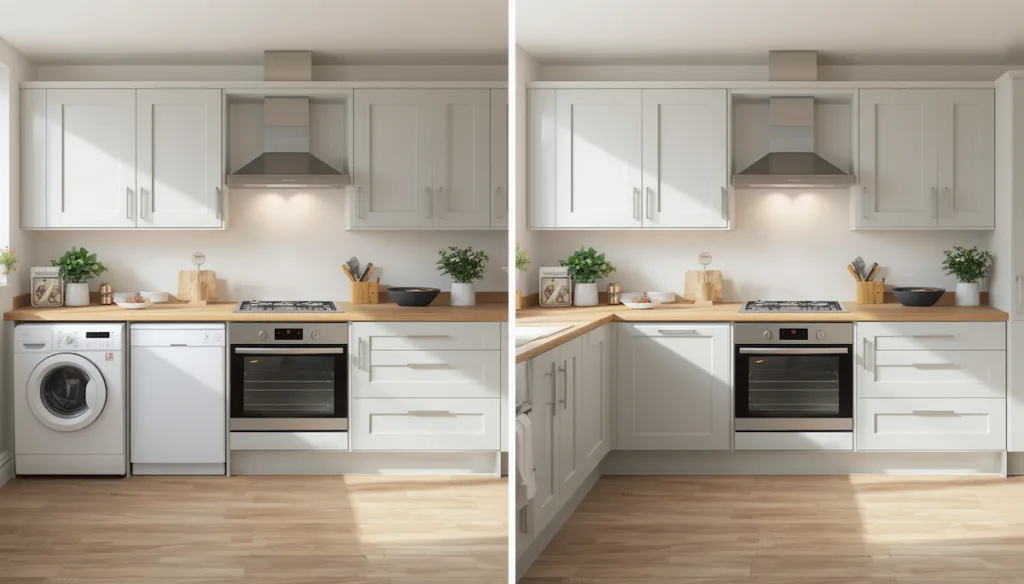
Integrated appliances sit behind a kitchen cabinet door and look like part of the cabinetry. Freestanding appliances stand on their own and are visible. Integrated appliances typically cost 20% to 40% more for an equivalent specification, are available in fewer models and capacities, are constrained in size by the cabinet they sit in, and are more difficult and more expensive to repair when something goes wrong. Freestanding appliances offer more choice, lower cost, easier servicing, and more flexibility to move or upgrade. The right choice depends on whether you value the kitchen’s visual consistency more than the practical advantages of freestanding. There is no universally right answer, but most UK households making the decision honestly conclude that the trade-offs favour freestanding more often than the kitchen showrooms suggest.
What does integrated and freestanding actually mean?
The terms are used loosely in kitchen showrooms and on retailer websites, which has the unhelpful effect of leaving consumers unsure what they are actually being sold. The technical definitions are clear, and worth getting straight before any spending decision is made.
The appliance sits inside a kitchen unit and is hidden behind a matching cabinet door. The appliance’s own front is not visible. When the cabinet door is closed, the kitchen run looks uniform and the appliance disappears into the cabinetry. Controls are typically hidden on the top edge or behind the door. The appliance dimensions are constrained to the cabinet cutout, which on most UK kitchens is 60cm wide for washing machines and dishwashers, with smaller or specific dimensions for refrigeration and ovens.
The appliance sits inside a kitchen unit but its front fascia, including controls, is visible. The control panel sits above a smaller decor door, or the front of the appliance is exposed entirely with the cabinetry surrounding it. Common for ovens, hobs, and some dishwasher designs. Slightly less visually uniform than fully integrated, but easier to operate and often easier to service.
The appliance is a complete self-contained unit with finished sides and a visible front. It is positioned in a gap in the kitchen run, under a worktop, or in a utility room. It can be pulled out, moved, replaced, and serviced from any side. Capacities, models, and prices span the widest range across UK retail. The kitchen run is interrupted by the appliance’s visible front, which is either accepted as part of the design or visually softened with matching colour finishes.
A freestanding appliance designed to fit neatly into a gap in the kitchen run without finished side panels. The visible front matches the cabinetry style enough to look intentional. A common compromise between full integration and pure freestanding, particularly for cookers and washing machines. Often the practical choice when the budget will not stretch to full integration but the kitchen aesthetic still matters.
The decision people usually mean when they say “integrated vs freestanding” is really fully integrated versus freestanding. The middle ground (built-in, slot-in) sits between the two on most of the cost, repairability, and flexibility dimensions covered below.
The side-by-side comparison
The honest way to compare integrated and freestanding appliances is to put them next to each other on every dimension that matters. The numbers below reflect typical UK market conditions at time of writing. Pricing varies significantly by brand and specification, so use these as relative indicators.
| Factor | Integrated | Freestanding |
|---|---|---|
| Typical price premium | 20% to 40% more than equivalent freestanding | Baseline |
| Model and brand choice | Limited (typically 30% to 50% of the freestanding range) | Widest available, every UK brand |
| Capacity options (washing machines) | Typically 7kg to 8kg, occasionally 9kg | 5kg to 12kg, full range available |
| Capacity options (dishwashers) | Standard 13-14 place settings, slimline 10 place | Same range plus larger and smaller options |
| Installation | Skilled fitter required, decor door alignment, longer install time | Self-install possible for most freestanding (excluding gas/hardwired) |
| Installation cost | £100 to £250+ for fitting and decor door work | £0 to £80 for delivery and basic connection |
| Repair access | Limited. Cabinet may need partial removal for some repairs | Full access from all sides |
| Repair time and cost | 20% to 50% higher labour cost typical due to access difficulty | Baseline |
| Replacement when appliance fails | Constrained by cabinet cutout — must find a model that fits | Any equivalent model fits in the gap |
| Replacement decor door | Required if kitchen door range is discontinued (often years later) | Not applicable |
| Resale impact | Positive — kitchen looks more cohesive to buyers | Neutral — kitchen looks functional but less designed |
| Visual impact | Cohesive, designed, premium kitchen aesthetic | Functional, visible appliance front |
| Ventilation | Restricted by cabinet enclosure — must follow manufacturer specs | Open airflow on all sides |
| Noise perception | Slightly muffled by cabinet enclosure | Direct noise from appliance |
| Energy efficiency rating | Same as equivalent freestanding model for the same brand | Same |
The repairability question that retailers do not raise
The single biggest practical difference between integrated and freestanding appliances is one that kitchen showrooms and appliance retailers almost never mention at the point of sale. Integrated appliances are significantly harder to repair, take longer to repair, and cost more to repair than equivalent freestanding models. This is not a marginal consideration. Across the typical 8 to 12 year service life of a major appliance, the difference adds up to real money and real inconvenience.
The reasons are mechanical rather than mysterious. An integrated washing machine is bolted into a kitchen cabinet, surrounded by units on both sides, and connected to a decor door on its own front. To access the machine for any repair beyond the most superficial, the engineer typically needs to disconnect the decor door, unscrew the appliance from the cabinet, pull it forward (assuming it can be pulled forward without removing flooring or trim), and then begin the actual repair. The same fault on a freestanding machine takes a fraction of the time to access.
The labour cost difference shows up directly on the invoice. Most appliance repair engineers charge a callout plus diagnostic fee that covers the first hour or so of work. On a freestanding machine, that often covers the entire repair. On an integrated machine, the access time alone can use up the first hour, putting the repair into a second labour charge or pushing it beyond what the customer can justify against the residual value of the appliance.
The deeper issue is that integrated appliances suffer from the same long-term industry trends as all other modern appliances. Sealed components, unavailable spare parts, and design choices that limit serviceability are widespread across the industry. See our companion analyses on sealed drums and washing machine bearings and planned obsolescence in appliances. When an integrated machine reaches the point where the manufacturer’s design has bounded its useful life, the access problem makes a marginal repair decision an outright write-off more often than it would on a freestanding equivalent.
Across a typical 10-year ownership of a major appliance, the integrated repair cost premium often runs to several hundred pounds in additional labour and access charges, on top of the initial purchase price premium. This is rarely mentioned at the point of sale and almost never appears in the kitchen designer’s quote.
The replacement problem nobody warns you about
The second major hidden cost of integrated appliances is the replacement problem, which only becomes visible the first time an integrated appliance reaches end of life and needs replacing.
A freestanding washing machine in a standard 60cm gap can be replaced by any other 60cm freestanding washing machine from any manufacturer. The replacement choice is the entire UK market. An integrated washing machine, by contrast, is constrained to fit a specific cabinet cutout, with specific door fixing arrangements, specific hinge geometry, specific control panel positioning, and specific overall dimensions. The replacement choice is whatever specific integrated models fit that specific cabinetry. That is typically a much narrower range.
It gets worse. Kitchen door ranges are discontinued over time. A kitchen fitted in 2018 with a specific door style may no longer have that door style available in 2028 when the integrated dishwasher fails. The replacement decor door, if a perfect match is wanted, may require having a bespoke piece made by a kitchen company, which can run to several hundred pounds on its own. The alternative is accepting a “close enough” match that does not quite blend, which undermines the entire visual rationale for the integrated decision in the first place.
Cabinet cutout dimensions
UK integrated appliances are designed around standard cabinet cutouts (typically 60cm wide for washing machines and dishwashers, with depth and height following EU norms). However, internal cabinet cutout dimensions vary slightly between kitchen manufacturers, and the precise positioning of fixing brackets is not standardised. A replacement integrated appliance may fit the cutout but not the existing fixings, requiring additional work.
Door fixing systems
Different manufacturers use different systems for attaching the decor door to the appliance. Some use sliding hinges that decouple the decor door from the appliance door entirely (the more flexible system). Others use fixed-mount systems where the decor door is bolted directly to the appliance front (less flexible). When replacing an appliance, the door fixing system needs to be compatible with the existing decor door, or the door needs to be modified.
Decor door availability
Kitchen door ranges are discontinued, restyled, or rebranded by manufacturers every few years. A decor door bought in 2018 may not be available as a matching piece in 2028. The household either pays for a bespoke match (£200 to £500+ for one door from a specialist) or accepts a visible mismatch.
Replacement cost in real terms
Across a 25-year kitchen lifespan, an integrated washing machine is likely to need replacing two to three times. Each replacement carries an integrated premium of typically £150 to £300 over the freestanding equivalent, plus installation, plus potentially decor door work, plus the constraint of choosing only from models that fit the cutout. The cumulative additional cost across the kitchen’s life is significant.
By appliance type: how the trade-off changes
The case for integration varies significantly by appliance type. Some appliances integrate cleanly and lose relatively little in functional or repair terms. Others lose more, and the case for choosing integrated is weaker. The honest summary by appliance type is below.
Washing machines
The case for integrated
The washing machine sits in the kitchen run on most UK properties and is visually prominent if freestanding. Integration hides it. The cabinet enclosure slightly reduces noise transmission, which can matter in open-plan kitchens. Standard 60cm cabinet cutouts mean replacement is at least possible within the integrated range.
The case against integrated
Integrated washing machines have the most significant capacity penalty of any integrated appliance. The maximum drum size that fits a standard cabinet is typically 7kg to 8kg, with 9kg as a rare upper limit. Freestanding machines go to 12kg and beyond. For families running large loads, the capacity difference adds wash cycles and running cost across the year. Repair access is restricted (machines are bolted to cabinet, decor door must be removed for service). Replacement choice is narrow. See our washing machine guides for the broader picture and washing machine drum sizes for the capacity considerations.
The honest verdict
Many UK households install integrated washing machines based on aesthetic considerations and then quietly regret the capacity constraint within a year or two. If you can locate the washing machine in a utility room, garage, or downstairs cupboard rather than the kitchen run, freestanding is almost always the better choice. If the machine must sit in the kitchen and visual integration is the priority, integrated works but with the trade-offs above understood up front. See our piece on how much space a washing machine needs around the sides if you are considering a freestanding installation tight to cabinetry.
Dishwashers
The case for integrated
Dishwashers are the appliance category where integration works most cleanly. Capacity differences between integrated and freestanding are minimal (most integrated full-size dishwashers handle the standard 13 to 14 place settings, the same as freestanding). The aesthetic benefit of disappearing the dishwasher into the kitchen run is significant. Slimline integrated dishwashers (45cm wide, 10 place settings) are widely available for narrower spaces. See our wider dishwasher guides.
The case against integrated
The price premium for integrated dishwashers is real (typically 20% to 30%). Repair access is constrained by the cabinet. Door fixing systems vary by brand and can cause headaches at replacement time. Some semi-integrated designs leave the control panel visible at the top, which compromises the cohesive look that justified paying the integrated premium in the first place.
The honest verdict
Of all the appliance categories, dishwashers integrate with the least functional penalty. If the budget supports the price premium and the kitchen design calls for a uniform run, integrated dishwasher is a defensible choice. The freestanding option remains better value for households who do not place high weight on visual integration.
Fridges and freezers
The case for integrated
An integrated fridge or fridge-freezer sits behind a tall decor door (or two doors for tall units) and disappears completely into the kitchen run. The visual effect is significant. Modern integrated refrigeration has come a long way in quality and capacity, with full-height fridge-freezers, under-counter fridges, drinks coolers, and integrated freezers all widely available. See our fridges and freezers guides.
The case against integrated
Capacity is the biggest constraint. An integrated fridge-freezer is typically narrower (54-55cm vs 60-70cm) and shallower than a freestanding equivalent, with usable capacity around 250 to 300 litres against 350 to 500 litres for an equivalent-footprint freestanding unit. The American-style and French-door fridge-freezers that have become popular in larger UK kitchens are almost exclusively freestanding. Ventilation requirements for integrated refrigeration are stricter (the cabinet must allow proper airflow per the manufacturer’s specs, or the compressor overheats and the unit fails early). See our climate classes guide for the wider context on refrigeration positioning, and can you put a fridge-freezer in a garage for placement considerations.
The honest verdict
For households where kitchen design is a high priority and capacity needs are moderate, integrated refrigeration is a reasonable choice. For households with larger storage requirements (large families, weekly shop pattern, batch cooking, ice and water dispensers), freestanding refrigeration is almost certainly the better choice. The capacity gap is the biggest practical consideration and is often underestimated until a year or two into ownership.
Ovens
The case for built-in
Ovens are different from the other appliance categories because the built-in (rather than fully integrated) format is the dominant choice in modern UK kitchens. A built-in oven is mounted at eye level or under the worktop, with the control panel visible. Capacity is comparable to freestanding cookers (60 to 80 litres for a single oven), and the ergonomics of eye-level access are significantly better than the bend-and-reach of a freestanding cooker. Most current kitchen design favours built-in oven plus separate hob over freestanding cookers. See our wider cookers and ovens guides and the related gas vs electric hobs buying guide.
The case against built-in
Built-in ovens require a dedicated cabinet housing, which adds cost to the kitchen build. Replacement is constrained by the existing housing dimensions, which vary between brands. Built-in ovens cost more than equivalent specifications in freestanding cookers because the build complexity is higher. Single ovens in built-in form, while ergonomic, have less total cooking capacity than a full-size freestanding cooker with a separate grill. Repair access can be constrained on units mounted at eye level due to the cabinet surrounds.
The honest verdict
For modern kitchen design, built-in ovens are the default and remain a sensible choice for most households. Freestanding cookers retain a place in larger kitchens with traditional design or in rentals where the simpler installation matters. The decision is usually made by the kitchen designer rather than the household, and the trade-offs are smaller than for washing machines or refrigeration.
Tumble dryers
The case for integrated
Integrated tumble dryers exist and work, particularly heat pump models which do not require external venting. They sit in a kitchen cabinet next to the washing machine in matching style. See our tumble dryer guides and the related heat pump vs vented vs condenser tumble dryer guide.
The case against integrated
Capacity is the bigger issue than for washing machines because integrated tumble dryers in standard cabinets cap out at 7kg to 8kg. Heat is the more important issue: even heat pump dryers generate heat output during operation, and the cabinet enclosure restricts ventilation. Some integrated dryers have ventilation requirements that limit where in the kitchen they can be installed. Vented dryers integrate poorly because the vent hose needs an external connection. The model range is significantly narrower than freestanding.
The honest verdict
If the tumble dryer can be placed in a utility room, garage, conservatory, or downstairs cupboard, freestanding is almost always the better choice. If it must sit in the kitchen and visual integration is the priority, an integrated heat pump dryer is workable but with capacity and ventilation trade-offs.
The cost analysis honestly
The honest cost comparison between integrated and freestanding appliances across a typical UK kitchen lifespan is the conversation kitchen designers and retailers do not usually have with the customer. The upfront price difference is only one part of the picture. Installation, repair, replacement, and decor door costs all stack up over time.
| Cost factor | Freestanding (washing machine example) | Integrated (washing machine example) |
|---|---|---|
| Initial purchase (mid-range) | £350 to £500 | £500 to £700 |
| Installation | £0 to £50 (often included in delivery) | £100 to £250 (specialist fitter) |
| Decor door (initial) | Not applicable | Included in kitchen build, or £150 to £300 if added separately |
| Typical repair callout | £80 to £130 diagnostic | £100 to £180 diagnostic (longer access time) |
| Major repair (e.g. pump replacement) | £150 to £220 including parts and labour | £200 to £300 due to access difficulty |
| Replacement at 10 years (purchase) | £350 to £500 for any equivalent model | £500 to £700 from narrower integrated range |
| Replacement decor door if discontinued | Not applicable | £200 to £500 for bespoke match, or visible mismatch accepted |
| Estimated 25-year total cost difference | Baseline | £800 to £1,500+ higher |
The £800 to £1,500 cumulative difference across a kitchen’s lifespan is not trivial, but it is also not the only factor. For households where the visual coherence of an integrated kitchen genuinely improves daily life (and many household budgets accommodate this comfortably), the additional cost is a reasonable trade. For households where the additional cost matters and the visual difference is acceptable, freestanding is the more economically rational choice. The point is to make the decision with full information, not to be told only the upfront price comparison.
Where each option genuinely fits
The honest answer to “which should I choose” depends on what kind of household you are and what kind of kitchen you have. The matched recommendations below are based on the most common UK household profiles.
New build or full kitchen renovation with design priority
If you are designing a kitchen from scratch with a budget that supports it, integrated appliances deliver a more cohesive visual result and a higher-value resale impression. Plan around the constraints (capacity, repair access, replacement timing) and they are manageable. Choose flexible door-fixing systems where possible to make future replacement easier. Avoid integrated washing machines if you have or expect to have a family of four or more and the capacity constraint will bite.
Tight budget or replacing piecemeal in an existing kitchen
Freestanding is the cost-effective choice. The 20% to 40% price premium for integrated, plus installation, plus higher repair costs, plus replacement constraints all add up. If your current kitchen has freestanding gaps, staying freestanding gives maximum flexibility on every replacement decision over the next 10 to 20 years.
Family of four or more with high appliance use
Capacity matters more than aesthetics for this profile. Freestanding washing machines and refrigeration give significantly more capacity for the same footprint. The integrated capacity constraint translates directly to extra wash cycles, extra running cost, and (for refrigeration) less stored food per shop. Freestanding is the practical choice unless utility room or garage placement allows you to keep the kitchen design uncompromised.
Apartment, flat, or open-plan kitchen
Integrated appliances reduce visual clutter and noise transmission, both of which matter more in open-plan and smaller homes. The reduced capacity is often less of an issue for smaller households typical in flats. Integration is a defensible choice here even on a moderate budget.
Utility room, garage, or downstairs cupboard available
If you have space outside the kitchen for the washing machine and tumble dryer, freestanding in the utility space is almost always the best choice. You get full capacity, easy repair access, and zero aesthetic compromise in the kitchen because the appliances are not in the kitchen at all. This is the strongest argument for freestanding even in otherwise integrated kitchens.
Rental property or short-term occupation
Freestanding is the universal answer. Lower cost, easier installation, easier replacement, no risk of decor door mismatch costs at exit. Integrated appliances in rentals are typically a poor financial decision for the landlord and an inflexible setup for the tenant.
Practical advice if you are choosing integrated
If you have weighed the trade-offs and decided that integration is the right choice for your kitchen, a few practical decisions made now will significantly affect your experience over the next 10 to 20 years.
Choose sliding-hinge door fixing where available
Sliding-hinge systems (sometimes called sliding door, glide hinge, or floating hinge) decouple the decor door from the appliance door. The decor door slides up as the appliance door opens. This is significantly more flexible at replacement time because the decor door is not bolted permanently to a specific appliance model. Fixed-mount systems, where the decor door is bolted directly to the appliance front, are less flexible but lighter on the hinges. The sliding-hinge approach is the more future-proof choice where it is available.
Keep spare decor doors if your range may discontinue
If you are fitting a kitchen with a door style that may not be available in 10 years, consider buying one or two spare decor doors at the time of installation. The extra cost is modest now and avoids a much larger bespoke-match cost later. Store the spares somewhere dry and flat to prevent warping.
Document the cabinet cutout dimensions
Take photographs and record the exact cutout dimensions of every integrated appliance housing. Keep the records with your house file. When the appliance fails in 8 to 10 years, the next person specifying a replacement will need this information and the kitchen plans may not be to hand.
Honour ventilation specifications
Integrated refrigeration and integrated tumble dryers both have specific ventilation requirements published by the manufacturer. The cabinet build must include the airflow paths the appliance needs. Skipping or shortcutting these specs leads to early compressor failure on refrigeration and overheating on dryers. The kitchen fitter and the appliance specification need to be aligned at the planning stage, not discovered afterwards.
Maintain access for service
Ensure that integrated appliances can actually be pulled forward for repair work. Tiled flooring laid up to the appliance front, decorative kickboards that cannot be removed, or pipework routed across the access path all create problems when service is needed. A well-designed integrated installation considers maintenance access from day one. See our piece on floor tiles in front of appliances for the most common error.
Consumer rights still apply
Whichever route you choose, the same UK consumer rights apply to both integrated and freestanding appliances. Goods must be of satisfactory quality, fit for purpose, and durable for a reasonable period. The 30-day right to reject, the six-month presumption that faults were present at purchase, and the underlying Consumer Rights Act 2015 protections cover integrated appliances exactly as they cover freestanding ones.
The UK Right to Repair regulations also apply to both, requiring spare parts to be available for between 7 and 10 years after a model was last sold, depending on the part category. This is genuinely useful protection for integrated appliances given the replacement-cost problem, because it means the original model’s parts should remain available for the life of the appliance regardless of whether the manufacturer continues making that exact model.
See our guides to consumer rights when buying appliances, your rights with faulty appliances under the Consumer Rights Act, and the UK Right to Repair framework for the full picture.
Consumer rights guidance on Whitegoods Help is provided as general information only and does not constitute legal advice. For complex disputes, especially those involving significant sums, consider seeking advice from a qualified solicitor or Citizens Advice. Individual circumstances vary and the application of consumer rights legislation depends on the facts of each case.
The Whitegoods Help view
The honest editorial position is that integrated appliances are an aesthetic and design choice rather than a functional or economic one. They deliver a more cohesive kitchen and a more designed feel. They cost more to buy, more to install, more to repair, and more to replace across the appliance’s lifespan. The capacity constraints, the repair access difficulties, and the decor door replacement risks are real and rarely volunteered at the point of sale.
None of this means integration is the wrong choice. For households where the kitchen is a major living space, where aesthetic coherence genuinely matters, and where the budget accommodates the additional cost across the kitchen’s lifespan, integrated appliances deliver a kitchen that looks better and feels more considered than the freestanding equivalent. That is a legitimate and worthwhile outcome.
The argument we would make is for honest decision-making. The integrated premium is significant. The retailer and the kitchen designer have commercial reasons to emphasise the visual benefits and to underplay the practical trade-offs. The independent perspective is that both options have a place, that the freestanding case is stronger than mainstream kitchen design suggests, and that the right answer for any given household is the one made with full information about what each route actually involves over 10, 15, and 25 years.
The kitchen renovation market has moved heavily toward integration over the past two decades, partly for legitimate design reasons and partly because integration suits the commercial structure of the kitchen industry. Designers, fitters, and appliance retailers all benefit from selling more complex and more expensive integrated solutions. The honest counterweight to that commercial pressure is the one consumers rarely hear: freestanding still works, still looks fine in most kitchens, costs less, repairs more easily, and gives flexibility that integration does not.
Putting it all together: the decision framework
✅ Choose integrated when
Kitchen design and visual coherence are a high priority. Budget supports the 20% to 40% price premium plus the installation cost plus the long-term repair and replacement premium. Household size is moderate and capacity demands do not push against the integrated limits. The kitchen is in an open-plan or visually exposed living space where the appliance front would be a distraction. The property is owner-occupied with a planned occupation of at least 10 to 15 years to recoup the design investment. The kitchen is being newly built or fully renovated, so integration can be designed in properly from the start. You can specify sliding-hinge door fixing systems to maximise future replacement flexibility.
❌ Choose freestanding when
Budget is the main constraint. Capacity matters significantly (large family, frequent heavy washing, batch cooking, large weekly food shops). A utility room, garage, or downstairs cupboard provides somewhere to put laundry appliances outside the kitchen. The property is a rental, will be sold within a few years, or has been bought as a project where flexibility matters. The kitchen has freestanding gaps already and replacement is the immediate question rather than full renovation. You want maximum flexibility on every replacement decision over the next 20 years. You expect to upgrade appliances during the kitchen’s life and want to keep options open.
Need help with your appliances?
Whether you are planning a kitchen renovation, replacing an existing appliance, or diagnosing a fault on something already installed, our nationwide repair service covers integrated and freestanding appliances across all major UK brands. Our spare parts service identifies the right component for your specific machine including model-specific parts for integrated installations.
Frequently asked questions
What’s the difference between integrated and built-in appliances?
“Integrated” usually means fully integrated, where the appliance sits behind a matching kitchen cabinet door and is completely hidden from view. “Built-in” usually means the appliance sits inside the cabinetry but its front fascia and controls remain visible. Built-in is most common for ovens. Integrated is most common for fridges, freezers, dishwashers, and washing machines. The terms are used inconsistently across retailers and kitchen designers, so it is worth confirming what is actually being supplied before purchase.
How much more do integrated appliances cost than freestanding ones?
Typically 20% to 40% more for an equivalent specification at the point of purchase. Across the full lifespan of an appliance, including installation, repair, and eventual replacement costs, the total premium often reaches £800 to £1,500 per appliance over a 25-year kitchen lifespan. The premium varies by appliance type, with dishwashers typically at the lower end and washing machines and refrigeration at the higher end.
Are integrated appliances harder to repair?
Yes, generally. Integrated appliances are bolted into kitchen cabinets, connected to decor doors, and surrounded by units on both sides. Most repairs require the engineer to disconnect the decor door, unscrew the appliance, and pull it forward before any actual repair work can begin. The additional access time typically adds 20% to 50% to the labour cost on most repairs. Some repairs that would be a routine job on a freestanding equivalent become uneconomical on an integrated machine because the access cost alone approaches the residual value of the appliance. See our repair or replace guide for the broader decision framework.
What happens when an integrated appliance needs replacing and my kitchen door style is discontinued?
Two options. First, find a near-match decor door from the manufacturer’s current range and accept a visible difference. Second, commission a bespoke door from a specialist kitchen company to match the original style, which typically costs £200 to £500 for a single door. Some households reduce the risk by buying one or two spare decor doors at the time of original installation and storing them flat for future use. See the practical advice section earlier in this article.
Do integrated washing machines hold less than freestanding ones?
Yes, significantly. Integrated washing machines are constrained to fit a standard cabinet cutout (typically 60cm wide externally but with a narrower internal drum housing). Maximum drum capacity is typically 7kg to 8kg, with 9kg as a rare upper limit. Freestanding washing machines go up to 12kg and beyond. For larger households, the capacity difference adds extra wash cycles across the year and increases running cost. See our washing machine drum sizes guide for the wider context.
Are integrated fridge-freezers smaller than freestanding?
Yes. Integrated fridge-freezers are typically 54-55cm wide and constrained in depth by the cabinet, with usable capacity around 250 to 300 litres. Equivalent-footprint freestanding fridge-freezers are typically 60-70cm wide and offer 350 to 500 litres. The capacity gap is the biggest practical consideration when choosing between integrated and freestanding refrigeration, particularly for larger households. American-style and French-door fridge-freezers are almost exclusively freestanding.
Can I replace an integrated appliance with a freestanding one (or vice versa) if I change my mind?
Yes, but with significant kitchen work involved. Replacing an integrated appliance with a freestanding one means removing the cabinet housing and possibly the decor door, finishing the exposed cabinet edges, and accepting a visual gap in the kitchen run where the freestanding appliance now sits. Replacing freestanding with integrated requires building or buying a cabinet housing, fitting a decor door, and installing the integrated appliance. Both are doable. Neither is cheap or trivial. Plan the kitchen with a longer view of which route suits you for the appliance’s lifespan, not just the next year or two.
Do integrated appliances last as long as freestanding ones?
The appliance itself is mechanically identical to the freestanding equivalent in most cases — the same drum, motor, pump, and electronics are inside. The lifespan of the appliance is the same. However, integrated appliances tend to be retired earlier in practice because the higher repair cost makes marginal repair decisions go the other way more often, and because the decor door issue can force replacement when the appliance itself would be worth repairing. The mechanical lifespan is the same. The economic lifespan in service is often shorter.
Does an integrated kitchen add value to my house when I sell?
Generally yes, for two reasons. First, the visual presentation of an integrated kitchen reads as higher specification to buyers and supports a higher asking price. Second, integrated appliances stay with the kitchen at sale, which means the buyer is not factoring in the cost of replacing them in the way they might with older freestanding appliances. The valuation uplift varies by market and property type. Estate agents in higher-value markets typically rate integrated kitchens favourably; in starter homes and rentals the effect is smaller and the cost may not be recovered.
What should I ask the kitchen designer about appliance integration?
Five key questions. (1) What is the cabinet cutout dimension for each integrated appliance? (2) What door fixing system does the integrated appliance use — sliding hinge or fixed mount? (3) What is the manufacturer’s ventilation requirement for integrated refrigeration and integrated tumble dryers, and does the cabinet build accommodate this? (4) What happens at replacement time if the current appliance model is no longer available? (5) Is the integrated appliance accessible for service without removing kitchen units? A designer who can answer these confidently is paying attention to the practical issues. One who cannot is selling the visual without considering the lifespan.
Is a slot-in cooker a sensible compromise between integrated and freestanding?
Yes, for cookers and ovens specifically. A slot-in freestanding cooker sits in a gap in the kitchen run, is finished to look intentional, and offers full freestanding capacity with the easy installation and repair of any freestanding appliance. The visual result is less uniform than a fully built-in oven plus separate hob, but the cost is lower and the flexibility is greater. For households who want a more designed look than pure freestanding without the cost and complexity of full integration, slot-in is the sensible middle ground.
Still deciding?
Here’s where to go next.
Ask the repair forum
Post the make, model and symptoms and get help from the Whitegoods Help community.
“Machine is 15 years old, but very light usage. Please see video…”
✓ Solved · LG · 4 replies
0 Comments