
Smart Appliances in the UK: The Honest Guide to Connected Fridges, Washing Machines and More (2026)
UK engineer guide to smart appliances in 2026. Security, lifespan, repair risks, UK PSTI Act consumer rights, and when connected is actually worth it.
Guidance compiled by Whitegoods Help. Includes background on the November 2026 European supermarket freezer cyber-attack reported by BBC News and the UK PSTI Act 2024.
01What happened? The supermarket freezer attack in context
In early November 2026, BBC News reported that supermarkets across seven European countries had been hit by a suspected cyber-attack affecting their commercial fridges and freezers. UK researchers quoted in the piece identified more than 800 refrigeration and building-control interfaces associated with British retailers that were accessible over the public internet.
The attack targeted commercial refrigeration rather than domestic smart appliances. There is currently no evidence that fridges, washing machines or other connected appliances in UK homes were affected. But the story has pushed a reasonable question back onto the front page: if commercial refrigeration can be reached from the public internet, what does that mean for the connected washing machine, oven or fridge-freezer sitting in a UK kitchen?
The honest answer is nuanced. The risk to any individual UK household from a cyber-attack on their smart appliance is low in absolute terms, but the broader concerns about connected appliance security, support lifespan and repairability are real and worth understanding before you buy. See the original BBC coverage at bbc.co.uk/news.
This is a Whitegoods Help independent engineer view of connected domestic appliances in the UK in 2026. It covers what connected actually means in day to day use, where it is and is not worth the money, what the UK PSTI Act 2024 gives you as a consumer, the honest repair and lifespan picture that retailers and manufacturers do not always volunteer, and what to do if you already own a smart appliance and want to keep it secure.
02What counts as a connected appliance in a UK home?
In the UK domestic appliance market in 2026, “smart” or “connected” typically means one of the following features is built in to the appliance.
Wi-Fi connectivity to your home network
The appliance joins your home Wi-Fi during setup, usually via a phone app. This is the baseline requirement for any other smart feature. If the Wi-Fi connection breaks, most other smart functions stop working too.
Remote control via a smartphone app
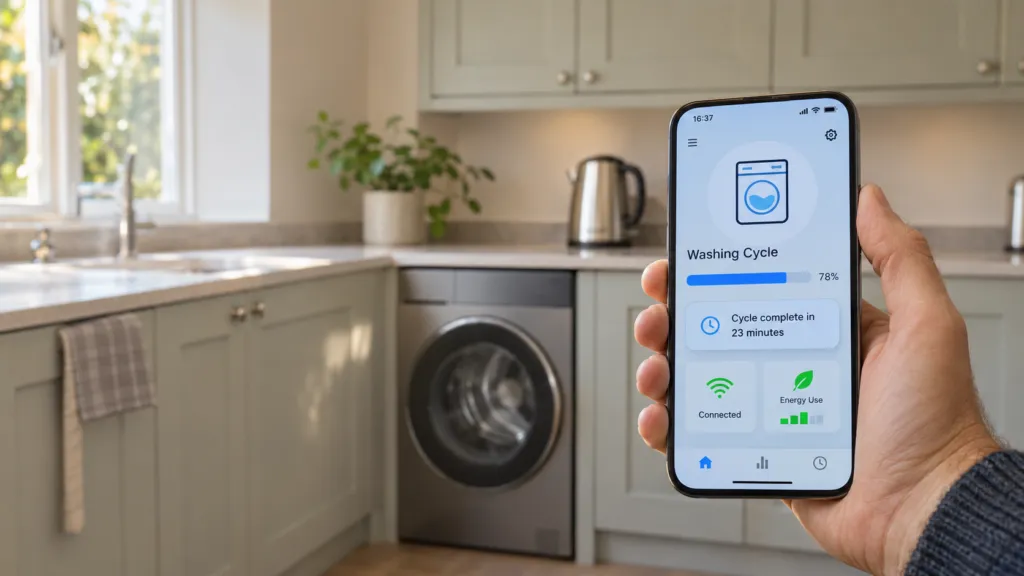
Start, stop, pause or configure a cycle from your phone. Available on most mid-range and above smart washing machines, dishwashers, ovens and tumble dryers from Bosch, Siemens, Samsung, LG, Hoover, Candy, Beko, Miele and others.
Alerts and status notifications
Phone notification when a cycle finishes, when the filter needs cleaning, when the fridge door has been left open, or when an error code appears. This is one of the more consistently useful smart features in daily use.
Remote diagnostics
The appliance reports fault data back to the manufacturer. In the best cases this means an engineer arrives knowing what the fault is before opening the panel. In the worst cases it means the data goes nowhere useful and you still need a diagnostic call.
Over-the-air firmware updates
The manufacturer can push software updates to the appliance, fixing bugs or occasionally adding features. Rarely talked about by retailers but one of the more quietly useful features over an appliance’s lifetime.
Energy monitoring
Running cost data per cycle, or integration with smart meter data to show your appliance’s share of the household energy bill. One of the more genuinely useful smart features, particularly on high-draw appliances. See our wider analysis in the appliance running costs guide.
Voice assistant integration
Amazon Alexa, Google Assistant or Apple Siri integration. Lets you start a cycle or check status by voice. In practice, usage drops off quickly after the novelty wears off.
Camera inside the fridge or oven
Some premium smart fridges include an internal camera so you can check contents from the supermarket. Some premium smart ovens include an internal camera for the same reason while cooking. Novelty value is high, actual usage is low in most households.
03Are domestic smart appliances actually at risk of hacking?
The honest answer is that the risk is low but not zero, and the broader picture is more nuanced than the headlines suggest.
Where the risk is genuinely low
No UK consumer has, to our knowledge in late 2026, been meaningfully harmed by a cyber-attack on a smart washing machine, fridge or dishwasher in their home. A targeted attack on an individual household’s appliance offers almost no return to an attacker and is operationally difficult. The scare stories about “hackers turning on your oven” remain largely theoretical.
Where the risk is real
Smart appliances with weak default credentials, no password enforcement, or no software updates can become part of what cyber-security professionals call a botnet. The appliance is not the target of the attack. It is a tool used to attack somewhere else. This is one reason the UK PSTI Act 2024 banned the sale of connected consumer devices with universal default passwords.
The second real risk is privacy data leaking from manufacturer cloud services. Several smart appliance manufacturers have had data breaches in the past five years exposing user accounts, Wi-Fi credentials saved in setup, and appliance usage data. This is a risk that lives with the manufacturer rather than the appliance.
The third risk is firmware-end-of-life. More on this below in the lifespan section, because it is the risk Whitegoods Help believes is most under-discussed and most relevant to UK households buying a smart appliance in 2026.
The reported attack targeted commercial refrigeration and building-control systems, which run on different networks, use different protocols, and are exposed to different threats than domestic smart appliances. The incident does raise reasonable questions about connected device security in general, but a direct read-across to home appliances is not supported by the evidence. The practical risk to a UK household’s smart washing machine from any similar incident is extremely low.
04What the UK PSTI Act 2024 means for consumers
The Product Security and Telecommunications Infrastructure (Product Security) regime, in force since 29 April 2024, is the UK legislation that sets minimum cyber-security standards for consumer connectable products sold in the UK. It applies to smart appliances as well as other smart home devices.
No universal default passwords
Manufacturers can no longer sell smart appliances in the UK that come with a universal default password (the same password across every unit sold). Any default must be unique per device, or the user must be forced to set a password at setup.
A security vulnerability reporting policy
Manufacturers must publish a clear way for security researchers and consumers to report vulnerabilities, and must respond. This has pushed many manufacturers into publishing security contact pages they previously did not have.
A declared minimum security support period
The manufacturer must declare, at the point of sale, how long they will provide security updates for the product. This is the single most important consumer-protection feature in the Act, because it exposes the gap between how long the appliance lasts physically (10 to 15 years in most cases) and how long it is supported digitally (sometimes as little as 2 to 5 years on budget brands).
The PSTI framework is enforced by the Office for Product Safety and Standards (OPSS). Non-compliant products can be withdrawn from the UK market and manufacturers can be fined. Consumers who find a smart appliance for sale in the UK without a declared security support period or with a universal default password have a legitimate consumer complaint under this regime.
Under the PSTI regime, the manufacturer’s declared minimum security update period must be visible to UK consumers at or before the point of sale. For most domestic smart appliances in 2026 this ranges from 2 years (budget brands) to 10 years (premium brands like Miele, Bosch Serie 8 and some AEG and Siemens models). A short declared period on an appliance expected to last 15 years is a flag, not necessarily a dealbreaker, but worth factoring into the buying decision.
05The Whitegoods Help honest view: it is a lifespan question, not a security question
The news cycle focuses on cyber-security because cyber-security makes headlines. The quieter and more consequential issue for UK households buying a smart appliance in 2026 is lifespan.
A well-made washing machine, fridge or dishwasher is expected to last 10 to 15 years, longer on premium brands. The smart features inside it are software, which depends on the manufacturer’s cloud services, firmware updates and companion app staying available for the appliance’s full physical life. In practice, this almost never happens.
The pattern Whitegoods Help has seen across the smart appliance market over the past five years is as follows.
| Appliance age | What typically happens to the smart features |
|---|---|
| Years 1 to 3 | Full support. App works, updates are pushed regularly, remote diagnostics function as advertised. |
| Years 3 to 6 | Support gradually reduces. The app is updated less often, some features deprecate (particularly voice assistant integration as the integrations churn), and the manufacturer begins pushing you toward their newer product line. |
| Years 6 to 10 | The companion app often stops being updated. New phone operating system versions start breaking the app. The remote diagnostics feature becomes unreliable. The appliance still works mechanically, but as a dumb washing machine. |
| Years 10 to 15 | The appliance is often still mechanically sound, but the smart platform behind it is effectively dead. The cloud service may have been retired, the app may no longer be in the Apple or Google stores. You have an expensive dumb appliance. |
This is not a hypothetical. UK consumers have already lived through the end of life of several smart appliance platforms. Whirlpool deprecated its 6TH SENSE Live app on various products. Hive devices from British Gas have had multiple feature retirements. Several budget smart kitchen brands that sold in UK supermarkets in the early 2020s no longer have working apps at all.
The Whitegoods Help honest view is that if you are buying an appliance you expect to keep for 10 to 15 years, the smart features should be treated as a 3 to 6 year value-add, not a lifetime feature. Pay for connected features based on what they are worth to you in the first few years, not on the assumption that they will last the life of the appliance.
Smart features that stay useful
- End-of-cycle notifications to your phone
- Door-left-open alerts on fridges and freezers
- Energy use data and running cost tracking
- Remote diagnostics that genuinely reduce engineer callouts
- Over-the-air firmware fixes for mechanical control bugs
Smart features most people stop using
- Starting a cycle from the sofa or supermarket
- Internal fridge or oven cameras
- Voice assistant integration
- Recipe suggestions from smart ovens
- Social or gamified features (laundry streaks, cycle sharing)
06When is a connected appliance actually worth the extra money?
Smart appliances typically carry a 10 to 30 percent price premium over their non-smart equivalents from the same brand. Whether that premium is justified depends almost entirely on how you intend to use the smart features.
Multi-household property management
Landlords with holiday lets or multiple rental properties can genuinely benefit from remote diagnostics and status monitoring. The ability to see that an appliance is working from a different city has real operational value.
Accessibility and mobility reasons
For users with mobility challenges, voice control, phone-based control, and audible alerts can be a genuine accessibility improvement rather than a convenience feature. The premium is often justified for this reason alone.
Energy monitoring on high-draw appliances
Smart ovens, washing machines running hot cycles, and tumble dryers all draw substantial electricity. Real-time cost visibility can shift behaviour meaningfully. Worth considering if your household bill is a concern.
Premium brands with mature remote diagnostics
Miele, Bosch Serie 8 and some Siemens iQ700 models have genuinely useful remote diagnostics that reduce engineer callouts. On budget brands, remote diagnostics is often a marketing claim rather than a working feature. If paying the premium for connected, pay it on a brand with a track record of actually supporting the system.
Where connected features are not worth the premium: a household that will never download the app, a kitchen where the appliance is next to the person using it (making remote control irrelevant), and any household buying a budget-tier smart appliance where the “smart” features are a tick-box rather than a genuine capability. See our existing editorial on should I buy a smart white goods appliance for the fuller decision framework.
Thinking about buying a smart appliance?
Our Help Forum has UK households discussing specific smart appliance models, which brands actually support their apps long-term, and which smart features turn out to be useful in daily life. Free to use, real UK engineers monitoring.
07What to check before buying a connected appliance
If you have decided a smart appliance is worth the premium for your household, the checklist below reduces the risk of ending up with a brick in six years.
Check the declared minimum security support period under PSTI. If the manufacturer declares less than 5 years, treat the smart features as short-term only.
Check the companion app’s user reviews on Apple App Store and Google Play. Low ratings, few reviews, or no updates in the past year are warning signs.
Confirm which specific smart features actually require the cloud service to work. Local-only features survive the cloud shutdown. Cloud-dependent features do not.
Confirm the appliance works fully as a non-smart appliance if the Wi-Fi fails or the app is removed. Any appliance that becomes non-functional without a working app should be rejected.
Check for Matter smart home standard support. Matter is the cross-industry standard that reduces vendor lock-in. Matter-compatible appliances are less vulnerable to a single manufacturer’s cloud shutdown.
Favour premium brands with a long track record of app support (Miele, Bosch, Siemens, Neff, AEG premium) over budget smart appliances where the smart features are often an afterthought.
Factor in the price premium honestly. If the smart features add £100 to £300 to the sticker price, decide whether you would pay that again for the same features in isolation.
Check the UK Right to Repair position. See our Right to Repair guide for the current regulations on spare parts availability.
08How to secure a smart appliance you already own
If you already own a connected washing machine, fridge, oven or dishwasher, the following steps reduce the security risk to effectively zero for a typical UK household. None take more than a few minutes.
-
Change any default password. If you set up the appliance before April 2024 and it had a universal default password (same password across all units of that model), change it to a strong, unique password. If you set it up after April 2024, PSTI rules should have forced you to set a unique password already.
-
Enable multi-factor authentication on the manufacturer account. If the manufacturer offers MFA on the account that controls the appliance, turn it on. Takes 30 seconds. This is the single most effective security step for domestic smart appliances in 2026.
-
Keep the firmware updated. Check the app for pending firmware updates every few months. Most manufacturers push updates automatically, but a few require manual confirmation.
-
Put smart appliances on a guest Wi-Fi network. Many home routers offer a guest network that is isolated from your main network. Putting smart appliances on the guest network prevents a compromised appliance from being used to reach your laptop, phone or home server.
-
Review which features actually need internet. If you never use remote control from the sofa, consider disconnecting the appliance from Wi-Fi entirely. Most appliances still work as normal appliances without being connected. The security and privacy benefits of being offline outweigh the loss of features most households never use.
-
Delete the manufacturer account when the appliance leaves the household. If you sell or scrap a smart appliance, factory-reset it and remove it from your account. This is the equivalent of wiping a phone before resale.
09What happens when the manufacturer discontinues support?
This is the question most consumers do not think to ask before they buy, and the question most retailers and manufacturers do not volunteer to answer. The honest UK position in 2026 is as follows.
If the appliance keeps working as a dumb appliance
Most smart washing machines, dishwashers, dryers and ovens continue to work as normal appliances after the smart features are discontinued. You lose the app, the notifications, and often the remote diagnostics. You do not lose the ability to wash clothes, do dishes, or cook food. This is the usual outcome and is manageable.
If the appliance partially bricks
Some smart appliances tie specific features to the cloud service in ways that cannot be worked around. A smart oven whose auto-cook recipes require the cloud may lose those features when the service shuts down. A smart fridge whose camera feed goes through the manufacturer’s servers may lose the camera. The appliance still functions in its core role but at reduced capability.
If the appliance fully bricks
Very rare in UK domestic appliances, but it has happened on specific smart home products from brands that have gone out of business or discontinued a product line entirely. If the appliance will not function at all without a live cloud connection, discontinuation of the service effectively ends the appliance’s life. This is the specific risk the PSTI Act’s declared support period is designed to flag.
Consumer rights when this happens
If an appliance is sold with specific smart features and those features are withdrawn within a reasonable timeframe for an appliance of that price and quality, UK consumers may have a claim under the Consumer Rights Act 2015 (goods must be of satisfactory quality and as described). See our broader guidance on consumer rights for appliances and the Consumer Rights Act. This area of consumer law is still evolving as smart appliances age out.
10The Whitegoods Help view
Connected appliances are neither the revolution the manufacturers claim nor the catastrophe the cyber-security headlines imply. They are a modestly useful set of features bolted onto appliances whose core job has not changed, sold at a modest premium, with specific trade-offs most consumers do not think about until they encounter them.
The November 2026 supermarket freezer story is a reasonable prompt to think about connected appliance security in the UK, but the real risk to a UK household from a cyber-attack on their smart washing machine is low. The practical steps above (strong password, MFA on the manufacturer account, guest Wi-Fi network, firmware updates) effectively eliminate the already-low risk.
The more consequential issue, and the one Whitegoods Help believes is under-discussed, is lifespan. A smart appliance bought in 2026 has a reasonable chance of outliving its software support, particularly on budget and mid-range brands. The PSTI Act now forces manufacturers to declare a minimum security support period at point of sale, which gives UK consumers a baseline. But the declared period on cheap smart appliances is often significantly shorter than the appliance’s physical life.
The practical advice from our engineers is to treat smart features as a 3 to 6 year value-add rather than a lifetime feature, to only pay the premium if you will actually use the features, and to always confirm the appliance works as a non-smart appliance if the Wi-Fi or app fails. On a 10 to 15 year appliance, that is the honest expected life of the smart layer.
11Safety and consumer protection notice
Guidance in this article is general information for UK households and does not constitute legal advice. For specific consumer rights disputes about smart appliance features that have been withdrawn or no longer function as advertised, consider contacting Citizens Advice or a qualified solicitor.
For UK PSTI Act enforcement questions, the Office for Product Safety and Standards (OPSS) is the responsible regulator.
Any suspected cyber-security incident involving an appliance in a UK household (unusual activity, accounts compromised, unknown devices appearing in the app) can be reported to the National Cyber Security Centre at ncsc.gov.uk. Full guidance on general appliance safety is in our DIY appliance repair safety guide.
Need help with a smart appliance fault or decision?
Whether you are weighing up a smart appliance purchase, dealing with a smart appliance that has lost its app support, or just want to know if the premium is worth paying on a specific model, our nationwide service and Help Forum cover every major UK brand.
12Frequently asked questions
Are smart appliances worth it in the UK in 2026?
Depends on which smart features you will actually use. For end-of-cycle notifications, energy monitoring, remote diagnostics on premium brands, and accessibility features, yes. For starting a cycle from the sofa, voice assistant integration, and internal cameras, usage drops off within months. Smart appliances typically cost 10 to 30 percent more than their non-smart equivalents. Pay the premium only if you will use the features in the first few years, because the smart layer typically outlives its software support by much less than the physical appliance’s life.
Can my smart washing machine be hacked?
In theory, yes. In practice, the risk to a UK household from a targeted cyber-attack on their smart washing machine is very low. The more realistic risks are weak default passwords (now banned on new sales under the UK PSTI Act 2024), data breaches at the manufacturer’s cloud service, and the appliance being enrolled in a botnet to attack somewhere else. Setting a strong unique password, enabling multi-factor authentication on your manufacturer account, and keeping the firmware updated reduces the risk to effectively zero for a typical home.
What is the UK PSTI Act 2024 and how does it protect me?
The Product Security and Telecommunications Infrastructure (Product Security) regime came into force on 29 April 2024. It bans the sale of smart consumer devices in the UK with universal default passwords, requires manufacturers to have a vulnerability reporting policy, and requires manufacturers to declare at point of sale how long they will provide security updates for the product. Smart appliances sold in the UK must comply. The Office for Product Safety and Standards (OPSS) enforces the regime.
What happens to a smart appliance when the manufacturer stops supporting the app?
In most cases, the appliance continues to work as a regular non-smart appliance. You lose the app, notifications and often the remote diagnostics, but the washing, drying, cooking or cooling function continues normally. A small number of appliances tie specific features (auto-cook recipes, camera feeds) to the cloud and lose those features. Very few appliances completely stop working without the cloud. Always confirm before buying that the appliance works fully without an internet connection.
How long will my smart appliance’s app support actually last?
Under PSTI, the declared minimum security support period is on the box or at point of sale. In practice in 2026, this ranges from around 2 years on budget brands to 10 years on premium brands like Miele and Bosch Serie 8. The declared period often does not match the physical lifespan of the appliance (10 to 15 years), so smart features are realistically a 3 to 6 year value-add rather than a lifetime feature on most mid-market smart appliances.
Should I disconnect my smart appliance from the internet?
If you do not use the app, notifications or remote diagnostics regularly, yes. Disconnecting from Wi-Fi eliminates the (already low) cyber-security risk and the data privacy exposure, while costing you nothing you were using. The appliance will continue to function as a normal non-smart appliance. If you do use the smart features, keep it connected but place it on a guest Wi-Fi network isolated from your main home network, and enable multi-factor authentication on the manufacturer account.
What does “Matter compatible” mean on a smart appliance?
Matter is a cross-industry smart home standard backed by Apple, Google, Amazon and Samsung among others. A Matter-compatible appliance can be controlled through any Matter-compatible app or hub, not just the manufacturer’s own app. This reduces vendor lock-in and means the appliance’s smart features are more likely to survive the manufacturer discontinuing their own app, because other Matter-compatible controllers can still reach the device. Matter support is a genuine positive feature to look for on a smart appliance in 2026.
If my smart appliance’s features are withdrawn, do I have a consumer rights claim?
Potentially, under the Consumer Rights Act 2015, which requires goods to be of satisfactory quality and as described. If specific smart features were a material part of the appliance’s description at point of sale and have been withdrawn within what a UK court would consider a reasonable timeframe for an appliance of that price and quality, there may be a claim. This area of consumer law is still being tested as early smart appliances age. See our broader guides on consumer rights for appliances and the Consumer Rights Act 2015, or consult Citizens Advice for a specific case.
Worried about your appliance?
Here’s where to go next.
0 Comments