
Fitting floor tiles in front of appliances
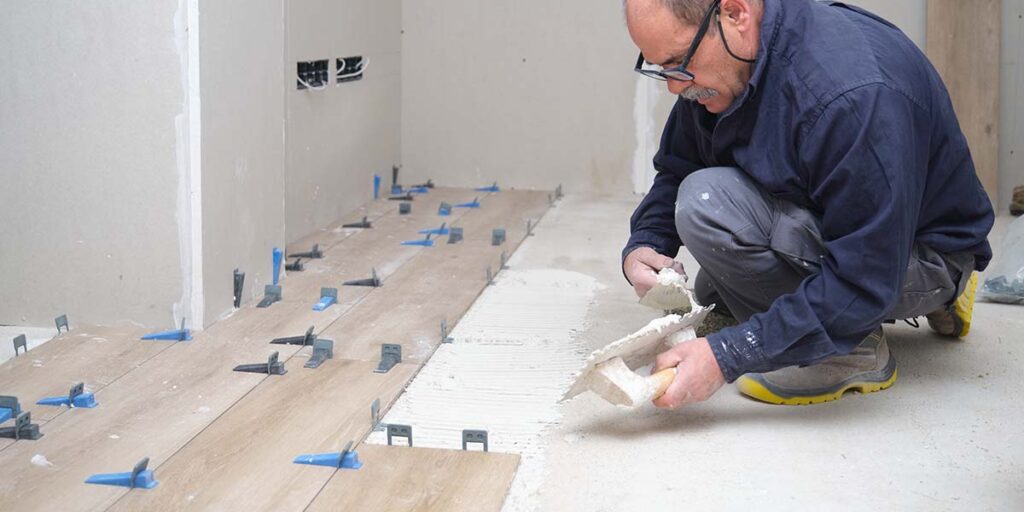

Always extend new flooring fully underneath where a washing machine, dishwasher, or tumble dryer will stand – not just up to its front edge. When an appliance drops down behind a raised floor level, a worktop above can stop it being tilted and lifted back out. Sort this at installation, not when the appliance fails.
Laying floor tiles or laminate right up to the front of a washing machine, dishwasher, or tumble dryer – without extending the flooring underneath where the appliance stands – is one of the most common kitchen installation mistakes. The appliance fits perfectly when first pushed back into position. The problem only becomes apparent later, when the appliance has to come out for a repair or replacement, and by then both the flooring and the appliance can be at risk.

If an appliance is already trapped behind tiles and will not come out, see our companion guide on what to do when an appliance is stuck behind a tiled floor.
Why does flooring in front of appliances cause problems?
Stopping the new flooring at the front of the appliance space looks tidy and saves a bit of material – nobody can see underneath the appliance anyway. Many fitters and homeowners do this routinely, without realising what they are storing up.
The trouble only shows itself when the appliance has to come out – for a repair, a replacement, or a kitchen renovation. By then, lifting the flooring to free it may no longer be a simple job, especially where tiles have been cemented in place or are part of a finished, sealed floor.
How does this problem actually work?
When an appliance is pushed back into position under a worktop, it sits on the original floor level – behind whatever new flooring has been laid in front of it. It drops by the full height that new flooring adds, anywhere from 5mm for thin vinyl up to 20mm or more for ceramic tiles laid on adhesive.
To get the appliance out again, it has to be pulled forward and the front feet lifted over that tile edge. But the worktop above limits how far the appliance can be tilted – and because the appliance can only be lifted from the front, the back has to come up a lot further to clear even a small step.

If the floor has dropped by just 10mm, the back of the appliance may need to be raised 25-30mm or more for the front feet to clear the tile edge. With a low-fitted worktop above, there may simply not be enough clearance to achieve that.
Which flooring types pose the biggest risk?
Not every floor covering behaves the same way. Hard, thick materials are the worst, but even soft vinyl can cause trouble if it has been cut around the appliance space.
 Ceramic and porcelain tiles
The most problematic. Tiles are rigid, hard-edged, often 10-12mm thick on adhesive, and cannot be compressed. An appliance foot meeting a tile edge cannot flex over it. If there is too little headroom under the worktop, the appliance is physically locked in. Freeing it may mean chiselling channels through the tiles – causing permanent damage.
 Laminate and engineered wood
Laminate typically adds 8-12mm to floor height. Like tiles, it creates a firm edge the feet cannot clear without enough upward clearance. There is an extra hazard: if the back feet slide under the edge of floating laminate as the appliance is pulled out, the floor can lift and crack or pop apart at the locking joints.
 Cushion floor and vinyl
Even soft floor coverings cause problems. Though thinner than tiles, they still add height. More critically, if the back feet of an appliance catch under the edge of vinyl as it is pulled out, the flooring can rip – particularly where it has been fitted with a cut edge rather than a seam at the front of the appliance space.
New flooring laid over oldA particularly common scenario. New cushion floor or laminate is laid straight on top of existing tiles to save the work of removing them. The combined height of old tiles plus new flooring creates a step large enough to lock an appliance in completely – cases where both layers had to be cut into are not rare.
Already dealing with a stuck appliance?
If your washing machine or dishwasher will not come out for a repair, the companion guide walks through every option – from adjusting the feet down fully to cutting channels in the flooring as a last resort.
What is the right way to install flooring near appliances?
The correct approach is simple but takes a few minutes of extra effort at installation. Done once, it removes a problem that can otherwise cost flooring, time, and money years later.
-
Pull the appliance out fully before you start. Disconnect it from the power, water, and waste, then move it clear of the appliance space so you can lay flooring across the whole footprint. See the guide on the best way to pull a washing machine out for safe technique.
-
Extend the flooring all the way to the back wall. Run the new floor covering fully into the recess where the appliance will stand, not just up to the front edge. The appliance will then sit on the same level as the floor in front of it – no step, no trap.
-
Check worktop clearance before pushing the appliance back. With the appliance sitting on the new floor level, is there still a useful gap above it under the worktop? Push it in and try tilting the front upwards. If you can lift it a few centimetres, future removal will be straightforward.
-
Do not let worktops be fitted too low. Standard UK kitchen worktop height leaves enough clearance above a 850mm appliance. If the worktop is being fitted lower than standard – particularly over a specific built-in appliance space – measure carefully before the worktop is fixed in place.
-
If you must lay flooring without moving the appliance, at minimum keep the new flooring out from under the appliance feet and test that the appliance can still tilt and pull out over the new edge before the room is finished. Do this while the flooring is still removable.
How can you test clearance before it becomes a problem?
If there is a generous gap between the top of an appliance and the underside of the worktop, there may be enough room to manoeuvre even with new flooring in front. A one-minute check tells you whether you have a margin or a problem.
With the appliance in its installed position, lift the front up as far as the worktop allows and estimate how much the front feet can be raised. Compare that figure to the thickness of the flooring about to be laid.
-

Front feet can be raised 25mm, flooring is 10mm thick. Plenty of margin – the appliance will still come out over the new floor edge. -
Front feet can be raised 8mm, flooring is 12mm thick. Not enough headroom. Either extend the flooring underneath or rethink the floor build-up before it is fixed in place. -
Always allow extra margin for adjustable feet. Most appliance feet have 10-15mm of travel – useful for levelling but not enough to lift a machine clear of a thick tile step on its own.
What safety steps should you take before moving an appliance?
Pulling a washing machine, dishwasher, or tumble dryer out for any reason – including flooring work – means working around mains electricity and pressurised water. A few minutes of preparation prevents most accidents.

Unplug the appliance at the socket (or switch off and lock out the circuit if it is wired in) and turn off the water supply at the isolating valves before disturbing it. Never pull an appliance out while it is still powered or filled – electrical, gas, and plumbing connections can be damaged or pulled apart unexpectedly.
Heavy appliances should be moved with two people where possible. If you are unsure about disconnecting an appliance safely – particularly with gas cookers or hardwired installations – book a qualified engineer rather than risking damage or injury.
Need help with a faulty appliance or parts?
If you have discovered a fault while moving an appliance, or you need a replacement part to get it working again, our engineer network and spares directory can help.
Frequently asked questions
Do I really need to extend flooring under the appliance?
Yes, ideally. Stopping the flooring at the front of the appliance space means the appliance sits lower than the floor in front of it. When it needs to come out, the feet have to clear that step, and with a worktop above there may not be enough room. Extending flooring all the way underneath costs a small amount of extra material and avoids a potentially very difficult future problem.
Can cushion floor or vinyl really cause a problem – it seems thin?
Yes. Even though soft floor coverings are thinner than tiles, they still add height and create an edge. More importantly, the back feet of an appliance sliding under loose or cut-edge vinyl as it is pulled out can tear or rip the flooring. This is a common and entirely avoidable problem.
What if the worktop is already fitted – is it too late?
Not necessarily. If there is a large gap between the appliance and the worktop above, there may still be enough clearance to pull the appliance out over new flooring. Test it before laying the flooring by lifting the front of the appliance to see how high the feet can be raised, then compare that to the thickness of the flooring you are about to lay.
What happens if the appliance is stuck and cannot come out?
When the adjustable feet are wound down fully and the worktop cannot be removed, the only remaining option is usually to cut channels in the flooring in front of the feet to let the appliance move forward. This damages the flooring and is a last resort. The companion guide on what to do when an appliance is stuck behind a tiled floor covers every step.
What if a new floor is being laid over old tiles to save effort?
This is the most risky scenario. The combined height of existing tiles plus new flooring creates a step larger than either alone, and can make appliances very difficult to remove. If laying new flooring over old tiles in a kitchen with under-counter appliances, pull each appliance out first, lay flooring underneath, and check clearance carefully before refitting.
How much space should I leave around a washing machine?
Standard freestanding washing machines and dishwashers are 600mm wide, but most need a small clearance around the sides to fit and to allow airflow. Our guide on how much space a washing machine needs round the sides covers the minimum gaps and why a tight fit can cause problems later.
Ask the repair forum
Post the make, model and symptoms and get help from the Whitegoods Help community.
0 Comments