
Why Is My Laundry Covered in Small Fibres After Washing?

Small fibres on laundry are almost always caused by normal microfibre shedding from fabrics, not a washing machine fault. The issue is typically made worse by mixing different fabric types, combining light and dark laundry, or overloading the drum. Adjusting how you sort and wash your laundry usually reduces the problem significantly.

Finding clothes covered in tiny fibres, lint, or fluff after washing is a very common complaint. In most cases it is not a fault with your washing machine, and understanding why it happens is the first step to solving it. This guide covers what these fibres are, why they appear, and the practical adjustments that reduce the problem.
What are these small fibres?
The particles you see on clothing after washing are microfibres, tiny strands shed from fabrics during normal wear and washing. Every type of fabric sheds them, including:
 Cotton and natural fibres. Particularly from towels, bedding, and older garments that have been washed many times.
- Synthetic fabrics. Polyester, fleece, and acrylic blends tend to shed more than natural fibres.
- Fast fashion and lower-cost garments. These can release significantly more fibres than higher-quality textiles.
- Heavily used items. The more a garment has been worn and washed, the more fibres it releases.
Microfibre shedding is a normal and unavoidable process. All laundry sheds fibres – they are just not always visible. The problem becomes noticeable when fibres transfer onto garments where they show up clearly, particularly due to colour contrast.
Is it a washing machine fault?
In the vast majority of cases, this is not caused by a fault with your washing machine. This is one of the most common misconceptions about this issue.
 Evidence it is not a machine fault
The problem typically persists even after replacing the appliance, occurs across different brands and models, and is more closely linked to washing habits and fabric combinations than the machine itself.
 What washing machines cannot do
Unlike tumble dryers, modern washing machines do not have lint filters capable of capturing fine microfibres. These fibres are either flushed away with wastewater or remain loosely attached to garments after the cycle.

If you have recently replaced your washing machine and the problem has continued, this is a strong indicator that the cause lies in your laundry habits or fabric types, not the appliance. Read our guide on how to tell if your washing machine is actually faulty.
Why does the problem seem worse for some people?
Microfibres are present on almost all washed laundry, but they are not always noticeable. The issue becomes apparent when there is a strong visual contrast, for example:
 Light fabrics, dark fibres
White or pale garments pick up dark fibres from towels, denim, or dark synthetics, making even small amounts of transfer highly visible.
 Dark clothing, white lint
Black or navy garments show up white lint from cotton towels, bedding, or light-coloured clothes very clearly.
 Bright lighting conditions
Strong natural light highlights airborne fibres when clothes are shaken out, making the issue appear more severe than it is in everyday wear.
 Modern synthetic fabrics
Many contemporary textiles, particularly synthetic blends, shed more microfibres than traditional materials. Fast fashion garments are especially prone to this.
What are the most common causes?
Mixing different fabric types
Washing lint-heavy fabrics such as towels, fleece, or cotton knitwear alongside smoother garments is the single most common cause. Heavy fabrics release fibres that cling directly to other items in the drum.
Mixing light and dark laundry
Combining light and dark items increases the visibility of transferred fibres, even if the amount of fibre transfer is no different from usual. This is one of the most common reasons the problem suddenly becomes noticeable.
Overloading the drum
When the drum is overloaded, garments cannot move freely. This increases friction between items, leading to more fibre shedding and transfer. See our guide on how to load a washing machine correctly.
Incorrect wash cycle or temperature
Aggressive cycles, high spin speeds, and unsuitable temperatures all increase fabric wear. Many garments, particularly synthetics, are designed for gentle, cool washes even if they do not look delicate.
Fabric wear and garment quality
Lower-cost garments and heavily used items release significantly more fibres over time. As a garment ages, fibre shedding naturally increases with each wash.
How do you reduce fibres on your laundry?
The good news is that this issue can usually be improved significantly by making a few adjustments to your washing routine.
-
Separate your laundry properly. Wash towels, bedding, and lint-heavy fabrics in a separate load from smooth or dark garments. This is the single most effective step you can take.
-
Separate light and dark items. Wash light and dark laundry separately to minimise the visibility of any fibre transfer that does occur.
-
Turn garments inside out. This keeps fibres on the inside of the fabric where they are less visible, and reduces surface wear during the wash.
-
Use the correct wash cycle. Select a lower temperature and gentler programme wherever possible. Check care labels – many modern garments benefit from a 30°C or delicate cycle. See our guide on what wash symbols mean.
-
Do not overload the machine. Leave enough space for clothes to move freely. A good rule of thumb is to fill the drum no more than three-quarters full for most loads.
-
Clean the pump filter regularly. A blocked filter affects water circulation and rinsing performance, which can leave more residue on garments. See our guide to cleaning your washing machine pump filter.
Does a tumble dryer help?
Yes, a tumble dryer can actually reduce visible lint on clothing. During the drying cycle, loose fibres are captured in the lint filter and separated from garments by the tumbling action.
Dryers do not prevent fibre shedding, they simply collect a portion of it. If you use a tumble dryer, clean the lint filter after every cycle to maintain effectiveness. Read more about tumble dryers on Whitegoods Help.
If you air-dry your laundry and the problem is significant, switching some loads to a dryer may provide a noticeable improvement, particularly for garments that attract a lot of lint.
Why is this more noticeable than it used to be?
There are several reasons why this issue has become more commonly reported in recent years:
 More synthetic fabrics. Modern clothing uses more polyester and synthetic blends, which shed more microfibres than traditional natural fabrics.
 Lower water usage. Modern washing machines use significantly less water than older models, which may result in fibres being less effectively rinsed away during the cycle.
- Fast fashion. Lower-cost garments often use lower-quality yarns that shed more fibres from the very first wash.
 Increased awareness. Microfibre pollution is now widely discussed as an environmental issue, which has made more people aware of fibre shedding in general.
When should you be concerned?
In most cases, fibres on clothing are a cosmetic issue rather than a fault or safety concern. However, further investigation may be needed if:
Excessive lint that appears suddenly without any change in washing habits, clothing being visibly damaged or degraded, or signs of poor rinsing such as white residue remaining on garments after washing.
In these situations, review your detergent quantity, wash cycles, and the condition of your appliance. If you suspect a genuine machine fault, our washing machine repair guide can help you diagnose the problem, or you can book a qualified engineer.
Frequently asked questions about fibres on laundry
Is my washing machine broken if it leaves fibres on clothes?
Almost certainly not. Fibre transfer is a normal part of the washing process. Modern washing machines do not have lint filters to capture microfibres, unlike tumble dryers. If the problem persists after replacing the machine, the cause is almost certainly your washing habits or fabric types rather than the appliance.
Why do my dark clothes attract so much white fluff?
Dark fabrics show light-coloured fibres very clearly, even when only a small amount of transfer has occurred. The most common cause is washing dark items alongside light-coloured lint-heavy fabrics such as cotton towels or bedding. Separating your laundry by colour and fabric type will make a significant difference.
Can I buy a filter to stop fibres getting on my clothes?
Some external microfibre filters can be fitted to the washing machine’s drain hose or outlet to capture fibres before they enter the water system. These can help reduce fibre shedding but will not eliminate it entirely. They are primarily designed to reduce environmental microplastic pollution rather than to improve laundry results.
Does washing at a lower temperature help reduce fibres?
Yes. Lower temperatures and gentler cycles reduce friction and fabric wear during washing, which means less fibre shedding overall. Most modern detergents work effectively at 30°C, so switching to a cooler wash is a simple and effective step. See our advice on washing at 30 degrees.
Why has this problem started suddenly – nothing has changed?
In many cases, something has changed without being immediately obvious – a new garment added to the wash, a towel reaching the end of its useful life, or a change in the mix of fabrics being washed together. Lighting conditions can also make a difference. Environmental factors, such as fibres from carpets or soft furnishings, can also contribute, particularly if clothes are sorted or stored in areas with lots of fabric.
Does fabric softener make the fibre problem worse?
Fabric softener can reduce friction between fibres and may slightly reduce shedding. However, it will not solve the problem if you are mixing incompatible fabric types. Overuse of fabric softener can also leave residue on garments. See our guide on fabric softener issues for more detail.
Can detergent type affect how many fibres end up on my clothes?
Yes. Using too much detergent can leave residues that trap fibres on garments rather than rinsing them away, particularly in modern low-water-use washing machines. Using too little detergent can leave dirt and fibres deposited back onto garments. Match the detergent dose to the load size, water hardness, and soil level for best results. Liquid and gel detergents tend to rinse out more thoroughly than powders, which can leave more residue if the rinse cycle is short or the load is overfilled. See our guide on which detergent is best.
Join the discussion
This article covers the key causes and solutions, but the full community discussion contains additional insights – including possible environmental factors such as fibres from carpets and soft furnishings.
Is washing machine taking in enough water?
It is normal for a modern washing machine to have very little visible water in the drum during a wash cycle. Rather than submerging laundry in a pool of water, modern machines shower it continuously using drum paddles and, on many models, a recirculation pump. If the laundry is coming out clean and the cycle completes in roughly the expected time, the water level is almost certainly fine.
How much water did washing machines used to use?
For most of the history of domestic washing machines, a standard wash cycle involved filling the drum with a substantial amount of water – enough to submerge the laundry. On a cottons wash, the water level would typically reach a few inches above the bottom of the drum. On a rinse cycle, it could rise halfway up the door glass. You could clearly see and hear water sloshing about during the cycle.
From the 1980s onwards, manufacturers began working to reduce water consumption, initially for environmental reasons, and increasingly because lower water use produces better energy efficiency ratings on the EU and UK labelling systems. Modern machines now use a small fraction of what older designs consumed.
How do modern machines wash with so little water?
The key design shift is from soaking to showering. Instead of submerging laundry in a large volume of water, modern machines keep wetting it continuously as the drum rotates.
 Drum paddles lift and shower water
The three paddles (lifters or baffles) inside the drum scoop up water from the small pool at the bottom and fling it over the laundry as the drum revolves. This continuously wets the clothes without requiring the drum to be filled. The action is similar to the difference between sitting in a bath and standing under a shower.
 Recirculation pump
Many modern washing machines include a secondary recirculation pump in addition to the drain pump. This pump takes water from the sump at the bottom of the machine and sprays it back into the top of the drum through a nozzle. This creates a continuous shower effect, keeping laundry wet without requiring it to sit in standing water.
 Brushless motors add to the quiet
Many modern machines use brushless (inverter) motors which run almost silently at low drum speeds. Combined with the very low water level, this can create a strong impression that something is wrong – the machine seems too quiet and too dry. In most cases both are normal features of modern design, not faults.
 Detergent designed for low water volumes
Modern concentrated detergents and pods are formulated to work effectively in the small water volumes modern machines use. The chemistry compensates for what lower water volume takes away in terms of dilution and mechanical action.
How do you tell if the water level is actually normal?
The most practical test is to observe the machine during a wash cycle and check a few things:
- Water is visible dripping or spraying onto the laundry as the drum rotates, even if there is very little visible pooled at the bottom.
- The laundry appears wet and is moving freely within the drum rather than sitting dry and still.
- The cycle completes in roughly the time quoted in the manual for the selected programme. A significant overrun can indicate a problem.
- Laundry comes out clean and adequately rinsed. If cleaning or rinsing performance has noticeably declined, that is more meaningful than the water level alone. See our guides: washing not getting clean and washing machines poor rinsing.
If all four of these check out, the water level is almost certainly normal. A fault that causes less water than normal to enter is unusual – faults relating to water tend to cause either none at all or too much, not a slightly reduced amount.
When is low water level actually a fault?
No water entering at all
If the machine starts a cycle but no water enters the drum, this is a clear fault. The drum will rotate dry. Laundry will not be cleaned. Common causes include a blocked inlet filter, a faulty water inlet valve, or the water tap being turned off. See our guide: washing machine won’t fill with water.
Performance noticeably worse
If the machine has always cleaned and rinsed well but has recently started leaving clothes dirty or soapy, and you have noticed the water level seems lower than before, this combination warrants investigation. The most likely cause is a fault in the pressure system that controls water level. See our guide: how washing machines control water levels.
A rare but serious fault: washing with no water
There is one uncommon but potentially dangerous scenario that is worth being aware of. In some fault conditions, a problem with the pressure system can cause the machine to incorrectly detect that water is already present in the drum when there is none. The machine then proceeds to wash, and heat, a completely dry load.

The outer drum is made of plastic. Heating a dry drum can cause the plastic to overheat, and dry laundry inside an overheating drum presents a fire risk. Do not restart the machine and book an engineer to diagnose the fault. This is rare but the potential consequences are serious enough to treat it with urgency.
Signs that the machine may be washing dry include: the drum rotating as normal but the laundry appearing completely unwetted after several minutes; the machine heating (audible element operation or hot casing) but no water visible anywhere; and the cycle completing but laundry that is bone dry and unclean. See our guide: how washing machines control water levels for more on how the pressure system works.
Concerned about your machine’s water level or performance?
If cleaning or rinsing quality has declined, or if you suspect the machine may be running without water, an engineer can investigate the pressure system and water inlet components.
Frequently asked questions about washing machine water levels
Is it normal to see very little water in the drum during a wash?
Yes, for most modern washing machines this is completely normal. Machines from the 1980s onwards progressively reduced the amount of water used, both for environmental reasons and to achieve better energy ratings. Modern machines use a fraction of what older designs did, and wash laundry by continuously showering it with water rather than submerging it. If the laundry comes out clean, the water level is almost certainly fine.
How do modern washing machines clean with so little water?
The drum paddles (lifters) inside the drum scoop water from the small pool at the bottom and fling it over the laundry as the drum rotates. Many machines also have a recirculation pump that takes water from the sump and sprays it back into the top of the drum, creating a continuous shower. This keeps laundry thoroughly wet without requiring it to sit in a pool of water.
My machine seems quieter than before as well as using less water – should I be concerned?
Not necessarily. Many modern machines use brushless (inverter) motors that run almost silently at low speeds. Combined with very low water levels, this can make the machine feel like it is barely doing anything. This combination of quiet and low water use is a feature of modern design, not a fault. Check that laundry is coming out clean and cycles are completing in the expected time before concluding something is wrong.
How do I know if there is actually a water level fault?
The most reliable indicators are changes in performance, not the water level itself. If the machine has been cleaning and rinsing well until recently and has now noticeably deteriorated, alongside an apparent drop in water level, this combination warrants investigation. A pressure system fault can sometimes cause the machine to fill to a lower level than intended. See our guide: how washing machines control water levels.
What if there appears to be no water at all in the drum?
If no water enters the drum at all, this is a fault. Common causes include a blocked inlet valve filter, a faulty water inlet valve, or the water supply tap being turned off. A rarer fault causes the pressure system to incorrectly detect water and start a cycle dry – this is dangerous as it can overheat the plastic drum and dry laundry. Stop the machine immediately if you suspect this is happening. See our guide: washing machine won’t fill with water.
My washing isn’t coming out as clean as it used to. Could the water level be causing this?
It is possible, though cleaning performance can also be affected by detergent, load size, programme selection, or the condition of the drum paddles. If you have ruled out those factors and the machine seems to use noticeably less water than before, a pressure system fault affecting the fill level is worth investigating. See our guides: washing not getting clean and washing machines poor rinsing.
Why does my machine seem to use even less water during the eco cycle?
Eco cycles are designed to minimise water and energy consumption, both by using less water for the wash and rinse stages and by extending the cycle duration so that the lower volume can do its work more effectively. The water level on an eco cycle can look strikingly low even compared to a standard wash on the same machine. This is intentional and is what gives eco cycles their high energy efficiency rating. The trade-off is the longer cycle time, often 3 to 4 hours, rather than poorer cleaning.
Holes in clothes photos
This page shows photos of holes that have appeared in clothes after washing, submitted by Whitegoods Help readers. The examples cover a range of fabric types, washing machine brands, and damage patterns. For a full explanation of causes, see the main guide: holes in clothes after washing – possible causes.
Until all other causes have been ruled out. Many holes in laundry have causes unrelated to the washing machine itself. Read the full guide before drawing conclusions.
Holes in Cotton Laundry
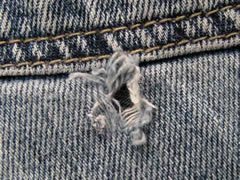
New cotton denim jeans, washed for the first time with three other pairs of similar jeans. Programme: coloureds economy E40, 1200 spin. Detergent: Bold 2-in-1, no other additives or bleach.
The damage shown in the photos below looks different to holes described by many others. These are more like tears or cuts – as though the fabric has been forced through something and cleanly cut. The description accompanying these photos:

“For several months now, I’ve been finding small holes in clothing – mostly in cotton t-shirt type material. At first, I assumed it was something I was doing wrong. I’ve been careful to wash on the right speeds and not fill the drum too full. The holes remain and they appear even in clothing worn only once.”

“I know the holes were not there prior to washing. Some of the holes are small and some almost look like a small tear. It doesn’t seem to matter what brand of clothing – Old Navy, Target, Aeropostale, GAP. This is frustrating!”
(Washer/dryer – drum capacity not reported)
Holes in Polyester and Acrylic Clothing
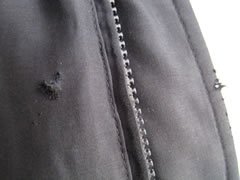
Zanussi ZWF 1221W, 1 year old. Small holes of approximately 1cm appeared in a polyester jacket washed as a single item. Programme: synthetics, 40°C, spin selector at 1200 (resulting in 900rpm actual spin for synthetics). No other items in the drum.
Hole in Bed Sheet

Submitted by Henri. The hole appeared after the sheet’s first wash. Fraying around the edges is consistent with friction or being snagged on a sharp object.
This was the only hole in the sheet, which suggests it may have caught on a sharp object inside the drum – such as the wire from an underwire bra that has worked its way beneath the drum. Objects that get trapped under the drum, particularly near the heating element or its bracket, can snag fabric when centrifugal force pushes it through the drum holes during spin.
Multiple Holes in T-Shirts – Submitted by Jackie


The bottom right photo in particular shows what appears to be a cut – as though fabric has been forced through a hole and cut cleanly. The others are smaller. Jackie’s description:
“Even my Miele (with a honeycomb drum) is causing damage to my laundry, much to my surprise! Did a light, coloured wash yesterday and out came a relatively new t-shirt with a hole at the front just below the neck line. I used a 40 wash with 1200 spin speed – makes no difference in my experience what programme or speed is used. Some holes are fairly tiny, but enough to ruin an item of clothing, others are quite sizeable chunks ripped from the garment. Have now invested in a huge net laundry bag – but we shouldn’t have to use one for every wash, should we?”
The Miele Honeycomb drum design does not have conventional round drum holes, and is specifically engineered to be gentler on fabrics than standard drum designs. It is therefore difficult to attribute holes occurring in a Miele Honeycomb drum directly to the drum design. It may be more accurate to say the holes occurred despite the Honeycomb drum, rather than because of it. As the main causes guide documents, many holes in laundry have causes unrelated to the drum itself.
Further Examples: Small Holes After Washing


Read the full guide on causes
Holes in clothes and possible causes – Small holes in clothes after washing (Washerhelp forum discussion) – Biological detergents can damage woollens and silks
Spin light flashing at end of the cycle
If the spin light is flashing at the end of a wash cycle and the laundry has not been spun, the most likely explanation is that the washing machine’s out-of-balance detection system prevented the spin from taking place. This is not a machine fault – it is a safety feature working as intended.
Not just specific models. The out-of-balance system described here is standard on all modern washing machines. It is particularly associated with the Hotpoint Aquarius WMA30, WMA31, WMA32, and WMA33, where a flashing spin light is the specific indicator used.
Why Does the Washing Machine Refuse to Spin?
Before entering a fast spin, every washing machine goes through a distribution phase. The drum rotates slowly in both directions to settle the laundry and spread it as evenly as possible around the drum. If the load is distributed well enough, the machine proceeds to fast spin. If not, the machine detects the imbalance and aborts the spin.
An unbalanced load during a fast spin can cause the drum to move violently, potentially damaging the machine. The out-of-balance detection system exists to prevent this. When it triggers, the laundry is left wet and the machine indicates that the spin did not complete – typically via a flashing light, though the specific indicator varies by model.
For a full explanation of how out-of-balance detection works and how to load correctly: washing machine won’t spin just one item or very small loads.
What to Do
Open the door, redistribute the laundry more evenly around the drum, and restart the spin cycle. A single item or a very small load is the most common trigger – these are difficult for the machine to balance and often need to be mixed with other items.
Check the instruction manual for the specific indicator the machine uses when it cannot balance a load for spin. Different models use different signals – a flashing light on some, a different method on others.
Not just small or single-item loads – there may be a separate fault. See: washing machine not spinning at end of cycle.
Related guides
Frequently Asked Questions
Why is the spin light flashing and my laundry is still wet?
The washing machine’s out-of-balance detection system has aborted the spin cycle because the load was not evenly distributed around the drum. This is a safety feature, not a fault. Open the door, redistribute the laundry evenly, and restart the spin. This is most common with single items or very small loads.
Is it safe to keep trying to spin an unbalanced load?
The machine will abort the spin again if the load is still unbalanced. Try redistributing the laundry more carefully, or add extra items to the drum to help balance the load. Running a fast spin with a seriously unbalanced load could cause the drum to move violently and damage the machine – the detection system is there to prevent this.
How do I know if this is the cause or if there is an actual fault?
If the machine completes the wash normally but the spin light flashes at the end, out-of-balance detection is the most likely cause. If the machine is refusing to spin any load – not just small or single items – or is stopping at other points in the cycle, there may be a different fault. See: washing machine not spinning at end of cycle.
Why are clothes getting stretched?
Clothes stretching in the wash is almost always caused by using the wrong cycle. Knitwear and delicates need a wool or delicate programme at a low temperature with a reduced spin – not a standard 40°C cotton cycle. Always check the care label before washing, and dry flat or hang gently rather than tumble drying if the label requires it.
Jumpers, cardigans, and other knitwear getting stretched out of shape – especially the sleeves – is a common problem. While build quality plays a role, the most likely cause is incorrect washing or drying. The fix is usually straightforward.
What Causes Clothes to Stretch in the Wash?
Delicate fabrics can be damaged by too much heat, agitation, or spinning. The most common causes of stretching are:
- Ignoring the care label and using the wrong wash cycle
- Washing delicates on a standard cotton cycle at 40°C
- Using a full spin speed on items that require a gentle or no-spin setting
- Tumble drying items that should be dried flat or hung carefully
- Using excessive heat, which weakens fibres over time
The Problem With Using One Programme for Everything
Many people wash most items on the same programme – typically a 40°C cotton cycle with a full spin. It is convenient, and for robust items it often works well. But for knitwear, wool, and delicate fabrics, this approach can shorten the lifespan significantly. Repeated exposure to the wrong cycle gradually weakens fibres, causing garments to lose their shape and sleeves to stretch until they are unwearable.
What Do Wash Symbols Mean?
Modern garments carry specific care symbols for washing, drying, and ironing. These instructions exist precisely to prevent damage, but they are often ignored – particularly once the label has faded or become difficult to read. Learning to recognise the most common symbols before that happens is worth the effort.
See the full guide: what do wash symbols mean?
Check Care Labels Before Buying
Some garments carry restrictive care instructions such as “hand wash only” or “dry flat” – requirements that are simply impractical for many households. Machine washing a hand-wash-only jumper even once can cause the sleeves to stretch badly. Laying items flat to dry, rather than hanging or tumble drying, is another instruction that many people will not routinely follow.
If the washing instructions are impractical for how the household does laundry, the garment is unlikely to last under normal use. Knowing this before purchase helps avoid disappointment later.
Frequently Asked Questions
Why do my jumper sleeves keep stretching in the wash?
The most likely cause is washing on the wrong cycle. Knitwear and wool require a delicate or wool programme at a low temperature, with a reduced spin speed. A standard 40°C cotton cycle with full spin applies too much heat and agitation to delicate fibres, causing them to loosen and stretch over time. Always check the care label and use the appropriate programme.
Can tumble drying cause clothes to stretch?
Yes. Many knitwear and delicate items should not be tumble dried at all. The combination of heat and tumbling action can stretch fibres and deform the garment’s shape. Items that must be dried carefully should either be dried flat on a clean surface or hung very gently. The care label will specify which method is required.
How do I know which wash cycle to use?
The care label on the garment is the most reliable guide. Symbols on the label indicate the maximum wash temperature, whether tumble drying is safe, and whether any special handling is required. See the full explanation: what do wash symbols mean?
Why does washing machine take so long to wash?
Wash cycles are longer because machines now use less water and lower temperatures to meet energy efficiency standards. Less water means rinsing takes longer, and lower temperatures require extended wash times to achieve the same cleaning results. Economy programmes take even longer for the same reason – using less heat means compensating with more time.
Modern washing machines take significantly longer to complete a wash cycle than older models. This is not a fault with any particular brand – all washing machines have become slower over time, and there are clear reasons why.
Why Do Washing Machines Take So Long Now?
Several factors have combined over the years to make wash cycles progressively longer:
- Less water. Modern machines use significantly less water than older ones. Less water makes rinsing less efficient, so rinse cycles have to run for longer to achieve the same result.
- Energy efficiency ratings. The introduction of mandatory energy labels has forced manufacturers to reduce electricity and water consumption. Washing for longer at lower temperatures and with less water is how machines pass these tests.
- Lower temperatures. The shift towards lower wash temperatures requires longer cycle times to achieve equivalent cleaning results. Higher temperatures dissolve and remove soiling faster – lower temperatures need more time and mechanical action to compensate.
- Cold fill only. Most modern washing machines take only cold water and heat it internally, rather than drawing hot water from the household supply. In the UK this has limited impact on most households’ overall wash times, but it is a contributing factor. See: cold fill versus hot and cold fill washing machines.
- Load balancing. Many modern machines go through extended procedures to sense and balance the load before spinning. An unbalanced load can cause repeated balance attempts, adding significant time to the overall cycle.
Ironically, while longer cycles are driven by environmental targets, running a machine for twice as long puts more wear on its components – which is likely to shorten its lifespan and lead to earlier replacement. This is not environmentally beneficial.
Do Not Try to Cut Down Wash Times
Many people find long cycle times frustrating and turn to quick wash cycles or option buttons to reduce them. This approach is counterproductive and can damage the machine over time.
The machine never gets hot enough or runs long enough to clean itself internally. See: causes of grease, slime, black mould, and smells inside washing machines.
One Way to Do More Washing in Less Time
If long cycle times are a genuine problem, buying a washing machine with a larger drum capacity allows more laundry to be washed in each load. Fewer loads per week can offset the longer time per cycle, reducing the overall time spent on laundry without compromising on wash quality.
Why Do Economy Programmes Take Longer?
This is a question that surprises many people. If an economy cycle uses less electricity, how can it also take longer to run?
“How is it that the ‘Economy’ cycles take twice as long as the regular wash? How is that economical? I would have thought that would use more electricity.”
The answer lies in understanding where washing machines actually consume electricity. Heating the water is by far the biggest energy cost – it uses far more electricity than the motor, pump, and controls combined. A machine running with the heater on for just 15 minutes will use considerably more electricity than the same machine washing without heat for several hours.
Economy programmes save energy by using lower temperatures or no heat at all. But because a lower temperature is less effective at cleaning, the machine compensates by washing for longer. Heat pump tumble dryers work on the same principle – recycling warm air rather than generating fresh heat is more efficient, but the lower thermal output requires a longer drying time. So economy cycles take longer but use less electricity overall.
Frequently Asked Questions
Why does my washing machine take so long to wash?
Modern washing machines use less water and lower temperatures to meet energy efficiency standards. Less water makes rinsing less efficient so rinse cycles run longer. Lower temperatures require extended wash times to achieve the same cleaning results. Load balancing procedures can also add time. This applies to all modern washing machines, not any specific brand.
Why do economy wash cycles take longer than normal cycles?
Economy cycles save electricity by using lower temperatures. Heating water is by far the biggest energy cost – running the motor and pump for a long time uses far less electricity than heating water for a short time. A lower temperature is less effective at cleaning, so the machine compensates by washing for longer. The result is a longer cycle that uses less electricity overall.
Is it OK to use quick wash cycles all the time?
No. Regularly using quick, short, or very low temperature cycles prevents the machine from ever running hot enough to clean itself internally. Over time this causes a build-up of grease, detergent residue, and black mould inside the drum, door seal, and pipes. Using a full temperature cycle regularly – at least once a week – helps prevent this. See: washing machine smells and black mould.