
Washing at 30 degrees 5 things you need to know
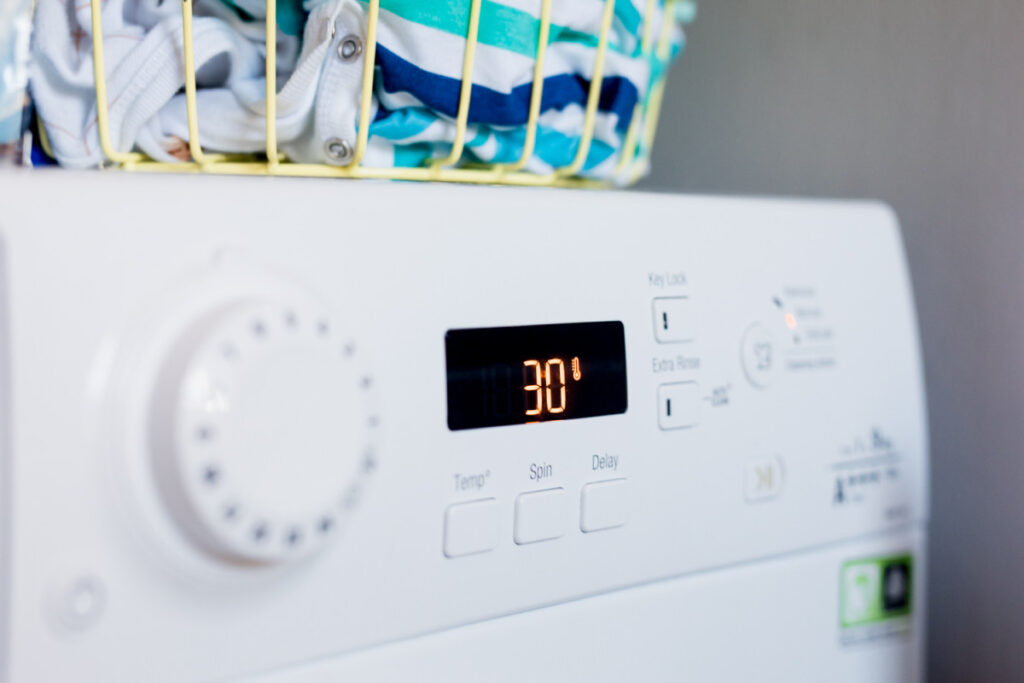

Washing at 30 degrees can save energy, but the savings per wash are smaller than headline percentages suggest. More importantly, washing exclusively at low temperatures can cause grease, slime, and bacteria to build up inside the machine over time, requiring hot maintenance washes that consume energy and potentially shortening the machine’s life. Understanding these trade-offs allows you to use low temperature washing sensibly rather than blindly.

If a garment label specifies 30 degrees, wash at that temperature regardless of this guide. Ignoring wash care labels can permanently damage fabric. The points below apply to everyday cottons and mixed loads where you have a choice of temperature.
1. Does your washing machine actually wash properly at 30 degrees?
Most washing machines have a 30 degree cycle, but not all 30 degree cycles are the same. Before assuming the machine will wash normal laundry properly at this temperature, it is worth checking what type of 30 degree programme your machine actually offers.
Many machines have a 30 degree setting that is designed specifically for delicates. A delicates cycle is short, uses a very gentle drum action, and ends with a slow spin. This is not suitable for cottons or heavier mixed loads, it will not clean them properly.
To wash everyday laundry effectively at 30 degrees, the machine needs either a dedicated 30 degree cottons programme, or the ability to manually select 30 degrees on a standard cottons wash cycle. Check the instruction manual to confirm which type of 30 degree programme your machine offers and what laundry types it is designed for before switching.
Check the programme guide for the 30 degree setting: what types of laundry is it designed for, and what is the final spin speed? A full-speed spin on a proper cottons programme is a good sign. A slow or gentle spin suggests the 30 degree cycle is intended for delicates only.
2. Do low temperature washes have real limitations?
Washing at 30 degrees works well for lightly soiled everyday laundry. It has genuine limitations that are worth understanding before relying on it as your default temperature.
 Heavy stains
Stubborn stains such as dried food with strong colour, thick grease, heavy mud, or grass are unlikely to be removed at 30 degrees. They need either a higher temperature wash or pre-treatment (soaking with detergent or a stain remover) before going in the machine. Washing a heavily stained item at 30 degrees and then having to wash it again at 40 or 60 uses more energy overall than washing it at the right temperature once.
Illness and hygiene items
Laundry from someone who has been ill – underwear, bedding, towels – should be washed at the highest temperature the fabric care label allows, not 30 degrees. Low temperature washes do not kill bacteria and viruses effectively. The same applies to heavily soiled items, cloth nappies, and anything used in contact with raw food.
If you do wash at 30 degrees regularly, treat stains promptly. A fresh stain that might wash out at 30 degrees can become fixed and permanent once it has dried. Pre-treating or rinsing stains before they dry significantly improves results at low temperatures.
3. How much energy do you actually save?
Industry testing has shown that washing at 30 degrees uses around 40% less electricity per cycle than washing at higher temperatures. This sounds significant. In practice, the absolute saving per wash is modest, because the amount of energy a washing machine uses per cycle is already relatively low.
To understand what a percentage saving means in real terms, it helps to look at the actual energy consumption involved. Independent testing has found that the average energy used per wash at 30 degrees is substantially less than at 40 or 60 degrees, but even the difference between 30 and 40 degrees typically amounts to a fraction of a kilowatt-hour per cycle.
At current UK electricity prices, the saving per wash when dropping from 40 to 30 degrees is likely to be only a few pence. Over a year of regular washing that may add up to a few pounds, real money but not the dramatic saving that percentage figures imply.

While the saving per household is modest, if adopted widely the aggregate energy and carbon saving across millions of households is genuinely significant. This is why low temperature washing is promoted by energy and environmental bodies. The societal benefit is much larger than any individual saving.
4. Can washing mostly at 30 degrees damage your machine?
This is the most important point and the one least often mentioned in low temperature washing promotions. Consistently washing at low temperatures causes a progressive build-up of grease, bacteria, soap residue, and black mould inside the machine: in the drum, door seal, sump hose, and internal components.
At higher temperatures, grease and soap residue are dissolved and flushed away. At 30 degrees, they accumulate. This is already a recognised problem for people who wash mostly at 40 degrees. Washing at 30 degrees makes it significantly worse, particularly if liquid detergent is used (which leaves more residue than powder) or if “colour-friendly” detergents are used that lack the enzymes and surfactants needed to clean the machine itself.

Run an empty drum wash at 60 or 90 degrees at least once a month to flush out grease, bacteria, and slime. Without this, the machine will develop smells and internal deterioration that can shorten its working life significantly. See our full guide: causes of grease, slime and black mould inside washing machines.
This creates a genuine trade-off: the energy saved by washing at 30 degrees is partially or fully offset by the energy used in regular maintenance washes. If maintenance washes are neglected, the machine deteriorates, which may lead to earlier replacement, which has a far larger environmental and financial cost than the energy saved by years of low temperature washing.
5. Does low temperature washing only make sense with full loads?
A small load at 30 degrees uses proportionally more water, detergent, and machine wear per item washed than a full load at 40 degrees. If you only have a few items that can be washed at 30 degrees and cannot wait for a full load, it is almost certainly more economical to add them to a normal 40 degree cottons wash.
The energy saving from low temperature washing is based on full load comparisons. Washing small loads frequently at any temperature is wasteful. The environmental and financial case for low temperature washing depends on washing full loads every time.
How do you use low temperature washing sensibly?
None of this means washing at 30 degrees is a bad idea. It means it works best when used thoughtfully rather than as a blanket switch.
 Check your machine has a proper 30 degree cottons programme, not just a delicates cycle.
- Use 30 degrees for lightly soiled, everyday laundry where lower temperature is genuinely sufficient.
- Treat stains before they dry to give low temperature washes a reasonable chance of removing them.
- Wash heavily soiled items, illness laundry, and hygiene items at higher temperatures regardless of the general setting used.
- Run a maintenance wash at 60 or 90 degrees at least monthly, with an empty drum and a machine cleaner or a small amount of detergent.
- Always wash full loads to maximise the efficiency of any temperature setting.
Looking for an energy-efficient washing machine?
If saving energy is a priority, the choice of machine matters as much as the temperature setting. Our guide covers what to look for.
Frequently asked questions about washing at 30 degrees
Does washing at 30 degrees actually save money?
Yes, but less per wash than the headline percentages suggest. The percentage saving is real, but because the absolute energy consumption per cycle is relatively low, the saving per wash amounts to only a few pence. Over a full year it may add up to a few pounds. The saving can be partially or fully offset if you need to run regular maintenance washes at high temperature to keep the machine clean and healthy.
Will my washing machine wash properly at 30 degrees?
It depends on the machine. Most machines have a 30 degree setting, but some are designed for delicates only – a short, gentle cycle with a slow spin that will not clean cottons adequately. Check the instruction manual to confirm whether the 30 degree programme is suitable for everyday laundry, or whether you can manually select 30 degrees on a normal cottons cycle.
Can washing at 30 degrees damage my washing machine?
Not directly, but washing at low temperatures consistently without regular maintenance washes at high temperature leads to a build-up of grease, soap residue, bacteria, and black mould inside the machine. This causes smells, can contaminate laundry, and may shorten the machine’s life. A monthly maintenance wash at 60 or 90 degrees (empty drum) prevents this.
What temperature should I wash at if someone in the house has been ill?
Wash laundry from an ill person at the highest temperature the care label on the garment allows. Low temperature washes do not reliably kill bacteria and viruses. The same applies to towels, bedding, cloth nappies, and anything used for food preparation or in contact with raw food.
How often should I do a maintenance wash if I mostly wash at 30 degrees?
At least once a month. Run the machine empty at 60 degrees (or 90 degrees if the machine allows) with a small amount of detergent or a washing machine cleaner. This dissolves grease and kills bacteria that accumulate at low temperatures. If the machine develops a musty or unpleasant smell, increase the frequency. See our guide: washing machine smells.
Does washing at 30 degrees work with all detergents?
Most modern detergents are formulated to work at lower temperatures and contain enzymes that activate at 30 degrees. However, some older or more basic formulations perform better at higher temperatures. Check the detergent packaging to confirm it is effective at 30 degrees. Powder detergents generally leave less residue in the machine than liquids, which can be a consideration if washing predominantly at low temperatures.
What is the lowest temperature that still kills bacteria?
Domestic washing temperatures of 60°C or above provide reliable disinfection for most common laundry-borne bacteria when combined with detergent. NHS infection-control guidance for healthcare laundry uses 65°C for 10 minutes or 71°C for 3 minutes as the disinfection threshold. At 40°C or below, bacterial and viral reduction is significant but not reliable for hygiene purposes. For ordinary household laundry this matters less, but for illness, cloth nappies, or items contaminated with raw food, 60°C is the practical minimum.
Ask the repair forum
Post the make, model and symptoms and get help from the Whitegoods Help community.
3 Comments
Grouped into 2 comment threads.
0 replies Well said Andy. No point using low (or as the ads go low low) temperatures if it knackers your machine prematurely but you try to tell the soap detergent manufacturers that as it would not surprise me to find that they`re working directly in cohoots with appliance manufacturers to shorten the life of washing machines for repeat sales. I was in this industry for decades so that would not surprise me one jot.
1 reply This is disturbing reading . My daughter recently did a 30 degree wash to find in covered in a foul looking mess ruining several items . We’re always being told to use 30 where possible now read this. An ruin your washing machine . An explanation would be welcome
This is disturbing reading . My daughter recently did a 30 degree wash to find in covered in a foul looking mess ruining several items . We’re always being told to use 30 where possible now read this. An ruin your washing machine . An explanation would be welcome
Likely replying to Maggie
Hello Maggie. Unfortunately this type of thing is rife. People never look at the full picture. What is the point in saving a few pence per wash only to have your washing machine ruined and be scrapped prematurely? It’s the same with eco wash cycles on dishwashers and washing machines? They use less energy but sometimes take up to 3 times longer. So what is saved on energy (or lower water usage) is undermined by the extra wear and tear on the motor and all moving parts.
Say a motor is designed to last for 3000 hours of life and you mostly use eco wash cycles that take at least twice as long. That means the motor is potentially going to last half as long, or at least have significantly more wear. So when it fails or wears out years prematurely you will most likely have to scrap the washing machine because it’s too expensive to replace.
Whenever anyone comes up with a way to save energy or water they need to work out at what cost. However, if saving energy and allowing companies to advertise that their products cost less to run results in many more sales they aren’t likely to car or may even be smirking that the appliance is likely to break down more or wear out quicker. If we want to save the planet we have to look at everything holistically.
Well said Andy. No point using low (or as the ads go low low) temperatures if it knackers your machine prematurely but you try to tell the soap detergent manufacturers that as it would not surprise me to find that they`re working directly in cohoots with appliance manufacturers to shorten the life of washing machines for repeat sales. I was in this industry for decades so that would not surprise me one jot.