
Hoover Tumble Dryer Fire Warning: What Owners Need to Know
A coroner has linked a fatal fire to a Hoover condenser tumble dryer. What the report says, what Haier and OPSS say, and what Hoover and Candy owners should do.
Guidance compiled by Whitegoods Help from the coroner’s report and the published responses from Haier UK and the Office for Product Safety and Standards. Last updated 22 October 2026.
There is a separate, formal safety notice covering built-in heat pump tumble dryers sold under the Haier, Hoover, Candy, Baumatic, Caple, Iberna, Lamona and Montpellier brands between 2019 and 2024. That notice tells owners to stop using the dryer until it has been modified. The coroner’s report covered on this page is about condenser dryers and is not a safety notice. Our guide to tumble dryer fire risk safety notices explains how to check whether your heat pump dryer is affected.
01What happened in Heckmondwike?
In the early hours of 8 June 2025 a fire broke out at a family home on Russell Close, Heckmondwike, West Yorkshire. Sohaib Ahmed, aged 38, and his nine-year-old daughter Manahal died. Another daughter was seriously injured but survived.
The inquest, which concluded on 24 July 2026, found that the fire was more likely than not started by a Hoover-branded condenser tumble dryer in the kitchen. The model was identified as the DX C10DCER-80, a 10kg condenser dryer.
The exact way the fire started could not be established. The coroner found the evidence could not determine whether ignition resulted from electrical tracking, a defective solder joint, a heater relay failure or another internal electrical fault. Two experts also told the inquest that this type of dryer may burn almost completely once a fire becomes established, making the original defect extremely difficult to identify afterwards.
The coroner’s stated worry is that this may point to a potentially serious failure mechanism that cannot be identified from the available evidence, and therefore cannot readily be prevented.
02What did the coroner find and ask for?
HM Senior Coroner for West Yorkshire (Western), Martin Fleming, issued a Prevention of Future Deaths report on 11 August 2026. It was published on the judiciary website on 19 October 2026, which is why it reached the national press this week.
The report was sent to Haier Smart Home UK & I Limited (Haier UK), the importer of Hoover and Candy appliances into the UK, and to the Office for Product Safety and Standards (OPSS), the government product safety regulator. Both were required to respond within 56 days.
What were the coroner’s three concerns?
-
A root cause analysis of this model.
The coroner asked whether Haier should examine other incidents involving the DX C10DCER-80 to identify any recurring failure modes, and whether design changes, technical service bulletins or a recall or safety campaign are needed.
-
A similar analysis of related dryers.
He asked whether the same exercise should be carried out across similar Hoover and Candy condenser and vented tumble dryers to establish whether they present a risk needing corrective action.
-
Whether sales of this model should be halted.
He asked whether it was appropriate to stop selling the DX C10DCER-80 pending the root cause analysis and any assessment by OPSS.
The coroner also said it was his understanding that OPSS had received a significant number of fire notifications from UK fire services involving this model. No figure has been published by the coroner, by Haier or by OPSS, and Haier disputes the point, as explained below.
How did events unfold?
8 June 2025
House fire at Russell Close, Heckmondwike. Two deaths, one serious injury.
24 July 2026
Inquest concludes the fire more likely than not started in the Hoover DX C10DCER-80 condenser dryer. Cause of ignition not established.
11 August 2026
Coroner issues Prevention of Future Deaths report to Haier UK and OPSS.
6 and 7 October 2026
Haier UK and OPSS submit their written responses.
19 to 21 October 2026
Report and responses published on the judiciary website. National and regional press coverage follows.
03Does the 1.6 million figure mean 1.6 million dryers are dangerous?
No, and this is where some of the headlines have gone further than the report. The coroner wrote that around 1.6 million current Hoover and Candy branded condenser or vented tumble dryers “may share this model’s characteristics”. That is a statement about how many machines are built on similar designs, not a finding that they are all faulty.
Neither Haier nor OPSS repeats or confirms the 1.6 million figure in their published responses, and no list of affected models has been published by anyone.
Several reports have said the coroner urged 1.6 million dryers to be “pulled” or withdrawn. He did not. He asked Haier to consider halting sales of one specific model, the DX C10DCER-80, and to consider investigating the wider range. Haier says production of that model ended by the first quarter of 2022, and OPSS says it understands the model is no longer available to buy in the UK.
A coroner must issue one whenever an inquest reveals a risk of future deaths and the coroner believes action could reduce it. It is a formal request for organisations to consider taking action. It is not a product recall, a regulatory finding or a court ruling that a product is defective, and it does not oblige the recipient to do anything beyond replying.
04What has Haier said?
Haier UK responded on 6 October 2026 in a nine-page letter it asked to be published in full. It says it has substantially completed a root cause analysis covering the DX C10DCER-80 and the wider condenser dryer platforms it describes as Infinity, pre-Infinity and EOLO. The DX C10DCER-80 sits on the Infinity platform, introduced in 2018 and manufactured until the first quarter of 2022. Vented dryers were left out because Haier says they have a different safety profile.
On the coroner’s point about fire notifications, Haier says the list of fire service notifications it received from OPSS contains no entry for the DX C10DCER-80 other than the Heckmondwike fire itself, which OPSS’s data records as DXC10DCERNFC. Haier believes the “significant number” of notifications referred to at the inquest concerned condenser tumble dryers generally, not this model.
Haier says there are no other safety incidents where it is certain this model was involved. One other fire involved a dryer the owner believed was a DX C10DCER-80, bought through eBay, but the model could not be confirmed. Haier says an independent expert review of that fire concluded it was most likely caused by lint igniting after inadequate cleaning of the filter or condenser.
Its analysis focused mainly on the main control board (PCB). Haier reports that PCB replacement rates are low, stable and falling, that its quality and manufacturing defect logs contain no entries for cracked boards or weak solder joints, and that no other incident shows tracking damage at the same point on the board.
In thermal testing, the hottest point on the board, around the heater relay, reached 80°C during a 70-minute cycle and 81.8°C during an extended 3 hour 40 minute cycle. With the supply voltage raised 10% above its normal range and solder joints deliberately weakened, the peak was around 83°C. The board material is rated to at least 130°C. Haier estimates lint needs around 250°C to ignite and says further testing on that point is still under way.
Separately, Haier says a risk assessment it carried out voluntarily with OPSS in the second quarter of 2026 placed PCB and connector failures in its lowest risk tier, but placed lint-induced failure in the middle tier, meaning the control relies on owners cleaning filters as instructed. It acknowledges that lint build-up is an inherent fire risk in condenser dryers from every manufacturer.
Haier’s conclusion, subject to final testing, is that the failure mechanisms the coroner raised do not show a widespread, replicable or systemic safety issue. It has decided it is not appropriate to halt sales of the model or similar models, and the model has not been subject to any recall, technical service bulletin, design change or safety campaign. It says it will keep monitoring and take corrective action if that becomes appropriate.
05What has OPSS said?
OPSS responded on 7 October 2026, signed by its Deputy Chief Executive, and its position is noticeably more cautious than Haier’s. It confirms that it opened a regulatory investigation into Haier UK’s compliance with product safety law earlier in 2026. That investigation covers reported fire incidents over recent years, Haier’s monitoring and failure analysis, recurring failure modes, and potential evidence of offences.
OPSS says it wrote to Haier UK in December 2025 setting out an expectation that the company would determine the root causes of tumble dryers linked to two fatal fires, including this one. It says it has not seen any root cause information from Haier for the model involved in the Heckmondwike fire, and that producing it is vital because many of these appliances remain in people’s homes.
OPSS asked Haier for incident and failure data across condenser and vented dryers that share design and manufacturing characteristics with the DX C10DCER-80, and received risk assessments in July 2026. It says it is still in discussion with Haier about how much confidence in product safety those assessments can provide.
OPSS also says it is engaged in other inquests involving Haier tumble dryers, including one at East London Coroner’s Court that concluded on 25 September 2026 and one opened in Manchester. It does not say which models or dryer types those inquests concern.
OPSS has the power to require corrective action, including restricting supply, withdrawal or recall, where a product does not conform with the regulations and the business has not acted. It says it will keep reviewing the evidence as a priority and will assess whether recall, withdrawal, suspension of sales or other action is appropriate for this and any other model as the evidence develops. No such action has been announced.
OPSS is also starting a wider, manufacturer-neutral study of condenser, vented and heat pump tumble dryers, including product testing and a look at whether the designated safety standard for tumble dryers needs review. The product safety minister, Kate Dearden MP, has arranged a meeting with Haier UK’s recently appointed managing director to reinforce the government’s expectations. A government spokesperson quoted by ITV News said ministers expect Haier UK to establish the root cause and will hold the company to account.
06What are repair engineers saying?
In discussion among UK appliance repair engineers this week, three themes came up repeatedly. None of them is a finding of fact about the Heckmondwike fire, but they reflect what engineers see when they strip these dryers down, and they add a practical angle that the official documents do not cover.
Lint gets past the filter
On condenser dryers with a conventional coil heater, fluff can gather behind the drum and around the heater housing, where the owner cannot see or reach it. Several engineers said they routinely find the heater panel coated in fluff on Hoover and Candy condenser dryers of this era.
Comparison with the Hotpoint and Indesit campaign
Some engineers drew a comparison with the Hotpoint and Indesit dryers that were the subject of a long-running fire risk campaign, where lint could reach the heater. That is their opinion based on experience, not an established fact, and no regulator has made that link.
A mesh guard over the heater
Engineers would like to see a metal mesh guard fitted over the heater element on all coil-heater dryers to stop fluff reaching it. No such requirement exists in the current safety standard, and OPSS has said it will look at whether that standard needs reviewing.
Built-in dryers and kitchen fitting
For integrated dryers, engineers pointed to installations where a kickplate covers the air intake and dust from under the units is drawn into the machine. They argue that built-in dryers should have an accessible service panel and a stated servicing interval, and that kitchen fitters should be made aware of the ventilation requirements.
The practical conclusion from all of this is the same. Cleaning the filter after every load is essential but it is not enough on its own. A condenser dryer that is more than a few years old benefits from having the heater area and internal ducting cleaned out by an engineer, and that applies to every brand, not just Hoover and Candy.
Not sure which type of tumble dryer you own, or whether it is covered by a safety notice?
Condenser, vented and heat pump dryers work differently and carry different risks. Our guides explain how to tell them apart and how to check every current UK tumble dryer safety notice against your model.
07Is there a recall for Hoover or Candy condenser tumble dryers?
No. As of 22 October 2026 there is no recall, no OPSS safety notice and no stop-use instruction for any Hoover or Candy condenser or vented tumble dryer. The DX C10DCER-80 does not appear on the government product safety database and Haier has not issued a notice for it.
That is very different from the heat pump dryer programme run by the same company, which many readers are mixing up with this story. The table below sets out the difference.
| Issue | Condenser dryer coroner’s report | Heat pump dryer safety notice |
|---|---|---|
| Dryer type | Condenser (and the coroner mentions vented) | Built-in heat pump |
| Brands | Hoover, Candy | Haier, Hoover, Candy, Baumatic, Caple, Iberna, Lamona, Montpellier |
| Model named | DX C10DCER-80 (made 2018 to early 2022) | Specific models made December 2019 to May 2024 |
| Status | Coroner’s report, OPSS investigation ongoing | Formal safety notice with stop-use instruction |
| Official advice | None issued beyond normal cleaning and use guidance | Stop using, unplug if accessible, book the free modification |
| How to check | No checker exists; find your model number on the rating plate | Serial number checker at productsafety.haier.co.uk |
If you own a built-in heat pump dryer from any of those brands, check it now using our guide to tumble dryer fire risk safety notices. If you own a Hoover or Candy condenser or vented dryer, read on.
08How do I find my tumble dryer’s model number?
The model number is printed on the rating plate, a sticker that is usually found inside the door opening when you open the dryer door, or on the back of the machine. On most Hoover and Candy dryers it also carries a 16-digit serial number and a production date.
Hoover condenser dryer model numbers in this range typically start with letters such as DX C, DXC, HL C or HLEC followed by the capacity in kilograms. The dryer in the Heckmondwike case was a DX C10DCER-80, although Haier notes that OPSS’s incident data recorded it as DXC10DCERNFC, so the same machine can appear under slightly different model codes. Write down the full code exactly as printed, because it will matter if Haier or OPSS later publish a list of affected models.
If a safety notice is issued in future, manufacturers can only contact owners they know about. You can register most brands free of charge at registermyappliance.org.uk, run by the appliance industry body AMDEA, or directly with Hoover or Candy.
09What should Hoover and Candy condenser dryer owners do now?
No authority has told owners to stop using these dryers, and Whitegoods Help is not going to tell you to either. What Haier’s response and the fire services agree on is that lint build-up is the most common cause of tumble dryer fires across every brand, and that is something every owner can control.
-
Clean the fluff filter after every single load.
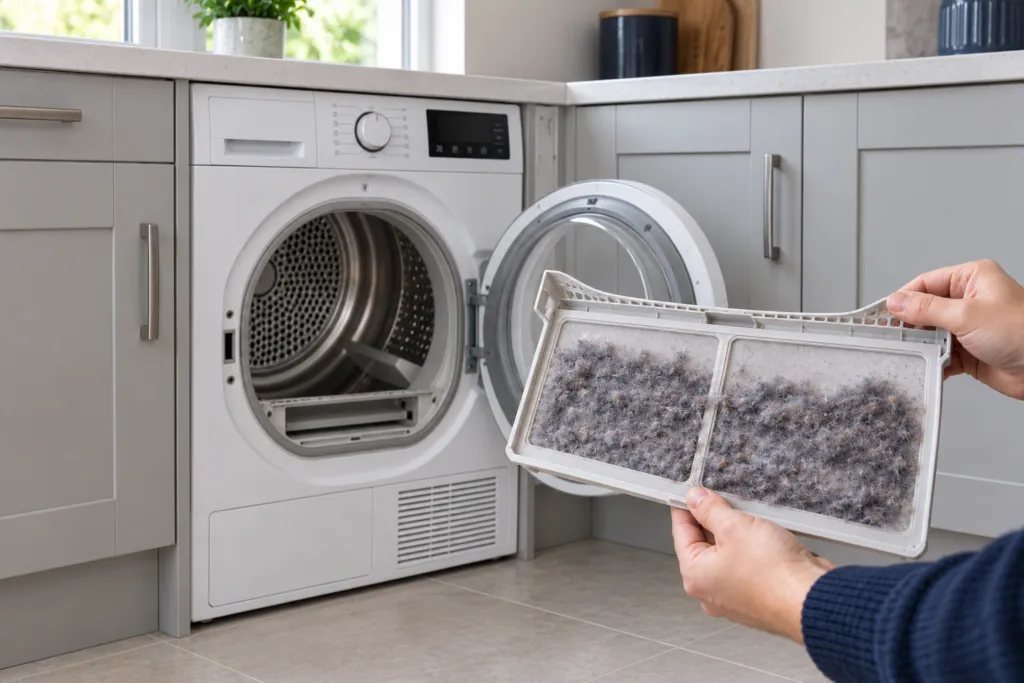
Pull it out, strip the lint off by hand and check the slot it sits in. A blocked filter forces the dryer to run hotter and for longer, and is the single biggest fire risk in any dryer. See why a blocked filter is a tumble dryer fire risk.
-
Clean the condenser unit at least monthly.
On a condenser dryer the heat exchanger at the bottom front collects lint that gets past the filter. Slide it out, rinse it under a tap until the water runs clear, let it dry and refit it. If the dryer is more than a few years old, have an engineer clean out the heater area and internal ducting too, because that is where lint collects out of reach.
-
Never run the dryer overnight or when the house is empty.
Both deaths in Heckmondwike occurred in the early morning. If a fire starts while you are asleep or out, there is nobody to act. Fire services across the UK give this advice for every dryer, whatever the brand.
-
Let the cool-down cycle finish.
Do not stop the dryer mid-cycle and leave hot clothes inside the drum. Our guide explains why you should not stop a tumble dryer mid-cycle.
-
Check for warning signs.
If you notice any of the signs in the checklist below, stop using the dryer and have it inspected before using it again. See tumble dryer tripping the electrics for one of the most common.
-
Register the dryer and note the model number.
That way you will be contacted directly if Haier or OPSS announce any action, rather than relying on news reports.
What are the warning signs of a tumble dryer fire risk?
- A burning or hot plastic smell during or after a cycle
- Clothes coming out unusually hot, or the outer casing hot to the touch
- The dryer tripping the electrics or the RCD
- Scorch marks or discolouration around the filter slot, door seal or back panel
- Cycles taking much longer than they used to, which points to restricted airflow
- Fluff appearing around the back of the drum or inside the door opening after the filter has been cleaned
Do not open the door. Opening it feeds the fire with oxygen. Switch the dryer off at the wall if you can do so safely, get everyone out of the house and call 999. Do not go back inside for belongings.
10Can I return or replace my Hoover or Candy condenser dryer?
Because no safety notice has been issued, there is currently no free repair, modification or replacement scheme for these dryers, and retailers are not obliged to take them back on the strength of the coroner’s report alone.
Your normal rights still apply. If your dryer develops a fault, the Consumer Rights Act 2015 gives you a claim against the retailer for up to six years in England, Wales and Northern Ireland, and five years in Scotland, provided you can show the fault was present at the time of purchase. Read our guide to consumer rights for appliances.
If you decide you would rather not keep a condenser dryer regardless, that is a personal choice rather than a legal remedy. Our comparison of heat pump, vented and condenser tumble dryers explains the differences, including why heat pump dryers run at lower temperatures.
Should Haier or OPSS announce a recall or safety campaign later, the remedy offered will normally be free of charge whatever the age of the appliance. We will update this page if that happens.
Worried about a tumble dryer that smells hot, trips the electrics or takes too long?
A qualified engineer can check the heater, thermostats, wiring and condenser for lint build-up and heat damage before a minor fault becomes a serious one. Find a local appliance engineer through Whitegoods Help.
11Safety notice
Tumble dryers contain a mains-powered heater, motor and control board. Always unplug the dryer before cleaning the condenser or removing any panel. Do not attempt to inspect or repair the heater, wiring or control board yourself unless you are competent to do so. If the dryer trips the electrics, smells of burning or shows any scorching, stop using it and have it checked by a qualified engineer.
You can check whether any appliance you own is subject to a recall on the government product safety alerts, reports and recalls service. See also our DIY repair safety advice.
12Frequently asked questions
Has the Hoover DX C10DCER-80 tumble dryer been recalled?
No. As of October 2026 there is no recall, safety notice or stop-use instruction for the DX C10DCER-80 or any other Hoover or Candy condenser tumble dryer. The coroner has asked Haier UK and OPSS to investigate, and OPSS has an open regulatory investigation, but no corrective action has been announced. The model stopped production in early 2022.
Should I stop using my Hoover or Candy condenser tumble dryer?
No official body has advised owners to stop using these dryers. Haier says its testing has not found a systemic fault and OPSS has not issued a notice. The sensible precautions are to clean the filter after every load, clean the condenser monthly, never run the dryer overnight or when out, and stop using it immediately if it smells of burning, trips the electrics or shows scorching.
What does the 1.6 million tumble dryers figure actually mean?
The coroner said around 1.6 million current Hoover and Candy condenser or vented dryers may share the characteristics of the DX C10DCER-80. It is an estimate of how many machines use similar designs, not a finding that they are faulty. Haier and OPSS have not confirmed the figure, no list of models has been published, and the coroner did not ask for 1.6 million dryers to be withdrawn.
Is this the same as the Haier heat pump tumble dryer safety notice?
No. The heat pump notice is a formal safety programme covering built-in heat pump dryers sold under Haier, Hoover, Candy, Baumatic, Caple, Iberna, Lamona and Montpellier brands between 2019 and 2024. Those owners are told to stop using the dryer and book a free modification. The coroner’s report concerns condenser dryers and no equivalent notice has been issued.
How do I find out if my tumble dryer is affected?
Find the rating plate inside the door opening or on the back of the dryer and note the full model number and serial number. There is currently no checker for condenser dryers because no models have been declared affected. Register the appliance at registermyappliance.org.uk or with the manufacturer so you are contacted if that changes. Heat pump dryer owners can use the serial checker at productsafety.haier.co.uk.
What is the most common cause of tumble dryer fires?
Lint build-up. Fluff that collects in the filter, the condenser and the ducting is highly flammable and can ignite if it is exposed to a hot heater, a faulty component or an electrical fault. Haier and UK fire services both identify lint as the leading cause of dryer fires across every brand. Electrical faults in heaters, thermostats and control boards are the next most common cause.
13Sources
This article is based on the primary documents rather than press reports. Whitegoods Help read the coroner’s report and both responses in full, and figures and quotations are taken from the following, all accessed on 22 October 2026.
- Sohaib Ahmed and Manahal Ahmed: Prevention of Future Deaths report, ref 2026-0417, Courts and Tribunals Judiciary, dated 11 August 2026, published 19 October 2026
- Response from Haier Smart Home UK and I Limited, 6 October 2026
- Response from the Office for Product Safety and Standards, 7 October 2026
- ITV News Calendar: Coroner’s concerns over Hoover tumble dryer after Heckmondwike fire deaths, 21 October 2026
- London Fire Brigade: stop using certain heat pump tumble dryers, 22 October 2025 (heat pump programme, for comparison)
- Product safety alerts, reports and recalls, GOV.UK
Still not fixed?
Here’s where to go next.
0 Comments