
Cooker Hoods: The UK Buying, Fitting and Maintenance Guide (2026)
The honest UK cooker hood guide. Ducted vs recirculating, extraction rates, filter changes, installation and the facts the retailers skip. Updated 2026.
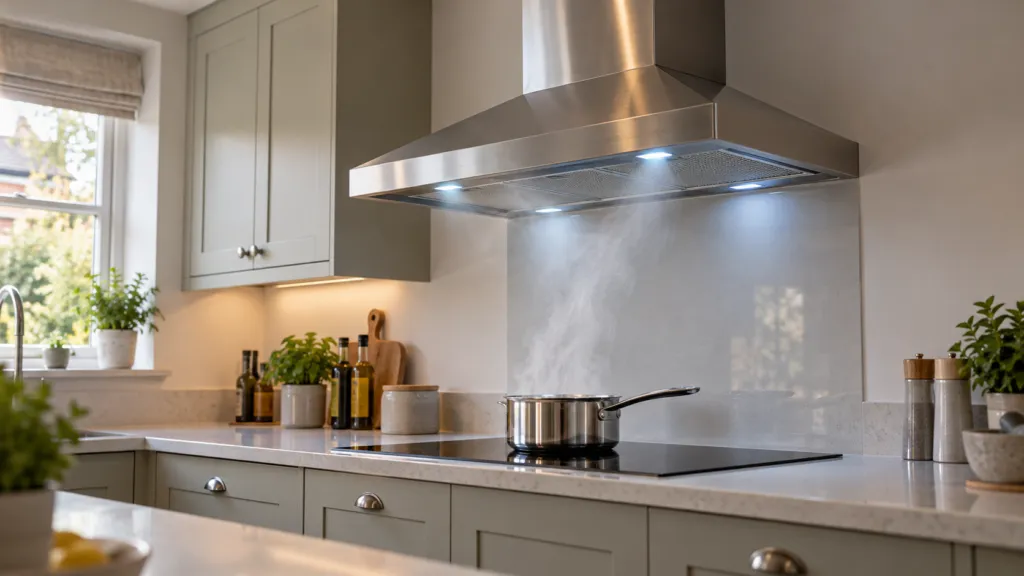
01What does a cooker hood actually do?
A cooker hood (also called an extractor hood or extractor fan when installed over a hob) has one main job: remove the airborne by-products of cooking before they damage your kitchen. Those by-products are more problematic than most households realise. Frying, roasting and even boiling release a continuous mix of microscopic grease droplets, steam, smoke and strong odours. Without extraction, all of it settles on wall paint, ceiling plaster, cabinet fronts, soft furnishings and the inside of nearby lampshades. Over months and years, this builds into the yellow-brown film that aged kitchens accumulate even when they are regularly cleaned.
Beyond the aesthetic argument, there is a health and safety one. Modern gas and induction cooking both generate ultrafine particulate matter during normal use, particularly when searing or stir-frying at high temperature. Research from DEFRA and Imperial College has documented that indoor PM2.5 levels during cooking regularly exceed outdoor air quality guideline limits. An effective extractor is one of the simplest household interventions available to control this.
A cooker hood that is properly specified, correctly fitted and actually used during cooking removes most of the grease, most of the steam, and almost all of the smoke and smells. One that is undersized, poorly fitted, or only switched on when the kitchen is already full of smoke does only a fraction of its job. Getting the specification right matters more than most consumers realise.
02Ducted or recirculating? The single most important choice
Every cooker hood is either ducted (vents the extracted air to outside the building through a run of pipework) or recirculating (filters the air through a charcoal filter and returns it to the kitchen). The same physical hood can often operate in either mode, selected during installation. Choosing correctly between the two makes more difference to real-world effectiveness than any other decision.
| Factor | Ducted (vented outside) | Recirculating (charcoal filter) |
|---|---|---|
| Grease, steam, smoke, smell removal | Removes almost entirely from the kitchen | Removes some, leaves most steam behind |
| Real-world effectiveness | Significantly higher at every rated spec | Noticeably weaker at the same spec |
| Ongoing running cost | No charcoal filter replacement needed | £15 to £40 per filter set, every 3 to 6 months |
| Noise | Quieter at equivalent extraction rate | Louder because air is forced through a filter |
| Building Regulations fit | Required for new build gas hob installations in most cases | Only suitable where ducting outside is impractical |
| When to choose it | Whenever ducting outside is physically possible | Only when ducting is genuinely not possible (interior kitchens, listed buildings, flats with no suitable external wall) |
Recirculating hoods are often installed by default because they are quicker and cheaper to install than running proper ducting to the outside. Households end up with a hood that looks the same but performs significantly worse than the ducted version they could have had. If you are specifying a new kitchen, insist on ducted installation unless the fitter can clearly explain why it is not physically possible. The additional installation cost (typically £100 to £250) pays back in effectiveness over the hood’s life.
03What extraction rate do you need?
Cooker hood extraction rates are measured in cubic metres per hour (m³/h), representing the volume of air the hood can move at its highest setting. Published figures range from around 150 m³/h on cheap basic hoods to 1,000 m³/h or more on premium units. Choosing the right rate for your kitchen matters because an undersized hood cannot keep up with real-world cooking regardless of how expensive it looks.
The industry rule of thumb is that a cooker hood should be able to exchange the air in the kitchen 10 times per hour during intensive cooking. The calculation is straightforward.
Kitchen volume (length x width x height, in metres) multiplied by 10 equals the minimum extraction rate in m³/h.
Example: a 4m x 3m kitchen with a 2.4m ceiling has a volume of 28.8 m³. Multiplied by 10 gives 288 m³/h as the minimum needed extraction rate at full power.
Add 20 percent for gas hob installations because gas combustion releases additional moisture and combustion products that need removing on top of normal cooking by-products.
| Kitchen size | Minimum rate (electric hob) | Minimum rate (gas hob) | Realistic buying target |
|---|---|---|---|
| Small kitchen (under 15 m³) | 150 m³/h | 180 m³/h | 300 to 400 m³/h |
| Medium kitchen (15 to 30 m³) | 150 to 300 m³/h | 180 to 360 m³/h | 400 to 600 m³/h |
| Large kitchen (30 to 50 m³) | 300 to 500 m³/h | 360 to 600 m³/h | 600 to 800 m³/h |
| Open plan kitchen (over 50 m³) | 500 m³/h and above | 600 m³/h and above | 800 to 1,000 m³/h and above |
The “realistic buying target” column reflects two facts manufacturers do not always highlight. First, the published rate is a theoretical maximum under ideal conditions. Real-world performance after a year of use is typically 70 to 80 percent of the published figure, because grease partially blocks the metal filters and ducting resistance increases. Second, running a hood at maximum power is noisy. Specifying a hood with 50 to 100 percent more capacity than the minimum means you can run it on a lower setting most of the time at reasonable noise levels.
04What size and style of cooker hood?
A cooker hood should be at least as wide as the hob it sits above, and ideally wider. A 60cm hob with a 60cm hood is the minimum; a 60cm hob with a 70cm or 90cm hood performs noticeably better because the extraction catches rising steam and smoke before it has spread sideways beyond the hood’s capture zone. Standard UK sizes are 60cm, 70cm, 80cm, 90cm, 100cm and 110cm.
Chimney hood
The classic shape with a visible chimney section running up to the ceiling, mounted on the wall above a hob. Suits traditional and transitional kitchen designs. Range from £100 to £1,200 or more. The most popular UK style and widely available in both ducted and recirculating variants.
Integrated or built-in hood
Hidden behind a cabinet door that matches the rest of the kitchen furniture, pulled out or opened to reveal the hood when cooking. Suits contemporary kitchens where the hood should disappear visually. Range £150 to £800. Generally slightly less effective than visible hoods of the same specification because the integration constrains airflow design.
Canopy hood
A shallow extraction unit fitted under a wall cabinet, with the cabinet forming the visible top of the hood. Space efficient in small kitchens. Range £100 to £500. Typically lower maximum extraction rate than chimney hoods, suitable for small to medium kitchens.
Island hood
Designed to hang from the ceiling above a hob that is positioned on a kitchen island rather than against a wall. Visible from all sides and typically more expensive because the design must look good as a feature. Range £400 to £2,500. Specification tends toward the higher end because island kitchens are usually open plan with higher extraction demands.
Downdraft extractor
Rises up out of the worktop behind or beside the hob when cooking, pulling steam downward and sideways rather than upward. The only solution when a hood above the hob is not possible. Range £500 to £2,500. Technically more challenging because the extractor is working against the natural upward movement of hot air, so look for high extraction rates (700 m³/h or above).
Venting hob (integrated extraction)
A hob with integrated downward extraction built into the central grille or around the zones. Removes the need for a separate hood entirely. Range £800 to £2,500. Covered in our induction hob buying guide under integrated extraction. Premium option that keeps the kitchen visually clean.
05Grease filters and charcoal filters: what you need to know
Every cooker hood has a grease filter. Recirculating hoods additionally have a charcoal (carbon) filter. Both need regular attention. Neglecting them is the single most common cause of a cooker hood that no longer works properly.
The grease filter
Grease filters are metal mesh panels (usually aluminium or stainless steel) that catch airborne grease particles before they reach the hood’s internal fan and motor. They slide out from underneath the hood for cleaning. Every cooker hood has them. They are durable and reusable rather than disposable, but they need actual cleaning rather than just wiping.
-
Clean monthly for average cooking households.
Weekly for households that fry a lot, cook with woks, or cook heavy meals multiple times a day. Visibly saturated or dripping filters have left it too long.
-
The dishwasher method works.
Remove the filter, place it in the dishwasher on an intensive hot cycle with normal dishwasher detergent. Most grease loosens and washes off. Repeat if heavily soiled. Note that aluminium filters can discolour or oxidise over multiple dishwasher cycles. Stainless steel filters are more dishwasher tolerant.
-
The soak method is more thorough.
Fill the sink or a large tub with boiling water, add a generous squirt of dishwashing liquid plus 100g of bicarbonate of soda. Soak the filter for 10 to 20 minutes, then scrub with a soft brush and rinse. Grease loosens dramatically with the bicarb-plus-detergent-plus-heat combination.
-
Allow to dry completely before refitting.
Water left in the filter mesh can drip onto the hob below or into the hood’s electronics.
-
Replace rather than clean if structurally damaged.
Bent, torn or corroded filters do not extract effectively. Replacement grease filters are £15 to £40 per set, model-specific. Available via our spare parts service.
The charcoal filter (recirculating hoods only)
Charcoal filters are not cleanable and must be replaced on a schedule. They sit above the grease filter inside recirculating hoods and absorb odours and finer particulates before the air is returned to the kitchen. The activated charcoal becomes saturated with absorbed material and stops working, usually without any obvious outward sign other than the hood becoming less effective at removing smells.
-
Replace every 3 to 6 months for average cooking.
Every 2 to 3 months for heavy cooking households. Set a calendar reminder because the hood will not tell you.
-
Match to your specific hood model.
Charcoal filters are model-specific and not interchangeable. Buy from appliance spare parts using the hood’s exact model number.
-
Budget £15 to £40 per set, per replacement.
This is the ongoing running cost of a recirculating hood that ducted hoods avoid.
-
Washable long-life charcoal filters are a compromise.
Some premium brands offer regenerable filters that can be heated in an oven at low temperature to reactivate the charcoal. These work for a limited number of cycles but still eventually need replacement.
06Installation: what you need to know before you buy
Height above the hob
Manufacturer specifications typically require 65cm to 75cm clearance above an electric or induction hob and 75cm to 90cm above a gas hob (gas requires more clearance because of the flame). Fitting lower than specified voids the manufacturer warranty and creates a fire risk. Fitting higher than specified reduces extraction effectiveness dramatically because the hood cannot catch rising steam before it spreads.
Electrical supply
Most cooker hoods run on a standard 13A plug or a 3A switched fused spur. The electrical load is small (typically 150 to 300 watts). Installation needs a nearby socket or spur, which is often added as part of the kitchen electrical first fix.
Ducting (ducted hoods only)
Rigid metal ducting is significantly better than flexible plastic. Shortest practical run with the fewest bends is best. Each 90 degree bend reduces real-world extraction by around 10 to 15 percent. External wall vent should be at least as large diameter as the duct and ideally fitted with a self-closing flap to prevent backdrafts and insect ingress. Terminating ducting into a loft space is poor practice (creates moisture issues) and should always run to the outside.
Building Regulations
Part F (Ventilation) and Part J (Combustion appliances) of the Building Regulations apply to cooker hood installations in England and Wales. New build gas hob installations typically require ducted extraction. Replacement in existing buildings is generally covered by permitted development, but new ducting through external walls may require Building Control notification. In Scotland and Northern Ireland the equivalent requirements apply. A qualified installer handles this.
Installation cost
Straightforward replacement of a hood where ducting and electrical supply already exist typically costs £80 to £180. New installation including ducting through an external wall and electrical supply addition typically £250 to £500. Downdraft extractors and venting hobs typically £400 to £800 due to more complex worktop and base cabinet modifications.
Need a qualified installer or help with an existing cooker hood?
Our Find an Engineer service covers nationwide installation of new cooker hoods and diagnosis of faults on existing units. Spare parts (grease filters, charcoal filters, motors) for every major UK brand.
07What should you expect to pay?
| Price band | Typical features | Expected brands |
|---|---|---|
| £80 to £180 | Basic standard or canopy hood, 150 to 300 m³/h, 2 or 3 speed, basic filters | Bush, Logik, Russell Hobbs, Hoover basic range |
| £180 to £400 | Chimney or integrated hood, 400 to 600 m³/h, 3 speed with boost, LED lighting, better build quality | Beko, Hotpoint, Indesit, Zanussi, Candy, Hisense |
| £400 to £800 | Chimney or integrated hood, 600 to 800 m³/h, touch controls, auto-sensing, timer, improved motor quietness | Bosch, Siemens, Neff entry, Samsung, LG |
| £800 to £1,500 | Premium chimney, island, or downdraft hood, 800 to 1,000 m³/h, premium build, reduced noise motors, extraction automation | Bosch Serie 8, Siemens iQ700, Neff mid range, AEG premium |
| £1,500 and above | Premium downdraft, island, or venting hob integrated extraction, 1,000 m³/h and above, professional specification | Miele, Gaggenau, Elica premium, Falmec, Faber |
For most UK households, the £180 to £400 band offers the best overall value. The jump from £80 to £180 to this band brings meaningfully better extraction rates, build quality, and motor noise characteristics. The jump from £400 upward buys quietness, aesthetics, and features (touch controls, auto-sensing) rather than fundamentally better extraction.
Prices verified against AO, Currys, John Lewis and Appliances Direct retail listings in October 2026. Expect sales discounts of 10 to 25 percent during seasonal promotions.
08Noise: the trade-off nobody mentions
Cooker hood noise is measured in decibels (dB) at the highest extraction setting. Manufacturer published figures typically range from 55 dB on quiet premium units to 75 dB or more on cheap high-power units. For context, 55 dB is roughly the volume of a normal indoor conversation. 70 dB is roughly a running vacuum cleaner. Running a 70 dB or higher hood on full power during a dinner party is loud enough that normal conversation becomes awkward.
Why quieter costs more
Reducing fan noise at a given extraction rate requires better motor design, better fan blade geometry, better vibration damping, and better acoustic insulation. All of this adds cost. Premium brands can achieve 55 to 60 dB at full power. Budget hoods typically run at 65 to 72 dB.
Oversizing solves this
A hood with 50 percent more extraction capacity than you strictly need can be run at a lower setting for most everyday cooking, which is dramatically quieter than running a minimum-spec hood at full power. The “oversize and run slower” strategy is often the best quiet-and-effective compromise for less than premium money.
Separate motor units
Some premium hoods place the motor remotely (in a loft space or external wall unit) rather than in the hood body. This dramatically reduces perceived noise in the kitchen because the motor noise source is physically separated from the room. Expensive to install but gives the quietest result possible. Mostly a premium-build-kitchen option.
09Common cooker hood faults and what they mean
Fan does not run at all
Check the plug or switched spur is live. Check any pull-cord or isolator switch. Try a proper appliance reset (unplug or trip the circuit for 5 to 10 minutes). If still no response, likely a failed control panel, capacitor, or motor. Motor replacement is usually £150 to £300 all in on a qualified repair.
Extraction has become much weaker over time
Almost always clogged filters. Clean the grease filters thoroughly (dishwasher or hot bicarb soak). Replace the charcoal filter if recirculating and not replaced in the past 6 months. Check ducting for blockages or kinks on ducted installations. If performance does not recover, a worn fan motor or deteriorated fan blades may be the cause.
Loud rattling or grinding noise
Usually a loose fan blade or a bearing fault in the motor. Switch off and investigate visually before continuing to run (a loose blade can shear and cause expensive damage). Motor replacement typically £150 to £300. On older hoods, this often tips the economics toward replacement rather than repair, particularly on sub £300 original hoods.
Light does not work
Lamp bulbs are user-replaceable on most hoods. LED units are typically more complex and may require a qualified replacement. On integrated LED hoods, the entire LED strip is sometimes the replacement part, typically £30 to £80 for parts and labour.
Water or condensation dripping from the hood
On ducted installations, usually indicates ducting with insufficient slope or a lack of a condensate drain point. Steam condenses in the ducting and runs back to the hood. On recirculating hoods, usually indicates saturated filters that can no longer absorb the moisture they are supposed to retain. Clean or replace filters first; investigate ducting if the problem persists.
10Running costs: how much to run a cooker hood?
Cooker hoods are low-power appliances compared to the hob they sit above. A typical domestic hood runs at 150 to 300 watts at full power, dropping to 50 to 100 watts on lower settings. At current UK electricity prices (around 27p/kWh at the Ofgem cap in October 2026), running a 250 watt hood for one hour per day costs around £0.07 or about £25 per year.
Where the running cost adds up is the LED lighting (which typically stays on for longer than the extraction) and, on recirculating hoods, the ongoing cost of replacement charcoal filters (£30 to £120 per year depending on cooking intensity). Ducted hoods have no filter replacement cost beyond the reusable grease filters, which is a quiet long-term advantage. See our wider analysis in the appliance running costs guide.
11Smart features: worth the extra?
Mid range and premium cooker hoods increasingly offer connectivity, auto-sensing, and integration with hobs. The honest editorial position is that most of these features are nice-to-have rather than essential, but some are genuinely useful.
Features worth the money
- Auto-sensing (hood detects cooking and adjusts extraction automatically)
- Delayed run-off (hood continues running at low speed for 10 to 15 minutes after cooking stops to clear residual air)
- Filter saturation indicator (reminds you to clean or replace filters)
- Touch controls (easier to clean than physical buttons)
- Dimmable LED lighting (useful for low-level kitchen task lighting at night)
Features of questionable value
- Wi-Fi app control (nice gimmick, limited practical use)
- Voice assistant integration (same as above)
- Air quality sensors (often inaccurate on domestic hood installations)
- Integration with specific hob brands (locks you into one manufacturer’s ecosystem)
- Bluetooth speaker integration (yes this exists)
12The Whitegoods Help view
Cooker hoods are one of the most under-specified kitchen appliances in UK households. The common pattern is a hood that is too narrow for the hob, too low in extraction rate for the kitchen volume, fitted recirculating when ducted was possible, and then neglected on filter maintenance for years. The combined result is a kitchen that smells of yesterday’s cooking, walls that gradually yellow, and a hood that the household eventually assumes is faulty when the real problem is specification plus maintenance.
The three single most important interventions for most UK households are: specify ducted installation wherever ducting outside is physically possible, oversize the extraction rate by 50 percent above the theoretical minimum so the hood can be run on a quieter lower setting, and set a calendar reminder for filter cleaning (monthly) and charcoal filter replacement (every 3 to 6 months for recirculating units). These three choices matter more than brand, price band, or any of the premium features.
Beyond that, the price band that offers the best value for most UK households is £180 to £400 for a mid range hood from Beko, Hotpoint, Zanussi, Hisense or similar. Spending more buys quietness, aesthetics, and smart features rather than fundamentally better extraction. For households doing a complete kitchen refit, the question is whether to specify a traditional hood or go to a venting hob (integrated downward extraction built into the hob itself). Venting hobs are premium kit (£800 to £2,500) but represent a genuine step forward in kitchen aesthetics and spatial design for the right household. Our induction hob buying guide covers this intersection in more detail.
Finally, there is the quiet point that a cooker hood is the single most effective domestic intervention against the ultrafine particulate pollution that modern research has identified as a meaningful indoor air quality concern. Specifying and maintaining a proper hood is a health decision as much as a cosmetic one. The industry has not generally pitched it this way, but it should.
Cooker hood installation involves working with mains electricity and, on ducted installations, structural work on external walls. Electrical work falls under Part P of the Building Regulations in England and Wales and must be carried out or certified by a competent electrician. Fitting a hood lower than the manufacturer specified clearance above the hob creates a fire risk and voids the warranty. If in any doubt about your ability to install safely, use a qualified installer. Our Find an Engineer service covers nationwide installation and fault repair.
Need help choosing, fitting or fixing a cooker hood?
Our nationwide service covers installation of new cooker hoods, diagnosis and repair of faulty existing units, and spare parts (grease filters, charcoal filters, motors) for every major UK brand.
13Frequently asked questions
Do I really need a cooker hood?
For a kitchen with any kind of hob, yes. Cooking generates airborne grease, steam, smoke and ultrafine particulate matter that settles on walls, cabinets and soft furnishings over months and years, and contributes to indoor air quality problems. A properly specified cooker hood removes most of this before it causes damage. Building Regulations typically require extraction for new gas hob installations and strongly recommend it for electric and induction hobs.
What is the difference between ducted and recirculating cooker hoods?
Ducted hoods vent extracted air to outside the building through pipework. Recirculating hoods filter air through a charcoal filter and return it to the kitchen. Ducted is significantly more effective at removing grease, steam, smoke and smells, and has lower running cost because no charcoal filter replacement is needed. Recirculating is only better when ducting outside is physically impossible. Many UK installations default to recirculating because it is quicker and cheaper to install, which is why many kitchens end up with less effective hoods than they could have had.
What size cooker hood do I need?
At minimum, as wide as the hob below. Ideally wider: a 70cm or 90cm hood above a 60cm hob catches rising steam more effectively than a 60cm hood above the same hob. For extraction rate, the rule is kitchen volume in m³ times 10 for electric hobs, or times 12 for gas hobs, equals minimum m³/h. Add 50 percent to that figure as the realistic buying target so the hood can be run on a lower, quieter setting most of the time.
How often should I clean my cooker hood filters?
Metal grease filters should be cleaned monthly for average cooking households, weekly for heavy cooking. The dishwasher on an intensive hot cycle is the easiest method; a hot soak with bicarbonate of soda and dishwashing liquid is more thorough. Charcoal filters on recirculating hoods are not cleanable and need replacement every 3 to 6 months. Set a calendar reminder because neither type of filter will warn you itself.
Can I install a cooker hood myself?
Replacing an existing cooker hood where ducting and electrical supply are already in place is reasonable DIY for a confident home repairer, provided the manufacturer specification height clearance above the hob is maintained and the electrical connection is made via a competent spur connection. New installations involving ducting through external walls, electrical first-fix work, or Building Control notifications are better handled by a qualified installer. The electrical work in particular may fall under Part P of the Building Regulations in England and Wales.
Why is my cooker hood so loud?
Running the hood on its highest setting is loud (typically 65 to 72 dB on budget hoods, 55 to 60 dB on premium hoods). If the hood is louder than usual even on normal settings, check the filters are clean (clogged filters make the motor work harder and run noisier), check for loose fan blades or vibration from mounting, and check that the ducting is not blocked. Persistent new noise usually indicates a motor or bearing issue.
How high should a cooker hood be above the hob?
Typically 65 to 75cm above an electric or induction hob, and 75 to 90cm above a gas hob (gas needs more clearance because of the flame). The exact figure is specified by the manufacturer for the specific model. Fitting lower voids the warranty and creates a fire risk. Fitting higher dramatically reduces extraction effectiveness because the hood cannot catch rising steam before it has spread sideways.
Are expensive cooker hoods actually better?
In specific ways, yes. Premium hoods (£800 and above) typically offer quieter motors at the same extraction rate, better build quality, better materials, and more polished control systems. In terms of raw extraction effectiveness per m³/h, a well-specified mid range hood from the £180 to £400 band performs almost as well as a premium hood costing three times as much. For most UK households, the mid range is the best overall value. Spend extra for quietness or aesthetics, not for fundamentally better extraction.
Still not fixed?
Here’s where to go next.
0 Comments