
Induction Hobs: The UK Buying Guide (And Everything You Need to Know)
Independent UK induction hob buying guide. Costs, running costs, pans, pacemaker safety, installation, and the honest trade offs retailers skip.
01What is an induction hob and how does it work?
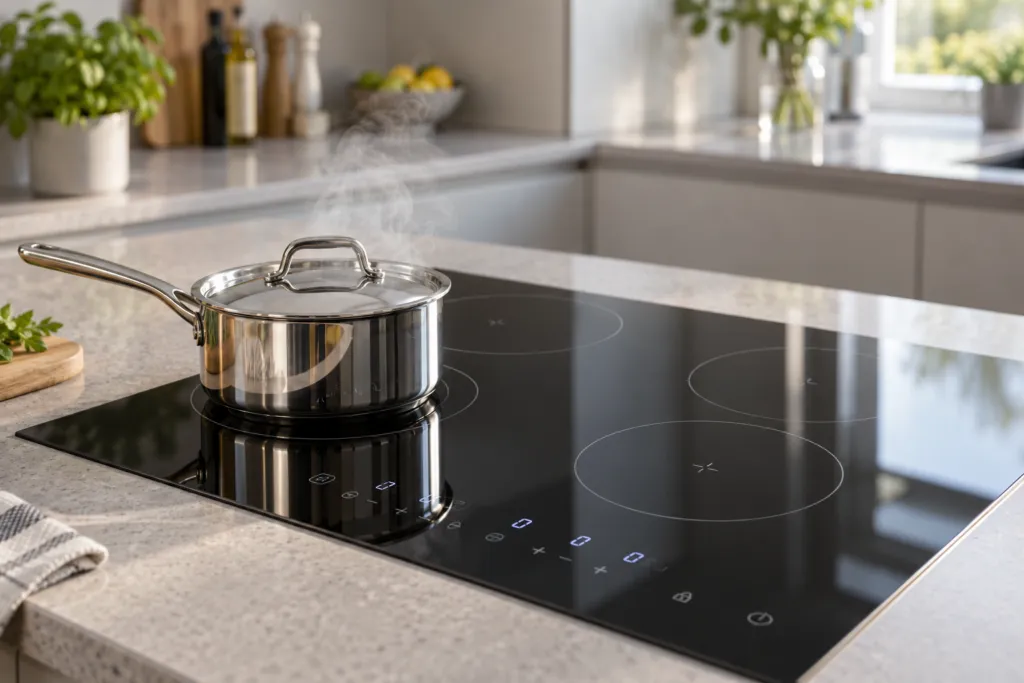
An induction hob uses electromagnetic induction to heat the pan directly rather than heating the hob surface and transferring that heat into the pan. A coil of wire beneath each zone generates a rapidly alternating magnetic field, which induces electrical currents in the base of a compatible pan. Those currents generate heat inside the pan itself. The hob surface stays relatively cool, only warming from residual heat conducted back from the hot pan.
This is a fundamentally different heating method from gas (burning fuel), ceramic (an electric element glowing red beneath glass), or halogen (visible light bulbs beneath glass). The practical consequences are significant: induction is faster, more efficient, more controllable, and safer in several specific ways, but it only works with pans that have a magnetic base and it requires a more capable electrical supply than other hob types.
Our existing gas vs electric hobs buying guide covers the wider comparison across all four types. This guide focuses specifically on induction and the questions UK households ask when they are seriously considering one.
02Why consider an induction hob in 2026?
Induction transfers around 85 to 90 percent of its energy into the pan. Gas transfers around 40 percent and ceramic electric around 70 percent. The practical result is that a litre of water boils in roughly half the time on induction compared to ceramic, and roughly a third faster than gas. Everyday cooking feels noticeably quicker.
Because the hob surface itself only warms from residual heat, there is no exposed flame, no glowing element, and no risk of burns from accidentally touching an empty cold zone. If the pan is removed, the induction coil shuts down within seconds. Spilled food does not burn onto the surface because the surface is not hot enough to carbonise it.
The higher efficiency translates into roughly 10 to 15 percent lower electricity use for the same cooking task. For a household cooking 90 minutes a day on the hob at the current Ofgem price cap, this is a saving of around £15 to £30 per year compared to ceramic. See our wider analysis in the appliance running costs guide.
A flat glass surface that never gets hot enough to carbonise spills wipes clean with a damp cloth. Spilled milk, boiled over pasta water, or splashed oil can be dealt with immediately rather than needing to be chiselled off after it has baked on. This is a large everyday quality of life improvement that consumers consistently cite as the biggest surprise benefit after upgrading.
Induction responds instantly to control changes, like a gas flame but more controllable. Delicate tasks like melting chocolate, holding a sauce at a simmer, or tempering eggs are significantly easier than on ceramic electric where the heat lags behind the control setting by minutes.
The UK Future Homes Standard restricts gas appliances in most new build homes from 2025 onwards. Several local authorities and developers have gone further. Choosing induction now avoids a second replacement in a few years if gas appliance rules tighten further in existing homes.
03What are the honest trade offs?
Where induction wins clearly
- Speed of boiling and heating
- Cleaning and spill management
- Safety around children and pets
- Precise temperature control
- Running cost efficiency
- No open flame or combustion products
- Flat surface easier to install into modern worktops
Where induction has drawbacks
- Higher upfront purchase cost than ceramic
- Only works with magnetic base pans
- May need a dedicated 32A circuit installed
- Glass surface can crack if a heavy pan is dropped
- Fan noise under the hob when running at high power
- Specific medical device considerations for a small number of users
- Cannot be used during a power cut unlike gas
04Will my existing pans work on induction?
The pan question is the single biggest consumer confusion around induction. The simple test is a fridge magnet. If a magnet sticks firmly to the base of the pan, that pan will work on induction. If the magnet does not stick, or only weakly adheres, the pan is not induction compatible and will not heat up on an induction hob.
Pan materials and their induction compatibility break down as follows:
| Pan material | Induction compatible? | Notes |
|---|---|---|
| Cast iron | Yes | Works perfectly, including enamelled cast iron like Le Creuset |
| Carbon steel | Yes | Works well, common for frying pans and woks |
| Magnetic stainless steel | Yes | Most quality stainless steel pans have a magnetic base. Check with a magnet |
| Non magnetic stainless steel | No | Some cheap or decorative stainless pans are non magnetic. Will not work |
| Aluminium | No, unless induction base | Pure aluminium does not work. Some aluminium pans have a magnetic steel base layer specifically for induction |
| Copper | No, unless induction base | Pure copper does not work. Some copper pans have a bonded magnetic base |
| Glass or ceramic | No | Does not work at all |
| Non stick coated | Depends on base material | Check the base with a magnet. Many non stick pans are aluminium with no magnetic base |
Most households find that around half their existing pans are already induction compatible, particularly if they have any quality stainless steel, cast iron, or carbon steel items. The non compatible pans typically need replacing or supplementing with induction specific alternatives.
Steel adapter discs that sit between an induction hob and a non magnetic pan are sold cheaply online. They technically work by heating up themselves and transferring heat to the pan sitting on top. Doing this loses most of the efficiency, speed, and control benefits of induction, and the disc gets dangerously hot in use. They are a short term workaround, not a reasonable long term solution.
05Pacemakers and other medical devices: what the evidence says
Induction hobs generate strong localised electromagnetic fields, which has prompted longstanding consumer concern about safety for people with implanted medical devices. The practical position based on current evidence is nuanced and worth stating clearly.
For modern pacemakers and implantable cardioverter defibrillators (ICDs), the risk from a correctly installed induction hob is small. Pacemaker manufacturers and the British Heart Foundation generally advise keeping an implanted device at least 60cm (around 2 feet) from an operating induction hob. This is a comfortable distance for normal cooking in most kitchens.
For people with implanted medical devices, two sensible steps apply. First, check with the device manufacturer or the cardiologist who fitted it for device specific guidance. Second, maintain the recommended separation distance in normal use, which usually just means not leaning over the hob with your chest directly against the surface while cooking. Older pacemakers (pre 2000) may have different guidance.
Insulin pumps, cochlear implants, and other active medical devices have their own manufacturer specific guidance. The practical starting point for anyone with any implanted device is to check with the device manufacturer before purchasing. This is not a reason to rule out induction for most people, but it is a reasonable question to settle before spending the money.
06What electrical supply does an induction hob need?
Induction hobs are high power appliances. A typical four zone domestic induction hob draws 7.2 kilowatts at maximum, with higher end models reaching 11 kilowatts. This exceeds what a standard 13 amp ring main socket can supply, so most installations need a dedicated circuit installed by a qualified electrician.
Most four zone induction hobs are supplied with the expectation of being hard wired to a dedicated 32 amp cooker circuit, often shared with an existing electric oven. If you already have a 32A cooker circuit in place from a previous electric cooker or hob, that same supply usually works with an induction hob of equivalent power rating. Confirm with the installing electrician.
If you do not have a cooker circuit, a qualified electrician needs to install one from the consumer unit to the hob location. Depending on the route and distance, this typically adds £150 to £400 to the installation cost. For older properties this can be higher if the consumer unit needs upgrading to handle the additional load. Budget for this when comparing total cost against ceramic or gas.
A small number of two zone and smaller four zone induction hobs are rated to work on a standard 13A plug by limiting their maximum simultaneous power draw. These are a useful option for rented accommodation, boats, caravans, or small kitchens where installing a new circuit is impractical, but they lack the raw power of a full install hob. Check the plate rating and model specification carefully before buying one of these.
07How much should you expect to pay?
| Price band | Typical features | Expected brands |
|---|---|---|
| £250 to £400 | Basic four zone, standard touch controls, limited power boost | Beko, Bush, Logik, Russell Hobbs, Candy |
| £400 to £700 | Four zone, flex zones for larger pans, power boost on all zones, child lock, pause function | Hotpoint, Indesit, Zanussi, Hoover, Hisense |
| £700 to £1,100 | Four or five zones, bridging zones, PowerBoost, cooking automation, residual heat indicator, improved glass quality | Bosch mid range, Siemens, AEG, Samsung, LG |
| £1,100 to £1,800 | Full flexInduction surface, integrated extraction options on venting models, cooking sensor integration, premium glass | Bosch Serie 8, Siemens iQ700, Neff, AEG premium |
| £1,800 and above | Full surface induction with pan detection anywhere, downdraft extraction, professional specification | Miele, Gaggenau, Siemens Studio Line |
For most UK households, the £400 to £700 band offers the best overall value. The jump from £250 to £400 to this band brings meaningfully better power management, pause and boost functions, and build quality. The jump from £700 upward brings refinements and automation that are nice to have rather than essential.
Installation adds £120 to £250 for straightforward replacement of an existing hob with the same electrical supply. If the circuit needs upgrading or new wiring installed, budget £300 to £600 total for installation and electrical work combined.
Prices verified against AO, Currys, John Lewis and Appliances Direct retail listings in October 2026. Expect prices to drift during sales and seasonal promotions.
08What features actually matter?
-
Power boost on every zone. A temporary high power mode that lets you boil water or heat oil quickly. Essential rather than optional on modern induction hobs. Check that boost is available on all zones, not just one or two.
-
Flex zones or bridging zones. Two or more zones that can combine into one larger cooking area for griddles, fish kettles, or oversized pans. Useful if you regularly use large or oblong cookware. Available from the £400 band upward.
-
Pause function. One button temporarily reduces all zones to low heat, so you can answer the door or deal with a child without burning dinner. Appears on mid range models and above.
-
Child lock. Locks the control panel so children cannot change settings. Standard on most hobs but worth confirming. Essential in households with young children.
-
Residual heat indicator. A warning light that shows a zone is still warm from a recent pan even though it is now switched off. Useful safety feature given the counter intuitive nature of induction where you cannot otherwise tell if a zone is hot.
-
Automatic pan detection. The hob detects when a compatible pan is placed on a zone and only activates when a pan is present. Standard across almost all induction hobs.
-
Integrated extraction (venting hobs). A fan built into the hob surface drawing cooking fumes downward. Available on premium models (£1,100 upward typically). Avoids the need for a wall mounted extractor hood, which some open plan kitchens prefer. Covered in more depth in our forthcoming cooker extraction guide.
Found a fault on your existing hob?
If you are replacing because of a fault rather than upgrade, it may be worth getting the existing hob diagnosed first. Many hob faults are economic repairs on machines under 8 years old.
09What are the common issues to watch for?
A quiet continuous fan noise under the hob is normal and expected during use, particularly on high power settings. The fan cools the induction electronics. If the noise becomes loud, intermittent, grinding, or persists after cooking has finished, the fan may have an issue worth investigating.
Some pans vibrate audibly on high power induction, producing a buzz or hum. This is the pan responding to the magnetic field, not a hob fault. Cast iron and heavy stainless pans do this less than lightweight pans. The sound disappears or reduces at lower power settings.
Dropping a heavy pan onto the hob can crack or shatter the glass surface. On most mid range hobs the entire top is a single piece and replacement glass costs £150 to £400 fitted, which combined with labour often exceeds the economic repair threshold on an older unit. Treat the surface with care and never use it as a worktop extension.
Many induction hob error codes relate to the pan not being detected rather than hardware faults. Check the pan is magnetic, correctly centred on the zone, and large enough to cover the zone’s minimum size. Our appliance error codes hub has brand specific lookups.
If the hob becomes unresponsive mid cook or displays locked symbols incorrectly, a proper power reset normally clears the fault. See our how to reset your appliance guide for the correct procedure.
10Safety considerations before you buy
Induction hob installation involves a high current circuit. In England and Wales, this falls under Part P of the Building Regulations and must be carried out or certified by a competent electrician. In Scotland and Northern Ireland the equivalent competence requirements apply. Never attempt to wire a 32A cooker circuit as a DIY project. See our general DIY repair safety principles for appliance safety more broadly.
Alongside the electrical competence requirement, two safety points are worth stating clearly. Induction hobs are heavy and awkward to lift into a worktop cutout. Allow for two people during fitting. The hob should be installed with the manufacturer specified clearances on all sides, including minimum distances from flammable materials below and extraction above. Rushing a tight fit creates ventilation problems that cause the hob to overheat and shut down repeatedly during normal cooking.
11The Whitegoods Help view
For most UK households replacing an existing hob in 2026, induction is the honest best choice. The combination of cooking speed, running cost efficiency, cleaning ease, safety around children, and future proofing against gas restrictions adds up to a clear overall win over ceramic electric. The genuine concerns, pan compatibility and installation cost, are both manageable one off issues rather than ongoing drawbacks.
The exceptions where induction may not be right are small but worth stating. Households with expensive non magnetic cookware that they would be reluctant to replace. Properties where installing a 32A circuit is impractical or disproportionately expensive. Individuals with implanted medical devices who have been specifically advised to avoid induction. Rental properties where a plug in portable hob is the only option. For everyone else, the question is which induction hob rather than whether to buy induction.
The retailer SERP for induction hobs is dominated by product listings and marketing content from the manufacturers themselves. The independent view that most consumers do not get is this: the £400 to £700 band from Hotpoint, Zanussi, Hisense or Hoover delivers 90 percent of what the premium brands offer at half the cost, and the upgrade from £700 to £1,500 buys refinements that most households will not notice day to day. Spend the extra on better pans if you have the budget, not on the hob itself.
Need help choosing or installing an induction hob?
Our Help Forum has real UK households discussing specific induction hob models, installation questions, and the pan compatibility problem. Free to use, real engineers monitoring.
12Frequently asked questions
Are induction hobs worth the extra cost over ceramic?
For most UK households, yes. The purchase price difference is typically £100 to £300, which is paid back over 5 to 10 years in reduced electricity costs. The quality of life benefits (faster boiling, easier cleaning, safer surface, precise control) are substantial and immediately noticeable. The main case for sticking with ceramic is budget constraints or an existing collection of non magnetic cookware that would be expensive to replace.
Do I need to buy all new pans?
Only if your current pans do not have a magnetic base. Test with a fridge magnet. If the magnet sticks firmly to the bottom of the pan, it works on induction. Most households find that half or more of their existing pans are already compatible, particularly stainless steel, cast iron, and carbon steel. Non compatible pans typically need replacing, which can be done gradually rather than all at once.
Is it safe to use an induction hob if I have a pacemaker?
For most modern pacemakers, yes, with a sensible separation distance. Pacemaker manufacturers and the British Heart Foundation generally recommend keeping the device at least 60cm (around 2 feet) from an operating induction hob, which is comfortable for normal cooking. Check with your device manufacturer or cardiologist for device specific advice before purchasing. Insulin pumps, cochlear implants and other active devices have their own manufacturer guidance to check.
How much does induction installation cost in the UK?
Replacing a hob where a 32A cooker circuit already exists typically costs £120 to £250 for fitting. If a new circuit needs to be installed from the consumer unit, add £150 to £400 for electrical work, giving a total of £300 to £600. Older properties may need consumer unit upgrades which push costs higher. Always use a Part P competent electrician in England and Wales.
Do induction hobs really use less electricity?
Yes, around 10 to 15 percent less than ceramic electric for the same cooking task, because more of the energy transfers directly into the pan rather than being lost as waste heat. For a household cooking 90 minutes a day on the hob at current UK electricity prices, this saves around £15 to £30 per year. See our wider breakdown in the appliance running costs guide.
What happens if the power goes off while cooking?
The hob stops immediately. Unlike gas, where you can continue cooking with a match if the ignition fails, induction requires mains electricity to function. For households in areas with frequent power cuts, a small camping stove or kettle gives backup cooking capability. This is a minor consideration for most of the UK where mains supply is highly reliable.
Still deciding?
Here’s where to go next.
1 Comment
Grouped into 1 comment thread.
You do us all an excellent service with this website, thankyou! I have bookmarked this page. Did you know that the Which? website lets you save your favourite pages. (a little heart icon at the bottom of the page and then you can find it in your profile). I wonder if you might consider adding such functionality aswell? Thanks again.