
NAC Independent Repair Partner Programme: What Aspiring Engineers Need to Know
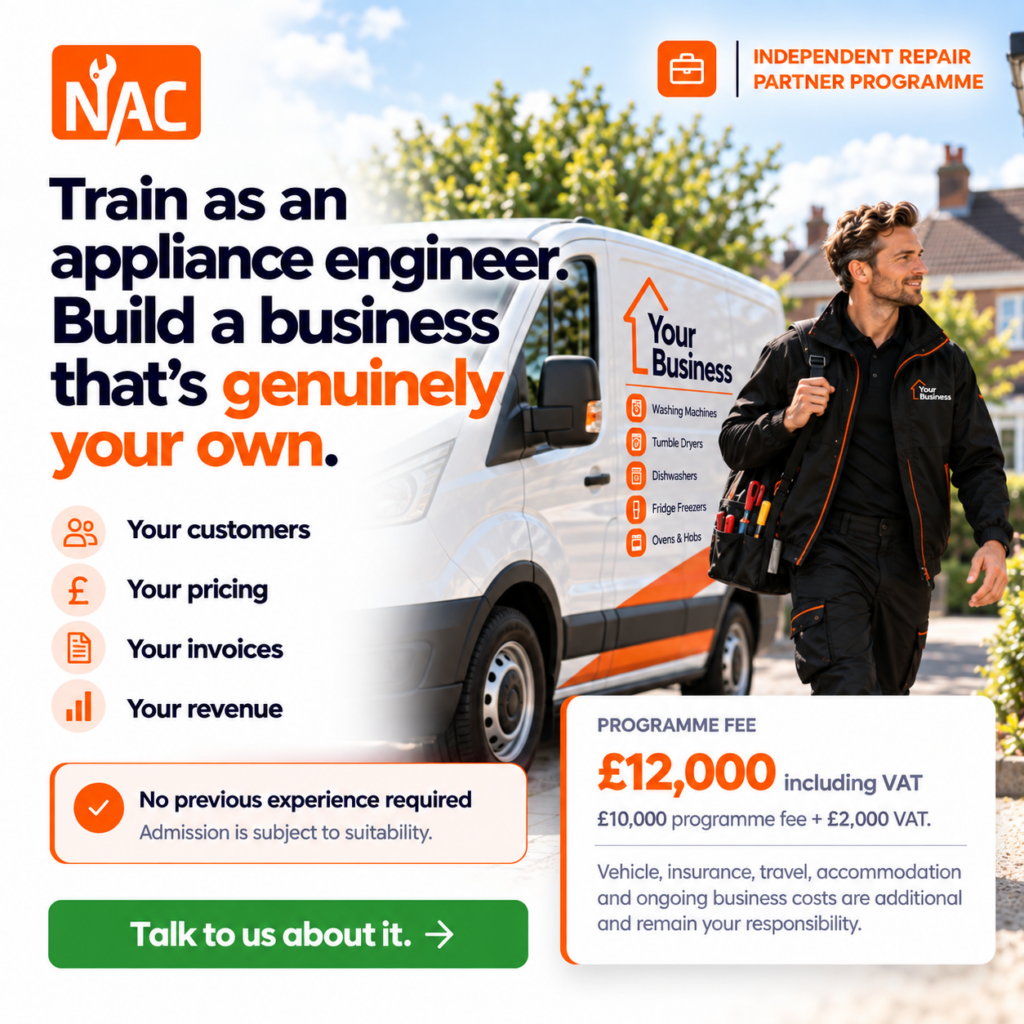

The NAC Independent Repair Partner (IRP) Programme is a £12,000 (including VAT) route into self-employed appliance repair for people with no previous experience. It combines two weeks of multi-brand training, two to four weeks of supervised field work, a toolkit and business-launch support, with access to suitable NAC repair jobs once competency is approved. NAC work is not guaranteed, and all running costs remain the partner’s responsibility.
Guidance compiled by Whitegoods Help. Programme details are summarised from published information and may change, so always confirm current terms in writing before committing.

Whitegoods Help Ltd shares owners with NAC (Domestic Appliances) Ltd, the company that runs the IRP Programme. This guide explains how the programme works based on its published terms, and sets out the questions any prospective partner should ask. It is not a recommendation to enrol, and the right route into the trade will differ from person to person.
What is the NAC Independent Repair Partner Programme?
The Independent Repair Partner Programme is a newly launched scheme from NAC, a UK appliance repair business that trains its own engineers. It is aimed at people who want to set up their own independent repair business rather than take a salaried job.
The programme brings together training, supervised experience, equipment and help with launching a business. Once approved as competent, partners can take on suitable NAC repair work in an agreed service area while building their own customer base alongside it.
No previous appliance repair experience is required. Admission depends on a suitability conversation and an assessment of repair demand in the applicant’s proposed area.
Programme fee including VAT
Weeks of typical initial training
Proposed payment per payable NAC job
Royalty on independently generated work
How is the IRP Programme structured?
The programme is built around four stages. Each one addresses a different gap that new engineers typically face when going self-employed.

Two weeks of foundation training, followed by two to four weeks on real customer visits alongside a working NAC engineer. Training is multi-brand and covers fault diagnosis and safe working practices.

A professional repair toolkit, electrical test equipment, PPE and initial workwear are included in the fee. Partners supply their own van, insurance and a compatible phone or tablet.

Branding, digital setup and local marketing support are offered where required. Partners can also set up their own independent websites and booking channels.

Ongoing technical support from the trainers, operational onboarding, and access to the ServiceMate job management system for NAC-supplied work.
The training element is delivered through the NAC National Training Centre, the same centre NAC uses for its own engineers. The centre states that it offers City & Guilds and CPD accredited courses, and that its instructors have more than 50 years of combined industry experience.
What does the £12,000 fee include, and what does it not?
The fee is £10,000 plus £2,000 VAT. Understanding exactly what sits inside and outside that figure is the most important part of any decision.
 Included in the fee
- Two weeks of foundation training
- Two to four weeks of supervised field experience
- Competency assessment
- Professional repair toolkit and electrical test equipment
- PPE and initial workwear
- Branding, digital setup and local marketing support where required
- ServiceMate access for NAC-supplied jobs
- Technical support and operational onboarding
 Not included
- Vehicle, fuel and running costs
- Business and public liability insurance
- Travel and accommodation during training
- A compatible smartphone or tablet
- Working capital and ongoing business costs
- ServiceMate for independent work (a separate paid subscription)
- Gas and dual-fuel training
- Any guaranteed volume of NAC work
Anyone costing a vehicle should also read the Whitegoods Help guide to electric vans for appliance repair engineers, since the van is usually the largest cost after training.
How do IRP partners get paid?
Partners handle two distinct kinds of work, and each follows different rules. This split is central to how the programme operates.
| Aspect | NAC-supplied repairs | Independently generated repairs |
|---|---|---|
| Customer contract | With NAC | With the partner’s business |
| Customer pricing | Set by NAC | Set by the partner |
| Customer payment | Paid to NAC | Paid to the partner |
| Parts and process | NAC requirements apply | Managed by the partner |
| Partner income | Proposed £50 per payable completed job, £30 per additional appliance, via self-billing | 100% of customer revenue, no royalty or commission |
A job offer or attendance does not automatically mean a fee is payable. A Commercial Schedule sets out which outcomes qualify, the self-billing cycle, VAT treatment and how recalls are handled. Genuine workmanship recalls do not attract a second fee.
At the proposed rate of £50 per payable job, recovering the £10,000 net programme fee from NAC work alone would take 200 payable jobs, before any vehicle, fuel, insurance or parts costs. This is basic arithmetic rather than a forecast, but it shows why building an independent customer base matters so much to the long-term picture.
For independent jobs, partners buy their own parts. Establishing a reliable supplier early, such as Spares4Appliances for genuine and compatible appliance spare parts, helps keep job times and costs predictable.
Who owns the website and phone number?
This is one of the most important questions in any network arrangement, and the IRP terms address it directly. There are two routes, and they work very differently.
Assets the partner providesA website, domain, phone number, social media accounts and booking process that the partner sets up remain the partner’s own. Revenue from work generated through them is kept in full.
 Assets NAC provides
Any website, domain, content, phone number or booking route supplied by NAC stays NAC-owned unless a separate written transfer is agreed. Enquiries through these channels are NAC-supplied jobs.
The published terms state that if the NAC relationship ends, NAC may retain, rebrand or redirect its own assets and enquiries. Using a local business name on an NAC-provided website does not transfer ownership. Anyone wanting a business they fully control should prioritise building their own independent channels from the start.
Partners do not buy an exclusive territory. Instead, a service area is agreed after NAC looks at where the applicant is based, local demand, existing coverage, sensible travel distances and how much work the applicant wants.
What are the stages from enquiry to independent trading?
The published journey runs through ten stages. Two of them, the area assessment and the competency assessment, act as the main gates.
-
Apply. Share background information and location.
-
Talk it through. A conversation about whether the programme is a good fit.
-
Area assessment. Demand in the proposed area is checked before any commitment is made. NAC states it will say so if the demand is not there.
-
Acceptance. A place on the programme is confirmed.
-
Foundation training. Two weeks of multi-brand repair training covering diagnosis and safe working practices.
-
Field experience. Normally two to four weeks alongside an NAC engineer, depending on progress.
-
Competency assessment. Assessment against documented standards. Attendance alone does not guarantee release to independent NAC work.
-
Launch the business. Branding, online presence and the kit to trade.
-
Independent operation. Suitable NAC work where available, once approval and onboarding requirements are met.
-
Build an own customer base. Independent customers, independent pricing and independent revenue over time.
Which appliances would an IRP partner repair?
The programme covers the main electrical appliance categories found in UK homes, subject to individual competency approval for each one.
- Washing machines and washer dryers
- Tumble dryers
- Dishwashers
- Fridges and freezers
- Electric ovens, cookers and hobs
- Microwaves

Gas and dual-fuel training is not included. Gas Safe registration alone does not authorise an IRP partner to carry out gas or dual-fuel jobs for NAC. In the UK, anyone working on gas appliances for payment must be on the Gas Safe Register by law.
Who is the IRP Programme likely to suit?
According to the programme page, technical knowledge matters less at the start than attitude, because the training is designed to supply the technical side. The profile NAC describes includes people who are:
- Seriously considering a practical career change
- Drawn to working for themselves
- Comfortable dealing with customers face to face
- Practical and good at working through problems
- Reliable, professional and willing to learn
- Interested in building a local business
The programme is less likely to suit someone who wants a fixed salary, guaranteed hours or a business funded entirely by someone else. It is a self-employed route, so income depends on workload, performance and the effort put into winning independent customers.
What matters more is how you handle yourself in someone’s kitchen at four o’clock on a Friday when a repair has gone sideways.
NAC IRP Programme page
How does the IRP compare with other routes into appliance repair?
The IRP is one of several ways into the trade. Each suits a different starting point and budget.
| Route | Best for | Main trade-off |
|---|---|---|
| Structured programme such as the IRP | Newcomers wanting training, kit, supervised experience and some initial work in one package | Significant upfront fee, and NAC work is not guaranteed |
| Standalone training courses | People who want the skills and will build the business side themselves | No supervised field work or job flow included |
| Employed engineer role | People who want a salary and a company van | Less control and no business of their own |
| Contract work for networks | Experienced engineers filling their diary | Risk of dependency on a single source of work |
For standalone learning, the Training Centre publishes online appliance repair training courses alongside its practical, hands-on training. The wider picture is covered in the Whitegoods Help guides on appliance repair training options and how to become a self-employed appliance repair engineer.
Anyone weighing network work against building their own brand should also read contract work versus building a repair business, which explains the dependency risk in detail.
What should you ask before committing £12,000?
NAC states that before anyone joins, it provides the programme specification, a written service-area assessment, payment terms, cancellation information and the IRP Agreement. These documents should be read carefully, ideally with an accountant or solicitor.
- What volume of NAC work does the written area assessment suggest, and how was it calculated?
- What happens, financially, if the competency assessment is not passed first time?
- What are the cancellation and refund terms at each stage?
- Exactly which job outcomes qualify for payment under the Commercial Schedule?
- What notice is required to reduce capacity for NAC work, or to leave the programme?
- Can the VAT element be reclaimed, given your own business and VAT position?
- What will insurance, vehicle and running costs realistically be in your area?
Speaking to working engineers is also worthwhile. The Whitegoods Help appliance repair forum has verified engineers who can share their experience of self-employment and network work.
Want to find out more about the IRP Programme?
The NAC National Training Centre carries full programme details and handles enquiries. An enquiry does not commit you or reserve a place.
Is appliance repair training safe for complete beginners?
Yes, provided it is properly supervised. Domestic appliances carry mains voltage, and some components hold a charge after the plug is removed, so safe isolation and electrical testing are core skills taught before any live customer work.
This article describes a training programme and is not repair guidance. Appliance repair involves mains electricity, water and, in some appliances, gas. Never attempt repairs without appropriate training, and always isolate the appliance from the supply first. Gas appliances must only be worked on by a Gas Safe registered engineer, and anyone who smells gas should call the Gas Emergency line on 0800 111 999. Householders with a faulty appliance should read the DIY appliance repair safety guide or use a qualified professional.
Need an appliance repaired rather than a new career?
Whitegoods Help can put you in touch with a qualified engineer, point you to the right spare part, or help you decode an error code first.
Frequently asked questions about the IRP Programme
How much does the NAC Independent Repair Partner Programme cost?
The programme costs £12,000 including VAT, made up of a £10,000 programme fee plus £2,000 VAT. Vehicle, insurance, travel, accommodation and ongoing business costs are additional.
Do I need appliance repair experience to join the IRP Programme?
No previous appliance repair experience is required. The programme starts with two weeks of multi-brand foundation training, followed by two to four weeks of supervised field experience. Admission depends on suitability and an assessment of demand in your area.
Is NAC work guaranteed for IRP partners?
No. NAC work depends on demand in the approved area, availability and performance, and there is no guaranteed minimum volume. Demand is assessed before acceptance, and completing training does not automatically authorise independent NAC work.
How much do IRP partners earn from NAC jobs?
The current proposed payment is £50 per payable completed NAC job, plus £30 for an additional appliance where applicable, paid through self-billing. Revenue from work partners generate independently is kept in full, with no royalty or commission.
Does the IRP Programme include gas appliance training?
No. Gas and dual-fuel training is not included, and Gas Safe registration alone does not authorise a partner to carry out gas or dual-fuel jobs for NAC. Gas work in the UK legally requires Gas Safe registration.
Is the IRP Programme a franchise?
It is not described as a franchise. Partners trade under their own business identity, do not buy an exclusive territory, and pay no royalty on independent work. NAC sets the terms only for the NAC-supplied repairs it allocates. For wider context, see the guide to becoming a self-employed appliance engineer.
Ask the repair forum
Post the make, model and symptoms and get help from the Whitegoods Help community.
0 Comments