
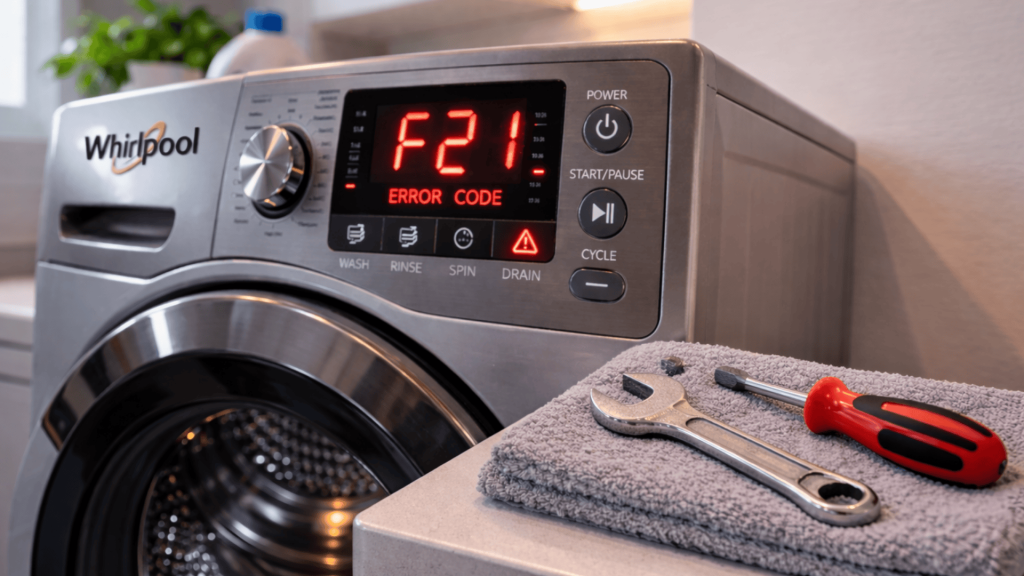
Your washing machine has stopped and a code is on the display. This guide explains what washing machine error codes actually mean, how reliable they are, how to read them correctly, and where to find the specific code for your brand. Written by engineers with decades of hands-on appliance repair experience.

An error code tells you which part of the machine’s self-diagnostic system detected a problem, not necessarily which component has failed. Use it as a starting point for diagnosis, not a definitive verdict. The same code can have several different causes, and experienced engineers always investigate further rather than replacing parts on the basis of a code alone.
What washing machine error codes actually mean
Modern washing machines run continuous self-diagnostics during every cycle. Sensors monitor water temperature, water level, motor speed, door lock status, drum rotation, and much more. When a reading falls outside the expected range, the machine logs a fault and often displays a code, stops the programme, or both.
Understanding what a code actually represents, rather than what it appears to say, is the difference between an accurate diagnosis and an expensive misdiagnosis.
 What a code identifies
An error code flags the system or sensor that detected the abnormal reading. An E3 water temperature fault, for example, tells you the machine detected an unexpected temperature condition, not that the heating element has failed. The fault could be a failed element, a failed thermistor, a wiring problem, or a control board issue.
 What a code does not tell you
It does not identify which specific component has failed, whether the fault is intermittent or permanent, whether the sensor itself is accurate, or whether a secondary fault caused the primary reading to go out of range. Replacing the component named in the code without further investigation frequently fails to cure the fault.
For a detailed explanation of why error codes can be both helpful and misleading, read our full analysis: appliance error codes – friend or foe?
How error codes are displayed on your machine
Not all washing machines show error codes in the same way. Knowing what to look for on your model is the first step to using the code effectively.
Most machines produced from the late 1990s onwards display alphanumeric codes on an LED or LCD screen. These typically take the form of a letter followed by a number, such as E3, F05, or OE. Write the code down exactly as shown before doing anything else – a misread sends the entire diagnosis in the wrong direction.
Older machines without digital displays use combinations of flashing indicator lights to communicate fault codes. The number of flashes, which lights flash, and the pattern all carry meaning. Hotpoint and Indesit machines are particularly known for this approach. Count the flashes in the repeating sequence carefully and note which lights are involved.
Some modern smart washing machines, particularly from Samsung and LG, transmit diagnostic data via Wi-Fi to a smartphone app. LG’s Smart Diagnosis feature uses a sound tone transmitted through the phone to a support line or app for analysis. These systems can provide more detailed fault information than a basic display code.
Some faults do not produce a displayed code at all, particularly on older machines or where the fault prevents the control system from completing its self-check. The machine may simply stop, fail to start, or behave abnormally. In these cases, fault diagnosis relies on the symptom itself and physical inspection.
Common washing machine error code categories
Across all brands, error codes tend to cluster around the same core system areas. Knowing what each category typically relates to helps you understand what the machine is telling you before you look up the specific code for your brand.

An E3 on a Hotpoint machine is not the same as an E3 on a Bosch. Always look up the code for your specific brand before drawing any conclusions.
| Code category | What it typically relates to | Common example codes | Common causes |
|---|---|---|---|
| Drain / pump fault | Machine unable to drain water within the expected time | E2, E20, F21, OE, 5E | Blocked filter, blocked pump impeller, kinked drain hose, failed pump, standpipe too high |
| Fill / water inlet fault | Machine not filling with water as expected | E1, E10, F17, 4E, IE | Closed tap, kinked inlet hose, blocked inlet filter, low water pressure, failed inlet valve |
| Heating / temperature fault | Water not reaching target temperature, or overheating | E3, E61, F05, tE, HE | Failed heating element, failed thermistor, wiring fault, limescale, control board issue |
| Door lock fault | Door interlock not engaging or releasing correctly | E5, E41, F34, dE, d5 | Failed door lock mechanism, wiring fault, door not fully closed, obstructed seal |
| Motor / drum fault | Motor not running correctly or drum not rotating as expected | E6, E52, F06, 3E, LE | Failed motor brushes, failed motor, blocked drum, wiring fault, control board issue |
| Unbalanced load | Load too unbalanced for the machine to spin safely | UE, E4, DC | Uneven load distribution, single heavy item, worn shock absorbers |
| Control board / communication fault | Internal communication error between electronic components | E9, E90, F11, AE | Failed control board, wiring harness fault, power supply issue, moisture damage |
| Overflow / water level fault | Unexpected water level detected inside the machine | E7, E35, FP, OE/OF | Failed pressure switch, blocked pressure hose, overfilling inlet valve, soap suds buildup |
What to do when an error code appears
-
Write down the code exactly as displayed. If the machine is showing a flashing light pattern, count the flashes carefully and note which lights are involved. A misread – such as reading E5 as E8 – leads the entire diagnosis in completely the wrong direction. Take a photograph if that is easier and more reliable.
-
Switch the machine off at the wall and wait 60 seconds, then restart. Some fault codes are triggered by a transient electrical fluctuation, a momentary sensor reading, or a minor software glitch. A power reset clears stored codes and allows the machine to restart its diagnostic cycle. If the same code reappears consistently, it represents a real fault.
-
Check the simple things first. A drain fault code could mean a blocked filter rather than a failed pump. A fill fault could mean the tap is turned off. Before assuming component failure, check the obvious physical causes that match the code category.
-
Look up the specific code for your brand. Use the brand directory below. The same code number means different things on different brands. Always use the guide for your specific machine.
-
Find your model number before calling anyone. An engineer needs the exact model number to identify the correct parts and access service information. The model number is on the rating plate, usually inside the door rim.
Washing machine error codes by brand
Most washing machine brands belong to one of five manufacturer groups, and brands within a group typically share the same control system and fault codes. The directory below is organised by parent group, so if your exact brand isn’t listed individually, the parent group’s guide will usually apply.
BSH Hausgeräte
Bosch, Neff, and Siemens all use the same BSH control platform and share an identical fault code system. The Bosch guide covers all three brands.
Bosch washing machine error codes – full guide
Covers WAE, WAS Logixx, WFF, WFL, WFP, WOK, WOL series and all modern models.
Siemens washing machine error codes
Same platform as Bosch – the Bosch guide covers all codes.
Beko Europe
Hotpoint and Indesit both use the same Beko Europe control platform on shared-platform models, with most fault codes identical across both brands. Whirlpool’s European range is also manufactured under the Beko Europe joint venture.
Full guide – WMA, WML, WDL, BHWD, WF, WD Ultima, Aqualtis, HVL
F01 – motor control board fault
F05 – heating system fault
Aqualtis F02 – drain fault
WD Washer Dryer F03 – flashing lights
10 flashes / F10 – motor or control fault
8 flashes / Error 8 – door lock fault
Full guide – WIA, WIDL washer dryer, WIXE, rotary dial models
F07 – motor fault
Error 3 / F03 – heating system fault
F04 – pressure system fault
Full guide – AWO, AWD, Dreamspace, EU series
FP – flood protection / overflow fault
Some later models share platforms with Hotpoint and Indesit.
Electrolux Group
AEG and Zanussi use an identical E-code system across the Electrolux platform. A guide for either brand applies to both, plus Electrolux-branded models.
Full guide – all Zanussi and ZWG series, E10 to EF0
E50 – motor fault, carbon brushes
E52 – tachogenerator and brushes
Haier Europe
Candy and Hoover both fall under Haier Europe and share manufacturing platforms. Codes are frequently interchangeable on machines built after the brands were consolidated. The standalone Haier brand uses its own platform.
Candy washing machine error codes
Covers Go, Smart, CO, COS, CMD washer dryer, and Grando series.
Full guide – Nextra, Optima, Vision HD
Error E1 – water fill fault
Error 8 – door lock fault
Nextra Error 3 – heating fault
Nextra Error 7 – fault code 7
Arçelik Group
Beko and Blomberg are both owned by Arçelik and share manufacturing platforms. Blomberg codes may cross-reference with Beko on some model generations.
Independent and own-brand manufacturers
The brands below operate on their own control platforms and don’t cross-reference with the major manufacturer groups above.
Full guide – all Direct Drive washing machine and washer dryer platforms
OE – drain fault
SE – motor hall sensor fault
CL – child lock active
Other brands
For washing machine brands not yet covered above – including Amica, Asko, Baumatic, Brandt, Creda, Daewoo, Dyson, Fagor, HEC, ISE, Panasonic, Servis, Smeg, Vestel, Zerowatt, and others – dedicated brand articles are being developed and will appear here as they are published. In the meantime, the general guidance on this page and the code category table above will help you interpret what the code is pointing to.
Why error codes are not always right
An experienced engineer knows that error codes are a useful tool, not an infallible verdict. There are several well-established reasons why codes can mislead even a careful technician.

Sensor faults masquerading as component faults
A temperature fault code does not necessarily mean the heating element has failed. It could mean the thermistor that measures the temperature has failed, giving a false reading to the control board. The board registers an abnormal temperature and logs a heating fault. The heating element itself is fine. Replacing the element on the basis of the code wastes money and fails to cure the fault.

Control board faults producing multiple codes
When a control board develops a fault, it can produce error codes across several different systems, because the board is responsible for reading, processing, and acting on all sensor inputs. A board fault can generate a drain code, a temperature code, and a door code in sequence. Treating each code individually leads to replacing functional components when the real culprit is the board itself.

Wiring and connection faults
A loose, corroded, or broken wiring connection between a sensor and the control board produces the same symptom as a failed sensor. The board receives no signal, or an out-of-range signal, and logs a fault for that system. Wiring faults are common on older machines and on machines that have been moved or previously serviced. Checking connectors and wiring looms is a standard early diagnostic step for any experienced engineer.

Limescale and contamination
In hard water areas, limescale builds up on temperature sensors, pressure switch hoses, and heating elements. A scaled thermistor reads water temperature incorrectly. A blocked pressure switch hose sends inaccurate water level signals. Both produce error codes suggesting component failure when the actual problem is limescale – cleared with descaler rather than a part replacement. Regular maintenance significantly reduces spurious fault codes in hard water areas.
For the full engineer perspective on error code reliability, read: appliance error codes – friend or foe?
Need an engineer to diagnose your error code?
If your error code is pointing to a fault you cannot resolve yourself, our repair booking service provides nationwide appliance repairs across all major brands. Qualified engineers, genuine parts, all repairs guaranteed.
Frequently asked questions
My washing machine is showing an error code but seems to work fine. What should I do?
Switch the machine off at the wall, wait 60 seconds, and restart. Transient error codes caused by voltage fluctuations, momentary sensor readings, or software glitches are common and often clear themselves after a power reset. If the code reappears consistently across multiple cycles, or the machine develops any symptom such as not draining, not spinning, or not heating properly, it represents a real fault that needs investigation. Note the code and use the brand directory on this page to understand what it means for your specific machine.
Can I clear an error code myself?
Switching the machine off at the wall and back on will clear most displayed codes. Some machines also have a specific reset procedure – typically holding two buttons simultaneously for several seconds – described in the instruction manual. Clearing the code does not fix the underlying fault. If the same code reappears, the fault is still present and needs to be diagnosed and repaired. Clearing the code is only useful to confirm whether the fault is consistent or intermittent.
The error code for my brand is not listed. Where else can I look?
Your machine’s instruction manual should include a fault code or troubleshooting table, usually near the back. If you have lost your manual, most manufacturers publish them as free downloads on their website, searchable by model number. Searching for your exact model number plus the error code in a search engine often finds specific guidance. For general guidance on what codes mean and how to use them, see our full analysis: appliance error codes – friend or foe?
The engineer says it needs a new control board based on the error code. Should I trust that?
Be cautious. Control board replacement is an expensive repair and should be a diagnosis of last resort rather than first resort. A reputable engineer will test the board and rule out sensor faults, wiring faults, and power supply issues before recommending board replacement. If you have any doubt, get a second opinion before authorising expensive work.
My machine shows a heating fault code. Does that mean I need a new element?
Not necessarily. A heating fault code can be caused by a failed element, a failed thermistor, a wiring fault between the element or thermistor and the control board, or a control board fault. An engineer will test the element and thermistor with a multimeter before concluding which has failed. It is also worth checking whether the machine is actually failing to heat, or whether it is stopping based on a sensor reading it considers abnormal. The symptom, combined with the code, gives a much clearer picture than the code alone.
My Hotpoint or Indesit machine is flashing its lights rather than showing a code. How do I read it?
Count the number of flashes in the repeating sequence and note which lights are flashing. On most Hotpoint and Indesit machines, the number of flashes corresponds to a fault code number – three flashes typically indicates a heating fault and eight flashes a door lock fault. The specific meaning varies between models and generations, so cross-reference with the model-specific guides on this page or your instruction manual. See our guides: flashing 10 times / F10 and flashing 8 times / Error 8.