
Beko Washing Machine Error Codes
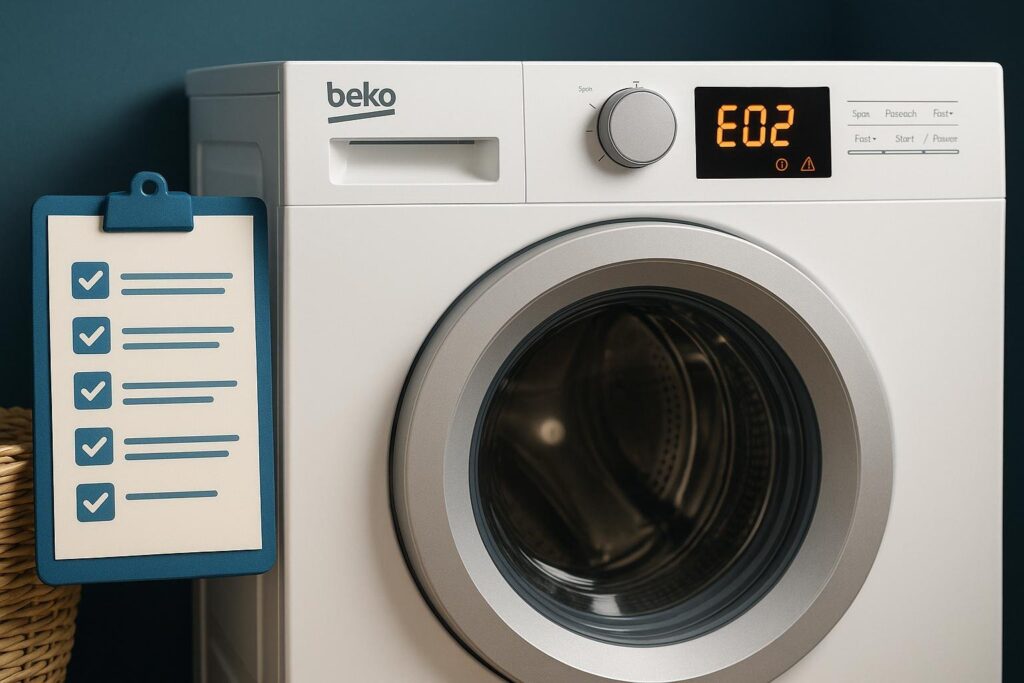

Beko washing machines display error codes as E followed by a one or two-digit number – E1, E2, E3, E11 and so on. Some Beko models also display H codes (H1, H2, H3 etc.) which are engineer-level diagnostic codes giving more specific component-level information. Find your code in the tables below. Older Beko machines without a digital display use combinations of LED indicator lights to signal faults instead.
Codes covered on this page
E02 – Heating
E03 – Drain
E04 – Fill
E05 – Pressure switch
E06 – NTC sensor
E07 / E08 – Motor
E11 – Spin / unbalanced
E13 – Leak / Aquastop
H1-H11 – Engineer diagnostic
What are Beko’s two error code systems?
Beko washing machines use two parallel error code systems that often catch users off guard. Understanding which system you are looking at is the first step to interpreting the code correctly. For broader Beko brand context, see our Beko brand hub.
 E codes – consumer-facing display codes
E codes are what most users see when something goes wrong – E1, E2, E3, E11 and so on. They identify the general fault category (door, heating, drain, motor) but do not always pinpoint the specific component. These are designed to be informative for the user without requiring engineer-level diagnosis.
 H codes – engineer diagnostic codes
H codes (H1, H2, H3, H11 etc.) are accessed via the machine’s service mode and provide much more specific component-level diagnosis. They are primarily used by engineers and identify exactly which sensor, switch, or component the control board has detected as faulty. Some Beko machines display H codes directly when certain faults occur.
LED indicator codes (older models)Older Beko machines without a digital display use combinations of indicator lights – typically the prewash, spin, rinse, and wash LEDs – to signal faults. The pattern of which lights are on, off, and flashing identifies the fault category. The code can be cross-referenced with the E code system below.
 Beko, Blomberg, Grundig, Leisure
Beko is owned by Arçelik and shares its manufacturing platform with Blomberg, Grundig, Leisure, and Flavel branded washing machines. The error code systems are largely identical across these brands. Following the formation of Beko Europe in 2024, Hotpoint and Indesit are now also under the same ownership group, although those brands continue to use their own legacy F code system.
Which Beko codes are seen most often?
Across the field, four code groups account for the majority of Beko fault callouts. Knowing which they are helps narrow the diagnosis before you open anything up.
Drain fault – almost always a blocked filter
Door lock – often the interlock at 5-10 years
Heating / NTC – element, thermistor, or limescale
Spin – usually unbalanced load, not a fault
Beko E codes – complete reference
The following codes apply to Beko washing machines and washer dryers with a digital display, including the WMA, WMB, WMY, WTV, WTG, WX, WR, and WMG series.
| Code | Fault description | Most likely causes | Check first |
|---|---|---|---|
| E01 / E1 | Door lock fault – machine not detecting the door is closed and locked | Door not fully closed. Failed door interlock mechanism. Wiring fault to the PCB. Obstruction in the door seal. Broken door handle or catch. On some Beko models E1 also indicates an NTC thermistor fault – check the H code if available for a more specific diagnosis. | Open and firmly close the door, ensuring nothing is trapped in the seal. If the door closes correctly and E01 persists, test the door interlock for continuity. See also washing machine door won’t open. |
| E02 / E2 | Heating fault – water not reaching target temperature | Failed heating element. Failed NTC thermistor. Wiring fault between element or thermistor and control board. Limescale heavily fouling the element in hard water areas. Control board fault. | Test the heating element for continuity with a multimeter – open circuit confirms failure. Test the NTC thermistor (approximately 4,700 ohms at 25°C on Beko machines, lower than the 30,000 ohm sensors used by some other brands). In hard water areas, descale before testing – see how to descale a washing machine. |
| E03 / E3 | Drain fault – machine unable to drain water within the expected time | Blocked pump filter (the most common cause). Kinked or blocked drain hose. Standpipe too high. Foreign object blocking the pump impeller. Failed drain pump motor. | Clean the pump filter behind the small access panel at the bottom front of the machine. Place towels and a shallow tray in front before opening as water will flow out. See washing machine not draining and no blockage and still not draining. |
| E04 / E4 | Water inlet / fill fault – machine not filling within the expected time | Tap closed or partially closed. Kinked or trapped inlet hose. Blocked inlet hose filter. Low mains water pressure. Failed inlet valve solenoid. | Confirm the tap is fully open. Straighten the inlet hose. Unscrew the inlet hose from the back of the machine and clean the small mesh filter inside the inlet port. |
| E05 / E5 | Pressure switch fault – water level sensor reading incorrectly | Failed pressure switch. Blocked or kinked pressure switch hose. Soap suds blocking the pressure system. Wiring fault to pressure switch. | Check the pressure switch hose – a narrow pipe running from the drum to the pressure switch – for blockage or kinks. Run a service wash to clear soap residue. Test pressure switch if hose checks are clear. See also too much foam in washing machines for the suds cause. |
| E06 / E6 | NTC thermistor fault – temperature sensor not reading correctly | Failed NTC thermistor. Loose or corroded wiring connector to the thermistor. Limescale on thermistor in hard water areas. | Test the NTC thermistor with a multimeter (approximately 4,700 ohms at 25°C, falling as temperature rises). Open circuit confirms failure. In hard water areas, descale before testing – see limescale in washing machines. |
| E07 / E7 | Motor or triac fault – motor circuit fault | Worn motor carbon brushes (most common on collector motor models over five years old). Failed triac on control board. Wiring fault. Motor winding failure. | With the machine unplugged, check the drum rotates freely by hand. Inspect motor carbon brushes – replace if worn below 10mm. See our carbon brushes diagnostics guide. If brushes are good, test motor for continuity. |
| E08 / E8 | Motor fault / tachometer error | Failed tachogenerator. Worn carbon brushes. Wiring fault between motor and control board. Motor failure. | Check carbon brushes first on collector motor models – replace if worn below 10mm. Test tachogenerator resistance (typically 100 to 200 ohms – open circuit confirms failure). |
| E09 / E9 | Door interlock fault – variant code | Failed door interlock. Wiring fault between interlock and PCB. Door not fully closing. | Same checks as E01 – confirm door closes correctly and test interlock for continuity. Some Beko models use E09 rather than E01 as the primary door lock code. |
| E10 | Door lock or control fault | Door interlock fault, control board fault, or wiring fault between the two. | Check door closes correctly. Test interlock. If both are good, the fault is in the wiring or the control board. |
| E11 | Motor fault or unbalanced load detected during spin | On some Beko models – motor fault, engineer diagnosis required. On others – unbalanced load detected, machine has paused the spin cycle for safety. | If the load is uneven, redistribute the laundry around the drum and restart the spin. If E11 persists with a balanced normal load, motor diagnosis is required. |
| E13 | Water leak detected (aquaspy / aquastop) | Water leakage detected by the anti-flood system in the machine base. Internal leak source – door seal, pump housing, internal hose connection. | Check the area around the machine for visible water. Tilt the machine slightly backward to drain any water from the base tray. Investigate the leak source before using the machine again. |
| E17 | Motor fault / inverter board fault on induction motor models | On collector motor models – similar to E07/E08 motor fault. On induction motor models – inverter board or motor speed sensor fault. | On collector motor machines, check carbon brushes first. On induction motor machines, engineer diagnosis is required for inverter board or speed sensor testing. |
| E18 | Various – model dependent (typically motor or control board variant) | Varies between models – refer to instruction manual for specific meaning, or check the H code via service mode for a more specific diagnosis. | Engineer diagnosis recommended given the model-dependent nature of this code. |
Beko H codes – engineer diagnostic reference
H codes are component-level diagnostic codes that identify the specific sensor, switch, or part the control board has detected as faulty. They provide more precise diagnosis than the consumer E codes and are typically displayed when entering service mode or appear directly on the display in some fault conditions.
| H code | Fault description | Most likely causes | Check first |
|---|---|---|---|
| H1 | NTC thermistor open or short circuit | Failed NTC thermistor. Wiring fault to the thermistor – open circuit (broken wire) or short circuit (insulation breakdown). | Test thermistor resistance (approximately 4,700 ohms at 25°C). Inspect wiring to thermistor for damage or loose connectors. |
| H2 | Heater detected open circuit – failed heating element | Failed heating element with internal break. Wiring fault between element and control board. Loose or burnt-out element terminal connection. | Test heating element for continuity with a multimeter. Open circuit confirms element failure. Check element terminal connections. |
| H3 | Heater detected stuck on / heater triac short circuit | Failed heater triac on the control board causing the element to remain on continuously. Element relay stuck closed. | Engineer diagnosis required. Triac and relay faults on the control board are not DIY repairs in most cases. |
| H4 | Inlet valve triac short circuit | Triac controlling the water inlet valve has failed, causing the valve to remain open or to fail diagnostic checks. | Engineer diagnosis required for the control board triac fault. Test the inlet valve solenoid first to rule out a valve fault. |
| H5 | Pump open circuit – failed drain pump or wiring fault | Failed drain pump motor. Open circuit in pump wiring. Pump capacitor failure on applicable models. | Test drain pump for continuity with a multimeter. Open circuit confirms pump failure. Check wiring connector at the pump. |
| H6 | Motor triac short circuit | Failed motor triac on the control board. May also cause the machine to trip the RCD. | Engineer diagnosis required. If the machine is also tripping the electrics, the triac is the likely cause. |
| H7 | Pressure sensor failure | Failed pressure switch. Wiring fault. Blocked or disconnected pressure switch hose. | Check pressure switch hose for blockage or disconnection. Test pressure switch if hose is clear. |
| H8 | Tachometer / motor speed sensor fault | Failed tachogenerator. Wiring fault. Worn carbon brushes on collector motor models. | Check carbon brushes first on collector motor models. Test tachogenerator resistance if brushes are good. |
| H11 | Motor or tachogenerator open circuit | Open circuit in motor windings or tachogenerator winding. Wiring fault. Disconnected motor connector. | Check motor wiring connector at both motor and PCB ends. Test motor windings and tachogenerator for continuity. |
How do you clear a Beko error code?
Many Beko error codes can be cleared with a simple reset once the underlying fault has been resolved. The standard reset procedure on most Beko washing machines is to hold the START/PAUSE button down for approximately 3 to 5 seconds. The machine cancels the active programme and clears the displayed code.
For a deeper reset, switch the machine off at the wall socket, wait at least 60 seconds, and switch back on. This clears any stored transient codes and allows the machine to restart its diagnostic cycle from a clean state.
Important – clearing the code does not fix the underlying fault. If the same code reappears as soon as you restart the cycle, the fault is genuine and needs to be diagnosed and repaired. Clearing the code is only useful to confirm whether a fault is consistent or transient.
What should you check before calling an engineer?
-
Power cycle the machine. Switch off at the wall socket, wait 60 seconds, and switch back on. Many transient Beko error codes clear on a power reset. If the same code returns consistently, it represents a real fault.
-
Clean the pump filter (E03 drain code). The filter is behind the small access panel at the bottom front of the machine. Place towels and a tray in front before opening. Unscrew anticlockwise, remove all debris including coins, check the pump cavity, and refit firmly. This single check resolves the majority of E03 faults.
-
Check the door closes correctly (E01 / E09 / E10 door codes). Open and firmly close the door, ensuring nothing is caught in the door seal. If the code persists, test the door interlock for continuity.
-
Check the water supply (E04 fill code). Confirm the tap is fully open, the inlet hose is not kinked, and the inlet filter mesh is clean.
-
Descale the machine (E02 / E06 temperature codes in hard water areas). Run an empty cycle on the hottest programme with a proprietary descaler before testing or replacing the heating element or thermistor. Limescale on the thermistor can produce false readings without any component actually failing.
-
Check carbon brushes (E07 / E08 motor codes on collector motor models). With the machine unplugged, check the drum rotates freely by hand. If it does, inspect the motor carbon brushes and replace if worn below 10mm.
-
Redistribute the load (E11 unbalanced code). Open the door and spread the laundry evenly around the drum before restarting the spin. Adding a towel alongside a single heavy item helps balance the load.
Safety notice

Always switch the machine off at the wall socket and unplug it before accessing the pump filter, opening any panels, or inspecting internal components. Never work on electrical components with the machine connected to the mains. Isolate the water supply at the inlet valve before disconnecting hoses.
A washing machine combines mains electricity with mains water – two of the most unforgiving things in a domestic setting. If you are not confident with electrical work or have any doubt about a fault, book a qualified engineer rather than attempt the repair yourself. See our full DIY appliance repair safety guide.
Beko has been the subject of several UK product safety notices in recent years across washing machines, tumble dryers, and fridge freezers. Examples include the Beko and Blomberg dryer safety notice, the Beko condenser tumble dryer safety notice, and the Beko fridge freezer safety notice. Always check the OPSS product safety database for any active recall on your appliance before continuing to use it.
Can you fix a Beko error code yourself?
 Straightforward to check or fix yourself
- Cleaning the pump filter (E03 drain code)
- Checking and cleaning the inlet hose filter (E04 fill code)
- Checking the door closes correctly and testing the interlock (E01, E09, E10)
- Replacing the door interlock on confirmed failure
- Power cycling to clear transient codes
- Descaling for temperature codes in hard water areas (E02, E06, H1)
- Replacing motor carbon brushes on collector motor models (E07, E08, H8)
- Redistributing the load (E11 unbalanced)
- Replacing the heating element on confirmed failure (H2)
- Replacing the drain pump on confirmed failure (H5)
 Requires an engineer or advanced competence
- Triac faults on the control board (H3, H4, H6)
- Inverter board faults on induction motor models (E17, E18)
- Pressure sensor faults if hose checks are clear (E05, H7)
- Water leak investigation (E13)
- Motor and tachogenerator faults if brushes are not the cause (H11)
- Any control board fault
- Any fault that persists after all basic checks have been completed
Beko error code pointing to a fault you cannot resolve?
If basic checks have not cleared the fault, a qualified engineer is the right next step. We cover Beko washing machine repairs nationwide with genuine spare parts available for most models including door interlocks, drain pumps, heating elements, NTC thermistors, and carbon brushes.
Beko, Blomberg, Grundig, and Leisure – shared platform
Beko owns Blomberg, Grundig, Leisure, and Flavel, and produces washing machines for all four brands on the same Arçelik manufacturing platform. The error code systems are largely identical across all of these brands – an E03 on a Beko machine means the same fault as an E03 on a Blomberg machine, with the same diagnosis steps and replacement parts.
Following the formation of Beko Europe in 2024, Hotpoint and Indesit also became part of the same ownership group. However, those brands continue to use their own legacy F code system rather than the Beko E codes, so the codes are not directly interchangeable between Beko and Hotpoint or Indesit despite the common ownership. See our Hotpoint washing machine error codes guide for those brands.
Looking for error codes on a different brand?
We have error code references for the other major UK washing machine brands. Use the cards below to jump to the relevant guide.
 Blomberg error codes
Blomberg – same Arçelik platform as Beko, identical code system.
Hotpoint error codesHotpoint – same Beko Europe group, different F code system.
Indesit error codesIndesit – same Beko Europe group, F code system.
AEG error codesFull E-code reference for AEG washing machines.
Bosch error codesBosch washing machine E-code reference.
Candy error codesCandy washing machine error code reference.
Want to learn appliance fault diagnosis properly?
Reading error codes is one of the more basic skills in appliance repair. For anyone wanting to develop the full skill set – whether for a career, a side business, or just to repair their own appliances confidently – the NAC National Training Centre offers practical hands-on courses and online training delivered by working engineers.
Frequently asked questions about Beko washing machine error codes
What does E03 mean on a Beko washing machine?
E03 is a drain fault – the machine has been unable to drain water within the expected time. In the vast majority of cases the cause is a blocked pump filter rather than a failed pump. The filter is behind the small access panel at the bottom front of the machine. Cleaning it takes around five minutes and resolves most E03 faults without any parts or engineer visit. If the filter is clear and E03 persists, check the drain hose for kinks then test the drain pump motor – see our deeper no blockage but still not draining guide.
What does E01 mean on a Beko washing machine?
E01 typically indicates a door lock fault – the machine is not detecting that the door is properly closed and locked. First confirm the door closes fully with nothing obstructing the seal. If it closes correctly and E01 persists, the door interlock has likely failed and requires replacement. On some Beko models E1 can also indicate an NTC thermistor fault – check whether the H code can be displayed for more specific diagnosis.
What does E02 mean on a Beko washing machine?
E02 indicates a heating fault – the water is not reaching target temperature. The most common causes are a failed heating element, a failed NTC thermistor (which on Beko machines reads approximately 4,700 ohms at 25°C – lower than the 30,000 ohm sensors used by some other brands), or limescale fouling the element in hard water areas. Test the element for continuity and the thermistor for resistance. In hard water areas, run a descaling cycle before replacing components.
What is the difference between E codes and H codes on Beko machines?
E codes are consumer-facing display codes that identify the general fault category (door, heating, drain, motor) but do not always pinpoint the specific component. H codes are engineer-level diagnostic codes that identify the specific sensor, switch, or part the control board has detected as faulty. H codes provide much more precise diagnosis. They are accessed via service mode on most Beko machines and sometimes display directly on certain faults. If you have access to the H code, it is more useful for diagnosis than the E code alone.
How do I clear an error code on a Beko washing machine?
Press and hold the START/PAUSE button for approximately 3 to 5 seconds to clear the code. For a deeper reset, switch the machine off at the wall socket, wait 60 seconds, and switch back on. Important – clearing the code does not fix the underlying fault. If the same code reappears as soon as you restart the cycle, the fault is genuine and needs to be diagnosed and repaired.
Are Beko and Blomberg washing machine error codes the same?
Yes. Beko owns Blomberg, along with Grundig, Leisure, and Flavel, and produces washing machines for all of these brands on the same Arçelik manufacturing platform. The error code systems and diagnosis steps are largely identical across all of these brands. Hotpoint and Indesit are now also under the same Beko Europe ownership group following the 2024 joint venture, but those brands continue to use their own F code system.
What does H1 mean on a Beko washing machine?
H1 is an engineer diagnostic code indicating an NTC thermistor open or short circuit fault. The temperature sensor itself has either failed or has a wiring fault. Test the thermistor with a multimeter – Beko thermistors typically read approximately 4,700 ohms at 25°C. Inspect the wiring connector at the thermistor and the control board for damage or looseness. In hard water areas, run a descaling cycle before testing as limescale can produce H1 without the thermistor actually failing.
Ask the repair forum
Post the make, model and symptoms and get help from the Whitegoods Help community.
2 Comments
Grouped into 1 comment thread.
What does red* symbol on beko 25430 built in dishwasher mean please?
Hi Philip, you could pop a post on our Dishwasher Repair Forum to get faster help – Link here: https://forum.whitegoodshelp.co.uk/category/dishwashers