
How to descale a washing machine in hard water areas
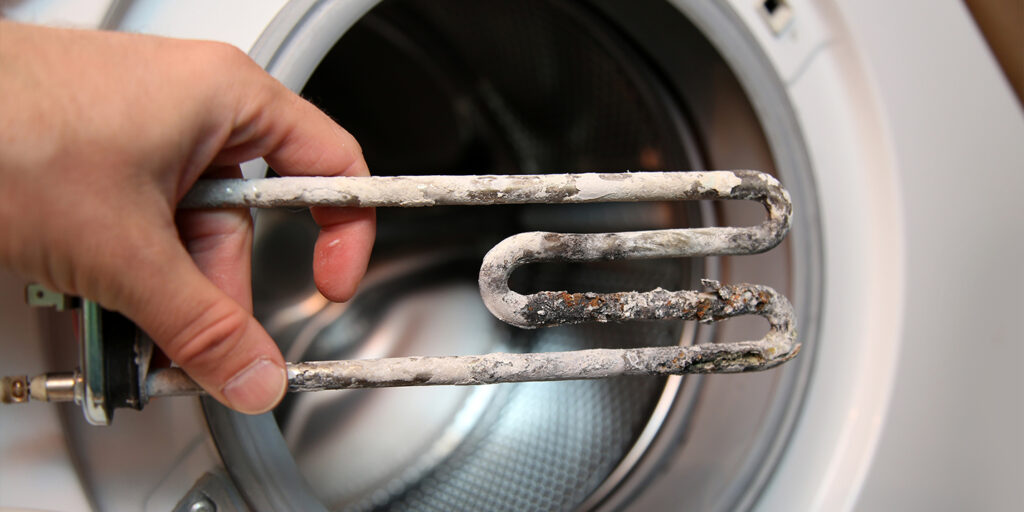

To descale a washing machine in a UK hard water area, run an empty hot wash (90 or 95°C) with 50-100g of food-grade citric acid placed directly in the drum. Repeat every 1 to 2 months in hard water areas to protect the heating element. Citric acid removes existing limescale, while products like Calgon only prevent new scale forming.
Roughly 60% of UK households live in a hard or very hard water area, and washing machines in those postcodes work harder and fail sooner than machines in soft water regions. The good news is that descaling is straightforward, cheap, and can be done with one inexpensive ingredient.
This guide explains exactly what to use, how often to do it, what to avoid, and how to tell whether your area really needs the effort.
How do you know if you’re in a UK hard water area?
Water hardness is measured by the amount of dissolved calcium and magnesium carbonate (mg/l of CaCO3). The higher the number, the more limescale your appliances will accumulate.
The easiest way to check is to enter your postcode into your water supplier’s hardness checker. Thames Water, Anglian Water, Affinity Water, Severn Trent and others all publish this online for free.

Including London, Kent, Surrey, Sussex and Essex. Almost universally hard to very hard water (often 250-350 mg/l). Descaling is essential.

Cambridgeshire, Norfolk, Suffolk, Bedfordshire and parts of the East Midlands are some of the hardest water areas in the country. Limescale builds up quickly here.

Mostly soft to moderately soft water. Descaling is still worthwhile occasionally, but limescale damage is much less of a concern.

Look inside your kettle. White flaky deposits on the element or scaly rings inside mean you’re in a hard water area. The same scale is forming inside your washing machine.
Why does hard water damage washing machines?
Limescale insulates the heating element. As scale builds up, the element has to work harder and stay on longer to heat the water, which raises your electricity bill and shortens the element’s working life.
For a deeper look at this, see our guide to limescale in washing machines and what causes the greyish-white coating inside the drum.
UK households in a hard water area
Scale on an element can cut efficiency by up to 12%
Typical years a heater lasts before scale-related failure
Scale also collects in the drum spider, around the door seal, and on the pressure chamber. Over time it contributes to unpleasant washing machine smells and black mould around the door seal by trapping detergent residue and biofilm.
What is the best way to descale a washing machine?
Several products will dissolve limescale, but they are not all equal. The table below compares the main UK options.
| Product | Typical UK price | How it works | Best for |
|---|---|---|---|
| Food-grade citric acid | £3-£6 per 1kg | Mild acid dissolves calcium carbonate scale | Regular descaling – the engineer’s choice |
| White distilled vinegar | £1-£3 per 5L | Acetic acid dissolves scale | Occasional use only – can soften rubber over time |
| Dr Beckmann Service-It Deep Clean | £3-£5 per sachet | Mix of acids and cleaners | One-off deep clean including drum and seal |
| Calgon (and similar) | £4-£8 per 500g | Sequesters calcium ions in each wash | Preventing new scale, NOT removing existing scale |
| Soda crystals | £1-£3 per kg | Alkaline – cuts grease and biofilm | Smells and residue, not limescale |
Citric acid is cheap, food-grade, gentle on rubber and plastic at sensible concentrations, and rinses away cleanly. A single 1kg bag is enough for 10 to 20 descales. Read our related guide on soda crystals and washing machines if you also want to deal with smells and detergent residue at the same time.
How do you descale a washing machine with citric acid?
The process takes about 90 minutes start to finish, most of which is the machine running on its own. Make sure the drum is completely empty before you start.

Citric acid is a mild irritant. Wear gloves when handling the powder and avoid getting it in your eyes. Never mix citric acid with bleach, chlorine-based cleaners or sodium percarbonate in the same wash – acid plus chlorine releases toxic fumes.
-
Remove anything from the drum. No clothes, no detergent. The drum must be completely empty so the citric acid can work on the scale itself, not on your laundry.
-
Weigh out 50 to 100g of food-grade citric acid. Use 50g for routine maintenance, 100g if you have visible scale or have never descaled before. Place it directly in the drum, not in the detergent drawer.
-
Select the hottest available wash cycle. A 90 or 95°C cottons cycle is ideal. If your machine no longer offers one, see our guide to washing machines with a 95 degree hot wash. Skip pre-wash and extra rinse for now.
-
Run the full cycle. Let the machine fill, heat, wash and spin. The hot acidic water will circulate through the drum, sump, pump, hoses and heater, dissolving scale as it goes.
-
Wipe the door seal and drawer. Once the cycle ends, pull the door seal back and wipe the rubber gasket with a cloth. Pull the detergent drawer out fully and rinse it under hot tap water.
-
Run a short cold rinse. A quick rinse-and-spin cycle flushes any remaining acidic residue from the system before you put laundry back in.
-
Check the pump filter. Loose flakes of dislodged scale can collect in the washing machine pump filter. Clean it out a day or two after descaling.
Heater already failed?
If your machine isn’t heating, runs cold, or trips the electrics, the element may already be beyond saving. Get it diagnosed properly before sinking more money into descaling.
Can you use white vinegar to descale a washing machine?
White distilled vinegar will dissolve limescale, but it’s not the engineer’s first choice. The trade-off is between cost and long-term seal condition.
 Advantages
- Very cheap and available in every UK supermarket
- Works as a descaler at typical 5% acidity
- Also deodorises mild smells in the drum and pipes
- Food-safe so no rinsing concerns for laundry
 Disadvantages
- Stronger smell, lingers for a wash or two
- Repeated use can perish rubber door seals and bellows
- Some manufacturers advise against it in the warranty terms
- Weaker per millilitre than citric acid – needs more product
If you choose vinegar, use around 500ml in the drum on the hottest empty cycle, and don’t make it a monthly habit – reserve it for occasional use.
What’s the difference between a descaler and a water softener?
This is the single most common misunderstanding in hard water areas. Calgon and similar tablets are not descalers. They are water softeners, and the two jobs are different.
 Descaler
An acidic product (citric acid, vinegar, dedicated descaler) that dissolves limescale that has already formed on the heating element and inside the machine. Used periodically on an empty wash.
Water softenerA product added with every wash that binds calcium and magnesium ions before they can deposit. Calgon, Glist and supermarket own-brands all fall into this category. They prevent new scale but do not remove existing scale.
In a very hard water area, the ideal approach is both: descale every 1 to 2 months with citric acid to remove what’s already there, and use a softener (or a higher detergent dose) with each wash to slow new scale forming. We cover this in more detail in our article on connecting a washing machine to a softened water supply.
How often should you descale in a hard water area?
Descaling too rarely lets scale build up faster than you can remove it. Descaling too often wastes time and product. Use the rough schedule below as a starting point and adjust based on what you find inside the drum and drawer.
| Water hardness | Typical UK regions | Descaling frequency |
|---|---|---|
| Soft (under 100 mg/l) | Most of Scotland, Wales, North West, NI | Once or twice a year |
| Moderately hard (100-200 mg/l) | Parts of the North East, South West, Midlands | Every 3-4 months |
| Hard (200-300 mg/l) | Much of the Midlands, Yorkshire | Every 2 months |
| Very hard (over 300 mg/l) | London, South East, East Anglia | Every 4-6 weeks |
You can also tie descaling to a regular washing machine maintenance routine so it doesn’t get forgotten.
How can you prevent limescale build-up?
Descaling tackles the problem once it’s there. These habits slow scale from forming in the first place and are worth adopting in any hard water area.
-
Use the correct detergent dose for your water hardness – read the back of the box for the hard water column, not the soft water one. -
Run a hot maintenance wash (60 or 90°C, empty) at least once a month to flush residue and biofilm. -
Leave the door and drawer slightly open between washes so the drum can dry out. -
Don’t rely on washing only at 30°C – cool washes leave more detergent residue, which combines with scale. See our guide on washing at 30 degrees for the full picture. -
Consider a whole-house water softener if you live in a very hard area – it pays back through every appliance, not just the washing machine.

Descaling involves running a machine on a hot cycle and handling mildly acidic products. Always read the manufacturer’s user manual before descaling – some warranties restrict which products may be used. Never open a machine to clean internal parts unless it is unplugged from the mains. If your machine is showing electrical faults, will not heat, trips the RCD, or leaks during the descaling cycle, stop and consult a qualified engineer. See our general washing machine repair safety advice before attempting any DIY work.
Not sure if it’s limescale or something worse?
Strange smells, slow heating, white residue and leaks can all point to faults that descaling won’t fix. Our engineers can diagnose what’s actually wrong and quote the repair.
Frequently asked questions
Will descaling damage my washing machine?
No, not when done correctly with food-grade citric acid or a dedicated washing machine descaler. The risk comes from using industrial-strength descalers, mixing acids with bleach, or pouring vinegar into a machine on every wash. Stick to the recommended doses and your machine will benefit, not suffer.
Does Calgon actually work?
Calgon is a water softener, not a descaler. It binds calcium ions in each wash so new scale cannot form on the heating element. It works well for prevention, but it will not remove scale that has already built up. In a hard water area you usually need both – a periodic citric acid descale to remove existing scale, plus a softener or correct detergent dose with each wash.
Can I just put vinegar in my washing machine every month?
It’s not recommended. White vinegar works as a descaler on an occasional empty cycle, but using it every month can soften and perish the door seal, drain hose and other rubber components over time. Citric acid is gentler and cheaper per descale.
How can I tell if limescale is already damaging my washing machine?
Signs include longer cycle times, water not getting as hot as it used to, a gritty white film inside the drum, flakes coming through with the wash, and eventually a heater fault. If your machine has stopped heating, see our guide on washing machine not heating water.
Should I run a service wash with descaler or just on its own?
Both have a place. A plain hot empty cycle (the service wash) tackles detergent residue and biofilm, which is what causes most smells. Adding citric acid turns the same cycle into a descale. In a hard water area, doing both at once is the most efficient approach.
Is descaling worth it on an old washing machine?
It can be, especially if the only fault is reduced heating performance. But if the heater has already failed, the bearings are noisy, or the drum spider is corroded, descaling alone won’t bring it back. See our guide to washing machine lifespan to weigh up repair against replacement.
Ask the repair forum
Post the make, model and symptoms and get help from the Whitegoods Help community.
0 Comments