
Appliance Repair Forum
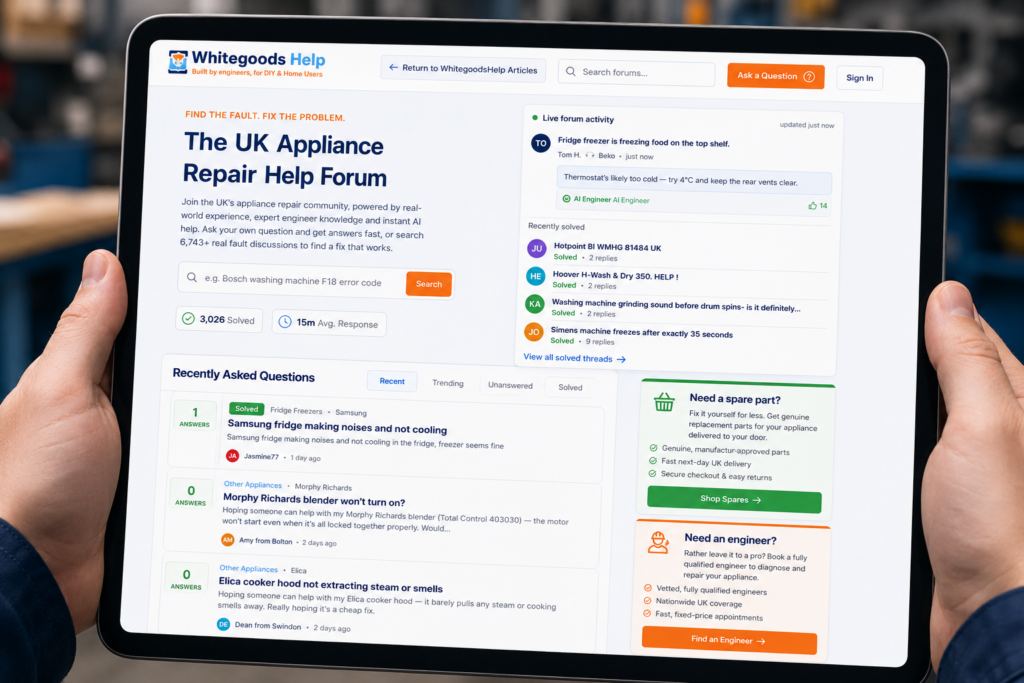

If you have a broken washing machine, tumble dryer, dishwasher, fridge, oven, or any other UK domestic appliance, the fastest free help available is the Whitegoods Help Forum. It combines instant AI-powered diagnostic help, real verified engineers monitoring the discussions, a searchable archive of 6,743+ real fault discussions (3,026 already solved), and a 15-minute average response time. That is several orders of magnitude faster than the traditional appliance repair forums where you post a question and hope someone replies in the next few days. The rest of this page covers how to use it well, when a forum is the right answer for your problem, and when to skip straight to a qualified engineer.
The Whitegoods Help Forum: modern appliance repair help
The Whitegoods Help Forum is the UK’s modern, engineer-backed appliance repair community, designed to give households the answers they need significantly faster than traditional forum-based help can deliver. It is free to use, free to search, and free to post questions on. It is not behind a paywall, does not require a subscription, and does not have premium tiers locked away.
What makes it genuinely different from a traditional appliance repair forum is the combination of four things working together.

Instant AI-powered help
When you post a question, an integrated AI trained on appliance fault diagnostics gives you an immediate response based on your symptoms, model, and error code. You do not sit waiting for someone to notice your post. The first useful guidance arrives within seconds. For many common faults (door interlock issues, drain pump blockages, error code lookups, simple diagnostic checks), the AI response alone is enough to resolve the problem.

Real verified engineers monitoring
Behind the AI, qualified appliance engineers with UK trade experience actively monitor the forum and step in on questions where their hands-on expertise is needed. This is not a community of consumers guessing at each other’s problems. The senior contributor on the platform alone has logged thousands of helpful contributions, with the verified-engineer badge to confirm it. When a complex or unusual fault comes up, the response comes from someone who has fixed that exact fault on a workbench, not someone who once read a similar post on another site.

15-minute average response time
Traditional appliance repair forums work on a “post and wait” model. You write up your problem, attach photos, and then refresh the page hoping someone replies. The wait time on most public forums is measured in hours at best, days or weeks at worst, and on quieter forums the question may never get answered at all. The Whitegoods Help Forum has a 15-minute average response time across all posted questions. The combination of instant AI help plus active human monitoring eliminates the dead-air wait that makes traditional forums so frustrating.

6,743+ real fault discussions, 3,026 already solved
The forum has a searchable archive of over 6,743 real UK appliance fault discussions, of which more than 3,026 are marked as fully solved. For any common fault, there is a high probability that someone has already asked your exact question and received a working solution. A few seconds of searching often delivers the answer before you even need to post. The archive is genuine UK-focused content covering every major brand and appliance type, not generic content scraped from elsewhere.
Get help with your appliance fault right now
Browse the live forum, search for your specific fault, or post a new question. Free, no signup needed to search, with AI-powered instant help and real UK engineers monitoring. Most questions get their first useful response within 15 minutes.
Every common UK appliance, every common fault
The Whitegoods Help Forum is organised by appliance category, so you can browse questions and answers specific to the appliance type you are dealing with. Each category has its own archive of real fault discussions and active live posts.
The largest category on the forum. Covers every major UK washing machine brand and every common fault: door interlock issues, drainage problems, error codes, vibration and noise, leaks, smell complaints, and more. See our supporting guides on washing machines and washing machine error codes.
Electric and gas cookers, built-in ovens, ceramic and induction hobs. Important note: any gas appliance fault must be referred to a Gas Safe registered engineer rather than attempted DIY. See our wider cookers and ovens section.
Cylinder, upright, cordless stick, and handheld vacuum issues. Belt failures, motor faults, suction problems, battery issues on cordless models, and brand-specific quirks.
Bean-to-cup, espresso, capsule, and filter coffee machines. Descaling, blockages, pressure faults, milk frother issues, and brand-specific service requirements.
Smaller and less common appliances: dehumidifiers, slow cookers, blenders, food processors, bread makers, cooker hoods, kettles, toasters, and anything that does not fit the main categories.
Combined washer-dryer faults are some of the trickiest because two appliances share one body. The forum covers both wash-side and dry-side faults, with engineer guidance on whether repair is economical given the dual-function complexity.
A growing category covering Roomba, Roborock, Eufy, Shark, and other robot vacuum brands. Navigation faults, battery issues, mapping problems, and brush and roller wear.
Air fryer faults span basket release issues, heating problems, fan noise, display faults, and the brand-specific quirks of the most popular UK models.
Microwave faults including turntable issues, magnetron problems, display faults, and the safety-critical question of when a microwave is no longer worth repairing.
Vented, condenser, and heat pump tumble dryer faults. Heating issues, sensor faults, lint and condenser blockages, and the specific concerns of older models in the context of the 2027 UK tumble dryer regulations.
Smaller active categories at present but growing. Dishwasher cleaning faults, fridge noise diagnosis, freezer temperature problems, ice maker issues, and refrigerant-system concerns. See our wider dishwashers and fridges and freezers sections.
Find your appliance and get help fast
Pick your appliance category, browse existing solved threads, or post your own question. Real engineers and AI-powered diagnosis ready to help.
What an appliance repair forum is, and why ours is different
An appliance repair forum is an online community where you describe a fault on your domestic appliance and other people help you diagnose and fix it. The format has existed for over two decades and has been a useful resource for UK households throughout that time. The traditional version, however, has some serious limitations that the modern Whitegoods Help Forum has been specifically designed to overcome.
 Traditional appliance repair forum problems
You post a question and have no idea when, or if, anyone will reply. Response times measured in hours, days, or weeks. Many active threads are from years ago and the original posters never came back to mark them solved. No way to know whether the advice is from a qualified engineer or a confident hobbyist guessing. Quality varies wildly between contributors. Modern brands and models are often poorly covered because the forum’s active period predates them. Search is often clunky and results are mixed in with old, unsolved, or partially relevant threads.
 What the Whitegoods Help Forum does differently
AI-powered instant first response, so you never wait for someone to notice your post. Average human response within 15 minutes. Real verified engineers monitoring all categories. Solved threads clearly marked, so you can find the actual answer fast. 6,743+ real, current UK fault discussions, with new questions added daily. Modern brands and current models well covered alongside older ones. Clean, fast search that filters by appliance type, brand, status (solved, unanswered, trending), and recency. Free to use with no premium tiers.
Stop waiting. Get an answer in minutes.
The Whitegoods Help Forum was built to fix everything traditional forums get wrong. AI answers in seconds, real engineers within 15 minutes, free for life.
The fastest route to fixing your appliance, step by step
For households dealing with a broken appliance right now, the practical sequence below is the fastest route to a working solution. Each step takes minutes rather than days.

Step 1: Check for an error code first
If your washing machine, dishwasher, dryer, or oven is showing a code on the display, that code is the most diagnostically useful single piece of information you have. Look it up in our appliance error codes hub first, and specifically our washing machine error codes coverage which is the most developed. Many error codes have a clear documented cause and a documented fix that solves the problem in minutes.
Step 2: Search the Whitegoods Help Forum
Head to the Whitegoods Help Forum and search for your specific symptom or model. With 6,743+ existing discussions and 3,026 solved threads, there is a strong probability that your fault has been asked about and answered before. The solved-thread filter narrows results to questions where the original poster confirmed the fix worked.

Step 3: Ask your own question if you cannot find an existing answer
If the search has not turned up the right answer, post your own question. Include the make, model, age, symptom, error code (if any), and what you have already tried. The AI gives an immediate first response based on what you have described. The human engineers and experienced contributors step in shortly after, usually within 15 minutes. See our guidance on writing a good forum question below for the specific information to include.

Step 4: Source parts if needed
When the forum advice identifies a specific replacement part (drain pump, door interlock, heating element, drum bearing, fan motor), our spare parts service identifies the correct part for your exact model and serial number. Genuine parts from approved suppliers, not generic alternatives that often look right but cause new faults.

Step 5: Call an engineer if DIY is not the right answer
For faults the forum identifies as beyond reasonable DIY, our appliance repair booking covers nationwide qualified-engineer callouts across all major UK brands. The forum advice often saves an unnecessary callout entirely; when a callout is the right call, it is much better-informed because you know what is likely wrong before the engineer arrives.
Start at Step 2 right now
Open the forum, type your symptom, and see what comes back. Most users find their answer in under a minute.
When a forum is the right answer, and when it is not
Forum-based help is excellent for some categories of appliance problem and a poor fit for others. The honest distinction below helps you decide whether to post on the Whitegoods Help Forum or go straight to a qualified engineer.
Good problems for the forum
A washing machine, dishwasher, or dryer showing an error code that you need explained and fixed. A specific fault you have already partially diagnosed but want a second opinion before ordering parts. An unusual symptom that does not match any obvious documented fault. A question about whether a repair is worth attempting given the appliance’s age and value. A part identification or sourcing question. A model-specific issue you suspect is a known fault. A question about technique on a repair you have started and need help to finish.
Skip the forum and call an engineer
Anything involving a gas appliance — gas hobs, gas ovens, gas cookers must only be worked on by a Gas Safe registered engineer. DIY gas work is illegal in the UK. Anything where the appliance is still in warranty — go to the manufacturer first, because DIY work typically voids the warranty. Urgent faults where you need a fix within the hour and cannot wait for any response. Faults where the question is really about consumer rights or replacement under warranty (see our consumer rights guidance). Burning, electrical, or hot plastic smells from any appliance — stop using it immediately and get a qualified diagnosis.
How to ask a great question on the forum
The quality of the answer you get on any forum (including ours) is largely determined by the quality of the question you ask. The AI on the Whitegoods Help Forum gives an immediate response regardless, but the answer it can give and the human engineers can follow up with both improve dramatically when the question is well-written. Five minutes of preparation before posting saves hours of back-and-forth afterwards.

State the make, model, and approximate age
“My washing machine is broken” is unanswerable. “My Hotpoint Aquarius WMAQF721P, approximately 6 years old” is the start of a useful conversation. The model number is on the rating plate, usually inside the door, on the back, or behind a service panel. Approximate age helps the engineer judge whether the fault is likely a known issue at that life stage of the model.
Describe the symptom precisely
Bad: “It’s not working.” Good: “It starts the cycle, fills with water, agitates for about 30 seconds, then stops with a flashing light and the door locked. No error code appears.” The responder needs to know what the appliance does, what it does not do, and at what point in the cycle the problem occurs. Every detail narrows the diagnosis.

Include the error code exactly as displayed
If your machine shows an error code, write it down exactly as it appears (E18, F-21, H4, etc.). Codes vary by brand and small differences matter. Many error codes have a documented cause and fix — see our appliance error codes hub for a quick lookup before you even post.
State what you have already checked
“I have already checked the door is properly closed, cleared the pump filter (no obstruction found), and confirmed the water supply is on and the inlet hose is not kinked” saves the responder from asking those questions. It also signals that you have done basic troubleshooting, which earns more detailed answers.

Add photos where relevant
Photos of the rating plate, the display showing the error, an unusual noise’s source (where possible), water on the floor, or any visible damage all help. The Whitegoods Help Forum supports image uploads on every post, and questions with images get better diagnostic outcomes than text-only ones.

Say whether the appliance is in warranty
This changes the right answer. A 7-month-old machine should normally go back to the manufacturer or retailer under warranty, not be DIY-repaired. A 7-year-old machine is a different conversation. State the position so the engineer’s advice is relevant to your specific situation. See our wider consumer rights when buying appliances guidance for the wider warranty picture.
Ready to post a question?
You now know what to include. Open the forum, post your question with the detail above, and get your first response within minutes.
The most common UK appliance faults the forum covers
The Whitegoods Help Forum sees the same recurring questions across thousands of households. The list below covers the most-asked faults with links to the relevant deeper WGH guides. For any of these, searching the forum will turn up multiple existing solved discussions before you need to post.
Washing machines

Door will not unlock or open
One of the most-asked questions on the entire forum. The dedicated guide is at washing machine door won’t open. Covers safety lock timing, drum drainage, interlock fault diagnosis, and the manual emergency release.

Will not drain water
See washing machine won’t drain water. Covers pump filter cleaning, drain hose obstructions, pump failure diagnosis, and the difference between a fully blocked drain and a slow drain.
Error codes
Look up your code on the washing machine error codes hub. Brand-specific code lists for Bosch, Siemens, Neff, Hotpoint, Indesit, Beko, Blomberg, Zanussi, AEG, Electrolux, Whirlpool, Samsung, Haier, Hoover, Candy, Hisense, Gorenje, Bush, and Logik are all linked.

Smells, mould, and cleaning
See why does my washing machine smell for the full diagnostic hub, and how to clean a washing machine for the maintenance routine.
Tumble dryers
Tripping the electrics
One of the most common dryer faults on the forum. See tumble dryer tripping the electrics. Covers heating element earth leakage, RCD sensitivity, motor faults, and safe testing.
Heat pump dryer issues
Heat pump dryer faults often centre on filter cleaning. See heat pump tumble dryer guide and the wider heat pump vs vented vs condenser tumble dryer buying guide.
Fridges, freezers, and dishwashers

Fridge noises and cooling problems
See why is my fridge making noise for the diagnostic hub covering every common fridge sound, and fridges and freezers for wider cooling, frost, and seal issues.

Dishwasher faults
Start at our dishwashers section for fault guides, error code references, and maintenance advice across all major dishwasher brands.
Got one of these problems? Search the forum first
With 6,743+ real fault discussions and 3,026 already solved, there’s a strong chance someone has already asked your exact question.
Safety: what you should never DIY
Some appliance faults are safe for a careful homeowner to address. Others should never be attempted by anyone who is not qualified. The line is important to understand before posting on any forum, including ours.
Gas appliances (gas hobs, gas ovens, gas cookers). All gas appliance work in the UK must be carried out by a Gas Safe registered engineer. DIY gas work is illegal, dangerous, and invalidates household insurance. The Gas Emergency Helpline is 0800 111 999. Always check the engineer’s Gas Safe ID card before work begins. Appliances under warranty (DIY work typically voids the warranty, so contact the manufacturer or retailer first). Any repair you do not feel confident about. The forum can advise on diagnosis even for these categories, but the actual work should always be professional.
For everything else, our DIY appliance repair safety guide covers the principles: always unplug before working, never bypass safety devices, never assume a capacitor has discharged, and never attempt work on parts of the machine you do not fully understand. Most washing machine and dishwasher DIY repairs are mechanical (pumps, hoses, drain filters, door seals) and are safe with sensible precautions. Most cooker, oven, and major electrical repairs are riskier and benefit from a qualified engineer.
Spare parts: getting the right one
The single most common reason a forum-recommended DIY repair fails is the wrong part being fitted. Appliance models vary by region, by production year, and sometimes by individual serial range within a single year. A part that fits one Hotpoint Aquarius is not guaranteed to fit another, even with the same headline model number.
Our appliance spare parts service uses the full model and serial number to identify exactly the right part for your machine, with genuine parts from approved suppliers rather than generic-fit alternatives that often look right but cause new faults. For the broader picture, the UK Right to Repair regulations require manufacturers to make functional spare parts available for between 7 and 10 years after a product was last sold.
Consumer rights: know your position before paying for any repair
Before paying for any repair, particularly on an appliance under three years old, it is worth checking what your existing legal rights cover. UK consumer law gives appliance buyers significant protection that retailers and manufacturers do not always volunteer information about. The forum can help you assess whether your specific situation gives you a consumer rights claim.

Consumer Rights Act 2015
Requires goods to be of satisfactory quality, fit for purpose, and as described. Faults within 30 days give a short-term right to reject. Faults within six months are presumed to be present at the time of purchase, putting the burden of proof on the retailer. See our guide to your rights with faulty appliances under the Consumer Rights Act.
UK Right to Repair
Requires manufacturers to make functional spare parts available for 7 to 10 years after a model was last sold. Major components like drums, motors, and seals are within scope. See our Right to Repair guide.

Warranties
If your appliance is still under manufacturer warranty, go to the manufacturer first before any DIY work. Voiding the warranty by attempting repair yourself is a costly mistake. See our wider consumer rights for appliances guide.
Consumer rights guidance on Whitegoods Help and on the forum is provided as general information only and does not constitute legal advice. For complex disputes, especially those involving significant sums, consider seeking advice from a qualified solicitor or Citizens Advice.
The Whitegoods Help view
The traditional appliance repair forum was a genuinely useful innovation when it first appeared, and the surviving examples still help thousands of UK households every year. But the model has aged. Posting a question and hoping someone notices, in a community of variable expertise, with no clear answer pathway and no guarantee of resolution, is not the experience modern consumers expect or deserve.
The Whitegoods Help Forum is our attempt to bring the best of the traditional forum model — the community knowledge, the real-world experience, the searchable archive of solved problems — together with the technology and the engineering credibility that the traditional model has been missing. AI-powered instant first responses. Verified engineers monitoring across every category. A 15-minute average response time that traditional forums simply cannot match. A clean modern interface designed for the smartphone era rather than the desktop era. Direct integration with the spare parts and qualified-engineer services for the cases where DIY is not the right answer.
The result, we believe, is the most useful free appliance repair help available to UK households in 2026. If you have a broken appliance, the forum is the place to start. If you have a working appliance and want to keep it that way, the forum is also where the maintenance and prevention knowledge lives. If you are deciding between repair and replacement on an aging machine, the forum has thousands of solved threads from people who faced the same decision and shared their outcome.
Free, fast, engineer-backed, and built for the way people actually need appliance help today. That is what we have built.
Free UK appliance repair help — start here
Ask a question on the forum and get instant AI-powered diagnostic help plus real engineer follow-up within 15 minutes on average. Or search 6,743+ real fault discussions to find an answer that already exists. Free, no signup needed to search, every major UK appliance brand and model covered.
Frequently asked questions about appliance repair forums
What is an appliance repair forum?
An appliance repair forum is an online community where consumers and engineers discuss how to diagnose and fix domestic appliances. The Whitegoods Help Forum is the UK’s modern version, combining AI-powered instant help, verified engineer monitoring, a 15-minute average response time, and an archive of 6,743+ real fault discussions across washing machines, dryers, dishwashers, fridges, ovens, hobs, vacuum cleaners, coffee machines, air fryers, and other UK domestic appliances.
How is the Whitegoods Help Forum different from a traditional appliance repair forum?
Four things. First, integrated AI gives you an immediate first response when you post a question, so you never sit waiting for someone to notice. Second, real verified UK engineers actively monitor the forum, not just consumers guessing. Third, the 15-minute average human response time is dramatically faster than traditional forums where waits run to days or weeks. Fourth, the searchable archive of 3,026+ solved threads means many questions have already been answered before you even need to post.
Is the Whitegoods Help Forum free to use?
Yes, completely free. Searching is free with no signup required. Posting questions is free. There are no premium tiers, no paywalls, no subscription requirements. The forum is supported by our spare parts and qualified-engineer services for the cases where DIY is not the right answer.
How quickly will I get an answer if I post a question?
The integrated AI gives you a first response within seconds of posting. Human responses from engineers and experienced contributors average 15 minutes across all categories, often faster. This is significantly quicker than traditional appliance repair forums where the wait for a useful reply is typically measured in hours or days.
Are the engineers on the forum actually qualified?
Yes. The forum is monitored by qualified appliance engineers with UK trade experience. Engineers are clearly marked with a verified-engineer badge so you can tell expert responses from general community input. The senior contributor alone has logged thousands of helpful contributions.
Which appliances does the forum cover?
Twelve major categories: washing machines, washer dryers, tumble dryers, dishwashers, fridge freezers, cookers, ovens and hobs, microwaves, coffee machines, air fryers, vacuum cleaners, robot vacuums, and other appliances (dehumidifiers, slow cookers, blenders, bread makers, kettles, cooker hoods, and more). Every major UK brand is represented across the existing 6,743+ discussions.
How do I write a good question to get a useful answer?
Include the make, exact model number, approximate age, precise symptom description, the error code if there is one, what you have already checked, and whether the appliance is still in warranty. Photographs of the rating plate and the visible problem help. The AI response improves significantly with this detail, and the human engineers can give much more targeted advice.
Can I repair my own appliance based on forum advice?
For mechanical faults on washing machines, dishwashers, and similar appliances (pump filter cleaning, drain hose checks, door seal replacement, drum belt replacement), yes — with sensible precautions including unplugging the appliance and following the engineer’s specific guidance. For electrical work, gas appliances, or any repair you do not feel confident about, get a qualified engineer instead. See our DIY appliance repair safety guide.
My appliance is still in warranty. Should I post on the forum?
You can post for diagnostic understanding, but the actual repair should go through the manufacturer’s warranty service rather than DIY. Attempting a repair yourself on an in-warranty appliance typically voids the warranty. Use the forum to understand what is likely wrong, then call the manufacturer to arrange warranty service. See our consumer rights when buying appliances guide.
What about gas appliances?
All gas appliance work in the UK must be carried out by a Gas Safe registered engineer. The forum can help diagnose what is likely wrong with a gas hob, gas oven, or gas cooker, but the actual repair work is a legal-requirement Gas Safe job, not a DIY one. The Gas Emergency Helpline is 0800 111 999 if you smell gas. Always check the engineer’s Gas Safe ID card before work begins.
What if I need a spare part after the forum diagnoses the fault?
Our appliance spare parts service identifies the correct part for your specific machine using the full model and serial number. Generic-fit parts from other sources often look right but cause new faults — genuine parts from approved suppliers are worth the small additional cost for reliability. The UK Right to Repair regulations require manufacturers to keep functional spare parts available for 7 to 10 years after a model was last sold.
What if the forum advice says I need a qualified engineer rather than DIY?
Our appliance repair booking covers nationwide qualified-engineer callouts across all major UK brands. The forum advice often saves an unnecessary callout entirely; when a callout is the right call, it is much better-informed because you arrive at the conversation knowing what is likely wrong.
Ask the repair forum
Post the make, model and symptoms and get help from the Whitegoods Help community.
0 Comments