
Washing machine leaking from underneath
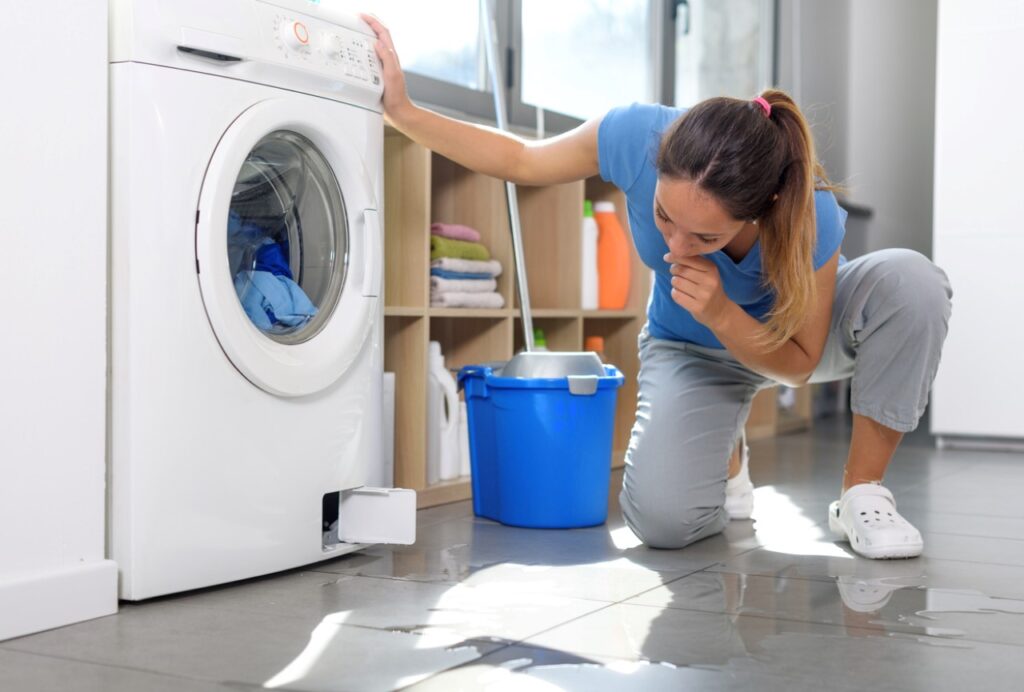

Most washing machine leaks appear underneath even when the source is at the back or sides. Before investigating, confirm the water is not coming from the door seal or the soap dispenser drawer – if it is, those are separate faults. A leak when the machine is not in use most commonly comes from a pressurised fill hose connection. A leak only during use points to the pump, sump hose, drum seal, or a plumbing fault.
This guide covers leaks from underneath the washing machine – both during use and when the machine is off. If water is clearly coming from the door or the soap dispenser drawer, see the dedicated guides for those sources before reading further.
 Leaking From the Door
 Leaking From the Soap Drawer
Leaking When the Machine Is Not in Use
Finding a pool of water underneath a washing machine that has not been used for several hours is almost always caused by one of two sources.

Fill hose connection under pressure
Most people leave the tap feeding the washing machine permanently on. The fill hose and its connections remain under mains water pressure at all times. A slow drip from where the hose screws onto the water valve – or at the tap end – will accumulate overnight and appear as a pool of water under the machine in the morning. A rusty stain around the connection point is often the evidence of a long-running slow drip. Pull the machine out and inspect both ends of the fill hose carefully. The small rubber washer inside the connector can be replaced, as can the hose itself. See our guide on aqua-stop hoses for information on flood-protection hoses that cut off the supply if the hose fails.

Pump or sump hose seeping after use
The pump and sump hose always retain a small amount of water after the cycle ends. A very small leak from either component may only produce visible water gradually after the cycle has finished – not noticeably during the wash itself. If the fill hose connections look dry and rust-free, inspect the pump body and the sump hose for signs of dampness or residue. See our guide on washing machine pumps.
Intermittent Leaks: Causes and How to Diagnose Them
Intermittent leaks are among the most frustrating faults to trace – the machine may not leak during a diagnostic inspection but does so at other times. The key to diagnosing them is identifying the specific conditions that trigger the leak.
| When does it leak? | Most likely cause | What to check |
|---|---|---|
| Only on certain wash programmes | A higher water level on some programmes reaches a damaged area of the drum seal or outer drum that lower-level washes do not reach | Inspect the door seal and drum seal carefully, particularly the lower sections |
| Only with large or heavy loads | Heavy loads bounce more on spin, causing the tub to move more than usual and water to escape from a weak point or loose connection | Try to reproduce the fault with a heavy load and watch from outside; check all hose clips and connections for looseness |
| Only during or after drain/rinse cycles | Water backing up in a blocked standpipe or drain connection and overflowing at the back of the machine rather than pumping cleanly away | Check the standpipe and drain connection for blockages or restricted flow; confirm the drain hose is not pushed too deep into the standpipe |
| Only on hot washes | Heat causes rubber hoses and seals to expand – a small gap that holds water cold may open enough to leak when hot | Run a hot cycle and watch all hose connections and the pump area during the wash phase |
Always try to recreate an intermittent leak under the conditions where it is known to occur – with the right load type, on the right programme, at the right temperature. Inspecting during a cold empty-drum test cycle will not reveal a fault that only appears with a full hot load. For more detailed guidance on tracing leaks, see our main guide: 5 essential tips when finding a washing machine leak.
How to Find the Source of a Leak From Underneath
Most leaks that appear underneath the machine originate from one of the following sources. Pulling the machine out carefully is usually necessary to investigate. See our guide on how to pull a washing machine out safely.
-

Fill hose connections – both at the tap and at the water valve on the machine. Look for rust staining or dampness around the connections. -
Drain hose connection – at the back of the machine and at the standpipe or U-bend. Check whether water is backing up in the drain rather than pumping away. -
Pump body and pump filter seal – the pump is typically at the front bottom of the machine. Check for moisture, residue, or visible cracking. See our guide on pump filter leaks after cleaning. -
Sump hose – the large black hose running from the base of the drum to the pump. Check clips and the hose body for cracks or looseness. -
Door seal (boot seal) – water can travel down the seal and appear under the machine rather than at the door. Inspect the full circumference of the seal, particularly the lower section, for tears, splits, or debris lodged in the folds. -
Drum seals and tub welds – on older machines, the tub itself can develop small cracks or the drum bearing seal can fail, allowing water to escape past the rear of the drum.
Need a Qualified Engineer?
Leaks from internal hoses, drum seals, or the pump body can be difficult to access and repair without experience.
All Washing Machine Leak Guides
5 Essential Tips for Finding a Washing Machine LeakHow to systematically locate the source of any washing machine leak – the main diagnostic guide.
 Leaking on Spin
Specific causes of leaks that only occur during or after the spin cycle.
Washing Machine OverfillingWhen a fault causes the machine to take in too much water – a common cause of leaks from the door or drawer.
 Too Much Foam
Excess suds can cause leaking from unexpected places – causes and how to resolve it.
Frequently Asked Questions
Why is there water under my washing machine when it hasn’t been used?
The most common cause is a slow drip from a fill hose connection that remains under mains water pressure after the machine has finished. Pull the machine out and check both ends of the fill hose for drips or rust staining. The rubber washer inside the connector may need replacing. The second possibility is the pump or sump hose seeping residual water slowly after the cycle ends.
My washing machine only leaks sometimes – how do I find the source?
The key is recreating the conditions under which the leak occurs. If it only happens on hot washes, run a hot programme and watch all hose connections during the wash phase. If it only happens with heavy loads, run a towel cycle and check during spin. If it only occurs during the drain cycle, check whether water is backing up in the standpipe rather than pumping away cleanly. Do not try to diagnose an intermittent leak with a cold empty-drum cycle – the fault may not reproduce.
Could a blocked drain cause a leak from underneath?
Yes. If the standpipe or drain connection becomes blocked or restricted, water being pumped out by the machine can back up and overflow at the rear, appearing under the machine as a leak. This is a common but often overlooked cause of leaks that only occur during drain or rinse cycles. Check the standpipe for debris and confirm the drain hose is not pushed too far in, restricting flow.
Ask the repair forum
Post the make, model and symptoms and get help from the Whitegoods Help community.
7 Comments
Grouped into 5 comment threads.
1 reply The washer was not running/not being used and no one was home using any water anywhere else in the house - no water was turned on. The washer is located in a laundry room next to the garage. A neighbor called and said she could see water running out under the garage door and down the driveway. Her husband could hear the water pump machinery going on and off behind the garage door (the house has well water.) He turned off the outside water pump to keep water going from the well to the house. When we finally were able to get to the house days later the carpet in the dining room which is next to the laundry was still damp and we could see where water had been on the tiles in the laundry room, in the hallway to the garage, a bathroom off that hallway and in the garage. ***What would cause the water from the house to continually run into the washer*** (and then out from underneath the washer onto the floors) ?? Some kind of broken/compromised seal or gasket inside the washer ??
0 replies My machine is leaking I have cleaned the rubber inside door it seems to be leaking more underneath if j need to change door rubber thankyou
My machine is leaking I have cleaned the rubber inside door it seems to be leaking more underneath if j need to change door rubber thankyou
1 reply Hi our washing machine has been leaking for a few weeks. The water leak is coming out the bottom after the spin cycle! Originally it was on the left side. we replaced the door/drum seal thinking it was this. This stopped the leak this side, now the leak is under the filter. The filter has been cleaned several times, no apparent block. All hoses have been checked, cleaned and water run though, appears no leaks here! Please any ideas?? I'm fed up getting wet feet!
Hi our washing machine has been leaking for a few weeks. The water leak is coming out the bottom after the spin cycle! Originally it was on the left side. we replaced the door/drum seal thinking it was this. This stopped the leak this side, now the leak is under the filter. The filter has been cleaned several times, no apparent block. All hoses have been checked, cleaned and water run though, appears no leaks here! Please any ideas?? I’m fed up getting wet feet!
Likely replying to Emma shipway
Hello Emma. Leaks are the type of fault that someone needs to be there to see in order to diagnose. Water can appear in one place but could have run from somewhere else higher up and dripped there so leaks have to be either observed or you need to find a hole in the sump hose or see caked up detergent, rust, leak marks on a part that confirms that is what is leaking. There’s a little bit more advice on leaks on spin here but you you have to see that parts are definitely leaking because you have seen the evidence or a hole etc. Guessing is very hit and miss and although you can guess lucky, more often than not people guess wrong.
0 replies Shredded plastic could be from the outer drum (a yellow / beige colour) or from the underside of the plastic drum paddles (lifters). If accompanied by a bad leak from underneath from a cracked or holed outer drum it's probably caused by a coin or other obstruction that's got into the machine (usually from a pocket) and damaged the drum (tub). If something's got inside you need to get it out but if it's damaged the outer drum it will need replacing at great expense unless it's just a crack which could be repaired (long shot) How to remove something from washing machine drum | How to repair a cracked plastic outer drum in washing machine
Shredded plastic could be from the outer drum (a yellow / beige colour) or from the underside of the plastic drum paddles (lifters). If accompanied by a bad leak from underneath from a cracked or holed outer drum it’s probably caused by a coin or other obstruction that’s got into the machine (usually from a pocket) and damaged the drum (tub).
If something’s got inside you need to get it out but if it’s damaged the outer drum it will need replacing at great expense unless it’s just a crack which could be repaired (long shot)
How to remove something from washing machine drum | How to repair a cracked plastic outer drum in washing machine
0 replies my washing machine started leaking yesterday quite badly from underneath the machine. i started to look for the problem and when i checked inside the drum and in the drain cover i found lots of bits of shredded plastic that looks like it has somehow broken off from the machine. i'm not sure what to do about it. i have put on a load and the machine works fine all the way to the spin cycle when the machine seems to get very loud compared to normal and ideas on what this might be and how i can fix the problem? Thanks
my washing machine started leaking yesterday quite badly from underneath the machine. i started to look for the problem and when i checked inside the drum and in the drain cover i found lots of bits of shredded plastic that looks like it has somehow broken off from the machine. i’m not sure what to do about it. i have put on a load and the machine works fine all the way to the spin cycle when the machine seems to get very loud compared to normal and ideas on what this might be and how i can fix the problem?
Thanks
The washer was not running/not being used and no one was home using any water anywhere else in the house – no water was turned on. The washer is located in a laundry room next to the garage. A neighbor called and said she could see water running out under the garage door and down the driveway. Her husband could hear the water pump machinery going on and off behind the garage door (the house has well water.) He turned off the outside water pump to keep water going from the well to the house. When we finally were able to get to the house days later the carpet in the dining room which is next to the laundry was still damp and we could see where water had been on the tiles in the laundry room, in the hallway to the garage, a bathroom off that hallway and in the garage.
***What would cause the water from the house to continually run into the washer*** (and then out from underneath the washer onto the floors) ?? Some kind of broken/compromised seal or gasket inside the washer ??
Likely replying to Cindy
Hello Cindy, it sounds like you need this article – Washing machine fills with water when off