
Should I Repair or Replace my Appliance?
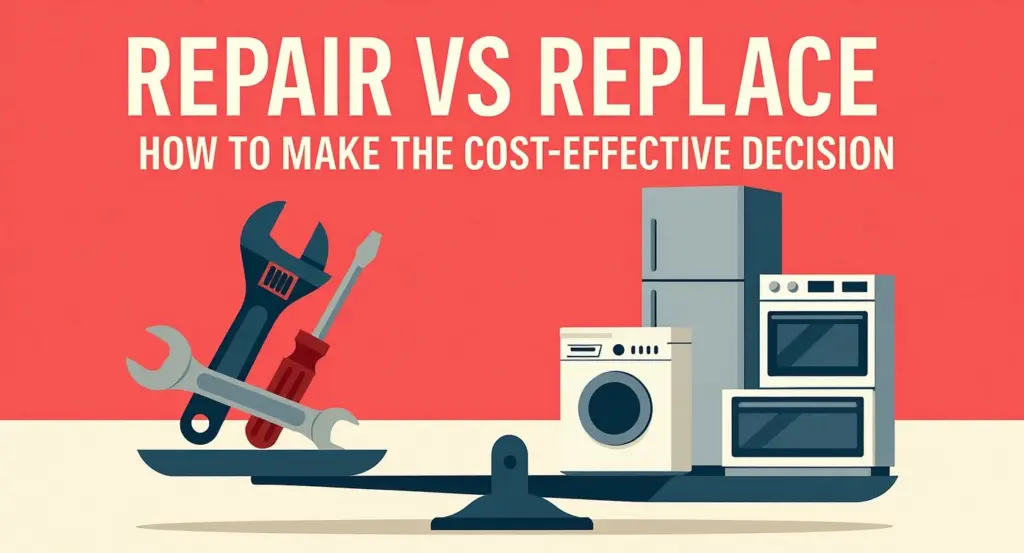
If a repair costs less than half the price of a comparable new appliance and the machine is under ten years old, repair is usually the better financial choice. If the repair quote exceeds 50% of replacement cost, the appliance is very old, or faults are recurring, replacement is likely to make more sense. This guide explains how to weigh up each factor properly.
Why does the repair-or-replace decision feel so difficult?
When an appliance breaks down, most people face the same problem: they have no reliable way of knowing whether the repair will be good value, how much longer the machine would have lasted anyway, or whether they are simply paying to delay an inevitable replacement by a few months.
Repair engineers and appliance retailers both have a financial interest in the outcome, which makes it hard to get impartial advice. This guide sets out a practical, clear framework for making the decision yourself, based on the appliance type, its age, the nature of the fault, and what a fair repair would actually cost.
What is the 50% rule and should you use it?
The 50% rule is the most widely used starting point for the repair-or-replace decision. The principle is simple: if the cost of a repair exceeds 50% of the cost of a comparable new replacement appliance, replacement is generally the more sensible financial choice.
It is a useful rule of thumb, but it has real limitations. It does not account for the age of the appliance, the likelihood of further faults, the environmental cost of scrapping a machine, or your current budget. The sections below cover each of these factors in more detail so you can apply the rule with the context it needs.
The 50% rule is a widely referenced consumer guidance heuristic, not a guaranteed financial formula. It is best used as a starting point for the decision, combined with the other factors covered in this guide.
How long should an appliance last? Expected lifespans by type
Knowing roughly where an appliance sits in its expected working life is one of the most important inputs to the repair-or-replace decision. The figures below are approximate and widely cited as industry guidance. Actual lifespan varies significantly depending on usage frequency, maintenance, brand quality, and installation conditions.
| Appliance | Typical lifespan | Repair worthwhile if under |
|---|---|---|
| Washing machine | 8 to 12 years | 8 years, subject to repair cost |
| Tumble dryer | 8 to 12 years | 8 years, subject to repair cost |
| Dishwasher | 9 to 12 years | 8 years, subject to repair cost |
| Fridge freezer | 10 to 15 years | 10 years, subject to repair cost |
| Cooker or oven | 10 to 15 years | 10 years, subject to repair cost |
| Washer dryer (combined) | 6 to 10 years | 6 years, subject to repair cost |
Lifespan figures are approximate guidance based on commonly cited industry estimates. Individual appliance longevity depends heavily on usage patterns, maintenance, water hardness, installation quality, and the original build quality of the machine. For a more detailed look at washing machine lifespan specifically, see our dedicated guide: how long should a washing machine last?
What factors should you weigh up when deciding?
The older the machine, the less value a repair returns. An appliance in the final two or three years of its expected lifespan is a weaker candidate for expensive repair, because even a successful fix may only delay an inevitable replacement by a short time.
Get a written quote before committing to any repair. Compare it against the cost of a comparable replacement, applying the 50% rule as a starting benchmark. A repair at 20 to 30% of replacement cost is almost always worth doing on a machine in reasonable condition.
A machine that has already been repaired once or twice in quick succession is signalling deeper wear. Paying for a third repair on an ageing appliance with a persistent fault history is rarely good value, as further issues are likely to follow.
Minor faults such as a blocked pump filter, a worn door seal, or a faulty door interlock are cheap to repair and are not indicators of general machine decline. Major faults such as a seized drum bearing, a failed motor, or a burned-out control board on an older machine are more expensive and carry a higher risk of further problems.
Older appliances are often significantly less energy efficient than their modern equivalents. If your current machine carries a D, E, F, or G energy rating and a newer replacement would achieve A or B, the ongoing running cost savings may make replacement the better long-term financial decision even if the immediate repair seems affordable. For context on how UK energy ratings actually compare, see our guide to understanding appliance energy ratings.
Manufacturing a new appliance carries a significant carbon cost. Repairing a machine and extending its working life by several years is almost always the more environmentally responsible choice, provided the energy efficiency of the machine is not dramatically poor. The UK Right to Repair regulations now require manufacturers to make spare parts available for a minimum period after manufacture, specifically to support repairability. Read more in our guide to your right to repair white goods.
Repair or replace? A side-by-side guide
✅ Repair is likely the right choice
- The appliance is under five years old and still within or recently out of its manufacturer guarantee
- The fault is a known minor component failure such as a door seal, filter, interlock, element, or pump
- The repair quote is under 30% of the cost of a comparable new replacement
- The machine is a premium or higher-build-quality model where comparable replacement would cost significantly more
- Spare parts are readily available, confirming the manufacturer is still supporting the model
- The appliance has no previous repair history and has been well maintained
❌ Replacement may be the better option
- The appliance is more than ten years old and the repair quote is substantial
- The same fault or related faults have recurred within a short period
- The repair quote exceeds 50% of the cost of a comparable new replacement
- Spare parts for the model are no longer available or have very long lead times
- The machine carries a poor energy rating and a new equivalent would be significantly cheaper to run
- There are multiple faults developing simultaneously, suggesting general component wear throughout
- The appliance is a combined washer-dryer over eight years old with a major fault, as repair costs relative to replacement value are often difficult to justify
Is it worth getting an appliance repaired if it is out of guarantee?
Yes, in many cases. A guarantee expiry does not mean a machine has reached the end of its useful life, and it does not affect your statutory consumer rights under the Consumer Rights Act 2015. If a fault develops that could reasonably be attributed to a manufacturing defect rather than fair wear and tear, you may still have a legal remedy against the retailer, regardless of how long you have owned the appliance.
For a full explanation of what your rights are after the manufacturer guarantee has expired, see our guide to appliances out of guarantee and your rights, and our detailed look at the Consumer Rights Act and faulty appliances.
Should you use the manufacturer’s engineer or an independent repairer?
Both have genuine advantages. Manufacturer engineers will have the deepest knowledge of specific models and access to genuine parts, but they can be more expensive and availability is sometimes limited. Independent engineers are often faster to attend, competitively priced, and many are highly experienced across a wide range of brands and models.
Whatever route you choose, always get a written quote before authorising any work. A reputable engineer should be able to diagnose the fault and provide a fixed price or clear estimate before any repair is carried out. Our guide to manufacturer versus independent engineers covers the key considerations in more detail.
Always confirm before booking whether a call-out or diagnostic fee applies and whether it is deducted from the repair cost if you proceed. For more on this, see our guide to what no call-out charge actually means.
Can you repair the appliance yourself?
For certain types of fault, DIY repair is entirely reasonable. Cleaning a blocked pump filter, replacing a door seal, fitting new carbon brushes, or clearing a blocked pressure system are tasks that many confident DIYers carry out successfully with the help of a good fault guide and the correct spare part.
Other repairs, particularly those involving the electrical supply, internal wiring, refrigerant circuits, or gas connections, must only be carried out by a qualified professional. Attempting electrical, refrigerant, or gas work without the appropriate qualifications is illegal, dangerous, and will invalidate any insurance or warranty.
Before attempting any DIY repair, read our DIY appliance repair safety guide and make sure you have the correct spare parts from a reputable supplier. Our Spare Parts Shop can help you find the right components for your model.
Are extended warranties worth having?
Extended warranties are frequently offered at the point of sale and can appear to offer good peace of mind, but the value they represent varies considerably depending on the terms, the appliance, and the price charged. In some cases they offer genuine protection; in others, the premium paid over the life of the policy exceeds the realistic cost of any repair you would actually need.
Our dedicated guide looks at the key questions to ask before buying: should I buy a washing machine extended warranty?
Always unplug an appliance from the mains before inspecting or attempting any repair. Never work on gas connections, refrigerant circuits, or mains electrical components unless you are a qualified professional. If an appliance is producing burning smells, sparking, or showing signs of physical damage, stop using it immediately. See our full DIY appliance repair safety guide for detailed guidance before attempting any work yourself.
Need help diagnosing the fault before you decide?
Our engineers can carry out a diagnosis and provide a clear repair quote with no obligation to proceed. If you would prefer to tackle a simpler repair yourself, we stock a wide range of genuine spare parts across all major appliance brands.
Frequently asked questions about repairing or replacing appliances
At what point is an appliance too old to be worth repairing?
There is no fixed rule, but as a general guide, appliances over ten years old become increasingly marginal candidates for expensive repair. The closer a machine is to the end of its expected lifespan, the less financial sense a high-cost repair makes. A minor, inexpensive fix on a twelve-year-old machine can still be worthwhile; a major, costly repair on the same machine usually is not.
What is the 50% rule for appliance repair?
The 50% rule states that if the cost of repairing an appliance exceeds 50% of the cost of a comparable new replacement, you are generally better off replacing it. It is a useful rule of thumb, but should be used alongside the age of the appliance, its fault history, and the nature of the repair needed rather than in isolation.
Do I have any rights if my appliance breaks down outside the guarantee period?
Yes. Under the Consumer Rights Act 2015, goods must be of satisfactory quality and last a reasonable length of time. If a fault develops that could reasonably be attributed to a manufacturing defect, you may have a legal remedy against the retailer even years after purchase. The burden of proof shifts in the retailer’s favour after an initial period (commonly described as the first six months under the Act), meaning you may need to provide evidence to support your claim, but the right to seek a repair, replacement, or partial refund does not simply end when the manufacturer guarantee expires.
Is it always better to repair than replace for environmental reasons?
In most cases, yes. The carbon footprint of manufacturing a new appliance is substantial, and extending the working life of an existing machine through repair is generally the more sustainable choice. The exception arises when the existing appliance has a significantly worse energy rating than a modern equivalent, in which case the ongoing energy consumption difference over several years could outweigh the environmental cost of manufacturing a replacement.
Should I repair or replace a washing machine that is seven years old?
A seven-year-old washing machine is generally still a good candidate for repair, provided the repair cost is reasonable relative to the replacement value. Most washing machines have an expected lifespan of 8 to 12 years, so a seven-year-old machine in otherwise good condition could have several years of useful life remaining. Apply the 50% rule to the repair quote and factor in whether the machine has had previous faults before deciding.
What are the UK Right to Repair rules for appliances?
UK Right to Repair regulations, retained from EU Ecodesign rules, require manufacturers of certain domestic appliances including washing machines, washer-dryers, dishwashers, fridges, and freezers to make spare parts available for a minimum period after manufacture. This is intended to support repairability and reduce premature replacement. For a full explanation, see our guide to the right to repair white goods.
How accurate are the “typical lifespan” figures for appliances?
The figures in the table above are widely cited industry estimates rather than guaranteed working lives. Real-world lifespan varies considerably based on how heavily the machine is used, how well it is maintained, the hardness of your local water supply, the quality of installation, and the build quality of the original model. A well-maintained mid-range washing machine in a soft water area used for two or three cycles per week could comfortably exceed 15 years, while a budget machine running daily in a hard water area might struggle to reach 6 to 7 years. Use the figures as a benchmark but recognise your specific machine may sit either side of the typical range.
Still not fixed?
Here’s where to go next.
Ask the repair forum
Post the make, model and symptoms and get help from the Whitegoods Help community.
“Machine is 15 years old, but very light usage. Please see video…”
✓ Solved · LG · 4 replies
0 Comments