
How to install a Washing Machine
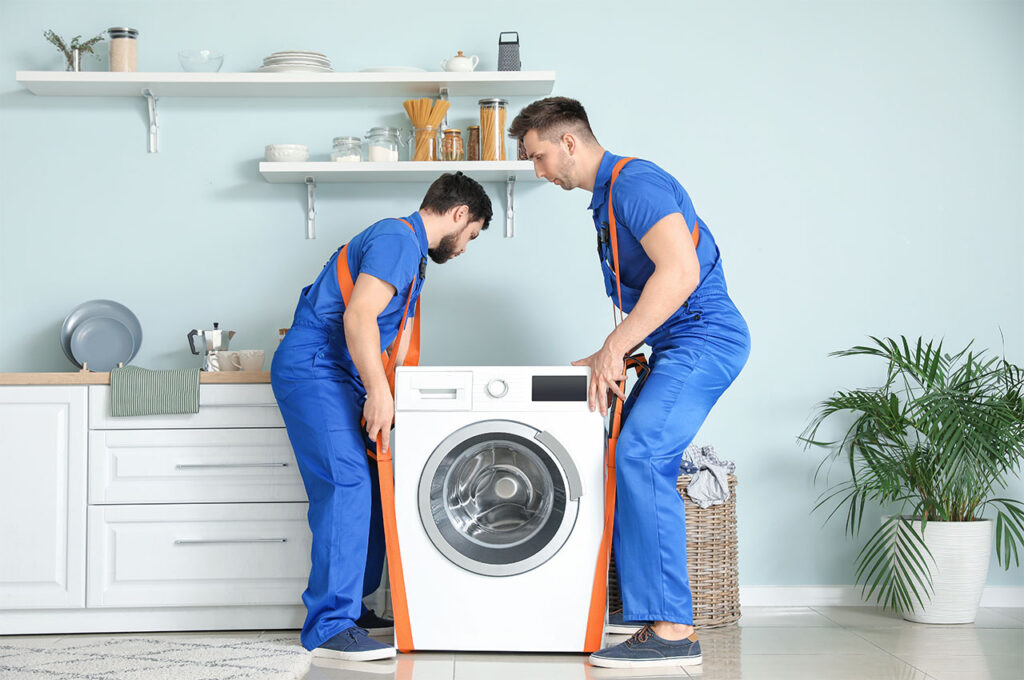

Installing a washing machine is straightforward and requires no specialist tools. Remove the transit packaging, level the machine, connect the fill hose hand-tight plus a fraction more, and connect the drain hose. Check for leaks before pushing the machine back into position. See Part 2 for drain hose installation detail.

All new washing machines are shipped with internal transit packaging – metal bolts and foam blocks that hold the drum rigid during transport. If the machine is run without removing them, the drum cannot move on its suspension and will bounce violently on spin, potentially causing serious damage to the machine and the room. Instructions for removing transit packaging are in the manual or on a label attached to the machine.
This guide covers the key steps and common pitfalls when connecting a washing machine. For drain hose installation specifically, see Part 2: How to install a washing machine drain hose. Plumbing in new pipework is a separate trade task not covered here.
Step-by-Step Installation
-
Remove all transit packaging. Unscrew and remove the transit bolts from the back of the machine – usually two to four bolts. Remove any foam blocks or packing from inside the drum. Keep the bolts somewhere safe; they will be needed if the machine is ever moved.
-
Position and level the machine. The machine must be level from left to right and from front to back. A machine that tilts forward can allow water to leak from the soap dispenser drawer during certain cycles. Adjust the feet as described in the next section.
-
Connect the fill hose. Screw the fill hose onto the water valve by hand, then tighten as described below. Do not over-tighten.
-
Connect the drain hose. Fit the drain hose into the standpipe or U-bend connection under the sink. Ensure the anti-backflow loop is maintained. See Part 2 for full drain hose guidance.
-
Check for leaks before pushing back. Turn on the water supply and run a short cycle. Inspect every connection – at the tap, along the hose, and at the machine – for drips. Wait at least 5 to 10 minutes and check again. A slow drip may not appear immediately.
-
Push the machine back into position carefully. Take care not to kink the fill hose as the machine goes back. A kinked hose will restrict or stop water flowing into the machine. Check the hose routing as the machine moves back into its final position.
Levelling the Machine
Most modern washing machines have adjustable feet at the front, and some have them at the rear as well. Adjusting the feet is easiest if the machine is tilted back slightly – this takes the weight off the front feet and makes them easier to screw in or out.
-

Check level from left to right – use a spirit level on top of the machine or a spirit level app on a smartphone -
Check level from front to back – a forward tilt can cause soap dispenser drawer leaks -
If locking nuts are fitted to the feet, undo these before adjusting the foot height, then re-tighten once level -
Confirm the machine does not rock on any corner once the feet are set – press each corner down in turn to check
If the feet are not adjustable and the floor is uneven, a purpose-made anti-vibration mat or wedge shims under the relevant feet will stabilise the machine. Folded cardboard works as a temporary fix but may compress or shift over time.
Connecting the Fill Hose
How Tight Should the Fill Hose Be?
Over-tightening is one of the most common installation mistakes – and it is counterintuitive because it actually increases the chance of leaks. Over-tightening damages or cuts the rubber washer inside the connector, which is the only component providing the seal.
Correct tightening
Screw the connector on by hand until it is firmly finger-tight – the rubber washer should be compressed but not squeezed flat. Then tighten a small amount further – no more than 2 to 5mm of additional turn. The rubber washer creates the seal; the threads only hold the connector in place.
 Over-tightening
Using tools to tighten significantly beyond finger-tight cuts into the rubber washer and creates a path for water to pass through. A leak caused by over-tightening may not appear immediately – it can develop hours or days later once the washer has been compressed and deformed.

A fill hose connection can appear completely dry at the time of installation and begin to drip hours or even days later – particularly if the machine has been moved back into position after checking. Check all connections before pushing the machine back, and keep checking the visible connections at the tap end over the following days. A slow drip that continues unnoticed can cause serious damage over time.
Should I Use the Old Hoses or the New Ones?
If the existing hoses are in good condition and longer than the new ones supplied with the machine, they can be reused. Washing machine hoses often outlast the machines they came with. New hoses supplied with a machine are typically short – only long enough to reach plumbing directly adjacent to the machine. If the new hoses are too short, either fit extension connectors or source longer replacement hoses (typically 2 to 2.5 metres).
Best practice is to fit the new hoses if they reach – they come ready to use with fresh rubber washers and no accumulated wear.
Replacing a Hot and Cold Fill Machine With a Cold Fill Only
Most modern washing machines are cold fill only – they heat water internally. If the existing plumbing has both a hot and cold supply tap for the previous machine, the hot supply tap will need to be capped off or blanked when the new cold fill machine is installed. See our guide on what to do with the old hot water tap.
Part 2: Drain Hose Installation
Drain hose installation – including correct connection to the U-bend, the anti-backflow loop requirement, standpipe installation, and what to do if the hose is too short – is covered in the companion guide. See Part 2: How to install a washing machine drain hose.
Post-Installation Checks
Before running the first full wash cycle, run through the post-installation checklist.
Related Installation Guides
 How to Install a Washing Machine Drain Hose (Part 2)
Drain hose connection methods, the anti-backflow loop, standpipes, and how to extend a hose that is too short.
5 Things to Check After Installing a Washing MachineThe checks to run after installation to confirm everything is correctly connected before first use.
 Aqua-Stop Hoses
How flood-protection inlet hoses work and whether they are worth fitting – particularly for upstairs installations.
 Won’t Drain After Installation or Moving
The most common reason a newly installed machine won’t drain – including the blanking piece fault.
More Installation Guides
Frequently Asked Questions
What are transit bolts and do I really need to remove them?
Transit bolts are large metal bolts screwed into the back panel of the machine that hold the drum rigid during transport. Without them, the drum would bounce around and damage itself and the machine’s internals during shipping. They must be removed before the machine is used – running a machine with transit bolts in place will cause the drum to bounce violently on spin and can cause serious mechanical damage. Instructions for locating and removing them are in the machine’s manual.
How tight should I make the fill hose connection?
Hand-tight until the rubber washer is compressed, then a small amount further – no more than 2 to 5mm of additional turn. Over-tightening cuts the rubber washer inside the connector and creates a path for water to leak through. The leak may not appear immediately; it can develop hours or days after installation. Check connections before pushing the machine back and monitor them over the following days.
Can I reuse the old fill hoses from the previous machine?
Yes, if they are in good condition and the right length. Washing machine hoses often outlast the machines they came with. The main reason to fit the new hoses supplied with the machine is that they come with fresh rubber washers and no accumulated wear. If the new hoses are too short, either extend them with a joiner and additional hose, or source longer replacement hoses.
My washing machine rocks after installation – how do I fix it?
Adjust the feet until all four corners are in firm contact with the floor and the machine is level from left to right and front to back. On most machines the front feet are adjustable; some also have adjustable rear feet. Tilt the machine back slightly to make it easier to screw the front feet in or out. Once level, tighten any locking nuts on the feet to prevent them loosening through machine movement. If the feet are not adjustable, use anti-vibration shims or pads under the relevant corners.
Ask the repair forum
Post the make, model and symptoms and get help from the Whitegoods Help community.
26 Comments
Grouped into 18 comment threads.
1 reply hi i have connected a new hot water hose but leaks both ends ? can you tell me why
0 replies Ideally there would be at least a quarter of an inch gap all the way around but I've seen many washing machines virtually wedged in place. If there is space above and below the machine, then at least there should be room for some airflow. If a washing machine was to bang about violently due to an out of balance load (or a fault) it could potentially cause damage to surrounding fittings. These days it should be fairly rare though because all washing machines now have out of balance protection. It doesn't always work too well but it's not like the old days when they could completely go crazy for the full duration of the spin and do a lot of damage.
Ideally there would be at least a quarter of an inch gap all the way around but I’ve seen many washing machines virtually wedged in place. If there is space above and below the machine, then at least there should be room for some airflow. If a washing machine was to bang about violently due to an out of balance load (or a fault) it could potentially cause damage to surrounding fittings. These days it should be fairly rare though because all washing machines now have out of balance protection. It doesn’t always work too well but it’s not like the old days when they could completely go crazy for the full duration of the spin and do a lot of damage.
0 replies Hi we have moved into a property & our washing machine just fits in the space ( touching sink on 1 side & bath on other side, plenty of room front & back.) I can slide it in & out fairly easily (as in it not wedged).. Is this safe , we appear to have no problems so far after a Month or so. Thanks
Hi we have moved into a property & our washing machine just fits in the space ( touching sink on 1 side & bath on other side, plenty of room front & back.) I can slide it in & out fairly easily (as in it not wedged).. Is this safe , we appear to have no problems so far after a Month or so. Thanks
0 replies Which way do the little blue and red taps face on a washing machine,towards you away from you or on the side
Which way do the little blue and red taps face on a washing machine,towards you away from you or on the side
1 reply Yes this is in the uk. It's really annoying as I can't do any washing
Yes this is in the uk. It’s really annoying as I can’t do any washing
Likely replying to tracy
Tracy, I’m assuming you mean the fill hoses, though every washing machine fill hose ever made should fit, nothing has changed with the actual connections and thread for decades. If you mean the drain hose then even they should be standard.
Sheila: When they are at right angles to the tap they are off, when they line up with the tap and if they were actual arrows would be pointing in the direction of the water flow they are on. However, these red and blue levers commonly break or crack so sometimes when you turn them you aren’t actually turning the tap.
1 reply Help. I have just moved into a new house. I have tried to connect the washer. The hoses on the washer are too big to connect to the pipes. How do I solve this problem?
Help. I have just moved into a new house. I have tried to connect the washer. The hoses on the washer are too big to connect to the pipes. How do I solve this problem?
1 reply Hi there, Just bought a second hand Hygena APM8702 Washer/Dryer. It came with the hot and cold water feeds unattached. Do you know which hose goes to which connection on the back of the machine?
Hi there,
Just bought a second hand Hygena APM8702 Washer/Dryer. It came with the hot and cold water feeds unattached.
Do you know which hose goes to which connection on the back of the machine?
Likely replying to Steve
Hello Steve the hot water valve should be red in colour, or if both are white then they should be marked R or C. If nothing is marked then cold is usually on the right side as you look at it from the back. There’s a 50/50 chance of getting it right anyway, so if connected, just put the machine on a rinse cycle and make sure only cold water is coming in, if hot swap them over.
1 reply Could you cut away an inch or so of the waste pipe to make room?
Could you cut away an inch or so of the waste pipe to make room?
Thank you for the tip.
I believe the fact that the hose was stretched at an angle meant that in every other respect the connection had to be perfect to create a water tight seal.
Indeed I was considering alterations to the pipe work.
However on a about the twentieth attempt and about a week on I have finally got that seal.
Just made sure that everything else was as perfect as possible, a shiny wire wooled thread, WD40 to make a smooth as possible turn to counteract the angle and not over tightening.
0 replies Really struggling to get a satisfactory seal on the inlet hose. The plumbing is directly above the waste pipe so I can't get a straight angle to attach the hose. It's a pity they don't have such a thing as a double right angle hose connector, that would solve the problem. The inlet hose has a rather large ring connector and the pipe itself is quite inflexible. I'm going to try buying a different hose, but may well have the same difficult overcoming the angle.
Really struggling to get a satisfactory seal on the inlet hose. The plumbing is directly above the waste pipe so I can’t get a straight angle to attach the hose. It’s a pity they don’t have such a thing as a double right angle hose connector, that would solve the problem.
The inlet hose has a rather large ring connector and the pipe itself is quite inflexible. I’m going to try buying a different hose, but may well have the same difficult overcoming the angle.
0 replies Hi S. Bennett. I don't think the draining is mentioned in this article but yes - and I have several articles on the subject which can be seen in the right column on this page or here Is your washer or dishwasher connected properly (misconnected)?
Hi S. Bennett. I don’t think the draining is mentioned in this article but yes – and I have several articles on the subject which can be seen in the right column on this page or here Is your washer or dishwasher connected properly (misconnected)?
0 replies Is it illegal to drain your washing machine into the storm drain.
Is it illegal to drain your washing machine into the storm drain.
1 reply Hi, I've just moved house with my (fairly new) washing machine. Previously the outflow pipe just hooked into the waste pipe (with a shepherds crook bend) but now thesame washing machine pipe actually fits over the waste pipe instead of inside it. It seems a tight fit (the removal men did it for me) but should it have some kind of extra tightening around it to stop leaks? e.g one of those metal collars with a tightening facility (can't remember the name!) The pipe contact is about 2" long.
Hi, I’ve just moved house with my (fairly new) washing machine. Previously the outflow pipe just hooked into the waste pipe (with a shepherds crook bend) but now thesame washing machine pipe actually fits over the waste pipe instead of inside it. It seems a tight fit (the removal men did it for me) but should it have some kind of extra tightening around it to stop leaks? e.g one of those metal collars with a tightening facility (can’t remember the name!) The pipe contact is about 2″ long.
Likely replying to Philippa Bromley
Hi Philippa. That kind of system isn’t ideal though I can’t say for certain whether it will cause any problems or not. The issue is that it should pump into a stand pipe with air gap around the pipe. By connecting it directly to a pipe you are in effect lengthening the drain hose which can make it pump out slower.
If the pipe just goes straight down and out though the wall to a drain it might not be so bad, but if it runs along cupboards and especially if it then goes up at some point then the pump may not be powerful enough to force the water all that way or may only manage it at reduced speed. Theoretically this could cause time out errors or reduced rinsing efficiency and different washing machines may be affected or not affected depending on how they work and other factors.
Regarding fixing, it might be safer to have a jubilee clip or one of those plastic tie straps on unless its a nice tight fit.
1 reply Any tips for how a to get a washing machine under a worktop apart from Brut force? The machine has adjustable feet on the front and rubber pads at the back. The space is big enough but there isn't much room to manoeuvre. Thanks
Any tips for how a to get a washing machine under a worktop apart from Brut force? The machine has adjustable feet on the front and rubber pads at the back. The space is big enough but there isn’t much room to manoeuvre. Thanks
1 reply Hi there. I had a washer dryer installed today and the waste pipe from the machine was just placed into the white pipe already plumbed in from the previous tenant. I was told I could just tape this in place. is this correct? Is there a part I can buy to make it more secure? Thanks
Hi there. I had a washer dryer installed today and the waste pipe from the machine was just placed into the white pipe already plumbed in from the previous tenant. I was told I could just tape this in place. is this correct? Is there a part I can buy to make it more secure? Thanks
Likely replying to Yvonne Rankine
Hello Yvonne. I’m assuming it pushes into a stand pipe rather than connecting to a plastic spigot at the u-bend. If it pushes into a stand pipe there should be a drain hose crook that forces the end of the drain hose into a shepherds hook configuration. The drain hose then just drops into the standpipe and shouldn’t come out.
A better idea (including a link to a picture of a drain hose crook) can be found in my article Tips for connecting a washing machine.
I have actually taped drain hoses in place in the past when I didn’t have a proper drain hose hook though it’s not ideal. You especially shouldn’t tape one up in a way that seals the drain hose in because an air gap is between the drain hose and the standpipe helps the water to run through the pipe.
0 replies You need two pipe pliers or pipe pliers and a pair of vice grips, or a pair of pipe pliers and a spanner. Basically the body of the tap needs holding with some pliers or grips whilst you turn the nut.
You need two pipe pliers or pipe pliers and a pair of vice grips, or a pair of pipe pliers and a spanner. Basically the body of the tap needs holding with some pliers or grips whilst you turn the nut.
0 replies There is a blocker nut on the pipe I need to connect to. But when I try to Un tighten it the pipe moves as well has anybody got any suggestion thanks
There is a blocker nut on the pipe I need to connect to. But when I try to Un tighten it the pipe moves as well has anybody got any suggestion thanks
0 replies Hi. I've just added two large paragraphs on the Make sure the washer is level section above, which is hopefully an improvement.
Hi. I’ve just added two large paragraphs on the Make sure the washer is level section above, which is hopefully an improvement.
0 replies I wish your article had mentioned in more depth on how to make a washing machine is level and the procedure of going about it, being a novice it would have been helpful. I recently bought a Zanussi ZWH120P after much research. But the information booklet on making the machine level was not clear enough for me. Some companies even supply you with a wrench for the specific purpose which is considerate. It would have been helpful if Zanussi had done so because I will have to go out and purchase one and am not sure what size adjustable wrench to buy.
I wish your article had mentioned in more depth on how to make a washing machine is level and the procedure of going about it, being a novice it would have been helpful. I recently bought a Zanussi ZWH120P after much research. But the information booklet on making the machine level was not clear enough for me. Some companies even supply you with a wrench for the specific purpose which is considerate. It would have been helpful if Zanussi had done so because I will have to go out and purchase one and am not sure what size adjustable wrench to buy.
hi i have connected a new hot water hose but leaks both ends ? can you tell me why
Likely replying to david
hello David. Either the rubber seal at both ends of the hose is missing, not seated properly, or damaged. One of the biggest causes of leaks on washing machine fill hoses can be over tightening. If you over tighten a hose then the small rubber seal can get crushed and cut. Make sure the hose is tight but only as tight as you can get it by hand.