
How to Install a Washing Machine drain hose
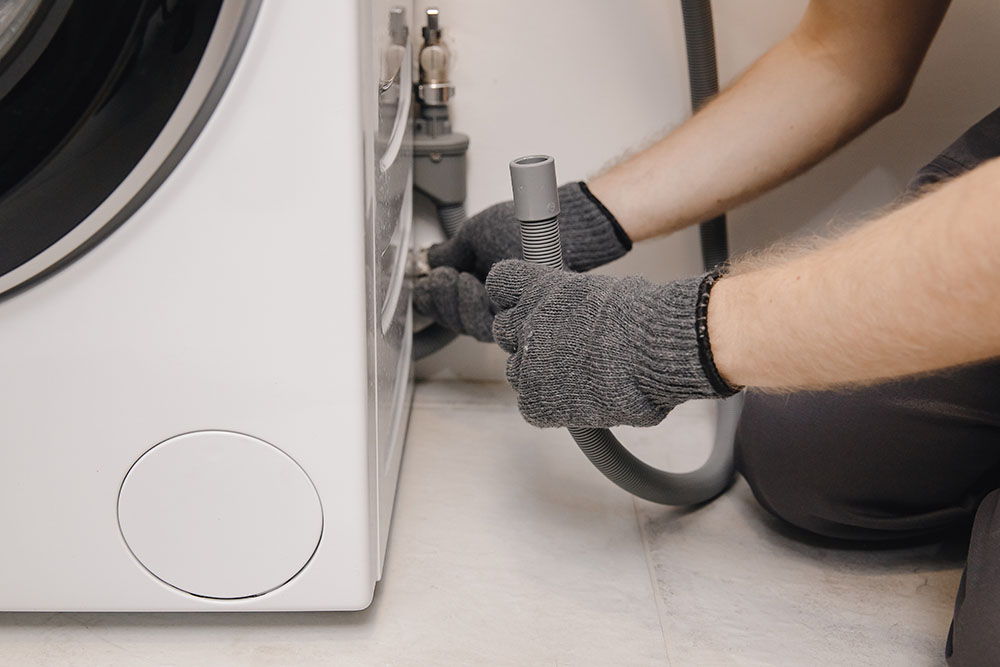

The drain hose should be permanently plumbed in – either into a standpipe or via a spigot connector on the U-bend under the kitchen sink. It must never simply be hooked over a sink. Once connected, ensure the hose runs upward by at least 10cm from the connection point before descending to the machine, to prevent backflow from the sink.
This guide covers drain hose installation specifically. For fill hose connection, taps, and the full washing machine installation process, see our washing machine installation guide (Part 1). Always follow the instructions in the machine’s manual – if you do not have one, download a copy from our instruction manual resource.
Why the Drain Hose Must Be Permanently Plumbed In
Hooking the drain hose over a sink edge is not an adequate installation. It is only acceptable as a very temporary arrangement – for example, testing a machine before plumbing in.
 Risks of an unsecured drain hose
- A dishcloth or washing up bowl left in the sink can block the drain, causing the sink to overflow
- If the hose falls out of the sink, the machine will flood the room – and continue filling indefinitely trying to compensate for lost water
- The machine is left unattended while flooding – this is how serious water damage occurs
 Correct permanent connection
- Into a standpipe with a properly fitted drain hose crook
- Via a spigot connector screwed to the U-bend under the sink
- Either method keeps the hose securely in position regardless of water pressure
Connecting to the U-Bend Under the Sink
Connection to the U-bend under the kitchen sink is now the most common method. It is straightforward, requires no external pipework, and is suitable for most domestic installations.
-
Fit the spigot connector to the U-bend. The spigot is a tapered plastic fitting that screws directly onto the U-bend body. Take care not to cross-thread the plastic fitting – hand-tighten until snug, then a quarter turn with pliers. Do not overtighten.
-
Push the drain hose firmly onto the spigot. The tapered profile means the hose tightens as it is pushed on. Push it on as firmly as possible until it fits snugly. A hose clip over the connection adds security and is recommended for any permanent installation.
-
Check for a blanking piece. On a new-build property or a spigot being used for the first time, there may be a blanking cap inside the connector. This must be removed before the drain hose is connected. See our guide on washing machine won’t drain after moving for more on this.
The Anti-Backflow Loop: Critical Installation Detail
The single most important detail beyond the physical connection is ensuring the drain hose does not run directly downward from the machine to the connection point. If there is a continuous descending run from the machine to the U-bend, water from the sink can travel back down the drain hose and into the washing machine drum – creating a persistent standing water fault that is often misdiagnosed as a machine problem.

The hose should travel upward from the spigot connection by at least 10cm (approximately 4 inches) before descending toward the machine. If the hose naturally runs straight down, secure it up to the underside of the worktop with a cable tie or clip to create the required loop. This prevents sink water from backflowing into the drum.
Drain Hose Too Short?
Factory-fitted drain hoses are typically 1.5 to 2 metres long – enough to reach a standpipe or U-bend directly beside or behind the machine. If the machine needs to be installed further from the drainage point, there are two options:
- Replace the drain hose with a longer aftermarket hose (typically 2 to 2.5 metres). This is the neater option and replaces the original hose entirely.
- Use a drain hose extension kit. A joiner connector allows an additional length of drain hose to be fitted to the original. Ensure the joint is secure and the total hose length does not exceed the maximum specified in the machine’s manual – excessively long drain hoses can reduce pumping efficiency.
Part of a Full Washing Machine Installation?
Related Installation Guides
 Won’t Drain After Installation or Moving
Why a newly plumbed washing machine may not drain – including the blanking piece fault and how to fix it.
 Machine Fills and Drains Simultaneously
Why a machine may fill and drain at the same time after installation – usually a siphoning issue.
 Aqua-Stop Hoses
How flood-protection inlet hoses work and whether they are worth fitting on your machine.
 How to Connect a Washing Machine Properly
A complete connection guide covering inlet hoses, drain hose, and what to check before first use.
More Installation Guides
Frequently Asked Questions
Can I just hook the drain hose over the sink?
Not as a permanent installation. A hose left unsecured over a sink can fall out during a cycle, flooding the room. The machine will continue filling indefinitely to compensate for the lost water – this is how serious water damage occurs. A blocked sink can also cause overflow. The drain hose must be permanently and securely connected to the plumbing.
Does it matter which way the drain hose runs?
Yes. The hose must not run in a continuous downward slope from the machine to the drain connection. It needs to rise by at least 10cm before descending to the U-bend or standpipe. Without this loop, water from the sink can siphon back into the machine drum. Secure the hose to the underside of the worktop with a clip or cable tie to create and maintain the correct loop.
What if the drain hose is too short to reach the plumbing?
Either replace it with a longer aftermarket hose (typically available up to 2.5 metres) or use a drain hose extension kit to join an additional length to the original. Do not exceed the maximum hose length specified in the machine’s manual – overly long drain hoses reduce pump efficiency and can cause draining problems.
Do I need a plumber to install a washing machine drain hose?
Not for a straightforward connection to an existing U-bend spigot – this is a simple push-fit connection that does not require any pipe cutting or soldering. If new plumbing is needed – a standpipe installed through a wall, or a new U-bend spigot fitted where none exists – then a plumber should carry out that work. The washing machine connection itself is separate from the plumbing work.
Ask the repair forum
Post the make, model and symptoms and get help from the Whitegoods Help community.
26 Comments
Grouped into 17 comment threads.
1 reply ahi please advice me on how to adjust the washing machine pipe. I understand it can influence the flow of water. Its draining foul water into the sink and I have no intention or know-how to unplug ubend where i suspect the problem is
1 reply I have just been given a washing machine the waste hose is short about one to two inches can this be fixed and washing machine used if an extension is put on the small hose I have
I have just been given a washing machine the waste hose is short about one to two inches can this be fixed and washing machine used if an extension is put on the small hose I have
3 replies Hi , B&Q do the kind of sink traps with the double inlets for d/w and w/m exactly as you need , its what i have, I'll send you photo of my setup if you want
Hi , B&Q do the kind of sink traps with the double inlets for d/w and w/m exactly as you need , its what i have, I’ll send you photo of my setup if you want
Likely replying to Rab
Thanks Rab. That’s what I was going to say, you can buy U-bends that have spigot connections designed for 2 appliances. The main thing to remember Lucinda is that if using such a system, it may be better to try and make sure you don’t have both appliances on at the same time. Just in case it can’t handle 2 appliances pumping out at the same time.
Likely replying to Andy Trigg (Whitegoodshelp)
Hi Andy,
We have a Bosch WAE24166/GB which due to kitchen renovation has ended up further from the drain and will require an extension. I am a little dubious about joined hoses so am looking at a 3.5M hose. However that particular hose includes a warning about checking outlet sizes [22/29mm] before buying which I am unable to do at the moment. Could you please advise if these sizes are compatible with my Bosch water pump..
Regards
Likely replying to Anthony Rudge
Hello Anthony, as far as I’m aware the sizes are to do with fitting on u-bend plumbing under the sink. They should fit all pumps. If your drain hose slots into an old style stand pipe you can ignore the measurements. If it pushes onto a tapered connector (spigot) under the sink the size might be significant although if tapered it will hopefully fit. The scenario you don’t want is where the rubber on the end of the drain hose is too wide to snugly fit. Even then though, yu may well be able to cut off the rubber section and push the actual plastic drain hose onto ta tapered spigot. However, you may need to use plumbers tape and/or a jubilee clip to make it watertight. There are a variety of different universal drain hoses here of varying lengths washing machine hoses including drain hoses
0 replies Hi, I want to install a Dishwasher and a Washing Machine that both connect to the sink trap. One will be positioned about 1M to the left of the sink, the other about 1.5M to the right of the sink. I also need to connect the sink overflow to the trap as well. Can you advise if there is a recommended trap suitable for this configuration? Also, is there a trap with the above configuration that would also support a double sink - or 1 and a half sink (and therefore two sink overflows as well)?
Hi, I want to install a Dishwasher and a Washing Machine that both connect to the sink trap. One will be positioned about 1M to the left of the sink, the other about 1.5M to the right of the sink. I also need to connect the sink overflow to the trap as well. Can you advise if there is a recommended trap suitable for this configuration? Also, is there a trap with the above configuration that would also support a double sink – or 1 and a half sink (and therefore two sink overflows as well)?
0 replies It's not unusual for there to be a gurgling sound as water is pumped out into the u-bend. If your other machine did it, maybe it didn't pump out quite as fast. If the washing machine appears to be working ok I wouldn't necessarily worry about it. But if you wanted to make sure, there is a possibility something like a small button, a piece of underwire from a bra or a hair grip etc could be stuck inside the plastic spigot that the drain hose is attached to. You could remove the drain hose and inspect the spigot and inside the end of the drain hose.
It’s not unusual for there to be a gurgling sound as water is pumped out into the u-bend. If your other machine did it, maybe it didn’t pump out quite as fast. If the washing machine appears to be working ok I wouldn’t necessarily worry about it. But if you wanted to make sure, there is a possibility something like a small button, a piece of underwire from a bra or a hair grip etc could be stuck inside the plastic spigot that the drain hose is attached to. You could remove the drain hose and inspect the spigot and inside the end of the drain hose.
0 replies Hi. My new Logik washing machine outlet pipe is fitted under the sink(the same as your second picture). but when it pumps out it makes a gurgling sound. you can here it quite loudly through the sink strainer. my old Hoover machine was plugged in the same way and had no problems. is there anything i can do to fix the problem??
Hi. My new Logik washing machine outlet pipe is fitted under the sink(the same as your second picture).
but when it pumps out it makes a gurgling sound. you can here it quite loudly through the sink strainer.
my old Hoover machine was plugged in the same way and had no problems. is there anything i can do to fix the problem??
0 replies Hi There, I want to install a washing machine in one corner of my kitchen but the soil stack is in the opposite corner 4 meters away on the other side of a door . Now ideally a new waste branch should be fitted below the floor level to the stack emerging near the machine for the drain hose to discharge into BUT its a concrete floor so the only way i can do this is. Raggle a channel under the threshold to lead an extended hose down below floor level ..then it'll emerge back above floor level and enter the stack at a boss which is 8" above floor level. Now will the washing machine pump be able to pump up the loop up from the pump on the back of the machine then go down 2" below the machine for 2 meters then emerge up onto the floor (below the sink unit) then up a further 8" into the stack? Ive seen many people wanting to install a machine in a basement but there must be owners who have had the same problemm as me, a doorway inbetween the machine and waste pipe. Regards Rab
Hi There, I want to install a washing machine in one corner of my kitchen but the soil stack is in the opposite corner 4 meters away on the other side of a door . Now ideally a new waste branch should be fitted below the floor level to the stack emerging near the machine for the drain hose to discharge into BUT its a concrete floor so the only way i can do this is. Raggle a channel under the threshold to lead an extended hose down below floor level ..then it’ll emerge back above floor level and enter the stack at a boss which is 8″ above floor level. Now will the washing machine pump be able to pump up the loop up from the pump on the back of the machine then go down 2″ below the machine for 2 meters then emerge up onto the floor (below the sink unit) then up a further 8″ into the stack? Ive seen many people wanting to install a machine in a basement but there must be owners who have had the same problemm as me, a doorway inbetween the machine and waste pipe.
Regards
Rab
1 reply Hi, I want to move my washing machine out of our kitchen into our hall/utility area. A previous owner has had an washing machine there before as there is the water pipe fitting already there behind a cupboard. My only concern is the waste for the washing machine. Where I would place the washing machine is roughly 50cm from the outside wall there is already a hole in the outside wall at floor level which has been filled using expanding foam. This hole runs through the wall and on the other side comes out 30cm above where the drain is which the downstairs bathroom and kitchen already drain into. It looks like the previous owner must have just stuck the washing machine waste hose through the wall and into the drain below as there is no pipe work there. Is it ok just to do the same or will that create problems? Any help is appreciated
Hi,
I want to move my washing machine out of our kitchen into our hall/utility area. A previous owner has had an washing machine there before as there is the water pipe fitting already there behind a cupboard. My only concern is the waste for the washing machine.
Where I would place the washing machine is roughly 50cm from the outside wall there is already a hole in the outside wall at floor level which has been filled using expanding foam. This hole runs through the wall and on the other side comes out 30cm above where the drain is which the downstairs bathroom and kitchen already drain into.
It looks like the previous owner must have just stuck the washing machine waste hose through the wall and into the drain below as there is no pipe work there.
Is it ok just to do the same or will that create problems?
Any help is appreciated
1 reply I have my washing machine in our utility room. we are going to buy a dishwasher (compact/tabletop) that will also go in the utility room. We have the water supply run into the room so okay to plumb in the water but is there a way to install the discharge pipe into the washing machine or its discharge pipe or would I have to run a very long discharge pipe the the sink?
I have my washing machine in our utility room. we are going to buy a dishwasher (compact/tabletop) that will also go in the utility room. We have the water supply run into the room so okay to plumb in the water but is there a way to install the discharge pipe into the washing machine or its discharge pipe or would I have to run a very long discharge pipe the the sink?
Likely replying to Timothy
Hello Timothy. If the washing machine pumps water into an old fashioned stand pipe it’s possible to T off it and create a second pipe for the dishwasher to pump into. If it pumps into a u-bend connection under a sink you’d have to try and find a u-bend with more than one spout to attach a drain hose to. Not sure if they are available or not.
Either way I would avoid having them both pump water at the same time.
0 replies Yes Sarah, this is covered in the article above under "Drain Hose" and more information is linked to there but I'll re post the link - it's tip 2 on this page 5 things to check for after connecting a washing machine. The subject is also covered in specific detail here Smells caused by plumbing faults Also, in case your washing machine smell is not connected to the drain hose read this article too - washing machine smells
Yes Sarah, this is covered in the article above under “Drain Hose” and more information is linked to there but I’ll re post the link – it’s tip 2 on this page 5 things to check for after connecting a washing machine. The subject is also covered in specific detail here Smells caused by plumbing faults
Also, in case your washing machine smell is not connected to the drain hose read this article too – washing machine smells
Leave a comment
0 replies Our washing smells bad; I suspect a hose issue with perhaps water coming backwards into the machine. There's a metre long waste hose which drops down halfway then back up before it connects into the pipe. Is this too long maybe and water is collecting somehow?
Our washing smells bad; I suspect a hose issue with perhaps water coming backwards into the machine. There’s a metre long waste hose which drops down halfway then back up before it connects into the pipe. Is this too long maybe and water is collecting somehow?
0 replies A washing machine pump can't really discharge too fast, they aren't that powerful, you can't adjust the water flow in any way either. But if you have a partial blockage in the plumbing it can cause water being pumped into the waste pipe to back up and spill out over the top of the pipe. Make sure there isn't any lint or other obstructions stuck inside the bends on the plumbing pipework which can restrict the water flow. If the pump has a filter you can check the filter regularly but lint comes off certain types of laundry such as towels so there's not much you can do to prevent it.
A washing machine pump can’t really discharge too fast, they aren’t that powerful, you can’t adjust the water flow in any way either. But if you have a partial blockage in the plumbing it can cause water being pumped into the waste pipe to back up and spill out over the top of the pipe. Make sure there isn’t any lint or other obstructions stuck inside the bends on the plumbing pipework which can restrict the water flow.
If the pump has a filter you can check the filter regularly but lint comes off certain types of laundry such as towels so there’s not much you can do to prevent it.
0 replies When our wash machine drains we have a lot of pressure from the dish charge hose. We connect the hose on to some 1and half inch PVC pipe that the drain that comes from the wash machine we would like to. Know.if their is a way we could stop so much pressure and be able to stop so much lint and stuff getting to the sub pump which plugs all the time.
When our wash machine drains we have a lot of pressure from the dish charge hose. We connect the hose on to some 1and half inch PVC pipe that the drain that comes from the wash machine we would like to. Know.if their is a way we could stop so much pressure and be able to stop so much lint and stuff getting to the sub pump which plugs all the time.
1 reply Is it possible to connect 2 extension hoses together to get more distance. The outlet pipe would run along the floor then a rise of about 2 feet up to the outlet under the sink.
Is it possible to connect 2 extension hoses together to get more distance. The outlet pipe would run along the floor then a rise of about 2 feet up to the outlet under the sink.
1 reply Hi I want to move my washing machine 2.0m away from the sink, which in effect, the drain pipe has to travel 2.0m plus about 0.8m uphill to reach to the sink from the floor, will the washing machine has capacity to pump out to such a distance and height. Thanks Rav
Hi
I want to move my washing machine 2.0m away from the sink, which in effect, the drain pipe has to travel 2.0m plus about 0.8m uphill to reach to the sink from the floor, will the washing machine has capacity to pump out to such a distance and height.
Thanks
Rav
0 replies Washing machine pumps aren't very strong, and can't push water much further than normal lengths. I used to have a washing machine in a pantry about 3 meters away from the sink though and used a drain hose extension to route it to the u-bend. It worked ok because the long run was along the floor. If it had been uphill it would have struggled to pump out that extra distance quick enough. Going down, then up again will increase the height the water has to pump and potentially be a problem though if going to a u-bend connection under a sink it may be fine as long as it doesn't go too low. The standpipe idea would work only if the subsequent run of water went straight out or down to a drain. If the water had to go up again it would only have a small force behind it as the pump would no longer be forcing it once it had pumped into the stand pipe and you;d be relying on just the natural water flow rate.
Washing machine pumps aren’t very strong, and can’t push water much further than normal lengths. I used to have a washing machine in a pantry about 3 meters away from the sink though and used a drain hose extension to route it to the u-bend. It worked ok because the long run was along the floor. If it had been uphill it would have struggled to pump out that extra distance quick enough.
Going down, then up again will increase the height the water has to pump and potentially be a problem though if going to a u-bend connection under a sink it may be fine as long as it doesn’t go too low. The standpipe idea would work only if the subsequent run of water went straight out or down to a drain. If the water had to go up again it would only have a small force behind it as the pump would no longer be forcing it once it had pumped into the stand pipe and you;d be relying on just the natural water flow rate.
0 replies Hi, I want to place my washing machine across the kitchen from the sink/waste outlet. Is it ok to run a 3 metre flexible drain hose from the machine down through the floor, along the joists then up and into the waste outlet? Or, would it be better to put a standpipe next to the washer then join it to a 40mm waste pipe below the floor and out to the (outside) drain? is there any history of long flexible hoses causing problems? Advice appreciated, Gary
Hi, I want to place my washing machine across the kitchen from the sink/waste outlet. Is it ok to run a 3 metre flexible drain hose from the machine down through the floor, along the joists then up and into the waste outlet? Or, would it be better to put a standpipe next to the washer then join it to a 40mm waste pipe below the floor and out to the (outside) drain?
is there any history of long flexible hoses causing problems?
Advice appreciated,
Gary
ahi
please advice me on how to adjust the washing machine pipe. I understand it can influence the flow of water. Its draining foul water into the sink and I have no intention or know-how to unplug ubend where i suspect the problem is
Hello Isabel. I’m not sure I fully understand your problem, but if you mean that water is backing up through the sink’s plug hole when the washing machine is draining, then there could be a partial blockage somewhere in the plumbing. It sounds more likely like the washing machine is pumping the water out okay, but the water cannot escape down the u-bend or the rest of the plumbing fast enough.
You would need to look for a partial blockage in the actual U part of the u-bend or in the pipework leading to the drain outside. All of the parts on a u-bend either just unscrew, or twist and pull apart. One way to test this theory is to fill up a washing up bowl to the top with water, and then pour it all out into the sink. If it takes a long time for the water to drain down the plug hole then this shows that there is a partial blockage somewhere as I described above.
If by any chance it all drains away as you would expect, then that would imply that there isn’t, and therefore any possible problem could be at the point where the drain hose attaches to the u-bend. In that case, you would just need to either unscrew the drain hose where it connects to the u-bend and check inside the end of the drain hose and where it connects to the u-bend. If the drain hose doesn’t fit onto a plastic spigot that screws onto the u-bend then it must just push onto it and would need carefully pulling and twisting off.