
Are there any downsides to Miele washing machines?
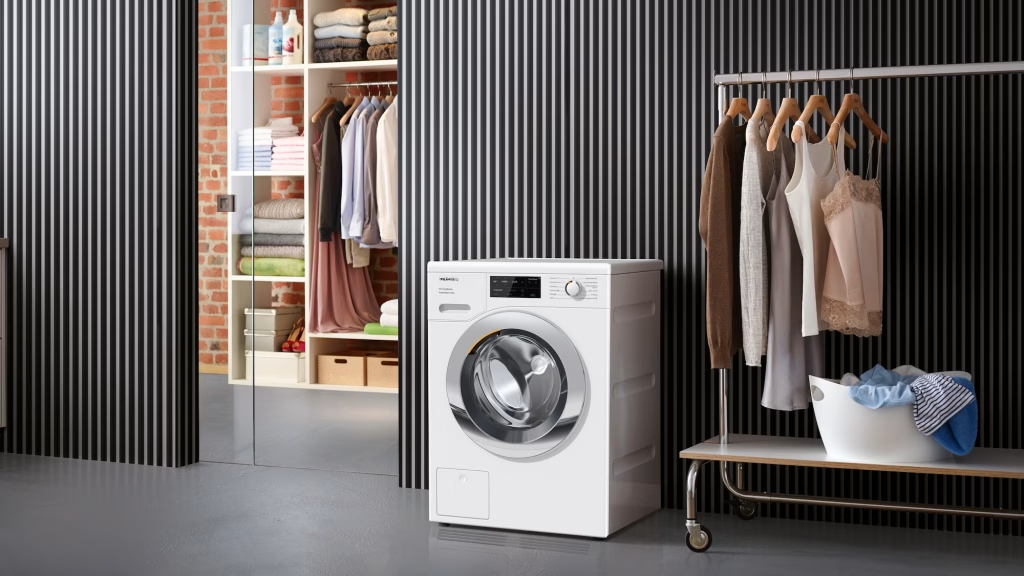

The main downsides to buying a Miele washing machine are a significantly higher purchase price, expensive repairs when something does go wrong, very few independent repairers willing to work on them, restricted access to genuine spare parts, and a 20-year lifespan claim that is qualified rather than guaranteed. Miele still represents superior quality overall – but the economics of ownership have become less favourable in recent years as build quality has shifted and repair costs have risen.
Miele washing machines are widely regarded as the best available in the UK mainstream market. The premium quality comes with genuine drawbacks that are worth understanding before parting with the money – and several of them have grown more significant in recent years. Whitegoods Help covers the real downsides below: repair costs, restricted servicing, the reality behind the 20-year claim, and how build quality has changed.
How much does a Miele washing machine actually cost?
Higher purchase price is the most obvious drawback. Miele washing machines typically cost two to four times the price of a mid-range mainstream model, putting them firmly in premium territory rather than mass-market.
The financial argument for a Miele has always been that the higher upfront cost is recovered over time through better reliability, fewer repairs, and a longer working life. That argument is valid in principle – but it depends on the machine actually lasting as advertised, and the maths becomes less favourable as repair costs rise and build quality shifts.
Why is it hard to find an independent repairer for a Miele?
Miele, like most premium brands, takes a protective approach to repairs and servicing. The brand and its authorised dealers believe strongly that repairs should be carried out only by Miele-trained engineers, both to maintain service standards and to protect the brand reputation. In practice, this narrows the choice of repairer considerably.
Very few independent washing machine repairers will take on a Miele. Most do not have access to the diagnostic software, technical documentation, or calibration tools needed to do the job properly. A handful of independents may attempt straightforward mechanical repairs, but for anything involving electronics most will decline.
This has two practical consequences. The choice of repairer is narrower than with mainstream brands, and without independent competition there is less price pressure on Miele’s own repair service – so repairs tend to be more expensive than equivalent work on a mainstream machine.

Miele has changed its sales policy for spare parts in the UK and Europe, removing public access to genuine parts through online retailers. One spare parts retailer described the change as follows.
“Miele have unfortunately changed their sales policy in UK and Europe. This applies to all online spare parts retailers. We can only sell Genuine Miele spare parts to repair engineers and not directly to the public. Unfortunately, we have had to remove thousands of parts from your view.”
This means DIY repair of a Miele washing machine is significantly harder than it used to be – and it leaves owners more dependent on Miele’s own engineer network. The wider context is covered in our analysis of the right to repair and appliance lifespan.
The comparison to prestige car ownership is apt. Just as servicing a Mercedes costs more than servicing a Ford, owning a Miele means accepting that repairs and servicing are priced accordingly. Most owners will never need a significant repair during the machine’s expected life – but if one is needed, costs can be substantial. Major components such as a motor or PCB can run to several hundred pounds in parts alone, before labour.
What guarantees do Miele offer?
Miele typically offers guarantees of 2, 5, or 10 years depending on the model and where it is purchased. When buying a Miele, seek out the longest guarantee available – given the cost of repairs if something does go wrong, a longer guarantee provides important protection and reflects Miele’s confidence in the product.
A 10-year guarantee on a premium appliance is genuinely significant. It also indirectly limits Miele’s ability to cut build quality to the point where machines fail early in their life, which makes a long guarantee a useful signal of the intended quality bracket.
Do Miele washing machines really last 20 years?
Miele have long marketed their washing machines as built to last 20 years. In more recent years the wording has been amended to “tested for the equivalent of 20 years’ use” – a meaningful distinction. Miele describes the testing as follows.
During these tests appliances have to wash for 10,000 hours. This involves running approximately 5,000 wash programmes. In terms of daily laundry this equates to about 5 programmes per week with an average run time of 2 hours for 20 years.
Miele product information on durability testing
There are two important qualifications here. “Tested for the equivalent of” is not the same as a guarantee that any individual machine will last 20 years. And households that wash more frequently than the test assumption will use up that equivalent lifespan faster – a family running seven or more loads a week could reach the test cycle equivalent in significantly less than 20 calendar years.
Test hours per machine
Wash programmes simulated
Wash cycles per week assumed
Years of equivalent use
Miele engineers can check how many wash cycles a machine has actually completed by connecting their diagnostic equipment – which itself illustrates how precisely usage is tracked against the designed lifespan.
Whitegoods Help has received a significant number of reports from owners whose Miele machines did not last anywhere near 20 years. The brand still produces machines of superior quality to most others, but it would no longer be accurate to assume a 20-year lifespan is typical. Many owners do report very long lives without issues – others report disappointment. The variance is higher than the 20-year marketing implies. For a broader view see our guide on how long a washing machine should last.
How has Miele build quality changed?
Miele’s build quality has always been the central justification for the premium price. The picture in 2026 is more nuanced than it used to be.
Independent testing and teardown investigations have found that some internal components on modern Miele machines – including the pump, water valves, and drive belt – are visually and functionally hard to distinguish from equivalent parts on mainstream machines. Not every component inside a Miele is uniquely high quality.
Other components do still reflect clear quality advantages: the motor, drum and bearings, cabinet construction, and certain internal fittings are noticeably superior to those found in mainstream washing machines.
 Still clearly better than mainstream
The motor, drum, bearings, and cabinet construction on a Miele are genuinely better-built than typical mainstream machines. The overall engineering standard, noise levels, and long-term mechanical reliability of the drum and motor assembly remain significantly above average.
 Not uniformly premium
Some internal components – pumps, water valves, belts – on modern Miele machines are comparable to those used in ordinary brands. Newer models are also noticeably lighter than older equivalents, with some parts that were previously metal now made from plastic, including the main outer drum on some models.
The overall picture is that Miele washing machines remain the best quality available in the mainstream UK market – but the margin of superiority has narrowed compared to machines made 15-20 years ago, while repair costs have not reduced proportionally.
Considering a different brand or looking for a repair quote?
Whether you are comparing Miele against the alternatives or you already own one and need it looked at, we can help.
Is a Miele washing machine worth buying overall?
Miele washing machines still represent the best quality available in the mainstream UK market for most buyers. The drum, motor, bearings, and cabinet quality remain genuinely superior. For a household that washes a moderate number of times per week and wants a quieter, better-built machine that is likely to cause fewer problems, a Miele remains a strong choice.
The economics of ownership now carry more risk than they once did. Higher repair costs, restricted parts access, mixed build quality in some areas, and a 20-year claim that is qualified rather than guaranteed all mean that the financial argument for a Miele is less clear-cut than it was a generation ago. Our wider piece on whether more expensive is necessarily better covers the broader principle.
If you do buy a Miele, three pieces of advice matter most: seek the longest guarantee available, be prepared to use Miele’s own engineers for any significant future repairs, and go in with realistic expectations about what “tested for 20 years” really means in practice.
Frequently asked questions
Are Miele washing machines worth the extra cost?
For most buyers who want a well-built, quiet, reliable machine and can absorb the higher purchase cost, Miele remains the best quality option in the mainstream UK market. The caveats are that repairs are expensive, spare parts are no longer available directly to the public, and the 20-year lifespan claim is qualified rather than guaranteed. The economics are less favourable than they were a generation ago, but the quality advantage over mainstream machines is still real.
Can I use an independent repairer for a Miele washing machine?
Very few independent repairers will work on Miele. Most lack the diagnostic software and technical documentation needed. For straightforward mechanical repairs a small number of independents may attempt the job, but for anything involving the electronics you will almost certainly need Miele’s own engineers or an authorised dealer.
Do Miele washing machines really last 20 years?
Miele tests their machines to the equivalent of 20 years of use at a specific usage rate of around 5 programmes per week, averaging 2 hours each. That is a testing benchmark, not a guarantee for individual machines. Households washing more frequently will reach the equivalent cycle count sooner. In practice many Miele machines do last a very long time without significant problems, but others have disappointed owners who expected 20 years and fell well short. See our wider guide on how long a washing machine should last.
How expensive are Miele washing machine repairs?
Costs vary by fault, but major components such as motors, PCBs, and drum bearings can run to several hundred pounds in parts alone before labour is added. Miele typically offers a fixed-price repair service, but it has restrictions and machines deemed uneconomical to repair may be written off. This is why a long guarantee matters particularly when buying a Miele.
Has Miele build quality declined in recent years?
Quality is still superior to most mainstream machines, but it has declined relative to older Miele models. Some internal components on newer machines – pumps, valves, belts – are now comparable to mainstream brands. Some parts that were previously metal are now plastic. Newer models are noticeably lighter than older equivalents. The drum, motor, bearings, and cabinet construction remain clearly better quality, but the gap between Miele and high-quality mainstream brands is narrower than it once was.
Can I still buy genuine Miele spare parts as a consumer?
No. Miele has restricted spare parts sales to registered repair engineers in the UK and Europe. Online spare parts retailers that previously sold Miele parts to the public have had to remove most of their Miele inventory. This means DIY repair of a Miele washing machine is now significantly harder than for most mainstream brands, and owners are more dependent on Miele’s own repair service or authorised dealers.
Ask the repair forum
Post the make, model and symptoms and get help from the Whitegoods Help community.
53 Comments
Grouped into 27 comment threads.
0 replies See: https://www.miele.co.uk/cs/legal/general-terms-conditions-13 This page will show you The standard repair rates £180 plus parts costs AND the alternative which is their fixed rate which is £289. The most important info is to click Terms and Conditions: where you will discover under 5. General terms under 3.Limitations, point 11. that drums/ bearings/ are NOT covered by the fix rate repair. I haven`t got the time nor interest (since Miele are not my "thing") but your best bet is get a decent cigar and a glass of whisky and settle down for a roller coaster read.
0 replies I have just bought a Miele washing machine www120cws but it is not a scratch on my old model.. The washing times are too long and a short wash only goes up to 40. The worst thing though is the spin which even after spinning on a wash and then spun again at 1400, does not get the clothes dry enough and nothing like my old machine either. Very disappointed.
I have just bought a Miele washing machine www120cws but it is not a scratch on my old model.. The washing times are too long and a short wash only goes up to 40. The worst thing though is the spin which even after spinning on a wash and then spun again at 1400, does not get the clothes dry enough and nothing like my old machine either. Very disappointed.
1 reply We have had our Miele W806 washing machine for 28 years & all I have had to replace is the shock absorbers on the drum which I did myself which was very easy as Miele made this machine easy to work on. This machine has been the most reliable domestic appliance I have known, But this machine cost us nearly £800 when new. I come from an engineering background & know real quality when I see it but I know that beyond all shadow of doubt that the newer models are like todays cars , All style and no substance. To get similar reliability / build quality today you would have to spend at least £2000 !!
We have had our Miele W806 washing machine for 28 years & all I have had to replace is the shock absorbers on
the drum which I did myself which was very easy as Miele made this machine easy to work on. This machine has been the most reliable domestic appliance I have known, But this machine cost us nearly £800 when new. I come from an engineering background & know real quality when I see it but I know that beyond all shadow of doubt
that the newer models are like todays cars , All style and no substance. To get similar reliability / build quality
today you would have to spend at least £2000 !!
1 reply We bought our first Miele washing machine in 2020, ignoring warning signs of only a 2 year warranty. The power control for the drum drive began intermittently failing after 300 cycles, Miele engineer warned it could be very expensive to repair and machine may be scrapped. Major retailer would not honour sale of goods, and we felt option of Miele 'fixed' repair cost of £289 coupled only Miele offer to discount same off a new machine if 'uneconomic to repair' was unreasonable risk. Regretably had to bin machine, and replace with a discounted Bosch with a 5 year warranty. Its a rich man's lottery.
We bought our first Miele washing machine in 2020, ignoring warning signs of only a 2 year warranty. The power control for the drum drive began intermittently failing after 300 cycles, Miele engineer warned it could be very expensive to repair and machine may be scrapped. Major retailer would not honour sale of goods, and we felt option of Miele ‘fixed’ repair cost of £289 coupled only Miele offer to discount same off a new machine if ‘uneconomic to repair’ was unreasonable risk. Regretably had to bin machine, and replace with a discounted Bosch with a 5 year warranty. Its a rich man’s lottery.
0 replies I'll have a go at repairing most appliance faults so access to information and parts is essential for me. I own a Miele Dishwasher and it's clearly a superior machine. I bought it 2nd hand on ebay for about £20. It needed a new pump, but information about the machine and spare parts were so hard to find. I'd really like Miele, but am more likely to buy Bosch because the parts are available.
I’ll have a go at repairing most appliance faults so access to information and parts is essential for me. I own a Miele Dishwasher and it’s clearly a superior machine. I bought it 2nd hand on ebay for about £20. It needed a new pump, but information about the machine and spare parts were so hard to find. I’d really like Miele, but am more likely to buy Bosch because the parts are available.
1 reply Greetings Miele owners - Engineered to last 15-20 years! I bought a Miele W1724 Washer in 2016 thinking . May 2024 ( under 8 years old) with quite light use (4-5 light loads a week) & the drum support spider has failed (drum rotating eccentrically & scraping the outer tub ). Apparently the spider is Aluminium (as most, if not all other machines) & they corrode & break + Miele spares seem essentially unobtainable at reasonable cost. Miele's fixed price repair at £289 explicitly excludes drum & bearings related issues (funny that), so the machine is a WRITE OFF at under 8 yrs old. NO better life span than many other makes & spares seem effectively unavailable here in UK. "that's a bit unlucky Sir". - Miele service line. I will NOT be buying another Miele!
Greetings Miele owners – Engineered to last 15-20 years!
I bought a Miele W1724 Washer in 2016 thinking .
May 2024 ( under 8 years old) with quite light use (4-5 light loads a week) & the drum support spider has failed (drum rotating eccentrically & scraping the outer tub ). Apparently the spider is Aluminium (as most, if not all other machines) & they corrode & break + Miele spares seem essentially unobtainable at reasonable cost. Miele’s fixed price repair at £289 explicitly excludes drum & bearings related issues (funny that), so the machine is a WRITE OFF at under 8 yrs old. NO better life span than many other makes & spares seem effectively unavailable here in UK. “that’s a bit unlucky Sir”. – Miele service line. I will NOT be buying another Miele!
Hi Mark. Did they say anything about excessive limescale or gunge causing the corrosion? I say this because the aluminium-based drum spider’s have always been subject to this type of excessive corrosion, but it only happens to some people, and not most.
It is almost certainly caused by the following, or a combination of, — not using enough detergent, using almost exclusively the low-temperature wash cycles (which we are of course told to do these days) and (probably) using liquid detergent. I have a very comprehensive article about this problem here, which affects every single washing machine — causes of washing machine smells and build up of slime and limescale
I appreciate your disappointment, and you are right about the extremely high repair costs of Miele appliances (which is one of the reasons I wrote this article). But a corroded drum spider is definitely caused as described in my article, and not related to build quality. In fact, if anything, I would expect a Miele drum spider to last longer than most under those conditions.
Please take time to read the article and understand. I say this because it would be very easy to just write off the Miele as not being good enough, but if unwittingly there are conditions that is causing a drum spider to be corroded then I’m sure you’ll appreciate that this will happen to your next washing machine as well, no matter what brand.
If on the other hand the drum spider was not covered in limescale and slime and grease and had just cracked then that could be more fairly attributed to lack of quality.
3 replies Hi, I have been offered a second hand Miele W 5740. Have read there are issues with drainage on that model Don't know that exact year of manufacture - have asked for the serial number to check. Know this model is no longer sold through retailers. But wondering if you know potentially the oldest it could be? And with the drainage issue - how likely is this to occur so would it be worth taking the machine on?
Hi, I have been offered a second hand Miele W 5740. Have read there are issues with drainage on that model Don’t know that exact year of manufacture – have asked for the serial number to check. Know this model is no longer sold through retailers. But wondering if you know potentially the oldest it could be? And with the drainage issue – how likely is this to occur so would it be worth taking the machine on?
Likely replying to Andy Trigg (Whitegoodshelp)
Hello Andy
I’m in the process off buying new appliances (Miele) in Portugal.
Did my research mainly from consulting Which reviews and found models I liked.
Nor the dishwasher G7160SCV or the heat pump drier TSA203WP was available here.
The numbers and models are different in many countries so it gets very confusing to find what you want.
Best
Ulla
Likely replying to Andy Trigg (Whitegoodshelp)
Hi Andy,
many thanks for your excellent site & above comments , particularly your low temperature & liquid detergent advice. All very interesting – I will only use powder & up the temp. in the ordered replacement (a relatively cheaper Bosch).
Miele service have not looked at the machine so haven’t made any comment, other than “that’s a bit unlucky Sir…”
I deduced the spider had gone by looking at the drum behaviour when rotated by hand ( bearings fine -smooth, drum scrapes ) so phoned them about repair options / costs. Fixed price (£289) repair excludes drum etc. so effectively it’s a write off from a Miele repair POV. I wasn’t initially too concerned – just thought here we go : several hours of work and the replacement spider cost – typically £40-100. However as a Miele owning member of the general public I find i’m not granted access to buy their spares (even on an under 10 year old machine – I thought there was a legal requirement for this) & the only info I find is they are stupidly expensive in any case (> £300!)
I would have expected Miele (“quality brand”) to seal or proof the spider better as this is a known issue, or least allow access to SPARES at a reasonable price – this that essentially irks me the most!
3 replies We are having to replace our Miele Washing machine. Not completely broken down but unable select more than one program. It was 25 years old in March of this year. Buying another Miele of course!
We are having to replace our Miele Washing machine. Not completely broken down but unable select more than one program. It was 25 years old in March of this year. Buying another Miele of course!
Thanks for your contribution, Martin. That’s a great experience and exactly what we should expect from a Miele washing machine. I still believe that you will not get a better quality washing machine than Miele, but it seems like they have a problem in being able to keep repairing their appliances at a reasonable cost – especially once they get past 10 years old. The only way a washing machine can last for 25 years is if it either never breaks down, or when it does break down it can be repaired at a reasonable price. If it can’t be repaired at a reasonable cost then it doesn’t matter how well it’s made it will just get scrapped the same as budget washing machines. I know for a fact that some people have had Miele washing machines that are eight or nine years old, and Miele engineers have told them that it is beyond economical repair. This is insane for a brand that you pay a premium price for in exchange for security that it will last a long time.
I’m pretty sure that most people’s experience of a Miele washing machine is still likely to be a very good one. Problems will only arise if a major fault occurs such as on the PCB, the motor, or the drum bearings. And hopefully this is still quite rare in a Miele washing machine.
My own Miele washing machine is probably about 17 years old and still running okay. However, I am pretty sure that if one of the parts I mention above fails it will not be worth repairing. But at 17 years I would not be too upset about that.
Out of curiosity, I’ve just looked for spare parts for my Miele washing machine, which is a W3740. I cannot find any spare parts for it at all, even on Miele’s own website. So despite being an appliance engineer, it looks like I would be unable to repair it. It’s also worth noting that despite being sold as designed to last 20 years, my W3740 is only 16 years old and I can find no spare parts to fix it with!
Looking at Miele’s website they charge £160 plus parts. I currently need to replace the door seal, which is perished. So my estimation is that (and this is assuming that they even have any parts for it available) it will cost me over £210+ to have a new door seal fitted.
So would it be worth spending £210 on a 16 year old washing machine? I think not. The problem is that you are only likely to get 20 to 25 years from one now if it doesn’t break down after 10 years. If it does, then it’s likely to be extremely expensive, and in many cases simply not worth repairing.
I can say for a fact that your 25-year-old Miele washing machine will have been built to a far higher standard than a new Miele washing machine will be. I know this because I have participated in a Which? Investigation where we completely stripped down 12 different brands of washing machine and laid out all their parts side-by-side. I was very surprised to find that many of the Miele parts looked no different in quality to most of the other much cheaper brands. If we had done this same investigation 20 years ago, I am very confident that virtually every Miele part would have looked better quality than any of the “normal brands”. The problem for Miele is that if they had kept up this quality, they may be having to charge £1200-£1500 just for their basic washing machine. No manufacturer is immune from having to constantly keep their prices competitive, and this usually means slowly reducing quality in the end.
So there’s no doubt a new one will not be as well-made as yours, or mine. However, are they still likely to be better quality than most of the other brands? I would say definitely yes, but only in certain areas such as the build quality of the drum and bearings, the casing and paint used and a few other areas. I didn’t find any difference in quality of parts like the drive belt, the pump, the water valves, the heating element, door seal and even the motor.
During my search to try to find out how much a new motor for my Miele W3740 would cost, I eventually found a spares site that had the following statement, which explains why I can find no parts for my washing machine –
“Miele have unfortunately changed their sales policy in UK and Europe. This applies to all online spare parts retailers. We can only sell Genuine Miele spare parts to repair engineers and not directly to the public. Unfortunately we have had to remove thousands of parts from your view. Hopefully Miele will change their sales policy again in the future.”
Even if you go to Miele’s own website, there are no spare parts for sale even directly from them, other than a handful of accessories or very simple parts like a new filter etc.
So the only option open to anyone with a Miele washing machine is to always pay a minimum of £160 plus parts (which is obviously going to keep going up) and have a Miele engineer fit them. This would be for even the most simple of repairs.
0 replies My washer and dryer are still going strong after twenty years. The washing machine did require a new pump a year ago. I just can't imagine owning a different brand. On the other hand, the broiling element of my oven of the same age has gone out. The $225 part was discontinued some ten years ago and is not to be found. The solution if I want to broil? A new oven...
My washer and dryer are still going strong after twenty years. The washing machine did require a new pump a year ago. I just can’t imagine owning a different brand. On the other hand, the broiling element of my oven of the same age has gone out. The $225 part was discontinued some ten years ago and is not to be found. The solution if I want to broil? A new oven…
2 replies Was the washing machine very noisy? If bearings had "gone", the washing machine should be very noisy on spin. A leak from the soap drawer is usually not serious and normally easily repairable – especially for £300! (washing machine leaking from soap dispenser drawer). Your problem highlights the dead-end Miele seemed to have found themselves on. They can no longer repair their own washing machines at reasonable prices, and have taken to writing them off as uneconomical to repair when they are well within the designed-for 20 years lifespan.
Was the washing machine very noisy? If bearings had “gone”, the washing machine should be very noisy on spin. A leak from the soap drawer is usually not serious and normally easily repairable – especially for £300! (washing machine leaking from soap dispenser drawer).
Your problem highlights the dead-end Miele seemed to have found themselves on. They can no longer repair their own washing machines at reasonable prices, and have taken to writing them off as uneconomical to repair when they are well within the designed-for 20 years lifespan.
Hello William. I honestly don’t know, I would imagine that the most expensive models, and the ones with five or 10 year guarantees may still be made in Germany. And the cheaper or more basic models may be made somewhere else. There is no reason why a Miele washing machine made in an alternative country would be of any lower quality per se. Not unless Miele had consciously decided to do that, which they may well have.
The only reason most manufacturers would transfer manufacture to a different country is to save on labour costs. If it was just to make them of lower quality, anyone can make lower quality. So theoretically the ones made in other countries would be made just as well (as long as that’s what the manufacturer wanted). Obviously they would totally oversee all of the production and would specify the exact standards and quality that they want. However, it is reasonable to suspect that there may well also be some reduction in the quality as well – being as the overriding reason is to be able to sell them cheaper.
There is a similar issue with Fender guitars (I am a musician as well). They have two types of guitar, one made in America, and another made in Spain. The ones made in Spain are much cheaper and considered of lower quality. I remember reading somewhere that they use cheaper pickups and cheaper tuning keys. However, at the end of the day these products are still Fender, and still Miele, so they are unlikely to be rubbish. But I honestly do not know the extent to which Miele appliances made in other countries than Germany have been also reduced in quality.
Leave a comment
3 replies I wish I had read this forum a few weeks ago. I have a 15 yr old Miele washing machine which has now got a leak and making a lot of noise. I decided to ring Miele to see what the options were. I live in Northern Ireland ( still part of the UK last time I looked) but had to ring Miele Ireland in Dublin which costs international rates. The guy I spoke to explained I could pay a fixed price repair of £309.00 for a call out and if machine couldn’t be fixed the £309.00 to be put towards another Miele. This is despite the UK site offering this service for £269.00. I decided to go for it as I liked my Miele. Technician came out and immediately said that it wasn’t worth repairing. The £309.00 was paid and I am still waiting for someone to contact me about getting a new machine. Not only that but I keep getting reminders to pay £309. Also, a request to pay 155 euros?? Keep ringing and put on hold. Wish I had just gone for a cheaper machine. The cost of the phone calls is adding up and I’m £309.00 out of pocket and no washing machine.
I wish I had read this forum a few weeks ago. I have a 15 yr old Miele washing machine which has now got a leak and making a lot of noise. I decided to ring Miele to see what the options were. I live in Northern Ireland ( still part of the UK last time I looked) but had to ring Miele Ireland in Dublin which costs international rates. The guy I spoke to explained I could pay a fixed price repair of £309.00 for a call out and if machine couldn’t be fixed the £309.00 to be put towards another Miele. This is despite the UK site offering this service for £269.00. I decided to go for it as I liked my Miele. Technician came out and immediately said that it wasn’t worth repairing. The £309.00 was paid and I am still waiting for someone to contact me about getting a new machine. Not only that but I keep getting reminders to pay £309. Also, a request to pay 155 euros?? Keep ringing and put on hold. Wish I had just gone for a cheaper machine. The cost of the phone calls is adding up and I’m £309.00 out of pocket and no washing machine.
Hi Andy. If you read Miele`s rather deflective explanation of what their test “concept” actually is, what they really mean is that it a Miele is built to a standard that can make it last 20 years BUT does say there is no guarantee to say that it would and to expect some repairs along the way and those are the main caveats. So except for the 20 year comment it is no different from any other make you can or should be able to get spares for often at 1/3rd the price
A real world washing machine example is my youngest brother`s washer dryer, a humble Indesit model WIDL126 (although it started off as another model!) which is about 28 years old perhaps 30: a second hand scrapper rebuilt jobby by me, has had 2 sets of bearings (the original set failure was the reason it was scrapped at, from failing memory, 7ish years old), 2 sets of m/brushes, 1 heater, 1 spiral dryer heater, 1 valve cluster and 1 s/hand pcb (only because I used a pcb and the complete loom from another similar scrapped machine and rewired to suit and about 8 clear outs of the dryers condenser in order to achieve that. The now rusted chassis and the sealed s/steel tank come drum unit (long now obsolete) are, like its suspension, still original but those parts will fail one day and that`ll be then curtains for it. It has only lasted that long because I fix it for him, if it was a case of an open wallet approach it would`ve gone to the scrap yard years ago as per it did 21 years ago! Notice the spider is still in one piece, premature rotting spider and fracture V cheap machine V expensive machines is more complicated than any explanation I have found to date.
Would I buy a new Miele? Nope, spares are a rip off, the call out is in the same camp, the fix fee alternative is hilarious bad news and they even charge you over 50 quid just to ask a question further there are few non Miele alternative parts available to make repairs economical AND that is even if you do the work yourselves = so a sure way to go personally bankrupt in style; all just my opinion yours` might be different; I don`t care either way.
As a suggestion keep away auto dose models as you would from bubonic plague (which never actually has ever disappeared!), and the same comment for internet connected machines – just making you lives more complex, risk of internet bugs, scams, problems you do not want to run a risk from….do you?
You might all remember that with some of the old Mieles that they had components on the PCB that failed that was fairly common – people harping on about the past machines is often just a case of those rose tinted glasses although I think they were better made than the new efforts especially the plastic/glass composite sealed tank models – they give you zero fighting chance (no matter what make) of repairing: boils down yes I`ll spend a fortune to pay for it or you buy a new machine and start again on another C21st marvel.
1 reply My Miele washing machine is running but not spinning to full capacity. I'm beginning to wonder if I should replace and not repair after reading comments. I've looked in filter ,all seems ok. It's about 10 years old so I think I've had my money's worth.
My Miele washing machine is running but not spinning to full capacity. I’m beginning to wonder if I should replace and not repair after reading comments. I’ve looked in filter ,all seems ok. It’s about 10 years old so I think I’ve had my money’s worth.
Hi Ann. It’s very difficult because unless someone looks at it, you don’t know how much it will cost to repair. Without that knowledge you can’t decide. 10 years is young for a Miele. Mine is about 18 years old and still works and sounds great.
It could have another 10 years but if it needed a new motor for example it could cost almost as much as an entry level new Miele. If it only needed new carbon brushes though it should be a lot cheaper.
I’d find out how much Miele charge for repairs. A lot of manufacturers have fixed repair prices now.
1 reply Miele washing machines w5714 seem to have a common fault at around 10 years , the electronics fail. The cost of repair is around $1000 Aus dollars which is about 50% of the cost of a new unit. Maybe it's time to try another brand, pretty sure most of the other brands will last at least 10 years.
Miele washing machines w5714 seem to have a common fault at around 10 years , the electronics fail.
The cost of repair is around $1000 Aus dollars which is about 50% of the cost of a new unit.
Maybe it’s time to try another brand, pretty sure most of the other brands will last at least 10 years.
Hi Richard. Yes Miele repairs are far too high. If they weren’t then Miele washing machines would last much longer. However, some cheap brands are only lasting a couple of years, though. Plus, the cheap brands are just as expensive to repair as a percentage of purchasing costs. In my Poll asking how long did your last washing machine last, almost a quarter of the 4,200 respondents said their last washer lasted 3 years or less
https://www.whitegoodshelp.co.uk/how-long-should-a-washing-machine-last/
I don’t have the same confidence in Miele as I had many years ago, though I still believe they are the best quality you can currently buy. So if money is no object, I’d still buy one. But if I had to go for value for money, I no longer trust that investing in a Miele will give me a good 20 years of life. So I would seriously look at another brand when my current Miele (of 17 years) breaks down.
1 reply Well we purchased our Miele WCG120XL white, 9kg 1600 Spin +++ washing machine from E & H Services in Belfast on 31.07.18. Until today we have used it approx twice a week without fault. Small washes never a full load. Today it broke down and my husband has went through the problem solving guide to no avail. We contacted company we purchased from and they advised us this model would have had 5 year warranty with it and give us Miele contact no. I have rang it six times and have been cut-off six times in mid conversation, and left listening a boring tune for 19 minutes and 38 seconds and then cut off! After reading above comments I am beginning to get a sinking feeling that £985.00 for a machine I was advised will probably out live me. May not have been the right choice. My husband has sent an E Mail to Miele who have advised him it will take 2 days for him to get a response. Will up date outcome.
Well we purchased our Miele WCG120XL white, 9kg 1600 Spin +++ washing machine from E & H Services in Belfast on 31.07.18. Until today we have used it approx twice a week without fault. Small washes never a full load. Today it broke down and my husband has went through the problem solving guide to no avail. We contacted company we purchased from and they advised us this model would have had 5 year warranty with it and give us Miele contact no. I have rang it six times and have been cut-off six times in mid conversation, and left listening a boring tune for 19 minutes and 38 seconds and then cut off! After reading above comments I am beginning to get a sinking feeling that £985.00 for a machine I was advised will probably out live me. May not have been the right choice. My husband has sent an E Mail to Miele who have advised him it will take 2 days for him to get a response. Will up date outcome.
2 replies I have had a Miele washing machine for 17yrs it started making a slight banging noise on the spin found a company that repair washing machine including Miele an expensive callout only to be told the drum was cracked so unrepairable but it still works !!
I have had a Miele washing machine for 17yrs it started making a slight banging noise on the spin found a company that repair washing machine including Miele an expensive callout only to be told the drum was cracked so unrepairable but it still works !!
My say is that whilst Miele Machines have gone down In quality…..(last 6ish years, did whole different design machines) they are still far superior than any other brands (Bosch, neff, Siemens, LG, whirlpool, ect)
I Have both the old type (W3922) and W1 (without Twindos)
The build quality on the 3922 is slightly better to the user……
Their latest machines have had lots of crisisisam due to the noise they make when spinning. As an engineer I can say that if it is not 100 Level it will shudder a bit… Why? Because they get on with spinning… They are not afraid to spin a (slightly) out of balance load…. whereas any other machine would fuss around trying to balance and end up either moving on to rinse or finishing wet
…
Anyway any miele cleans much better than other machine and works amazing as long as you have some common sense…
A few tips coming from an engineer…
Use Powdered soap at least once every five load
MEASURE : You want to see a good amount of suds however if the clothing seems to be covered in white foam you have too much
Yeah this wrecks the machine by coating an aluminum part which holds the drum….when this breaks it will be unusable and probably uneconomical to repair…
Do a wash at least 60 (preferably 95) degrees Celsius or higher once every 8ish loads, yes towels and cloths will not come out any different to a 40/60 degrees was apart from being much more cleaner
Happy laundering
1 reply We have had our miele washing machine for nearly 20 years no problems till now got very noisy tried to get it repaired but quotes very expensive more than a new machine three to four hundred pounds still looks like new any advice please.
We have had our miele washing machine for nearly 20 years no problems till now got very noisy tried to get it repaired but quotes very expensive more than a new machine three to four hundred pounds still looks like new any advice please.
1 reply "If buying a Miele try to find one with a long guarantee. Typically they are guaranteed for 2, 5 or 10 years." Our machine was bought with a 10 year warranty, but Miele no longer offer the 10 year warranty, but now only offer a 2 year warranty, although this can be extended, at a cost. [https://www.miele.co.uk/c/miele-extended-warranty-25.htm] I've had a W304 for 18 years without fault until now. The spring on the outer of the drum seal clamp has broken and Miele will no longer allow spares to be sold to the consumer. [https://spares4miele.co.uk/] You have to get a registered engineer to come out with this part and fit it. It takes a few seconds to fit, but the cost of the call-out on such an old machine makes it prohibitive. I've sourced a 'used' part on eBay which will extend the life for maybe another year. As I understood it, this policy by Miele contravenes the 'Right to Repair' law that went into effect on July 1, 2021. This, I need to pursue further. At this moment it time, I am uncertain as to whether or not I would purchase another Miele washing machine.
“If buying a Miele try to find one with a long guarantee. Typically they are guaranteed for 2, 5 or 10 years.”
Our machine was bought with a 10 year warranty, but Miele no longer offer the 10 year warranty, but now only offer a 2 year warranty, although this can be extended, at a cost.
[https://www.miele.co.uk/c/miele-extended-warranty-25.htm]
I’ve had a W304 for 18 years without fault until now.
The spring on the outer of the drum seal clamp has broken and Miele will no longer allow spares to be sold to the consumer.
[https://spares4miele.co.uk/]
You have to get a registered engineer to come out with this part and fit it.
It takes a few seconds to fit, but the cost of the call-out on such an old machine makes it prohibitive.
I’ve sourced a ‘used’ part on eBay which will extend the life for maybe another year.
As I understood it, this policy by Miele contravenes the ‘Right to Repair’ law that went into effect on July 1, 2021.
This, I need to pursue further.
At this moment it time, I am uncertain as to whether or not I would purchase another Miele washing machine.
Hi John. I believe the right to repair is virtually useless in its current forum as I detail here https://www.whitegoodshelp.co.uk/white-goods-right-to-repair/
They only have to make spare parts available to the trade and not the public. Plus there’s no restrictions on what they can charge for the spares. So there’s nothing to stop manufacturers just pricing the old spare parts so high no one will buy them. I honestly don’t think a single thing will change because of the right to repair.
1 reply I feel I’m well placed to comment on this. In the last ten years I’ve had a crap experience with the vast majority of washing machines. We brought a Hotpoint that was DOA, had a Zanussi that wore its bearings out in 14 months despite never being overloaded or overworked, a Samsung that failed completed after 5 months and took 4 visits from Samsung to fix…..before flooding our utility a month later and finally an LG that worked great for 5 years, but the rigours of having two teens and two twin primary schoolers finally caught up with it. For us, I run a business, my wife works and we have kids, I’m happy to pay more to get reliability, rather than having to go through the inconvenience of having engineers out or to replace them every few years. So, with this is mind, last year we decided to get a Miele when the LG gave up. It had the promotional 10 year warranty, it was raved about in reviews, which gave it a Best Buy, what’s not to like? Ordered direct from Miele UK. Arrived damaged. It took them a week to arrange collection and then another week for them to send the new one. Not off too a good start. New one arrived and fitted. First impressions? Didn’t seem like a premium machine. Heavy? Absolutely! Quiet? Absolutely not! It makes a constant ticking noise when the drum is turning and making a metallic clonking noise during every single spin. Miele engineer visited and could hear the noise, could confirm that wasn’t right but because he “Couldn’t SEE the issue” he didn’t fix it. Told us to call back if it got worse. Yesterday I came downstairs and into the utility and saw a pool of water under the machine. Odd. I pulled it out and checked, no visible leaks. So I cleaned it up and put in a service request to Miele just in case. 15 mins later and my skin on my hand is bright red and other parts are white as snow. It’s a peroxide burn, the Twindos system is leaking. The cartridge was empty and we had only done 3 washes from it. Engineer called us today to say that “It could be a faulty cartridge” and to buy a replacement and see if it happens again. If they came out and find it was that, I’d be charged for the visit, as they don’t cover those under warranty. So I’ve got a chemical burn, the machine sounds like a bag of nails and now I’ve lost a full cartridge of detergent and have to pay another £15 for it to potentially happen again. Honestly? I might just buy another LG, that or the cheapest machine I can find and run it until it dies. The customer service has been dire so far and I’m a little past giving more chances to be fobbed off.
I feel I’m well placed to comment on this. In the last ten years I’ve had a crap experience with the vast majority of washing machines. We brought a Hotpoint that was DOA, had a Zanussi that wore its bearings out in 14 months despite never being overloaded or overworked, a Samsung that failed completed after 5 months and took 4 visits from Samsung to fix…..before flooding our utility a month later and finally an LG that worked great for 5 years, but the rigours of having two teens and two twin primary schoolers finally caught up with it.
For us, I run a business, my wife works and we have kids, I’m happy to pay more to get reliability, rather than having to go through the inconvenience of having engineers out or to replace them every few years. So, with this is mind, last year we decided to get a Miele when the LG gave up. It had the promotional 10 year warranty, it was raved about in reviews, which gave it a Best Buy, what’s not to like?
Ordered direct from Miele UK. Arrived damaged. It took them a week to arrange collection and then another week for them to send the new one. Not off too a good start.
New one arrived and fitted. First impressions? Didn’t seem like a premium machine. Heavy? Absolutely! Quiet? Absolutely not! It makes a constant ticking noise when the drum is turning and making a metallic clonking noise during every single spin. Miele engineer visited and could hear the noise, could confirm that wasn’t right but because he “Couldn’t SEE the issue” he didn’t fix it. Told us to call back if it got worse.
Yesterday I came downstairs and into the utility and saw a pool of water under the machine. Odd. I pulled it out and checked, no visible leaks. So I cleaned it up and put in a service request to Miele just in case. 15 mins later and my skin on my hand is bright red and other parts are white as snow. It’s a peroxide burn, the Twindos system is leaking. The cartridge was empty and we had only done 3 washes from it.
Engineer called us today to say that “It could be a faulty cartridge” and to buy a replacement and see if it happens again. If they came out and find it was that, I’d be charged for the visit, as they don’t cover those under warranty.
So I’ve got a chemical burn, the machine sounds like a bag of nails and now I’ve lost a full cartridge of detergent and have to pay another £15 for it to potentially happen again.
Honestly? I might just buy another LG, that or the cheapest machine I can find and run it until it dies. The customer service has been dire so far and I’m a little past giving more chances to be fobbed off.
A bit late now of course but automatic dosing is fraught with problems and costly to repair especially on a Miele if out of warranty.
Personally I don`t like Miele (but for non obvious reasons which I cannot go into publically or put it this way an on going incident starting from late 1930`s Germany if you get my drift). The last time I checked earlier this year, around July, their callout / labour charge goes something as follows: £150 for the first hour then 100 quid for a full second hour then an undisclosed per £ for minutes after that either way plus spares costs which, least it should be common knowledge by now to all who did their buying homework, will also be mega bucks. Rich mans machine. One of the least unreliable machines, least historically, is, I agree, an LG and spares, so long as not obsolete after 4 years, are fairly priced.
Also the entry level 700 quid models now have sealed plastic tanks just like all other brands ther than Chinese and Korean made machines. I dread to think how much a sealed tank unit is for a Miele.
Although I was in the repair trade until late 2022 I would never buy a Miele for fear of spare parts not being available to the general public (and trade too now unless trade accounted) in direct contravention of the EU UK 10 year parts availability act which is a nonsense in its current form in anycase: manufacturers can charge what they like….as Miele sure as hell do and Miele will not flog parts as DIY.
What to buy……answer is an unhelpful to most folk as nothing expensive: the more expensive an appliance is the crappier the service in some shape or form: so you might, as far as washing machines go, buy a 300 quid Indesit with the freebee 10 years parts warranty for when the bearing in the sealed tank fail or the only manufactuers replacement pcboard fails – has to be programmed onsite…you then either pay to get it fixed – their labour circ 130 quid, but you can buy parts online easily or just scrap the bu*ger as it is cheaper to scrap a 300 quid machine after 5 years ( if unlucky), so say 6 years (known Indesits last 14 years with a few cheap repairs along the way) than to scrap a 1000 quid Miele at 10 years old (if also unlucky!). Miele warranty is bad for the premium money you shell out on purchase. It was only ever promotional (every now and again) expensive top range Miele that were advertized with a 10 year parts and labour warranty which I`ll admit was good value = 100 quid a year. The appliance trade is and has always been over the 39 years I was a service engineer been a complete racket. The old saying goes: beware of possessions possessing you!
0 replies We have had Miele appliances and kitchens in our last 3 houses. Unfortunately our 9 month old WEG665 front loading Twindos washing machine has developed a fault which renders it inoperable. We were advised that the soonest a third party contractor could attend was 10 days. With such a premium brand 10 days is simply not good enough. After making a formal complaint to Miele customer services this has been reduced to 6 days and the technician is a Miele employee. Whilst this revised day is an improvement it is still very disappointing. Apparently it is due to our location…… St Andrews, not exactly Outer Mongolia!
We have had Miele appliances and kitchens in our last 3 houses. Unfortunately our 9 month old WEG665 front loading Twindos washing machine has developed a fault which renders it inoperable. We were advised that the soonest a third party contractor could attend was 10 days. With such a premium brand 10 days is simply not good enough. After making a formal complaint to Miele customer services this has been reduced to 6 days and the technician is a Miele employee. Whilst this revised day is an improvement it is still very disappointing. Apparently it is due to our location…… St Andrews, not exactly Outer Mongolia!
0 replies I have a Miele semi integrated washing machine and stacked tumble dryer . Both fitted and matching my surrounding Pronorm kitchen units . For the second time in ten years the washing machine has broken down The first time in 2018 ,after much correspondence with Miele they agreed to repair rather than replace Now it has broken down again and the Miele engineer reported that it should be replaced . Apart from my having to tolerate a white unit completely out of keeping with my smart kitchen, I cannot get a clear acknowledgment that my existing dryer can again be stacked above . Numerous calls to Miele ,Domestic and General insurance and the supplier AO has resulting in three days of hours and hours of phone calls , being transferred to other depts and still no conclusive answer . The after sales service of Miele is a disgrace . They cannot be relied on . The claim by Miele to produce long lasting products is in my experience false
I have a Miele semi integrated washing machine and stacked tumble dryer . Both fitted and matching my surrounding Pronorm kitchen units .
For the second time in ten years the washing machine has broken down
The first time in 2018 ,after much correspondence with Miele they agreed to repair rather than replace
Now it has broken down again and the Miele engineer reported that it should be replaced .
Apart from my having to tolerate a white unit completely out of keeping with my smart kitchen, I cannot get a clear acknowledgment that my existing dryer can again be stacked above . Numerous calls to Miele ,Domestic and General insurance and the supplier AO has resulting in three days of hours and hours of phone calls , being transferred to other depts and still no conclusive answer .
The after sales service of Miele is a disgrace . They cannot be relied on . The claim by Miele to produce long lasting products is in my experience false
0 replies nothing is good about them.... they cost ridiculous money, break easily, and cost to much to fix/take forever for a tech to show up. in less than one month of use the washer/dryer we bought both broke, and even managed to throw themselves off balance 7 times! they leak, they don't dry properly and the wait time for the tech is up to 90 days! minimum 30!
nothing is good about them…. they cost ridiculous money, break easily, and cost to much to fix/take forever for a tech to show up. in less than one month of use the washer/dryer we bought both broke, and even managed to throw themselves off balance 7 times! they leak, they don’t dry properly and the wait time for the tech is up to 90 days! minimum 30!
2 replies When will somebody give results on the quality of the clothes and bedding that are washed. The trend of using less water and the ruff tumble action of the items in the machines causes pilling and massive creasing. I personally feel no consideration is given to the increased electricity used in 2021 washing machines. Regards Stella. Please comment would be appreciated.
When will somebody give results on the quality of the clothes and bedding that are washed. The trend of using less water and the ruff tumble action of the items in the machines causes pilling and massive creasing. I personally feel no consideration
is given to the increased electricity used in 2021 washing machines.
Regards Stella. Please comment would be appreciated.
Likely replying to Stella Fordham
Hello Stella. Some people do seem to have a problem with excessive filling and shedding of fibres though many modern clothes have quite restrictive wash labels that need to be carefully read and understood and adhered to otherwise damage to the clothes can occur. Some T-shirts say do not spin, I’ve even got a T-shirt on this morning which for some bizarre reason the wash label says do not use fabric softener. I’ve no idea why, and need to look into this. It also many of the wash labels say to wash only with similarly coloured items. I think the problem you describe may well at least be partially due to washing items on wash cycles and circumstances that the wash labels warn against. Also, many people wash items that should be washed on a gentle cycle, or a cycle with the one line underneath indicating gentle action on a normal wash cycle with a normal wash action instead.
Unfortunately, adhering to the ridiculous wash labels is very difficult these days. Most people never even look at the wash labels and could be forgiven for assuming you can just wash them on 40 degree cottons wash like we have washed most things for decades.
Having said all that, it is possible that modern washing machines may be contributing to the problem but I think all the afore mentioned should be ruled out first.
Likely replying to Andy Trigg (Whitegoodshelp)
Hi Andy, he didn’t check the reason for the leak (it was coming out of the detergent drawer) but said the bearings had gone as well and it was too expensive to fix.
I received confirmation this morning that the payment has now been received. Now awaiting communication regarding purchase of new appliance but have discovered the same model is more expensive on the Ireland site than the UK site. Regretting the whole thing.
2 replies My miele washing machine has broken down the engineer said suspension on drum snapped and short circuited the board..so I will need both fixed..could anyone tell me roughtly how much it's going to cost. I'm in a delma as to keep or buy a new machine..
My miele washing machine has broken down the engineer said suspension on drum snapped and short circuited the board..so I will need both fixed..could anyone tell me roughtly how much it’s going to cost. I’m in a delma as to keep or buy a new machine..
Likely replying to Jan
Hi Jan – we’ve just been quoted £297 for a new board for our 11 year old machine and unsure if we should replace or buy another Miele or Bosch or get fixed. But that price should give you a clue what to expect for some of it. I asked engineer to check bearings and drum, luckily good, and he said a drum replacement would be £1000! Absolutely crazy. Of course it’s out of warranty. Check to see if yours still has one?
0 replies To be honest Francine I'd say the chances are a Mile would work out cheaper in the long run because it should last at least twice as long if not 3 times as long. But you have to invest the money upfront by paying twice as much.
To be honest Francine I’d say the chances are a Mile would work out cheaper in the long run because it should last at least twice as long if not 3 times as long. But you have to invest the money upfront by paying twice as much.
0 replies I recently switched from Miele to Hotpoint because it was a lot cheaper to run, but I remember when I first bought the Miele one that it was very hard to find one that wasn't online (I like to see the product before I buy!) I would say a major downside of the Miele is the price, which is one of the first points that you made. It's incredibly difficult to jusitfy that cost to someone if the only benefit is that it will last for a long time. The Hotpoint one I bought to replace it hotpoint ultima is energy efficient so I'll see a return on the investment in my energy bills. Do you think I've made the right decision?
I recently switched from Miele to Hotpoint because it was a lot cheaper to run, but I remember when I first bought the Miele one that it was very hard to find one that wasn’t online (I like to see the product before I buy!)
I would say a major downside of the Miele is the price, which is one of the first points that you made. It’s incredibly difficult to jusitfy that cost to someone if the only benefit is that it will last for a long time. The Hotpoint one I bought to replace it hotpoint ultima is energy efficient so I’ll see a return on the investment in my energy bills.
Do you think I’ve made the right decision?
0 replies Yes it's a shame that the bearing went, they are massive drum bearings compared to the other manufacturers. If it was still under guarantee though I'd have had it repaired. However, I can see how the offer of a new one at half price would be tempting as it's not likely to come again. It was a pretty good offer. My own Miele washing machine must be at least 12 years old and it still sounds like a new one. I expect it to last up to another 10 years. If it did break down though, and was going to be very expensive to repair I would have to consider whether to buy a new one or not. I hope you are happy with your new one.
Yes it’s a shame that the bearing went, they are massive drum bearings compared to the other manufacturers. If it was still under guarantee though I’d have had it repaired. However, I can see how the offer of a new one at half price would be tempting as it’s not likely to come again. It was a pretty good offer. My own Miele washing machine must be at least 12 years old and it still sounds like a new one. I expect it to last up to another 10 years. If it did break down though, and was going to be very expensive to repair I would have to consider whether to buy a new one or not. I hope you are happy with your new one.
0 replies The drum bearing broke on our Miele washing machine 2 years before the 10-year guarantee ran out. The engineer told us we only did 1,005 washes, mostly on Express cycle and no hot washes. We were careful never to overload it. I think the engineer could tell from his diagnostic laptop. So he offered us half price off a new washing machine, based on their list price, which was a few hundred pounds more expensive than John Lewis. Alternatively, we could get it repaired and the new part would carry a 10-yr guarantee. After much deliberation (at half price it was still very expensive) we decided to get a new Miele. Our confidence in the brand is slightly dented but fingers crossed, this new machine will last longer than 1000 washes!
The drum bearing broke on our Miele washing machine 2 years before the 10-year guarantee ran out. The engineer told us we only did 1,005 washes, mostly on Express cycle and no hot washes. We were careful never to overload it. I think the engineer could tell from his diagnostic laptop. So he offered us half price off a new washing machine, based on their list price, which was a few hundred pounds more expensive than John Lewis. Alternatively, we could get it repaired and the new part would carry a 10-yr guarantee. After much deliberation (at half price it was still very expensive) we decided to get a new Miele. Our confidence in the brand is slightly dented but fingers crossed, this new machine will last longer than 1000 washes!
See: https://www.miele.co.uk/cs/legal/general-terms-conditions-13
This page will show you The standard repair rates £180 plus parts costs AND the alternative which is their fixed rate which is £289.
The most important info is to click Terms and Conditions: where you will discover under 5. General terms under 3.Limitations, point 11. that drums/ bearings/ are NOT covered by the fix rate repair.
I haven`t got the time nor interest (since Miele are not my “thing”) but your best bet is get a decent cigar and a glass of whisky and settle down for a roller coaster read.