
Washing machines and associated problems with sizes
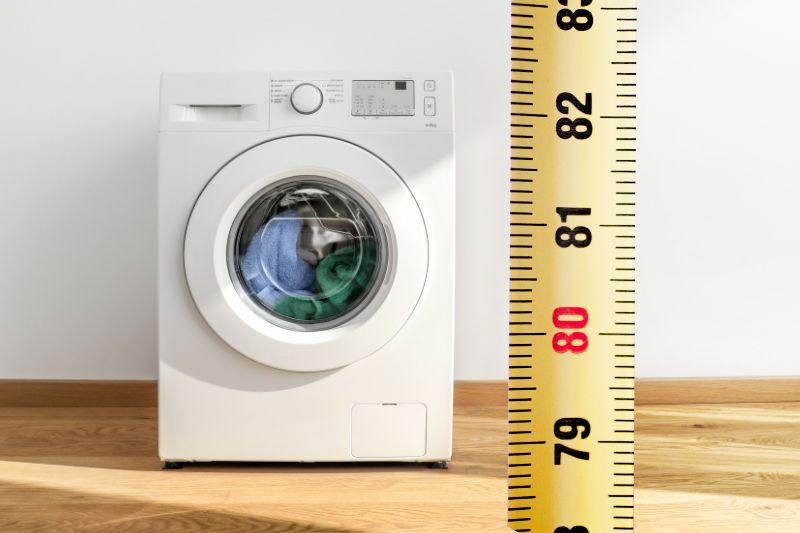

There is no single standard washing machine size, but almost all are built to fit the standard UK kitchen space of 60cm wide, 60cm deep, and 85cm high. In practice, width varies between 59 and 60cm across virtually every model on the market. Genuinely slimmer machines are rare, tend to have small drum capacities, and are often discontinued. If height is the issue, a manufacturer height reduction kit may help.
If you need a washing machine that is even slightly smaller than average, you will find the options extremely limited. This guide explains why, what the real measurements are across the market, and what workarounds are available.
Why Washing Machines Are Nearly All the Same Size
The standard UK kitchen space for a washing machine is 60cm wide, 60cm deep, and at least 85cm high – and manufacturers build to fill that space as completely as possible. A larger drum means a more saleable machine. There is no commercial incentive to make a washing machine several millimetres narrower and lose internal drum volume as a result.
Width of virtually every standard washing machine – 32 out of 33 models checked fell within this range
Height of almost every standard machine – most within 1mm of this figure
Depth – which varies by several millimetres between models and matters least for fitting
Washing Machine Width
Width is the dimension that causes most installation problems in UK kitchens, where the space under a worktop is often tight. The frustrating reality is that there is almost no meaningful width variation across the market – a survey of 33 different models found 32 between 59 and 60cm, and only one at 52cm.

If a listing shows a machine significantly narrower than 59cm, verify the dimension directly with the manufacturer before purchasing. Width measurement errors on product listings are not rare, and if the mistake originated with the manufacturer it will appear consistently across all retail sites. Do not rely on a single source. Bookmark or print the page showing the stated measurement – this provides evidence if the delivered machine does not match the specification.
What About Slimline Washing Machines?
Genuinely slimmer washing machines – around 15cm narrower than standard – have appeared occasionally over the years. They consistently have much smaller drum capacities (some as low as 3kg) and tend to be discontinued after a few years because they do not sell in sufficient volumes. Searching for “slimline washing machine” or “compact washing machine” online will produce results, but most of these turn out to be machines that are slimmer in depth rather than width – which is not what most people need.
Top-loading washing machines are significantly narrower but cannot have a worktop fitted above them, limiting where they can be installed. A comparison of available drum sizes and capacities is in our guide on washing machine drum sizes.
Washing Machine Height
Height is even more uniform than width. Of 33 models surveyed, only 3 were less than 85cm – and only by 1mm. For all practical purposes, standard washing machines are 85cm tall.
Height Reduction Kits
If a machine needs to fit under a worktop lower than 85cm, the solution is a manufacturer-supplied height reduction kit. This replaces the standard lid with a thinner flat lid and removes or replaces the feet with lower profile fixings. The height saving is typically around 20mm – usually enough to achieve the required clearance.
Do not simply remove the lid to lower the machine’s height without checking whether a proper height reduction kit is available and what it involves. There are safety considerations specific to each model. See our guide on reducing the height of a washing machine before attempting this.
Washing Machine Depth
Depth shows the most variation of any dimension and is also the least critical measurement for most installations. A washing machine that is deeper than the space will simply stick out further rather than not fitting at all.
When Depth Does Matter
There are situations where a machine sticking out further than expected causes real problems. Before purchasing, consider:
- Kitchen doors or room doors that open across the machine’s position – a machine that sticks out further may prevent a door from opening fully or at all
- Kitchen drawers in adjacent units that cannot be fully opened if the machine protrudes too far
- The machine door and door handle – the quoted depth should include the door, but confirm whether it also accounts for the door handle and any front panel protrusion. When open, the door adds considerable depth to the front of the machine
- Hoses and cables at the back – the manufacturer’s quoted depth is usually the machine body only. Space behind the machine for inlet hoses, the drain hose, and the mains cable also needs to be accounted for. See our guide on whether washing machine depth specifications include pipes and hoses
Practical Tips for Finding a Smaller Machine
-

Use comparison sites with dimension filters. Most allow filtering by height, width, and depth. This is a useful starting point – but do not trust the quoted measurements without verification. -
Cross-reference dimensions across multiple sites. If a dimension looks unusually small, check it on at least two other retail sites and on the manufacturer’s own specification page. -
Contact the manufacturer directly if the measurement is critical and the dimension looks significantly different from the market standard. -
Check the drum capacity of any smaller machine you find. Reduced dimensions almost always mean a reduced drum – some compact machines have drums as small as 3.5kg, which is insufficient for a typical family. See our guide on the difference between drum capacities. -
Measure the existing machine even if it currently fits – modern machines are often slightly wider and deeper than older equivalents. Do not assume the same measurements apply. -
Confirm whether the depth measurement includes the door handle and front protrusion. The quoted depth is sometimes the body only, not the full installed depth with the door closed.
For a data table of actual washing machine dimensions across 33 surveyed models, see our washing machine sizes comparison guide.
Related Size and Installation Guides
Related Guides
 Washing Machine Sizes Comparison
A table of actual height, width, and depth measurements from 33 surveyed washing machines.
 Reducing the Height of a Washing Machine
How manufacturer height reduction kits work and the safety considerations involved.
 Do Depth Specs Include Pipes and Hoses?
Whether quoted washing machine depth measurements include the space needed for rear connections.
 Washing Machine Drum Sizes Explained
What drum capacity ratings mean in practice and how to choose the right capacity for your household.
Frequently Asked Questions
Is there a standard washing machine size in the UK?
There is no formal standard, but the market has converged on a de facto standard because virtually all UK kitchens provide the same space: 60cm wide, 60cm deep, 85cm high. Manufacturers build to fill this space. In practice, width is between 59 and 60cm and height is 85cm on almost every model available.
Can I find a washing machine narrower than 60cm?
It is extremely difficult. Of 33 models surveyed, only one was meaningfully narrower at 52cm – and this should be verified with the manufacturer before relying on it. Slimline washing machines have existed but tend to have very small drum capacities and often get discontinued. Top-loading machines are narrower but cannot have a worktop above them.
What if my machine needs to fit under a lower worktop?
A manufacturer height reduction kit may be the answer. These replace the lid with a much thinner version and adjust the feet, typically saving around 20mm. Most major brands offer them for their washing machine ranges. Do not simply remove the lid without checking what a proper height reduction involves – there are model-specific safety considerations.
Does the quoted depth of a washing machine include the door?
It should, but this is not always consistent. Some manufacturers quote the body depth only. The door, door handle, and any front panel protrusion can add several centimetres to the effective depth when the door is closed. For space-critical installations, contact the manufacturer to confirm exactly what the quoted depth measurement includes.
57 Comments
Grouped into 39 comment threads.
2 replies How can you easily manouevre a washing machine into a tight space? You say the standard gap in a kitchen is 60cm, but as my washing machine is 59.5cm that is only half a cm wiggle room. Is this reasonable to allow so little gap round the sides? Are there contraptions to help get the machines in and out easily?
2 replies I need a second opinion please! I'm looking for a new washer and the one I have my eye on is 645mm deep (according to the Coop) or 615mm deep(according to Currys!) I have a space 730mm deep, measuring from back wall to edge, but includes the waste pipe work running across the bottom of the wall. Do you think this will fit in ok? It is right behind the back door, which has to be able to open fully to accommodate a wheelchair. Your thoughts would be appreciated, my head is spinning! thank you.
I need a second opinion please! I’m looking for a new washer and the one I have my eye on is 645mm deep (according to the Coop) or 615mm deep(according to Currys!) I have a space 730mm deep, measuring from back wall to edge, but includes the waste pipe work running across the bottom of the wall. Do you think this will fit in ok? It is right behind the back door, which has to be able to open fully to accommodate a wheelchair. Your thoughts would be appreciated, my head is spinning! thank you.
Likely replying to Mrs M
Hello Mrs M. That’s why I advise in my article that we can’t trust the specs given on web sites. I’ve seen lots of mistakes. The depth of a standard worktop should be 600 mm and washing machines don’t usually stick out too much over that but things like plumbing can stop them pushing back flush against the wall, and bulging doors or control panels and knobs can also add to the problem as shown in one of my photos. Manufacturers usually design so they don’t stick out too much over 600 mm worktop even with plumbing behind the machine which is extremely common.
However, they can stick out a few inches or so but it does sound like you have plenty of depth if you get 730 mm. If it’s the longer measurement of 645 it still sounds like there’s room for plumbing. Ultimately if you order online you can send it back within 14 days with no reason needed as long as you haven’t used it.
1 reply I live in a block of flats specifically designed for use of wheel chair users and therefore the height of the units is lowered. The height of a washing machine needs to be 80-82 centimetres. Machines of this height appear to be very difficult to find. Surely there is a market for smaller machines to conform with the needs of the disabled under the Disability Act?
I live in a block of flats specifically designed for use of wheel chair users and therefore the height of the units is lowered. The height of a washing machine needs to be 80-82 centimetres. Machines of this height appear to be very difficult to find. Surely there is a market for smaller machines to conform with the needs of the disabled under the Disability Act?
Hello Mary. The only thing I can think of is built in washing machines, which are much lower than a freestanding washing machine. They are normally raised up by up to 5 or 6 inches using plastic windup legs and feet. I would imagine that in the situation that you describe, one would be fitted into the kitchen and not raised up to the standard height.
1 reply My old Bosch machine is 59.5 cm wide and there is no room at all either side. I had a new kitchen installed 11 years ago and I noticed they could barely fit the washer in then (it was already 11 years old then). Now it leaks so I can’t use it but cannot find any machines to replace it. I would never buy possible dangerous ones and want a good make. Have spent days trawling Internet but the nearest is a Miele 59.6cm. At the moment I can’t put a feather between fitted cupboards either side. I feel very stressed as Car not working, kitchen wall needs decorating after new central heating installed. What do other people do in such situations?
My old Bosch machine is 59.5 cm wide and there is no room at all either side. I had a new kitchen installed 11 years ago and I noticed they could barely fit the washer in then (it was already 11 years old then). Now it leaks so I can’t use it but cannot find any machines to replace it. I would never buy possible dangerous ones and want a good make. Have spent days trawling Internet but the nearest is a Miele 59.6cm. At the moment I can’t put a feather between fitted cupboards either side. I feel very stressed as Car not working, kitchen wall needs decorating after new central heating installed. What do other people do in such situations?
1 reply Trying to replace a Siemens 7kg machine but the spacedimensions available are 59.5cm width, 84 cm height and a limiting 58cm depth, any ideas if machines that could fit. The Siemens model we've had for 13 years is now discontinued
Trying to replace a Siemens 7kg machine but the spacedimensions available are 59.5cm width, 84 cm height and a limiting 58cm depth, any ideas if machines that could fit. The Siemens model we’ve had for 13 years is now discontinued
Hello David. I think the conclusion of my article and research was that when it comes to height and width, there aren’t any smaller washing machines other than the odd millimetre. Not having enough depth is the least problematic size issue unless you have a door or drawer that opens across the washing machine like the one in my article. It’s also the measurement that has the greatest size differences when I did my research (Washing Machine Sizes Comparison) though I can’t sure whether these were real differences and not for example differences in the way manufacturers measure.
For example, could one measure the literal depth of the cabinet and another measure the depth of the lid which overhangs at the back? The only thing you can do is to scour price comparison sites or manufacturers sites and study the technical specifications where size is always quoted.
1 reply Hi I have recently taken out an integrated washer/drier of 52.5cm max depth (inc . door etc.). Unfortunately I cant find a replacement one that fits , can you help please Regards Michael Clarke
Hi
I have recently taken out an integrated washer/drier of 52.5cm max depth (inc . door etc.). Unfortunately I cant find a replacement one that fits , can you help please
Regards
Michael Clarke
Sorry Michael. The only thing you can do is trawl through all the sites selling them, and look at the specs of them all to try and find one. If you’ve already done that and can’t find one, they probably don’t make one. If that’s the case and it’s depth you need you would have to try a kitchen company for ideas. It’s crazy that people have this problem.
1 reply Am trying to find a washing machine which will fit into a space 84cm x 55cm. Not so bothered about depth (Why on earth would a kitchen refurbishment in a local authority flat not have standard sizes??) Any pointers?
Am trying to find a washing machine which will fit into a space 84cm x 55cm. Not so bothered about depth (Why on earth would a kitchen refurbishment in a local authority flat not have standard sizes??) Any pointers?
Hello Gillian. Yes it’s very frustrating. There is very little excuse that I can think of unless a kitchen is designed specifically for someone who has requested lower worktops. Washing machines are usually 85 cm high, so making a worktop just 1 cm lower is ludicrous and can not possibly have any benefit. Widthwise, they should be 60 cm, so saving 5 cm may be useful in a small kitchen but only if it is absolutely necessary because again, washing machines are not made at 55 cm wide, they are on average 59 cm wide.
If your kitchen is extremely small it’s possible there wasn’t much choice, although as I said saving 1 cm in high seems pretty pointless. Widthwise is a different matter, though. In an extremely small kitchen it may be difficult, but anybody in the kitchen fitting business should know that if you do not create spaces which are the standard 60 x 60 cm, then you will definitely not be able to fit the overwhelming majority of either washing machines or dishwashers in there.
1 reply Could you please tell me if there are any machines I can fit in space and put a cabinet door over it, I already have this but unfortunately after 13 years my machine isn’t working now and the model is discontinued. Not having a utility room this worked perfectly so am looking for a small depth machine.
Could you please tell me if there are any machines I can fit in space and put a cabinet door over it, I already have this but unfortunately after 13 years my machine isn’t working now and the model is discontinued. Not having a utility room this worked perfectly so am looking for a small depth machine.
1 reply Hi I have been searching for a freestanding washing machine ideally about 82cm/83cm in height. For my old washing machine I ended up having to take the nuts off the legs to get it to fit into its space (under a worktop) after a kitchen refurb. I cannot seem to find any. I called a few washing machine manufacturers and they all said they dont have height redunction kits anymore due to the location of their washing machine electronics. My current washing machine is about to pack up so I need a replacement. Any ideas?. I thought about buying a integrated one(although it wont look great) Thanks
Hi
I have been searching for a freestanding washing machine ideally about 82cm/83cm in height. For my old washing machine I ended up having to take the nuts off the legs to get it to fit into its space (under a worktop) after a kitchen refurb. I cannot seem to find any. I called a few washing machine manufacturers and they all said they dont have height redunction kits anymore due to the location of their washing machine electronics. My current washing machine is about to pack up so I need a replacement. Any ideas?. I thought about buying a integrated one(although it wont look great)
Thanks
1 reply I recently had to fit a free standing Miele for a family remember. The Miele engineer simply shrugged when he was told that the previous free standing Mile went back 6cm further than the new one. With the machine in place, I kept measuring the depth to the wall minus the lid. After some time I discovered that the back of the machine protrudes about 25mm past the lid. In the end I had to hack away the plaster and train the pipes so that they didn't extend past the lid. Is that normal? Isn't the lid supposed to be there to prevent people crushing pipes when they push it back?
I recently had to fit a free standing Miele for a family remember. The Miele engineer simply shrugged when he was told that the previous free standing Mile went back 6cm further than the new one.
With the machine in place, I kept measuring the depth to the wall minus the lid. After some time I discovered that the back of the machine protrudes about 25mm past the lid.
In the end I had to hack away the plaster and train the pipes so that they didn’t extend past the lid.
Is that normal? Isn’t the lid supposed to be there to prevent people crushing pipes when they push it back?
Leave a comment
1 reply Are integrated door hinge anchors on machines all standard distances positions etc ?
1 reply I've spent hours trawling through sites for a narrow WIDTH washing machine - less than 60cm but whenever I look up narrow width it gives me narrow DEPTH. Washing machine retailers are incredibly frustrating, as is google. Thanks for the links, unfortunately these don't have a filter for specs of width except the hotpoint site which only has a filter for 595mm which is the size of all of them on their site. The only site where its a little easier to check the specs is appliancesdirect in case anyone is looking. Most of the selections have dimensions on the min detail or can get it through the quick glance. Alternatively I would recommend just going into the shops with a tape measure.
I’ve spent hours trawling through sites for a narrow WIDTH washing machine – less than 60cm but whenever I look up narrow width it gives me narrow DEPTH. Washing machine retailers are incredibly frustrating, as is google.
Thanks for the links, unfortunately these don’t have a filter for specs of width except the hotpoint site which only has a filter for 595mm which is the size of all of them on their site. The only site where its a little easier to check the specs is appliancesdirect in case anyone is looking. Most of the selections have dimensions on the min detail or can get it through the quick glance. Alternatively I would recommend just going into the shops with a tape measure.
1 reply Are dimensions of a washing machine usually stated in the order of Height. Width. Depth in the specifications? I need to be absolutely sure?
Are dimensions of a washing machine usually stated in the order of Height. Width. Depth in the specifications? I need to be absolutely sure?
Likely replying to Janice
Hello Janice. They might not necessarily be in the exact same order on every washing machine but the measurement should always have, H W and D in front of the figures for height width and depth. Any web page selling a washing machine should have technical specifications tab or section where the measurements are listed.
1 reply Hi is there a integrated washing machine that can have its back legs adjusted from the front many thanks Robert
Hi is there a integrated washing machine that can have its back legs adjusted from the front many thanks Robert
1 reply That's the problem Jesse. These days with all the extra large drum capacities they can't afford to cut the size down or they just can't fit parts in. There are no machines with reduced width other than potentially a few millimetres other than compact machines (which are very rare and only have very small drums) or top loading washing machines.
That’s the problem Jesse. These days with all the extra large drum capacities they can’t afford to cut the size down or they just can’t fit parts in. There are no machines with reduced width other than potentially a few millimetres other than compact machines (which are very rare and only have very small drums) or top loading washing machines.
Andy
Thanks for the quick feedback much appreciated I will have to maybe remove a redundant pipe in a storage cupboard to make space for a washing machine which I did not want to touch the storage cupboard is next to the bathroom so basically will need to check first if pipe is okay to remove then drill a hole through the storage wall ground level through to bathroom wall and connect outlet pipe under the bath and out to the front wall
Andy thanks again
1 reply hi i have just been told that my kitchen work top base is 80cm high but i cant find any machines at that height, they are about 84-85cm. Any suggestion? is there a kitchen work base that low (80cm). do you know of any washing machine or fridge with that height? help please
hi i have just been told that my kitchen work top base is 80cm high but i cant find any machines at that height, they are about 84-85cm. Any suggestion? is there a kitchen work base that low (80cm). do you know of any washing machine or fridge with that height? help please
Likely replying to Jaz
Hello Jaz. You may have to look at built-in appliances. As far as I know all freestanding washing machines are roughly the same height. There’s nothing in it for the manufacturer to make a washing machine smaller than the standard kitchen unit size. They have to cram enough in as it is without making them smaller, especially now they have much larger drum capacities.
0 replies I'm having the same problem as the ones already mentioned. I need a machine to fit a space h- 86cm w-63cm and d-60cm. I've spent hours looking on line and the only one I can find is a tiny compact Zanussi which is not fit for purpose and doesn't have great reviews. I've read that machines need at least an inch of space at the sides and top and several at the back to allow for pipe work? my current Indesit machine is on its way out after 10 years of brilliant service. Any advice would be gratefully received!! Wendy.
I’m having the same problem as the ones already mentioned. I need a machine to fit a space h- 86cm w-63cm and d-60cm. I’ve spent hours looking on line and the only one I can find is a tiny compact Zanussi which is not fit for purpose and doesn’t have great reviews. I’ve read that machines need at least an inch of space at the sides and top and several at the back to allow for pipe work? my current Indesit machine is on its way out after 10 years of brilliant service. Any advice would be gratefully received!!
Wendy.
0 replies Hello Beverley. Sorry no I don't. The last time I did research in this area I didn't find a single one that was less than 58.5 cm wide (Washing Machine Sizes Comparison . I can only suggest that sadly you will always have a big problem unless you manage to increase the width of the space.
Hello Beverley. Sorry no I don’t. The last time I did research in this area I didn’t find a single one that was less than 58.5 cm wide (Washing Machine Sizes Comparison . I can only suggest that sadly you will always have a big problem unless you manage to increase the width of the space.
0 replies Hi I have a sourcing requirement for a freestanding washing machine of max 58cm width. Are there any models you are aware of?
Hi
I have a sourcing requirement for a freestanding washing machine of max 58cm width.
Are there any models you are aware of?
0 replies Zanussi ZWC1301 3Kg Washing Machine - White - A Rated £409 at AO and Currys, £389 at bootskitchenappliances.com, £399 at Coop Electrical. Spin Speed 1300 rpm Dimensions (cm) - (H)67.0 x (W)49.5 x (D)51.5 Candy Aquamatic AQUA1042D1 4Kg Washing Machine White - A+ Rated £599 at AO, £499 at Tesco Direct, £454 at Appliances Direct. Spin Speed 1000 rpm Dimensions (cm) - (H)70.0 x (W)51.0 x (D)46.3
Zanussi ZWC1301 3Kg Washing Machine – White – A Rated
£409 at AO and Currys, £389 at bootskitchenappliances.com, £399 at Coop Electrical.
Spin Speed 1300 rpm
Dimensions (cm) – (H)67.0 x (W)49.5 x (D)51.5
Candy Aquamatic AQUA1042D1 4Kg Washing Machine White – A+ Rated
£599 at AO, £499 at Tesco Direct, £454 at Appliances Direct.
Spin Speed 1000 rpm
Dimensions (cm) – (H)70.0 x (W)51.0 x (D)46.3
0 replies Hi I live in a flat and have a spiral staircase and I am restricted in the size of a washing machine do the maximum width I can have is 55 I’d like a washer dryer can anyone help with where I could get one
Hi I live in a flat and have a spiral staircase and I am restricted in the size of a washing machine do the maximum width I can have is 55 I’d like a washer dryer can anyone help with where I could get one
0 replies Please help me!!! I am at my wit's end!!!. My baumatic integrated washing machine has packed in, this washing machine seems to be the only one in the world with a width of 590 and it fits very snuggly into the space provided. I have trawled the internet, shops etc and cannot find another one this wide. Does anyone know of a integrated washing machine that could fit into a very tight space. I am drowning in clothes that need washing. I really am desperate for help!!!!
Please help me!!! I am at my wit’s end!!!. My baumatic integrated washing machine has packed in, this washing machine seems to be the only one in the world with a width of 590 and it fits very snuggly into the space provided. I have trawled the internet, shops etc and cannot find another one this wide. Does anyone know of a integrated washing machine that could fit into a very tight space. I am drowning in clothes that need washing. I really am desperate for help!!!!
0 replies Use one of the price comparison sites to search for appliances filtered by sizes and see the published specifications and sizes.
Use one of the price comparison sites to search for appliances filtered by sizes and see the published specifications and sizes.
0 replies Bosh used to do one in the UK and I used to link to it but it went obsolete so I had to remove my link. I think it was 4Kg drum. Any washing machine that slim is likely to be useless to a family though as the drum would be far too small.
Bosh used to do one in the UK and I used to link to it but it went obsolete so I had to remove my link. I think it was 4Kg drum. Any washing machine that slim is likely to be useless to a family though as the drum would be far too small.
0 replies A washing machine 50 cm wide does exist, but maybe you can not get it in the UK. It is an Electrolux machine, maybe only sold on the continent. It used to be made in Sweden.
A washing machine 50 cm wide does exist, but maybe you can not get it in the UK. It is an Electrolux machine, maybe only sold on the continent. It used to be made in Sweden.
0 replies No Peter, not that I know of. Width is the one measurement that is fairly consistent. If they reduced the width to 500 mm they just wouldn't be able to fit the parts inside it. The only washing machines that are significantly thinner than normal that I've ever seen are top loaders, or compact washing machines which are a very small niche market with very small drum capacities such as just 3 or 4Kg (the average is now 6 or 7Kg). Most of the compact washing machines don't last long before becoming obsolete because they just isn't enough demand.
No Peter, not that I know of. Width is the one measurement that is fairly consistent. If they reduced the width to 500 mm they just wouldn’t be able to fit the parts inside it. The only washing machines that are significantly thinner than normal that I’ve ever seen are top loaders, or compact washing machines which are a very small niche market with very small drum capacities such as just 3 or 4Kg (the average is now 6 or 7Kg). Most of the compact washing machines don’t last long before becoming obsolete because they just isn’t enough demand.
0 replies I have a 500mm space. Is there a washing machine that will fit I the space
I have a 500mm space. Is there a washing machine that will fit I the space
0 replies I require a washing machine which is between 55 to 58 cm width does anyone out there know were I can purchase As 99% of washing machines are 60cm width plus...... help please I am struggling to find one ?
I require a washing machine which is between 55 to 58 cm width does anyone out there know were I can purchase
As 99% of washing machines are 60cm width plus…… help please I am struggling to find one ?
0 replies I have been looking for a fairly decent washing machine with the depth no larger than 550mm I thought I found one when I bought the Samsung Eco bubble but just to reiterate what has already been said not all sizes shown are the actual sizes The machine was more realistically a 600mm x 600mm and not the 600 x 550 stated . ! I had the inconvenience of returning the machine hence the search starts again Smaller machines with big loads seem to be quite noisy according to the reviews I have read has anyone had any success in finding a decent machine with.out Compromising on the load size?
I have been looking for a fairly decent washing machine with the depth no larger than 550mm I thought I found one when I bought the Samsung Eco bubble but just to reiterate what has already been said not all sizes shown are the actual sizes The machine was more realistically a 600mm x 600mm and not the 600 x 550 stated . ! I had the inconvenience of returning the machine hence the search starts again
Smaller machines with big loads seem to be quite noisy according to the reviews I have read has anyone had any success in finding a decent machine with.out Compromising on the load size?
0 replies Try searching using my "Compare white goods by size, colour, spin speed, drum size and many other filters" links in my article above Robert.
Try searching using my “Compare white goods by size, colour, spin speed, drum size and many other filters” links in my article above Robert.
0 replies can you help, I need a condenser tumble dryer no WIDER than 50 cm or 19 or 20 inch regards Robert
can you help,
I need a condenser tumble dryer no WIDER than 50 cm or 19 or 20 inch
regards
Robert
0 replies You could get by using detergent designed to go inside the drum, especially if it also contains fabric softener.
You could get by using detergent designed to go inside the drum, especially if it also contains fabric softener.
0 replies Hi. I want fit a washer under worktop in the corner of kitchen. but it will stop me accessing the drawer from above. Any alternatives to the standard drawer?
Hi. I want fit a washer under worktop in the corner of kitchen. but it will stop me accessing the drawer from above. Any alternatives to the standard drawer?
0 replies The only thing you can do is trawl through all the washing machines specs. Sadly you can't always trust the specs 100% though, I've seen errors before although if you bought one and it was different to the measurements advertised you would at least be entitled to return it.
The only thing you can do is trawl through all the washing machines specs. Sadly you can’t always trust the specs 100% though, I’ve seen errors before although if you bought one and it was different to the measurements advertised you would at least be entitled to return it.
0 replies The space for our washing machine is in the corner of the kitchen and has a cupboard door, which opens in front of it. The kitchen fitters made the space almost perfectly for the machine that we had. Now our machine is dead and I'm having loads of trouble trying to replace it. The space is slightly less than the standard 600mm (only by 2 or 3 mm) and the depth must be less than 590mm. Our dead machine is an Indesit IWDC 6143 (595mm wide x 535mm deep). I would rather not buy another Indesit as we've had loads of problems with them but I cannot find anything else that fits. any suggestions?
The space for our washing machine is in the corner of the kitchen and has a cupboard door, which opens in front of it. The kitchen fitters made the space almost perfectly for the machine that we had. Now our machine is dead and I’m having loads of trouble trying to replace it. The space is slightly less than the standard 600mm (only by 2 or 3 mm) and the depth must be less than 590mm. Our dead machine is an Indesit IWDC 6143 (595mm wide x 535mm deep). I would rather not buy another Indesit as we’ve had loads of problems with them but I cannot find anything else that fits. any suggestions?
0 replies Yes removing the feet can reduce the height although only by a small amount. The best way to reduce height is to replace the lid with a flatter one. The feet are there for stability and to prevent damage to the floor so you'd need to judge whether that was ok or not. Some manufacturer's height reduction kits did involve removing the feet but replacing them with thinner studs. If you removed the feet and the machine was placed on a carpet this could block any air vents (if fitted in the base) or if the base is open would block air getting underneath and could be a very bad idea.
Yes removing the feet can reduce the height although only by a small amount. The best way to reduce height is to replace the lid with a flatter one. The feet are there for stability and to prevent damage to the floor so you’d need to judge whether that was ok or not. Some manufacturer’s height reduction kits did involve removing the feet but replacing them with thinner studs. If you removed the feet and the machine was placed on a carpet this could block any air vents (if fitted in the base) or if the base is open would block air getting underneath and could be a very bad idea.
0 replies I have an Indesit WIL123 washer which is 83cm high under an 85cm high worktop. I wish to replace it but most machines are 85cm high. I have a vague recollection that the feet were removed to get under the worktop. Does this sound feasible and could this be done with a replacement?
I have an Indesit WIL123 washer which is 83cm high under an 85cm high worktop. I wish to replace it but most machines are 85cm high. I have a vague recollection that the feet were removed to get under the worktop.
Does this sound feasible and could this be done with a replacement?
0 replies All the help I have is put into this article. Have you tried the links on the right column where you can search for washing machines by width and height? Also, you can look into the height reduction kits many manufacturers have which I mention in the article.
All the help I have is put into this article. Have you tried the links on the right column where you can search for washing machines by width and height? Also, you can look into the height reduction kits many manufacturers have which I mention in the article.
0 replies can you please help I am at my wits end need washing machine with height no more than 82cm,would you know of retailer in my area .
can you please help I am at my wits end need washing machine with height no more than 82cm,would you know of retailer in my area .
How can you easily manouevre a washing machine into a tight space? You say the standard gap in a kitchen is 60cm, but as my washing machine is 59.5cm that is only half a cm wiggle room.
Is this reasonable to allow so little gap round the sides? Are there contraptions to help get the machines in and out easily?
Likely replying to Ruby
Hello Ruby, I have advice on moving a washer on my best way to pull a washing machine out article under the heading, “Tips for pushing a washing machine back in place”.
Likely replying to Andy Trigg (Whitegoodshelp)
Hi Andy
We have an integrated Hotpoint washing machine and today the lights on the display panel started flashing wildly so presume a fault as it didn’t complete the wash cycle and the drum was filled with water.
The dimensions are (H,W,D) = (65,60,54). There isn’t much scope to go for something much higher than 65 – 70cm. Where would you advise me to search for a supplier where I can replace with these dimensions please? Our current one does 6-7kg load which we need as a family of 4
Appreciate any advice you can provide
Thanks
Sunil