
Washing Machine Sizes Comparison
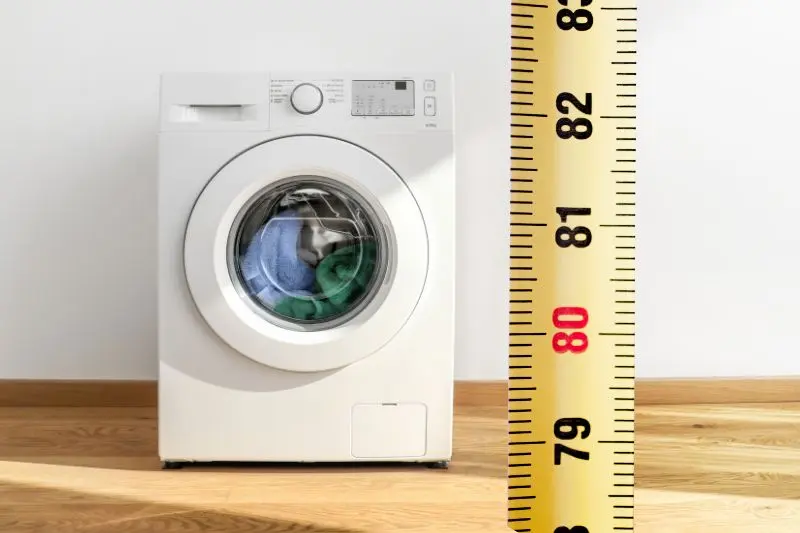
Most washing machines are 60cm wide and 85cm tall, with little variation. Depth is where real differences exist, ranging from around 40cm on slimline models to 64cm on deeper machines. If you need to fit a machine into a tight space, depth is the dimension to focus on. The table below shows real measurements from 34 models across mainstream and less common brands.
See our main article: washing machine sizes and associated problems.
About this data
The specifications below were gathered from a range of common brands and models, including a few more unusual ones. The table is not definitive – model numbers are not included as that data would quickly go out of date. The purpose is to show the range of variation that exists and where dimensions tend to be consistent.
Width is almost always 60cm or very close to it. Height is almost always 85cm. Depth is where meaningful variation occurs, ranging from around 40cm on slimline models up to 64cm on deep machines. If you need a machine shallower than average, use the depth column to get a sense of how common shorter-depth machines are.
If you are searching for a smaller than normal machine, price comparison sites allow you to filter by depth, width, or height.
Washing machine size comparison table
All measurements are in centimetres. Asterisked notes indicate unusual results or where a second source gave a different figure.
| Width (cm) | Depth (cm) | Height (cm) | Notes |
|---|---|---|---|
| 60 | 54 | 85 | |
| 59 | 59 | 85 | |
| 60 | 60 | 85 | |
| 59.5 | 53.5 | 85 | |
| 59.5 | 60.5 | 85 | |
| 60 | 60 | 85 | |
| 59.5 | 60.5 | 85 | |
| 59.5 | 60.5 | 85 | |
| 59 | 54 | 85 | |
| 60 | 52 | 85 | |
| 60 | 45 | 85 | * 47.8cm on a different source |
| 59.7 | 58.7 | 85 | |
| 60 | 54 | 85 | |
| 60 | 52.2 | 85 | |
| 59.5 | 56.5 | 85 | |
| 59.7 | 58.2 | 84.5 | |
| 60 | 56 | 85 | |
| 60 | 43.2 | 85 | Candy |
| 59.5 | 45 | 85 | * 5kg drum |
| 60 | 60 | 85 | |
| 60 | 54 | 85 | |
| 60 | 52 | 85 | Hoover |
| 60 | 62 | 84 | Smeg, 11kg drum |
| 60 | 58 | 85 | |
| 60 | 56 | 85 | |
| 60 | 64 | 85 | |
| 59.6 | 63.6 | 85 | |
| 60 | 60 | 85 | |
| 60 | 54 | 85 | |
| 59.8 | 59 | 84.8 | Beko |
| 59.8 | 59 | 84.8 | Bosch |
| 60 | 40 | 85 | Zerowatt, 6kg drum |
| 59.5 | 50 | 85 | White Knight, 5kg drum |
| 60 | 52 | 85 | Candy, 8kg drum |
What does the data show?
The vast majority of machines in this sample are between 59 and 60cm wide, with most at exactly 60cm. Width is the most standardised dimension. A machine described as “60cm wide” may actually measure 59.5 or 59.8cm, accounting for the gap between adjacent units.
Height is almost universally 85cm across the sample, with only a small number of exceptions (84, 84.5, 84.8cm). This is the most consistent dimension of all. Adjustable feet typically allow a few centimetres of height adjustment when levelling.
Depth ranges from 40cm (Zerowatt, 6kg) to 64cm in this sample. This is where meaningful variation exists and where a tight alcove can cause real problems. Standard full-size machines tend to fall between 52 and 64cm deep. Slimline machines can be 40 to 47cm. Always measure your space including any protrusion from hoses and the door.
Larger drum capacity generally means greater depth. The 11kg Smeg in the sample is 62cm deep; the 5kg White Knight is only 50cm. If you specifically need a shallow machine, smaller drum capacity models are more likely to meet that requirement.
Measure your space carefully, including depth to the wall behind, allowing for pipes, and any height restriction from cabinets above. Filter by depth on price comparison and retailer sites to narrow the field before comparing on other factors. Always verify the listed dimensions against the manufacturer’s data sheet before purchasing, as published specifications occasionally differ between sources (as shown by the 45cm vs 47.8cm discrepancy for one model in the table above).
More on washing machine sizes
For the full context on why sizes matter, drum capacity differences, and what to watch out for when fitting a new machine, see our related guides.
Frequently asked questions about washing machine sizes
Are all washing machines the same size?
Width and height are largely standardised: most machines are 60cm wide and 85cm tall, with only minor variations of a centimetre or two. Depth, however, varies significantly – from around 40cm on slimline models to 64cm on the deepest standard machines in this sample. If you have a tight alcove, depth is the dimension that matters most.
What is the smallest depth available for a freestanding washing machine?
Slimline freestanding washing machines start at around 40cm depth, as shown by the Zerowatt 6kg model in the sample. Below that, you are typically looking at compact washer-dryers or specialist appliances. Slimline machines almost always come with smaller drum capacities (5 to 7kg rather than 9 to 11kg) because the depth restriction limits drum size.
How much space should I leave around a washing machine when fitting it?
Most manufacturers recommend a small gap (typically 1 to 2cm) around the machine to allow for vibration during the spin cycle without the machine touching adjacent units, which would transfer noise and vibration. Behind the machine, allow enough depth for hoses and the supply tap connections – typically 5 to 10cm beyond the machine body. Check the installation instructions for your specific model, as some have specific clearance requirements.
Does an integrated washing machine have different dimensions?
Yes. Integrated washing machines (designed to be hidden behind a kitchen cabinet door) have slightly smaller external dimensions and a different door design to accommodate the kitchen unit door fitted to the front. They typically sit within a kitchen cabinet aperture of around 60cm wide and 82cm high. If you are replacing a freestanding machine with an integrated one (or vice versa), the machines are not directly interchangeable.
Will a machine that says “60cm wide” actually be 60cm?
Often slightly less. Many manufacturers describe their machines as “60cm” but the actual measurement is 59.5 or 59.8cm. This is intentional – the small gap allows the machine to fit cleanly into a 60cm-wide kitchen unit aperture without binding against adjacent cabinets. If your space is exactly 60cm, the machine will fit. If your space is less than 60cm, measure carefully against the manufacturer’s actual specification.
What dimension should I prioritise when buying?
Depth, in almost all cases. Width and height are largely standardised, so a machine that fits one 60cm space will fit another. Depth varies most across the market, and is where compatibility problems typically occur, particularly in older kitchens with shallow alcoves or rented properties with limited installation space. Measure your space’s depth first and use that as the filter when shopping.
Still deciding?
Here’s where to go next.
Ask the repair forum
Post the make, model and symptoms and get help from the Whitegoods Help community.
“Machine is 15 years old, but very light usage. Please see video…”
✓ Solved · LG · 4 replies9 Comments
Grouped into 3 comment threads.
1 reply Hello my 9kg washer has broken and I need to buy a new one asap. This time we would love a 14kg washer but so far, I've only managed to find depths that would stick out TOO MUCH. My current machine is 58cm and there is space behind for the pipes etc. BECAUSE WE SO MUCH WOULD LOVE A 14KG WASHER we are prepared to have A MAX DEPTH OF 61CM. We'd like a decent energy rating. We'd like white with a silver door frame OR white with a white door frame OR if we HAVE TO reluctantly we'd accept white with black door frame. Our budget ideally would be approx £400 but for the right machine with the right depth (no more than 61cm), etc, WE WOULD GO TO £560 IF NECESSARY. PLEASE PLEASE PLEASE COULD YOU FIND ME SOME THAT MEET OUR REQUIREMENTS. I've spent all day looking. Even a 13kg would be considered. Thanking you in anticipation. Peter - Greater Manchester.
0 replies I have found this information really helpful. I've just had a new kitchen fitted with free standing cooker, fridge and washing machine. We had to take the legs off the washing machine to get it back under the worktop. I've had it more than 10 years but am concerned about getting a new one when it eventually breaks down.
I have found this information really helpful. I’ve just had a new kitchen fitted with free standing cooker, fridge and washing machine. We had to take the legs off the washing machine to get it back under the worktop. I’ve had it more than 10 years but am concerned about getting a new one when it eventually breaks down.
5 replies Hi Andy Do you correlate size to manufacturer/model, is it possible? Might be useful in helping to identify fire damaged appliances
Hi Andy
Do you correlate size to manufacturer/model, is it possible?
Might be useful in helping to identify fire damaged appliances
Likely replying to John Gow
Hello John. No I didn’t take note of the exact models and sizes as that would make my data out of date quite quickly. Manufacturers are constantly changing and deleting models. The chart gives a very good idea of the kind of differences there are though, so it’s just a case of popping onto one of the price comparison sites and filtering results on width, depth or height.
Likely replying to Andy Trigg (Whitegoodshelp)
Hi Andy
I’m in need of a new washing machine but because I only have 60cm possibly 61cm at most depth overall as it is in a cupboard (not integrated). I’m having trouble finding one that does not have the cheese grater drum. I find these are more likely to make holes in the clothes. I don’t want hoover or any that are linked to them due to safety problems they have had but these do seem to be smaller in depth. Just wonder if you could point me in the direction of a good make and model that will fit for me to look at.
many thanks
Likely replying to sue
Hello Sue. Washing machine drums have had the multiple holes in them for at least 50 years and as you have found the overwhelming majority of washing machine still have the same type of drums so it’s difficult to agree that there is a problem with them. If used according to proper instructions and the correct wash cycle is chosen it should be very rare for any holes to happen at all. Holes in clothes is a complicated issue as you can see from my article here holes in clothes after washing. But many of the holes are not caused by the washing machine. It’s whirlpool and Indesit that are most linked to safety issues. The only drum I can recommend that does not have the standard holes in it is the Miele honeycomb drum but of course the Miele washing machines are a lot more expensive.
Likely replying to Anne Spittle
Hello Anne. I presume you want to put a washing machine somewhere where there isn’t a worktop above it? Built-in washing machines are designed to fit tightly underneath a worktop. Their casings are quite flimsy and they stand on plastic adjustable legs. They get their stability from being clamped tightly between the floor and a worktop. I would expect a built-in washing machine would be quite unstable if it was just placed on the floor somewhere and it would move about a lot.
Hello my 9kg washer has broken and I need to buy a new one asap. This time we would love a 14kg washer but so far, I’ve only managed to find depths that would stick out TOO MUCH. My current machine is 58cm and there is space behind for the pipes etc. BECAUSE WE SO MUCH WOULD LOVE A 14KG WASHER we are prepared to have A MAX DEPTH OF 61CM. We’d like a decent energy rating. We’d like white with a silver door frame OR white with a white door frame OR if we HAVE TO reluctantly we’d accept white with black door frame. Our budget ideally would be approx £400 but for the right machine with the right depth (no more than 61cm), etc, WE WOULD GO TO £560 IF NECESSARY. PLEASE PLEASE PLEASE COULD YOU FIND ME SOME THAT MEET OUR REQUIREMENTS. I’ve spent all day looking. Even a 13kg would be considered. Thanking you in anticipation. Peter – Greater Manchester.
Likely replying to Peter
Hello Peter. If you look at the chart featured in my article above, you can see that there are washing machines with the kind of depth that you are looking for. But, if you’ve spent a long time looking for a washing machine with a smaller depth – and an extremely large drum, and found nothing, then I would assume it is because they are not available. You just can’t fit an extra large drum into a smaller space.