
Microplastic Filters for Washing Machines
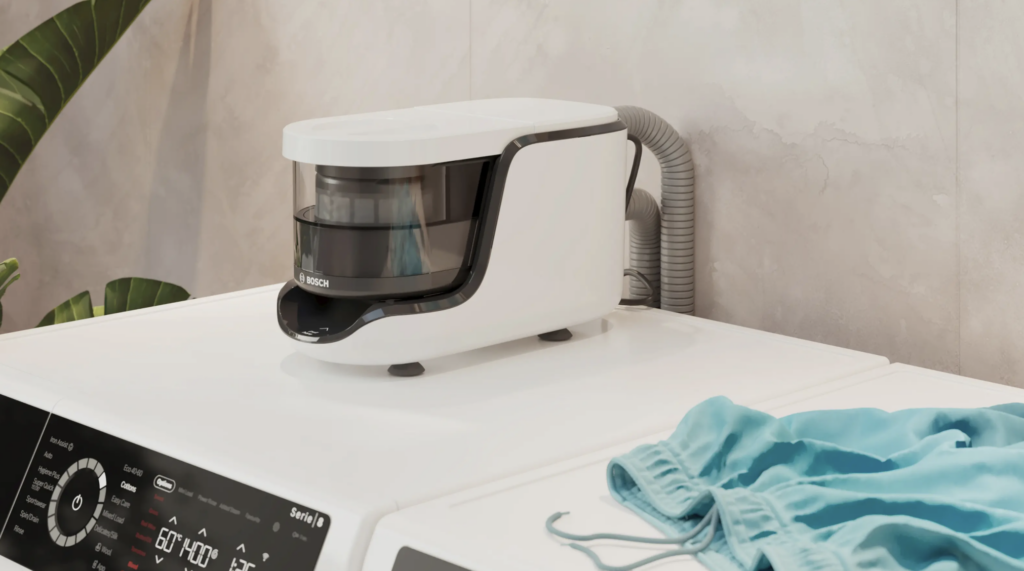

Synthetic clothing sheds hundreds of thousands of microscopic plastic fibres in every wash, and standard sewage treatment cannot filter them out. The Bosch Microplastic Filter, developed with UK climate tech firm Matter Industries, captures up to 97% of these fibres at the washing machine before they reach the drain. It retrofits to any washing machine of any brand or age and is now available in the UK.
Domestic laundry is now one of the largest single sources of microplastic pollution entering the world’s oceans, alongside tyre wear and primary plastic manufacturing. For the first time, there is a properly engineered consumer product that addresses it at source.
This article explains the problem, the technology, what the Bosch filter does, and what your options are if you want to act on it.
What is microfibre pollution from washing machines?
Every time a synthetic garment goes through a wash cycle, friction between the fabric and water releases vast numbers of microscopic plastic fibres into the wastewater. These fibres, typically smaller than 5mm and often invisible to the naked eye, are shed from polyester, nylon, acrylic, polyamide, elastane and other plastic-based textiles.
Microfibres released in a single 6kg wash load
Of ocean microplastics traced to synthetic textile laundry
Of human blood samples now test positive for microplastics
From the washing machine, these fibres flow into the household drainage system and on to wastewater treatment plants, which were never designed to filter particles at this scale. A significant proportion pass straight through and enter rivers, estuaries and oceans. The remainder collect in sewage sludge that is frequently spread on agricultural land as fertiliser, re-entering the environment by another route.
Once in the environment, microplastics persist effectively forever. They are eaten by plankton, fish and shellfish, and work their way back up the food chain. Recent studies have detected microplastics in human heart tissue, brain cells, lung tissue, blood, and the placentas of unborn children. The long-term health implications are still being investigated but the current direction of the evidence is concerning.
Why are washing machines at the centre of the problem?
The shift toward synthetic textiles over the past 50 years means the average UK household’s wardrobe contains far more plastic-based fabric than it once did. Polyester is the world’s most-used clothing fibre. Polyester fleece, polyester-cotton blends, sportswear, performance wear, nylon hosiery, acrylic knitwear and elastane in everything from leggings to bedlinen all shed plastic fibres in the wash.

Water-efficient cycles use less water, which concentrates the fibre load. Faster spin speeds increase mechanical friction. Synthetic fabrics shed most heavily in the first few washes after purchase but continue shedding throughout their life. And UK households now run 150 to 200 cycles a year.
The result is that every washing machine in the country is, in effect, a continuous slow-release source of plastic pollution. This has nothing to do with the quality of the machine or how well it is maintained. It is a function of what is being washed, not how.
How do microplastic filters solve the problem?
The most direct way to stop microfibres reaching wastewater is to filter them out at the source: the washing machine itself. The science of catching microfibres at this stage is well established, but until recently the consumer-facing products were limited to wash bags (which capture some fibres but reduce wash performance and require manual handling) or DIY in-line filters that often clogged or leaked.
What has changed in the last few years is the arrival of commercially robust, retrofit microplastic filter units designed specifically to sit between the washing machine’s outlet hose and the drain. The most significant development for UK consumers is the launch of the Bosch Microplastic Filter, developed in partnership between BSH Home Appliances (the maker of Bosch and Siemens appliances) and Matter Industries, a Bristol-based climate technology company. The filter has been on the market in continental Europe since 2024 and is now available in the UK.
| Option | Capture rate | Cost | Effort per wash |
|---|---|---|---|
| Bosch Microplastic Filter | Up to 97% | £290 – £390 one-off | None – empty every 6 weeks |
| Microfibre wash bag (e.g. Guppyfriend) | Roughly 25 – 50% | £25 – £35 | Manual loading and emptying every wash |
| DIY in-line drain filter | Variable | £30 – £80 | Frequent cleaning, prone to blockage |
| No filtration | 0% | £0 | None |
What does the Bosch Microplastic Filter actually do?
The Bosch WMZMPF10 is an external filter unit that connects between the washing machine’s drain hose and the existing wastewater outlet. It uses a self-cleaning filtration technology called Regen, developed and patented by Matter Industries, which captures microfibres without needing replacement filter cartridges.
 Up to 97% capture rate
Independent testing and the manufacturer’s published figures both indicate the filter captures up to 97% of microfibres released during a wash cycle. The remaining 3% are typically too small to be caught by any current filtration technology and would pass through any consumer-grade system.
 Universal retrofit
The filter connects to the washing machine’s wastewater hose and is placed on or next to the appliance. No drilling, no plumbing changes, no electrical connection required. It works with any washing machine, of any brand, of any age.
 No replacement cartridges
The Regen technology inside the unit is self-cleaning. Captured fibres collect in a removable container that is emptied as a normal maintenance task. The filter unit itself is designed to last the life of the washing machine without consumable spares.
 Up to 6 weeks between emptying
Based on a typical European washing pattern of around 20 cycles per six-week period, the fibre container needs emptying about every six weeks. The fibres can be wiped out into normal household waste – no special disposal required.
The filter has a two-year manufacturer guarantee. UK retail prices at time of writing range from around £290 to £390 depending on retailer. The product is available through specialist appliance retailers, Bosch’s own UK distribution, and a growing number of independent appliance suppliers.
Who are Matter Industries?
Matter Industries is the Bristol-based climate technology company that developed the filtration technology inside the Bosch Microplastic Filter. The company has been working on microplastic capture since 2019 and was founded by Adam Root, a former marine engineer.
Matter has raised significant venture funding to scale the technology, including a $10 million Series A round with investors including S2G Ventures, Regeneration.VC (Leonardo DiCaprio’s consumer climate tech fund), SOUNDwaves and Katapult. The company was named a finalist for the 2025 Earthshot Prize, the global environmental award founded by Prince William, for its work on industrial and domestic microplastic capture.
Beyond the partnership with Bosch on consumer-facing filtration, Matter is also working on industrial-scale microfibre capture for the textile manufacturing industry. The same Regen technology can be applied at the point of textile production, where the highest concentration of fibre shedding occurs. Partnerships in development include Paradise Textiles and the Alpine Group, with the aim of capturing microfibres at source in the supply chain rather than waiting for them to reach domestic washing machines.
The combination of consumer-facing retrofit filtration, integrated future-product design and upstream textile industry capture represents a comprehensive approach to a problem that no single solution can address on its own.
Should you fit a microplastic filter to your washing machine?
The honest answer is that it depends on your priorities, washing patterns and budget. A microplastic filter is not yet a regulatory requirement in the UK, and not having one does not invalidate any warranty or insurance. But for households who want to reduce their environmental impact and can absorb the upfront cost, the case is straightforward.
Reasons to fit one
- Captures up to 97% of microfibres at source
- Fits any washing machine of any brand or age
- No plumbing or electrical work required
- No replacement cartridges, ever
- Only needs emptying every 6 weeks
- Tangible, measurable environmental impact
 Reasons to hold off
- £290 – £390 upfront cost
- Zero financial payback – the return is purely environmental
- Takes up physical space next to the machine
- Tight kitchen integration may need clearance checks
- Requires routine emptying as a maintenance task
- Not yet required by UK law

For a household running 150 to 200 wash cycles per year, mostly with synthetic or blended garments, the volume of microfibres captured over the life of the filter is significant. Across the lifespan of one unit, the captured fibre mass runs into kilograms. Multiplied across millions of UK households, the potential impact at scale is substantial.

Unlike a heat pump tumble dryer or an efficient washing machine, a microplastic filter does not save the household any money over its lifespan. The cost is genuine and upfront, the running cost is zero, and the return on investment is nil. The return is environmental, not economic. That should be clearly understood before purchase.
One of the most important features of the Bosch filter is that it does not require buying a new washing machine. The alternative approach – integrated filtration in new machines – only addresses appliances bought from the day that product launches. The retrofit filter can immediately address the millions of existing washing machines already in UK homes, which would otherwise continue to release microfibres for the remainder of their service life.
Thinking about a new washing machine instead?
If you’re due to replace your machine anyway, integrated microplastic filtration is starting to appear on premium models. Our buying and repair guides can help you weigh up replacing versus keeping what you have.
What is coming next in microplastic filtration?
The current retrofit market is at an early stage. The Bosch filter is one of the first commercially robust consumer products, but several developments are in progress that will change the landscape over the next few years.
2025 – France leads on regulation
France becomes the first country in the world to mandate microplastic filters on all new washing machines sold domestically. The European Union has a corresponding directive under active consideration.
2026 – Retrofit reaches the UK mainstream
The Bosch Microplastic Filter goes on general sale in the UK. Independent appliance retailers begin stocking it alongside other sustainable laundry products. Public awareness of microfibre pollution accelerates.
2027 – 2030: Integrated filters in new machines
Matter Industries’ “Matter Inside” programme works with manufacturers to integrate Regen technology directly into new washing machines on the production line. Integrated filtration is expected to become a standard feature on mid to premium washing machines.
Beyond 2030 – Upstream capture in textile manufacturing
The largest single concentration of microfibre release happens during fabric production, before any garment reaches a consumer. Capturing fibres at this stage stops them entering the waste stream at all. This is where Matter’s industrial partnerships are focused.
For UK consumers in 2026, the practical position is that the retrofit filter is the only option available immediately, but the broader industry is moving steadily toward making microplastic capture a standard feature of laundry rather than an optional add-on.
The Whitegoods Help view
Whitegoods Help welcomes the arrival of properly engineered microplastic filtration for domestic washing machines. The microfibre pollution problem is genuine, scientifically well-established and growing. The technology to address it is now mature enough to be sold as a consumer product with a two-year warranty and a 97% capture rate.
The retrofit approach is the right one for a country with tens of millions of existing washing machines that are not going to be replaced any time soon. The captured fibres are physical, weighable, and immediately diverted from the waterways. Few environmental interventions at the household level have such a clean and quantifiable impact.
Whitegoods Help engineering team
The upfront cost is real. For households on tight budgets, £290 to £390 is a significant outlay for an environmental benefit with no financial return. That is a legitimate constraint and we do not pretend otherwise. But for households who can afford it and want a tangible action, this is one of the most direct steps available.
The broader industry direction is encouraging. Integrated filters in new machines, mandatory filtration through legislation, and upstream capture in textile manufacturing all point toward a future where microfibre pollution from laundry is structurally addressed rather than left to individual consumer choice. Until that future arrives, the retrofit filter is what’s available now, and it works.
How can you reduce microfibre pollution while you decide?
Whether or not you fit a microplastic filter, there are simpler practices that reduce microfibre release without any equipment cost. None of them match the capture rate of a dedicated filter, but each makes a measurable difference.
-
Wash full loads where possible. Larger loads reduce the friction-to-fabric ratio and shed fewer fibres per item. See our guide on loading a washing machine correctly. -
Wash at lower temperatures. Cooler cycles reduce fibre breakdown and release. Our article on washing at 30 degrees covers the trade-offs in detail. -
Avoid the longest, hottest, most agitated cycles for synthetics. Use the gentler synthetic-specific programme rather than the heavy cotton cycle for polyester and blends. -
Consider a microfibre wash bag for items shedding heavily. Bags do not match a proper filter’s capture rate but they do help reduce release from new synthetic garments in their first few washes. -
Buy fewer synthetic garments where natural alternatives exist. Cotton, linen, wool, hemp and other natural fibres do not contribute to plastic pollution. This is the upstream fix that no filter can match. -
Take care of clothes to extend their life. A garment kept in use for an extra year is a garment whose embedded plastic stays in the wardrobe rather than entering the waste stream. -
Choose eco-friendly detergents that don’t compound the chemical load entering the waste stream alongside microfibres.
Microfibre pollution from laundry is real, measurable and growing. The Bosch Microplastic Filter is the first properly engineered consumer product that addresses it at source, captures up to 97% of fibres, fits any machine, and requires no consumables. It costs money and saves none, but few household environmental actions are as direct or as effective.
Concerned about your washing machine’s environmental impact?
Whether you’re fitting a microplastic filter, looking at an energy upgrade, or trying to keep an existing machine running longer, our repair service and spare parts support sustainable laundry choices.
Frequently asked questions about microplastic filters
What is a microplastic filter for a washing machine?
A microplastic filter is a small unit that connects between a washing machine’s wastewater outlet and the household drain. It captures microscopic plastic fibres shed by synthetic and blended garments during the wash cycle, before they enter the wastewater system. The most prominent current product in the UK is the Bosch Microplastic Filter (WMZMPF10), developed in partnership between BSH Home Appliances and Bristol-based climate technology company Matter Industries.
How effective is the Bosch Microplastic Filter?
The Bosch Microplastic Filter captures up to 97% of microfibres released during a wash cycle, according to the manufacturer and independent testing. The remaining 3% are typically too small to be captured by any current consumer-grade filtration technology.
Does the filter work with any washing machine?
Yes. The Bosch Microplastic Filter is designed as a universal retrofit unit and connects to the wastewater hose of any washing machine, regardless of brand, model or age. No plumbing modifications, drilling or electrical connections are required. The same applies whether the machine is a Bosch, Hotpoint, Beko, Samsung, LG or any other brand.
How much does the Bosch Microplastic Filter cost in the UK?
UK retail prices at time of writing range from approximately £290 to £390 depending on retailer. The product is available through specialist appliance retailers, Bosch’s UK distribution network and a range of independent appliance suppliers. The filter has a two-year manufacturer guarantee.
How often does the filter need emptying?
The captured fibres collect in a removable container inside the filter unit. Based on a typical European wash pattern of approximately 20 cycles per six-week period, the container requires emptying around every six weeks. The fibres can be disposed of in normal household waste. No replacement filter cartridges are needed because the underlying Regen filtration technology is self-cleaning.
Is a microplastic filter required by law in the UK?
Not currently. France has introduced legislation requiring microplastic filters on new washing machines sold from 2025 onwards, and the European Union is considering similar measures. The UK is monitoring the position but has not yet introduced equivalent requirements. The direction of travel suggests microplastic filtration is likely to become a standard or mandatory feature on new washing machines across Europe within the next few years.
Who are Matter Industries?
Matter Industries is a Bristol-based climate technology company that developed the Regen filtration technology inside the Bosch Microplastic Filter. The company was founded in 2019 by Adam Root, a former marine engineer, and has raised significant venture funding to scale its microplastic capture technology. Matter was named a finalist for the 2025 Earthshot Prize and is also working on industrial-scale microfibre capture for the textile manufacturing industry.
Are microplastics actually a serious problem?
Yes. Microplastics have now been detected in human heart tissue, brain cells, lung tissue, blood and the placentas of unborn children, as well as throughout marine ecosystems and the food chain. Domestic laundry from synthetic textiles is recognised as one of the largest single sources of microplastic pollution entering the world’s oceans. The long-term health implications of microplastic exposure are still being investigated, but the current scientific consensus is that reducing release at source is a sensible precautionary measure.
Ask the repair forum
Post the make, model and symptoms and get help from the Whitegoods Help community.
0 Comments