
How to drain washing machine
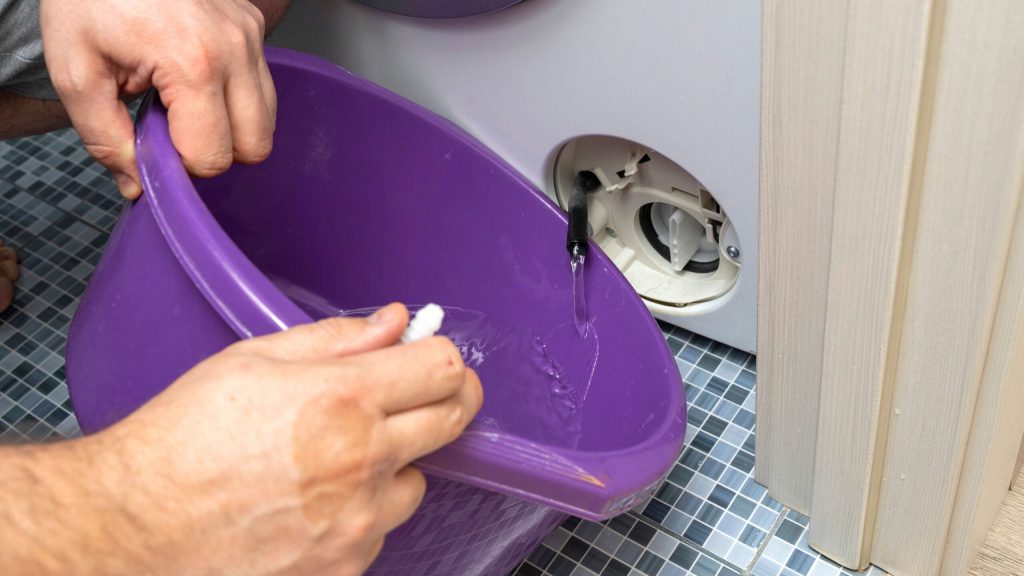

To drain a washing machine stuck full of water, unplug it first, then try four methods in order of ease: use the small drain tube next to the pump filter; pull the machine out and lower the drain hose into a bowl; scoop water from the drum (only if the door opens safely); or tilt the machine back and partly open the pump filter into a bowl. Never tip a washing machine on its side while it still contains water.
A washing machine stuck full of water needs to be drained before it can be repaired, moved, or replaced. Whitegoods Help covers four methods below in order of ease – start with Method 1 and work down the list only if needed. Read through all the options first so you know what to expect before you start.

A washing machine full of water presents an electrocution risk if the power is still connected. Pull the plug at the wall before doing any of the methods below. Never lay a washing machine on its side while there is water inside – water can seep onto electrical components and cause permanent damage or a safety hazard. Do not attempt any of these methods if the water inside is still hot from a cycle that was interrupted.

If the machine is empty but still will not drain properly when running, the problem is elsewhere. See our guide on what to do when a washing machine will not drain water.
What should you check before starting?
Two quick checks can save you a lot of work. If either applies, you may not need to drain the machine manually at all.
Has the machine gone completely dead?
If the machine stopped mid-cycle and is now unresponsive, it is worth checking whether a tripped fuse or circuit breaker is the cause. Getting it running again may let it pump the water out itself. See our guide on what to do when a washing machine will not start.
Has the machine just been plumbed in or moved?
If the machine has just been connected to a u-bend for the first time, or moved to a new property, there is a common and simple cause. U-bend connections have a blanked-off spigot that must be removed before a washing machine drain hose is fitted – if that blanking piece is still in place, the machine cannot pump out at all. See our guide on what to do if a washing machine will not drain after being moved.
Method 1: use the pump filter drain tube
This is the easiest method and should always be tried first. Most modern washing machines have a small drain tube next to the pump filter, designed specifically for this purpose.
-
Find the access flap. Look for a small flap or kick strip at the bottom front of the machine. Behind it you should find the pump filter – a circular cap that unscrews – and often a small drain tube nearby, sealed with a bung or clip.
-
Set up a shallow tray and towels. Place a shallow tray or several towels on the floor in front of the access panel. The tube releases water slowly but it will still spill.
-
Release the tube into the tray. Pull out the drain tube, remove the bung, and lower the end into your tray. Water will drain slowly by gravity.
-
Empty and repeat. Empty the tray as needed and repeat until the machine is empty. With a full drum this can take 10-20 trips.

There is likely a blockage – a sock, small garment, or debris is preventing flow through the pump area. Extreme patience may work eventually, but in most cases Method 2 or Method 4 is more practical. Move on rather than waiting an hour for nothing.
If your machine has no drain tube at all, or the trickle is too slow to be useful, proceed to Method 2. Our guide on where to find the washing machine pump filter covers what to look for on different models.
Method 2: lower the drain hose into a bowl
This is the most reliable method but requires pulling the machine out first – which is hard work when it is heavy with water and laundry. Our guide on the best way to pull a washing machine out covers safe technique.
-
Disconnect the drain hose at the back. Once the machine is far enough forward to reach the drain hose, disconnect it from wherever it currently connects – either a standpipe (just pull it out) or the u-bend under the sink (unscrew the connection).
-
Block the u-bend spigot. With the drain hose disconnected from the u-bend, anything poured down the sink will come straight out into the cupboard below. Block the u-bend spigot with a cloth, put the plug in the sink, or make sure nobody uses the sink until the hose is reconnected.
-
Free the hose from the cupboard. Pull the drain hose out from the cupboard if needed. If the hole in the cupboard side is too small for the hose fitting to pass through, remove the plastic spigot piece from the end of the hose to allow it through.
-
Lower the hose into a bowl. Lower the end of the drain hose into a washing-up bowl or large bucket placed on the floor, below the level of the machine. In most cases water will siphon out into the bowl on its own.
-
Empty repeatedly. Empty the bowl repeatedly until the machine is fully drained.
If lowering the hose produces nothing or only a slow trickle, a blockage inside the machine – typically a sock or small garment stuck in the pump or sump hose – is preventing flow. You will need to use one of the alternative methods below to get the bulk of the water out first before tackling the blockage. See also our guide for when there is no obvious blockage but the machine still will not drain.
Method 3: scoop or siphon water from the drum
This method does not fully empty the machine on its own, but it reduces the water level enough to make the machine lighter and easier to manoeuvre. It only works if the door can be opened safely while water is still present.
-

Check the water level first. If water is above the lip of the inner drum, do not open the door – water will flood straight out. Modern machines rarely have water that high, but check before proceeding. -
Do not force the door open. If the door interlock is still engaged after a power cut or fault, forcing it risks breaking the lock mechanism and creating a more expensive repair. -
Scoop or siphon out into a bowl. Use a jug or small bucket to scoop water out, or use a length of tube to siphon. This will remove water above the base of the drum. -
Expect water still left behind. There is more water below the visible drum level than you might expect. This method alone will not empty the machine – use it to reduce the weight before attempting Method 2 or Method 4.
Stuck on the diagnosis rather than the draining?
If you already know the machine has a drainage fault and you want it fixed rather than emptied yourself, our engineer network can diagnose and repair the underlying cause.
Method 4: drain directly through the pump filter (advanced)
This is a faster but messier alternative when the drain tube is absent or blocked and pulling the machine out is not practical. It works by tilting the machine back and partly opening the filter to let water pour directly into a bowl.
Do not attempt this alone, on laminate or wooden floors, or with hot water still inside the machine. Have plenty of towels ready before starting, and clear everything out from under the kitchen units in front of the machine.
-
Tilt the machine back. Pull the machine forward enough to be able to tilt it backwards – ideally leaning against the kitchen worktop behind it. The second person holds the machine steady throughout.
-
Position a sturdy bowl underneath. Place a large washing-up bowl directly underneath the pump filter access point. With the machine tilted back, the front – where the filter is – will be raised slightly, and the bowl can sit beneath it.
-
Open the filter very slowly. Begin to unscrew or open the filter cap a fraction at a time. Water will start to flow into the bowl. Control the flow by how far you open the filter.
-
Tighten between bowls. When the bowl is full, quickly tighten the filter back up. Empty the bowl. Repeat until the machine is drained.
If the filter cap comes fully off, or the machine tips forward, water will flood out very fast and you will not be able to stop it. Keep a firm grip on the cap, and make sure the second person has a secure hold on the machine at all times. If you are not confident you can do this safely, stop and book a qualified engineer instead.
What if the pump filter will not unscrew?
In some cases the pump filter appears jammed and will not turn. A common cause is a wire from an underwire bra, or another small metal object, that has worked itself into the filter mechanism and is physically blocking it from rotating.
If this happens, the main sump hose leading into the pump may need to be removed to retrieve the obstruction from the other side – which then frees the filter. This is not straightforward with a machine full of water, and in this situation booking an appliance repair engineer is usually the most practical option.
Frequently asked questions
What is the easiest way to drain a washing machine full of water?
The easiest method is using the small drain tube next to the pump filter, if your machine has one. It is located behind a small flap or kick strip at the bottom front of the machine. Unplug the machine, remove the bung from the tube, lower the tube into a tray, and let the water drain out slowly. If there is no drain tube, or it is blocked, the next best method is to pull the machine out and lower the drain hose into a bowl so the water can siphon out by gravity.
Can I lay the washing machine on its side to drain the water?
No. Never lay a washing machine on its side while it contains water. Water can seep into electrical components inside the machine and cause serious damage or a safety hazard. Always drain the water out completely using one of the methods in this guide before moving or tilting the machine significantly.
Why will water not come out of the drain hose when I lower it?
If no water siphons out when you lower the drain hose, there is almost certainly a blockage somewhere – typically a sock, small garment, or debris stuck in the pump or in the hose itself. You will need to try an alternative draining method, or retrieve the blockage from the pump filter or sump hose, before the machine can drain. See our guide for when there is no obvious blockage but the machine still will not drain.
The pump filter will not unscrew – what should I do?
A jammed pump filter is most often caused by an obstruction – commonly an underwire bra wire – lodged inside the filter mechanism. The pump can sometimes be accessed via the main sump hose to retrieve the obstruction from the other side, which then frees the filter. This is difficult to do with the machine still full of water – in that situation, booking a repair engineer is usually the most practical solution.
The machine went dead mid-cycle and is now full of water – where do I start?
First check whether the machine can be restarted – a blown fuse, tripped circuit breaker, or door interlock fault can cause a mid-cycle shutdown. If the machine can be restarted, it should pump the water out itself. If it remains dead or will not pump out, start with Method 1 in this guide. See also our guide on what to do when a washing machine will not start.
How long does it take to drain a washing machine manually?
Most methods take 15-30 minutes. Method 1 (drain tube) is the slowest because the tube releases water by gravity through a narrow bore – expect 20-30 minutes for a full drum. Method 2 (drain hose siphon) is the fastest when there is no blockage, often draining a full machine in 5-10 minutes. Method 4 (filter tilt) is fast but messier and depends on how carefully you control the flow.
Ask the repair forum
Post the make, model and symptoms and get help from the Whitegoods Help community.
13 Comments
Grouped into 7 comment threads.
0 replies Nice one Ann. Thanks for updating.
0 replies Hi Re my email above. I did it! Used a squirt of the silicon spray, the prong of a fork to insert between the end of the hose and the plastic connector which allowed me to stretch the end of the hose a bit, and some muscle power. I was just about to give up and cut the hose when it came free. But thanks for showing how to empty the machine and get my washing out of it.
Hi
Re my email above. I did it! Used a squirt of the silicon spray, the prong of a fork to insert between the end of the hose and the plastic connector which allowed me to stretch the end of the hose a bit, and some muscle power. I was just about to give up and cut the hose when it came free. But thanks for showing how to empty the machine and get my washing out of it.
1 reply Hi my old front loading Electra 1000 is stuck, full of water and a load of laundry, drum won't spin, door won't open. I've checked the fuse - it's OK, fanbelt seems to be okay. I've tried emptying the water but I can't seperate the end of the drain hose from the plastic connector that joins it to the sink drain. I undid the metal hose clamp but just can't pull the two ends apart - joined like this the hose end is too big to pull out through the hole in the sink unit so that I can lower it to ground level in order to drain the water. Is there an easy way the separate the two ends? I have some WD40 and some silicon spray - would that do the job? Once I get it emptied, from what I've read online, the next thing to check is the door lock? Thanks
Hi my old front loading Electra 1000 is stuck, full of water and a load of laundry, drum won’t spin, door won’t open. I’ve checked the fuse – it’s OK, fanbelt seems to be okay. I’ve tried emptying the water but I can’t seperate the end of the drain hose from the plastic connector that joins it to the sink drain. I undid the metal hose clamp but just can’t pull the two ends apart – joined like this the hose end is too big to pull out through the hole in the sink unit so that I can lower it to ground level in order to drain the water. Is there an easy way the separate the two ends? I have some WD40 and some silicon spray – would that do the job?
Once I get it emptied, from what I’ve read online, the next thing to check is the door lock?
Thanks
Likely replying to Ann
Hello Ann. If you can’t drain the washing machine through the drain hose my article lists several other ways to drain it although some can be messy. The cause of the washing machine going dead in the first place could be many things (including a door lock) so just changing the door lock is a gamble that could pay off or be a waste of time. All the possible causes of why the washing machine is dead are covered in one of the first links in this article under the heading, “If the washer went dead during the cycle”
0 replies Thanks for the advice Andy :) I'd never have even thought to pull machine out and lift, to get a bowl under it. I did just that and all seems to be well
Thanks for the advice Andy :) I’d never have even thought to pull machine out and lift, to get a bowl under it. I did just that and all seems to be well
1 reply Thanks so much for this advice Andy. My washer was stuck with loads òf water in it and I couldn't move it by myself so drained out using 2 of your methods. Didn't know what on earth to do until I found your article - so helpful! Thanks again Ange
Thanks so much for this advice Andy. My washer was stuck with loads òf water in it and I couldn’t move it by myself so drained out using 2 of your methods. Didn’t know what on earth to do until I found your article – so helpful! Thanks again Ange
3 replies Thank you very much for this advice Andy. In my case the machine had water sitting in it and would not spin. There was a kick cover on the front and then a black access port behind that, similar to one of your pics. I slightly raised the front of the machine on some timber and slid a tray in that caught the water in stages as I progressively unscrewed the port. I think a lot of water would go under the machine without the tray. The port screw was tight as the thread was partly gummed up with hard water inside so I used some pliers but was careful not to strain it as it is only plastic. Once the main port was able to be fully unscrewed it was basically obvious that hard water and fluff had blocked the pump impeller and port collector and stopped water pumping out. I removed enough stuff to fill about 2 egg cups. I gave it all a thorough clean, including the thread of the port and simply turned the machine back on and the F05 error code had self cancelled and all was well. Hotpoint - WMFG 1053 Thanks again, large family so washing machine failure is an immediate crisis.
Thank you very much for this advice Andy. In my case the machine had water sitting in it and would not spin. There was a kick cover on the front and then a black access port behind that, similar to one of your pics. I slightly raised the front of the machine on some timber and slid a tray in that caught the water in stages as I progressively unscrewed the port. I think a lot of water would go under the machine without the tray. The port screw was tight as the thread was partly gummed up with hard water inside so I used some pliers but was careful not to strain it as it is only plastic. Once the main port was able to be fully unscrewed it was basically obvious that hard water and fluff had blocked the pump impeller and port collector and stopped water pumping out. I removed enough stuff to fill about 2 egg cups.
I gave it all a thorough clean, including the thread of the port and simply turned the machine back on and the F05 error code had self cancelled and all was well. Hotpoint – WMFG 1053 Thanks again, large family so washing machine failure is an immediate crisis.
Likely replying to Andy Trigg (Whitegoodshelp)
Hello Andy
You say that it’s dangerous to put a washing machine on it’s side if it’s full of water. While it should be obvious that water would get into the electrics, would it be possible to just move the machine out and tip it slightly forward the open the door — My flat has a side door that opens out on to some stone steps leading to the garden —- and simply tip the machine forward and open the door?
Obviously this would break just about every Health and Safety rule in the book and require two fairly strong blokes to do this and the one at the bottom is going to get very wet feet if nothing else and the washing will have to be rewashed.
Equally obvious is the fact that as there is more water below the drum and this would need to come out also.
It would then be possible to lift the machine so that its front with the door open is facing the ground and then slightly lower the top so that any remaining water would also drain out through the door.
Your Sincerely. Steve.
Steve is the managing director of Bodge It and Scarper. ( Cowboy Mechanics to the Nobility and Gentry.
Likely replying to steve slater
Hello Steve. Yes, if none of the other methods of draining out the water work you could try to move the washing machine over to the back door. The first thing to try is to lower the drain hose outside so that it is several inches or more lower than the level of the pump. That can start off the siphoning very well. But as you point out, if the washing machine is full of water it may be very heavy. Not only might it be a job for 2 people, but a prime concern is that you do not damage the flooring. This is very easy to do with certain floorings. You might try putting a thick towel underneath the feet of the washing machine to help it slide if it cannot be lifted and carried.
If the water will not come out through the drain hose though then you could try opening the door but unless you are able to lean the washing machine completely over at 90° you’re not going to be able to drain out all of the water. A much easier option, is one that I mentioned in my article above under draining through the pump filter. That is the method that I have always used if the water wall not siphon out through the back of the drain hose. It will get most of the water out and is far less strenuous and difficult than trying to drag the washing machine over to the door.
Nice one Ann. Thanks for updating.