
Potential health risks from unused hot water tap

A disused hot water tap behind a washing machine can leave stagnant, lukewarm water trapped in the pipework, ideal conditions for Legionella bacteria to grow. The domestic risk is low, but it is easily eliminated by fitting a blanking cap to the unused tap or having the redundant pipework removed by a plumber.
Why does an old hot water tap create a health risk?
Temperature range in which Legionella bacteria multiply most rapidly
Almost all washing machines sold in the UK today use a single cold-water supply
A blanking cap on the unused hot tap costs very little and eliminates the risk
Decades ago, washing machines in the UK commonly used both a hot and a cold water supply. Homes were plumbed accordingly, with a dedicated hot tap installed alongside the cold one behind the machine.
Modern washing machines are cold-fill only. They draw cold water and heat it internally, so the hot tap is no longer connected or used. The problem is what happens inside the pipework when that tap sits idle.

Legionella pneumophila is a naturally occurring bacteria found in water. It multiplies rapidly in warm, stagnant water between 20°C and 45°C, and can cause Legionnaires’ disease – a potentially serious form of pneumonia – if contaminated water droplets or aerosols are inhaled. The UK Health Security Agency (UKHSA) and the HSE both identify stagnant pipework as a contributing risk factor.
A disused tap that remains connected to the hot water supply creates what plumbers call a dead leg – a section of pipe with no regular water flow. The water inside stagnates, settles at a lukewarm temperature, and creates the exact conditions in which Legionella can take hold.
How does the risk arise with a washing machine specifically?
The typical scenario is straightforward. A cold-fill washing machine is installed and connected to the cold tap. The old hot tap is turned off and forgotten. No one uses it, but it remains connected to the hot water system through a short section of pipe inside the wall.
That section of pipe never flushes. The water inside it sits at an intermediate temperature for weeks, months, or years. If the tap is ever accidentally opened during a house move, a repair visit, or a routine check, there is a risk of dispersing bacteria into the air.
| Scenario | Risk level | Why |
|---|---|---|
| Hot tap in regular use, water flowing freely | Very low | Regular flow prevents stagnation |
| Hot tap turned off but still connected to supply | Low to moderate | Dead-leg pipework can harbour bacteria over time |
| Hot tap capped off with a blanking cap | Very low | No pathway for stagnant water or aerosol dispersal |
| Redundant pipework fully removed by a plumber | Eliminated | No dead-leg pipework remaining |
How serious is the risk in a domestic home?
It is important to keep this in perspective. Legionnaires’ disease is predominantly associated with large, complex water systems – cooling towers, hotel plumbing, hospital water supplies, and commercial buildings. The HSE acknowledges that the risk in a typical private home is low.
A single disused domestic tap does not carry the same risk as a commercial water system. However, the risk is not zero, and the fix is simple enough that there is no good reason to leave it unaddressed.
Water systems in domestic premises present a low Legionella risk, provided basic precautions are taken. Flushing out infrequently used outlets regularly is a straightforward and effective control measure.
Health and Safety Executive (HSE), Legionella Guidance for Domestic Premises
Older adults, smokers, people with weakened immune systems, and those with chronic lung conditions are more susceptible to Legionnaires’ disease. If anyone in the household falls into one of these groups, acting promptly is particularly advisable.
What should you do about an old hot water tap?
There are two practical solutions depending on your situation and budget. Both are far preferable to simply leaving the tap turned off and forgotten.
 Option 1: Fit a blanking cap
A blanking cap screws or pushes onto the tap outlet, sealing it completely. This prevents the tap from being accidentally opened and removes any risk of aerosol dispersal. Blanking caps are inexpensive and the job takes minutes. See our guide: how to blank off the tap.
 Option 2: Remove the pipework
A qualified plumber can isolate and remove the redundant hot water pipework entirely. This eliminates any dead-leg pipe inside the wall and is the definitive, permanent fix, especially recommended if the pipework runs any significant distance. See our washing machine installation guide for installation context.
Need a hand with your washing machine?
If you are not confident working around your plumbing or water supply, a qualified engineer can help. Book a repair visit or find the parts you need using the links below.
What if my machine is already connected to cold only?
If your washing machine is connected solely to the cold tap, which is the case for almost all modern machines, then the hot tap behind the machine is entirely redundant. Simply having it turned off is not sufficient.

Cap off the old hot tap using a blanking cap, or ask a plumber to remove the pipework. See our guide on converting a hot-and-cold fill machine to cold-only supply for full details on managing this transition.
Does it matter if the hot tap is still being used?
If your washing machine is actively using the hot water supply, as some older twin-fill machines do, then water flows through the tap with every wash cycle. Regular flow significantly reduces the risk of stagnation and bacterial growth.
That said, very few washing machines sold in the UK today use a hot fill. Check the back of your machine: cold-fill-only models have a single inlet hose connection. Twin-fill machines have two, one marked hot, one marked cold.
Can you connect a cold-fill machine to the hot tap?
Some people wonder whether feeding a cold-fill machine with hot water could improve washing performance or reduce energy consumption. Whitegoods Help does not recommend this.
 Why it is a bad idea
- Cold-fill machines are calibrated to heat water from cold – feeding them hot water disrupts temperature sensing
- It can cause wash performance problems and damage internal components
- It may invalidate your manufacturer’s warranty
What to do instead
- Connect the machine to the cold water supply only
- Cap off or have a plumber remove the old hot tap
- Let the machine manage water heating as designed
For a full explanation, read our guide: can you connect a cold-fill washing machine to the hot tap?
What should you check behind your washing machine?
Not sure what you have? Follow these steps to assess the situation quickly.
-
Pull out the machine slightly and look at the water connections at the rear. Count the number of inlet hoses – one means cold-fill only, two means hot-and-cold fill.
-
Locate all taps on the wall. If there are two taps (one cold, one hot) but only one hose connected to the machine, the hot tap is redundant.
-
Check whether the hot tap is open or closed. If open but unconnected, close it immediately. Either way, it should be capped off.
-
Fit a blanking cap to the hot tap outlet, or contact a plumber to remove the dead-leg pipework entirely. See our guide to blanking off the hot tap for full instructions.

Any work involving your home’s hot water pipework should be carried out by a qualified plumber. Do not attempt to cut or modify pipework yourself unless you are fully competent to do so. If you have broader concerns about Legionella risk in your water system, particularly in larger or older properties, contact a water hygiene specialist. The HSE provides free Legionella guidance for domestic properties, including landlord responsibilities. Landlords have a legal duty of care under the Health and Safety at Work Act 1974 to assess and control Legionella risks.
Related guides
Frequently asked questions about old hot water taps and Legionella
Can a washing machine cause Legionnaires’ disease?
A washing machine itself is not a source of Legionella. The risk comes from stagnant water sitting in a disused hot water tap or dead-leg pipe that remains connected to the hot supply behind the machine. If that water is disturbed and aerosolised, there is a theoretical inhalation risk. In practice, domestic risk is considered low, but capping off unused hot taps removes it entirely.
What is a dead leg in plumbing?
A dead leg is a section of pipe connected to the water supply with no regular flow through it. Water stagnates inside, and if the pipe is part of the hot water system, it can settle at temperatures between 20°C and 45°C, the ideal range for Legionella bacteria to multiply. Dead legs are a recognised risk factor in both commercial and domestic water systems.
How do I know if my washing machine uses hot and cold fill?
Check the back of your machine. A cold-fill-only machine has a single inlet hose connection, usually marked with a blue label or the word “cold”. A hot-and-cold-fill machine has two connections, one for hot, one for cold. The vast majority of washing machines sold in the UK since the early 1990s are cold-fill only.
Is it safe to just turn off the old hot tap and leave it?
Turning the tap off is better than leaving it open, but it does not fully resolve the issue. The section of pipe between the closed tap and the main hot water supply can still hold stagnant water. Fitting a blanking cap to the tap outlet, or having the pipework removed, is the proper fix.
Can I connect my cold-fill machine to the hot tap to save energy?
This is not recommended. Cold-fill machines are designed and calibrated to heat water from cold. Feeding them a hot water supply can interfere with temperature sensing, compromise wash performance, damage internal components, and may invalidate the manufacturer’s warranty. Connect cold-fill machines to the cold supply only.
Who is responsible for Legionella risk in a rented property?
Landlords have a legal duty of care under the Health and Safety at Work Act 1974 and the associated Approved Code of Practice (L8) to assess and control Legionella risks in rental properties. This includes identifying and addressing dead-leg pipework. Tenants who suspect a risk should report it to their landlord in writing. The HSE’s guidance covers landlord responsibilities in full.
Can I just flush the hot tap occasionally instead of capping it off?
Flushing infrequently used outlets is a recognised control measure cited in HSE guidance, and is a reasonable interim approach if capping is not yet practical. Run the hot tap fully open for one to two minutes at least once a week to flush out any standing water and prevent stagnation. However, this only works if you remember to do it consistently, and the fundamental dead-leg pipework remains in place. Fitting a blanking cap or having the pipework removed is a more reliable long-term solution, particularly if anyone in the household is in a higher-risk group.
Broken Door Glass Photos
This page collects photographic evidence of shattered washing machine door glass submitted by readers, alongside a breakdown of 122 reported incidents by brand. Reports have come in steadily since 2008. In around a quarter of cases, the glass shattered spontaneously while the machine was switched off and not in use. For the underlying causes, consumer rights, and what to do if this happens to you, see the main exploding door glass guide.
Read the main article: washing machine exploding door glass.
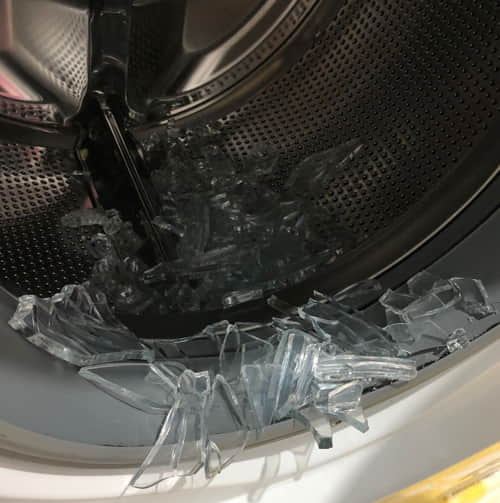
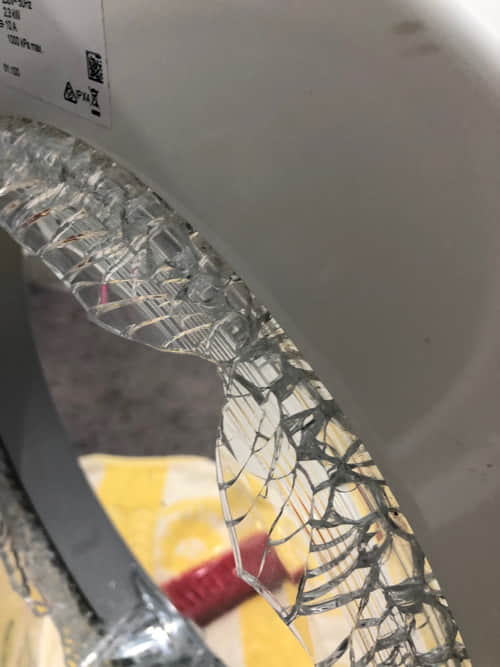
Photographic evidence: shattered door glass
The photos below were submitted by readers who experienced washing machine door glass shattering. The majority of incidents occurred while the machine was running, most commonly during the spin cycle. However, a significant number of reports involved glass that shattered spontaneously while the machine was switched off and not in use, in some cases having not been used for several days.



Which brands are affected?
The table below shows the breakdown of shattered door glass incidents reported to Whitegoods Help. The total covers reports received via comments on the original door glass article from 2008, and reports submitted directly from December 2014 onwards.

Including 30 cases where the washing machine was not in use at the time. Some machines had not been used for several days before the glass shattered spontaneously.
The rate of new reports has slowed considerably since the initial peak around 2008 to 2009 and has been a slow trickle in recent years, suggesting this issue is not getting worse over time.
| Brand | Total incidents | Of which: machine not in use |
|---|---|---|
| Beko | 45 | 8 |
| Miele | 14 | 5 |
| LG | 9 | 5 |
| Bosch | 8 | 3 |
| Hotpoint | 8 | 0 |
| Samsung | 6 | 3 |
| Hoover | 5 | 1 |
| Indesit | 5 | 0 |
| Zanussi | 5 | 1 |
| Candy | 2 | 0 |
| Electrolux | 2 | 2 |
| John Lewis brand (made by Zanussi) | 2 | 0 |
| Whirlpool | 2 | 0 |
| AEG | 2 | 1 |
| Brand not specified | 2 | 0 |
| Baumatic | 1 | 0 |
| Haier | 1 | 0 |
| Ignis | 1 | 0 |
| Logik | 1 | 1 |
| Tricity Bendix | 1 | 0 |
| Total | 122 | 30 |
These figures represent only incidents reported directly to Whitegoods Help via article comments and email, not all incidents that have occurred. Beko’s high count should be read in the context of their very large market share in the UK during the period covered. The data does not allow any reliable comparison of risk between brands. For a discussion of causes and context, see the main article: washing machine exploding door glass.
What should you do if your door glass shatters?
Shattered washing machine door glass can produce very sharp shards and dagger-shaped pieces. Wear sturdy shoes and protective gloves before clearing up. Vacuum or sweep thoroughly to catch tiny fragments, paying particular attention to areas where children or pets might walk. Do not handle bare glass. If glass has entered the drum, check the drum, door seal, and sump area thoroughly before next use to prevent damage to the machine or laundry.
The main exploding door glass guide covers the causes, who is responsible under consumer law, how to claim, and whether the door can be safely repaired or the machine should be replaced.
Has your door glass shattered?
Read the main guide for advice on causes, responsibility, and your consumer rights. A repair engineer can assess whether the door glass and frame can be safely replaced.
Frequently asked questions about the door glass data
Does this data show that one brand is more dangerous than another?
No. The figures reflect incidents reported to Whitegoods Help via comments and email submissions, not the underlying rate of failure across all sold machines. Beko’s higher count needs to be read in the context of their very large UK market share over the period covered – a brand that sells many more machines will accumulate more reports even if its actual failure rate is the same or lower than smaller brands. This data does not support any reliable comparison of risk between manufacturers, and should not be used to make brand-specific safety claims.
How common is washing machine door glass shattering?
It is uncommon as a proportion of machines sold, but not so rare as to be a freak event. The 122 incidents reported to Whitegoods Help over the period covered are a small fraction of UK washing machine sales, but well above the rate that would be expected from a properly designed and manufactured component. Tempered safety glass is widely used in domestic products and very rarely fails when correctly specified. The clustering of these incidents across multiple brands suggests the issue is real but exact rates per brand are not publicly available.
Why do some machines shatter while not in use?
30 of the 122 reports (around one in four) involved machines that were switched off, with some not used for several days before the glass spontaneously shattered. This pattern is consistent with delayed tempered-glass failure caused by microscopic damage or a nickel sulphide inclusion in the glass – a known mechanism in toughened safety glass where internal stress and tiny impurities cause failure long after manufacture, sometimes years later. The main exploding door glass guide covers the causes in more detail.
Is the door glass on washing machines safety glass?
Yes. Washing machine door glass is required to be toughened (tempered) safety glass, which breaks into many small relatively blunt pieces rather than large dagger-shaped shards when shattered. However, the photographic evidence shows that some of these failures produce larger and sharper fragments than the safety standard would predict, including the dagger-shaped shards seen in several submitted photos. This is one of the reasons the issue has been a recurring concern for affected users.
Is the data still being collected?
Yes, Whitegoods Help continues to log incidents as they are reported. The rate of new reports has slowed considerably since the 2008 to 2009 peak, which may reflect improvements in door glass manufacturing, changes in consumer reporting habits, or a genuine reduction in the underlying rate. If your washing machine door glass has shattered, you can contribute to the data by reporting it through the main article.
Can the door glass be replaced on its own?
It depends on the model. On some machines the door glass is fitted into a frame that can be split, allowing the glass alone to be replaced. On many modern machines, the door glass and frame are supplied only as a complete sealed unit and must be replaced together, which costs significantly more. Your retailer or manufacturer should advise on availability for your specific model. If the failure occurred within a reasonable lifetime for the appliance, the Consumer Rights Act 2015 may apply.
LG Direct Drive safety notice
LG issued an advisory safety notice in 2020 for certain 8kg 6 Motion Direct Drive washing machines. Under specific circumstances, water can leak onto the chrome badge or decal, potentially causing it to become live and deliver an electric shock. If you have one of the affected models, contact LG to arrange a resolution.
In certain circumstances, water ingress can cause the chrome decal on affected LG washing machines to become live. LG describes the risk as a “mild electric shock” and states that affected machines are safe to continue using, but recommends owners contact them. If you have an affected model, check your model number below and contact LG.
Which Models Are Affected?
The advisory applies to 8kg LG 6 Motion Direct Drive washing machines. The following model number prefixes are affected:
- 405KW***####
- 412KW***####
- 501PW***####
- 510PW***####
- 404KW***####
- 510KW***#####
Check the model number label on your machine – usually found inside the door opening or on the back of the appliance – and compare it against the prefixes listed above.
What to Do
-
Locate the model number on your LG washing machine and check whether it matches one of the affected prefixes listed above.
-
Contact LG directly to report the issue and arrange a resolution. The dedicated helpline number set up for this advisory was 0344 847 5454, available Monday to Saturday, 9am to 6pm.
-
If the helpline number is no longer active, contact LG via their official website. Safety notice helplines are often only operational for a limited period.
The number 0344 847 5454 was set up specifically for this advisory notice and may no longer be in operation. If you cannot reach it, contact LG through their main website for current contact details.
At the time this advisory was reported, the notice did not appear to be prominently listed on LG’s own website. If you are having difficulty finding information about this issue through LG’s website, contact their customer service team directly and refer to the 8kg 6 Motion Direct Drive electric shock advisory from 2020.
More appliance safety notices
Some Hotpoint & Indesit washing machines have electric shock risk
Hotpoint and Indesit issued an official safety notice regarding an electric shock risk on certain washing machines manufactured between 2007 and 2009. The issue was brought to light by BBC Watchdog. As these are now older machines, many will have already been identified and dealt with – but if you own a Hotpoint or Indesit washing machine from this period, it is worth checking whether yours is affected.
Certain Hotpoint and Indesit washing machines manufactured between 2007 and 2009 are subject to an official safety notice due to a risk of electric shock. No specific model numbers are listed in the notice – the absence of model numbers may indicate that all Hotpoint and Indesit washing machines manufactured in this period could potentially be affected.
Background
The issue was initially raised by BBC Watchdog. At that stage, Hotpoint and Indesit conducted a risk assessment under the General Product Safety Regulations and classified the risk as “very low” – concluding that no direct consumer notification was required at that time.
The manufacturers subsequently revised their position and issued a formal safety notice. They also stated that they had identified a way to reduce the risk from “very low” to “extremely low”. The safety notice does not give specific details of how an electric shock could be received.
Hotpoint described the electric shock risk as very small. However, any confirmed electric shock risk on a household appliance warrants checking, particularly as the modification to reduce the risk is available through the manufacturer.
Is Your Washing Machine Affected?
If you own a Hotpoint or Indesit washing machine that may have been manufactured between 2007 and 2009, check whether it is affected using the manufacturer’s own checker and follow their instructions if it is.
Visit the Hotpoint safety notice page to check your model: check your Hotpoint or Indesit appliance on the Hotpoint website. If the page is no longer available, contact Hotpoint directly via their main website.
More appliance safety notices
Haier and Bush washing machine Safety Notice
Certain Bush and Haier washing machines sold through Argos have been recalled due to a fire risk. If you own one of the models listed below, stop using it immediately and contact the recall helpline on 0800 888 6124.
This safety notice covers a potential fire risk in certain Bush and Haier washing machines sold exclusively through Argos. An electronic component in the control panel may overheat and in certain circumstances presents a risk of fire.
According to Argos, a defective electronic component in the control panel “can lead to localised damage and present a risk of fire.” If you own one of the affected models, stop using it and contact the recall helpline immediately.
Bush Washing Machine Models Affected
- BUSH WM 1270TVE (White) and BUSH WM 1270TVEME (Silver)
- BUSH DIHWD1270TVE (White) and BUSH DIHWD1270TVEME (Silver)
- BUSH WM1470TVE (White) and BUSH WM1470TVEME (Silver)
- BUSH DIHWD1470TVE (White) and BUSH DIHWD1470TVEME (Silver)
Haier Washing Machine Models Affected
- HAIER HWD1470TVE (White) and HAIER HWD1470TVEME (Silver)
- HAIER HWD1270TVE (White) and HAIER HWD1270TVEME (Silver)
- HAIER 1470TVE (White) and HAIER 1470TVEME (Silver)
Phone: 0800 888 6124
Email: modifications@0800repair.com
Washing machine safety notices – Washing machine safety issues and warnings
Is It Safe to Leave a Washing Machine On?
Leaving a washing machine, tumble dryer, or dishwasher running while you are out or asleep is a low-probability but high-consequence risk. White goods appliances are involved in over 1,000 accidental fires in England every year. The recommendation is to run these appliances only when someone is in the house and awake, in a position to hear a smoke alarm or smell burning. You do not need to watch them, but someone needs to be there.
Official UK fire safety guidance recommends not leaving white goods appliances running unattended. This does not mean sitting and watching every cycle, but it does mean having someone in the house who can respond to a smoke alarm or smell burning.
Washing machines, tumble dryers, and dishwashers are involved in house fires every year in the UK. Although this question is most commonly asked about washing machines, the same risks apply equally to tumble dryers and dishwashers, and this guide covers all three. Future dedicated guides for each appliance type are planned. For now, this is the real risk, what the most current statistics show, the specific advice for each appliance, and how to make an informed decision rather than simply hoping for the best.
The Real Risk: What the Current Statistics Show
Appliance fires are not as rare as most people assume. According to Electrical Safety First, 1,140 accidental electrical fires involving common household white goods, such as tumble dryers and washing machines, occurred across England in the year to 2025, the equivalent of three fires every single day. This figure covers England alone and does not include the rest of the UK.
 Washing machines and tumble dryers
Among the most common sources of accidental electrical fires in UK homes. Fires can result from electrical faults in the machine, overheating components, lint accumulation around heating elements in tumble dryers, or faults in the wiring and plug. Modern machines have better thermal protection than older ones, but are not immune from fire risk.
 Dishwashers
Less commonly discussed but also a documented source of appliance fires. Heating elements, pumps, and wiring are all potential fault sources. The same principle applies: a dishwasher running while the house is empty or everyone is asleep carries the same response-time problem as any other appliance.
 Fridges and freezers
These run 24 hours a day and cannot practically be switched off. However, a significant proportion of fridge and freezer fires are linked to blocked air vents at the rear of the appliance, where dust and lint accumulate over time. Pull fridges and freezers out periodically and clean the rear panels and vents. Check for relevant safety notices: fridge and freezer safety notices.
 Floods and leaks
Fire is the most serious risk, but large leaks are a significant secondary concern. A washing machine with a failed hose or seal running unattended can flood a room before anyone responds. Some leaks can run continuously until the water supply is turned off. Water damage from an unattended appliance leak can be both extensive and expensive.
The figure of 1,140 accidental white goods fires per year in England is sourced from Electrical Safety First’s Electrical Fire Safety Week 2025 campaign, published in 2025. This is the most current publicly available figure from a nationally recognised electrical safety body. The Home Office publishes annual detailed fire statistics for England (most recently for April 2024 to March 2025, published August 2025), which provide the underlying data. For the most detailed breakdown, see the Home Office detailed analysis of fires, England, April 2024 to March 2025.
For historical comparison, the former Electricity Safety Council reported 22 deaths and 2,500 injuries from appliance electrical fires in 2012, with washing machines and tumble dryers identified as the second most common cause of electrical fires in UK homes at that time. The current Electrical Safety First figures indicate the problem remains substantial over a decade later.
The nature of the risk matters as much as its scale. A fire starting in a machine you are watching can be caught quickly, as the first-hand account below demonstrates. A fire starting in a machine running overnight, or while the house is empty, has hours to develop before anyone responds. The same fault that produces a contained incident in a supervised home can burn a house down in an unsupervised one.
A Real Account: Why Being Present Changes the Outcome
The following account was shared by a Whitegoods Help reader and illustrates exactly why the presence of someone in the house changes the outcome of an appliance fire:
“My Indesit tumble dryer caught fire from the rear of the appliance within a couple of minutes of being started. Within a couple of minutes I could smell smoke. I dashed back to the machine where there was very slow grey smoke coming from around the sides of the dryer. I quickly pulled the laundry out and could see flames through the rear of the drum, approximately 7 to 10 inches high and clearly well alight. Because I caught the fire straight away, the flames hadn’t even damaged a plastic panel located above the motor compartment.
I think it’s important to mention: I was about to go out in my car as soon as I started the machine. There were four family members upstairs in bed when this incident occurred. I was genuinely having palpitations with the thought of what could have happened. The machine was around 5 years old and had been serviced just one month ago.”
Whitegoods Help reader, dryer fire account
This account makes the risk concrete. The machine had been recently serviced. The fire started within minutes. Being present made the difference between a contained incident and a potentially fatal house fire with four sleeping occupants. The same fault, one hour later with the house empty or everyone asleep, would have been a very different outcome.
Specific Advice for Each Appliance Type
Washing machines
Washing machines are among the most common sources of accidental electrical fires in UK homes. Electrical faults in the motor, wiring, PCB, or heating element are the most frequent causes, alongside flooding from failed hoses or door seals. Running a washing machine overnight or while the house is empty is not advisable. If you must use a delay start feature, set it to complete as close to when someone will be awake and present as possible.
Tumble dryers
Tumble dryers carry a higher fire risk than washing machines, primarily because of the combination of continuous heat and the lint they accumulate. Lint around or on the heating element is a significant fire accelerant. There has also been a large-scale recall programme in the UK for certain tumble dryer models from major brands, covering machines manufactured within specific date ranges. Check whether your machine is subject to a current recall before using it unattended.
Do not stop a tumble dryer mid-cycle and leave the laundry inside. In some circumstances, hot laundry left in a stopped drum can reach a temperature sufficient to ignite. If you need to stop the dryer to go out or to bed, cancel the cycle properly rather than simply switching it off mid-run. Read the full explanation: why you should not stop a tumble dryer mid-cycle.
Dishwashers
Dishwashers are often left running overnight because the cycle is long and the noise is unwelcome while the household is awake. The same fire and flood risks apply. If the dishwasher must run while the household is asleep, ensure smoke alarms are fitted nearby and that the machine is not subject to any current safety notice or recall.
Is It Safe to Use Delay Start?
The presence of a delay start feature on a machine does not mean the manufacturer endorses unsupervised overnight operation. Manufacturers include the feature because it is useful and commercially desirable, not because it removes the fire and flood risk. Cases of appliance fires and floods occurring during delay-start cycles are documented.
If you use delay start, set the cycle to complete as close as possible to when someone will be awake and in the house. A cycle finishing at 6am when the household rises at 6:30am is a considerably more manageable risk than a cycle running from midnight through to 2am.
Economy 7 Tariffs and Running Appliances Overnight
Economy 7 tariffs offer cheaper electricity during off-peak overnight hours, making running appliances at night financially attractive. Against this saving needs to be weighed the increased risk associated with unsupervised overnight operation. For most households, the electricity saving from running one or two appliance cycles during off-peak hours is relatively modest. It is worth calculating the actual saving before deciding whether it justifies the overnight risk.
If you do use Economy 7 for appliance cycles, set the cycle to run as late in the off-peak window as possible, so the machine finishes closer to when the household wakes up and someone is available to respond if needed. Read our full analysis: Economy 7 tariffs and white goods appliances.
Do Modern Appliances Have Better Safety Protection?
Yes, to a meaningful degree. Most modern appliances are controlled by software built into the main PCB. These machines typically have thermal protection that aborts the cycle if overheating is detected. They will time out and display error codes if filling, draining, or heating takes too long. Washing machines can abort the spin if the load is dangerously unbalanced.
However, these protections do not cover all failure modes. A flooding leak from a failed inlet hose, a fire starting from an electrical fault in the wiring or plug rather than the main PCB, or a dryer fire caused by lint ignition around the heating element, are all scenarios that onboard protection cannot prevent or detect in time. The protections reduce certain risks but do not eliminate the case for supervised operation.
Practical Steps to Reduce the Risk
-
Run appliances only when someone is in the house. The key protection against an appliance fire is a person who can hear a smoke alarm or smell burning and respond quickly. You do not need to watch the machine, but someone needs to be present. -
Fit a smoke alarm near your washing machine, tumble dryer, and dishwasher. Standard cooking-sensitive alarms are unsuitable in kitchens due to false alarms from cooking. Optical alarms, which are less sensitive to cooking fumes, are a better choice near appliances. Test any alarm regularly to confirm it is working. -
Clean the tumble dryer lint filter after every cycle. A blocked lint filter restricts airflow, causes overheating, and concentrates flammable material near the heating element. This is the single most important maintenance action for reducing tumble dryer fire risk. -
Pull fridges and freezers out periodically and clean the rear. A significant proportion of fridge and freezer fires are linked to dust and fluff accumulation blocking rear ventilation. Clean behind these appliances every six to twelve months. -
Check whether your appliance is subject to a recall or safety notice. Several major appliance recalls have been issued in the UK, including for large numbers of tumble dryers. Check the UK government’s product recall list: Trading Standards product recalls and safety notices. Also check: Whitegoods Help appliance safety notices. -
If using delay start, set it to finish as close to waking time as possible. Do not use delay start to run appliances through the middle of the night with the household asleep and no one able to respond. -
Turn off the water supply taps after using the washing machine. A machine that develops a leak while the supply is on can flood continuously until someone turns off the water. Turning off the inlet taps after each use eliminates this risk entirely. Read our guide: should you turn off the taps after using the washing machine?
More Safety Guides
How dangerous are our appliances?A frank look at the fire, flood, and injury risks from domestic white goods, what the statistics show, and how to put the risk in realistic perspective.
 8 ways to make your appliances safer
Practical steps every household can take to reduce the risk of fire, flood, and injury from washing machines, dryers, dishwashers, and fridges.
Why you should not stop a tumble dryer mid-cycleThe specific risk of stopping a tumble dryer part-way through a cycle and leaving laundry inside, and why cancelling the cycle properly matters.
 Washing machine door glass danger
Why washing machine door glass sometimes shatters unexpectedly, how common it is, and what to do if it happens.
 Extension leads and white goods appliances
Why using extension leads with washing machines, dryers, and dishwashers carries genuine fire risk, and the rules if one must be used.
 Appliance safety hub
All Whitegoods Help safety guides in one place, including fire risks, electric shock, manufacturer recalls, and safe appliance use.
Is your appliance safe to use?
If your appliance has been recalled, is making unusual noises, or has shown any signs of overheating, do not leave it running unattended.
Frequently Asked Questions
Is it safe to leave a washing machine on when you go out?
It is not recommended. According to Electrical Safety First, 1,140 accidental electrical fires involving white goods occurred in England in the year to 2025, the equivalent of three per day. A fire starting in an empty house has far longer to develop before anyone responds. Official UK fire safety guidance recommends having someone in the house when these appliances are running. Source: Electrical Safety First, Electrical Fire Safety Week 2025.
Is it safe to run a washing machine overnight?
The same risks apply as leaving one running while you are out, with the additional consideration that sleeping occupants are less likely to respond quickly to a smoke alarm or the smell of burning. If you use a delay start or Economy 7 tariff to run the machine overnight, set the cycle to finish as close to when the household wakes as possible rather than running through the middle of the night.
How many house fires are caused by white goods each year in the UK?
According to Electrical Safety First’s 2025 campaign data, 1,140 accidental electrical fires involving white goods such as washing machines and tumble dryers occurred across England in the year to 2025, the equivalent of three fires per day. This figure covers England only. The Home Office publishes detailed fire statistics annually through its official statistics programme, with the most recent release covering April 2024 to March 2025, published August 2025. Source: Electrical Safety First, 2025; Home Office fire statistics, 2025.
Are tumble dryers more dangerous than washing machines to leave running?
Yes, generally. Tumble dryers carry a higher fire risk because of the combination of continuous heat and the lint they accumulate. Lint around the heating element is a significant fire accelerant. Additionally, there have been large-scale tumble dryer recalls in the UK affecting specific brands and model years. Never leave a tumble dryer running when the house is empty or everyone is asleep, and never stop one mid-cycle without cancelling the programme properly first.
Is it safe to use the delay start feature on a washing machine or dishwasher?
The delay start feature does not remove the fire and flood risk. Manufacturers include it for convenience, not because it makes unsupervised operation safe. If you use delay start, set the cycle to complete as close to when someone will be awake and present as possible, and ensure smoke alarms are fitted nearby.
Do modern appliances have better fire protection than older ones?
Partially. Most modern appliances have PCB-controlled thermal protection that can abort cycles if overheating is detected, and they will display error codes if filling, draining, or heating takes too long. However, these protections do not cover all failure modes. Wiring faults, hose failures, and lint fires are not reliably prevented by onboard protection. Modern machines reduce certain risks but do not eliminate the argument for supervised operation.
Should I turn off the taps and socket when the washing machine is not in use?
Turning off the water supply taps after each use is good practice. A developing leak cannot flood continuously with the supply off. Turning off the wall socket when the machine is not in use is also beneficial where the socket is easily accessible, removing the small risk of an electrical fault in the standby circuit. Read our guide: should you turn off the taps after using the washing machine?