
Exploding Door Glass – Who’s Fault Is It?
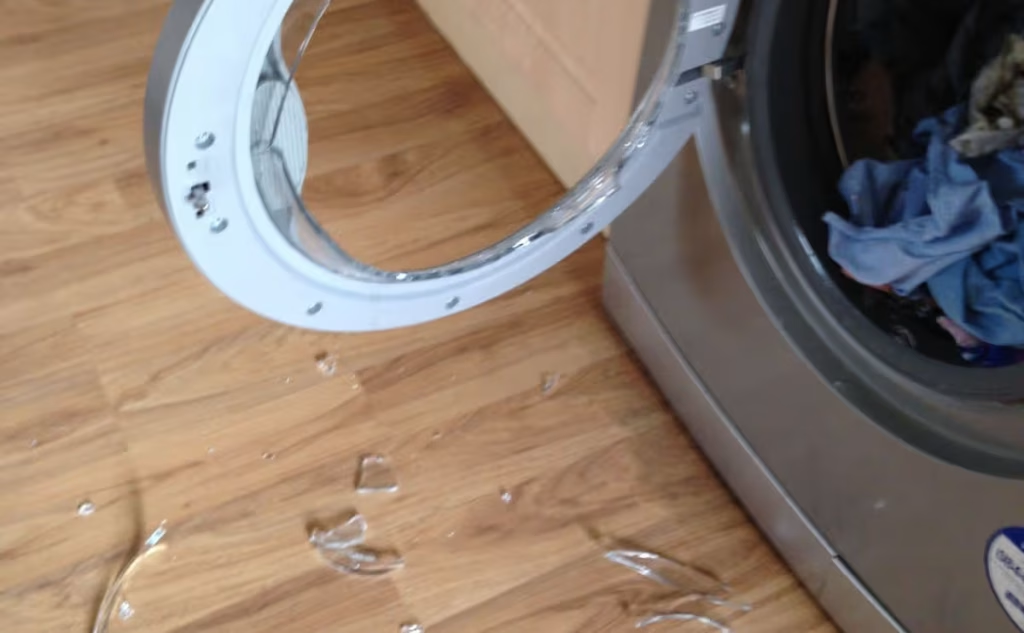

Responsibility for a shattered washing machine door glass is genuinely difficult to establish – for either party. Manufacturers routinely attribute the failure to misuse by the user, but this explanation does not account for all cases, particularly when glass shatters hours after a cycle has finished. The Consumer Rights Act 2015 may provide a route to a remedy, especially if the machine is relatively new. Your strongest position is to document everything, challenge the manufacturer’s explanation in writing, and understand what they need to prove before they can lawfully refuse your claim.
When a washing machine door glass shatters, the manufacturer almost always blames the user. But the reality is considerably more complicated – and in many cases, the consumer has a stronger position than they realise. Here is a clear analysis of where responsibility lies and what you can do about it.

This article provides general guidance only and does not constitute legal advice. For your specific circumstances, contact Citizens Advice or a legal professional. For first steps after a glass failure, see our guide: washing machine door glass shattering – how real is the risk?
What Manufacturers Typically Say – and Why It Does Not Always Hold
When a consumer reports a shattered door glass, the standard manufacturer response is consistent: the glass was damaged by a foreign object in the drum, the machine was overloaded, or the user was washing items incorrectly. These explanations are offered whether or not there is any evidence to support them.
This response is understandable from a commercial perspective – accepting responsibility for a glass failure would expose manufacturers to significant liability across potentially thousands of incidents. But as an explanation it has serious weaknesses.
 The manufacturer’s typical claim
The glass was damaged by a coin, key, or metal object in the drum. Or the machine was overloaded. Or the user washed items with zips or buckles incorrectly. The failure is attributed to misuse – removing any manufacturer liability.
 Why this explanation is often inadequate
Glass frequently shatters hours after a cycle has finished – when the machine is not in use and no impact is possible. Experienced appliance engineers rarely saw this problem with older machines, despite routine overloading and foreign objects. Something has changed in how glass is made or specified.
If a manufacturer claims the glass was damaged by misuse, they need to be able to demonstrate that. They cannot simply assert misuse without evidence – particularly when the failure occurred when the machine was switched off and not in use.
Has Something Changed With Modern Door Glass?
The pattern of door glass failures has changed noticeably over time. Engineers with decades of experience in appliance repair report that washing machine door glass simply did not shatter like this in previous generations of machines – despite those machines being routinely overloaded and having foreign objects left in drums.
Older machines used thick, conventional glass
Earlier washing machine door glass was typically thick and conventional – it could crack under significant impact, but it did not shatter spontaneously. Replacing a door glass was rare in decades of appliance repair, and when it did occur, the cause was always an obvious unusual incident such as something heavy dropped onto an open door.
Modern machines use toughened (tempered) glass
Contemporary washing machine door glass is almost universally toughened (tempered) – the same type used in shower enclosures, oven doors, and double-glazed units. Toughened glass is manufactured under internal tension. When it breaks, it releases that stored energy simultaneously, shattering into multiple fragments rather than cracking progressively.
Toughened glass can fail without obvious cause
A well-documented property of toughened glass is that it can fail spontaneously – hours, days, or even weeks after the initial damage or stress that caused it to weaken. The same phenomenon is documented in oven doors, shower enclosures, and conservatory roof panels. It is inherent to the material and is not unique to washing machines.
Manufacturing flaws can cause failure with no external cause
Research into toughened glass failures documents that manufacturing defects – including impurities in the glass and errors in the tempering process – can cause spontaneous failure that cannot be attributed to any external force or user action. This is a known and accepted cause of failure in the glass industry, even if appliance manufacturers are reluctant to acknowledge it.
Do Manufacturers Have a Duty of Care?
A legitimate question in this context is whether appliance manufacturers have a legal or moral obligation to design against foreseeable misuse – not just ideal use.
Consider that washing machines already incorporate safety-by-design features that prevent injury from foreseeable behaviour:
- Door locks during spin – the door cannot be opened while the drum is rotating at speed, preventing injury from contact with a spinning drum
- Overload protection – many machines detect out-of-balance loads and reduce spin speed to limit vibration
- Thermal cutouts – protect against overheating of motors and heating elements
These features demonstrate that manufacturers already accept the principle of designing against foreseeable misuse and failure modes. The question is why the same principle has not been consistently applied to door glass – either by using more robust glass, adding a protective outer layer, or providing clear warnings about the risk of glass failure from specific causes.
The manufacturer’s argument
Users are responsible for loading machines correctly, not leaving foreign objects in pockets, and following the instruction manual. If misuse causes damage, that is the user’s responsibility – not the manufacturer’s design obligation.
The consumer’s counter-argument
Manufacturers know that overloading and foreign objects are common in real-world use. If a foreseeable user behaviour – even if technically incorrect – creates a risk of shattering glass that can injure people or pets, the design should prevent that outcome rather than simply excluding liability.
Your Legal Position Under the Consumer Rights Act
Regardless of the moral arguments, your practical options depend on your legal rights. The Consumer Rights Act 2015 provides a framework that is more useful than many consumers realise in this situation.
 Within 30 days
You have an absolute right to a full refund if the appliance is not of satisfactory quality. A door glass shattering within 30 days is almost certainly a valid claim – the retailer cannot reasonably argue the product met the required standard.
Within 6 monthsThe fault is presumed to be inherent unless the retailer can prove otherwise. This is a significant advantage – the burden of proof lies with the retailer to demonstrate misuse, not with you to prove a defect.
After 6 monthsThe burden shifts to you to demonstrate an inherent fault. An independent engineer’s report or evidence that the glass failed without any impact (e.g. the machine was switched off) strengthens your position considerably.
 Key principle
Under the Consumer Rights Act, goods must be of satisfactory quality – which includes safety. Glass that shatters dangerously, potentially injuring people or pets, may not meet this standard regardless of the cause of failure.
For a full explanation of your rights, see our guide: Consumer Rights Act and faulty appliances. Note that your claim is always with the retailer, not the manufacturer – even if the manufacturer’s engineer visits to assess the machine.
What You Can and Cannot Prove – and Why That Matters
The central difficulty with door glass failures is that – in most cases – neither party can definitively prove what caused the glass to fail. This is actually more useful to you as a consumer than it might appear.
| Claim | Who must prove it | Difficulty |
|---|---|---|
| “The glass failed due to a manufacturing defect” | Consumer (after 6 months) | Difficult – requires specialist glass analysis |
| “The glass failed due to user misuse” | Manufacturer / retailer | Also difficult – especially if machine was not in use when glass failed |
| “The glass shattered spontaneously without external cause” | Both parties face difficulty | This is a documented property of toughened glass – hard for either side to exclude |
| “The product is not of satisfactory quality” (within 6 months) | Retailer must disprove | Strongest position for consumer – burden on retailer |

A manufacturer who blames misuse needs to be able to substantiate that claim. If you can demonstrate you used the machine normally – no foreign objects, no unusual overloading, and particularly if the glass failed when the machine was not in use – ask them directly: what specific evidence do they have that the failure was caused by your actions?
What to Do After a Door Glass Failure – Step by Step
-
Photograph everything immediately – the broken glass, the machine interior and exterior, the drum contents, and the surrounding area. Do this before clearing anything. This is your evidence, and it cannot be recreated later.
-
Note the circumstances precisely – was the machine running? Had it recently finished a cycle? Was it completely idle? How long had it been since the last wash? Write this down immediately while it is fresh.
-
Contact the retailer – not the manufacturer. Your legal rights under the Consumer Rights Act are with the retailer who sold you the machine. State clearly that the appliance has failed in a way that is not consistent with satisfactory quality and that you are making a formal claim.
-
Do not accept “it’s out of guarantee” as a final answer. The manufacturer’s guarantee is separate from your statutory rights. The Consumer Rights Act applies for up to six years – a guarantee expiring does not end your rights. See our guide: out of guarantee does not mean out of rights.
-
Challenge the manufacturer’s explanation in writing. If they claim misuse, ask them specifically: what evidence demonstrates that this failure was caused by misuse rather than a spontaneous failure of toughened glass – which is a documented and known phenomenon? Put this question in writing. Their response – or lack of it – is informative.
-
Consider an independent engineer’s report if the claim is disputed and the machine is worth pursuing. A written report confirming that there is no evidence of foreign object damage or abnormal drum wear strengthens your position, particularly for claims after six months.
-
Escalate if the retailer refuses a valid claim. Contact Citizens Advice, use an alternative dispute resolution service, or pursue the claim through the small claims court. A formal letter before action resolves many disputes before court proceedings begin. See our guide: claiming compensation from a retailer.
What Manufacturers Should Do – but Often Don’t
If manufacturers genuinely believe that misuse is a significant cause of door glass failure, the appropriate response is a clear, prominent warning in the instruction manual and on the machine itself – something along the lines of:
“Warning: Overloading the drum, leaving coins, keys, or hard metal objects in pockets, or washing items with exposed metal components may damage the door glass and cause it to shatter. Toughened glass can fail without warning. Keep children and pets away from the machine during operation.”
The absence of such a warning is itself relevant. If a manufacturer knows that foreseeable user behaviour can cause the glass to shatter – and that shattering can cause injury – the failure to warn users of that risk is a significant omission. It also undermines the argument that misuse by the user is solely responsible, since users were never informed of the risk.
Frequently Asked Questions
The manufacturer is blaming me for the glass breaking – what should I do?
Do not simply accept this. Ask them in writing what specific evidence they have that the failure was caused by your actions rather than a spontaneous failure of toughened glass – which is a documented phenomenon. If the machine is within six months of purchase, the burden of proof lies with the retailer to demonstrate misuse, not with you to prove a defect. Document everything, put your claim in writing to the retailer, and be prepared to escalate if needed. See our guide: Consumer Rights Act and faulty appliances.
The glass shattered when the machine was switched off – how can it be my fault?
This is a strong position for you. Spontaneous failure of toughened glass – occurring when the machine is not in use – is particularly difficult for a manufacturer to attribute to misuse. They cannot claim overloading or foreign objects caused an impact if no wash cycle was running. Document the circumstances precisely – time since last use, whether any wash cycle had just completed, and how long the machine had been idle. This detail significantly strengthens your position.
Am I entitled to a replacement machine or a refund?
Potentially, yes – particularly if the machine is relatively new. Under the Consumer Rights Act, goods must be of satisfactory quality, which includes safety. Glass shattering unexpectedly – especially with a risk of injury – may not meet this standard. Within 30 days you have a right to a full refund. Within six months, the retailer must prove misuse rather than you proving a defect. After six months, an independent report demonstrating no evidence of misuse strengthens your claim. Your remedy is from the retailer – not the manufacturer.
Can I claim if the machine is out of its guarantee?
Yes – the manufacturer’s guarantee and your statutory rights under the Consumer Rights Act are completely separate. A guarantee expiring does not remove your right to claim against the retailer. You have up to six years (five in Scotland) to bring a claim. The difficulty increases over time as you will need to demonstrate an inherent fault, but the right exists. See our guide: out of guarantee does not mean out of rights.
What should I photograph after the glass breaks?
Photograph the broken glass – both inside the machine and on the surrounding floor. Photograph the drum interior showing what was in it at the time (or that it was empty). Photograph the door frame and seal. Photograph any visible damage to the machine exterior. Take wide shots showing the context and close-ups of the glass fragments. Do all of this before clearing anything. This evidence cannot be recreated and is essential if you need to dispute the manufacturer’s explanation.
Where can I see photos of other people’s broken door glass?
Whitegoods Help has collected reader-submitted photographs of shattered door glass across many brands, along with a running tally of reported incidents. See: broken door glass photos and brand tally.
Has your washing machine door glass shattered?
Read our main guide on the risk and causes first, then see the photo gallery for real-world examples across different brands.
Ask the repair forum
Post the make, model and symptoms and get help from the Whitegoods Help community.
20 Comments
Grouped into 11 comment threads.
1 reply My sia washing machine door have completely cracked.the machine was not in use.I did not overload it the last time I used it.There are NO metal objects.I bought it in March 25 I have had it for less than 5months.I was told I was not covered by the warranty.Can anyone help me please.Is it worth contacting tue omnibus man.
0 replies I have just had my beko washing machine door explode on me my machine is only 18 months old
I have just had my beko washing machine door explode on me my machine is only 18 months old
0 replies Hi our Beco washing machine door has just broken. Luckily we were all out at the time and the washer machine wasn’t in use. We inherited the washer machine with the house we think it was purchased 2019 but no receipt or insurance on the machine. Just wondering what it can be very scary to home to have a load of broken glass on the floor.
Hi our Beco washing machine door has just broken.
Luckily we were all out at the time and the washer machine wasn’t in use.
We inherited the washer machine with the house we think it was purchased 2019 but no receipt or insurance on the machine.
Just wondering what it can be very scary to home to have a load of broken glass on the floor.
2 replies My machine glass door shattered this morning. A John Lewis machine; at least 11 years old, no insurance. No metal objects and not overloaded. The man who fitted it showed me how full to fill it. It was very scary and glass shards and tiny crumbs over the washing which I will need to discard. I use a laundry egg; surely this can’t be the problem? It would have been tested. Annie
My machine glass door shattered this morning. A John Lewis machine; at least 11 years old, no insurance. No metal objects and not overloaded. The man who fitted it showed me how full to fill it. It was very scary and glass shards and tiny crumbs over the washing which I will need to discard. I use a laundry egg; surely this can’t be the problem? It would have been tested. Annie
0 replies Our Beko WTB941R4W washing machine had the glass explode out. Purchased in 2019. We were sat watching TV and heard the sound of glass shattering, thinking someone was trying to break into our utility room window we jumped up only to find the large sharp pieces of glass on the floor. We checked our cameras in the room to find that 2 hours after the washer has finished a 30° wash. The glass had just exploded out without warning. Reading a lot of articles on the matter the blame is often placed on the customer for miss using the washer, in our case I have some heavy duty work trousers that have some large metal buttons that on occasion get caught in between the seal and the glass which has caused a mark on the glass. We have yet to contact Beko regarding the incident, but I have a feeling we will be to blame for this incident in some as often seems the case. let see what they have to say.
Our Beko WTB941R4W washing machine had the glass explode out. Purchased in 2019.
We were sat watching TV and heard the sound of glass shattering, thinking someone was trying to break into our utility room window we jumped up only to find the large sharp pieces of glass on the floor.
We checked our cameras in the room to find that 2 hours after the washer has finished a 30° wash. The glass had just exploded out without warning.
Reading a lot of articles on the matter the blame is often placed on the customer for miss using the washer, in our case I have some heavy duty work trousers that have some large metal buttons that on occasion get caught in between the seal and the glass which has caused a mark on the glass.
We have yet to contact Beko regarding the incident, but I have a feeling we will be to blame for this incident in some as often seems the case.
let see what they have to say.
1 reply ELECTROUX EFLS617STT0 Purchased 2016 Glass in door just exploded. It sent shards of glass into and out of spinning drum. Almost got my arm cut multiple times trying to reach the power button to turn the machine off. It happened the moment I walked into the utility room, so i saw it happen. What a dangerous mess. We had to trash some clothes that were torn to shreads. Load was not overloaded or underloaded. Same load size as always.and no metal objects. Probably lost $300 in clothes. Electrolux basically asked if anyone was hurt or other property damage. Husband took door off to remove the glass still remaining in the door. It had exposed glass with sharp knawrled edges waiting to cut anyone walking by. Took about 4 hours of cleanup in the utility room and inside the drum. I'm afraid to leave the house now with a front loader machine running for fear it will destroy itself while running. This was not tempered glass because it came apart with multiple glass shards. I was almost sliced several times and could have been killed trying to turn off the machine with glass flying in the room. The picture above on this webpage is a good example of what I experienced except I had a little less glass remaining in the door.
ELECTROUX EFLS617STT0
Purchased 2016
Glass in door just exploded. It sent shards of glass into and out of spinning drum. Almost got my arm cut multiple times trying to reach the power button to turn the machine off. It happened the moment I walked into the utility room, so i saw it happen. What a dangerous mess. We had to trash some clothes that were torn to shreads. Load was not overloaded or underloaded. Same load size as always.and no metal objects. Probably lost $300 in clothes. Electrolux basically asked if anyone was hurt or other property damage. Husband took door off to remove the glass still remaining in the door. It had exposed glass with sharp knawrled edges waiting to cut anyone walking by. Took about 4 hours of cleanup in the utility room and inside the drum. I’m afraid to leave the house now with a front loader machine running for fear it will destroy itself while running. This was not tempered glass because it came apart with multiple glass shards. I was almost sliced several times and could have been killed trying to turn off the machine with glass flying in the room. The picture above on this webpage is a good example of what I experienced except I had a little less glass remaining in the door.
Hello Julie. Unfortunately, my article and experience is only relating to UK washing machines. I have no idea what real differences there are in washing machines in say the US or other faraway places :)
However, your description strongly implies that safety glass is not present. Is it a very old washing machine by any chance?
1 reply I bought my Hotpoint Washing machine in 2019 and tonight after 4 years of use the glass door has exploded! Nothing sharp or coins where in with the laundry so it seems obvious that it must be a manufacturers fault. My last washer/dryer lasted me 10 years so very disappointed to learn that this seems to be an ongoing issue for many. Tomorrow I will be ringing up Hotpoint to see what they have to say as mine does not seem to be listed on the list of those that have been recalled.
I bought my Hotpoint Washing machine in 2019 and tonight after 4 years of use the glass door has exploded! Nothing sharp or coins where in with the laundry so it seems obvious that it must be a manufacturers fault. My last washer/dryer lasted me 10 years so very disappointed to learn that this seems to be an ongoing issue for many. Tomorrow I will be ringing up Hotpoint to see what they have to say as mine does not seem to be listed on the list of those that have been recalled.
1 reply Today our hoover tumble dryer's door glass was not on and had not been on in over week hear loud bang and the glass was in two bits
1 reply I have a brand new lg washtower in a vacation home that had just finished a remodel. We walked into the laundry room after being gone 3 weeks and there were large shards of glass on the floor. The internal glass had shattered. Two unwashed towels were in the washer. Just absolutely bizarre. LG has been great (thru Costco support) and is replacing the glass for us.
I have a brand new lg washtower in a vacation home that had just finished a remodel. We walked into the laundry room after being gone 3 weeks and there were large shards of glass on the floor. The internal glass had shattered. Two unwashed towels were in the washer. Just absolutely bizarre. LG has been great (thru Costco support) and is replacing the glass for us.
LG DLEX4000B glass on the inside of the dryer door shattered. A large bedspread and no metal objects. It just doesn’t make sense. I know people shopping for a dryer will not look here for potential problems so I am going to repost on a few shopper sites. I think people should be warned about he poor designs.
If my washer’s door gasket had not failed earlier I probably would not be so upset. The door gasket isn’t on the door so it would be out of the way when putting clothes into or pulling them out. NO, they put the gasket where you have to drag the clothing across the surface of the gasket with each load. CRAZY design.
1 reply The glass on our Beko WTL104121W washing machine unexpectedly broke this evening while not in use. Came as a surprise while sat in living room too hear an almighty crash and too see the washer glass on the floor when entering the kitchen. The machine is only 4 months old
The glass on our Beko WTL104121W washing machine unexpectedly broke this evening while not in use. Came as a surprise while sat in living room too hear an almighty crash and too see the washer glass on the floor when entering the kitchen. The machine is only 4 months old
Likely replying to Colin McGlone
Hello Colin. I’ve started getting more recent reports like yours after a long period of hearing nothing. I can’t be sure if it’s because the issue disappeared and has comeback, or whether it’s just something as simple as the presence of my articles on Google going up and down.
I haven’t had this problem myself, but I’ve had a very similar issue when, all of a sudden, one of the large conservatory roof glass panels at my house suddenly did exactly the same. Just out of nowhere, the internal panel of the double glazed unit just spontaneously shattered.
I did a bit of research about it and found that it is one of the potential issues with this type of glass. It is made with a built-in tension inside the glass so that if it breaks, the whole thing goes at once and should break into small harmless pieces. The conservatory company tried to tell me that I’d have to pay for a new one, but I insisted that it must’ve been a fault in manufacture, or installation. They ended up installing a new one for me for free.
The washing machine manufacturers seem to be holding a similar line. I don’t know if anything has changed, but in the early days they just blamed the customer, saying they must have overloaded the washing machine or washed something with a metal buckle etc.
Leave a comment
1 reply Our washing machine beko glass door exploded this was during the usual rinse cycle this was four weeks ago they finally sent out a engineer who condemned the machine and now beko say due to us having good insurance to replace the machine they cannot help us. We lost a lot of washing due to small Chards of glass all over the clothing and we have 3 children thank God none were near the machine. This is a pure machine faulty as agreed by the engineer so surely beko should give some recompense.
Our washing machine beko glass door exploded this was during the usual rinse cycle this was four weeks ago they finally sent out a engineer who condemned the machine and now beko say due to us having good insurance to replace the machine they cannot help us. We lost a lot of washing due to small Chards of glass all over the clothing and we have 3 children thank God none were near the machine. This is a pure machine faulty as agreed by the engineer so surely beko should give some recompense.
Likely replying to Jason shaw
Hello Jason. If they have conceded it’s a fault then yes you ought to be able to claim for damaged laundry too. I don’t know what insurance they are talking about. If it’s an extended warranty and it’s covered it’s not so bad, but you shouldn’t have to claim on house insurance. House insurance would only reclaim from them anyway and put your policy renewal up.
My sia washing machine door have completely cracked.the machine was not in use.I did not overload it the last time I used it.There are NO metal objects.I bought it in March 25 I have had it for less than 5months.I was told I was not covered by the warranty.Can anyone help me please.Is it worth contacting tue omnibus man.
Hi. I’m afraid the full answer is in the article.