
How to get faulty washing machine exchanged

Under the Consumer Rights Act 2015, you are entitled to a full refund if a washing machine develops a genuine fault within the first 30 days. After 30 days, the retailer can offer a repair or replacement instead. Faults within the first 6 months are legally presumed to have been present when the appliance was sold, which significantly strengthens your position. These rights apply to the retailer, not the manufacturer.
Getting a faulty appliance exchanged can feel like a fight – but knowing exactly what the Consumer Rights Act 2015 entitles you to, and how retailers are likely to respond, makes the process considerably less stressful. This guide covers UK consumer rights only.
Your Right to a Refund Within 30 Days
The Consumer Rights Act 2015 gives consumers a clear short-term right: if a new appliance develops a genuine fault within the first 30 days of purchase, you are entitled to a full refund if that is what you want. You do not have to accept a repair or replacement during this period – you can simply reject the goods and get your money back.
Some major retailers operate their own 28 or 30-day exchange policies as a commercial decision. These are separate from your legal rights and do not reduce them. If a retailer offers an exchange under their own policy, that is fine – but your statutory right to a refund exists regardless of any retailer policy.
Before Demanding an Exchange: Is It Actually Faulty?
Before pursuing any complaint, it is worth making sure the problem is a genuine appliance fault rather than an installation error or user issue. A significant proportion of calls to new appliances in the first week turn out to be caused by installation mistakes or settings the user is unfamiliar with – not defects in the machine.
This matters because if an engineer attends and finds the fault is not with the appliance, you may be charged for the visit. See our guide on is the washing machine actually faulty? for a checklist of common non-faults before contacting the retailer.

No retailer will exchange an appliance on the basis of a customer report alone. They are entitled to have a fault confirmed by an engineer before taking any action. This is reasonable – the same list of common non-faults is the reason why.
After 30 Days: Repair, Replacement, or Refund?
Once the 30-day short-term right has passed, the Consumer Rights Act 2015 still protects you – but the remedies available change. The retailer now has the right to attempt a repair or offer a replacement before a refund is required. A full refund at this stage is only owed if a repair or replacement is not possible, takes too long, or causes significant inconvenience.
Before instinctively demanding an exchange, consider whether the fault genuinely warrants it. A minor fault that can be fixed quickly – a faulty door seal, a blocked filter, or a simple component – is not necessarily grounds for a full rejection, and the hassle of arranging an exchange may exceed the inconvenience of a straightforward repair. A retailer can also argue that replacing the appliance is disproportionately expensive compared to the cost of a repair, which gives them grounds to insist on repair first.
Faults Within the First 6 Months
One of the most important provisions in the Consumer Rights Act 2015 is the 6-month presumption. Any fault that appears within the first 6 months of purchase is legally presumed to have been present when the appliance was sold – an inherent fault – unless the retailer can prove otherwise. The burden of proof sits with the retailer, not the consumer.
This significantly strengthens your position if a substantial fault develops before the 6-month mark. After 6 months, the presumption reverses – you would need to demonstrate that the fault is inherent, which is considerably harder.
 Within 30 days
Right to a full refund if the appliance is genuinely faulty. Retailer cannot insist on repair or replacement during this period.
 30 days to 6 months
Fault is presumed inherent. Retailer can offer repair or replacement first, but must prove the fault was not present at sale if they dispute your claim.
 6 months to 6 years
You may still have a claim, but the presumption no longer applies. You would need to demonstrate the fault is inherent or that the appliance has not lasted a reasonable time.
 Out of guarantee
Being outside the manufacturer’s guarantee does not end your statutory rights. You may still be entitled to a repair or compensation depending on the circumstances.
Should You Complain to the Manufacturer?
Under UK consumer law, your legal rights sit with the retailer – the party you bought the appliance from – not the manufacturer. The manufacturer has an obligation to honour the guarantee that came with the product, but they have no legal obligation to exchange a faulty appliance or return your money, since you paid the retailer, not them.
Some manufacturers will nonetheless get involved voluntarily and offer to exchange or repair an appliance. If they offer something acceptable, there is no reason not to take it. But if they cannot or will not resolve the issue, return to the retailer – that is where your enforceable rights lie. For more on this, see our guide on who is responsible for faulty appliances.
Why Retailers Are So Reluctant to Exchange
Retailers face a difficult position under consumer law. They are responsible for goods sold by a supply chain they do not fully control, and they must often absorb the cost of faults that originated with the manufacturer. Understanding this helps explain why they are cautious about agreeing exchanges without engineering confirmation. For a fuller picture of the retailer’s position, see our guide on whether the Consumer Rights Act is too hard on retailers.
Out of Guarantee – You May Still Have Rights
Once a manufacturer’s guarantee expires, retailers will routinely tell you that you have no rights and must pay for any repair. This is not always correct. The Consumer Rights Act 2015 allows up to 6 years from purchase to take legal action in England, Wales, and Northern Ireland (5 years in Scotland). Being out of guarantee is not the same as being out of legal rights.
However, having 6 years to claim does not mean every breakdown within that period entitles you to compensation. Your entitlement depends on all the circumstances – cost, usage, the nature of the fault, and whether a reasonable person would consider the appliance to have lasted long enough. See our guides on being out of guarantee but still covered and the Consumer Rights Act and faulty appliances for more detail.
Bought Online? Additional Rights Apply
If you bought your appliance online or by mail order, you have additional rights under the Consumer Contracts Regulations 2013. These give you the right to cancel and return goods within 14 days of receipt for any reason – not just because of a fault. See our guide on distance selling regulations for appliances for more information.
Need the Appliance Repaired While the Dispute Is Resolved?
If you need the machine working in the meantime, Whitegoods Help can connect you with a vetted repair company.
Related Guides
The Consumer Rights Act and Faulty AppliancesA full explanation of what the 6-year limitation period means – and what it does not automatically entitle you to.
Out of Guarantee? You May Still Be CoveredWhy the manufacturer’s guarantee expiring does not necessarily mean you have no rights or recourse.
 Manufacturer or Retailer: Who Is Responsible?
Who holds the legal obligation when an appliance develops a fault and who you should direct your complaint to.
 Claiming Compensation From a Retailer
Practical steps for making a formal complaint and pursuing a claim when a retailer refuses to help.
Frequently Asked Questions
Am I entitled to a replacement if my washing machine breaks down shortly after purchase?
Within the first 30 days of purchase, you are entitled to a full refund under the Consumer Rights Act 2015 if the appliance is genuinely faulty. After 30 days, the retailer can offer a repair or replacement first. A replacement is more likely the sooner after purchase the fault occurs – retailers become increasingly reluctant to offer an exchange the longer you have had the appliance.
Can the retailer make me accept a repair instead of an exchange?
After the first 30 days, yes – the retailer can insist on attempting a repair before agreeing to a replacement or refund. They can also argue that replacing the appliance is disproportionately expensive compared to the cost of a repair. However, if a repair fails or cannot be completed in a reasonable time, your right to a refund or replacement is restored.
What does the 6-month presumption mean?
Any fault that appears within the first 6 months of purchase is legally presumed to have been present when the appliance was sold. The retailer must prove the fault was not inherent if they want to dispute your claim. After 6 months, the presumption reverses – you would need to demonstrate the fault was inherent or that the appliance failed unreasonably soon.
Should I contact the manufacturer or the retailer about a faulty appliance?
Your legal rights sit with the retailer. The manufacturer is only obligated to honour the guarantee that came with the product. Contacting the manufacturer first can sometimes resolve things quickly and voluntarily, but if they cannot help, your enforceable rights are against the retailer – not the manufacturer.
Does the 6-year limitation period mean I can claim any time my appliance breaks down?
No. The 6-year period is the window within which you can take legal action – it does not mean every breakdown within that time entitles you to compensation. Your entitlement depends on the cost of the appliance, how it has been used, the nature of the fault, and whether the appliance has lasted a reasonable time given all the circumstances.
Do I have extra rights if I bought the appliance online?
Yes. Purchases made online or by mail order are covered by the Consumer Contracts Regulations 2013, which give you the right to cancel and return goods within 14 calendar days of receipt for any reason – not just because of a fault. This is separate from and in addition to your rights under the Consumer Rights Act 2015.
167 Comments
Grouped into 87 comment threads.
1 reply We bought a Hotpoint washing machine in Jan 2025 after a couple of months it developed an intermittent fault where water leaked under machine Hot point sent engineer but he said he could not find fault but leak is happening nearly every wash now another engineer is coming tomorrow if he cannot find fault what are my options
1 reply Hi I bought a candy i'smart washing machine in November 2022 so not even 6 months old, everything was fine until last month when the drum was banging around, rubber seal had come away, blue arc inside the drum. Long story short, I had the door, circuit and motor replaced as the engineer said it was a known fault, worked fine for a week and then another fault. It didn't spin or rinse and was on the last minute for 20 minutes and then an error code appeared on the panel E08, called Candy who said it the was motor and an engineer would be out to 'fix' again. The first engineer who came said they know about these faults and just keep sending engineers out to fix. Can I insist they replace or am I stuck with a washing machine known to be faulty. Thanks Lisa
Hi I bought a candy i’smart washing machine in November 2022 so not even 6 months old, everything was fine until last month when the drum was banging around, rubber seal had come away, blue arc inside the drum. Long story short, I had the door, circuit and motor replaced as the engineer said it was a known fault, worked fine for a week and then another fault. It didn’t spin or rinse and was on the last minute for 20 minutes and then an error code appeared on the panel E08, called Candy who said it the was motor and an engineer would be out to ‘fix’ again. The first engineer who came said they know about these faults and just keep sending engineers out to fix. Can I insist they replace or am I stuck with a washing machine known to be faulty.
Thanks Lisa
Hello Lisa. Read my article consumer rights act and white goods for further understanding of our consumer rights. In this article it states that if the washing machine is less than six months old, then it is up to the retailer to prove to you that there isn’t an inherent fault. It sounds like this would be very difficult for them to do, especially with the comments from the engineer. They could just say that they can’t accept hearsay as if he hasn’t written it down, which is very unlikely, then you have no proof that he actually said that.
I would go back to the retailer and complain that it has had two major faults within six months, and that the engineer has said it is a known problem, and you require a replacement or refund under the consumer rights act 2015. If they don’t accept this, tell them that as the washing machine is less than six months old when these faults happened, they need to prove that these faults were not present when they sold it to you.
1 reply I purchased a Whirlpool Top Load Washer back in August 2020 at Lowe’s in Baytown Texas and also purchased 3 yr. Protection Plan. Since this date, I have consistently had service reports for same problem (water pump & control panel goes out) for which the LPP. The last service incident was 11/25/2022 and the repairman ruled “non-repairable” due to history and submitted for replacement. However, LPP insisted that once again these parts be replaced! I have since sent emails to both Lowe’s and Whirlpool to no avail. Today, the same problem occurred once again and I had to call for service. Once again they claim I’m not eligible for replacement. Any advice?
I purchased a Whirlpool Top Load Washer back in August 2020 at Lowe’s in Baytown Texas and also purchased 3 yr. Protection Plan. Since this date, I have consistently had service reports for same problem (water pump & control panel goes out) for which the LPP. The last service incident was 11/25/2022 and the repairman ruled “non-repairable” due to history and submitted for replacement. However, LPP insisted that once again these parts be replaced! I have since sent emails to both Lowe’s and Whirlpool to no avail. Today, the same problem occurred once again and I had to call for service. Once again they claim I’m not eligible for replacement. Any advice?
0 replies HI bought a washing machine in november 2022, its now just about 3 months later and there is smoke coming from the machine. Hotpoint sent out an engineer today who checked it and said it needs a new drum and a new door seal because theres a twist?? in the drum but i want it replaced not repaired because if its broke (with smoke) within 3 months what else could be wrong with this one. Currys is saying no way get it repaired not our problem its past 30 days get lost. The man we spoke to was rather rude about it. How would you advise going about getting a replacement rather than a repair. We have the engineer report stating the problem, the smoke and the age of the machine. what do we say to currys to get them to listen that it has been sold to us as faulty so its on them to replace not repair
HI bought a washing machine in november 2022, its now just about 3 months later and there is smoke coming from the machine. Hotpoint sent out an engineer today who checked it and said it needs a new drum and a new door seal because theres a twist?? in the drum but i want it replaced not repaired because if its broke (with smoke) within 3 months what else could be wrong with this one. Currys is saying no way get it repaired not our problem its past 30 days get lost. The man we spoke to was rather rude about it. How would you advise going about getting a replacement rather than a repair. We have the engineer report stating the problem, the smoke and the age of the machine. what do we say to currys to get them to listen that it has been sold to us as faulty so its on them to replace not repair
1 reply I bought candy washerdryer on 15/1/23 it is now not working can I ask for replacement from currys
I bought candy washerdryer on 15/1/23 it is now not working can I ask for replacement from currys
Hello Susan. Within the first 30 days, we can usually ask for a full refund. After 30 days, and up to 6 months we may still be entitled to a refund or exchanged washing machine, but this would depend on what the fault is. It’s not likely, or arguably even reasonable, to expect a retailer to replace a washing machine that may be just had a loose wire, for example.
However, no retailer is going to replace anything until the manufacturer’s engineer has been out to establish exactly what the problem is. So if the engineer confirms that there is a fault on the washing machine, you would need to decide what to do. Supposing they found a small fault, and said they can fix it in 10 minutes. For me, it would not make any sense to refuse the repair and then try and fight for replacement.
But if they said there is a fault, and they have to order the part, which could take a couple of weeks or so, then that may be a lot less acceptable. Or if they found that a major fault had occurred, that may also be less acceptable. The main thing to bear in mind though is that the manufacturer is not going to replace the appliance. They will only offer to repair it. If it does get replaced under the consumer rights act 2015, it would have to be by the retailer. Who tend to be very reluctant to do so.
If you accepted a repair, and then something else went wrong shortly after, you would have a much stronger case to have it replaced. Especially if the same fault occurred. They are normally only entitled to one repair attempt.
1 reply Hi, I bought a Hisense washing machine on 10/01/2023 ...since then I've had problems including overheating, door leak, crumpled washing plus the programmes taking longer than they should, ie its adding between 10 and 15 minutes to each programme. The retailer has insisted I report this to the manufacturer which I did - the engineer failed to turn up for the appointment on Monday 13th - wasnt notified and no reason given. Next appointment is Monday 20th which will be 2 weeks after my initial report. These faults were reported to both the retailer and manufacturer within 30 days of purchase.
Hi, I bought a Hisense washing machine on 10/01/2023 …since then I’ve had problems including overheating, door leak, crumpled washing plus the programmes taking longer than they should, ie its adding between 10 and 15 minutes to each programme. The retailer has insisted I report this to the manufacturer which I did – the engineer failed to turn up for the appointment on Monday 13th – wasnt notified and no reason given. Next appointment is Monday 20th which will be 2 weeks after my initial report. These faults were reported to both the retailer and manufacturer within 30 days of purchase.
Hello Ann. I wouldn’t expect wash times being 10 to 15 minutes longer to be caused by any fault. Wash times are always estimates, and can be affected by various factors such as the temperature of the water coming in, and how long it takes to balance the laundry properly before spins. So, for example, I would expect wash times to be longer in winter when the cold water going into the machine is much colder to start.
But if there are faults on the washing machine within the first 30 days, most retailers will replace it as long as it is confirmed there are faults. At the moment I think it’s very unlikely a retailer would replace the washing machine with an engineer being booked. You may need to wait and see what the engineer says is wrong with it before deciding whether to try and get it replaced. If it is something fairly serious it is likely to be easier to get it replaced and if it’s something relatively simple.
1 reply My candy washer is 10 months old still under guarantee. An engineer came out and the drum needed replaced I gave them the model number and its been 4 weeks the engineer came back out to change the drum and they have sent the wrong size now I'm out of pocket and still no washer. I have asked for a replacement but they are delaying this what can I do?
My candy washer is 10 months old still under guarantee. An engineer came out and the drum needed replaced I gave them the model number and its been 4 weeks the engineer came back out to change the drum and they have sent the wrong size now I’m out of pocket and still no washer. I have asked for a replacement but they are delaying this what can I do?
Hello Charlene. Under the consumer rights act 2015 we have a right for repairs to be carried out within a reasonable time. I think most people would agree that 4 weeks, followed by potentially another 3 or 4 weeks waiting for the correct part is not a reasonable time.
The problem is that the manufacturers tend to be understaffed, and their engineers seem to have far too many jobs to do. This is evidenced by the fact that it usually takes 2 or 3 weeks to even get a first visit, and then if they have to order parts it can take as long again for them to complete a repair. There’s no other explanation for such poor service. Unfortunately, to them, it is not an unreasonable time because it’s the normal time, it’s just the normal way that they work and have become accustomed to it.
If by any chance they have promised to fast-track and fit the correct part really quickly, you might want to give them another chance. But potentially you could be waiting a fair bit longer. Maybe they have given you a timeframe?
If it looks like you are going to be weeks without it, and this is totally unacceptable, you should complain to the retailer, telling them that under the consumer rights act 2015 you have a right to repairs carried out in a reasonable timeframe. And that this is definitely not a reasonable timeframe, so you want it replacing. Especially being as it is only 10 months old and has already suffered an extremely serious failure. That alone could be justification for a replacement. The consumer rights act says that products should be of sufficient quality and fit for purpose. A major fault within 10 months, that has not been caused by wear and tear, is hardly good quality.
At the end of the day though, I suspect they will just stubbornly stick to telling you that you have to wait for the part to arrive and let them fix it. This is not really true, but when they stick to that, there is often little that consumers can do. This is because by the time you’ve organised yourself, maybe got advice from citizens advice, sent them a letter et cetera, the part would probably have arrived and it could have been fitted. So in cases like this it is very hard to get a satisfactory solution.
1 reply Hello, I bought a LG washing machine on the 07/12/2022 we have used it about 20 times. Now a tiny piece of the gasket is broken so unable to use the washing machine as it leaks. The company is asking for £145 for repairs although its still on warranty which is unfair as it is a brand new machine and we have are shocked that its broken so easily.
Hello,
I bought a LG washing machine on the 07/12/2022 we have used it about 20 times. Now a tiny piece of the gasket is broken so unable to use the washing machine as it leaks. The company is asking for £145 for repairs although its still on warranty which is unfair as it is a brand new machine and we have are shocked that its broken so easily.
Hello Nefertiti. Wow, £145 to repair a washing machine is now unbelievably ludicrous. It won’t be long now before no one bothers repairing any washing machine. If the manufacturer wants to charge you for the repair, they must presumably be insisting that the fault is not covered under the guarantee because it was caused by either overloading or something being left inside a pocket? Whereabouts is the damage, is it on the front of the doors to where the door glass presses onto it when closed, or is it at the back where it almost touches the revolving drum, or is it in the side somewhere?
1 reply I purchased LG washer and dryer set in 2018 it 3 years old, and the washer has been damaged by the warranty company technicians doing service from end of June 2022-now. my own research, I found out that the washer has been discontinued. I was told that I needed to purchase both a new washer and dryer as a stack unit. When I was only refunded money, just for the washer this December 2022. They also cosmetically damage to my dryer as they unstacked it. In the case where washer is discontinued how do you fight? I am stuck with a dryer, but I have no washer to sit under the dryer.
I purchased LG washer and dryer set in 2018 it 3 years old, and the washer has been damaged by the warranty company technicians doing service from end of June 2022-now. my own research, I found out that the washer has been discontinued. I was told that I needed to purchase both a new washer and dryer as a stack unit. When I was only refunded money, just for the washer this December 2022. They also cosmetically damage to my dryer as they unstacked it.
In the case where washer is discontinued how do you fight? I am stuck with a dryer, but I have no washer to sit under the dryer.
Hello Denise. I’m not sure I fully understand exactly what has happened correctly. I’m assuming you mean that the manufacturers engineers cause damage to your washing machine, that caused it to need replacing and they refunded money in order to replace it. But because you have a tumble dryer connected to the washing machine using a tumble dryer stacking kit, and it was not possible to buy a new washing machine that fitted to the tumble dryer stacking kit, then you also need a new tumble dryer and stocking kit?
If that is the case, then I would expect that anyone who needs to compensate you for damaging a washing machine would also need to pay for the new tumble dryer and stacking kit. Obviously, they are likely to be reluctant to do this. But in cases where someone has caused damage to your property, they should be liable to pay for all of the financial consequences. In law, this is called consequential loss. You would need to quote this phrase, “consequential loss”. No one should expect to only partially pay for financial losses caused by something they have done.
It is a bit unusual for someone to damage a washing machine and then have to do pay for a tumble dryer too, but if it is no longer possible to replace the washing machine with one that can fit underneath your tumble dryer, then the consequences of their negligence, or accidental damage mean that to put it right you have to have both appliances replaced. I would contact citizens advice for confirmation of this.
1 reply Thankyou found your article very useful had my candy washer nearly 5 months bought from currys x candy been out twice now did blame manufactures for problem now waiting for drum not In stock curry have replied candy can take as long as they want by law and especially in these times were parts are not easy to get but currys are looking into the problem waiting for a call from them but had the problem since Christmas it's a nightmare
Thankyou found your article very useful had my candy washer nearly 5 months bought from currys x candy been out twice now did blame manufactures for problem now waiting for drum not In stock curry have replied candy can take as long as they want by law and especially in these times were parts are not easy to get but currys are looking into the problem waiting for a call from them but had the problem since Christmas it’s a nightmare
Thanks Nicola. That’s what I keep telling people. It’s only the retailer who is responsible when things go wrong and we need to use our consumer rights. The only problem is the retailers keep fobbing us off to the manufacturers. The only obligation the manufacturer has, is to honour the guarantee. We have to remember that we gave our money to the retailer and that’s who our contract is with
Leave a comment
1 reply my washer dryer came with a 2yr guarantee. it's now 13 months old and has stopped working. the engineers have been out twice. replaced parts but it is still not working. they are coming back for the 3rd time next week. can I ask for a replacement or a refund.
my washer dryer came with a 2yr guarantee. it’s now 13 months old and has stopped working. the engineers have been out twice. replaced parts but it is still not working. they are coming back for the 3rd time next week. can I ask for a replacement or a refund.
It’s not as clear-cut with it being over 12 months old, but if it is still under the manufacturer’s guarantee, and they have failed to repair a fault twice, then you may be able to argue for a replacement or refund. Normally if we accept a repair, they have one chance to fix it. If they don’t fix it for the 3rd time, then without a doubt I would chase the retailer for a replacement or refund under the consumer rights act 2015.
1 reply Our new machine has gone faulty within 8 days of delivery (drum is rubbing on door seal causing smoke and washing smells like burnt rubber). Called the retailer (who contacted the manufacturer) and manufacturer are sending an engineer out in 11 days time “to confirm fault”. Can I insist they come quicker or just replace the machine urgently? Thanks
Our new machine has gone faulty within 8 days of delivery (drum is rubbing on door seal causing smoke and washing smells like burnt rubber). Called the retailer (who contacted the manufacturer) and manufacturer are sending an engineer out in 11 days time “to confirm fault”. Can I insist they come quicker or just replace the machine urgently? Thanks
It’s normal for a retailer to insist on confirmation from the manufacturer before refunding or replacing an appliance. There are many faults that could actually be caused by the user. It’s unlikely but it’s even possible the drum could be catching because of an obstruction that got inside the washing machine.
It’s a difficult situation, and a sad state of affairs when it takes 11 days to get someone to look at an essential appliance. The only hope is if you can persuade them that 11 days is unacceptably long to wait, maybe send them a video of the smoking?
1 reply Company has offered a replacement washing machine but want to charge for taking away the old machine and plumbing in new o it’s under guarantee. Can they do this?
Company has offered a replacement washing machine but want to charge for taking away the old machine and plumbing in new o it’s under guarantee. Can they do this?
Hello Mary. I’ve never heard of this. How can they charge for picking up a faulty appliance? Unless they are swapping it out of goodwill? Also I presume by plumbing in you mean connecting up. Again, this sounds disingenuous if they want to charge just to connect it up. It might be inconvenient for them, but it’s far more inconvenient for a customer to have problems with a faulty appliance and have to have it replaced. I have course don’t know the exact circumstances. You may need to contact someone like citizens advice.
1 reply I purchased Hoover Washing Machine from John Lewis in July 2022. On 28 Sept it developed a fault, on spin cycle loud banging noise. I informed John Lewis and Hoover and was given an appointment for an engineer to come on the 14 Oct (Pacifica) When engineer came he removed rubber seal around door and tightened 2 bolts on concrete at drum. On 1st use on Monday 17 Oct the noise was still there. Informed John Lewis & Pacifica who arranged for another engineers visit for 26 Oct. On the 25 I received a text stating times for visit 10.24 - 13.24. I phoned Pacifica at 14.20 as no engineer had arrived. Informed he was coming but could be delayed. Telephoned them again at 15.23 as engineer had still not arrived. Informed could not get hold of engineer but had left a message and sent an email to management. Telephoned again at 16.26 as engineer had still not arrived. informed they left another message for him to make contact, but also informed me the engineer works to 6pm. I waited all day but nobody arrived. Sent email to John Lewis explaining this, to receive an email back they would be contacting the company to see what happened. Still waiting to hear back from them. What is my position with regard to this as I have made the effort to let them try to resolve this.
I purchased Hoover Washing Machine from John Lewis in July 2022. On 28 Sept it developed a fault, on spin cycle loud banging noise. I informed John Lewis and Hoover and was given an appointment for an engineer to come on the 14 Oct (Pacifica) When engineer came he removed rubber seal around door and tightened 2 bolts on concrete at drum. On 1st use on Monday 17 Oct the noise was still there. Informed John Lewis & Pacifica who arranged for another engineers visit for 26 Oct.
On the 25 I received a text stating times for visit 10.24 – 13.24. I phoned Pacifica at 14.20 as no engineer had arrived. Informed he was coming but could be delayed. Telephoned them again at 15.23 as engineer had still not arrived. Informed could not get hold of engineer but had left a message and sent an email to management. Telephoned again at 16.26 as engineer had still not arrived. informed they left another message for him to make contact, but also informed me the engineer works to 6pm.
I waited all day but nobody arrived.
Sent email to John Lewis explaining this, to receive an email back they would be contacting the company to see what happened. Still waiting to hear back from them.
What is my position with regard to this as I have made the effort to let them try to resolve this.
Sorry I thought I’d already replied Frances. I would say it’s a clear-cut case of you are entitled to a replacement or full refund. Hopefully it’s been done by now. You should have been entitled to this when it first broke down because it was within 6 months but even if you accept a repair, if the repair fails you are also entitled to a refund or replacement.
This right is with John Lewis, and them only.
3 replies Hi there, I really need your advice please. My Indesit washing machine was recalled last year and replaced with an equivalent Hotpoint machine. The replacement came in October. In July this year, I noticed smoke coming out of the drum after a wash cycle. An engineer was sent out and said that the drum had dropped which caused the friction. He also implied that this is common with this washing machine. I asked for a replacement machine as I don’t feel safe using a patched up machine especially as it was a replacement for my recalled machine. The manufacturer is sticking to their script of ‘it’s not a fire hazard so it will be fixed not replaced’. How can I get a replacement? As I genuinely don’t feel safe with this machine. Marcia
Hi there,
I really need your advice please.
My Indesit washing machine was recalled last year and replaced with an equivalent Hotpoint machine. The replacement came in October.
In July this year, I noticed smoke coming out of the drum after a wash cycle.
An engineer was sent out and said that the drum had dropped which caused the friction.
He also implied that this is common with this washing machine.
I asked for a replacement machine as I don’t feel safe using a patched up machine especially as it was a replacement for my recalled machine.
The manufacturer is sticking to their script of ‘it’s not a fire hazard so it will be fixed not replaced’.
How can I get a replacement? As I genuinely don’t feel safe with this machine.
Marcia
Hi Marcia. You would have to insist on a replacement with the retailer you bought it from. Only they are obliged to do anything under the Consumer Rights Act 2015. The manufacturers may or may not offer replacements but if they do it’s something they do out of so-called good will.
If it’s developed a drum bearing fault after such a short time it would seem to be of poor quality and therefore a breach of the Consumer Rights Act. You may need help from Citizens Advice or similar if they refuse.
Hi Marcia. If its still under guarantee they may be able to insist on a repair if it’s over 6 months old unless you can prove it’s an inherent fault. if it is out of guarantee I would claim it hasn’t lasted a reasonable time and isn’t of sufficient quality. Drum bearing failure isn’t a fire risk by the way. Any “smoke” will have been friction and I’ve never heard of that kind of friction causing a fire.
1 reply Been without a machine now two weeks.bought hotpoint washing machine November 22 had a engineer out and he has found I have a hole in the drum.Not happy about them replacing the drum and would like a exchange being only 7months old
Been without a machine now two weeks.bought hotpoint washing machine November 22 had a engineer out and he has found I have a hole in the drum.Not happy about them replacing the drum and would like a exchange being only 7months old
Hello Matt. I can sympathise, it’s not very good having to have such a major repair done in such a short time. However, what has caused the hole in the drum? The only time I’ve ever seen holes in the drums (which are plastic now) is when coins or other such substantial items have been left inside pockets. Are there any dints in the stainless steel drum?
Anyway, it would be unusual for your fault to be caused by a foreign obstruction, and not be challenged by the engineer. They would always normally attempt to charge the customer in those circumstances.
Unfortunately, once an appliance is over 6 months old, a retailer can deny us a replacement unless we can prove that the fault was inherent. It’s a very annoying and almost vague rule. If a fault happens within the first 6 months, it is assumed that the fault was inherent, and present when sold to us – unless the retailer can prove otherwise. But after 6 months, the burden of proof switches to the consumer.
I don’t fully understand the point of that though, because if the retailer and engineer accept that there is a fault, and that it was not caused by misuse, then it must surely also been an inherent fault. Just over 6 months is in no way long enough for wear and tear to have any remote effect. It just seems to be an arbitrary period that the consumer rights act 2015 have set in place (maybe as a concession to retailers).
The big problem with this is that how can the consumer “prove” that a fault was inherent without getting an expensive report from an independent engineer? I would say that if the engineer and retailer accept that it has gone faulty, and it is nothing to do with the consumer, then that surely is proof – but if that was the case there would be no need for this arbitrary 6 month period where the burden of proof switches around.
1 reply Hi I have a Zanussi microwave and this is the third time it has stopped working completely they say they are sending out an engineer in two weeks to look at it , it’s not a year old yet do you think this is reasonable??
Hi I have a Zanussi microwave and this is the third time it has stopped working completely they say they are sending out an engineer in two weeks to look at it , it’s not a year old yet do you think this is reasonable??
Hello David. No you definitely don’t expect a microwave to break down three times before the year. The problem is that after six months, we have to prove that any fault was inherent, which is extremely difficult to do. So unless the retailer wants to replace it out of goodwill it’s difficult to do anything. You could try saying that it is obviously not fit for purpose, or not of sufficient quality under the consumer rights act 2015.
18 replies Hello S. My understanding is if you have suffered what is legally called, "consequential loss" you are entitled to compensation. From my experience manufacturers aren't used to having to pay any of that out though and are likely to be resistant. We all suffer consequential loss if we have to take time off work for example in order for one of their engineers to fix a fault but no one ever seems to pay us for that. I think that theoretically we can claim for things like that but we are likely to have to take them to the Small Claims Court. I would approach it by saying you have suffered consequential loss. Because that is a legal term. If you have to pay another £85 for someone to refit a replacement then if they refuse you may have to take further advice from somewhere like Which? Or citizens advice.
Hello S. My understanding is if you have suffered what is legally called, “consequential loss” you are entitled to compensation. From my experience manufacturers aren’t used to having to pay any of that out though and are likely to be resistant. We all suffer consequential loss if we have to take time off work for example in order for one of their engineers to fix a fault but no one ever seems to pay us for that. I think that theoretically we can claim for things like that but we are likely to have to take them to the Small Claims Court.
I would approach it by saying you have suffered consequential loss. Because that is a legal term. If you have to pay another £85 for someone to refit a replacement then if they refuse you may have to take further advice from somewhere like Which? Or citizens advice.
Likely replying to Andy Trigg (Whitegoodshelp)
Hi Andy. I am struggling to get any meaningful response from LG about a Washer Dryer that has been faulty since delivered. I would appreciate some advice on what I can do next?
A bit of a long story but here is the precised version: bought the machine end of January from LG online with a credit card, delivered 2 February, reported the fault that the Washer Dryer did not dry on 11 February, engineer comes around on 23 February and cannot find the cause of the fault. I give LG Customer Services the opportunity to put things right with a replacement but after several weeks of no communications about the replacement THEY suggest on 12 March that I can have a Return and Refund. So for a month now I have had nothing from LG Support except that the issue is with another Department, who for some reason are not contactable by me!?!?. My question is, how long can this go on and how do I get LG to start taking some kind of action or talk to me about a proposed return date?
Anything you can give me to help would be gratefully received. Thanks, Pete.
Hi Pete. It sounds like very poor service. There should be two departments, one for the service side, and one for the retail side. There’s no reason why you shouldn’t be able to complain directly to the retail department. They are the ones who you paid, and they are the ones with responsibilities under the Consumer Rights Act 2015. The service department is only obliged to carry out repairs under the guarantee period.
Did they find no fault, or found a fault but couldn’t work out what was wrong? The latter seems very unusual. If they found no fault, that could explain their reluctance to refund. If they couldn’t fix a fault that they acknowledge was present, then you should have been entitled to a full refund immediately.
Hi Andy, thanks for the response.
I agree there should be a different number for different departments, but there does not seem to be in this case! They all go through LG Customer Service who yet again (updated today) have fobbed me off with the usual, “it is with another department” excuse.
I have asked for a copy of their complaints procedure, to see what I can do next.
The repair man took the machine apart to look at the condensing unit and found nothing (well it is brand new, so that was expected!). He then stuck in a dry kitchen towel, turned the machine off after 5 minutes and the towel came out dry! I tried to tell the issue is with a full dry cycle or a wash and dry, but he didn’t seem to have time to run those cycles! He also stated that if I had an issue with the machine, as it was within the first 30 days I could just ask for a replacement or a refund (which I did and have been for months now!).
How can I get a full refund “immediately” when there is no one in LG to talk to about this …. that is the issue? They use Customer Service to stop you talking to someone who can actually address the issue.
Kind regards,
Pete
Hi Pete. Yes, for me, it seems to be that your problem is that they didn’t find a fault. Even if you’d bought the appliance from a normal retailer, they too would be refusing to replace it because they have found no fault.
I fear it is quite common for engineers to advise customers to get in touch with the retailer and ask for a replacement. It is disingenuous because they must know that you are not going to get a replacement unless they have written down on their paperwork that there is a fault. They say it because it gets them off the hook, so to speak. As soon as they say that, customers are content, the engineer goes on his way with no further confrontation.
But the reality is that no one is likely to replace an appliance if an engineer has been out to look at it and found no fault. What happens is, a customer gets in touch with the retailer and says I bought this appliance from you, it’s gone faulty, and I want it replacing or my money back. The retailer will always then say you must get an engineer out under the manufacturer’s guarantee to inspect it and confirm that it is faulty.
No retailer is ever going to replace an appliance just because a customer rings up and says it’s faulty. To be fair, even if an appliance has 100% broken down, the fault could be caused by a user error, or a faulty wall socket, or by various other things that are not covered under the guarantee.
So it is fair to say that it is normal and acceptable for retailers to require this. When an engineer is called out, if they find a fault then they report a fault, and presumably give some sort of documentation to that effect. A customer then get back in touch with the retailer with evidence that there is a fault. It may even be possible for some engineers to have the ability to set these wheels in motion themselves. When I worked for Comet, I used to visit washing machines that were still under guarantee and purchased from Comet. I often reported back to my manager that an appliance needed replacing and things were in place to facilitate this. I would be surprised if this is not the case with LG.
The problem in your case though, is not only that you cannot speak to the retail section, which is not really acceptable, but that clearly the retail section has been told by the service section that they could find nothing wrong with it, and in fact put a towel inside and it dried it okay.
So it may well be that there is definitely a fault. And it also may be, that the engineer just did not test it properly. But you are currently stuck in limbo, because unless an engineer confirms there is a fault on the appliance, it is likely that the retail section is going to be unwilling to replace it. However they should at least have the decency to tell you this instead of messing you about.
The only thing you could try to do is to insist that the engineer told you to contact them and arrange for it to be replaced. Unfortunately, if he hasn’t left any paperwork that mentions any fault, or this advice, there is every chance they will continue to be stubborn. But you should make it very clear that it is unacceptable for their engineer to advise you that you are entitled to a replacement if this is not the case.
After that, I would imagine you would need them to send an engineer again to try and find a fault. That is if it is definitely faulty, and you are sure that you are using it exactly as described in the instruction booklet (presumably you are aware that you can only tumble dry about half the amount of laundry that you can wash, and therefore need to take half out before drying?).
On that note, exactly what happens when you put it on a drying cycle? Does the drying cycle complete as expected? Does it constantly take in a trickle of cold water and occasionally pump the water away? Does the laundry come out cold, or hot and wet?
You may find this article and its comments of use if trying to establish a fault when engineer doesn’t find anything Repair company want to charge if engineer can’t find fault
Andy, thanks once again for a most comprehensive response. To answer your questions at the end: the machine completes the drying cycle as expected but the clothes/towels come out soaking (see today’s little Youtube video of the issue … https://youtu.be/rctt308g3m8); yes, it does take in water and occasionally uses the pump to drain water; the laundry comes out hot and wet …. providing you don’t wait for the cool down period (which can be hours with this machine!).
Today I talked with Citizens Advice who have sent me some pre-formatted letters to complete and send to LG. I have also been in touch with my Credit Card company to see if they can do anything with respect to the Consumer Rights Act 2015 and get the transaction refunded through them (however, I was told they are 4-5 weeks behind on chasing these cases!).
Anyway, another week goes by and I still have a faulty Washer Dryer that LG have me over a barrel with …. I hope this thread helps and warns people of some of the pitfalls of buying from LG direct and their atrocious customer support.
Thanks once again for all your advice.
Likely replying to Andy Trigg (Whitegoodshelp)
Hi Andy
We have a 10.5KG+ Samsung W machine. Approx 14 months old. Purchased because it should be heavy duty.
The door seal has failed and is leaking.
The seal has a nibbled shape out of it which is the same shape as the door moulding.
Many people have complained about exactly the same problem on the samsung forum. Some people complaining that their seal failed within weeks/a few months.
It is clear from the shape of the missing bit of seal AND the many complaining about the exact same shape of seal breaking off, that the machines are either engineered incorrectly or have a seal design or material flaw.
Yet with all that evidence (i mean c’mon that the missing bit of rubber is the same shape as the door moulding!) Samsung and the retailer are sticking to the mantra that the seal is a consumable part and its wear and tear.
They want us (and all those other complainants) to foot the repair bill. – notwithstanding the point im arguing, who knows how soon it will happen again as the door mould will be the same shape putting undue stress on that part of the seal (unless they have upgraded the seal)
In my view, the machine part manufacture or design is flawed or faulty and so renders the machine not fit for purpose.
We’ve been arguing this with Samsung and AO for 2 weeks now, with increased stress and problems keeping clothes washed at a laundrette – We have 4 young kids.
Its not as simple as ‘just pay for the seal.’ The machine was expensive and we have a low income. Surely we should expect more than 14 months out of a machine that is surely made for heavy duty use being for 10.5kg loads. (even if it was wear and tear – which it is not).
Do you have any advice?
I have asked for esculation to an ombudsman but its all taking ages and of course all the while we are struggling with washing.
thanks for the page and its advice so far.
Hello Darren. I could be wrong but this sounds familiar. Someone might have mentioned it elsewhere. A washing machines door seal is definitely a part that is subject to wear and tear. But this does not exclude it from the possibility of a claim under the sale of goods act 2015. Just because a part eventually wears out, you can’t say that any fault on it, (no matter how young the part is, or no matter what the nature of the issue) could not possibly be caused by faulty workmanship, faulty design, or poor quality build.
So just to be sure, the only thing that they can honestly say, is if the part has worn out through normal use, then it should not be covered. But of course part of the consumer rights act 2015 states that products should be of sufficient quality, and should last a reasonable time. So, even when it comes to what could be described as wear and tear, they cannot exclude the door seal if it has worn out through normal usage in an abnormally quick, and unacceptably short time. A door seal should be of sufficient quality to last a “reasonable time”.
In a case like you describe, it sounds like the door seal has become damaged rather than has worn out. This is actually quite unusual. I have seen it before, but rarely, and have always put it down to something getting trapped between the door glass and the rubber. In this case it’s difficult to comment further because I do not know the extent of the part that has torn, and exactly where.
Would you be able to send me a photograph? Just contact me using my contact form at the bottom of the page. I will reply and you can then attach a photo to an email.
Likely replying to Andy Trigg (Whitegoodshelp)
Hi Andy, I purchased a Samsung Series 6+ washing machine, 11kg load, 1400rpm spin for £769.00 in December 2022 from John Lewis. At the start I put about 6-7 kg mixed load of cotton clothes, and the washing machine continued to run in addition about 3hours and 30 mins to the time it was programmed to run. I wasn’t using the washing machine much but this happened again in February 2023. I contacted John Lewis by the number they provided via WhatsApp. They replied, “My understanding is the program adjusts based on the current load.” They also sent me a link to the online manual. I am an educated person so I started to follow the instructions carefully and started to put small amounts of clothes i.e cotton clothes together- towels together etc in small loads to avoid the same problem happening again. I also started to experience on the cotton clothes that the detergent was being left on the clothes and last month a clothing item was torn apart aswell eventhough that wash was very few items and a quick wash for about 10-15 mins. This month in April I noticed water leaking when I was putting the washing machine on. As soon as I realised the water was actually leaking out of the washing machine, I contacted John Lewis about it. They gave me the telephone number to contact Samsung and replied, “They will be able to arrange for an engineer to come out and look at the washing machine and hopefully get it back in working order again. There is no charge.” However, when I rang Samsung they said I have 2 year warranty, I have to pay for an engineer to come out and to inspect and also said I have to pay for the rubber seal to have it replaced because it’s not included in the seal. The case handler also said, I haven’t been following the manual instructions properly and also I have overloaded the washing machine with clothes and the seal has broken. I felt she was making the whole situation more difficult for me as she came to know about my health issues. This call upset me so I rang back Samsung again and complained about her. I have still got evidence of the text messages with John Lewis regarding the problems I reported to them regarding this washing machine as I’ve never used the washing like that. Please can you advise me what to do? I saved money to buy this expensive washing machine because I thought since I have got serious health issues, I assumed I was buying a good quality washing machine at that price. Also I am in my late 40s and this isn’t the first washing machine I’ve purchased. I’ve been using washing machines since the age of 18 years. I always read manual instructions and when taking clothes out, I’m only take out one item at a time. I just feel like having a replacement or my money back. I have read Darren’s comment here in this month aswell and I agree with him, a lot of people are having problems with the rubber seal. I really do believe that the rubber seal is of low quality compared to the price I’ve paid. Please also let me know how I can send you pictures of this issue. Thank you very much. Much appreciated.
Likely replying to Hajan
Hello Hajan. Thank you for the photographs. I have uploaded the one showing the damage to the front of the door seal for everyone to see.
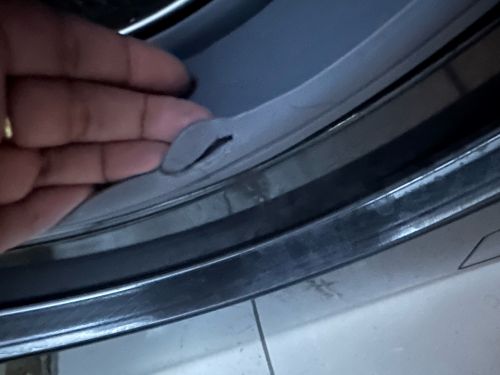
I have seen damage like this in the past, though it was on other brands of washing machine, and I’ve only seen it a few times. It is very difficult to be sure exactly how this happens. As an engineer, you look at things very logically. And logically, it’s just not something that should happen. The front of the door seal (the flange) does not move, and because the back of the door glass presses against it, nothing should be able to reach it in order to cause any damage.
I remember concluding that maybe something got trapped between the door seal flange and the back of the door glass when the door was closed, and then when the drum started to revolve this item got yanked back into the drum causing the damage. But this purely speculative, and not something I can be certain of at all. In fact it seems very unlikely that someone would be able to run the laundry inside the drum, leaving a part of a towel, or a sleeve hanging over the door seal and then subsequently closing the door over it never noticing. It’s obviously possible but it seems like an extremely rare possibility.
If the door flange has gone sticky and tacky, prior to this damage then that could explain how it has eventually got into that state. Though for the door flange to go sticky and tacky like that it usually has to be attacked by some sort of adverse chemical reaction, and is not something that is known to be able to happen on its own. This would be something on the laundry, or some cream someone could be using for example. Basically something that is introduced inside the washing machine that is not fabric softener, nor washing machine detergent, or ordinary dirt.
There is every chance that any engineer that sees this would also be unable to really account for it in a logical way. So in these circumstances it is very common for an engineer to blame overloading, or some other issue introduced by the user.
My problem with blaming overloading, and I’m not saying that it can’t be that, is that I struggle to see how any laundry that is inside the drum could rub against this flange during the cycle. Once the door has been properly closed, the door glass should press completely onto the rubber flange and create a watertight seal. If I look at my Miele washing machine, I can see that the entire rubber flange section is completely covered by the door glass.
One way that I can envisage an issue, is if by any chance the rubber flange on this type of washing machine is not completely covered by the door glass. In other words, the door glass presses against the lower half of it, which creates a watertight seal, but maybe the top half of this flange sticks out? If that was the case, then obviously any laundry being dragged around in that area could rub against this flange and cause damage.
If this can be seen to be the case, then there could be an argument for it being a poor design. Unfortunately, the manufacturers are likely to still insist that it only happens if the drum is overloaded. But the design of the door seal and the door glass is supposed to keep laundry away from this section altogether. It’s definitely not what I would class as a normal issue.
Also, I’ve been looking through your other photos again and this one which shows an item of laundry twisted into knots and torn, has the washing machine caused this knotting and twisting?
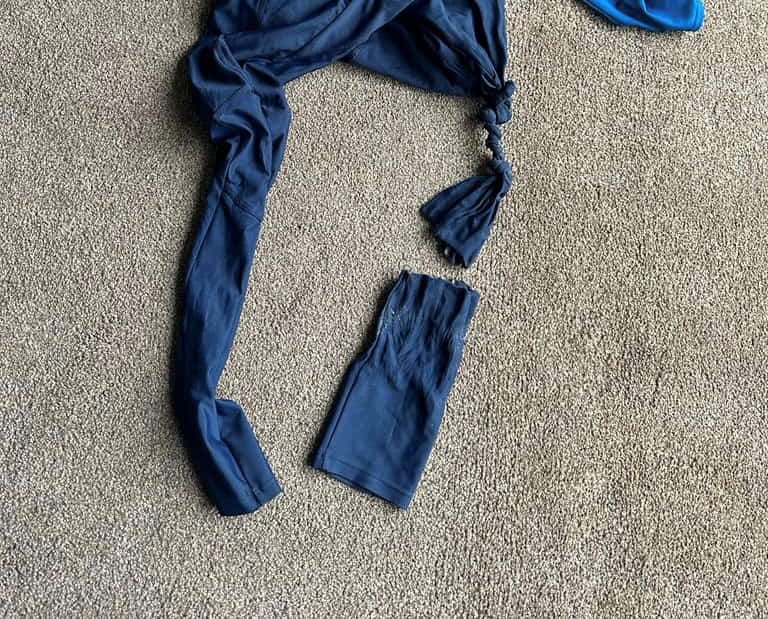
If so, then it looks very much like some items have got trapped between the door glass on the door seal during the wash cycle and spin, which in my opinion should not be possible. As I said in my previous reply, once the door glass has been closed, firstly the shape and design of the door glass should prevent laundry moving forward and keep it away from the door seal. And secondly, the bottom of the door glass should press firmly up against the whole of the door seal’s flange to create a seal.
Even if a washing machine is overloaded, I don’t see how laundry should be able to get trapped (possibly between the bottom of the door glass and the door seal. So there may well be something about the design of this particular washing machine that causes this problem. But I cannot say with any confidence that this is the case because I have not examined one.
Likely replying to Andy Trigg (Whitegoodshelp)
Hi Andy,
I bought a washing machine from Currys in April. After around 40 days it started giving problems like not completing washing cycle completely. Whirlpool sent an engineer who replaced a control board and a heater. it worked for 2 weeks and then again started giving the same problem. Then the company sent an another engineer who started blaming my drainage and floor level and advised not to use the machine till it gets fixed and booked another visit after 2 weeks. Meanwhile I checked my drainage system and there is nothing wrong it. After 2 weeks the engineer’s visit was postponed due to non-availability of the spares.
When I called Currys, the customer service says that they will refund if the engineer report says that the machine is non-repairable.
The machine is down for most of the time since I bought and I have to use the launderette service to wash my clothes and the repair is just getting ages to complete. Could you please advise what should I do?
Many thanks in advance, looking forward for your reply.
Hello Kishor. I believe you are entitled to a replacement washing machine. It doesn’t matter if the washing machine is repairable or not. You have given them more than enough chances to repair it properly. Under the consumer rights act 2015, if we accept a repair, but the repair is not successful, we do not have to let them try again and we are entitled to ask for a replacement.
Also, if it is still under six months old, then under the consumer rights act 2015 they have already breached your consumer rights by selling you a washing machine that had an inherent fault (unless they can prove that it is your fault). If they are still trying to get out of it, you will need to get consumer help from somewhere like citizens advice, or Resolver.
Likely replying to Andy Trigg (Whitegoodshelp)
Hi Andy,
Just came across this, we have a 450 quid tumble made by hotpoint and it’s 14 months old today it has decided to keep switching itself on which worries me a little with 2 small kids in the house so I decided to give hotpoint a call, they basically told me to do one as it’s 2 months out of warranty and to go back to ao, I did that and they have said the same, surely this is covered somewhere? I’m at a loss tbh
Hello Chris. The manufacturer has no obligation other than to honour the guarantee. So if it’s out of guarantee, and they don’t decide to help you out as a goodwill gesture, there’s nothing you can do with them. If you believe the dryer breaking down just 2 months out of the guarantee breaches the consumer rights act then they are right to say you have to take it up with the retailer.
The biggest problem you have is that you do not know what has gone wrong until someone has diagnosed the issue. Unfortunately you’re going to need to find out exactly what has gone wrong, and quite possibly pay to get it repaired before you can then challenge the retailer for compensation. For me the whole consumer rights act is weak and a mess, as was the sale of goods act before it. It is so vague, and so ambiguous that hardly anybody really knows what rights we have. They’re fairly straightforward if something serious goes wrong. So for example say an engineer came out and said that the main PCB has to be repaired and it will cost £200. Such a case should be relatively straightforward. It’s only 2 months after guarantee and it’s going to cost £200 to repair. This should be an acceptable. But if it was to turn out to be just something relatively minor and was only going to cost £70 to repair it’s a much more difficult one to call. There is definitely an argument that it shouldn’t go wrong at all just 2 months out of the 12 month guarantee but older retailers are the same, they will just fob everyone off and dig their heels in. So only the persistent, or those who may have enlisted the help of consumer groups like citizens advice or Which? are likely to get anywhere.
0 replies I have a faulty new washing machine and will be taking your advice on how to complain. But mine is integrated into a fitted kitchen and I have paid £85 for it to be fitted. Where do I stand with that?
I have a faulty new washing machine and will be taking your advice on how to complain. But mine is integrated into a fitted kitchen and I have paid £85 for it to be fitted. Where do I stand with that?
3 replies Hi, I bought an expensive Bosch washing machine online from John Lewis. It does not wash clothes and they come out just as dirty as they went in. I informed John Lewis of fault 15 days after delivery. John Lewis sent two Bosch engineers to check my machine - neither could find fault. I asked John Lewis/Bosch to do actual wash loads to see for themselves that the machine is faulty, but they won’t. They won’t refund or replace. Their is obviously a fault that the 15 minute check by the engineer is not picking up. What else can I suggest to them?
Hi, I bought an expensive Bosch washing machine online from John Lewis. It does not wash clothes and they come out just as dirty as they went in. I informed John Lewis of fault 15 days after delivery. John Lewis sent two Bosch engineers to check my machine – neither could find fault. I asked John Lewis/Bosch to do actual wash loads to see for themselves that the machine is faulty, but they won’t. They won’t refund or replace. Their is obviously a fault that the 15 minute check by the engineer is not picking up. What else can I suggest to them?
Likely replying to Robina Merakech
Hi Robina. That’s a very unusual issue. I can understand the engineers being sceptical of a fault if it appears to be ok because fault causing a washing machine to not wash laundry would normally be quite obvious. It’s also very rare for a new machine to have a problem like that. But just saying there is nothing wrong is very unhelpful. As you say they don’t spend any time checking appliances out these days as they are under so much time-pressure. So it’s possible they are missing something.
What they should bear in mind is that there must be some explanation, and no one is going to go to all the stress and hassle of complaining persistently – just to pass time. There has to be an explanation.
The things that spring to mind are what wash cycle do you use, how long does it take, and does it complete the cycle and turn off as you would expect?
Likely replying to Andy Trigg (Whitegoodshelp)
Hi Andy,
Thanks for your reply. ‘Cottons’ on 60 degrees takes a three and a half hrs. ‘Easy care’ on 40 degrees takes two and a half hrs. Cycle completes and turns off.
I bought the Bosch washing machine online from John Lewis in November 2021. 15 days after delivery, I informed John Lewis in writing that the washing machine was not washing clothes, was not fit for purpose and requested a refund or replacement.
They sent two Bosch engineers on separate occasions – neither found a fault with machine, yet to myself and my adult son it is obvious that the machine was not fit for purpose.
I have used Bosch washing machines for the last 20yrs and my two previous models washed excellently. I read all manuals fully and follow instructions carefully, so rule out user error. Machine was installed by John Lewis.
I showed engineers the poorly washed clothes. I emailed lots of photos of uncleaned clothes to John Lewis. I argued that just because engineers could not find a fault or error message within their 15 minutes checks, this was not conclusive that the machine was not faulty/unfit for purpose (I would so appreciate it if you would back me up on this). I requested that John Lewis/Bosch do in situ wash loads themselves to witness the poor wash performance for themselves, John Lewis declined. I suggested that the machine needs to be taken back to the factory and taken apart to find what the fault really is, John Lewis declined. I requested mediation, John Lewis said that they do not belong to an ADR scheme (I find that surprising) and declined mediation.
Two months later, John Lewis keep repeating that, because two Bosch engineers found no fault, Bosch will not refund or replace John Lewis, therefore John Lewis will not refund or replace me. As no fault found, means no repair either!
Independent engineers are saying if Bosch engineers found no fault, they are not likely to either and that I should go back to manufacturer, but Bosch are sticking to their findings. My son has supported my claim. What other evidence could I offer?
I have informed John Lewis that I will not be using the washing machine further as it does not wash and is just wasting my electricity. I desperately need the space and money for a working washing machine and feel that John Lewis and Bosch are being inflexible in resolving this.
Please please help.
Likely replying to Robina Merakech
Hi Robina. Yes not finding fault doesn’t prove anything – especially if they don’t spend much time testing Repair company want to charge if engineer can’t find fault but unfortunately you can’t prove there is a fault either yet.
Exactly what model is it? And are those 2 programs you mentioned the ones you use? What does it say in the manual about Easy Care? It might not be suitable for normal washing as I just found this on Google from Bosch site –
“Is easy care a gentle wash?
Suitable for freshening up cotton or easy-care fabrics. … The program offers two rinse cycles with a gentle washing action for greater fabric protection.
Have you tried cottons 40 normal wash with no time reducing options selected? Also finally, make sure it’s not caused by any of the issues in this article – washing not getting cleaned in washing machine
1 reply I brought a second hand washer it had a year guarantee.I have had problems from day 1.when they delivered it they didn't change the old pipes I was left with no instruction book or guarantee.Iput the washer on a quick twash but the drum was still full of water.i tried to spin&drain it but it didn't work. I rung the supplier but they would never get back to me.i was still recovering from a serious accident a broken neck both arms and a broken jaw my jaw was that bad I had to have a metal plate put in I am now deaf in my right ear after they drilled through my ear canal I'm just waiting now for my dental surgery the company no what I was going through anyway I tried to fit the washer pipes and found a plastic piece stuck in the pipe has soon as I removed it the water drained out.on several occasions the washer as flooded my kitchen causing damage to my carpets and furniture being so ill I just don't have the energy to do anything about it.but when it happened again and I was told by the plumber never put the pipes on and the old pipes were a meter shot so every time I was having to drain the water it eventually came off I was so mad.I rung the supplier and told them I want my money back I still have 4months warranty but I was told 2 get in touch with Indesit I told them that was there job not mine he just put the phone down I tried calling again and asked for the manager to call me back OK after ringing up every 15mins he came to the phone and said ring indesit I asked for the number but didn't have it right I gave them the serial number and told them to get back to me 4days later and no reply so rung back they told me they had gave indesit my details and were going to call me.After a few days I decided to ring indesit my self I was told that the washer I had was 6yrs old.some 1 is coming out Monday but I have to pay a call out fee I rung back the supplier and told him that washer is 6yrs old he said we have not been open for that long no but scrap yards have is there anything I can do to get my money back
I brought a second hand washer it had a year guarantee.I have had problems from day 1.when they delivered it they didn’t change the old pipes I was left with no instruction book or guarantee.Iput the washer on a quick twash but the drum was still full of water.i tried to spin&drain it but it didn’t work. I rung the supplier but they would never get back to me.i was still recovering from a serious accident a broken neck both arms and a broken jaw my jaw was that bad I had to have a metal plate put in I am now deaf in my right ear after they drilled through my ear canal I’m just waiting now for my dental surgery the company no what I was going through anyway I tried to fit the washer pipes and found a plastic piece stuck in the pipe has soon as I removed it the water drained out.on several occasions the washer as flooded my kitchen causing damage to my carpets and furniture being so ill I just don’t have the energy to do anything about it.but when it happened again and I was told by the plumber never put the pipes on and the old pipes were a meter shot so every time I was having to drain the water it eventually came off I was so mad.I rung the supplier and told them I want my money back I still have 4months warranty but I was told 2 get in touch with Indesit I told them that was there job not mine he just put the phone down I tried calling again and asked for the manager to call me back OK after ringing up every 15mins he came to the phone and said ring indesit I asked for the number but didn’t have it right I gave them the serial number and told them to get back to me 4days later and no reply so rung back they told me they had gave indesit my details and were going to call me.After a few days I decided to ring indesit my self I was told that the washer I had was 6yrs old.some 1 is coming out Monday but I have to pay a call out fee I rung back the supplier and told him that washer is 6yrs old he said we have not been open for that long no but scrap yards have is there anything I can do to get my money back
Likely replying to Andrea Smyth
Hi Andrea. I’m not 100% sure of the full situation so it’s hard to advise. You don’t say how long you’ve had it and, if it was second hand I don’t understand why they would tell you to contact Indesit. I have an article about rights when buying second hand which mentions buying from a shop or trader https://www.whitegoodshelp.co.uk/consumer-rights-buying-second-hand-washing-machine/
1 reply I have an expensive LG washer and it’s gone wrong within 7 months the error is still showing after repair and I have now been without a working machine for over a month. They can’t get the part I need what are my rights.
I have an expensive LG washer and it’s gone wrong within 7 months the error is still showing after repair and I have now been without a working machine for over a month.
They can’t get the part I need what are my rights.
Likely replying to Sarah Norkett
Hello Sarah. If they can’t repair it within a reasonable time then the retailer should replace it. Note it is the retailer and not the manufacturer. Although in theory the manufacturer can replace it if they wanted to, in practice they rarely do because they are not obliged to. If the manufacturer is still insistent on waiting for the part to come and repairing it you will get no further with them at all.
You would need to contact the retailer, and tell them that under the 2015 consumer rights act they are responsible because the retailer cannot repair it in a reasonable amount of time. Sadly I can predict that they will just say that it is nothing to do with them and you need to let the retailer repair it but this is not really true. Remind them that they and they alone are responsible for all of the rights that you have from the 2015 consumer rights act (who is responsible for faulty appliances?). Being without a major white goods appliance for over a month should be totally unacceptable. You might need to get help from a consumer group like Citizen’s advice Which?
1 reply I moved into a new house on 31 July 2020 and a new washer/dryer machine was part of the deal. It is an AEG as are all the other appliances in the house and all other houses on the estate. Since 2nd June this year the dryer part of the machine has not been working properly. I registered the machine with AEG and an engineer has now been 5 times to try and fix it over a period of more than 11 weeks. Still not fixed. I registered with AEG (Electrolux) who passed the information to Pacifica and then onto 0800 repairs (only one engineer in this area of Scotland), these companies are based in England. The engineer doesn't think there is anything else he can do to the machine and has passed his report to Electrolux. I have tried to find out by phoning and have now sent a letter of complaint to consumer services at AEG. No-one is coming back to me. The machine has a two year warranty. What can I do now?
I moved into a new house on 31 July 2020 and a new washer/dryer machine was part of the deal. It is an AEG as are all the other appliances in the house and all other houses on the estate. Since 2nd June this year the dryer part of the machine has not been working properly. I registered the machine with AEG and an engineer has now been 5 times to try and fix it over a period of more than 11 weeks. Still not fixed. I registered with AEG (Electrolux) who passed the information to Pacifica and then onto 0800 repairs (only one engineer in this area of Scotland), these companies are based in England. The engineer doesn’t think there is anything else he can do to the machine and has passed his report to Electrolux. I have tried to find out by phoning and have now sent a letter of complaint to consumer services at AEG. No-one is coming back to me. The machine has a two year warranty. What can I do now?
Likely replying to Ann Lane
Hello Ann. AEG have become very popular with builders as they are generally reasonably priced and decent appliances. In cases where you feel that you have a valid complaint under the consumer rights act 2015 then you have to complain to the people who you bought it from. This is usually a retailer – but it seems that things are much harder when it is a builder. From what I have experienced and learnt from people contacting me, builders are often even worse than retailers when it comes to complying with the consumer rights act, which is going to cost them time and money.
But ultimately the manufacture of a product is only responsible for carrying out repairs under the guarantee. If they aren’t able to do that you can claim against the people you bought it from. Sometimes manufacturers can be forward-thinking and offer to replace a troublesome appliance but not that often and they are not obliged to.
The only people that are obliged by law to compensate us or replace a product (if it has broken the consumer rights act) are the people that you gave the money to. A retailer or builder is the person that bought the washing machine from AEG. You bought the washing machine from the builder (in most cases the retailer) and that is why consumer law puts the onus on them.
As I said I’ve come across a lot of people that have had trouble with builders. They are often not interested when an appliance that they sold you as part of the house is not fit for purpose, or has not lasted a reasonable time etc. This is especially true the further away it gets from the end of the manufacturer’s guarantee. As far as they are concerned, and this goes unfortunately for most retailers too, they sell you the appliances, if they go faulty whilst under the manufacturer’s guarantee you should not bother them and need to contact the manufacturer. If they go faulty outside of the guarantee, you should also not bother them and get in touch with the manufacturer. However, this is completely wrong and they are not entitled to wash their hands of it because we have consumer rights that last up to 6 years (five in Scotland).
In your case it sounds like AEG have been unable to repair your appliance despite more than enough attempts. You would really hope that AEG themselves would replace it for you in order to salvage their reputation with you and your friends and family, but they are not obliged to. So if they won’t you’ll have to try and get the retailer (which in your case is presumably the builder) to do it. You may need to solicit the help of a consumer rights group such as citizens advice.
1 reply I brought a washing machine from ao they offered me an exange after the machine broke down after 8 months which was good They also said has my warranty was only valid till sept thi year from old one they would only cover me till sept this year with new one meaning new one wil only be covered for 2 months is this correct procedure should I not get the 1 year warranty with the new product Donna
I brought a washing machine from ao they offered me an exange after the machine broke down after 8 months which was good
They also said has my warranty was only valid till sept thi year from old one they would only cover me till sept this year with new one meaning new one wil only be covered for 2 months is this correct procedure should I not get the 1 year warranty with the new product Donna
Likely replying to Donna
Hello Donna. Unfortunately yes this is correct. They all do that. I suppose they are frightened of almost perpetual guarantees if they keep having to exchange something. But obviously that is highly unlikely, and even if it was, it would serve them right for producing rubbish.
But it is standard practice that any manufacturers guarantee we get starts on the day we get the product and finishes one year (or whatever the term is) later. If the appliance is exchanged at any time within that period nothing changes. Just like if you had a repair, say a brand-new motor fitted, they would not extend the warranty on that specific part so that it continues after the rest of it has expired – although there is an argument that that would be fair.
1 reply I have. Had my washing machines for 4month now it not working l have spent 5hour on phone done all I WAS told and still not working curry don’t want to now there fit it
I have. Had my washing machines for 4month now it not working l have spent 5hour on phone done all I WAS told and still not working curry don’t want to now there fit it
Likely replying to Linda Lightbown
Hello Linda. If it’s under six months old, unless they can prove it’s something to do with how it’s being used or fitted then the retailer should give you a refund or an exchange. You would need to tell them that the consumer rights act 2015 says that unless they can prove otherwise it has failed within six months so therefore when they sold it to you it was already faulty. Selling a faulty product is in breach of the consumer rights act.
0 replies Hi, I bought an integrated washing machine just over two months ago from a local retailer. I had to have them out during the first couple of weeks as the machine had not been installed properly. Since then I have had problems. Yesterday a loud clicking noise occurred and the door locked. The machine is in the "Off" position. I have phoned the retailer who are sending me out today to see if the installation is correct and the a white goods engineer to inspect the machine. I am disabled and need a working machine. What are my rights? The machine is a Bloomburg.
Hi, I bought an integrated washing machine just over two months ago from a local retailer. I had to have them out during the first couple of weeks as the machine had not been installed properly. Since then I have had problems. Yesterday a loud clicking noise occurred and the door locked. The machine is in the “Off” position. I have phoned the retailer who are sending me out today to see if the installation is correct and the a white goods engineer to inspect the machine. I am disabled and need a working machine. What are my rights? The machine is a Bloomburg.
1 reply We bought a new washing machine. After 5 months of little use the bearings went so they replaced them after another few months they are going again .we called hot point now they tell us the machine is out of warranty. So the bearings have gone twice. Should I have to pay
We bought a new washing machine. After
5 months of little use the bearings went so they replaced them after another few months they are going again .we called hot point now they tell us the machine is out of warranty. So the bearings have gone twice. Should I have to pay
Likely replying to Allan
Hi Allan. I can’t think of a better example of an inherent fault. It’s ludicrous for drum bearings to fail once never mind twice in such a short time. I would speculate water is getting into them through a faulty seal. You should contact a consumer group for help if they refuse to repair it. However, don’t waste your time with the manufacturer. They are not obliged to do anything after the guarantee has expired. It’s only the retailer who is responsible under the Consumer Rights Act 2015 (Who is responsible for faulty appliances?)
1 reply I had a new Hotpoint washing machine installed by Currys on the 23rd January, today 23rd.Feb the machine emitted smoke with the smell if rubber when the door was opened,all the clothes smelt of rubber. The machine is one day over from the exchange system,the Hotpoint engineer is visiting on the 25th. What is my legal position? Can I demand a replacement?
I had a new Hotpoint washing machine installed by Currys on the 23rd January, today 23rd.Feb the machine emitted smoke with the smell if rubber when the door was opened,all the clothes smelt of rubber. The machine is one day over from the exchange system,the Hotpoint engineer is visiting on the 25th. What is my legal position? Can I demand a replacement?
Likely replying to Barry Purdy.
Hi Barry. Its going to depend on the cause of the fault. If by any chance something serious has gone wrong like the drum bearings or the drum itself that’s pretty much a serious issue that should never happen after such a short time. Within 6 months the fault is now assumed to have been present when sold and therefore the retailer sold a faulty appliance with an inherent fault. However, a strong burning rubber smell can be caused by something getting trapped between the drum and door seal and can be caused by overloading, which they would blame on the user.
1 reply Bought a Miele in March. It worked for 7 weeks and then the control panel wouldn’t respond. We contacted Miele but due to lockdown it was August before an engineer came. Today the engineer phoned to say the fault was caused by liquid damage (spillage). I am unaware of any spillages which could have occurred. Miele say it’s not their responsibility and the engineer says the machine is unrepairable. So basically £1200 for approx 20 washes. Don’t know where I stand.
Bought a Miele in March. It worked for 7 weeks and then the control panel wouldn’t respond. We contacted Miele but due to lockdown it was August before an engineer came. Today the engineer phoned to say the fault was caused by liquid damage (spillage). I am unaware of any spillages which could have occurred. Miele say it’s not their responsibility and the engineer says the machine is unrepairable. So basically £1200 for approx 20 washes. Don’t know where I stand.
Likely replying to Mrs A
Hello Mrs A. This is a tricky one. To be honest my first thought is that I would have expected a Miele washing machine to be built of sufficient quality to not be destroyed by something being spilled onto it. I would expect it to be difficult for liquid to get inside because any liquid spilt on top of the washing machine just runs down and I would expect it to be quite difficult for it to get inside. Even in a cheap washing machine it’s not something that would be easy unless it was a big serious spillage.
Have they offered any proof that it has been caused by spillage? Have they shown you the part that has water or liquid damage on it? Have they explained how a liquid from the normally innocuous spillage could get inside so easily? If you know there was an incident then obviously that’s one thing that if you are adamant that nothing has been spilt on it those are the lines of enquiry I would be taking.
1 reply Hi, my daughter bought a hotpoint washer from curry's online which was delivered 6/9/20, horrendous banging on spin cycle and called c/s on 5/10/20, engineer came out, did something said all ok, it wasn't, it was still banging. She called again, engineer came out, fault= said need new tank, door seal and bearing failure. Curry's said no to refund as it's gone past 30 days... obviously the original complaint was well within 30 days the rest of it was waiting for engineers. Have demanded to speak to manager and was told he'll get back to us.... unsurprisingly he hasn't.... please help, young baby in house no washing grr!!!!
Hi, my daughter bought a hotpoint washer from curry’s online which was delivered 6/9/20, horrendous banging on spin cycle and called c/s on 5/10/20, engineer came out, did something said all ok, it wasn’t, it was still banging. She called again, engineer came out, fault= said need new tank, door seal and bearing failure. Curry’s said no to refund as it’s gone past 30 days… obviously the original complaint was well within 30 days the rest of it was waiting for engineers. Have demanded to speak to manager and was told he’ll get back to us…. unsurprisingly he hasn’t…. please help, young baby in house no washing grr!!!!
Likely replying to Mark Shaw
Hello Mark. As described in my article above if a fault occurs within the first six months the Consumer Right Act 2015 says that the appliance was faulty when it was sold to you, unless the retailer can prove otherwise. This is described in the section headed, FAULTS WITHIN THE FIRST 6 MONTHS ARE DEEMED TO HAVE BEEN PRESENT WHEN SOLD. So I would complain that they have sold you an appliance that had an inherent fault and you should not have to have such extensive repairs done on such a new machine.
1 reply I purchased a new washing machine and 15 days later it broke down.Engineer said the motor had blown and it now needs a new one and control panel.Asked how long he said he has no idea.Can I ask for a new one ?It could take weeks and we have washing piling up after a holiday.It had been used 4/5 times
I purchased a new washing machine and 15 days later it broke down.Engineer said the motor had blown and it now needs a new one and control panel.Asked how long he said he has no idea.Can I ask for a new one ?It could take weeks and we have washing piling up after a holiday.It had been used 4/5 times
0 replies This is a very difficult one because there is a reasonable likelihood that much of the delays are caused by the current situation i.e Covid 19. It's obvious that so many things have been affected and are in short supply or have long waiting lists. Therefore the only thing I can advise is to get in touch with somewhere like citizens advice or Which? who will have formulated opinions and decisions based upon the current situation.
This is a very difficult one because there is a reasonable likelihood that much of the delays are caused by the current situation i.e Covid 19. It’s obvious that so many things have been affected and are in short supply or have long waiting lists. Therefore the only thing I can advise is to get in touch with somewhere like citizens advice or Which? who will have formulated opinions and decisions based upon the current situation.
0 replies My machine was faulty and two repairs later I needed new parts my washing machine was only 4 months old. The parts cannot be got and they are ordering them in but cannot say how long. They then agreed to send me a new machine which when ordered was going to take 5 days. I heard nothing for two weeks and when I inquired about this they told me the machine was out of stock for another 4 weeks. So all in all I have not had a working washing machine for nearly 2 months. I have had to order yet another model and it will take another week for delivery. . Do I have any right for financaly help with laundry Bills from hot point?
My machine was faulty and two repairs later I needed new parts my washing machine was only 4 months old. The parts cannot be got and they are ordering them in but cannot say how long. They then agreed to send me a new machine which when ordered was going to take 5 days. I heard nothing for two weeks and when I inquired about this they told me the machine was out of stock for another 4 weeks. So all in all I have not had a working washing machine for nearly 2 months. I have had to order yet another model and it will take another week for delivery. . Do I have any right for financaly help with laundry Bills from hot point?
1 reply hi i broufght a bush washing machine from argos in febuary 2018 and then in mid july this year it started leaking water from underneath i had seperate insurance but when i booked a repair they told me it was still under the manufaturers guarentee argos had to set up a repair i called argos and they booked me in to have it repaired the engineer came out and they said they had to order 4 parts for it they left ordered the parts when they next came back they only had 3 parts they then said they had to order the forth part when they next due to come the part hadnt been ordered so they had to reorder on the day of the appointment they said the part was damaged then they said that the machine couldnt be repaired and they emailed argos now argos are saying that im not entitled to a repair or replacement machine what are my rights please help
hi i broufght a bush washing machine from argos in febuary 2018 and then in mid july this year it started leaking water from underneath i had seperate insurance but when i booked a repair they told me it was still under the manufaturers guarentee argos had to set up a repair i called argos and they booked me in to have it repaired the engineer came out and they said they had to order 4 parts for it they left ordered the parts when they next came back they only had 3 parts they then said they had to order the forth part when they next due to come the part hadnt been ordered so they had to reorder on the day of the appointment they said the part was damaged then they said that the machine couldnt be repaired and they emailed argos now argos are saying that im not entitled to a repair or replacement machine what are my rights please help
Likely replying to carol northfield
Hello Carol. If the washing machine is less than 3 years old and it cannot be repaired then you need to try and argue with the retailer that it has not lasted a reasonable time. Under the consumer rights act 2015 products should last a reasonable time. However, Bush are pretty much a budget washing machine and it is debatable how long they should be expected to last. Sadly the average life span of a washing machine these days is only about 7 years, possibly less. However, that would still mean it has lasted half as long as you would expect, and therefore in theory you should be entitled to 50% refund. In practice retailers are generally very poor at giving customers their consumer rights. They quickly realised that all they have to do is play dumb and say sorry there’s nothing they can do and probably 95% of people will just go away. It’s a very successful tactic.
How long a washing machine should last is not an exact science, but obviously the cheaper ones don’t last as long, and if they are washing for a large family then 3 or 4 years is actually quite normal these days. If you look at my article how long should a washing machine last you can see a more detailed look at the topic. If you look at the poll on the page too you can see how many people’s washing machines are not even lasting 3 years these days. It’s a very sad state of affairs but it’s a consequence of them being so cheap.
1 reply We purchased a Samsung washing machine last October 2019 from A.O.com. Samsung have sent an engineer out who said it needs a new drums,new pump,new seal and memory board. I dont want 4 new parts fitted to a machine that is 9 months old. I would like an exchange am I entitled to this?
We purchased a Samsung washing machine last October 2019 from A.O.com. Samsung have sent an engineer out who said it needs a new drums,new pump,new seal and memory board. I dont want 4 new parts fitted to a machine that is 9 months old. I would like an exchange am I entitled to this?
Likely replying to Mrs Melligan
Hello Mrs Melligan. It seems very strange to fit so many disparate parts. Sometimes an engineer might order a load of parts just to be on the safe side because they aren’t entirely sure which exact part is needed but if they fit all of the parts they are pretty confident it will clear all faults. At 9 months old it’s extremely difficult to get a replacement. If you have had nothing but trouble with it, or if the engineer had said that it was not repairable you would have a strong case. But if it is repairable albeit with a lot of parts they will both argue an exchange is not necessary. If you have had many problems with it you could try arguing that it is not fit for purpose, or made of sufficient quality. To be honest I think it’s very unlikely that all of those parts are necessarily. Another way of looking at it is that once all of those parts are fitted it would give the washing machine a new lease of life. If all of those parts genuinely have broken down though then you definitely could argue that the washing machine is definitely not built to a satisfactory quality.
1 reply My John Lewis washing machine ha self dosing was not told on purchase.It won’t rinse properly after using a pod. The won’t exchange for it although I was prepared to pay more money for a more expensive machine. Have any rights
My John Lewis washing machine ha self dosing was not told on purchase.It won’t rinse properly after using a pod. The won’t exchange for it although I was prepared to pay more money for a more expensive machine. Have any rights
Likely replying to Mrs J Hickman
Hello Mrs Hickman. If there is definitely a fault on it then you should have a right to have it exchanged if it has happened quite quickly after purchase. The issue is likely to be around where there are not there is a fault. And they would need to send an engineer out to look at it in order to see if it is faulty or not. Unfortunately no retailer will accept the word of a customer claiming it is faulty. The manufacturer would have to come out and investigate it first. The reasons are explained in my article above.
1 reply I have a logik washer dryer from Currys in October this is the third time now it is just blowing cold air instead of hot have to get the engineer out now again. It seems to be tripping out a lot where do I stand on this problem
I have a logik washer dryer from Currys in October this is the third time now it is just blowing cold air instead of hot have to get the engineer out now again. It seems to be tripping out a lot where do I stand on this problem
Likely replying to Paul s
Hello Paul. It all depends on what is causing it. That’s a fault that can be caused by overloading or stopping the dryer halfway through a cycle as well as failing parts. If the engineer isn’t claiming it’s user error then you could argue (with the retailer) that it should be replaced.
1 reply Hi, i ordered a candy washing machine via very on the 23rd Feb it arrived today however went to put my first cycle on it fills up starts working go to do school run come home to find an e09 code. Very do not want to refund me despite it being the first time I used the machine. Any help or advise? I do not want to wait for an engineer i simply want my money back as.
Hi, i ordered a candy washing machine via very on the 23rd Feb it arrived today however went to put my first cycle on it fills up starts working go to do school run come home to find an e09 code. Very do not want to refund me despite it being the first time I used the machine. Any help or advise? I do not want to wait for an engineer i simply want my money back as.
Likely replying to Ashleigh
Hello Ashleigh. My article explains why no one will exchange an appliance without an engineer confirming it is faulty. Many faults, especially on washing machines, can be related to installation faults or user faults (see the list here is the washing machine actually faulty?”) If an engineer confirms the washing machine is faulty though you should be able to reject it then. The engineer will want to repair it, he might be able to authorise a replacement if it’s a big fault, but if they won’t you will need to demand a replacement from the retailer. If it’s a very minor fault it may well be better to just get it fixed. Getting it replaced will involve dealing with the retailer and waiting. So if for example the engineer can fix it in 5 mins you have to decide if it’s worth the hassle. But if something quite serious has failed, or he has to order parts for it – I would insist on getting it replaced asap.
3 replies Hi I bought a hotpoint washing machine in October. Now find out its dangerous. What can I do.??
Hi I bought a hotpoint washing machine in October. Now find out its dangerous. What can I do.??
Likely replying to June Vidal
Hello June. Yes this is another avoidable and chaotic disaster. I say avoidable because Hotpoint washing machine door lock wiring used to overheat and burn out 20 years ago, and here we are again. Back then there was less risk of an actual fire though because more of the parts were made of metal. This washing machine was clearly sold to you with an inherent and dangerous fault. The retailer should be obliged to replace it or give you your money back.
However, I can almost guarantee that they won’t, at least not without a fight. They will simply try to pass you on to the manufacturer. They will say the manufacturer has organised a system to deal with it all. But you can’t even get through to them on the telephone, and you cannot get through to their website. As your washing machine is only a few months old and well under the six months that the consumer rights act 2015 stipulates as the period in which any fault is deemed to be an inherent fault unless they can prove otherwise.
Sadly the retailers have a well practised and very successful way of dealing with our claims on faulty appliances and products. They simply refuse to do anything and hope we give up. I would guess 99% of people do give up. So this policy is highly successful for them. I have heard in the media that Hotpoint are arranging to replace these faulty washing machines. However under UK consumer law they are not obliged to do so at all. That obligation falls only onto the retailer which seems a little unfair. However that is how it is. The retailer is obliged by law to replace or refund and I think this is is clearly a case of breach of the consumer rights act 2015 as you can get because the manufacturer has admitted that there is a serious fault. So unfortunately our options are to either fight the retailer or join the queue to try and get in touch with Hotpoint. If you decide to fight the retailer I would strongly recommend you get proper consumer help and advice from somewhere like Citizens Advice
Likely replying to Andy Trigg (Whitegoodshelp)
Hi Andy
I bought a hotpoint washing machine on the 19/01/20 from currys online. My son used it on the 2nd day and I came home from work to the machine still going. I enquired about it my son told me that it kept resetting itself and wouldn’t stop. I turned it off at the mains and released the clothes. But they were soaking wet.
On Friday 24 ,I tried to use it to wash school clothes and it kept resetting itself again. I must mention that the soap was still in the soap dispenser both times.
On Friday morning I called the helpline and they want to charge me for an engineer to come out ..so I quoted consumer protection . They then said I won’t be charged if it’s a manufacturer fault. They gave me a 2 week timeslot! 6/2/20.
On Friday night as I was washing smoke came out of machine. I turned off completely.
On Saturday I called again this time demanding I want my money back as the appliance is not fit for purpose.
Currys are willing to take machine back and refund my money but I am having to deal with the manufacturer whirlpool who are a complete nightmare! Currys say as long as I get an authorisation code from manufacturer they are good to go. Manufacturer are insisting on sending an engineer out but cannot give me an emergency call out. I insisted and still waiting on their call. Meanwhile I have had to go to a laundromat to wash my kids uniform costing more money.
What can I do. The machine is less than a week old.
Likely replying to Abie
Hello Abie. Have you read all my advice, and checked all the points in my other article it inks to called Is your washing machine really faulty?. I know it’s frustrating when it appears no one believes your washing machine is faulty, it obviously could be – but from a betting odds point of view they usually aren’t. I explain in this article that it’s very rare for a washing machine to be faulty right from the factory. So there’s no way any retailer will exchange one until an engineer has confirmed it is faulty. Most of the time if one has a fault the first time it’s used it is one of the faults in my article I just linked to.
If it is faulty I don’t think you will have any problems, the engineer should arrange for it to be exchanged. You can reject it under the Consumer Rights Act 2015. But if it isn’t they will charge you so it’s wise to make sure it’s not an installation fault. One installation fault that can cause a washing machine to stick is if the washing machine is losing water through siphoning. That would cause it to constantly be filling with water but then losing it down the drain and filling up again etc.
So it may well be faulty, but they have to check first.
0 replies Hello, I purchased a fridge freezer from curry's in November 2018 which was delivered in December 2018. It has been used for 6 weeks and then broke. The engineer came out and said the compressor was broken which has to be ordered and will take another week. I asked for a new fridge freezer as its so new and a serious fault has occurred but they just kept repeating it is out of the 30 days and has to be repaired, not replaced. Just checking if this is correct? Thanks for your help
Hello,
I purchased a fridge freezer from curry’s in November 2018 which was delivered in December 2018. It has been used for 6 weeks and then broke. The engineer came out and said the compressor was broken which has to be ordered and will take another week. I asked for a new fridge freezer as its so new and a serious fault has occurred but they just kept repeating it is out of the 30 days and has to be repaired, not replaced. Just checking if this is correct?
Thanks for your help
1 reply Purchased a Daewoo 8kg washing machine in March 2018 from the studio catalogue , it's now October and it's counter balance in, the big concrete weight inside has cracked and exploded inside the machine. It's under guarantee so I called the Daewoo repair line, they arranged for an engineer, engineer came, told me it needed parts, so he ordered parts, 2 weeks later he comes with the parts but explains that one part got damaged in delivery, so can't fix, so he orders another part, a week later they arrive with the part, broken again, reordered, week later engineer comes opens the box with the new part, broken again!!! So reordered again!! I've waited 4 weeks now, had to go to the laundrette, cost me a fortune for 5 peoples washing. I've emailed studio, Daewoo, 0800 repair daewoos repair center. Asked for compensation for the laundrette, studio deducted my bill by £35.00. The bill was close to £80,£90 for 4 weeks. I don't know what to do, I'm out of pocket, got no working washing machine and Daewoo are refusing to replace, and insisting on repair, but I've been waiting 4 weeks!!! 0800 repairs manager told me that it was my choice to go to the laundrette. And they wouldn't be reimbursing me.. If the engineer turns up at my house next Friday with another broken part and no fix, then I think I may lose the plot... Help!!!
Purchased a Daewoo 8kg washing machine in March 2018 from the studio catalogue , it’s now October and it’s counter balance in, the big concrete weight inside has cracked and exploded inside the machine. It’s under guarantee so I called the Daewoo repair line, they arranged for an engineer, engineer came, told me it needed parts, so he ordered parts, 2 weeks later he comes with the parts but explains that one part got damaged in delivery, so can’t fix, so he orders another part, a week later they arrive with the part, broken again, reordered, week later engineer comes opens the box with the new part, broken again!!! So reordered again!! I’ve waited 4 weeks now, had to go to the laundrette, cost me a fortune for 5 peoples washing. I’ve emailed studio, Daewoo, 0800 repair daewoos repair center. Asked for compensation for the laundrette, studio deducted my bill by £35.00. The bill was close to £80,£90 for 4 weeks. I don’t know what to do, I’m out of pocket, got no working washing machine and Daewoo are refusing to replace, and insisting on repair, but I’ve been waiting 4 weeks!!! 0800 repairs manager told me that it was my choice to go to the laundrette. And they wouldn’t be reimbursing me.. If the engineer turns up at my house next Friday with another broken part and no fix, then I think I may lose the plot… Help!!!
Likely replying to Emma
Hello Emma. From your description of the problems you’ve had it looks like you have a strong case to reject the washing and insist on a replacement. Under the consumer rights act they have to repair your appliance in a reasonable time. As it has been an extremely unreasonable amount of time you could argue that they have breached the consumer rights act. You may very well need to take advice from an acknowledged consumer group.
What you are trying to claim for is called consequential loss. If you had to use the launderette it is reasonable to suspect that you had little choice. If there was an easier way of getting all your washing done you would have clearly used it. You cannot have expected that anyone would pay for the launderette. I get the impression you have only considered trying to claim it back after it has developed into a bit of a farce, and your patience has been stretched to breaking point.
As I said, use the phrase “consequential loss” to show that you are aware of this legal term. The repairs manager sounds very unhelpful if that’s what he said. However, you have to bear in mind that your rights in this matter are really against the retailer who sold it. The repair company are just the agents for the manufacturer. You do not have a direct relationship with them. You did not contract 0800 repair to carry out any work. You bought the washing machine from the retailer, it came with a guarantee, and it is the pursuance of the guarantee that has resulted in them becoming part of the problem.
If your washing machine was out of guarantee, and you had called out a repair company then you have a direct contract with that company. If things go wrong you have consumer protection to pursue with them. But in a case where your contract is with someone else, and they employ a third party, if something goes wrong then your claim is with the original company. As I said, you will probably be better off getting some official consumer advice and help. My guess is that your claim is against the retailer under the consumer rights act. You may well have to threaten to take them to the Small Claims Court.
0 replies Hi I purchased a washer dryer Hoover. After 5 or 6 months call out repair cause there was water in machine with clothes and error code shown. Then I took out repair policy and digital screen was replaced. There after every other week or 2 had to call out repair. Double glass cracked as machine had washing, was replaced.Digital screen was replaced 3 time, motor itself was replaced. Also the memory reader also replaced. Then on going issues with some kind of chemical or acid smell from the dispensary draw. Which wasn't to be found. Soon machine begain to do it's own mind of washing functions .Was not responding good. A TOTAL FAIL. Eventually after a long battle the machine was written off and replaced with machine of my chose .WISH ME LUCK.
Hi I purchased a washer dryer Hoover. After 5 or 6 months call out repair cause there was water in machine with clothes and error code shown. Then I took out repair policy and digital screen was replaced. There after every other week or 2 had to call out repair. Double glass cracked as machine had washing, was replaced.Digital screen was replaced 3 time, motor itself was replaced. Also the memory reader also replaced. Then on going issues with some kind of chemical or acid smell from the dispensary draw. Which wasn’t to be found. Soon machine begain to do it’s own mind of washing functions .Was not responding good. A TOTAL FAIL.
Eventually after a long battle the machine was written off and replaced with machine of my chose .WISH ME LUCK.
0 replies Thanks for the update Matt. To be honest if it was me I'd be tempted to take the £80. It depends how determined you are to plough on with the issue.
Thanks for the update Matt. To be honest if it was me I’d be tempted to take the £80. It depends how determined you are to plough on with the issue.
1 reply Thanks for the update Matt. It's very helpful for everyone when people update with their experiences. I didn't realise the dishwasher had been repaired. I suppose they don't get many people wanting a refund or replacement when the appliance is currently working OK. It's complicated matters a bit. If Citizens Advice knew it was currently repaired and working OK and still said you are entitled to reject it then it's going to be a case of battling on.
Thanks for the update Matt. It’s very helpful for everyone when people update with their experiences. I didn’t realise the dishwasher had been repaired. I suppose they don’t get many people wanting a refund or replacement when the appliance is currently working OK. It’s complicated matters a bit. If Citizens Advice knew it was currently repaired and working OK and still said you are entitled to reject it then it’s going to be a case of battling on.
Hi Andy,
So I got a reply from the John Lewis head of customer service today saying that as the dishwasher is currently working they would not be offering a refund or replacement but they would offer me £80 as a goodwill gesture if I would consider that closure of the issue. I declined and now have filed the case with online dispute resolution – this is probably going to drag on now.
1 reply It's possible but I'd expect very difficult without getting help from a consumer group with experience in helping people make these claims.
It’s possible but I’d expect very difficult without getting help from a consumer group with experience in helping people make these claims.
Hi Andy,
Today I called the consumer advice line of citizens advice and they advised me that I am definitely in the right here and I should go back to John Lewis and tell them I am exercising my right to regect to the product as it does not meet the criteria of satisfactory quality under the consumer rights act 2015.
I then called John Lewis again armed with this information and they said that the second Bosch engineer shouldn’t have repaired the product only reported the fault but as he has carried out repairs they are not obliged to refund or exchange. Sounds like a load of rubbish to me.
I went back to citizens advice and they have said I need to find out which ADR or ODR John Lewis are signed up to – this is a 3rd party mediation in the event of a dispute. Customer services at John Lewis did not have this info over the telephone but they said they would email me – I’m not holding my breath. Citizens Advice also told me I should send a formal letter via recorded delivery to John Lewis outlining the problems, the advice I have received and what actions I want taken.
2 replies Hi I purchased a Bosch dishwasher in April 2016 which was installed in our new kitchen in june 16. September 16 the diswasher tripped our RCD and when power was restored it came up with E09 error. Contacted John Lewis who put us in touch with Bosch who sent an engineer a few days later - the fault was a heat pump which the engineer replaced. He stated that it is very unusual for a heat pump to go so soon in the life of the machine. Anyway move onto Feb 17 and we've had exactly the same fault - tripped RCD and E09 error. Another week wait for an engineer and he reported exactly the same fault and replaced the heat pump. The engineer suggested the fault could be caused by limescale build up (I find this strange as we use salt and the new part wasn't even 5 months old). I have now gone to John Lewis as I have no faith in the machine and I have said that under the consumer rights act I should be entitled to an exchange or refund. John Lewis have refused and said that as the machine is over 6 months old they are under no obligation beyond their repair guarantee. I've argued that as the first issue happened before 6 months and the same issue has returned then it is an inherent fault. I feel I'm going round in circles with this. Any advice on next steps would be appreciated.
Hi
I purchased a Bosch dishwasher in April 2016 which was installed in our new kitchen in june 16. September 16 the diswasher tripped our RCD and when power was restored it came up with E09 error. Contacted John Lewis who put us in touch with Bosch who sent an engineer a few days later – the fault was a heat pump which the engineer replaced. He stated that it is very unusual for a heat pump to go so soon in the life of the machine. Anyway move onto Feb 17 and we’ve had exactly the same fault – tripped RCD and E09 error. Another week wait for an engineer and he reported exactly the same fault and replaced the heat pump. The engineer suggested the fault could be caused by limescale build up (I find this strange as we use salt and the new part wasn’t even 5 months old).
I have now gone to John Lewis as I have no faith in the machine and I have said that under the consumer rights act I should be entitled to an exchange or refund. John Lewis have refused and said that as the machine is over 6 months old they are under no obligation beyond their repair guarantee. I’ve argued that as the first issue happened before 6 months and the same issue has returned then it is an inherent fault. I feel I’m going round in circles with this. Any advice on next steps would be appreciated.
Likely replying to Matt
Hello Matt. I agree that the limescale build up explanation is very unlikely to say the least. If the heater had failed due to limescale build up he would have called you over and shown it to you. My guess is it was clean as a whistle. As you say, limescale couldn’t build up in those times. Besides, the detergent is supposed to protect from limescale.
Regarding the 2 same faults within less than a year I would think most people would have lost confidence in the appliance too. Ironically if you’d tried for an exchange the first time it failed you’d have a stronger case. In the first 6 months a fault is now deemed to be inherent unless the retailer can prove otherwise. After 6 months the onus falls onto the customer to prove it was inherent and that’s what they are saying.
I would say that 2 exact same faults in less than a year are fairly strong evidence that the heater is a substandard part or has a design flaw, or is not of sufficient quality.
However, it’s not cast iron proof. You might arguably just have been extremely unlucky. It’s difficult to prove it’s an inherent fault without evidence from somewhere showing a lot of people are finding the same problem. I would try telling them that when it failed within the first 6 months then according to the sale of goods act that was an inherent fault. The fact that it has failed again only strengthens that claim. Therefore you want an exchange or refund.
You might need to get consumer help if they still refuse. Let us know how you get on.
Hi Andy,
Thanks for the advice – I needed someone to tell me I was on the right side of the law in this regard. I’ve been pestering John Lewis every day but they are not budging on this. I guess the only route I have now is small claims court – obviously I can claim the expense of the dishwasher but am I entitled to claim any additional compensation for time or inconvenience?
2 replies I had a bush washing machine delivered on 13 Feb 2017 used it on the following day and it won't take the fabric softener in, rung Argos today 15 feb and they are sending someone to look at it tomorrow 16 feb , am I entitled to a replacement machine .
I had a bush washing machine delivered on 13 Feb 2017 used it on the following day and it won’t take the fabric softener in, rung Argos today 15 feb and they are sending someone to look at it tomorrow 16 feb , am I entitled to a replacement machine .
Likely replying to Ann simpson
Hello Ann. If it proves to be faulty then technically it was sold with a fault which breaches the Sale of Goods Act. Unless they can prove otherwise, any fault in the first 6 months is deemed to be an inherent fault.
However, there are as far as I’m aware still provisions in the Sale of Goods Act for a retailer to insist on a repair if replacing it is going to be disproportionately more expensive than a repair. If the fault is serious I would expect them to agree to a replacement. However, the fault you describe seems unlikely to be anything serious. It’s very unusual for something like that to be faulty from the start. So if for example they took off the lid and found a wire had become disconnected they should be entitled to carry out the repair.
So it all depends on what has gone wrong. If they say it needs a part ordering and you suspect or they admit it might be a week or two before they can get back to fix it I would be tempted to try insisting on a replacement or a refund. At the end of the day, if there is a fault then they have breached the Sale of Goods Act.
Likely replying to Ann simpson
Hello Ann. As it is under 6 months old it is deemed to have been faulty when sold unless they can prove otherwise. This means the retailer has breeched the Consumer Rights Act 2015. If there is a serious fault, or if it is going to take several days or more to fix you should be able to ask for an exchange or refund. However, you need to remember that it is not the engineer or manufacturer who is obliged to exchange it but the retailer. You have to fond out what is wrong first and if the engineer insists they can only repair it and you want an exchange you must argue that with the retailer. If the engineer can fix it easily and quickly though you might want to consider just getting it fixed.
0 replies It's possible Paul, though might not be easy. At 14 months you'd have to show that the fault was present at the time of purchase (an inherent fault) or that it hasn't been of satisfactory quality. Normally they can put faults down to wear and tear. However, a software fault isn't related to wear in any way. Have you tried unplugging it for 10 mins or so just in case something's crashed? If it has a software fault I would think you might have a case for saying it hasn't lasted a reasonable time because such a fault is unrelated to usage. You may need to get advice from a consumer group or organisation. The examples in my article here show that faults can be covered under the sale of goods act even when out of guarantee - Out of guarantee doesn’t always mean you should pay
It’s possible Paul, though might not be easy. At 14 months you’d have to show that the fault was present at the time of purchase (an inherent fault) or that it hasn’t been of satisfactory quality. Normally they can put faults down to wear and tear. However, a software fault isn’t related to wear in any way. Have you tried unplugging it for 10 mins or so just in case something’s crashed?
If it has a software fault I would think you might have a case for saying it hasn’t lasted a reasonable time because such a fault is unrelated to usage. You may need to get advice from a consumer group or organisation. The examples in my article here show that faults can be covered under the sale of goods act even when out of guarantee – Out of guarantee doesn’t always mean you should pay
0 replies HI, I purchased a Hotpoint Washing machine from AO.com 14 months ago and today it has developed a Software Fault E-09. I could use Hotpoints 10 year parts guarantee but I would be liable for a £99 labour charge. Under the Consumer Goods Act, would you say it's reasonable to contact AO.com to sort the fault, as a machine developing a software fault within 14 months falls under the category of supplying an item of unsatisfactory quality? Thanks Paul
HI, I purchased a Hotpoint Washing machine from AO.com 14 months ago and today it has developed a Software Fault E-09.
I could use Hotpoints 10 year parts guarantee but I would be liable for a £99 labour charge.
Under the Consumer Goods Act, would you say it’s reasonable to contact AO.com to sort the fault, as a machine developing a software fault within 14 months falls under the category of supplying an item of unsatisfactory quality?
Thanks
Paul
1 reply Hi I originally had a tumble dryer that was recalled and offered the chance to purchase a replacement Hotpoint model for £99. Have had it since Feb this year and it broke down over a fortnight ago. I phoned and an engineer called 8 days later and needed to order part. This was over a week ago and I am still no closer to having it repaired. Have phoned them but they were not interested. What rights if any do I have with this? Many thanks
Hi I originally had a tumble dryer that was recalled and offered the chance to purchase a replacement Hotpoint model for £99. Have had it since Feb this year and it broke down over a fortnight ago. I phoned and an engineer called 8 days later and needed to order part. This was over a week ago and I am still no closer to having it repaired. Have phoned them but they were not interested. What rights if any do I have with this?
Many thanks
Likely replying to Lynne Evans
Hello Lynne. The sale of goods and services act says repairs must be carried out within a reasonable time but they don’t define what a reasonable time is. Sadly it’s common for repairs to take weeks when they order parts. I’ve known many cases when a customer has waited weeks for parts and the engineer turns up with them but they are the wrong parts so they need ordering again. If something like that happened I would think that’s clearly now an unreasonable time. Retailers don’t replace appliances unless the manufacturer says they will foot the bill. If a manufacturer is in the process of repairing one there’s no way a retailer will exchange an appliance unless the user is extremely angry or persistent or has a consumer group behind them.
0 replies Yes this is correct. The old parts are the customer's property and even though they don't want them councils won't let any business vehicle take waste to the dump. They have to pay. We can take them but not businesses.
Yes this is correct. The old parts are the customer’s property and even though they don’t want them councils won’t let any business vehicle take waste to the dump. They have to pay. We can take them but not businesses.
0 replies Hi, We originally had a Hotpoint Dryer which caught fire last year. Thankfully I was in the kitchen at the time and we managed to turn it off and get it outside quickly. It was also on the recall list so Argos eventually agreed to replace it and we paid the extra to buy a Hoover Dryer. From the beginning the dryer seemed to be way too hot (even on a wool cycle) and clothes were coming out too hot to touch. Then in the last few months the dryer melted the inside on our baby's cot bumper and burnt a hole in our duvet, both of which say on the label they can be tumble dried. We contacted Argos who sent out an engineer from Hoover. He did all his diagnostic tests and said the temperature was correct so his boss told him to drill holes in the drum and replace the paddles. We opted instead for a new drum, which the engineer actually recommended. He came back out and replaced the drum but has left a dent in our fridge freezer where he didn't have hold of the drum properly and as he was leaving he just dumped the old drum and box on my doorstep! When I questioned this, he told me that Hoover aren't allowed to take the old drums to the tip as it costs them too much money and told me to just 'leave it outside your drive, the travellers will come and take it within an hour!' He wouldn't even take the box, telling me the council tip wouldn't take it as it had their brand name on it. I queried this a few times but he was adamant he couldn't take it and I was so baffled I took his word for it. It's now been nearly 3 weeks and we are left with a large tumble dryer drum we can do nothing with! Can you please confirm if this is correct or have I been taken for a fool? I'm trying to contact Hoover to complain but they are conveniently very busy on other calls! Thank you for your advice.
Hi,
We originally had a Hotpoint Dryer which caught fire last year. Thankfully I was in the kitchen at the time and we managed to turn it off and get it outside quickly. It was also on the recall list so Argos eventually agreed to replace it and we paid the extra to buy a Hoover Dryer.
From the beginning the dryer seemed to be way too hot (even on a wool cycle) and clothes were coming out too hot to touch. Then in the last few months the dryer melted the inside on our baby’s cot bumper and burnt a hole in our duvet, both of which say on the label they can be tumble dried.
We contacted Argos who sent out an engineer from Hoover. He did all his diagnostic tests and said the temperature was correct so his boss told him to drill holes in the drum and replace the paddles. We opted instead for a new drum, which the engineer actually recommended.
He came back out and replaced the drum but has left a dent in our fridge freezer where he didn’t have hold of the drum properly and as he was leaving he just dumped the old drum and box on my doorstep!
When I questioned this, he told me that Hoover aren’t allowed to take the old drums to the tip as it costs them too much money and told me to just ‘leave it outside your drive, the travellers will come and take it within an hour!’
He wouldn’t even take the box, telling me the council tip wouldn’t take it as it had their brand name on it. I queried this a few times but he was adamant he couldn’t take it and I was so baffled I took his word for it. It’s now been nearly 3 weeks and we are left with a large tumble dryer drum we can do nothing with! Can you please confirm if this is correct or have I been taken for a fool? I’m trying to contact Hoover to complain but they are conveniently very busy on other calls! Thank you for your advice.
0 replies It would depend on exact circumstances but people just take the hit. It's extremely common for repairs to take weeks waiting for parts. It's just accepted that we suffer while we wait. If you have suffered financial loss because of incompetence, or maybe a brand new machine is faulty you might be able to claim. But if they refuse it's likely to need a lot of effort to get it back. It's definitely worth trying though if you have receipts. Some companies might offer something. Let us know if you do how you got on.
It would depend on exact circumstances but people just take the hit. It’s extremely common for repairs to take weeks waiting for parts. It’s just accepted that we suffer while we wait. If you have suffered financial loss because of incompetence, or maybe a brand new machine is faulty you might be able to claim. But if they refuse it’s likely to need a lot of effort to get it back. It’s definitely worth trying though if you have receipts. Some companies might offer something. Let us know if you do how you got on.
0 replies Is it reasonable to ask for a refund on the washing I've had to do at the launderette (if I provide receipts) while waiting for parts/engineers? We've been waiting 2 weeks now for our Beko washing machine to be repaired. Was told today it will still be another week so obviously had to do washing another way. Just wanted to know if people do this or just accept the hit? Thanks
Is it reasonable to ask for a refund on the washing I’ve had to do at the launderette (if I provide receipts) while waiting for parts/engineers? We’ve been waiting 2 weeks now for our Beko washing machine to be repaired. Was told today it will still be another week so obviously had to do washing another way. Just wanted to know if people do this or just accept the hit?
Thanks
0 replies If it has failed under 6 months old - especially with so many faults and so much messing about with the engineers you are entitled to a full refund or replacement. Tell Currys you want a new machine or a refund as under the sale of goods act they have sold you a washing machine with an inherent fault. Don't let them fob you off with the manufacturer - it is the retailer who is in breech of the sale of goods act. Carefully read all of my article. All the answers are there including about who is responsible, and how faults within the first 6 months are deemed to be present when sold - and even an explanation as to why retailers try to fob us off.
If it has failed under 6 months old – especially with so many faults and so much messing about with the engineers you are entitled to a full refund or replacement. Tell Currys you want a new machine or a refund as under the sale of goods act they have sold you a washing machine with an inherent fault. Don’t let them fob you off with the manufacturer – it is the retailer who is in breech of the sale of goods act.
Carefully read all of my article. All the answers are there including about who is responsible, and how faults within the first 6 months are deemed to be present when sold – and even an explanation as to why retailers try to fob us off.
0 replies My husband and I bought a hotpoint washing machine as part of a dual package with Currys six weeks ago. We had to contact Currys who in turn contacted Hotpoint as a fault appeared and we were unable to use the machine. It was discovered by the engineer that the motherboard and motor and a valve leak had been found. Over the next few days another engineer came with replacements and this too was found that they could not repair it as thee motherboard would not connect with engineers computer and he said he would order another but he felt we needed a complete replacement of washer. I contacted Curry and Hotpiunt to help and give us an uplift number but was told 28 would mean only repair but they would contact me about it.I explained we are in our 70s and it was a very big purchase for us and did not expect thus after 6 weeks. Is there anything else we could do please..
My husband and I bought a hotpoint washing machine as part of a dual package with Currys six weeks ago. We had to contact Currys who in turn contacted Hotpoint as a fault appeared and we were unable to use the machine. It was discovered by the engineer that the motherboard and motor and a valve leak had been found. Over the next few days another engineer came with replacements and this too was found that they could not repair it as thee motherboard would not connect with engineers computer and he said he would order another but he felt we needed a complete replacement of washer. I contacted Curry and Hotpiunt to help and give us an uplift number but was told 28 would mean only repair but they would contact me about it.I explained we are in our 70s and it was a very big purchase for us and did not expect thus after 6 weeks. Is there anything else we could do please..
1 reply I bought a Blomberg (Beko) washer/dryer on 12.12.15. On Sunday 2.10.16 it broke down with washing inside and I was unable to open the door. I called the Beko customer service department the following day and spoke to three different people throughout the day trying to secure an engineer. At the end of the day I was was told the engineer would arrive on 5.10.16. That evening the engineer's company called to say that I had been misinformed by Beko and that an engineer was not free until the following Tuesday 11.10.16. I had a call from the engineers on 5.10.16 saying an engineer would stop by to try and and open the door (which he did). He also checked the machine thoroughly and said it was irreparable and Beko should replace it. The following day another engineer from the same company was sent by Beko to take pictures. He also checked the machine and came to the same conclusion as his colleague that the machine was irreparable. He called his contact at Beko head office who agreed I was entitled to a new machine. The engineer contacted me immediately to tell me of this agreement and that Beko would call me yesterday (7.10.16) to arrange a date/time for delivery. They did not call, so I telephone them. I spoke to 2 staff at customer services (one of whom was rude to me). I then called Beko head office only to discover that Beko had reneged on their promise of a new machine. I contacted the engineers and reiterated the conversation. They were appalled Beko had broken the verbal agreement of a new machine and immediately e-mailed their contact at Beko. This was 5pm - the time Beko closes. I will not hear from anyone until Monday 10.10.16. Would you please let me know my rights - especially as there was the verbal agreement for me to receive a replacement machine. I have spent all week dealing with this issue with at least six different staff members of Beko and I am in exactly the same place as I was last Sunday but now very upset by the disrespectful treatment I (and the engineering company) have received from Beko. Thank you.
I bought a Blomberg (Beko) washer/dryer on 12.12.15. On Sunday 2.10.16 it broke down with washing inside and I was unable to open the door. I called the Beko customer service department the following day and spoke to three different people throughout the day trying to secure an engineer. At the end of the day I was was told the engineer would arrive on 5.10.16. That evening the engineer’s company called to say that I had been misinformed by Beko and that an engineer was not free until the following Tuesday 11.10.16. I had a call from the engineers on 5.10.16 saying an engineer would stop by to try and and open the door (which he did). He also checked the machine thoroughly and said it was irreparable and Beko should replace it. The following day another engineer from the same company was sent by Beko to take pictures. He also checked the machine and came to the same conclusion as his colleague that the machine was irreparable. He called his contact at Beko head office who agreed I was entitled to a new machine. The engineer contacted me immediately to tell me of this agreement and that Beko would call me yesterday (7.10.16) to arrange a date/time for delivery. They did not call, so I telephone them. I spoke to 2 staff at customer services (one of whom was rude to me). I then called Beko head office only to discover that Beko had reneged on their promise of a new machine. I contacted the engineers and reiterated the conversation. They were appalled Beko had broken the verbal agreement of a new machine and immediately e-mailed their contact at Beko. This was 5pm – the time Beko closes. I will not hear from anyone until Monday 10.10.16. Would you please let me know my rights – especially as there was the verbal agreement for me to receive a replacement machine. I have spent all week dealing with this issue with at least six different staff members of Beko and I am in exactly the same place as I was last Sunday but now very upset by the disrespectful treatment I (and the engineering company) have received from Beko. Thank you.
Likely replying to Lindsay Clifford
Hello Lindsay. It sounds like quite a farce you’ve endured. I’m puzzled as to what is wrong with the appliance if they said it can’t be repaired and then sent a second engineer out to take photos. That sounds very unusual to me. They can’t afford to send engineers out to take photos without good reason. What have the engineers said is wrong with the machine?
If for some reason Beko have changed their mind and decided they’d rather repair it you can’t force them to replace it. They only have an obligation to repair it whilst under their guarantee. They would only be obliged to replace it if it genuinely could not be repaired. However, no washing machine that young cannot be repaired. It’s more a question of whether it’s more economical to replace it if it’s going to be a very labour intensive repair and needing a lot of parts. It’s possible the engineers were trying to get out of doing a big time-consuming repair but their manager has overruled them.
If you have decided you do not want a repair and want to insist on a replacement then you could try arguing with Beko but they will only comply if they decide they want to. Only the retailer has any legal obligation to replace it if you can show that it has breached the sale of goods act by not being fit for purpose or not lasting a reasonable time. If it genuinely is unrepairable and hasn’t even lasted a year then it’s a very strong case you have.
If Beko come back and say they want to repair it then you have to decide whether to accept that and put it all behind you, or fight with the retailer who will not happily replace it if Beko have already refused. However, that doesn’t mean the retailer is right to do that, but you would have to show that you are entitled to a replacement because it hasn’t been fit for purpose or lasted a reasonable time or it had an inherent fault. To be honest, if it’s the first time the appliance has broken down you might struggle to win.
1 reply Hi I bought a Bosch washing machine from John Lewis 2.5 years ago, so it's now out of John Lewis' guarantee. It's just starting developing a loud grinding noise, and I'm pretty sure it's the bearings. Local repairers have advised it's uneconomic to repair, and that's mostly down to labour. The machine has been used daily since it was purchased (we are a young family with 3 kids), so I didn't expect to get a decade out of it, but still, I feel short changed that it's only managed 2 and a half years (German engineering and all that). Any idea whether I have any recourse? Is it worth appealing to John Lewis' better nature, or am I being naive? Thanks David
Hi
I bought a Bosch washing machine from John Lewis 2.5 years ago, so it’s now out of John Lewis’ guarantee. It’s just starting developing a loud grinding noise, and I’m pretty sure it’s the bearings. Local repairers have advised it’s uneconomic to repair, and that’s mostly down to labour.
The machine has been used daily since it was purchased (we are a young family with 3 kids), so I didn’t expect to get a decade out of it, but still, I feel short changed that it’s only managed 2 and a half years (German engineering and all that).
Any idea whether I have any recourse? Is it worth appealing to John Lewis’ better nature, or am I being naive?
Thanks
David
Likely replying to David Westland
Hello David. Yes I would agree that 2.5 years is a very short life for a washing machine. Bosch still have a decent reputation, but they have a strange pricing structure selling washing machines from as little as £230 and right the way through up to nearly £1000. It’s hard to pigeonhole such a brand but clearly their cheaper washing machines are budget washing machines, and as such I wouldn’t expect them to last much longer than 3 or 4 years these days if washing for a family of 5. Some of these wash machines are just ridiculously cheap and so we shouldn’t expect too much from them.
Having said that your case would depend a lot on how much the washing machine cost. I would say if it was one of the “cheap ones” then there is less of a strong case if it’s been washing for five people, but there is still theoretically a potential case with it only lasting 2 1/2 years.
If it was £400 to £500 I would think there is a reasonable case that it should have lasted longer. Unfortunately the average life of a washing machine these days is probably only 6 or 7 years but by that standard your washing machine are still being quite short lived. Also, I don’t think it’s fair going on the average life of a washing machine which is decreasing every few years because at the end of the day thing should be judged not on how long they last on average but how long they ought to last for what they cost.
If you have any case it is definitely under the sale of goods act against the retailer, which says that products should be of sufficient quality to last a reasonable time. Whether 2 and a 1/2 years washing for 5 people is a reasonable time or not is subjective to a great extent. The main but not sole qualifier is how much it cost.
1 reply Hi I' got a Samsung washer from AO since January 23rd. In February it rubbed a groove in the seal in one wash. The seal was replaced the problem occurred again at the end of June. I rejected it Samsung sent an engineer today. He told me it was nothing that I had done. However AO have contacted Samsung who said that a part has bent due to overloading which I know I haven't done. The engineer never looked in the back of the machine or looked at it with a load in. Where do I stand?
Hi I’ got a Samsung washer from
AO since January 23rd. In February it rubbed a groove in the seal in one wash. The seal was replaced the problem occurred again at the end of June. I rejected it Samsung sent an engineer today. He told me it was nothing that I had done.
However AO have contacted Samsung who said that a part has bent due to overloading which I know I haven’t done. The engineer never looked in the back of the machine or looked at it with a load in.
Where do I stand?
Likely replying to Jackie
Hello Jackie. The only thing I can imagine that could be a user fault is if something has got inside the machine and caused the lip of the drum that runs behind the door seal to get bent or buckled out of shape. Either that or possibly the suspension has failed causing the drum to twist which could have caused the door seal to rub against something inside the machine. If the latter though, I fail to see how anyone could categorically say that the fault is caused by overloading.
Where is the groove in the door seal?
1 reply Thanks for the reply I have finally got a response and they are swapping the machine out on the basis it had two quick succession repairs and the drum was a major part So hopefully replacement will be fine fingers crossed
Thanks for the reply
I have finally got a response and they are swapping the machine out on the basis it had two quick succession repairs and the drum was a major part
So hopefully replacement will be fine fingers crossed
Likely replying to David
Hello David. Many thanks for the feedback, it is very useful for people to see. It also shows that as I advise in my articles, retailers put up barriers to discourage people but will commonly will concede if people are stubborn enough to stick to their rights. As long as they are in the right of course.
1 reply Hi I have a Samsung washing machine purchased in April this year it has now been determined by the engineer it will need a new drum as the machine spins loads constantly out of balance and moves violently and noisy AO.com will not replace as it is over 30 days even though i have said it is within six months and against the sales of goods act they say that Samsung want to replace the drum and will not issues a uplift code and that AO want to enforce a repair I am really annoyed as the machine is just over 2 months old and feel we have to have the machine repaired with a new drum which seems a big repair I'm banging my head against a brick wall and going to have to let Samsung do the repair Any advice Thanks David
Hi I have a Samsung washing machine purchased in April this year it has now been determined by the engineer it will need a new drum as the machine spins loads constantly out of balance and moves violently and noisy
AO.com will not replace as it is over 30 days even though i have said it is within six months and against the sales of goods act they say that Samsung want to replace the drum and will not issues a uplift code and that AO want to enforce a repair
I am really annoyed as the machine is just over 2 months old and feel we have to have the machine repaired with a new drum which seems a big repair
I’m banging my head against a brick wall and going to have to let Samsung do the repair
Any advice
Thanks
David
Likely replying to David
Hello David. The sale of goods act says if it breaks down within the first 6 months that it was sold with an inherent fault unless the retailer can prove otherwise. Unfortunately I believe the act still says that if they can show it is significantly more expensive to replace the appliance they can insist on a repair which totally contradicts the idea we can get a refund or replacement.
I suspect that as the manufacturer is refusing to refund AO, AO are insisting on a repair because the manufacturer IS willing to repair it under their guarantee. Your argument is that whether the manufacturer will sanction an exchange or not is irrelevant under the sale of goods act. AO sold it to you, it was inherently faulty and with a major fault, so you want it exchanged or money refunded. To be honest I would think it makes more sense to pursue a refund if you have lost confidence in the Brand or model and want to buy a different one than just arguing for a replacement instead of a repair.
0 replies Very Useful Indeed. My Two Appliances were delivered and on next day one of them worked perfect and the other had some sort of fault. The retailer would not accept exchange without first manf. looking at the product. So i have been OK with that . It shows i gave them a chance. But I still want my appliance as new because the fault is from factory and not at home. I am insisting on Refund or exchange. Not sure what the eng will make of it. The first eng came on second day and said there was no fault but he did not check the appliance and was out in 6min as is on his report but said i could exchange it but he failed to put a exchange order so the retailer wont change it unless a Snr. Engineer came to check it out. Amazing how retailers find ways around the law. Especially the Big ones.
Very Useful Indeed. My Two Appliances were delivered and on next day one of them worked perfect and the other had some sort of fault. The retailer would not accept exchange without first manf. looking at the product. So i have been OK with that . It shows i gave them a chance. But I still want my appliance as new because the fault is from factory and not at home. I am insisting on Refund or exchange. Not sure what the eng will make of it. The first eng came on second day and said there was no fault but he did not check the appliance and was out in 6min as is on his report but said i could exchange it but he failed to put a exchange order so the retailer wont change it unless a Snr. Engineer came to check it out. Amazing how retailers find ways around the law. Especially the Big ones.
0 replies Hello Janice. The main thing to remember is that the engineer, and the manufacturer are not interested in replacing anything. They can't give you your money back because you didn't give the money to them. If you want to try and get it replaced under the sale of goods act you have to go to the retailer. Manufacturers do sometimes offer to swap machines over as goodwill under certain circumstances but if they are not interested in replacing it you cannot pressure them to do so. There are no rules as to how many times something can be repaired. It would be a lot simpler if there was. The sale of goods act relies on terms such as "reasonable" and "satisfactory", which are of course completely subjective. It relies on people agreeing with you when you say what has happened is unreasonable. The manufacturer or the retailer may well genuinely believe that it isn't unreasonable, and that it's just been a bit of bad luck and misfortune but it is now sorted. You would probably have to get help from a consumer body and may have to threaten to take them to the Small Claims Court if you want to insist that the dishwasher is not fit for purpose because they cannot fix a fault properly. You would then have to rely on the Small Claims Court judge agreeing. They mostly presumably use common sense and previous cases to decide. If the dishwasher is currently working okay however, I would think it is impossible to get it replaced. They will just come back and say what is the problem it is working okay and they would have a point. There's no certainty that it is going to fail again even though your experience has sadly led you to believe it probably will. So if it does break down again with the same fault, that is the time to press for an exchange.
Hello Janice. The main thing to remember is that the engineer, and the manufacturer are not interested in replacing anything. They can’t give you your money back because you didn’t give the money to them. If you want to try and get it replaced under the sale of goods act you have to go to the retailer. Manufacturers do sometimes offer to swap machines over as goodwill under certain circumstances but if they are not interested in replacing it you cannot pressure them to do so.
There are no rules as to how many times something can be repaired. It would be a lot simpler if there was. The sale of goods act relies on terms such as “reasonable” and “satisfactory”, which are of course completely subjective. It relies on people agreeing with you when you say what has happened is unreasonable. The manufacturer or the retailer may well genuinely believe that it isn’t unreasonable, and that it’s just been a bit of bad luck and misfortune but it is now sorted.
You would probably have to get help from a consumer body and may have to threaten to take them to the Small Claims Court if you want to insist that the dishwasher is not fit for purpose because they cannot fix a fault properly. You would then have to rely on the Small Claims Court judge agreeing. They mostly presumably use common sense and previous cases to decide. If the dishwasher is currently working okay however, I would think it is impossible to get it replaced. They will just come back and say what is the problem it is working okay and they would have a point. There’s no certainty that it is going to fail again even though your experience has sadly led you to believe it probably will. So if it does break down again with the same fault, that is the time to press for an exchange.
0 replies I purchased a dishwasher from Currys for my daughter and after a few months it went wrong. The engineer fixed the machine but after a few weeks the same fault happened. We have just had the fourth visit to repair the same fault which has meant taking time off work and the dishwasher hasn't worked for about a third of its life. The argument is that the machine is working when the engineer leaves so therefore they won't exchange it. So can I ask (under this new consumer act) how many times is an engineer required to repair the same fault until it is agreed that the dishwasher be exchanged. This is causing a lot of unnecessary stress on my daughter who needs a dishwasher in her home and has to keep taking time off work.
I purchased a dishwasher from Currys for my daughter and after a few months it went wrong. The engineer fixed the machine but after a few weeks the same fault happened. We have just had the fourth visit to repair the same fault which has meant taking time off work and the dishwasher hasn’t worked for about a third of its life. The argument is that the machine is working when the engineer leaves so therefore they won’t exchange it. So can I ask (under this new consumer act) how many times is an engineer required to repair the same fault until it is agreed that the dishwasher be exchanged. This is causing a lot of unnecessary stress on my daughter who needs a dishwasher in her home and has to keep taking time off work.
2 replies Hi I have a dryer that's been recalled due to a fault and I am to contact the engineer to place a fix. Though the dryer has also developed a fault with the timer, I'm not sure how long it's been going on for but it has got progressively worse, on a 2 hour cycle it only runs for 10minutes. I bought the dryer 1yr and 5months ago, is there any chance of getting it replaced as the recall proves it had an inherent fault to begin with or having both parts replaced? Or would I need to rely on a gesture of good will?
Hi I have a dryer that’s been recalled due to a fault and I am to contact the engineer to place a fix. Though the dryer has also developed a fault with the timer, I’m not sure how long it’s been going on for but it has got progressively worse, on a 2 hour cycle it only runs for 10minutes. I bought the dryer 1yr and 5months ago, is there any chance of getting it replaced as the recall proves it had an inherent fault to begin with or having both parts replaced? Or would I need to rely on a gesture of good will?
Likely replying to John mcgee
Hello John. If you’ve had an appliance for a year and 5 months then it will normally be extremely difficult to get it replaced. The engineer (and manufacturer) will only be interested in carrying out their obligation to repair it under the guarantee. If there’s been a safety notice issued about the appliance then the manufacturer is only interested in repairing the appliance unless by any chance it is so big an issue that they cannot cope. The recent Hotpoint, Creda, and Indesit safety notice for example has affected potentially millions of tumble dryers and they just cannot cope. The manufacturer has therefore been offering to replace some dryers though they are only offering heavily discounted ones. If yours is one of these dryers it may be possible to get a new dryer from the manufacturer quite cheaply – but not free. You have to also remember that you’ve had 15 months use from it.
The only chance of getting it replaced (unless by any chance the manufacturer thinks it is in their interests to replace it) is via the retailer who sold it to you under the sale of goods act. If the fault on the appliance is the fault that has been found and warned about in the safety notice then you may stand a chance of claiming compensation under the sale of goods act. It’s hard to imagine any better proof that an appliance was sold with an inherent fault. However, if the fault is unrelated to it then it’s a different matter. You could try to combine the fact that it’s broken down with a second fault with the inherent fault. Normally it’s very hard to get an appliance exchanged after well over a year without either having extreme problems, a litany of problems, or being prepared for a massive fight.
As you could imagine they may be hundreds of thousands of a particular appliance sold, so for a retailer to replace even a small percentage of them when a safety notice has been issued it would be something they would fight against unless by any chance the manufacturer is willing to compensate them. What normally happens is that the retailer will contact the manufacturer and say this customer is wanting a replacement appliance. The manufacturer will then normally turn round and say we are not going to replace it, or it is out of guarantee so there is nothing we can do. Then the retailer goes back to the customer and says there’s nothing that they can do. However, as this article explains that is not always the case – Out of guarantee doesn’t always mean you should pay for repairs
Likely replying to John mcgee
Hello John. As the appliance has broken down within six months it is assumed that the appliance had a fault when it was sold to you. Unless they can prove that the fault has been caused by you, or how it is being installed, then this is the case under the consumer rights act.
This is a relatively recent amendment, which started when the consumer rights act replaced the old sale of goods act. However, I honestly cannot see what the point of this “new right” is. This is because the retailer has to either replace the appliance or repair it. But the retailer still gets to choose which is the most convenient.
So after 30 days we can’t easily insist on a replacement. Now as every product sold in the UK always has at least a minimum of 12 months guarantee – we have always had the right for an appliance to be repaired free of charge in the first 12 months.
So if it is more convenient for a retailer to have the manufacturer repair it, which of course it always is, then the retailer will always insist on having it repaired. There may be cases where a repair is so expensive, or so big, that it is easier to replace it. But for most faults they are likely to insist on a repair.
The only option I can see is if you object strongly to having a new compressor fitted you would have to threaten to take them to the Small Claims Court. And potentially have to carry that threat out. At a Small Claims Court you would claim that the appliance has suffered a major defect in a very short time. And that the consumer rights act says that this breaches your consumer rights because it was clearly faulty when sold. Therefore you reject the appliance and want it replacing, or a full refund. It may be that if you word it correctly they will concede to this threat.
If they keep stalling, you will have to decide whether to go ahead or not. Taking a retailer to the Small Claims Court is not difficult. The whole process is deliberately made to be relatively easy. You should be able to do it all online. Whether you would win or not though is not guaranteed. I suspect that you would. I would argue what is the point of the consumer rights act declaring that any product failing within six months is deemed to have an inherent fault and sold as faulty right from the start if all the retailer has to do is to ensure it is repaired, which it always has been and always will be because it has a 12 month guarantee.
Of course the retailer knows that all this will take time. And you have no fridge freezer. So unfortunately they hold most of the cards. Please let us know if you have any success.
1 reply Bought fridge, freezer and dishwasher (Indesit) from AOL only 6 months ago. The fridge has stopped working. Contacted Indesit who will send an engineer out in 2 weeks to inspect, How they expect me to cope for 2 weeks, in this day and age is shocking - had to resort to long life milk and supermarket shopping every night for fresh produce. Once engineer visits and a fault is found, he will write a report, that will be sent to head office for them to decide whether I should be given a refund or replacement. This process can take 4 weeks. Am I being unrealistic not being able to cope without a fridge for over a month? In the meantime, I have ordered another fridge due to be delivered on Saturday - so I have bought 2 new fridges in 6 months (better off buying from second hand shop) - am I entitled to demand a full refund for the fridge that that I no longer want or need because it is faulty.
Bought fridge, freezer and dishwasher (Indesit) from AOL only 6 months ago. The fridge has stopped working. Contacted Indesit who will send an engineer out in 2 weeks to inspect, How they expect me to cope for 2 weeks, in this day and age is shocking – had to resort to long life milk and supermarket shopping every night for fresh produce. Once engineer visits and a fault is found, he will write a report, that will be sent to head office for them to decide whether I should be given a refund or replacement. This process can take 4 weeks. Am I being unrealistic not being able to cope without a fridge for over a month? In the meantime, I have ordered another fridge due to be delivered on Saturday – so I have bought 2 new fridges in 6 months (better off buying from second hand shop) – am I entitled to demand a full refund for the fridge that that I no longer want or need because it is faulty.
Likely replying to Sonia Joy
Hello Sonia. It’s sad that it should take so long. Unfortunately though they do have to send an engineer out to ensure that the fault is definitely caused by a fault on the appliance, and not its environment or the way it’s being used. For example if kept in a cold environment like a garage they can stop working (How are fridges and freezers affected by the room temperature?)
If the fridge proves to be faulty, then it depends on what’s gone wrong as to what is the best thing to do. If it was me, and the fault seemed minor I would get it fixed asap. If it seems serious, and or it is going to take weeks to get repaired I would ring their customer services dept quoting the sale of goods act and say you want it replaced asap. It must be repaired in a reasonable time and I wouldn’t think any reasonable person (including a small claims court judge) would say that being without a fridge bought only 6 months ago for a month is reasonable or acceptable.
From what I can see, AOL are pretty strong on customer service. It’s one of the reasons they’ve become so successful, but chances are their success means they are extremely busy and could be why it takes so long for an engineer to come out.
The thing to bear in mind is that the repair engineer (probably Indesit) is different to the seller (AOL). The engineer and the company that send him is only interested in repairing it and their only obligation is to repair it. If they decide to offer to replace it that’s entirely up to them, and they don’t do it lightly because it costs them more money. On the other hand, the people you bought it from are bound by the sale of goods act, and even if the manufacturer refuses to replace it the seller has separate obligations and cannot say they can’t replace it simply because the manufacturer won’t. This is explained fully in my other article here – Is manufacturer or retailer responsible for faulty appliances?
Whether you have a solid case for getting it exchanged under the sale of goods act (by the seller – not the manufacturer) varies from case to case and only the faults that are very expensive and faults that occur within the first month tend to get exchanged with little or no fuss.
0 replies Hello, as my article describes, it's very rare for a retailer to agree to swap an appliance without an engineer confirming it is faulty, that the fault hasn't been caused by misuse or during installation - and that the fault is quite serious. It's unusual for a drum paddle to break off so soon so they may well suspect something heavy like trainers could have been washed and caused it to break (although how they could prove that I don't know). If the drum paddle is one of the types that can be easily replaced by clipping in then I would expect you'd have quite a battle on your hand to get them to replace it when it can be fixed within minutes. If on the other hand they said it needed stripping down to replace it or even needed a new drum it should be much easier to argue that you want to reject the machine and get a refund or replacement with it happening so soon.
Hello, as my article describes, it’s very rare for a retailer to agree to swap an appliance without an engineer confirming it is faulty, that the fault hasn’t been caused by misuse or during installation – and that the fault is quite serious. It’s unusual for a drum paddle to break off so soon so they may well suspect something heavy like trainers could have been washed and caused it to break (although how they could prove that I don’t know).
If the drum paddle is one of the types that can be easily replaced by clipping in then I would expect you’d have quite a battle on your hand to get them to replace it when it can be fixed within minutes. If on the other hand they said it needed stripping down to replace it or even needed a new drum it should be much easier to argue that you want to reject the machine and get a refund or replacement with it happening so soon.
0 replies Just purchased a whirlpool washer, after 6 days the drum paddle has broken off. After contacting the retailer they can't send an engineer out for over a week. Am I entitled to a replacement ? Rather than it been fixed.
Just purchased a whirlpool washer, after 6 days the drum paddle has broken off. After contacting the retailer they can’t send an engineer out for over a week. Am I entitled to a replacement ? Rather than it been fixed.
2 replies Many thanks for the update Jarrod. It shows how my warnings about it being a long hard trail are still accurate. I wrote this article Is the sale of goods act too hard on retailers? to explain (not justify) why I think it's so hard. Retailers constantly rely on the manufacturer to replace appliances and when (as they often do) they refuse because they have no legal obligation to do so the retailers erroneously use this as a reason why they can't replace it.
Many thanks for the update Jarrod. It shows how my warnings about it being a long hard trail are still accurate. I wrote this article Is the sale of goods act too hard on retailers? to explain (not justify) why I think it’s so hard. Retailers constantly rely on the manufacturer to replace appliances and when (as they often do) they refuse because they have no legal obligation to do so the retailers erroneously use this as a reason why they can’t replace it.
Likely replying to Andy Trigg (Whitegoodshelp)
Hi ANDY wonder if you can give us any advice – we have a haeir machine which has set on fire this weekend – thankfully it was in the daytime and we were at home when it happened and able to stop it spreading – it appears on a quick google that the machine has actually been on a product recall last year but we were never aware of this – does anybody have any liability to provide us with a new machine ? Thankfully it is only a machine we are missing and not a whole house or anybody’s lives !
Many thanks
Likely replying to Laura
Hello Laura. That’s another reminder never to leave washing machine’s dishwashers or tumble dryers running at night or when no one is in the house. It’s also a reminder of why we should always register new products when we buy them. The first thing a manufacturer would do when they discover a serious safety issue is contact all of the people who have bought one and registered it with them. If we haven’t registered the appliance then we cannot find out about it unless we stumble across it in the media.
In cases where an appliance has been subject to a safety notice the manufacturer usually takes over. However, under the sale of goods act the retailer is ultimately responsible. Therefore if the manufacturer doesn’t deal with it as you would like then you can try to hold the retailer who sold it to you responsible under the sale of goods act. You would have to claim that they breached the sale of goods act by selling you an appliance that had an inherent fault.
2 replies Sorry Jarrod, I didn't work out the age properly. Yes, under 6 months old it's considered to have been faulty when sold which breaches the sale of goods act. Read my article here - Sale of Goods Act especially the section headed, "Faulty under 6 months old?"
Sorry Jarrod, I didn’t work out the age properly. Yes, under 6 months old it’s considered to have been faulty when sold which breaches the sale of goods act. Read my article here – Sale of Goods Act especially the section headed, “Faulty under 6 months old?”
hello Andy , thank you for your help & advice
iv had success in getting an exchange for my faulty washer . exchanging it for an alternative make and model .
It sure was’nt easy though ! argos customer service , constantly quoting their polices & hiding behind the manufactures warranty & 30 day back guarantee & me reciting my consumer rights to them ( very frustrating ) after countless phone calls & numerous emails to them, including to the CEO , COO and customer relations manager ! they called me back & said they can in this instance offer me an exchange … surprisingly being able to send the new washer next working day & at the same time taking the faulty 1 away ! the replacement will actually be here 4 days earlier than they could “fix” the faulty 1 , but all in all sorted in 4 days , so not bad ! 4 hard days but totally worth it .
1 reply If a fault occurs within the first six months it can be deemed to have been sold with an inherent fault but after six months the onus is on the consumer to prove it. After 6 months it gets more complicated. To be honest I'd seriously consider a 1400 spin as most washers aren't built well enough for such fast spins. If Argos are hoping to get Indesit to refund them that could by why they insist on another Indesit.
If a fault occurs within the first six months it can be deemed to have been sold with an inherent fault but after six months the onus is on the consumer to prove it. After 6 months it gets more complicated. To be honest I’d seriously consider a 1400 spin as most washers aren’t built well enough for such fast spins. If Argos are hoping to get Indesit to refund them that could by why they insist on another Indesit.
It’s only 3 months old ! So can I argue that it was sold faulty & therefore I am entitled to a refund ! Is the motherboard & the motor both main faults ( if these were repaired I’m worried it will do the same again & it’s gona b a longer time elapsed so they will try to fob me off even more than they r trying to now ) I am after an replacement of any kind , & I will have a look at the 1400 spins from indesit & consider them ! I spoke to them 3 times yesterday … I’m still waiting for a call back !
Thanks for ur help
0 replies hi , iv found your sight very useful and wanted ur direct opinion . i ordered an indesit washer from argos in dec 2015 - its now march 2016 .. from the off its basically been playing up but thought i was being fussy ... wet loads coming out ! ( did 1 wash - all lights came on and wouldnt open, had to turn off via power point ! then another time i started a wash ... went to start up and it froze - turned on and off ... did the wash ! ) any way , i called them and an engineer has come out and diagnosed a problem with the motor and motherboard - it fail test on high speed motor ! also as this didnt initially show up as a fault, so he thinks its the motherboard thats the main problem ! he has ordered these 2 parts to replace ! on reflection , im not entirely happy so called argos ! 1st person said fine a replacement could be sent and i expressed i would prefer to choose a new model ... she said call them back when i picked wat i wanted ... so i looked and the only similar item was a different brand ! when i called back to explaine this , the 2nd person said , i couldnt have a replacement of any kind i should contact manufacturer ... i said i wanted it sorted by argos who i purchased from, so he was trying to contact indisit but couldnt get through , so was gona ring me back ... but he hasnt yet ! i looked online and found it is argos not idiset i need to deal with and i feel item is of substandard quality and not fit for purpose ... it has a inherent fault so can i reject it ? i then called argos again and expressed my wish and they have escalated my request and i will receive a call in the next 24hrs . im not after a full refund but an alternative ! can i insist on an alternative product based on my rights ? i would like an alternative rather than a repair or replacement of the same make and model as im so unhappy with it , i would have had the same make but nothing else in my price range with a 1600 spin . i would really appreciate your thoughts on this before i speak to someone else from argos .
hi , iv found your sight very useful and wanted ur direct opinion .
i ordered an indesit washer from argos in dec 2015 – its now march 2016 .. from the off its basically been playing up but thought i was being fussy … wet loads coming out ! ( did 1 wash – all lights came on and wouldnt open, had to turn off via power point ! then another time i started a wash … went to start up and it froze – turned on and off … did the wash ! ) any way , i called them and an engineer has come out and diagnosed a problem with the motor and motherboard – it fail test on high speed motor ! also as this didnt initially show up as a fault, so he thinks its the motherboard thats the main problem ! he has ordered these 2 parts to replace !
on reflection , im not entirely happy so called argos ! 1st person said fine a replacement could be sent and i expressed i would prefer to choose a new model … she said call them back when i picked wat i wanted … so i looked and the only similar item was a different brand ! when i called back to explaine this , the 2nd person said , i couldnt have a replacement of any kind i should contact manufacturer … i said i wanted it sorted by argos who i purchased from, so he was trying to contact indisit but couldnt get through , so was gona ring me back … but he hasnt yet !
i looked online and found it is argos not idiset i need to deal with and i feel item is of substandard quality and not fit for purpose … it has a inherent fault so can i reject it ? i then called argos again and expressed my wish and they have escalated my request and i will receive a call in the next 24hrs . im not after a full refund but an alternative ! can i insist on an alternative product based on my rights ? i would like an alternative rather than a repair or replacement of the same make and model as im so unhappy with it , i would have had the same make but nothing else in my price range with a 1600 spin .
i would really appreciate your thoughts on this before i speak to someone else from argos .
1 reply I have a recalled hotpoint tumble dryer. I want the retailer currys to provide another one, as I want shot of this asap. But currys wont supply a replacement because they say hotpoint has to give them the go ahead. Why is thus, I want another dryer NOW, not in six months
I have a recalled hotpoint tumble dryer. I want the retailer currys to provide another one, as I want shot of this asap. But currys wont supply a replacement because they say hotpoint has to give them the go ahead. Why is thus, I want another dryer NOW, not in six months
Likely replying to Eileen Breeze
Hello Eileen. If the manufacturer did give them the go ahead to replace it then yes, it would be very convenient for the retailer, but the manufacturer has nothing to do with replacing appliances under the sale of goods act. Therefore if the manufacturer won’t give them the go ahead to replace it that’s quite irrelevant under the sale of goods act.
If you are wanting a replacement because the dryer was sold to you with an inherent fault (which if there’s an admitted design fault causing them to potentially catch fire I would think is proof enough) then the only people responsible are the ones that sold it to you. It’s up the retailer to them pursue the manufacturer for compensation. If they did, and did it more often then manufacturers might be forced to build better appliances.
It may depend on exactly how old it is but you could have a strong case for a full refund or replacement under the sale of goods act because if you can show it had this fault when you bought it (which it must have) then they breached the sale of goods act when they sold it and sold you a faulty appliance.
0 replies Thank you for your very good advice.
Thank you for your very good advice.
0 replies The latest amendment to the Sale of Goods Act (as mentioned in my article above) says that if it breaks down within 6 months it is deemed to have been sold with an inherent fault. The 28 days or 1 month exchange policy many retailers have is nice, and useful, but it's an addition to our statutory rights and doesn't affect our Sale of Goods Act rights. I would never leave appliances like washing machines, tumble dryers or dishwashers running when no one is around to at least smell smoke as sadly they do sometimes catch fire and cause house fires. With some appliances such as fridges and freezers we have no choice - but the appliances I mention do not have to be run when we are in bed or all out - it's just not worth the risk how dangerous are our appliances?
The latest amendment to the Sale of Goods Act (as mentioned in my article above) says that if it breaks down within 6 months it is deemed to have been sold with an inherent fault. The 28 days or 1 month exchange policy many retailers have is nice, and useful, but it’s an addition to our statutory rights and doesn’t affect our Sale of Goods Act rights.
I would never leave appliances like washing machines, tumble dryers or dishwashers running when no one is around to at least smell smoke as sadly they do sometimes catch fire and cause house fires. With some appliances such as fridges and freezers we have no choice – but the appliances I mention do not have to be run when we are in bed or all out – it’s just not worth the risk how dangerous are our appliances?
0 replies Had a Hotpoint washing machine delivered and installed by Currys 3 weeks ago. Last night my husband called me into the kitchen as there was thick smoke and an electrical smell coming from the machine. Currys are sending an engineer in a weeks time by which point we'll be over the time limit for the refund from the 2015 legislation. As the fault occurred and was logged during thar period is that the date that applies rather than the inspection date? Very concerned that this could have set the house on Fire had we not been awake or at home!
Had a Hotpoint washing machine delivered and installed by Currys 3 weeks ago. Last night my husband called me into the kitchen as there was thick smoke and an electrical smell coming from the machine. Currys are sending an engineer in a weeks time by which point we’ll be over the time limit for the refund from the 2015 legislation. As the fault occurred and was logged during thar period is that the date that applies rather than the inspection date? Very concerned that this could have set the house on Fire had we not been awake or at home!
1 reply You should be able to get a full refund if the appliance went faulty so soon. However, would you be able to get a new one delivered by someone else any quicker? Presumably the lack of next day is due to the Christmas period and holidays which is likely to affect everyone else. I would have thought apart from being so frustrated the simplest way is to let them replace it. You could end up being promised (for a sale) and let down by another company.
You should be able to get a full refund if the appliance went faulty so soon. However, would you be able to get a new one delivered by someone else any quicker? Presumably the lack of next day is due to the Christmas period and holidays which is likely to affect everyone else. I would have thought apart from being so frustrated the simplest way is to let them replace it. You could end up being promised (for a sale) and let down by another company.
0 replies HI I had a washing machine delivered on 17/12/15 from AO.com and it broke down with an error code on 23/12/15. I immediately rang to report this and the earliest they could get an engineer out to me was 30/12/15. I have patiently waited (up neck in washing over Christmas) and the engineer has arrived to tell me that yes the machine is faulty and has given me an uplift number to get an exchange. The previous day I had rang AO and asked them if I got the uplift number from the engineer on the day how soon could I get a replacement s I had already been waiting all over Christmas, and they advised me I could have it the next day delivery. What a surprise!!!! I've just rang with the uplift number and been advised that the earliest they can deliver a new machine is saturday 2/1/16. I therefore insisted but got nowhere and therefore asked for a fun refund by the end of today so that I could go and buy a new machine from somewhere else tomorrow, as I could not wait until saturday. Is it me or am I being unreasonable. Does anyone know my rights in this situation? Any advice would be appreciated. Thanks
HI
I had a washing machine delivered on 17/12/15 from AO.com and it broke down with an error code on 23/12/15. I immediately rang to report this and the earliest they could get an engineer out to me was 30/12/15. I have patiently waited (up neck in washing over Christmas) and the engineer has arrived to tell me that yes the machine is faulty and has given me an uplift number to get an exchange. The previous day I had rang AO and asked them if I got the uplift number from the engineer on the day how soon could I get a replacement s I had already been waiting all over Christmas, and they advised me I could have it the next day delivery. What a surprise!!!! I’ve just rang with the uplift number and been advised that the earliest they can deliver a new machine is saturday 2/1/16. I therefore insisted but got nowhere and therefore asked for a fun refund by the end of today so that I could go and buy a new machine from somewhere else tomorrow, as I could not wait until saturday. Is it me or am I being unreasonable. Does anyone know my rights in this situation? Any advice would be appreciated. Thanks
0 replies I bought a hotpoint tumble drier in May and it has been recalled because of the possibility of catching fire. I am waiting to hear when they will visit and make safety adjustments. As it is still well in gaurantee can I request a refund as I would rather not keep the machine?
I bought a hotpoint tumble drier in May and it has been recalled because of the possibility of catching fire. I am waiting to hear when they will visit and make safety adjustments. As it is still well in gaurantee can I request a refund as I would rather not keep the machine?
0 replies Hi Brought a washing machine from John Lewis 9 months ago, when first used it had a slight pump noise, this slowly got worse to the point of being really noisy, I have a 2 year guarantee from John Lewis and a 5 year one from Panasonic, engineer arrived said it was a noisy pump and ordered another one, a week later new one fitted, after he left I put some washing on and the noise returned, also noticed he had scratch the machine when replacing the rubber seal with screwdriver's! and I found a screw next to the machine, second engineer came out but the fault could not be repeated, one week later it's back intermittently called John Lewis and an engineer coming out this week any advice? I have recorded the noise, but John Lewis and Panasonic state they can not open file.
Hi
Brought a washing machine from John Lewis 9 months ago, when first used it had a slight pump noise, this slowly got worse to the point of being really noisy, I have a 2 year guarantee from John Lewis and a 5 year one from Panasonic, engineer arrived said it was a noisy pump and ordered another one, a week later new one fitted, after he left I put some washing on and the noise returned, also noticed he had scratch the machine when replacing the rubber seal with screwdriver’s! and I found a screw next to the machine, second engineer came out but the fault could not be repeated, one week later it’s back intermittently called John Lewis and an engineer coming out this week any advice? I have recorded the noise, but John Lewis and Panasonic state they can not open file.
0 replies After 4 years it's highly unlikely that anyone would exchange an appliance. Even if they conceded they had liabilities under the sale of goods act they would only be obliged to repair it, or if it was unrepairable they'd be able to knock off the 4 years you've had use of the washer in any refund. It will depend on exactly what has gone wrong as to whether or not you have a claim under the sale of goods act, which allows for the fact that products can and do break down due to wear - especially ones like washing machines that are very mechanical. If something relatively minor has failed it may be judged to be reasonable that such things happen. The sale of goods act gives us up to 6 years (5 in Scotland) to make a claim but it doesn't say there is a 6 year guarantee (Sale of Goods Act gives us 6 years to claim for faulty appliances?). On the other hand, if something really expensive has gone, especially anything that makes it beyond economical repair then depending on how much it cost and how its been used it might be judged to have not lasted a reasonable time.
After 4 years it’s highly unlikely that anyone would exchange an appliance. Even if they conceded they had liabilities under the sale of goods act they would only be obliged to repair it, or if it was unrepairable they’d be able to knock off the 4 years you’ve had use of the washer in any refund.
It will depend on exactly what has gone wrong as to whether or not you have a claim under the sale of goods act, which allows for the fact that products can and do break down due to wear – especially ones like washing machines that are very mechanical.
If something relatively minor has failed it may be judged to be reasonable that such things happen. The sale of goods act gives us up to 6 years (5 in Scotland) to make a claim but it doesn’t say there is a 6 year guarantee (Sale of Goods Act gives us 6 years to claim for faulty appliances?).
On the other hand, if something really expensive has gone, especially anything that makes it beyond economical repair then depending on how much it cost and how its been used it might be judged to have not lasted a reasonable time.
0 replies Bought a washer dryer from John Lewis about 4 years ago and it has already stopped working (not coming on) what are my chances of getting it replaced given that John Lewis are supposed to pride themselves on good customer service and quality products?
Bought a washer dryer from John Lewis about 4 years ago and it has already stopped working (not coming on) what are my chances of getting it replaced given that John Lewis are supposed to pride themselves on good customer service and quality products?
0 replies Very frustrating. It is normal for a retailer to insist on an engineer diagnosing the fault before authorising any exchange to make absolutely sure what has gone wrong and that it is nothing to do with misuse in any way. It does sound like it may have gone again, though I've never heard of a heating element going so often, that's very unusual indeed. Quite a few error codes have more than one possible cause. All of my Hoover codes give E03 as being a timeout on pump, which could be several things including something stuck in the pump filter. Only their dishwashers give E03 as being related to the heater, maybe they have changed on later machines machines. Unfortunately retailers absolutely hate Exchanging appliances unless it is within the first week or so. If the manufacturer doesn't agree to exchange in the machine the retailer will have to foot the bill and they are understandably extremely reluctant to do this even though they are often obliged to under the sale of goods act.
Very frustrating. It is normal for a retailer to insist on an engineer diagnosing the fault before authorising any exchange to make absolutely sure what has gone wrong and that it is nothing to do with misuse in any way. It does sound like it may have gone again, though I’ve never heard of a heating element going so often, that’s very unusual indeed. Quite a few error codes have more than one possible cause. All of my Hoover codes give E03 as being a timeout on pump, which could be several things including something stuck in the pump filter. Only their dishwashers give E03 as being related to the heater, maybe they have changed on later machines machines.
Unfortunately retailers absolutely hate Exchanging appliances unless it is within the first week or so. If the manufacturer doesn’t agree to exchange in the machine the retailer will have to foot the bill and they are understandably extremely reluctant to do this even though they are often obliged to under the sale of goods act.
0 replies Hi, We bought a Hoover washing machine and around 7/8 months later it had to have the heater replaced after it was causing an e03 error. We have had an engineer out twice since then for the same e03 error and are now having to arrange our 4th visit in a month to get this sorted. This as you can imagine is massively inconvenient and we have lost more money than the machine is worth in having to take the days off work. They are still refusing to replace it without an engineer seeing it again. Which will mean IF he approves it we will then have to take more days off to have the replacement installed. We have requested for them to just replace it. No luck. Any advice? The machine is clearly faulty and nothing the engineers do can seem to stop it doing it again. Which means we have to manually remove wet clothes from the machine and dry them and then go about arranging the engineer again.
Hi,
We bought a Hoover washing machine and around 7/8 months later it had to have the heater replaced after it was causing an e03 error. We have had an engineer out twice since then for the same e03 error and are now having to arrange our 4th visit in a month to get this sorted.
This as you can imagine is massively inconvenient and we have lost more money than the machine is worth in having to take the days off work.
They are still refusing to replace it without an engineer seeing it again. Which will mean IF he approves it we will then have to take more days off to have the replacement installed.
We have requested for them to just replace it. No luck.
Any advice?
The machine is clearly faulty and nothing the engineers do can seem to stop it doing it again. Which means we have to manually remove wet clothes from the machine and dry them and then go about arranging the engineer again.
0 replies Excellent information just what I needed! I bought a new Siemens wash machine & within 8 weeks it emitted the most terrible smell like drains!! On Siemens advice I did several 90* washes only for the smell to come back 3 weeks later! I repeated the process again then the smell returned after 6 wks! In all I've lost count of how many 90* washes I've done with soda crystals! Yesterday I took the clothes out of the machine to find them spotty with black oil marks!!! The machine was purchased in March so machine is not yet 5 mths old!! The engineer is coming next Wednesday so I'm without a machine till then. Whatever happens I will ask for a new machine and different make!!
Excellent information just what I needed! I bought a new Siemens wash machine & within 8 weeks it emitted the most terrible smell like drains!! On Siemens advice I did several 90* washes only for the smell to come back 3 weeks later! I repeated the process again then the smell returned after 6 wks! In all I’ve lost count of how many 90* washes I’ve done with soda crystals!
Yesterday I took the clothes out of the machine to find them spotty with black oil marks!!! The machine was purchased in March so machine is not yet 5 mths old!!
The engineer is coming next Wednesday so I’m without a machine till then. Whatever happens I will ask for a new machine and different make!!
0 replies I would have thought definitely, within reason. If the damage was particularly severe they might question how because the water should have come out within seconds and so you'd expect it would be stopped and the water mopped up. This could still be enough to damage laminate flooring etc. but I suppose it depends how much the claim is for as to whether they think it's reasonable or not. Often companies try to get people to claim on their house insurance, which is out of order really. They have insurance called product liability and they should claim on theirs. Let me know how you get on as it might make a useful and interesting article.
I would have thought definitely, within reason. If the damage was particularly severe they might question how because the water should have come out within seconds and so you’d expect it would be stopped and the water mopped up. This could still be enough to damage laminate flooring etc. but I suppose it depends how much the claim is for as to whether they think it’s reasonable or not.
Often companies try to get people to claim on their house insurance, which is out of order really. They have insurance called product liability and they should claim on theirs.
Let me know how you get on as it might make a useful and interesting article.
0 replies This is the first comment: Comments are listed in chronological order (jump to latest comments) Hi, I am interested in your advice. Curry's delivered a washing machine that leaked the first time I used it. It was a Hoover D8PX and the rubber bung on the hose at the front next to the filter cap was not present. It spilled the entire loads worth of water all over my laundry room and into a cellar area below. There is quite a lot of water damage to the floor, walls and ceiling below the washing machine. They have accepted that they sold me faulty goods and the new machine is being delivered today. Are they liable for the damage done to my house? Cheers, Nik.
This is the first comment: Comments are listed in chronological order (jump to latest comments)
Hi,
I am interested in your advice.
Curry’s delivered a washing machine that leaked the first time I used it. It was a Hoover D8PX and the rubber bung on the hose at the front next to the filter cap was not present. It spilled the entire loads worth of water all over my laundry room and into a cellar area below. There is quite a lot of water damage to the floor, walls and ceiling below the washing machine.
They have accepted that they sold me faulty goods and the new machine is being delivered today. Are they liable for the damage done to my house?
Cheers,
Nik.
We bought a Hotpoint washing machine in Jan 2025 after a couple of months it developed an intermittent fault where water leaked under machine Hot point sent engineer but he said he could not find fault but leak is happening nearly every wash now another engineer is coming tomorrow if he cannot find fault what are my options
Hi John. I have a specific article about that here – can engineer charge if they can’t find a fault?