
Extension sockets and adapters
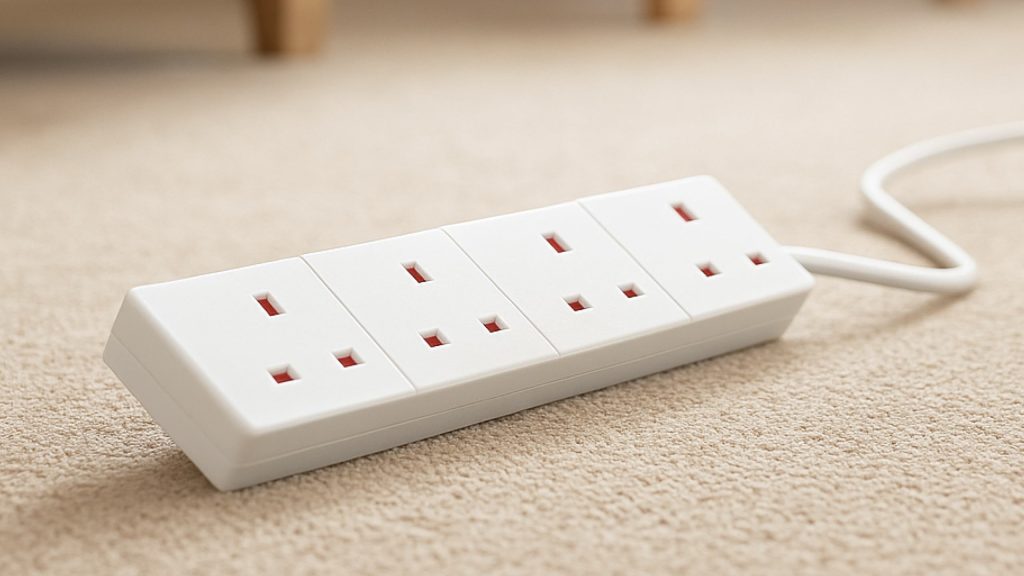

If an extension lead must be used, it must be 3-core (with an earth wire), rated for at least 13 amps, fully unwound if it is a reel type, and positioned where it cannot get wet. Never use two large appliances on the same extension or multi-socket adapter – the combined current draw can exceed 13 amps and cause overheating.

Washing machines, tumble dryers, and dishwashers draw close to 10 to 13 amps and should be connected directly to a dedicated wall socket wherever possible. Extension leads and multi-socket adapters introduce additional connection points that can overheat, and most manufacturer instruction books specifically advise against their use with large appliances.
Extension leads and multi-socket adapters are used in virtually every home, and sold in their millions. They are legal products and can be used safely. The issue with large white goods appliances is specific: the current they draw, combined with the extra connection points and potentially lower-rated cable of an extension lead, creates a genuine overheating risk that a direct wall socket connection does not.
Why Large Appliances Are Different
The problem is not that extension leads are inherently dangerous – it is that they are frequently used with appliances drawing far more current than the lead was designed for, or in combinations that exceed the 13-amp limit of a standard UK wall socket.
| Appliance type | Approximate current draw | Extension lead risk |
|---|---|---|
| Washing machine | 10 to 13 amps | High – near the maximum for a single socket |
| Tumble dryer | 10 to 13 amps | High – never combine with any other large appliance |
| Dishwasher | 8 to 10 amps | High – leave little headroom for any other device |
| Microwave | 4 to 7 amps | Medium – dangerous if combined with any large appliance |
| Kettle | 8 to 13 amps | High – never combine with a washing machine or dryer |
| Phone charger, lamp, router | Under 1 amp each | Low – safe to combine on a multi-socket extension |
A washing machine and a kettle running simultaneously on the same extension or socket will exceed 13 amps and cause overheating. A radio, two lamps, and a phone charger combined will draw less than 3 amps – well within any extension lead’s capacity.
“Do not connect via an extension lead. Extension leads do not guarantee the required safety of the appliance (e.g. danger of overheating).”
Miele washing machine instruction manual
“Do not connect the appliance by an extension lead, multi socket adaptor or similar. These can overheat and are a fire hazard.”
Miele tumble dryer instruction manual
If an Extension Lead Must Be Used: The Requirements

Must be 3-core with an earth wire
A 2-core extension lead has no earth. Using a large appliance without an earth connection puts the user at risk of electric shock if the appliance develops an insulation fault. See our guide on electric shocks from washing machines for more on why earthing matters.

Must be rated for 13 amps
Many extension leads use thinner cable than the appliance’s own flex, rated for 5 or 10 amps. If the cable is noticeably thinner than the appliance’s cable, it is not suitable. A 10-amp rated extension used with a washing machine drawing 13 amps will overheat.

As short as possible
Longer cable means more resistance and more heat generated. Use the shortest extension that achieves the connection needed. Do not coil unused cable – lay it out fully.

Not positioned where it could get wet
If the washing machine leaks, a live extension socket on the floor behind or beside it becomes extremely dangerous. Position any extension socket at worktop height or somewhere it cannot be reached by water from a leak or overflow.
Reel-Type Extension Cables: A Specific Danger
Extension cables on a reel must be fully unwound before use. Wound cable acts as an inductor – it generates heat when current flows through it. All reel-type extensions have two current ratings printed on the body: one for fully unwound and a lower rating for wound or partially wound. The wound rating is typically around 10 amps – which is insufficient for a washing machine, dryer, or dishwasher drawing up to 13 amps.

Do not use a reel-type extension lead as a permanent connection for a large appliance. Even when fully unwound, many reel extensions are only rated for 10 amps – below the requirement for a washing machine or dryer. Avoid them for white goods entirely where possible.
How to Calculate Whether You Are Overloading a Socket
The 13-amp limit applies to the total current draw of everything connected to a single socket or extension. You can check your own combination using the formula below.
Amps = Watts ÷ Voltage. In the UK, use 240 volts for this calculation. Do not use the fuse rating of the appliance as its amp draw – these are different figures.
The wattage of each appliance is on its rating plate – usually found on the back of the machine, inside the door, or on the underside. As an example: a dishwasher rated at 1930W draws 1930 ÷ 240 = 8.04 amps. A toaster rated at 930W draws 930 ÷ 240 = 3.87 amps. Combined, those two appliances draw 11.91 amps – within the 13-amp limit. Adding a washing machine drawing 10+ amps would take the total well over the limit.
The Socket Overload Calculator from Electrical Safety First can help with this calculation if you prefer not to do it manually.
For help finding the rating plate or model number on specific appliance types, see our guides on how to find an appliance model number and where to find the model number on a fridge or freezer.
The Warning Sign: A Fishy Smell Near Appliances
A strange fishy or burning plastic smell near an appliance, plug, or socket that has no other obvious explanation is a warning sign of electrical overheating. Burning or arcing in plastic components – plugs, sockets, adapters, and extension leads – can produce this distinctive smell before any visible damage appears.
Unplug the appliance and inspect the plug, socket, and any extension lead for discolouration, melting, or scorch marks. A discoloured plug or socket face indicates overheating that must be investigated before the appliance is used again. Do not ignore this warning sign.
Related Safety and Electrical Guides
Related Guides
Electric Shocks or Tingles From a Washing MachineWhy a missing or broken earth connection causes shocks – and why it must be investigated immediately.
Washing Machine Tripping the ElectricsCauses of a washing machine tripping an RCD or blowing a fuse – and how to diagnose them.
Is It Safe to Leave the Washing Machine On?The genuine fire risk from unattended appliances and how to manage it safely.
 8 Ways to Make Appliances Safer
Practical steps every household can take to reduce fire, flood, and electrical risks from large appliances.
Frequently Asked Questions
Can I plug a washing machine into an extension lead?
Ideally not – manufacturers including Miele explicitly advise against it in their instruction manuals. If it is unavoidable, the extension must be 3-core with an earth wire, rated for at least 13 amps, as short as possible, fully unwound if it is a reel type, and positioned where it cannot get wet. Never use the washing machine and another large appliance on the same extension.
Can I plug two large appliances into the same extension lead?
Not if either is a washing machine, tumble dryer, or dishwasher. These appliances draw 10 to 13 amps individually – two together would exceed the 13-amp maximum of a standard UK socket and cause the extension lead to overheat. Even two moderate appliances – a washing machine and a microwave or kettle – can exceed this limit.
How do I know if my extension lead is rated for 13 amps?
Check the rating printed on the body of the extension lead or on the plug. If the cable appears noticeably thinner than the appliance’s own flex, it is likely rated below 13 amps. Do not guess – only use an extension if you can confirm it is rated for 13 amps and has a 3-pin plug with an earth pin.
Does a reel extension lead need to be fully unwound?
Yes, always. Wound cable generates heat when current flows through it. Reel-type extension leads have two amp ratings – one for fully unwound and a lower one for wound or partially wound. The wound rating is typically around 10 amps, which is insufficient for a washing machine or dryer. Always fully unwind a reel extension before use and avoid this type for permanent large appliance connections.
What does a fishy smell near a plug or socket mean?
A fishy or burning plastic smell near an appliance, plug, socket, or extension lead that has no other explanation is a warning sign of electrical overheating. Unplug the appliance and inspect all connections for discolouration, melting, or scorch marks. Do not use the appliance or socket again until the cause has been identified and made safe.
77 Comments
Grouped into 51 comment threads.
3 replies Hello again, Does 3 way and 3 core mean the same thing? And also what's a 4 way strip? Is that ok to use in an extension? F
3 replies Hello, the only wall socket available for my combi grill/ oven/microwave is about 2 cms too far. All the advice online seems to be to never use an extension with a microwave. Please cheer me up and tell me this aint necessarily so.
Hello, the only wall socket available for my combi grill/ oven/microwave is about 2 cms too far. All the advice online seems to be to never use an extension with a microwave. Please cheer me up and tell me this aint necessarily so.
Likely replying to Erica Ling
Hello Erica. I can see that one electrical safety site says “Don’t power microwaves using extension leads” but they don’t say why not, which is unsatisfactory. I don’t know of any reason why you can’t, other than as general advice it’s best to avoid extension leads on appliances that draw a lot of power as it introduces extra parts to potentially have a poor connection and overheat. For that reason alone if it’s not strictly necessary it’s best to avoid. To be honest I also find a lot of these extension leads don’t seem to be particularly well made.
Extension leads are designed to extend the reach of a 13 amp wall socket – that’s what they do. Unless it says in the extension lead’s instructions not to use with specific appliances I don’t see what the problem is.
If washing machines and tumble dryers can be plugged into extension leads, a microwave doesn’t use any more power and is often on for far less periods. If you need to use one make sure it’s a good quality one and as short as possible and rated 13 AMPs. To be sure I would try asking Electrical Safety First what the reason is behind their advice to not use one with a microwave.
The best way to use an extension socket in your case would be for someone who knows what they are doing to make up a short lead from 13 Amp cable, a plug and a single extension socket which can still be bought separately rather than a large overly long bought one with more sockets than you need.
2 replies Yes Dennis.
Yes Dennis.
Likely replying to Andy Trigg (Whitegoodshelp)
Hi Andy,
I am looking at connecting my tumble dryer, which is several inches short of the socket, via a single socket extension. The extension cable length I am looking at will either be 20 or 50cm so quite short. I will ensure it is 13 A and 3 core. Is this correct and adequate? Further, the extension will connect to a twin socket on the wall. Do I need to refrain from using the other wall socket at the same time the dryer is on, as that shouldn’t be a problem?
Many thanks – this is an excellent site that will hopefully help resolve my issue!
Kind regards
Likely replying to Francis
Hello Francis. Yes that’s correct. Ideally the extension lead should be as short as possible. You could cut the extension cable down so it’s not overly long and fit a good quality plug to it. Especially if it’s really long. If you wanted to be fastidious about it you could make your own extension cable by cutting it to length as just described and replacing the block extension sockets with a single extension socket. In fact I’ve just found a pretty good single socket extension cable here
With an appliance drawing so much current the ideal is no extension socket. But if one is required the shorter the better and preferably a single socket instead of those multiple sockets.
Regarding using both sockets at the same time there seems to be conflicting advice and opinion about it. To be totally safe ensure nothing else is plugged in that also draws a lot of current such as a fire, dishwasher or washing machine. According to one source twin sockets can endure only 13 Amps but other sources say they can take much more. You may find this thread of interest
26 amps from twin 13 amp socket
If necessary, you could plug 2 appliances in if you could ensure they didn’t run at the same time.
2 replies This is probably a stupid question but I have a washer and dryer that I want to plug into the same plug. I am aware of the one device per plug rule. However, the plug is hidden behind the washer and it's a nightmare to get at it if I want to swap plugs. As such, is it a problem if I run both washer and dryer through an extension lead to the same plug but only ever run one at a time? Both appliance cables have 13a fuses, so does the extension cable, the wall plug is 25a. I am renting so can't change the electrics. Thanks,
This is probably a stupid question but I have a washer and dryer that I want to plug into the same plug.
I am aware of the one device per plug rule.
However, the plug is hidden behind the washer and it’s a nightmare to get at it if I want to swap plugs.
As such, is it a problem if I run both washer and dryer through an extension lead to the same plug but only ever run one at a time?
Both appliance cables have 13a fuses, so does the extension cable, the wall plug is 25a.
I am renting so can’t change the electrics.
Thanks,
Likely replying to Steve
Hello Steve. There’s no one device per plug rule. The rule is only related to the amount of power drawn by any combination of devices. The maximum is 13 Amps. A washing machine and dryer will greatly exceed 13 amps so they should not be run at the same time from any wall socket or extension lead. However, plugging them into the same extension lead will do no harm other than allow the two appliances to potentially be put on at then same time causing overloading. If you are in a position to ensure that never happens then you could leave them both plugged into the same socket.
Conversely you could have 6 devices all running from an extension socket with no issues if they are all devices that use very little power and their combined consumption is less than 13 amps (in the UK).
2 replies @ Andy Trigg: You're right. I've double checked the fuse in my TV and it's only 5 amps, which seems to work well enough. I must have had a false memory when writing my previous post.
@ Andy Trigg: You’re right. I’ve double checked the fuse in my TV and it’s only 5 amps, which seems to work well enough. I must have had a false memory when writing my previous post.
1 reply Hello Would you have any idea about the best way to set up electrical appliances in a caravan awning? I'm looking to have 2 freezers a tumble dryer a dishwasher and washing machine. Separately there will be an air fryer and a nutri bullet and induction hob would be very grateful for your advice thankyou
Hello
Would you have any idea about the best way to set up electrical appliances in a caravan awning? I’m looking to have 2 freezers a tumble dryer a dishwasher and washing machine. Separately there will be an air fryer and a nutri bullet and induction hob would be very grateful for your advice thankyou
Hello Julie. I can’t really advise much because I have no idea about what kind of electricity supply you have installed and its limits. If by any chance you have a normal supply with several plugs, it should be no different from a normal house or kitchen. In other words, each 13 amp plug can take literally 13 amps maximum.As tumble dryers, dishwashers, and washing machines all you was very close to 13 amps when heating up, they need to be in their own separate socket. Something like a couple of freezers would usually be able to be plugged into adapters or extension leads although ideally everything would have its own socket. You can get a good idea of how many amps certain appliances use here https://www.twothirtyvolts.org.uk/socket-overload/
1 reply Hi I need to plug my washing machine into an extension lead can you let me know which one to use that will be safe
Hi I need to plug my washing machine into an extension lead can you let me know which one to use that will be safe
Hello Linda. The best method would be to make one yourself, or get one made up by someone who knows what they are doing. I’ve just updated my article adding a section called, “Make your own extension cable” with a link to some extension sockets that could be used. Alternatively, it’s difficult to be sure what to buy because there are so many rubbish quality electrical products online, even on the big famous sites.
Try to use one with as short a cable as possible. And try to use one with a few extension sockets as possible. In other words, if your washing machine’s cable is just a couple of feet short of a wall socket. Use an extension cable with just 1 m, and not six gang 3 m cable. If you need to order online I would look on somewhere like Screwfix who should always be selling pretty decent quality products.
If you buy one from a DIY store, again you should expect that they would be at the very least reasonable quality.
1 reply I have been very reluctant to use any socket adapter even for low rated appliances. An old fire fighter told me that they spoil the jaws on your socket and cause fires that way. I have never found any evidence to back this up, I was looking for some today when I found your website. Presumably if you had anything to say on this you would have mentioned it above.
I have been very reluctant to use any socket adapter even for low rated appliances. An old fire fighter told me that they spoil the jaws on your socket and cause fires that way. I have never found any evidence to back this up, I was looking for some today when I found your website. Presumably if you had anything to say on this you would have mentioned it above.
Hi Adrian. My old neighbour was a fireman, and he told me the same over 25 years ago. I would think one would need to be heavily overloaded though, and with appliances that use a lot of electricity. Maybe people plugged in a washing machine and dishwasher – that would overload for sure.
Here is a good example of what they mean –
https://www.whitegoodshelp.co.uk/wordpress/wp-content/uploads/2022/12/Mains_adaptor.jpg
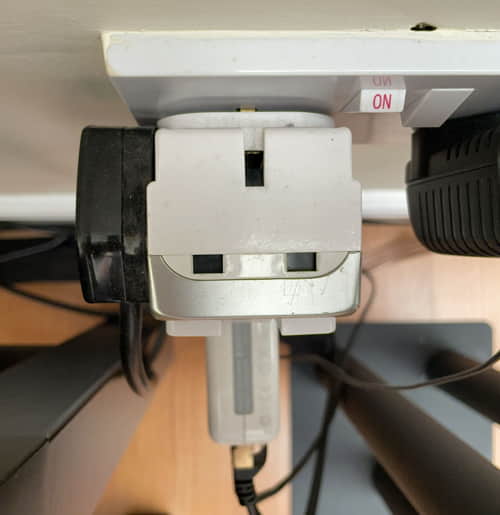
That is one of my adaptors with a large wi-fi adaptor plugged in. It is heavy, and as you can see, it causes the adaptor to drop. The live and neutral prongs in the wall socket are likely to be slightly prized further apart. This could create a small gap between the top of the prongs on the plug and the top of the prongs inside the socket.
So if a large amount of current is drawn there could be small sparks jumping across the gap, which under certain circumstances could create heat.
However, even though I sometimes also plug an electric oil heater into it, I’ve never noticed any excess heat, and I’ve checked. Under normal circumstances, the hi-fi Amp and wi-fi adaptor hardly draw any power at all, and I can’t imagine how it could create any dangerous heat. However, I hope that’s a good explanation :)
1 reply Got a 10 amp can I run my fridge freezer off it x
1 reply Hi I want to know if it's safe to plug a tabletop fridge and a kettle into the same 2 socket extension cable?
Hi I want to know if it’s safe to plug a tabletop fridge and a kettle into the same 2 socket extension cable?
Likely replying to Caroline
Hello Caroline. To be sure you would need to work out the exact wattage of both appliances and divide by the voltage to get how many amps they use combined. The instructions are in my article. However, most kettles are likely to use very close to 13 amp so shouldn’t really be run with any other appliance.
Leave a comment
1 reply Hi, I have a fridge freezer and a chest freezer but only one socket, can I plug them both into a 13 amp extension lead?
Hi, I have a fridge freezer and a chest freezer but only one socket, can I plug them both into a 13 amp extension lead?
Likely replying to Julie
Hello Julie. For some reason the overload calculator tool in my article doesn’t show fridges. Presumably because they vary too much in how much electricity they use. I would think they would OK but the only way to be sure is to work it out. I’ve added several new paragraphs to this article underneath the tool explaining how to work out how many amps your appliances use.
1 reply Hi. I have just purchased a single electric oven which I bought as it said it did not need installation as it was on 13amp plug. However the plug cable is too short and does not reach the plug socket on the wall. I have an extension lead for 13amp appliances and will only have the oven plugged in. Would this be safe as in the instructions it advises not to use extension cable. Please help
Hi. I have just purchased a single electric oven which I bought as it said it did not need installation as it was on 13amp plug. However the plug cable is too short and does not reach the plug socket on the wall. I have an extension lead for 13amp appliances and will only have the oven plugged in. Would this be safe as in the instructions it advises not to use extension cable. Please help
Likely replying to Alexandra
Hello Alexandra. In a perfect world you’d have the mains lead on the oven replaced with a longer one that reaches. But extension leads were invented to allow us to plug in things that would otherwise not reach. They can’t be intrinsically unsafe or they wouldn’t be around. However, manufacturers’ don’t like them and advise against using them.
Extension cables and leads are a source of potential problems and are likely to vary in quality. Their main concern is likely to be that an oven uses a lot of power, so if you used an extension socket and then plugged any other appliance in with it then it could cause an overload situation. The other concern is that it introduces extra connections at the extensions’s sockets that could cause overheating problems if they weren’t good quality and good connections.
Try to use an extension cable as short as possible. Consider getting the cable on the extension cut down to be just long enough to reach or try to buy one as short as possible or get one made up for you. They are by design usually quite long and you don’t want one that’s way too long. Finally keep an eye on it. Keep checking it to make sure the plug isn’t getting hot and starting to burn. Regularly unplug the oven from the extension and check the plug and socket and also check the extension cable’s plug and the wall socket.
1 reply Is it safe to cut plug off a 4-way extension lead and wire it into a covered mains wall socket for a fridge freezer
Is it safe to cut plug off a 4-way extension lead and wire it into a covered mains wall socket for a fridge freezer
Likely replying to Pauline Santer
Hello Pauline. As long as the extension is 13 Amp, (thick cable and with a 13 amp fuse in plug) and wall socket is 13 amp (check it has a 13 Amp fuse) and as long as you don’t plug appliances needing more than 13 amps combined I can’t think of an issue. If any don’t have a 13 amp fuse you can’t rectify it by fitting a 13 amp fuse – the cable will not be designed for 13 amp!
1 reply Been reading some of the posts and though some information i was already aware of others i was not. Which has prompted me to ask the following 2 questions. Question 1. When totting up the amps, reading some posts, people think that we add the amp of the fuse in the plug together to get the total, I am assuming this is incorrect as you would only get 4 X 3 amp plugs in a 4-way extension lead. My way of thinking was each product should have an amp rating, ie 2400 watts for a toaster would equal 10 amps, 100 watt dvd player would equal 0.42 amps, would i be correct in that assumption. Question 2. If i am correct about the watts ( Wattage of product divided by 240 Voltage = Amps) then should I be o.k for the following, Single wall socket, 12-way extension lead (Tower), each level of 3 sockets has an on/off switch, for products not used all the time. Television, Skybox, BT Vision Box, DVD Recorder, Playstation 3, 5.1 Amplifier, Aerial Signal Booster, Lamp, Fan, Laptop, Phone Charger. Not all products are on at the same time you will be glad to know, and this is not how they are connected now. Apologies for the tong post, but there does not seem to be much information out there regarding safety of extension leads with 10 or more sockets.
Been reading some of the posts and though some information i was already aware of others i was not. Which has prompted me to ask the following 2 questions.
Question 1. When totting up the amps, reading some posts, people think that we add the amp of the fuse in the plug together to get the total, I am assuming this is incorrect as you would only get 4 X 3 amp plugs in a 4-way extension lead. My way of thinking was each product should have an amp rating, ie 2400 watts for a toaster would equal 10 amps, 100 watt dvd player would equal 0.42 amps, would i be correct in that assumption.
Question 2. If i am correct about the watts ( Wattage of product divided by 240 Voltage = Amps) then should I be o.k for the following,
Single wall socket, 12-way extension lead (Tower), each level of 3 sockets has an on/off switch, for products not used all the time.
Television, Skybox, BT Vision Box, DVD Recorder, Playstation 3, 5.1 Amplifier, Aerial Signal Booster, Lamp, Fan, Laptop, Phone Charger.
Not all products are on at the same time you will be glad to know, and this is not how they are connected now.
Apologies for the tong post, but there does not seem to be much information out there regarding safety of extension leads with 10 or more sockets.
Likely replying to Ian
Hello Ian. Yes, the fuse amp rating is the ampage that the fuse wil blow at, which is often very different to the amp rating of the appliance. If an appliance doesn’t have it’s amp rating on the rating plate the ampage can be worked out from the wattage and voltage – Amps = watts divided by voltage. In the UK the voltage is (officially 230v but in practice 240 v) so a 1000 watt appliance divided by 240 is 4.16 amps so a 5 amp fuse would be required.
1 reply Hi is it safe to plug 2 extension leads into a double wall socket ( so one extension per socket ) thanks
Hi is it safe to plug 2 extension leads into a double wall socket ( so one extension per socket ) thanks
Likely replying to cal
Hello Cal. I’m not an electrician, but my understanding is that a double wall socket is designed to supply a maximum of 13 Amps. Therefore if you connected extension leads into each one you should be able to plug in multiple things as long as they didn’t exceed 13 Amps combined. It’s a good idea to keep products plugged in to a minimum but 4 low power items plugged in to an extension lead can draw half the power of 1 tumble dryer for instance so it’s more about the amount of power being drawn than the amount of appliances. Have a play with the extension overloading tool at the bottom of my article.
1 reply That's what I meant. Sorry, I get confused a lot because I'm Autistic. You're right, motors don't draw a lot of power or my fan would need more than the 3 amp fuse it's got (which is the same as my lamp, incidentally).
That’s what I meant. Sorry, I get confused a lot because I’m Autistic. You’re right, motors don’t draw a lot of power or my fan would need more than the 3 amp fuse it’s got (which is the same as my lamp, incidentally).
1 reply I'm trying to connect a washing machine and getting no power. First I plugged it into the extension cable that the old machine was connected to. When that didn't work, I connected it to a standard fixed socket in the wall just to check. Again no power. The new washing machine has a 10 amp plug while the old one had a 13amp. Could that be the problem and can it be safely cured by putting a 13 amp fuse into the washing machine plug?
I’m trying to connect a washing machine and getting no power. First I plugged it into the extension cable that the old machine was connected to. When that didn’t work, I connected it to a standard fixed socket in the wall just to check. Again no power.
The new washing machine has a 10 amp plug while the old one had a 13amp. Could that be the problem and can it be safely cured by putting a 13 amp fuse into the washing machine plug?
1 reply Hi Can I safely plug in a 55 inc. TV, Sky HD box, Sky wireless hub, a Cinema surround system and a Amazon box into a multi socket lead. Best regards Brian Gibson
Hi Can I safely plug in a 55 inc. TV, Sky HD box, Sky wireless hub, a Cinema surround system and a Amazon box into a multi socket lead.
Best regards
Brian Gibson
Likely replying to Brian Gibson
Hello Brian. The main rule of thumb is not to exceed 13 amps. Although it sounds like you would be plugging a lot of things in, none of the items are likely to draw a lot of current so even when combined they may use much less electricity than a single electric fire. The way to check is to look at each appliance’s rating plate which should tell you how many amps it draws, then add them all together to see if they add up to more than 13 Amps.
I’ve just reinstated a very handy overload checking tool provided by electrical safety first (Electrical safety Council). I originally had this tool as part of my article but it went faulty so I removed it. It appears to be working okay at the moment and you can find it at the bottom of the article now.
1 reply Can I safely plug in a landline and fire into an extension socket, or does fire need to be connected via a wall socket. Thanks
Can I safely plug in a landline and fire into an extension socket, or does fire need to be connected via a wall socket. Thanks
0 replies Hi Can I plug a freezer into an extension lead?
Hi Can I plug a freezer into an extension lead?
0 replies Hi, as my article says it's not ideal to use high energy appliances with an extension cable but at the end of the day they are designed to extend a 13 amp wall socket so should be safe. An electric hot plate won't use any more electricity than a washing machine, tumble dryer or dishwasher and possibly millions of people use those appliances at the end of an extension socket. My own tumble dryer is plugged into an extension socket. Just don't buy cheap rubbish ones.
Hi, as my article says it’s not ideal to use high energy appliances with an extension cable but at the end of the day they are designed to extend a 13 amp wall socket so should be safe. An electric hot plate won’t use any more electricity than a washing machine, tumble dryer or dishwasher and possibly millions of people use those appliances at the end of an extension socket. My own tumble dryer is plugged into an extension socket. Just don’t buy cheap rubbish ones.
0 replies Is it safe to plug an electric hot plate into an extension with an RCD? The appliance would only be in use for two hours at a time.
Is it safe to plug an electric hot plate into an extension with an RCD? The appliance would only be in use for two hours at a time.
0 replies I'm not sure what you mean about extending the dishwasher wire with the extra wire joint Jk. If you mean to extend the mains cable without using any extension adaptor you could join another small piece of 13 amp cable to the end of the mains lead using a proper 13 amp amp. An alternative would be to extend the dishwasher mains lead by making a single socket extension lead. I wouldn't use those small break off terminal strip plastic connectors that are designed for single wires. Regarding a gas hub and a dishwasher plugged into the same wall socket I can't see a problem. If it's a gas hob then presumably it will draw very little power for maybe just the ignition?
I’m not sure what you mean about extending the dishwasher wire with the extra wire joint Jk. If you mean to extend the mains cable without using any extension adaptor you could join another small piece of 13 amp cable to the end of the mains lead using a proper 13 amp amp. An alternative would be to extend the dishwasher mains lead by making a single socket extension lead.
I wouldn’t use those small break off terminal strip plastic connectors that are designed for single wires.
Regarding a gas hub and a dishwasher plugged into the same wall socket I can’t see a problem. If it’s a gas hob then presumably it will draw very little power for maybe just the ignition?
0 replies Hi Is it safe to to extend the dishwasher Wire with the extra wire joint on to it to extend the lead so that it can reach the wall socket. And also the gas hub and dishwasher are they both safe pluged into the double wall socket. Much appreciated
Hi
Is it safe to to extend the dishwasher
Wire with the extra wire joint on to it to extend the lead so that it can reach the wall socket.
And also the gas hub and dishwasher are they both safe pluged into the double wall socket.
Much appreciated
0 replies Hello Elis. A tumble dryer will use almost 12 amps. There's not much left in a 13 amp socket. If the chest freezer uses more than a few amps it will overload the socket. I would assume that the combined amps that those two appliances use is greater than 13 amps.
Hello Elis. A tumble dryer will use almost 12 amps. There’s not much left in a 13 amp socket. If the chest freezer uses more than a few amps it will overload the socket. I would assume that the combined amps that those two appliances use is greater than 13 amps.
0 replies 1 have a new double socket extension. When I have the small chest freezer on and then work tumble drier it fuses. Please explain why.
1 have a new double socket extension. When I have the small chest freezer on and then work tumble drier it fuses. Please explain why.
0 replies Mains leads are as short as they think they can get away with because it's cheaper. If they cut 1 inch off all their washing machines that can save them millions of inches of mains cable. It's annoyingly the same with everything these days including my phone charging cable. Over the 40 years I've been in the appliance trade I reckon appliance mains cables have shrunk by a good couple of feet or more. They might have even halved if I think about it, but slowly over many years.
Mains leads are as short as they think they can get away with because it’s cheaper. If they cut 1 inch off all their washing machines that can save them millions of inches of mains cable. It’s annoyingly the same with everything these days including my phone charging cable. Over the 40 years I’ve been in the appliance trade I reckon appliance mains cables have shrunk by a good couple of feet or more. They might have even halved if I think about it, but slowly over many years.
0 replies So why don't they make leads on appliances a lot longer? Some are hardly worth the bother so you have to use an extension lead...
So why don’t they make leads on appliances a lot longer? Some are hardly worth the bother so you have to use an extension lead…
0 replies Just a normal 3 core 13 amp extension Laura.
Just a normal 3 core 13 amp extension Laura.
0 replies hi,ive bought a new fridge freezer ,the plug wire is too short-can I use an extension lead?-if so which type?
hi,ive bought a new fridge freezer ,the plug wire is too short-can I use an extension lead?-if so which type?
0 replies I have my fridges and freezers all connected via an extension cable. If the extension cable is good quality, and not very long and not overload I can't see what the problem would be. Extension cables do introduce the possibility of overloading, if really long potential drops in current and potential extra connection faults so maybe they just want to discourage it but extension cables are a legitimate product used by millions of people and designed specifically to extend the reach of wall sockets.
I have my fridges and freezers all connected via an extension cable. If the extension cable is good quality, and not very long and not overload I can’t see what the problem would be. Extension cables do introduce the possibility of overloading, if really long potential drops in current and potential extra connection faults so maybe they just want to discourage it but extension cables are a legitimate product used by millions of people and designed specifically to extend the reach of wall sockets.
0 replies I have just purchased a Beko under counter frost free freezer, but the plug is to short to reach my socket, and the instructions say dont use an extension cable, why is this?? and would it be OK to use an extension cable?
I have just purchased a Beko under counter frost free freezer, but the plug is to short to reach my socket, and the instructions say dont use an extension cable, why is this?? and would it be OK to use an extension cable?
0 replies Many thanks, Andy, thats very helpful. The ability to leave the cable coiled is actually used as a main selling feature for these cable tidy devices, so I'm sure you are right in that if it were a concern, there would be a requirement to place a warning on them. Much appreciated!
Many thanks, Andy, thats very helpful.
The ability to leave the cable coiled is actually used as a main selling feature for these cable tidy devices, so I’m sure you are right in that if it were a concern, there would be a requirement to place a warning on them.
Much appreciated!
0 replies Overheating of cables in coiled positions is something I associate with mains cabled because of the current they carry. Chargers usually have a large plug containing a transformer that reduces the current to low voltages. The charger plug usually gets quite hot but is designed to do so. For that reason they need air circulating around them. The thin cable that plugs into the device is probably only carrying a fraction of the voltage so it may not be subject to the same overheating concerns but I can't reliably say whether it's ok or not. I would expect if it was an issue though that the instructions for the cable storage device or printed somewhere on it there ought to be a warning as there is on mains cable extensions that come in a wound reel.
Overheating of cables in coiled positions is something I associate with mains cabled because of the current they carry. Chargers usually have a large plug containing a transformer that reduces the current to low voltages. The charger plug usually gets quite hot but is designed to do so. For that reason they need air circulating around them. The thin cable that plugs into the device is probably only carrying a fraction of the voltage so it may not be subject to the same overheating concerns but I can’t reliably say whether it’s ok or not. I would expect if it was an issue though that the instructions for the cable storage device or printed somewhere on it there ought to be a warning as there is on mains cable extensions that come in a wound reel.
0 replies I know you should completely unwind an extension cable before use, but it is safe to use a charger cable only partially unwound, (ie when charging a phone, tablet, etc?) The reason I ask, is that cable storage tidies are available that allow you to only unwind exactly the amount of cable you need to prevent trailing wires when charging small devices. This doesn't sound very safe to me, but is it ok to do?
I know you should completely unwind an extension cable before use, but it is safe to use a charger cable only partially unwound, (ie when charging a phone, tablet, etc?)
The reason I ask, is that cable storage tidies are available that allow you to only unwind exactly the amount of cable you need to prevent trailing wires when charging small devices.
This doesn’t sound very safe to me, but is it ok to do?
0 replies Yes Tom as long as they were never used at the same time.
Yes Tom as long as they were never used at the same time.
0 replies Hi there i want to have a dishwasher and a washing machine. But i only have one wall socket. If i get a 13amp extension lead but only ever used one at a time never at the same time would this be safe?
Hi there i want to have a dishwasher and a washing machine. But i only have one wall socket.
If i get a 13amp extension lead but only ever used one at a time never at the same time would this be safe?
0 replies brill site,from experience and eltro sensitive person,dont play with electic,my freind a farmer said les my shed give sparking when change swithes,ie on off and other switches, i felt around the use box 6 inches away, i could feel the electric, waiting to short out to earth of a person/animal, i used my electric mains test and showed him,7 inches away from the meter the air was live the tester lit before contact, i went the following day with rubber mat ,wooden brush with bristle,swept all the cobwebs away and cleaned the fuse box,all while off? after this it was safe,but if you dont know about electric ,stay away, in uk its av killer?usa and europe 110 volt, not too bad
brill site,from experience and eltro sensitive person,dont play with electic,my freind a farmer said les my shed give sparking when change swithes,ie on off and other switches, i felt around the use box 6 inches away, i could feel the electric, waiting to short out to earth of a person/animal, i used my electric mains test and showed him,7 inches away from the meter the air was live the tester lit before contact, i went the following day with rubber mat ,wooden brush with bristle,swept all the cobwebs away and cleaned the fuse box,all while off? after this it was safe,but if you dont know about electric ,stay away, in uk its av killer?usa and europe 110 volt, not too bad
0 replies Hello, my expertise doesn't extend too far into electrician territory regarding taking spurs off existing sockets. But any standard socket can accept any appliance apart from a cooker which needs special sockets. So ideally a washing machine should be plugged directly into the nearest wall socket. If there isn't one close enough it is possible to use a good quality extension cable as long as it isn't too long. It's not ideal but extension cables are designed to extend the reach of a wall socket and you should be to plug any appliance in as long as you don't overload it.
Hello, my expertise doesn’t extend too far into electrician territory regarding taking spurs off existing sockets. But any standard socket can accept any appliance apart from a cooker which needs special sockets. So ideally a washing machine should be plugged directly into the nearest wall socket. If there isn’t one close enough it is possible to use a good quality extension cable as long as it isn’t too long. It’s not ideal but extension cables are designed to extend the reach of a wall socket and you should be to plug any appliance in as long as you don’t overload it.
0 replies Hi there I have a query regarding washing machine. If I wanted to move it other side of kitchen, does it need a new power point. Can I spur off a existing 6mm twin earth cable from a cooker switch? Or plug the washer into a standard double socket on other end of kitchen? Any advice I would appreciate it thanks.
Hi there I have a query regarding washing machine. If I wanted to move it other side of kitchen, does it need a new power point. Can I spur off a existing 6mm twin earth cable from a cooker switch? Or plug the washer into a standard double socket on other end of kitchen? Any advice I would appreciate it thanks.
0 replies Motors don't draw much, only the heating element.
Motors don’t draw much, only the heating element.
0 replies Seems amazing, but isn't really. Hairdryers have motors, which is what draws all the power.
Seems amazing, but isn’t really. Hairdryers have motors, which is what draws all the power.
0 replies Yes it's amazing that hairdryer can use the same amount of electricity as a washing machine.
Yes it’s amazing that hairdryer can use the same amount of electricity as a washing machine.
0 replies To be safe I'd stick to a maximum of 13 amps. I've seen in forums where people say they can cope with up to 20 Amps, but others say 13 Maximum. I would think if each side of the socket had independent wiring it should cope with 13 Amps each socket but I reckon a double wall socket is likely to have just one normal set of live and neutral and therefore only 13 Amps.
To be safe I’d stick to a maximum of 13 amps. I’ve seen in forums where people say they can cope with up to 20 Amps, but others say 13 Maximum. I would think if each side of the socket had independent wiring it should cope with 13 Amps each socket but I reckon a double wall socket is likely to have just one normal set of live and neutral and therefore only 13 Amps.
0 replies I HAVE A DOUBLE WALK SOCKET IS IT SAFE TO PLUG A WASHER AND A DRYER IN TO THEM
I HAVE A DOUBLE WALK SOCKET IS IT SAFE TO PLUG A WASHER AND A DRYER IN TO THEM
0 replies Anything with a heating element in will draw a lot of power. TVs hardly draw anything in comparison though. If you use the tool at the bottom of my article you can drag four TVs into an extension socket and they still hardly use any electricity compared with a washing machine.
Anything with a heating element in will draw a lot of power. TVs hardly draw anything in comparison though. If you use the tool at the bottom of my article you can drag four TVs into an extension socket and they still hardly use any electricity compared with a washing machine.
0 replies According to the socket overloading tool at the bottom of my article a typical washing machine will draw about 10 A. I'm pretty sure in the past at least I've registered washing machines drawing more than this. However, even if they only draw 10 A I would've thought a 10 amp fuse is cutting it a bit fine as you may get fluctuations. All UK washing machines have always come with a 13 amp fuse fitted.
According to the socket overloading tool at the bottom of my article a typical washing machine will draw about 10 A. I’m pretty sure in the past at least I’ve registered washing machines drawing more than this. However, even if they only draw 10 A I would’ve thought a 10 amp fuse is cutting it a bit fine as you may get fluctuations. All UK washing machines have always come with a 13 amp fuse fitted.
0 replies Personally, I would fit anything that draws a lot of power with a 13 amp fuse; TV, washing machine, tumble dryer, anything like that. Also, once you've replaced the fuse, get in touch with the manufacturer of your machine to point out their error (or the seller if it's a refurb).
Personally, I would fit anything that draws a lot of power with a 13 amp fuse; TV, washing machine, tumble dryer, anything like that. Also, once you’ve replaced the fuse, get in touch with the manufacturer of your machine to point out their error (or the seller if it’s a refurb).
0 replies The longer a cable ends up, and the more plugs and sockets it has the more there is to go wrong including things overheating due to poor connections. The products you mention don't use much power at all though so it shouldn't be overloaded.
The longer a cable ends up, and the more plugs and sockets it has the more there is to go wrong including things overheating due to poor connections. The products you mention don’t use much power at all though so it shouldn’t be overloaded.
0 replies Is it OK to use extension cables with just one socket at the end to plug a multi-socket lead into if all that's in the multi-socket lead is a phone charger and a handheld console charger?
Is it OK to use extension cables with just one socket at the end to plug a multi-socket lead into if all that’s in the multi-socket lead is a phone charger and a handheld console charger?
0 replies Very informative, and useful...a simple article like this will save lives.
Very informative, and useful…a simple article like this will save lives.
Hello again,
Does 3 way and 3 core mean the same thing? And also what’s a 4 way strip? Is that ok to use in an extension?
F
Likely replying to Francis
Hello Francis. Three way usually refers to 1 of those square adapters that you plug into a socket. They commonly have three sockets. Three core means that the cable has got three cores running through it, live, neutral, and earth. It is vital that any extension cable that is to be used for a white goods appliance is not only three core, but 13 amp. I 13 amp cable is usually fairly thick. A four-way strip is presumably just an extension cable with four sockets at the end.
Likely replying to Andy Trigg (Whitegoodshelp)
Hi Andy, your Website is very helpful:) thanks for sharing your knowledge.
I’ve just moved to a flat and there’s no designated space for the fridge in the kitchen, hovewer I moved to the kitchen anyway but there’s no sockets on that wall so I wanted to run an extension cord along the wall and above the door. The extension si 5meters. Do you think that will be OK? Thank you :)
Likely replying to Justyna Litwin Martinelli
Thanks Justyna. Yes that should be fine as long as it’s good quality and in good condition. Fridges don’t use much electricity so the risk of overheating is far less than on something like a tumble dryer or washing machine. At the end of the day, no matter what manufacturers say about avoiding using extension cables, extension cables exist. They are sold, sanctioned by the government, and they exist solely so that we can extend the length of wall sockets. So as long as they are used sensibly, not overloaded and ideally kept as short as possible there should be perfectly fine.