
Dishwasher Fires
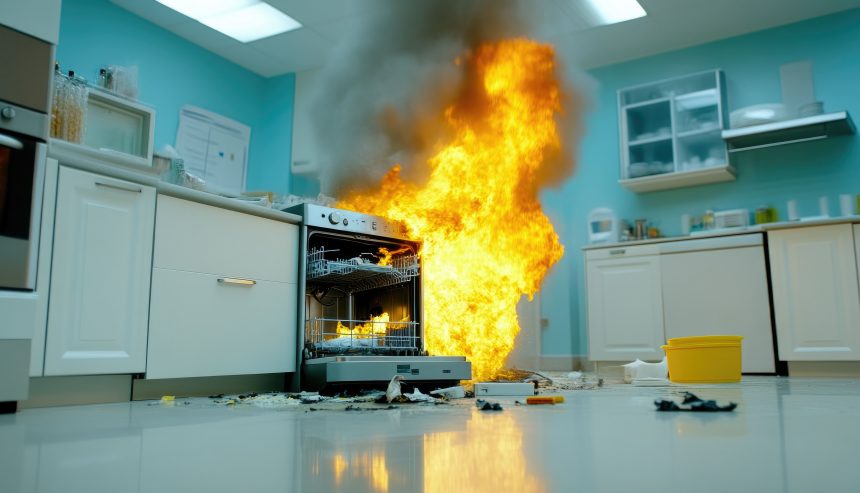
Dishwashers can and do catch fire – sometimes with devastating consequences. This page collects real accounts from people who have experienced dishwasher fires, followed by practical steps to reduce the risk in your own home. All large appliances carry some fire risk, but dishwashers appear more frequently than most in reports of appliance fires.

The accounts below show how quickly a dishwasher fire can become catastrophic – and how often it is only the presence of someone in the house that prevents complete disaster.
Real Experiences: Dishwasher Fires
The following accounts were submitted by real people after experiencing dishwasher fires in their own homes. They are published here to illustrate why this is a genuine risk – and why it matters.
Amanda Edwards: “My AEG Favorit has just caught fire. I have just seen from your very informative website here that this model was recalled in March 2008 (I bought it in October 2007). Luckily I was standing right next to it when I heard popping and hissing and streams of smoke coming from the top of the front panel. I unplugged it. We usually put it on at night. My son sleeps directly above it. Had I not been there my house could have burnt down. I dread to think of the consequences.”
Mark Stoneman: “Our dishwasher caught fire at 3.30 in the morning. Luckily my wife heard what seemed like earthquake/rumble and woke up. It was the sounds of cracking when she said something is not right so I went to investigate downstairs and I found our kitchen alight. Flames and smoke from the dishwasher had caught the kitchen bench alight and smoke was halfway down the room. I got everyone out of the house and was instructed to wait for the fire brigade but they were 15 mins away so managed to get buckets of water and get it out. Our house and family were saved but how could this faulty product still be out there and we as home-owners not informed of the risks to our families and property?”
E F P Lee: “Purchased Zanussi ZDF601K in February 2007, on the night of the 6 December 2007 this dishwasher caught fire. Smoke alarms alerted us, we had three dogs in the kitchen, we had to leave one in as the smoke was so dense we could not find him, we risked our lives trying to get the dogs out.”
Alejandro: “My 2 year old dishwasher AEG Favorit F50870 caught fire and destroyed my house for a month. Insurance company takes care of us. How many cases and even deaths still waiting to come???”
Martin: “I was in the room next door and heard a loud bang from the kitchen. Thinking the dog had dragged something off a worktop I rushed in. I was greeted by billowing black smoke coming from the front of the dishwasher and a rather alarming red glow at the top of the door. Alarmingly we normally put the dishwasher on timer to come on after midnight! My wife has had a serious hip and socket replacement last week so would have been unable to move quickly or climb out of windows.”
Johnathan Chapman: “Our dishwasher caught fire and fortunately we were in the house otherwise it could have been very nasty.”
Mark: “Our Zanussi ZDF 501 caught fire the other night, 2 years after we’d purchased it. Fortunately we were in the house at the time, and were able to stop the fire within seconds of smelling the smoke. Having said that, the flames were pretty big, and the molten plastic from the dishwasher had started a secondary fire on our lino floor. I’ve no doubt the whole house would have gone up in smoke if we’d been out.”
In every single case above, the person was in the house. In several cases, the dishwasher was running at night or was typically set to run while everyone slept. This is the highest-risk scenario for any appliance fire.
How to Reduce the Risk of a Dishwasher Fire
Manufacturers periodically issue appliance safety notices when known faults are identified – but often years after the appliance was sold. Owners who have moved house, or never registered the appliance, may be completely unaware that a safety recall applies to their machine.
However, fires can start in any appliance regardless of whether a known safety issue exists. The single most effective precaution is to treat appliances as the fire risks they can be, and never leave them running unsupervised in high-risk situations.
 Never run a dishwasher, washing machine, or tumble dryer when everyone is out of the house – or when everyone is in bed. If a cycle is interrupted by needing to leave, pause or cancel it and resume on return. This is a minor inconvenience that can prevent catastrophe. See: risks of leaving an appliance running when out or in bed.
- Register appliances with the manufacturer when purchased so they can contact you if a safety notice is issued. See: should you register your appliance?
- Never ignore faults. Unusual sounds, burning smells, or unexpected behaviour should always be investigated and not dismissed. Have a fault checked promptly.
- Install a smoke alarm close to the appliance. Dishwashers are typically in kitchens where standard alarms may be triggered by cooking. There are kitchen-rated smoke alarms designed to avoid false alarms from cooking while still detecting genuine fire.
- Keep a fire extinguisher accessible that is rated for use on electrical appliances.
- Never leave pets unattended in the same room as a running appliance. As several of the accounts above demonstrate, animals trapped in a smoke-filled room face extreme danger.
- Check whether your appliance is subject to a safety notice. See the full list: dishwasher safety notices | all appliance safety notices.
More appliance safety guides
Frequently Asked Questions
Can dishwashers really catch fire?
Yes. Dishwasher fires are reported regularly and can start with very little warning – sometimes with popping or hissing sounds, sometimes silently with smoke. The electrical components, control panels, and plastic parts inside a dishwasher can all ignite under fault conditions. The accounts on this page demonstrate how quickly a dishwasher fire can escalate.
Is it safe to leave a dishwasher running overnight?
No – this is one of the highest-risk things a householder can do with any appliance. Several of the fires described on this page occurred when the dishwasher was set to run at night. If a fire starts when everyone is asleep, the time to detect and respond is far shorter. The strong advice from appliance safety experts is never to run a dishwasher, washing machine, or tumble dryer when everyone is in bed or out of the house.
How do I find out if my dishwasher has a safety recall?
Check the safety notices listed on Whitegoods Help: dishwasher safety notices | all appliance safety notices. Also register appliances with the manufacturer when purchased, so they can contact you directly if a safety notice is later issued.
What should I do if my dishwasher smells of burning or makes unusual sounds?
Turn the dishwasher off immediately at the appliance and at the wall socket. Do not use it again until it has been checked by a qualified engineer. A burning smell or unusual popping, crackling, or hissing is a sign of a potential electrical fault. Do not dismiss it or continue to use the appliance hoping the fault will resolve itself.
What type of fire extinguisher should I have near kitchen appliances?
A CO2 extinguisher is suitable for electrical appliance fires. A water-based extinguisher must never be used on electrical fires. A dry powder extinguisher is also suitable for electrical fires but is messy and damages surfaces. For kitchens, a CO2 extinguisher or a combined fire blanket and CO2 extinguisher is the most practical choice. Always ensure the extinguisher is within its service date.
Appliance safety tips – Detergent capsules – danger to children – Fire risks in appliances
6 Comments
Grouped into 5 comment threads.
1 reply We returned home today to find it full of smoke and the Candy dishwasher on fire! Luckily, we had only been out for a couple of hours and managed to catch it before it took real hold. Needless to say, the kitchen is ruined, the house stinks and my wife and I feel sick after inhaling toxic smoke. I will seriously consider only using electrical appliances when at home in future, and when fully awake. I will also ensure appliances are switched off when not in use.
0 replies Thanks for adding your experience Pauline. It could be water getting onto electrics and shorting them out or a component like a pump catching fire, or various other things. Was it one of these? Bosch, Neff and Siemens dishwashers fire risk safety notice. It would be very old though if it was. I have a useful article everyone should read and hopefully share here - 8 ways you can make your appliances more safe
Thanks for adding your experience Pauline. It could be water getting onto electrics and shorting them out or a component like a pump catching fire, or various other things. Was it one of these?
Bosch, Neff and Siemens dishwashers fire risk safety notice. It would be very old though if it was.
I have a useful article everyone should read and hopefully share here – 8 ways you can make your appliances more safe
0 replies Our slimline Bosch dishwasher caught fire last night. Luckily had not gone to bed but usually in bed or at work while dishwasher on! By reading these threads realise how dangerous can be. Don't risk it. We have no idea of what caused the problem at the moment. Circuit board?
Our slimline Bosch dishwasher caught fire last night. Luckily had not gone to bed but usually in bed or at work while dishwasher on! By reading these threads realise how dangerous can be. Don’t risk it. We have no idea of what caused the problem at the moment. Circuit board?
0 replies I've since written more about the dangers and give several tips to make appliance use more safe here - How dangerous are our appliances? and here 8 ways to make your appliances safer
I’ve since written more about the dangers and give several tips to make appliance use more safe here – How dangerous are our appliances? and here 8 ways to make your appliances safer
0 replies Thanks for sharing your experience Charles. It's something I keep going on about but it's really important. Dishwashers, washing machines and tumble dryers just do not need to be left running totally on their own with no one in the house or only in bed. It's just not worth the risk.
Thanks for sharing your experience Charles. It’s something I keep going on about but it’s really important. Dishwashers, washing machines and tumble dryers just do not need to be left running totally on their own with no one in the house or only in bed. It’s just not worth the risk.
We returned home today to find it full of smoke and the Candy dishwasher on fire! Luckily, we had only been out for a couple of hours and managed to catch it before it took real hold. Needless to say, the kitchen is ruined, the house stinks and my wife and I feel sick after inhaling toxic smoke.
I will seriously consider only using electrical appliances when at home in future, and when fully awake. I will also ensure appliances are switched off when not in use.
My candy dishwasher caught today must be a fault