
Black jelly-like substance in soap dispenser and on soap drawer
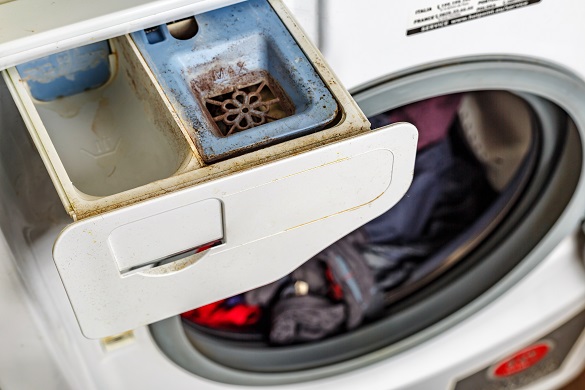

Black or grey jelly-like growth in a washing machine soap dispenser drawer is biofilm – a colony of bacteria and fungi feeding on detergent and fabric softener residue in a persistently damp environment. It looks unpleasant, can block the dispenser nozzles, and causes practical problems including fabric softener flushing too early and leaks from the drawer. It can be cleaned out and controlled but will return without addressing the underlying dampness.
What Biofilm Is and Why It Grows in Soap Dispensers
Biofilm is a colony of bacteria and fungi that forms on surfaces where two conditions are met: moisture and a nutrient source. A washing machine soap dispenser provides both permanently – residual detergent and fabric softener are the nutrient source, and the dispenser is never fully dry between washes.
The growth accelerates in poorly ventilated spaces where the dispenser stays damp for extended periods. Leaving the drawer closed between washes creates exactly these conditions.
Why It Causes Problems Beyond Appearance

Blocked dispenser nozzles
The top of the dispenser recess has small water inlet nozzles that flush detergent into the drum. Biofilm builds up in and around these nozzles, restricting or redirecting the water flow. Blocked nozzles mean detergent is not fully flushed into the drum at the start of the wash.

Fabric softener taken out too early
When nozzles are partially blocked, water is deflected into the fabric softener compartment during the initial fill rather than being directed into the main wash compartments. This causes the softener to be drawn out during the wash cycle rather than the rinse – reducing its effectiveness. See our guide on fabric softener taken out too soon.

Leaking from the drawer
Deflected water can spray towards the front of the dispenser recess and escape under the drawer, appearing as a leak from the soap drawer area. See our guide on washing machine leaking from the drawer.
How to Remove the Biofilm
-
Remove the soap drawer completely.
Most washing machine drawers have a clip or tab at the back of the fabric softener compartment that, when depressed, allows the drawer to be pulled all the way out. Consult the instruction manual if the release mechanism is not obvious.
-
Clean the drawer.
Soak the drawer in hot water with a small amount of bleach solution or a commercial bathroom mould remover. Use an old toothbrush to scrub inside all compartments and around any internal channels. Rinse thoroughly before refitting.
-
Clean the dispenser recess inside the machine.
With the drawer removed, clean the inside of the recess – including the nozzles at the top. Use an old toothbrush dipped in diluted bleach or a mould cleaning spray. Pay particular attention to the nozzle openings as these are where blockages form and where biofilm is most persistent.
-
Run a hot maintenance wash.
After reassembling, run a maintenance wash at 60 degrees or above with no laundry – either with a machine cleaning product or with soda crystals directly in the drum. This cleans the drum, door seal, and internal components of any related residue. See our guide on washing machine smells and internal cleaning.

In severe cases biofilm can be so embedded in the plastic and nozzle channels of the dispenser that cleaning does not fully remove it. If this is the case, a new soap dispenser unit may need fitting. This is a relatively inexpensive spare part for most models – search by model number at Spares4Appliances.
How to Prevent It Returning
-

Leave the drawer open between washes. Even partially open allows air to circulate and the dispenser to dry out. A dry dispenser cannot sustain biofilm growth. This single habit is the most effective prevention measure. -
Wipe the drawer and recess dry after the last wash of the day. A quick wipe with kitchen paper removes the moisture that biofilm needs to survive and multiply. -
Check the inlet valve is not dripping. A water inlet valve that does not close fully leaves a slow constant drip into the dispenser, providing persistent moisture even when the machine is not in use. Remove the drawer and check for water dripping into the recess some time after the machine has finished. If dripping is present, the inlet valve or its filter needs attention. -
Remove and clean the drawer regularly. A monthly clean prevents build-up from becoming established. It also prevents detergent and fabric softener residue hardening in the compartments.
Related Guides
 Washing Machine Smells
Causes of grease, slime, and black mould throughout the machine – and how to clean and prevent it.
Washing Machine Leaking From the DrawerWhy water escapes from the soap drawer area – including blocked nozzles and overfilling.
Fabric Softener Taken Out Too SoonWhy softener is pulled into the drum during the wash rather than the rinse – and how blocked nozzles cause this.
 Dispenser or Drum – Where to Put Detergent
When putting detergent directly in the drum makes more sense than using the dispenser drawer.
Frequently Asked Questions
What is the black jelly in my washing machine soap drawer?
It is biofilm – a colony of bacteria and fungi that forms on surfaces where there is persistent moisture and a nutrient source. In a soap dispenser, detergent and fabric softener residue provide the nutrients and the dispenser stays damp between washes. The result is a grey or black jelly-like growth that is persistent and difficult to remove without thorough cleaning.
Is black mould in a soap dispenser harmful?
Biofilm in a washing machine soap dispenser is primarily a hygiene and functional concern rather than a direct health risk in normal use – laundry is washed in the same cycle and emerges clean. However, very heavy biofilm growth can affect washing performance by blocking nozzles and causing fabric softener to be taken out at the wrong point. It can also contribute to the broader mould and grease build-up that causes washing machines to smell. Cleaning it out and preventing recurrence is worthwhile for both practical and hygiene reasons.
How do I stop black mould coming back in the soap dispenser?
The single most effective measure is leaving the drawer open or partially open between washes to allow it to dry out. Biofilm cannot sustain itself on a dry surface. Also check that the water inlet valve is not dripping – a constantly damp dispenser from a leaking valve will defeat all other prevention measures. Monthly cleaning of the removed drawer prevents residue build-up that feeds the growth.
28 Comments
Grouped into 22 comment threads.
1 reply Hi, I have a 6 week old indesit washing machine full of green/black slime. My previous russell hobbs one broke down after 14 months by overheating and melting the doorseal then flooding. I also had a problem with mould on that one, i kept getting black "fluff" and horrible smelling clothes for me and my 2 yr old. He has eczema and asthma and ended up being hospitalized, long story short, when i bought new washing macine when on delicate cycle started flooding over my sink when draining. The indesit fitters, currys told me it cos the pipes under my sink are all wrong and water have to go through to many pipes before getting to drain pipe. These pipes i have had changed,so hose connects to u bend then outside. This was done 2 weeks after new washing macine fitted. Now i noticed my little boys skin sore and itchy and rashy all over 2 weeks ago black " fluff " on laundry again. And nasty smells from washing macine. I dont use any wasing detergernt as son reacts to it, and i do every wash on 90 c as my son has dustmite allergy also. Now inside the door seal is full of black sludge. Ive done 3 90c washes with indesits macine cleaning powder and 10 previous empty 90c washes with bicarb and the black sludge just keeps coming. I keep wiping away what i can get to. I can see down the gap under the drum there still lots there.now currys have offered a replacement macine as I've done everything recommended and it was them who fitted it. But im worried itvwill happen again as this will be 3rd newcwashing machine in 1half years. Could it be because i live on 1st floor flat, or something to do with my pipes, im so worried as its a neccesity to my little boys health to have a working clean mould free washing macine and hes been so ill since we moved here with our washing macinevproblems being the main cause. Any help or advice will be greatly appreciated
1 reply I recently had my washing machine soap drawer cause major problems and flooded my downstairs neighbour. I had to use this guide among others to completely dismantle my washing machine to dislodge the blockage which was a combination of this black stuff and undissolved powder in the pipe connecting the soap drawer to the drum. As far as i can see its caused by the powder compartments jets lacking pressure, though it does come out at the correct temperature. I have thoroughly. cleaned the compartment with a bleached toothbrush and even poured undiluted bleach into it on a maintenance wash to hopefully clear away the rest of the black mould and powder from various parts of the machine. I was wondering what the possible causes of this lack of pressure in the powder compartment are and how to fix it? Having taken it apart and put it back together again and working. I still cant see why the other two compartments on either side controlled by the same part spray strongly enough, but the centre compartment for the detergent barely drizzles. Hopefully I can prevent this from happening again.
I recently had my washing machine soap drawer cause major problems and flooded my downstairs neighbour. I had to use this guide among others to completely dismantle my washing machine to dislodge the blockage which was a combination of this black stuff and undissolved powder in the pipe connecting the soap drawer to the drum.
As far as i can see its caused by the powder compartments jets lacking pressure, though it does come out at the correct temperature. I have thoroughly. cleaned the compartment with a bleached toothbrush and even poured undiluted bleach into it on a maintenance wash to hopefully clear away the rest of the black mould and powder from various parts of the machine.
I was wondering what the possible causes of this lack of pressure in the powder compartment are and how to fix it? Having taken it apart and put it back together again and working. I still cant see why the other two compartments on either side controlled by the same part spray strongly enough, but the centre compartment for the detergent barely drizzles.
Hopefully I can prevent this from happening again.
Likely replying to Matt
Hi Matt
I think that you will find that any blockage occurs in the compartments above the holes over the soap dispensers.
I have a Bosch machine, which suffers from black deposits building up above the Fabric Conditioner dispenser into a-sponge I consistency. No amount of-treatments using chemicals and hot washing cycles deals with it because the deposit is in the holes that the water emerges from before entering the soap dispenser. As it happens we always put the soap directly in the drum; we do however put fabric conditioner in the centre compartment of the soap dispenser.
You have to remove the whole soap dispenser frame from the machine and dismantle the top water dispenser compartments above the-holes, where the deposits are. The two halves of mine are just clipped together.
The blockage was preventing any water from reaching the fabric conditioner below.
In this top compartment, hot and cold water emerges from the hot and cold nozzles and is directed diagonally across the other nozzle into the respective spray areas above each soap compartment below.
When both hot and cold water emerge together, the water from the 2 nozzles collides and some of it is diverted into the centre area above the Fabric conditioner. With this upper centre area filled with the black sponge-like substance, the water had to find its way out through the hot and cold-holes. Perhaps this middle area only receiving, a-reflected mix and not a direct jet of water is why it is more prone to collecting fungus: It never gets a stream powerful enough to dislodge deposits. The two areas above the never used soap dispensers do not suffer the same problem.
I am resigned to repeating this sponge removal once a year.
Incidentally, this machine also has a double walled vertical tube inside the back panel that the waste water travels up before it leaves the machine. The gap between the two walls collects a grey jelly substance and it eventually overflows into the centre drain path and blocks the pump output.
I first noticed this grey sludge building up in the waste pipe after the soap manufacture changed its washing powder formulae.
Even putting the machine through a normal-Hot wash with flushing chemicals does not have its full effect on this residue due to the machine adding cold water for safety reasons to the hot water just before it pumps it out. Hot water is needed to dissolve the sludge.
I have to stop the machine just before this cold water is added and then select-drain to get the hot water to pass through this-sediment catcher.
Incidentally, low water pressure in my case is restricted to the hot water, which is fed from a tank in the loft, which obviously would be worse if the machine was on the first floor. Go up one floor and the hot water pressure drops by a third in my case. The drop in mains pressure one floor up would not be significant.
I understand that some new machines have a liquid reservoir for the fabric conditioner. This feature may help prevent the black fungus from forming. Now for the grey sludge!
1 reply Wondering why manufacturers dont invent a washing machine without a dispenser drawer, so that people can add the dispenser drawer to the wash and the water can come in straight from the mains. I have written to hotpoint. I suggest everyone else emails their manufacturer about the mould problem too and hopefullly they may invent this!!
Wondering why manufacturers dont invent a washing machine without a dispenser drawer, so that people can add the dispenser drawer to the wash and the water can come in straight from the mains. I have written to hotpoint. I suggest everyone else emails their manufacturer about the mould problem too and hopefullly they may invent this!!
1 reply I've recently noticed Black Jelly-like substance in the powder drawer. I tried to clean it out, but my Whites wash has just come out with black grease marks on it. In a panic I went and bought a machine cleaner, but the next wash has stained the clothes again. Any ideas? I've been given a mix of advise inc bearings problems.
I’ve recently noticed Black Jelly-like substance in the powder drawer. I tried to clean it out, but my Whites wash has just come out with black grease marks on it. In a panic I went and bought a machine cleaner, but the next wash has stained the clothes again. Any ideas? I’ve been given a mix of advise inc bearings problems.
Likely replying to andrea
Hello andrea: I would say the same as I did on my last comment. It sounds like you’ve dislodged a lot of black slime and jelly. I would do several washes with no laundry in to try and get rid of it all. I would do most or all of them on a hot wash with good detergent (preferably not liquid). Maybe do the last couple with some old sheets or something in to try and attract anything that isn’t being pumped away.
1 reply I hope that this is on the right topic. I recently opened my soap drawer and slopped water all over the place. The whole fabric conditioner compartment appears to be filled with some almost solid jelly like substance, which never clears out. I have tried taking the drawer out, but it appears to be stuck, and I don't want to force it since I may never get it back in again. I have been considering using neat bleach (household stuff) so that it would at least disolve the stuff without a need to add too much liquid. For example, pouring boiling water into it might do the trick, but would probably over flow before doing any good. Also, I would prefer to dissolve it before too much runs elsewhere into my washing machine. Could this also be causing the terrible state of my washing? My machine is a pain in the neck anyway, as it keeps stopping and has to be re-started. I think this may be due to poor water pressure (I am in an upstairs flat, and the water has to be drawn from the mains on the ground floor. I don't think that they used the most efficient way of doing this). The person who sold me the place may have known about the problem, but neglected to tell me, so I don't know if it stopped when I moved in or whether it's always done it. I tend not to be able to wash my clothes properly, and the drum stinks of mildew all the time. The water also collects in the filter, and I have to empty this regularly. This water stinks as well. Now my washing comes out smelling not very nice, although the smell usually goes away once they are dry. I did have some success with using baking powder, but I'm afraid of this clogging the pipes up if the circulation fo water is not good. Can this all be due to the blockage in the soap compartment, or is there more going on? Any advise would be appreciated, as I don't really have the money for a new machine, but it costs to keep washing stuff as well.
I hope that this is on the right topic. I recently opened my soap drawer and slopped water all over the place. The whole fabric conditioner compartment appears to be filled with some almost solid jelly like substance, which never clears out. I have tried taking the drawer out, but it appears to be stuck, and I don’t want to force it since I may never get it back in again. I have been considering using neat bleach (household stuff) so that it would at least disolve the stuff without a need to add too much liquid. For example, pouring boiling water into it might do the trick, but would probably over flow before doing any good. Also, I would prefer to dissolve it before too much runs elsewhere into my washing machine.
Could this also be causing the terrible state of my washing? My machine is a pain in the neck anyway, as it keeps stopping and has to be re-started. I think this may be due to poor water pressure (I am in an upstairs flat, and the water has to be drawn from the mains on the ground floor. I don’t think that they used the most efficient way of doing this). The person who sold me the place may have known about the problem, but neglected to tell me, so I don’t know if it stopped when I moved in or whether it’s always done it. I tend not to be able to wash my clothes properly, and the drum stinks of mildew all the time. The water also collects in the filter, and I have to empty this regularly. This water stinks as well. Now my washing comes out smelling not very nice, although the smell usually goes away once they are dry. I did have some success with using baking powder, but I’m afraid of this clogging the pipes up if the circulation fo water is not good. Can this all be due to the blockage in the soap compartment, or is there more going on?
Any advise would be appreciated, as I don’t really have the money for a new machine, but it costs to keep washing stuff as well.
Likely replying to Jessica
Hello Jessica: I have a help article about this on Washerhelp – The fabric conditioner / rinse aid compartment is always full of water (it’s the bottom article). Basically the gunge you describe is blocking the hole to the tube which siphons out the water from the fabric conditioner compartment when the conditioner is flushed out. You need to remove the cap in the fabric conditioner compartment to clean it out inside and you really need to remove the soap dispenser drawer.
They all come out and shouldn’t be difficult. If there isn’t a clip at the back or something to press to release the drawer it will just need easing out by holding the sides at the back and lifting and pulling. Instructions on how to remove the drawer to clean will be in the instruction book. (Download appliance instruction books)
The gunge in your soap dispenser isn’t likely to be causing your poor washing results and smells but it could be just another symptom of what’s causing those other problems. The black jelly-like substance in the soap dispenser is discussed in my article above.
Read these articles for help on the other issues –
1 reply I have a Siemens washing machine and suffer the black slime coming out of the water inlet holes above the wash powder drawer which is impossible to get at because this is an integral part of the machine. Their solution to this is to put it on repeated (at least 5 or 6) boil washes to cure it. I can't see how boiling water in the drum will cure this problem because it is a cold fill machine, but they are adamant. When you mention the valve, is this a valve within the machine which will be passing. I only have standard washing machine valves at the back of the machine which as far as I am aware remain open. Your help would be be appreciated.
I have a Siemens washing machine and suffer the black slime coming out of the water inlet holes above the wash powder drawer which is impossible to get at because this is an integral part of the machine. Their solution to this is to put it on repeated (at least 5 or 6) boil washes to cure it. I can’t see how boiling water in the drum will cure this problem because it is a cold fill machine, but they are adamant. When you mention the valve, is this a valve within the machine which will be passing. I only have standard washing machine valves at the back of the machine which as far as I am aware remain open. Your help would be be appreciated.
Likely replying to Chris Sheard
Hello Chris: I agree, doing boil washes is no use for dealing with the black slime in the soap dispenser.I’ve fixed the link at the bottom now which was broken as they had moved the page.
The slime needs a steady supply of water and soap to thrive so you need to dry it out after use. Maybe even stop using the soap dispenser drawer for detergent and try putting tablets in the drum instead using the correct dispenser or net.
You could also try turning off the taps when you’ve finished washing and de-pressurising the hoses by putting the machine onto non fast coloureds for a few moments to get the valve to suck out the remaining water. This would be a lot of messing about though and may not even be practical if you can’t get to the washer taps but if you can it may be worth trying if only to see if it makes any difference,
0 replies Never had a black mould problem with the hot fill machines and. I don't think cold fill is inefficient method of heating the water as the machine takes ages to heat up
Never had a black mould problem with the hot fill machines and. I don’t think cold fill is inefficient method of heating the water as the machine takes ages to heat up
0 replies I am so pleased to have found this forum! I had been doing a 30deg C wash with a liquid detergent for about a year & was not doing a maintenance wash at all. The black mould was in the dispenser draw & in the two folds of the door rubber - horrible. After doing two 90deg washes & thoroughly cleaning all areas I intend to continue using a powder containing bleach, washing at 40deg & doing a maintenance wash regularly. Many thanks for all the advice.
I am so pleased to have found this forum! I had been doing a 30deg C wash with a liquid detergent for about a year & was not doing a maintenance wash at all. The black mould was in the dispenser draw & in the two folds of the door rubber – horrible. After doing two 90deg washes & thoroughly cleaning all areas I intend to continue using a powder containing bleach, washing at 40deg & doing a maintenance wash regularly. Many thanks for all the advice.
0 replies Wow! And I thought I was the only one with this problem. This is great info everyone & as I have a Bosch Classixx too I am going to try & follow the instructions above & clean from the top down. Wish me luck!
Wow! And I thought I was the only one with this problem. This is great info everyone & as I have a Bosch Classixx too I am going to try & follow the instructions above & clean from the top down. Wish me luck!
0 replies I've just stripped out the drawer filler assembly on my Bosch Classixx 1200 6 year old washing machine, due to the common issue of the fabric conditioner not emptying. After seeing the inside of this it is clear that it is probably almost impossible to clean without disassembly, as cleaning from below with a toothbrush or similar will just push the sludge upwards and block the channel completely. Here is how I did this on mine. Only proceed if you are confident you know what you are doing around water, mechanical components and electricity!!! Mind your hands, a lot of the sheet metal parts are sharp. 1) turn off machine and unplug from mains 2) remove machine top (2 x torx at back, top slides backwards) 3) remove 3x torx to front panel exposed by removing drawer, and 1x torx at the controls end of the front panel (you need a long T20 bit as a short bit in a hex holder won't get into the tight & deep holes) 4) unclip the front panel from the machine and put to one side 5) remove 2x torx on the bar across the machine (if not you won't be able to get the drawer filler assembly out) 6) use pliers to slide the 2x hose clamps up the hoses between the drawer filler and the valves at the back of the machine. I found it easier to remove these at the valve than at the drawer filler. Detach the hoses from the valves (remember which is which!) 7) there are 6 clips holding the top of the drawer filler to the bottom of the drawer chamber. Unclip them, and via careful manouvering it should be possible to get the whole top assembly out (there is a peg at the back of the assembly which needs to be moved out of the hole it is sat in to get it all out). Once you have it out, you can split it into two halves - the jet holes are all in a separate piece of plastic which is clipped in to the main body which has the water channels. I used a Menda spudger (google it) to pry the small plastic tabs so I could get the two parts separated without damaging anything. The amount of filth inside was disgusting - and indeed the conditioner channel was totally blocked with black sludge. Now was the time for lots of hot water, fairy liquid and a toothbrush to clear it all out. Once you have it clean, clip it all back together in the reverse order, and then test it works!
I’ve just stripped out the drawer filler assembly on my Bosch Classixx 1200 6 year old washing machine, due to the common issue of the fabric conditioner not emptying. After seeing the inside of this it is clear that it is probably almost impossible to clean without disassembly, as cleaning from below with a toothbrush or similar will just push the sludge upwards and block the channel completely.
Here is how I did this on mine. Only proceed if you are confident you know what you are doing around water, mechanical components and electricity!!! Mind your hands, a lot of the sheet metal parts are sharp.
1) turn off machine and unplug from mains
2) remove machine top (2 x torx at back, top slides backwards)
3) remove 3x torx to front panel exposed by removing drawer, and 1x torx at the controls end of the front panel (you need a long T20 bit as a short bit in a hex holder won’t get into the tight & deep holes)
4) unclip the front panel from the machine and put to one side
5) remove 2x torx on the bar across the machine (if not you won’t be able to get the drawer filler assembly out)
6) use pliers to slide the 2x hose clamps up the hoses between the drawer filler and the valves at the back of the machine. I found it easier to remove these at the valve than at the drawer filler. Detach the hoses from the valves (remember which is which!)
7) there are 6 clips holding the top of the drawer filler to the bottom of the drawer chamber. Unclip them, and via careful manouvering it should be possible to get the whole top assembly out (there is a peg at the back of the assembly which needs to be moved out of the hole it is sat in to get it all out).
Once you have it out, you can split it into two halves – the jet holes are all in a separate piece of plastic which is clipped in to the main body which has the water channels. I used a Menda spudger (google it) to pry the small plastic tabs so I could get the two parts separated without damaging anything. The amount of filth inside was disgusting – and indeed the conditioner channel was totally blocked with black sludge. Now was the time for lots of hot water, fairy liquid and a toothbrush to clear it all out.
Once you have it clean, clip it all back together in the reverse order, and then test it works!
0 replies Catherine: If fabric conditioner isn't being taken into drum, there could be another fault - Fabric conditioner doesn't get taken into washing machine
Catherine: If fabric conditioner isn’t being taken into drum, there could be another fault – Fabric conditioner doesn’t get taken into washing machine
0 replies Just grappling with the fabric conditioner dispenser as we speak. I have thoroughly scrubbed the black growth off repeatedly. I have been inside the housing up to my elbow with various sponges and brushes and cloths. I can't get any more black gunk out. And yet my fabric conditioner will NOT dispense. Grr. My husband is poking around at the nozzles with a bit of wire. Surely there must be a better design. If we ever get the wretched thing to work properly again, I will remove the drawer every morning and leave it to dry out.
Just grappling with the fabric conditioner dispenser as we speak. I have thoroughly scrubbed the black growth off repeatedly. I have been inside the housing up to my elbow with various sponges and brushes and cloths. I can’t get any more black gunk out. And yet my fabric conditioner will NOT dispense. Grr. My husband is poking around at the nozzles with a bit of wire. Surely there must be a better design. If we ever get the wretched thing to work properly again, I will remove the drawer every morning and leave it to dry out.
0 replies Detergent drawers could not be more effective in encouraging black mould if they were specially designed for the purpose - the plastic mouldings have sharp corners, both in the tray and the slot, which trap residues and are difficult to clean. My Bosch washer instructions do not sufficiently emphasise the importance of cleaning it. By the way, a joy to discover a forum with such well-considered responses informed by technical knowledge and practical experience.
Detergent drawers could not be more effective in encouraging black mould if they were specially designed for the purpose – the plastic mouldings have sharp corners, both in the tray and the slot, which trap residues and are difficult to clean. My Bosch washer instructions do not sufficiently emphasise the importance of cleaning it.
By the way, a joy to discover a forum with such well-considered responses informed by technical knowledge and practical experience.
0 replies Claudia: I've never been convinced of the effectiveness of these so-called appliance cleaning products. They seem to just make an already clean washer or dishwasher smell a bit nicer but struggle to deal with really dirty or smelly appliances. Have you read my article Washing machine smells causes of grease, slime and black mould inside washing machines and tried the 90 degree boil washes with normal detergent?
Claudia: I’ve never been convinced of the effectiveness of these so-called appliance cleaning products. They seem to just make an already clean washer or dishwasher smell a bit nicer but struggle to deal with really dirty or smelly appliances. Have you read my article Washing machine smells causes of grease, slime and black mould inside washing machines and tried the 90 degree boil washes with normal detergent?
0 replies Hi, I bought a washing machine cleaner to clean my washing machine as I occasionally see flakes of dark brown stuff on my washed clothes. To my horror, the water (without) was filled with it and despite repeating 12 times, the problem persisted. After dismantling all that I could internally (horrible design), I found a whole lot more black slimy stuff which I scrubbed off manually. Thinking I had gotten to the root of the problem, I filled the washing machine with water and still I find a lot of the stuff, even though the colour had lighten. Tried to get washing machine repairmen to help but they say they only repair, they do not clean. Asked a favor from my air con man who tried to vacuum both the inlet and the outlet of the washing machine. Couldn't get anywhere else as the rest of the parts are glue together (horrible design again). What should I do?
Hi, I bought a washing machine cleaner to clean my washing machine as I occasionally see flakes of dark brown stuff on my washed clothes. To my horror, the water (without) was filled with it and despite repeating 12 times, the problem persisted. After dismantling all that I could internally (horrible design), I found a whole lot more black slimy stuff which I scrubbed off manually. Thinking I had gotten to the root of the problem, I filled the washing machine with water and still I find a lot of the stuff, even though the colour had lighten. Tried to get washing machine repairmen to help but they say they only repair, they do not clean. Asked a favor from my air con man who tried to vacuum both the inlet and the outlet of the washing machine. Couldn’t get anywhere else as the rest of the parts are glue together (horrible design again). What should I do?
0 replies jenni: It's not a fault on the washing machine unless by any chance the water valve isn't shutting off properly and allowing a very slow but constant drip of water into the dispenser as described in my article. If the machine isn't in a damp environment or the dispenser constantly wet because of a valve not shutting off I would get your water authority to check your water supply. You could try turning off the tap after each wash if possible to see if it helps.
jenni: It’s not a fault on the washing machine unless by any chance the water valve isn’t shutting off properly and allowing a very slow but constant drip of water into the dispenser as described in my article.
If the machine isn’t in a damp environment or the dispenser constantly wet because of a valve not shutting off I would get your water authority to check your water supply. You could try turning off the tap after each wash if possible to see if it helps.
0 replies I get black mould-like stuff in the dispenser drawer (nowhere else in the machine) but is is not jelly like but is sticky and difficult to remove and is felt-like. I have tried everything, as you have suggested, soaking and scrubbing the drawer with Milton Solution, and as the black stuff get gets into the inlet and in the runners where the drawer slides in and out, my husband has had to use the pressure hose to try and clean the inlet. When I spoke to the retailer and manufacturer (John Lewis) I was just told to do a hot wash! Is there anything else I should be doing? Many thanks Jenni
I get black mould-like stuff in the dispenser drawer (nowhere else in the machine) but is is not jelly like but is sticky and difficult to remove and is felt-like. I have tried everything, as you have suggested, soaking and scrubbing the drawer with Milton Solution, and as the black stuff get gets into the inlet and in the runners where the drawer slides in and out, my husband has had to use the pressure hose to try and clean the inlet. When I spoke to the retailer and manufacturer (John Lewis) I was just told to do a hot wash! Is there anything else I should be doing?
Many thanks
Jenni
0 replies Many thanks for your help. Will try it out and let you know how I get on. Great website by the way.
Many thanks for your help. Will try it out and let you know how I get on. Great website by the way.
0 replies sharon: Sometimes the first clean dislodges a lot of gunk so keep cleaning it until hopefully it stops.
sharon: Sometimes the first clean dislodges a lot of gunk so keep cleaning it until hopefully it stops.
0 replies I cleaned my machine with a machine cleaner i got and it has left my house smelling like mouldy damp water what can i do to get rid of the smell
I cleaned my machine with a machine cleaner i got and it has left my house smelling like mouldy damp water what can i do to get rid of the smell
0 replies Thanks for your reply, oh dear, it sounds like I've got big problems then. I'll read the other articles at my leisure. I think I will probably have to call someone in, even if it's just someone of my aquaintance to knows washing machines. I tend to be a bit clumsy in the 'removing things' category and I just seem to manage to break things. I've had some success with using white vinegar and boiling water, as the water level has now gone down somewhat. I've wiped round the rubber seal - my sponge started by being COVERED in black mold - eeek! and then started to come away clean - so that's obviously another area I need to look at. Thank you again, hopefully I can at least get an improvement going.
Thanks for your reply, oh dear, it sounds like I’ve got big problems then. I’ll read the other articles at my leisure. I think I will probably have to call someone in, even if it’s just someone of my aquaintance to knows washing machines. I tend to be a bit clumsy in the ‘removing things’ category and I just seem to manage to break things. I’ve had some success with using white vinegar and boiling water, as the water level has now gone down somewhat.
I’ve wiped round the rubber seal – my sponge started by being COVERED in black mold – eeek! and then started to come away clean – so that’s obviously another area I need to look at.
Thank you again, hopefully I can at least get an improvement going.
0 replies I recently had a problem with the conditioner department of my washing machine,I also noted the black slime attached to the jet holes etc. The way I removed the black slime was: Using an old toothbrush and 2 large teaspoons of bi-carbonate soda, mixed in hot water & scrubbed the black slime away! This seems to be working.
I recently had a problem with the conditioner department of my washing machine,I also noted the black slime attached to the jet holes etc. The way I removed the black slime was: Using an old toothbrush and 2 large teaspoons of bi-carbonate soda, mixed in hot water & scrubbed the black slime away! This seems to be working.
Hi, I have a 6 week old indesit washing machine full of green/black slime. My previous russell hobbs one broke down after 14 months by overheating and melting the doorseal then flooding. I also had a problem with mould on that one, i kept getting black “fluff” and horrible smelling clothes for me and my 2 yr old. He has eczema and asthma and ended up being hospitalized, long story short, when i bought new washing macine when on delicate cycle started flooding over my sink when draining. The indesit fitters, currys told me it cos the pipes under my sink are all wrong and water have to go through to many pipes before getting to drain pipe.
These pipes i have had changed,so hose connects to u bend then outside. This was done 2 weeks after new washing macine fitted. Now i noticed my little boys skin sore and itchy and rashy all over 2 weeks ago black ” fluff ” on laundry again. And nasty smells from washing macine. I dont use any wasing detergernt as son reacts to it, and i do every wash on 90 c as my son has dustmite allergy also. Now inside the door seal is full of black sludge. Ive done 3 90c washes with indesits macine cleaning powder and 10 previous empty 90c washes with bicarb and the black sludge just keeps coming. I keep wiping away what i can get to. I can see down the gap under the drum there still lots there.now currys have offered a replacement macine as I’ve done everything recommended and it was them who fitted it.
But im worried itvwill happen again as this will be 3rd newcwashing machine in 1half years. Could it be because i live on 1st floor flat, or something to do with my pipes, im so worried as its a neccesity to my little boys health to have a working clean mould free washing macine and hes been so ill since we moved here with our washing macinevproblems being the main cause. Any help or advice will be greatly appreciated
Likely replying to cheryl
Hello Cheryl. I have a further article linked to at the bottom of this article before the comments start which explains the causes of smells, grease, slime and black mould in washing machines which should help –