
Which is best a top loader or a front loader?
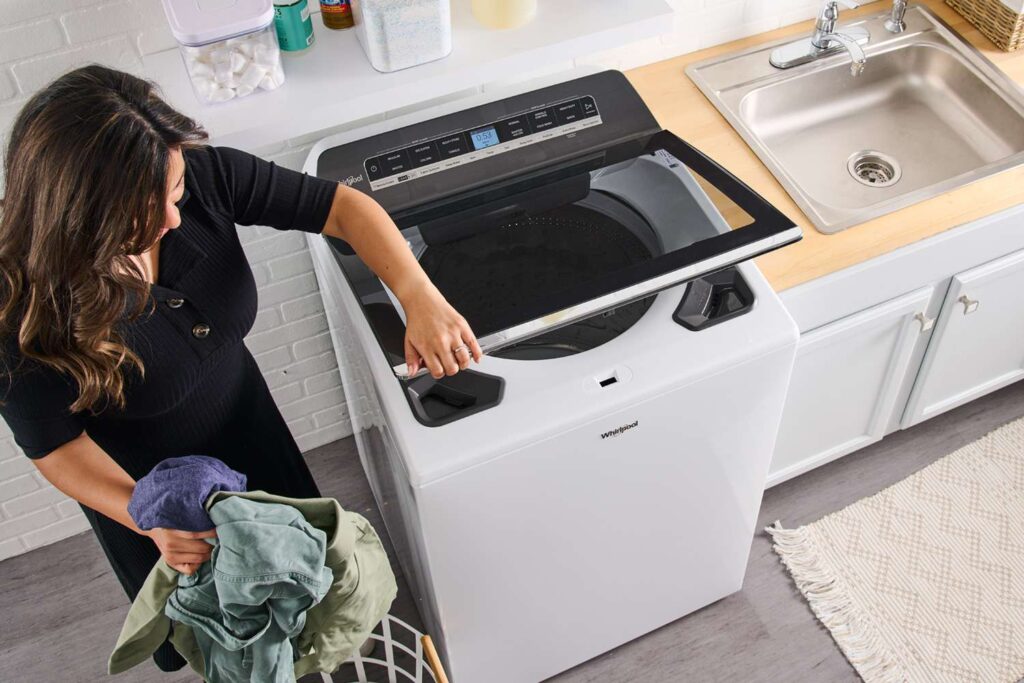

For most UK households, a front-loading washing machine is the better choice. Front loaders use significantly less water and electricity, wash more effectively, and fit under a standard kitchen worktop. Top loaders remain worth considering only in specific situations: where the available width is too narrow for a front loader, where the machine cannot be positioned under a worktop, or where thorough rinsing is a priority and running costs are less important.
Front Loaders vs Top Loaders: The Key Differences
| Factor | Front loader | Top loader |
|---|---|---|
| Water use | Significantly less – up to 60% less than a top loader | Much higher water use per cycle |
| Electricity use | Lower running costs | Higher running costs due to more water to heat |
| Detergent use | Less detergent required | More detergent required |
| Wash performance | Generally better, particularly at lower temperatures | Variable – some models perform well but not consistently recognised as best buys |
| Rinsing | May leave some detergent residue due to lower water volumes | Higher water volume may rinse more thoroughly |
| Width | Standard 600mm wide – fits a standard kitchen slot | Can be narrower – useful where space is very restricted |
| Under worktop | Designed for this – the standard UK installation | Cannot be installed under a worktop (lid needs to open upward) |
| Drum capacity | Available up to 12kg and beyond | Historically had larger drums but front loaders have closed this gap |
| Reliability | More electronics and components | Potentially more mechanically simple – fewer electronic components |
Why Front Loaders Dominate in the UK
UK kitchens have historically been compact, with appliances fitted under worktops in a standard 600mm-wide slot. Front-loading washing machines were designed for exactly this configuration. Top loaders cannot be installed under a worktop because the lid must open upward – ruling them out entirely for the majority of UK kitchen layouts.
Beyond installation practicality, front loaders have significant advantages in running costs. Using up to 60% less water per cycle than a top loader means substantially lower water heating costs, lower detergent use, and in metered properties, lower water bills.
When a Top Loader Makes Sense
 Situations where a top loader is worth considering
- Very restricted width. Some top-loading washing machines are significantly slimmer than the standard 600mm front loader. In spaces where 600mm cannot be accommodated, a narrow top loader may be the only practical option
- No worktop installation required. Where the washing machine stands freestanding in a utility room, outbuilding, or other space where the lid can open freely, the installation constraint does not apply
- Rinsing is a priority. Top loaders use more water per cycle, which may result in more thorough rinsing. For households where detergent residue causes skin sensitivity, this could be a relevant consideration – though improving rinse performance on a front loader by adding an extra rinse cycle is a simpler and cheaper solution for most
Being able to add forgotten items after the cycle has started is sometimes cited as a top loader advantage. Most modern front-loading washing machines now include a pause-and-add function that allows items to be added shortly after the cycle begins. This feature has largely eliminated the practical difference between the two types on this point.
Rinsing: The Top Loader Argument
Modern front-loading washing machines use less water as an efficiency measure – but this can mean less water available for thorough rinsing. For most households this is not a significant issue. For those with skin sensitivity to detergent residue, or who wash items such as nappies that require thorough rinsing, the additional water volume in a top loader’s rinse cycles may be relevant.
Adding an extra rinse cycle to a front loader (most machines offer this as a programme option) addresses the rinsing concern without sacrificing the front loader’s advantages elsewhere. See our guide on why modern washing machines may not rinse as thoroughly.
Buying Guides
Related Guides
 Which Is the Best Washing Machine to Buy?
Brand quality, price tiers, and what actually matters when choosing a washing machine.
 Washing Machine Drum Sizes
How drum capacity is measured, what the kg ratings mean in practice, and how to choose the right size.
 Why Washing Machines May Not Rinse Thoroughly
How water reduction affects rinsing – and what to do if detergent residue is a problem.
5 Tips for Buying a New AppliancePractical advice for getting the best value from a new washing machine purchase.
Frequently Asked Questions
Are top-loading washing machines better than front loaders?
Not for most UK households. Front loaders use significantly less water, electricity, and detergent, wash more effectively, and are designed for the standard UK under-worktop installation. Top loaders are better only in specific situations: where the available width is too narrow for a 600mm front loader, where the machine will not be under a worktop, or where thorough rinsing is a priority over running costs.
Can a top-loading washing machine go under a worktop?
No. The lid must open upward to load the machine, which requires clear space above the top of the machine. A top loader cannot be installed under a standard kitchen worktop. This is the primary reason top loaders are very rarely sold in the UK compared to front loaders.
Do top loaders rinse better than front loaders?
Top loaders use more water per cycle, which may result in more thorough rinsing. However, for most households the rinsing performance of a modern front loader is adequate, and adding an extra rinse cycle (available as a programme option on most machines) addresses the concern without the disadvantages of higher water and energy use throughout the full cycle.
29 Comments
Grouped into 24 comment threads.
1 reply We have a house in Malaysia and I have a top loading Samsung washing machine and I love it. It does the washing in half the time of my front loader in the UK and gets everything a lot cleaner. The new Samsung models are amazing with great water efficiency and anti tangle facility. I have been looking to buy one in the uk but without success.
1 reply I am sick to death of front loaders. Every front loader I have had suffers the same problem - dirt and mould grows in the door rubber and this gets transferred onto clothes (particularly thin materials such as shirts) from time to time during washing. Scrub as I might I cannot keep the mould and dirt away, and besides I don't actually want to have to scrub the machine after every wash. A top loader cannot suffer this problem as gravity keeps the washing away from the door.
I am sick to death of front loaders. Every front loader I have had suffers the same problem – dirt and mould grows in the door rubber and this gets transferred onto clothes (particularly thin materials such as shirts) from time to time during washing. Scrub as I might I cannot keep the mould and dirt away, and besides I don’t actually want to have to scrub the machine after every wash. A top loader cannot suffer this problem as gravity keeps the washing away from the door.
Likely replying to Michael Brooks
Hello Michael: You might find this link useful Washing machine smells
1 reply i have a maytag top loader washing machine please can anyone recommend a wash powder that does not leave a white residue on dark garments. When in America this did not happen at all.
i have a maytag top loader washing machine please can anyone recommend a wash powder that does not leave a white residue on dark garments. When in America this did not happen at all.
Likely replying to gamston
Hello Gamston: White residue or steaks left on laundry can be caused by a number of factors. It’s unlikely to be the detergent itself at fault. Have a look at this article, hope it helps – Keep getting residual washing powder marks after washing
1 reply You can use soap powder in a top loader but not in a front loading washing machine, thereby avoiding all the problems of allergic reactions AND no need for any fabric softener!
You can use soap powder in a top loader but not in a front loading washing machine, thereby avoiding all the problems of allergic reactions AND no need for any fabric softener!
Likely replying to Keith Tunnicliff
Hello Keith. Is there a known difference between top loader (and twin tub) detergent compared to front loader detergent with regards to allergies? As far as I know the only difference is that front loader detergent has suppressants in it to prevent excessive foaming.
0 replies Top loaders every time for me! Front loaders never seem to have enough water in them, and they don't rinse properly! When you wash a small load of, lightweight synthetic items, you have to put a bath towel in with them, otherwise the paddles don't lift them, and they just sit there at the bottom of the drum! I always end up adding extra water to every single front loader I've owned, I really wish you could still get Hotpoint top loaders. Plus, the amount of time it takes to do a wash is ridiculous. I washed some clothes for a neighbour when her washer broke down, at the time I had a Hotpoint top loader. She said the soles of her white socks, and her other whites, had never looked as clean ,or smelled as fresh! She though I must have used an expensive detergent, so I told her it was just the supermarket's own brand non- bio, and that it was all down to the machine.
Top loaders every time for me! Front loaders never seem to have enough water in them, and they don’t rinse properly! When you wash a small load of, lightweight synthetic items, you have to put a bath towel in with them, otherwise the paddles don’t lift them, and they just sit there at the bottom of the drum! I always end up adding extra water to every single front loader I’ve owned, I really wish you could still get Hotpoint top loaders. Plus, the amount of time it takes to do a wash is ridiculous. I washed some clothes for a neighbour when her washer broke down, at the time I had a Hotpoint top loader. She said the soles of her white socks, and her other whites, had never looked as clean ,or smelled as fresh! She though I must have used an expensive detergent, so I told her it was just the supermarket’s own brand non- bio, and that it was all down to the machine.
0 replies I had a Hotpoint top loader back I'm the 70s and I regret ever giving it up it washed incredibly well and it meant because it was a top loader that you could add the odd bit (like an escaped sock)! It had a paddle in it like the commercial washers and fed the water through a filter on the top if the paddle of of the paddle trapping dog hair and other fluff brilliantly
I had a Hotpoint top loader back I’m the 70s and I regret ever giving it up it washed incredibly well and it meant because it was a top loader that you could add the odd bit (like an escaped sock)! It had a paddle in it like the commercial washers and fed the water through a filter on the top if the paddle of of the paddle trapping dog hair and other fluff brilliantly
0 replies I recently bought a Whirlpool American top loading washing machine off ebay. The seller said it was in mint condition. The machine was brand new even still had shipping strip and protective cover of console. I have to say it's the best machine I have owned. You have 3 load setting and uses hot water. I know they don't have internal heaters but have a good supply of hot water. What impresses me the most is the amount of washing it can take and the speed it completes a cycle. Most loads done in just over 30 mins. I know they use a tremendous amount of water, but I seem to be washing less loads due to the enormous tub. I think it's 640rpm, but I have a separate spin dryer that spins 2800rpm, so I spin my clothes in that. I also like the fact you can use any type of washing powder. I have been using Persil twin tub powder. I remember my mum having a Hotpoint top loader and she was pleased with that. I also have a quite new LG steam washer, it's a good machine but cycle times tend to be long. If the LG is fully loaded the display can come up with 3 hours 37 mins. It does have turbo wash but only has 1 rinse. I converted my garage into a gym and laundry room so space is not an issue. The garage is well heated so no danger of frost bursting pipes. Paul
I recently bought a Whirlpool American top loading washing machine off ebay. The seller said it was in mint condition. The machine was brand new even still had shipping strip and protective cover of console. I have to say it’s the best machine I have owned. You have 3 load setting and uses hot water. I know they don’t have internal heaters but have a good supply of hot water. What impresses me the most is the amount of washing it can take and the speed it completes a cycle. Most loads done in just over 30 mins.
I know they use a tremendous amount of water, but I seem to be washing less loads due to the enormous tub. I think it’s 640rpm, but I have a separate spin dryer that spins 2800rpm, so I spin my clothes in that.
I also like the fact you can use any type of washing powder. I have been using Persil twin tub powder. I remember my mum having a Hotpoint top loader and she was pleased with that.
I also have a quite new LG steam washer, it’s a good machine but cycle times tend to be long. If the LG is fully loaded the display can come up with 3 hours 37 mins. It does have turbo wash but only has 1 rinse.
I converted my garage into a gym and laundry room so space is not an issue. The garage is well heated so no danger of frost bursting pipes.
Paul
0 replies I lived in Australia for many years and had various top load machines, the traditional type with an agitator or, as some had, a pulsator in the bottom of the tub. I found both machines to be highly effective and fast. I was also able to wash in tap cold water, which is a fair bit warmer than UK tap cold and still got excellent results using detergents such as Cold Power. Yes, they use more water but the expense of more water was offset by the reduction in water heating energy consumption. Back in the UK I have had h-axis top loaders for 13 years and have only recently gone back to a front loader. I found the h-axis top loaders to be every bit as good as any front loader I have used. As far as I can see there is no performance difference whatsoever. However, when I bought my front loader I opted to by an old second hand machine (approx 15 years old when I bought it) but in excellent condition. The main reason for this was that I wanted a machine that used more water than modern machines particularly when rinsing. I got a Bosch WFF2001 and although it is a bit noisy I couldn't be happier with it. They really were top end machines of their day and German built.
I lived in Australia for many years and had various top load machines, the traditional type with an agitator or, as some had, a pulsator in the bottom of the tub. I found both machines to be highly effective and fast. I was also able to wash in tap cold water, which is a fair bit warmer than UK tap cold and still got excellent results using detergents such as Cold Power. Yes, they use more water but the expense of more water was offset by the reduction in water heating energy consumption. Back in the UK I have had h-axis top loaders for 13 years and have only recently gone back to a front loader. I found the h-axis top loaders to be every bit as good as any front loader I have used. As far as I can see there is no performance difference whatsoever. However, when I bought my front loader I opted to by an old second hand machine (approx 15 years old when I bought it) but in excellent condition. The main reason for this was that I wanted a machine that used more water than modern machines particularly when rinsing. I got a Bosch WFF2001 and although it is a bit noisy I couldn’t be happier with it. They really were top end machines of their day and German built.
0 replies I have a Westinghouse top-loader that I bought in Australia 20-years ago. It has never broken down or needed spares. There are 3 water levels (low, medium, high) to choose from and 3 wash cycles, plus you can set the clothes to soak pre-wash and even re-use the water by saving to a trough during the first spin of the cycle and then syphoning back into the machine for a new wash. You can use the machine just for rinsing/spinning and you can manipulate the wash while it's in motion (i.e. add more water if you think the clothes need it.) Having had nothing but fantastic service from my top-loader I would never go back to a front-loader. I just hope that when my Westinghouse finally gives up the ghost I'll be able to get another or something similar.
I have a Westinghouse top-loader that I bought in Australia 20-years ago. It has never broken down or needed spares. There are 3 water levels (low, medium, high) to choose from and 3 wash cycles, plus you can set the clothes to soak pre-wash and even re-use the water by saving to a trough during the first spin of the cycle and then syphoning back into the machine for a new wash. You can use the machine just for rinsing/spinning and you can manipulate the wash while it’s in motion (i.e. add more water if you think the clothes need it.) Having had nothing but fantastic service from my top-loader I would never go back to a front-loader. I just hope that when my Westinghouse finally gives up the ghost I’ll be able to get another or something similar.
0 replies Top loaders can spin very well with little vibration and some models have a mechanism to check this. Also with a semi automatic top loader u can easily add water when the pressure is low(this is done in most African countries). When using washing powder, front loaders tends to have more residual powder in the cloths than top loaders becos when rinsing the water still has to pass over the caked powder in compartment.
Top loaders can spin very well with little vibration and some models have a mechanism to check this. Also with a semi automatic top loader u can easily add water when the pressure is low(this is done in most African countries). When using washing powder, front loaders tends to have more residual powder in the cloths than top loaders becos when rinsing the water still has to pass over the caked powder in compartment.
Leave a comment
0 replies Marian & geoff: The answer to your questions is UK kitchens. Traditionally most UK kitchens are very small and our houses often not big enough for laundry rooms. Therefore most people required their washing machine to fit under a work surface in the kitchen. Because of that top loaders were always relatively rare purchases and economies of scale meant they just became increasingly expensive compared to front loaders.
Marian & geoff: The answer to your questions is UK kitchens. Traditionally most UK kitchens are very small and our houses often not big enough for laundry rooms. Therefore most people required their washing machine to fit under a work surface in the kitchen. Because of that top loaders were always relatively rare purchases and economies of scale meant they just became increasingly expensive compared to front loaders.
0 replies Further to my reply "Oct 11 2011" Our Hotpoint 9605 electronic de-lux,"washing away in the laundry room as I write",dous everything better than all front loaders.2 major reasons are, it uses more water in all the programmes ( other than spinning) and the action really moves the clothes backwards and forwards washing the dirt out fully.I tried asking Hotpoint why they had dropped them all those years ago,despite the fact that spares are still available,But no-one available knew that they used to manufacture a top-loader! The supplier I have used for spares told me some 5-6 years back that this type of machine would probably retail at around £1000 now (circa 2005-7) Is this the more likely reason top loaders of my 9605 vintage became unavailable?
Further to my reply “Oct 11 2011″
Our Hotpoint 9605 electronic de-lux,”washing away in the laundry room as I write”,dous everything better than all front loaders.2 major reasons are, it uses more water in all the programmes ( other than spinning) and the action really moves the clothes backwards and forwards washing the dirt out fully.I tried asking Hotpoint why they had dropped them all those years ago,despite the fact that spares are still available,But no-one available knew that they used to manufacture a top-loader! The supplier I have used for spares told me some 5-6 years back that this type of machine would probably retail at around £1000 now (circa 2005-7) Is this the more likely reason top loaders of my 9605 vintage became unavailable?
0 replies Only 2 top-loader brands seem available in UK (Bosch seemingly having given up). Why? In CH I have just walked past a shop window displaying: Miele W144; Miele softronic; Elecrolux; Brandt which also could act as a dryer. Inside shop were a variety of front-loaders too. This choice should be available in the UK. why isn't it?
Only 2 top-loader brands seem available in UK (Bosch seemingly having given up). Why? In CH I have just walked past a shop window displaying: Miele W144; Miele softronic; Elecrolux; Brandt which also could act as a dryer. Inside shop were a variety of front-loaders too.
This choice should be available in the UK. why isn’t it?
0 replies If anything Bini, a top loader uses more water so it could be worse. It all depends on whether they have software that sets a certain amount of time for filling and aborts if it detects it's filling too slow or not. Some top loaders may not be as sophisticated as front loaders but I couldn't say in this situation which would be better. It can also from model to model and manufacturer to manufacturer.
If anything Bini, a top loader uses more water so it could be worse. It all depends on whether they have software that sets a certain amount of time for filling and aborts if it detects it’s filling too slow or not. Some top loaders may not be as sophisticated as front loaders but I couldn’t say in this situation which would be better. It can also from model to model and manufacturer to manufacturer.
0 replies Hi I live in a high-rise apartment building and live on the top floor which has the disadvantage of very low water pressure. I would like to know that does a front load washer require more water pressure in compariosn to a Top load washer or is it the other way round.
Hi I live in a high-rise apartment building and live on the top floor which has the disadvantage of very low water pressure. I would like to know that does a front load washer require more water pressure in compariosn to a Top load washer or is it the other way round.
0 replies the rush by manufacturers to front loaders came about simply to satisfy the pressure applied by kitchen suppliers making the new craze for units to fit under work surfaces,including all white goods.Until this desire to have a "modern kitchen arrived kitchens concentrated on simply being efficient.The mnfsbefore this craze"still with us" of building kitchens with every item possible saddled with the need to fit under a work surface ,produced machines that lasted.We still have our top load machine now 30 years old which continues to outwash all front loaders friends and family have.Made by Hotpoint with a load of in excess of 9 kilos it is easy to repair and spares are stil available.
the rush by manufacturers to front loaders came about simply to satisfy the pressure applied by kitchen suppliers making the new craze for units to fit under work surfaces,including all white goods.Until this desire to have a “modern kitchen arrived kitchens concentrated on simply being efficient.The mnfsbefore this craze”still with us” of building kitchens with every item possible saddled with the need to fit under a work surface ,produced machines that lasted.We still have our top load machine now 30 years old which continues to outwash all front loaders friends and family have.Made by Hotpoint with a load of in excess of 9 kilos it is easy to repair and spares are stil available.
0 replies Top loaders win hands down for me. I grew up with a Hotpoint top loader.. sadly no longer made in a decent size and moved to a front loader a few years ago. I hate it - nothing is rinsed adequately and the whole system seems to rely on chemicals to get things clean rather than real water. I don't agree with the 'energy efficiency' bs either. A top loader washes a large load in a fraction of the time a front loader takes, thereby using far less electricity. Obviously water usage is important IF you live in a place where that's an issue - I live in Scotland, we've never been short of water here! My next washing machine will be a top loader. My son and husband have eczema and react badly to the poor rinsing in the front loader. I use a fraction of the amount of liquid detergent recommended just to save their skin, but then of course the machine won't wash things well owing to lack of water. I'm just fed up of small washes taking nearly two hours too.
Top loaders win hands down for me. I grew up with a Hotpoint top loader.. sadly no longer made in a decent size and moved to a front loader a few years ago. I hate it – nothing is rinsed adequately and the whole system seems to rely on chemicals to get things clean rather than real water. I don’t agree with the ‘energy efficiency’ bs either. A top loader washes a large load in a fraction of the time a front loader takes, thereby using far less electricity. Obviously water usage is important IF you live in a place where that’s an issue – I live in Scotland, we’ve never been short of water here! My next washing machine will be a top loader. My son and husband have eczema and react badly to the poor rinsing in the front loader. I use a fraction of the amount of liquid detergent recommended just to save their skin, but then of course the machine won’t wash things well owing to lack of water. I’m just fed up of small washes taking nearly two hours too.
0 replies 1. No-one has mentioned the convenience of top-loaders - you don't have to crouch to load them and it is a lot easier to take the washed laundry out. For anyone over 60 or so this is quite a big plus. 2. There are two types of top-loaders, those with a drum revolving in a vertical plane, and those where the drum is set horizontally. Our machine (Bosch UK) has a vertical drum, which is OK but can get jammed if the machine is inadvertently started with the drum door open. The horizontal kind, which we have used many times in Australia, doesn't have this proplem, and the lid can be opened while washing, which can sometimes be useful.
1. No-one has mentioned the convenience of top-loaders – you don’t have to crouch to load them and it is a lot easier to take the washed laundry out. For anyone over 60 or so this is quite a big plus.
2. There are two types of top-loaders, those with a drum revolving in a vertical plane, and those where the drum is set horizontally. Our machine (Bosch UK) has a vertical drum, which is OK but can get jammed if the machine is inadvertently started with the drum door open. The horizontal kind, which we have used many times in Australia, doesn’t have this proplem, and the lid can be opened while washing, which can sometimes be useful.
0 replies Washerhelp - many many thanks for this link. I'm ordering a new doorseal in the morning and I will follow the link's advice re preventing the build up of mould in future. Michael
Washerhelp – many many thanks for this link. I’m ordering a new doorseal in the morning and I will follow the link’s advice re preventing the build up of mould in future.
Michael
0 replies Front loaders win when comparing efficiency. But here is a point to consider, washing machines with more modern features usually break down easily. If we compare durability, i think top loaders still win. The older models of top loaders even last long enough to be passed down to the next generation.
Front loaders win when comparing efficiency. But here is a point to consider, washing machines with more modern features usually break down easily. If we compare durability, i think top loaders still win. The older models of top loaders even last long enough to be passed down to the next generation.
0 replies I don't think so tariq. They have pressure switches to control the water level just like front loading washing machines, so they aren't likely to wash without the required level of water.
I don’t think so tariq. They have pressure switches to control the water level just like front loading washing machines, so they aren’t likely to wash without the required level of water.
0 replies is manual washing is possible in top loading washing machine in case there is a water shortage?
is manual washing is possible in top loading washing machine in case there is a water shortage?
0 replies You might find the following article useful, which covers mould, and bad smells in washing machines. I would think the problem can occur with either type of washing machine. Washing machine smells - causes of grease, slime and black mould inside washing machines
You might find the following article useful, which covers mould, and bad smells in washing machines. I would think the problem can occur with either type of washing machine.
Washing machine smells – causes of grease, slime and black mould inside washing machines
0 replies Do the front loading washing machines sold in the U.K. have mold problems causing the clothes to smell badly after the wash?
Do the front loading washing machines sold in the U.K. have mold problems causing the clothes to smell badly after the wash?
We have a house in Malaysia and I have a top loading Samsung washing machine and I love it. It does the washing in half the time of my front loader in the UK and gets everything a lot cleaner. The new Samsung models are amazing with great water efficiency and anti tangle facility. I have been looking to buy one in the uk but without success.
Likely replying to kingfisher
Thanks kingfisher, it’s good to have a view from someone who’s used both.