
Soda Crystals and washing machines
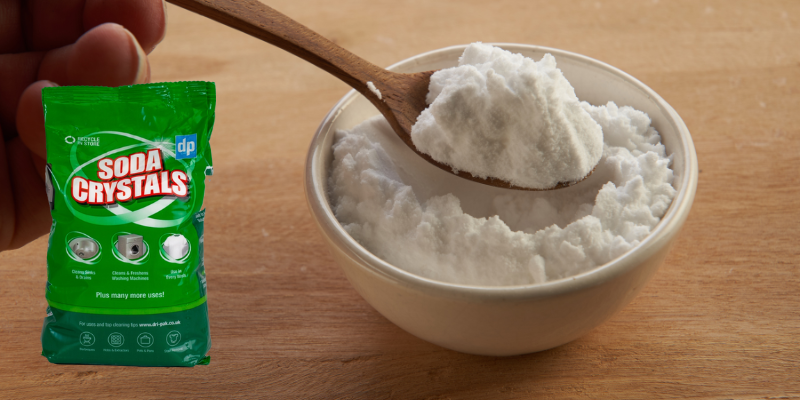

Soda crystals are a cheap, multi-purpose cleaner that can be used in washing machines to dissolve grease, soften water, and clean the drum and drum spider. They are safe to use despite the aluminium warning on the packet – the soda crystals manufacturer confirms the warning relates to visible surface pitting only, not structural damage to internal components.
Soda crystals (sodium carbonate) are an old household cleaning staple that costs a fraction of branded washing machine cleaners and performs many of the same functions. They are worth knowing about for both regular maintenance and occasional deep cleaning.
What Soda Crystals Can Do for a Washing Machine

Maintenance washing – cleaning the machine
Soda crystals dissolve grease effectively. Putting them directly into the drum and running a hot wash (60 degrees or above) helps clear grease, detergent residue, and mould build-up from the drum, door seal, and inner workings. This is particularly useful if the machine is run mostly on low-temperature programmes or with liquid detergent – both of which tend to leave more residue over time. See our guide on washing machine smells and how to clean the machine for the full maintenance wash process.

Water softening in hard water areas
Soda crystals soften water by precipitating calcium and magnesium ions – the same minerals that cause limescale. Adding them to the drum alongside detergent in hard water areas means you can use the soft-water dosage of detergent rather than the hard-water dosage, reducing detergent cost. Given that soda crystals are significantly cheaper than detergent, this can save money over time in hard water areas. See our guide on limescale in washing machines for more on managing hard water.

Washing aid
Soda crystals can be added to wash cycles alongside detergent to boost cleaning performance, help remove stains, and improve results in hard water. They are not a substitute for detergent but work alongside it.
Are Soda Crystals Safe for the Drum and Internal Parts?
Soda crystals packaging carries a warning against use on aluminium. Washing machines contain aluminium components internally – most notably the drum spider, the cast alloy component that connects the drum to the shaft. This naturally raises the question of whether using soda crystals could cause damage.
“There shouldn’t be anything to worry about. The only reason we advise against using soda crystals on aluminium is that they can cause pitting – small indentations on the surface. This would be undesirable on anything visible. But as the drum spider is not on show and is not a surface finish concern, the pitting would not undermine the strength or stability of the component.”
Soda crystals manufacturer – in response to a direct question about drum spider safety
The conclusion is that soda crystals are safe to use in a washing machine. The aluminium pitting concern applies to visible, cosmetic surfaces – not to structural internal components. The drum spider is a functional component not a surface finish, and small surface pitting does not compromise its strength.
How to Use Soda Crystals in a Washing Machine
Put a full cup (approximately 500g) of soda crystals directly into the empty drum – not in the dispenser drawer. Select the hottest programme available (60 degrees minimum, 90 degrees for a thorough clean). Run the cycle with no laundry inside. Do this every few months, or more frequently if the machine has a smell or is mostly used at low temperatures.
Add a tablespoon or two of soda crystals to the drum with the laundry. Also put the detergent in as normal, but use the soft-water dose shown on the detergent packet rather than the hard-water dose. Soda crystals are not suitable as a replacement for detergent – they do not contain surfactants and will not clean effectively alone.
Soda crystals are sold in most supermarkets, hardware stores, and online. They are one of the cheapest cleaning products available – typically less than £2 for a 1kg bag. They should be stored in a dry place as they absorb moisture from the air.
Related Guides
Related Guides
Washing Machine SmellsCauses of grease, mould, and bad smells in washing machines – and how to clean them effectively.
 Is Calgon Worth Using?
Whether dedicated anti-limescale products add protection beyond what detergent and soda crystals already provide.
Limescale in Washing MachinesHow limescale builds up in hard water areas and what approaches genuinely protect against it.
 Which Type of Detergent Is Best?
Powder, liquid, and tablet detergents compared – and how detergent choice affects machine hygiene.
Frequently Asked Questions
Can soda crystals damage a washing machine?
No, not in normal use. The warning on soda crystals packaging against use on aluminium refers to visible cosmetic surfaces – the crystals can cause minor surface pitting on aluminium that is unsightly on anything on show. Internal components such as the drum spider are structural, not cosmetic, and small surface pitting does not affect their strength. Soda crystals manufacturer advice confirms they are safe to use in washing machines.
How often should I use soda crystals in my washing machine?
For maintenance washing, every two to three months is a reasonable frequency for most machines. If the machine is used predominantly on low-temperature programmes, with liquid detergent, or shows signs of grease build-up or smell, cleaning more frequently – monthly – is worthwhile. Regular maintenance washing significantly extends the useful life of a washing machine by preventing grease and residue accumulation.
Are soda crystals better than branded washing machine cleaners?
Soda crystals are effective at dissolving grease and are much cheaper than dedicated branded machine cleaners. Branded products may include fragrance and additional cleaning agents that soda crystals do not, and some include specific agents for removing mould. For general grease dissolution and maintenance, soda crystals work well. For a machine with established mould or a persistent smell, a dedicated machine cleaner used alongside soda crystals may give a more thorough result initially.
25 Comments
Grouped into 15 comment threads.
3 replies I read with interest your comment on the use of soda crystals in the washing machine. My mother has a 10 year old hotpoint washer at the moment and it's still going strong, and before that a tricity bendix which lasted for 22 years. (apologies for any miss spellings in the manufacturers names) Which she said took her three years to save up for. I think shes pulling my leg. For as long as I can remember she has never bought any biological washing powder or liquid, as she always makes her own. We both suffer from dermatitis and since I moved out 15 years ago she also makes mine. It consists of Borax substitute, Soda crystals, soap flakes and something else, i can't remember. She has made some changes to the mixture over the years depending what she can get hold of. The 22 year old bendix was fed this concoction for its entire life and so is the hotpoint. I have a 8 year old bosch and I use it too. (must ask her how to make it actually as i'm suddenly feeling embarrassed that i get my mum to do it.) I have used shop bought powder occasionally if i'm waiting for my order from mother, but it doesn't get my white sport socks white like the home made stuff.(I know, I know, I'll ring her after I've written this and and get a crash course in washing powder making.) Also, Something went wrong with my machine about three years ago and the guy from bosch said "I see you use limescale remover" To which i said "No, and never have." He said that it still looked brand new. No mold or greasy build up in the drum seals, so I was chuffed. Anyway. I was surprised to read your above article on the affects of soda crystals on the aluminum spider. Would we have not had any problems to this affect? I wash maybe 4 or 5 loads a week. and always with this home made concoction. Just thought you might find it of interest.
2 replies Hi all. My 21 year old AEG machine suffered a drum spider failure two years ago at 19 years old (it's a well-built machine - much better than many new ones). I replaced the spider with an original part but it has only lasted another 2 years. The bearings are fine and we don't overload the drum. The only thing different is that my wife has started using washing soda crystals in most washes and she tends to do low temp washes as we always did. Generally two washes a week on average. The "new" drum spider is completely corroded and 2 arms have failed. I wonder if the alkaline content of the soda crystals has actually accelerated the corrosion? The first spider lasted nearly 20 years in the same hard water area before it failed but my wife wasn't using soda crystals. A chat to a chemist at work suggested that soda crystals will increase the alkalinity of the washing powder or liquid and this will have a corrosive effect on aluminium. The solution is to design a stainless steel spider like the drum or even a plastic/composite spider. Has anyone else experienced such premature failure of a spider and could washing soda be to blame?
Hi all.
My 21 year old AEG machine suffered a drum spider failure two years ago at 19 years old (it’s a well-built machine – much better than many new ones). I replaced the spider with an original part but it has only lasted another 2 years. The bearings are fine and we don’t overload the drum. The only thing different is that my wife has started using washing soda crystals in most washes and she tends to do low temp washes as we always did. Generally two washes a week on average.
The “new” drum spider is completely corroded and 2 arms have failed. I wonder if the alkaline content of the soda crystals has actually accelerated the corrosion? The first spider lasted nearly 20 years in the same hard water area before it failed but my wife wasn’t using soda crystals. A chat to a chemist at work suggested that soda crystals will increase the alkalinity of the washing powder or liquid and this will have a corrosive effect on aluminium. The solution is to design a stainless steel spider like the drum or even a plastic/composite spider.
Has anyone else experienced such premature failure of a spider and could washing soda be to blame?
Likely replying to Rick
Hi Rick. Corroding of the drum spider is usually associated with not using enough detergent. As my article describes, when I contacted the manufacturer of soda crystals, they assured me that the soda crystals they only cause small pitting on aluminium.
Have a look at my related article about grease and slime inside washer machines, which is far more likely to cause the corrosion you describe. I would also steer clear of liquid detergent’s. I also wouldn’t use soda crystals if you have soft water, as they soften water even further. If water is too soft, it makes cleaning the laundry more difficult, as it creates a lot of soap suds that cushion laundry from rubbing against each other. It also makes it harder for detergent to dissolve.
1 reply Hii there! Have you any suggestions on how the residue left by soda crystals in the drum can be removed. I used them to give the machine a good wash and flush through, but there is a white residue layer in the machine that seems to only move if you rub it away Any suggestion of what i can used. I run the machine with an empty drum but to no avail. Thanks in advance.
Hii there!
Have you any suggestions on how the residue left by soda crystals in the drum can be removed.
I used them to give the machine a good wash and flush through, but there is a white residue layer in the machine that seems to only move if you rub it away
Any suggestion of what i can used. I run the machine with an empty drum but to no avail.
Thanks in advance.
Likely replying to Stuart
Hello Stuart. I’ve not know soda crystals to leave a residue and we’ve used them many times. Maybe the residue is grease that the soda crystals loosened but got deposited? I would try using more, on a boil wash. Failing that I’d just try putting it on with ordinary detergent, no laundry and boil wash. Sometimes a few maintenance washes are needed.
1 reply I wonder if you canhelp me please my indesit washing machine is not draining out from the machine ,however it drains out when i take the hose and put it into a bowl on the floor the machine is about 4 years old . i rang indesit who said it seems like it needs crystals to clean it out i have now purchased these rather expensive things but was curious to see your write up on soda crystals are these just the run of the mill crystals you can buy in the supermarket and more to the point could this solve the problem . many thanks
I wonder if you canhelp me please my indesit washing machine is not draining out from the machine ,however it drains out when i take the hose and put it into a bowl on the floor the machine is about 4 years old . i rang indesit who said it seems like it needs crystals to clean it out i have now purchased these rather expensive things but was curious to see your write up on soda crystals are these just the run of the mill crystals you can buy in the supermarket and more to the point could this solve the problem .
many thanks
Likely replying to chris jones
Hello Chris. A washing machine not draining water is unlikely to be caused by needing cleaning, have a look at my article – Washing machine won’t drain water
1 reply To Washerhelp, Thank you for your comments however please remember it is not just detergents that can cause corrosion of aluminium. As I mentioned in the post above anything aqueous with a pH above about 8.0 can cause aluminium to be corroded. Detergents have a pH above about 8.0 or they will not work. The powdered Oxi products contain sodium carbonate and sodium percarbonate both of which are corrosive to aluminium. It could be argued that including the sodium percarbonate in the damaging laundry aids is a little unfair as, when mixed with water, it disassociates into hydrogen peroxide (for the cleaning) and sodium carbonate. Borax and sodium hydroxide, in solution are also corrosive to aluminium at the required concentration. What I did not mention above, not wishing to cloud the issue is that aluminium is also generally corroded by acids with a pH below about 4.0. Nitric acid is a well-known and well-documented exception to this. When I first dismantled our 7.5-year-old Frigidaire built Kenmore front loader due to bearing failure I thought the deposits I found on the spider were clumped unused detergent. I soon realised I was wrong when they would not dissolve and flush away, they were even difficult to remove with the pressure washer and even then they were not completely removed. When I first saw the corrosion of the spider, after the deposits had been removed I initially thought it was galvanic corrosion, being familiar with the galvanic corrosion of aluminium in the presence of steel and seawater. However further thought and investigation soon convinced me I was wrong, particularly when I discovered the above about the corrosion of aluminium in aqueous solutions, this includes pastes by the way. On discovering the above information I put a drop of 5% bleach solution, straight from the bottle, and a drop of vinegar, in different, previously undamaged areas of the spider removed from our machine. The following morning there was no sign of the vinegar and no sign of damage to the spider where it had been. Where the bleach had been was a nice little pile of white corrosion products that closely resembled the deposits I had previously removed. Additionally these products were difficult to remove close to the aluminium when, with a 6x magnifying glass slight pitting of the previously undamaged aluminium could be seen. It has taken me all of the above to get round to asking you - are you really sure that it is detergent that you are seeing or could it possibly be detergent and/or products of corrosion? You have seen what you describe I have not, and I can only describe what I found and what I concluded from my experiences removing it and the tests I later carried. One other question if you do not mind. Have you ever seen a fractured spider without any sign of the white deposits?
To Washerhelp,
Thank you for your comments however please remember it is not just detergents that can cause corrosion of aluminium. As I mentioned in the post above anything aqueous with a pH above about 8.0 can cause aluminium to be corroded.
Detergents have a pH above about 8.0 or they will not work. The powdered Oxi products contain sodium carbonate and sodium percarbonate both of which are corrosive to aluminium. It could be argued that including the sodium percarbonate in the damaging laundry aids is a little unfair as, when mixed with water, it disassociates into hydrogen peroxide (for the cleaning) and sodium carbonate. Borax and sodium hydroxide, in solution are also corrosive to aluminium at the required concentration.
What I did not mention above, not wishing to cloud the issue is that aluminium is also generally corroded by acids with a pH below about 4.0. Nitric acid is a well-known and well-documented exception to this.
When I first dismantled our 7.5-year-old Frigidaire built Kenmore front loader due to bearing failure I thought the deposits I found on the spider were clumped unused detergent. I soon realised I was wrong when they would not dissolve and flush away, they were even difficult to remove with the pressure washer and even then they were not completely removed.
When I first saw the corrosion of the spider, after the deposits had been removed I initially thought it was galvanic corrosion, being familiar with the galvanic corrosion of aluminium in the presence of steel and seawater. However further thought and investigation soon convinced me I was wrong, particularly when I discovered the above about the corrosion of aluminium in aqueous solutions, this includes pastes by the way.
On discovering the above information I put a drop of 5% bleach solution, straight from the bottle, and a drop of vinegar, in different, previously undamaged areas of the spider removed from our machine. The following morning there was no sign of the vinegar and no sign of damage to the spider where it had been. Where the bleach had been was a nice little pile of white corrosion products that closely resembled the deposits I had previously removed. Additionally these products were difficult to remove close to the aluminium when, with a 6x magnifying glass slight pitting of the previously undamaged aluminium could be seen.
It has taken me all of the above to get round to asking you – are you really sure that it is detergent that you are seeing or could it possibly be detergent and/or products of corrosion? You have seen what you describe I have not, and I can only describe what I found and what I concluded from my experiences removing it and the tests I later carried.
One other question if you do not mind. Have you ever seen a fractured spider without any sign of the white deposits?
Likely replying to David F
Hi David: You obviously have experience in the more technical side of these reactions. Yes I have seen many drum spiders where one or more of the arms have a fine crack all the way through yet they are perfectly clean and unaffected by any visible corrosion.
Most of the ones I’ve seen that are really bad the alloy (I’m not sure they are 100% aluminium) has crumbled away and usually caked in jelly-like gunge and grease as described here Washing machine smells – causes of grease, slime and black mould inside washing machines
The fact that it only affects a minority of washing machines implies it’s caused by something specific to them. I’ve always assumed it was not using enough detergent allowing a build up of the grease and slime.
1 reply As a follow up to the above post, should you be interested in seeing what corrosion can do to aluminium spiders please visit 'fixitnow.com/wp/2009/10/28. I hardly need add that I wrote the piece at the end of that post disagreeing with the suggestion that it was due to galvanic corrosion.
As a follow up to the above post, should you be interested in seeing what corrosion can do to aluminium spiders please visit ‘fixitnow.com/wp/2009/10/28. I hardly need add that I wrote the piece at the end of that post disagreeing with the suggestion that it was due to galvanic corrosion.
Likely replying to David F
Thanks David: I agree that the cause of this phenomena is unlikely to be related to a clash of metal. I think it’s related to the detergents and/or a build up of grease and slime, which eats away at the alloy. I’ve seen many of them in this state and they always corrode in the same place and are always caked in slime and grease and white detergent.
I’ve seen many without any slime or grease though and just a thin crack in one or more of the arms. Maybe they have a tendency to crack, and that allows the corrosion to take hold if the environment is bad enough.
1 reply Hi there, I have just done the ultimate test on our fairley new cold fill washing machine, my wife now and again spills curry on her white dressing gown we would put it in our zanussi washing machine and the stains would be gone but this new Hotpoint washing machine is total rubbish put the said article in last night with same washing liquid and there is still a stain on it put it in again by its self this morning and the stain is still there.Which goes to show hot and cold fill washing machines are the best do you know of any manufacterer that has any old stock left ?. Cheers Nigel
Hi there,
I have just done the ultimate test on our fairley new cold fill washing machine, my wife now and again spills curry on her white dressing gown we would put it in our zanussi washing machine and the stains would be gone but this new Hotpoint washing machine is total rubbish put the said article in last night with same washing liquid and there is still a stain on it put it in again by its self this morning and the stain is still there.Which goes to show hot and cold fill washing machines are the best do you know of any manufacterer that has any old stock left ?.
Cheers Nigel
Hello Nigel: I wouldn’t think this has anything to do with the hot and cold fill issue. If anything, a cold fill washing machine should wash better than a hot and cold fill. A cold fill washing machine takes longer to wash, which clearly helps, it also removes the possibility of some stains being “fixed” by coming into contact with hot water and if using biological detergent it’s been shown that they work much more efficiently by starting with cold water.
A quick search on Google for “remove curry stains” indicates they are a very stubborn stain indeed and quick action is required as soon after the incident as possible.
0 replies Oliver: Soda crystal are supposed to be safe. There's no issues with them that I'm aware of other than they can cause mild pitting on aluminium but that's only cosmetic not structural.
Oliver: Soda crystal are supposed to be safe. There’s no issues with them that I’m aware of other than they can cause mild pitting on aluminium but that’s only cosmetic not structural.
0 replies Hello Everyone! This is all very complicated and technical. Can anyone please recommend a totally safe product to eliminate unpleasant odours from washing machines and to keep the pipes etc. clear (especially as I live in a hard water area)? Some products which are commercially available are designed to be used every time you use the washing machine and therefore can work out to be quite expensive. Thank you so much; your help is very much appreciated.
Hello Everyone!
This is all very complicated and technical. Can anyone please recommend a totally safe product to eliminate unpleasant odours from washing machines and to keep the pipes etc. clear (especially as I live in a hard water area)? Some products which are commercially available are designed to be used every time you use the washing machine and therefore can work out to be quite expensive. Thank you so much; your help is very much appreciated.
0 replies Further to my posts above I have now found a very informative and, I think, easy to read, one page paper by a Gaute Svenningsen on the corrosion of aluminium. To read it just Google "Gaute Svenningsen Aluminium Corrosion" and click on the appropriate link. I know his description as micro galvanic corrosion, which I agree is a good description, is at variance with my assertion that it is chemical corrosion. I am still trying to work out how to describe it in the future! The bottom line is however that it corrodes and the end result is exactly the same.
Further to my posts above I have now found a very informative and, I think, easy to read, one page paper by a Gaute Svenningsen on the corrosion of aluminium. To read it just Google “Gaute Svenningsen Aluminium Corrosion” and click on the appropriate link.
I know his description as micro galvanic corrosion, which I agree is a good description, is at variance with my assertion that it is chemical corrosion. I am still trying to work out how to describe it in the future! The bottom line is however that it corrodes and the end result is exactly the same.
Leave a comment
0 replies To Washerhelp Thank you for your response and comments. Yours is the first post that I have seen, or heard of, where fracture of the spider has not been accompanied by corrosion. Unfortunately it begs more questions:- 1. Are there many of these in comparison to those where corrosion is evident? 2. Are they across the board or are they limited to only specific manufacturer(s)? No metal is 100% pure, even precious metals of high purity usually have it quoted as 99.9something% pure, meaning, in essence that it is in fact, by definition, an alloy. I know that not all complaints of foul odours can be traced to build ups in the spiders, there are documented other sources in many posts on the web. However I do believe that when all other sources/remedies have been tried, it will be found that the majority of those remaining, should the investigation be completed, that the source will be found to be build up on the spider, there is virtually nothing else left. I have actually found a couple of posts where owners, other than myself, have dismantled their machines, removed deposits the same as mine, and the foul odours have disappeared. I agree it would seem as though there is something specific about the machines, or the way they are used, and that does not imply misuse-deliberate or otherwise, that causes these problems and I, for one, would like to try and find out what it is. As an example the two instruction books that came with our machines state that it is in order to use powdered detergent, just use less, and that it is in order to use bleach again with a quantity limitation. This could be construed as a desire to induce early failure in the hope of selling more machines. A point you have made elsewhere! When I dismantled our 7.5-year-old Frigidaire built Kenmore (purchased in the USA, we now live in Canada again) it was because of the racket the machine had started to make. We have a second, very similar machine in our guest apartment, now about 3 years old and purchased in Canada, so noise comparisons were very easy. I had no idea what I was getting into. I had wondered to myself, when we purchased the first machine, what they had done to enable the bearings to take the very high out of balance cantilever load that these machines impose on their bearing arrangement. I now know, nothing! Prior to dismantling our machine I did not perform any research or even investigate any tips for dismantling. I just took it apart. Prior to this dismantling the only repairs I had carried out were to tighten up the two halves of the outer drum relative to each other because of a slight leak and remove the drain pump and hose to clean them out because the Chief Laundress, who has a much more sensitive sense of smell than I, was complaining of a mouldy/mildew kind of smell coming from the machine. Soaking in bleach, hot wash cycle had done nothing to reduce it; according to CL. Again I/we had done no internet investigation. Our efforts at that time did not produce the desired result. It was not until after the bearing repair, when CL informed me there was no more smell that I put 2 and 2 together. Not long after I had completed the repair to our machine I was asked to have a look at a similar machine belonging to one of my sisters-in-law, because of the smell. Even I could smell it. When I got by the smell I discovered the bearings were on the way out. The machine was dismantled; the bearings, although on the way out, had not deteriorated sufficiently to render the seal ineffective, there was no evidence of water or corrosion in the bearing housing. There was a build up of foul smelling gunk around the hub of the spider. There was very little evidence of corrosion on the spider and I considered it suitable for further service. Said sister-in-law stated that she only very rarely used bleach, had only ever used liquid detergent (Tide) and did not use liquid fabric softener. These are the only two front loaders I have ever worked on, in fact the only other two machines I have ever worked on were a TL Kenmore (manufacturer unknown) on which I changed a timer and an old Hoover with the impeller on the side of the tub, this later was about 40 years ago. So my experience with the guts of the machines is extremely limited. We also seem to be getting away from the original subject of this thread. Sorry about that.
To Washerhelp
Thank you for your response and comments.
Yours is the first post that I have seen, or heard of, where fracture of the spider has not been accompanied by corrosion. Unfortunately it begs more questions:-
1. Are there many of these in comparison to those where corrosion is evident?
2. Are they across the board or are they limited to only specific manufacturer(s)?
No metal is 100% pure, even precious metals of high purity usually have it quoted as 99.9something% pure, meaning, in essence that it is in fact, by definition, an alloy.
I know that not all complaints of foul odours can be traced to build ups in the spiders, there are documented other sources in many posts on the web. However I do believe that when all other sources/remedies have been tried, it will be found that the majority of those remaining, should the investigation be completed, that the source will be found to be build up on the spider, there is virtually nothing else left. I have actually found a couple of posts where owners, other than myself, have dismantled their machines, removed deposits the same as mine, and the foul odours have disappeared.
I agree it would seem as though there is something specific about the machines, or the way they are used, and that does not imply misuse-deliberate or otherwise, that causes these problems and I, for one, would like to try and find out what it is. As an example the two instruction books that came with our machines state that it is in order to use powdered detergent, just use less, and that it is in order to use bleach again with a quantity limitation. This could be construed as a desire to induce early failure in the hope of selling more machines. A point you have made elsewhere!
When I dismantled our 7.5-year-old Frigidaire built Kenmore (purchased in the USA, we now live in Canada again) it was because of the racket the machine had started to make. We have a second, very similar machine in our guest apartment, now about 3 years old and purchased in Canada, so noise comparisons were very easy. I had no idea what I was getting into. I had wondered to myself, when we purchased the first machine, what they had done to enable the bearings to take the very high out of balance cantilever load that these machines impose on their bearing arrangement. I now know, nothing! Prior to dismantling our machine I did not perform any research or even investigate any tips for dismantling.
I just took it apart. Prior to this dismantling the only repairs I had carried out were to tighten up the two halves of the outer drum relative to each other because of a slight leak and remove the drain pump and hose to clean them out because the Chief Laundress, who has a much more sensitive sense of smell than I, was complaining of a mouldy/mildew kind of smell coming from the machine. Soaking in bleach, hot wash cycle had done nothing to reduce it; according to CL. Again I/we had done no internet investigation. Our efforts at that time did not produce the desired result. It was not until after the bearing repair, when CL informed me there was no more smell that I put 2 and 2 together.
Not long after I had completed the repair to our machine I was asked to have a look at a similar machine belonging to one of my sisters-in-law, because of the smell. Even I could smell it. When I got by the smell I discovered the bearings were on the way out.
The machine was dismantled; the bearings, although on the way out, had not deteriorated sufficiently to render the seal ineffective, there was no evidence of water or corrosion in the bearing housing. There was a build up of foul smelling gunk around the hub of the spider. There was very little evidence of corrosion on the spider and I considered it suitable for further service. Said sister-in-law stated that she only very rarely used bleach, had only ever used liquid detergent (Tide) and did not use liquid fabric softener.
These are the only two front loaders I have ever worked on, in fact the only other two machines I have ever worked on were a TL Kenmore (manufacturer unknown) on which I changed a timer and an old Hoover with the impeller on the side of the tub, this later was about 40 years ago. So my experience with the guts of the machines is extremely limited. We also seem to be getting away from the original subject of this thread. Sorry about that.
0 replies Many posts on many sites claim that the corrosion of the spiders is due to galvanic action. I do not agree, I believe it is primarily chemical corrosion. Should the corrosion have been galvanic between the stainless steel drum and the aluminium spider the majority of the corrosion would have been at the junction of the two metals i.e. at the ends of the arms. I have seen no photographs of spiders corroded in such a manner, nor read of any similar descriptions. Aluminium is corroded when immersed in an aqueous solution with a pH value above about 8.0. All detergents have to be above about 8.0 or they would not work. The Material Safety Data Sheets (MSDS) put out by Proctor and Gamble state that the pH for one of the liquid Tides is 8.0 and for one of the Tide powdered detergents as 11.0. Bleach, (sodium hypochlorite) is also very corrosive to aluminium. I should add that for corrosion of the spider to take place these levels are considerably above the levels found in a washing machine during the wash/rinse phases of the cycle. Sodium carbonate (washing soda)and sodium percarbonate found in some laundry aids are also corrosive to aluminium, provided the required concentrations are reached. I believe the mechanics of the corrosion are as follows. Even after the fastest spin small quantities of water will remain on the shaft and towards the centre of the spider. Any recesses in the spider close to the centre will aggravate this situation. This water will contain very, very small quantities of laundry aids used, soil from the laundry and chemicals from the tap water. Should this water be allowed to stand the water will evaporate until such time as sufficient has gone to allow the pH of the remaining mixture to rise above the threshold at which corrosion will occur. Additionally the retained water will quickly become foul smelling leading to, I believe, many of the complaints about mold and mildew. The first MSDS I found on the web for sodium carbonate gave its pH for a 1.0% solution as 11.5 I.e very corrosive to aluminium.
Many posts on many sites claim that the corrosion of the spiders is due to galvanic action. I do not agree, I believe it is primarily chemical corrosion.
Should the corrosion have been galvanic between the stainless steel drum and the aluminium spider the majority of the corrosion would have been at the junction of the two metals i.e. at the ends of the arms. I have seen no photographs of spiders corroded in such a manner, nor read of any similar descriptions.
Aluminium is corroded when immersed in an aqueous solution with a pH value above about 8.0. All detergents have to be above about 8.0 or they would not work. The Material Safety Data Sheets (MSDS) put out by Proctor and Gamble state that the pH for one of the liquid Tides is 8.0 and for one of the Tide powdered detergents as 11.0. Bleach, (sodium hypochlorite) is also very corrosive to aluminium. I should add that for corrosion of the spider to take place these levels are considerably above the levels found in a washing machine during the wash/rinse phases of the cycle.
Sodium carbonate (washing soda)and sodium percarbonate found in some laundry aids are also corrosive to aluminium, provided the required concentrations are reached.
I believe the mechanics of the corrosion are as follows.
Even after the fastest spin small quantities of water will remain on the shaft and towards the centre of the spider. Any recesses in the spider close to the centre will aggravate this situation. This water will contain very, very small quantities of laundry aids used, soil from the laundry and chemicals from the tap water. Should this water be allowed to stand the water will evaporate until such time as sufficient has gone to allow the pH of the remaining mixture to rise above the threshold at which corrosion will occur.
Additionally the retained water will quickly become foul smelling leading to, I believe, many of the complaints about mold and mildew.
The first MSDS I found on the web for sodium carbonate gave its pH for a 1.0% solution as 11.5 I.e very corrosive to aluminium.
0 replies Thanks, Darryl Will get some made up. My daughter has a part time job at MacDonalds and you just cannot shift the grease stains from the uniform. I t will be an interesting test, since Vanish doesn't shift them.
Thanks, Darryl Will get some made up. My daughter has a part time job at MacDonalds and you just cannot shift the grease stains from the uniform. I t will be an interesting test, since Vanish doesn’t shift them.
0 replies There are many variables involved in removing any type of stain which is why most folk will get varying results with similar stains and removal techniques. Some of these are- the strength of the stain (with curry- what was in it?), time the stain is left, the material stained, the size of the wash the stained article is washed in. My opinion with this particular issue is simply that your Zanussi washer had a more efficient wash cycle than your new Hotpoint, all other variables being roughly similar.
There are many variables involved in removing any type of stain which is why most folk will get varying results with similar stains and removal techniques. Some of these are- the strength of the stain (with curry- what was in it?), time the stain is left, the material stained, the size of the wash the stained article is washed in.
My opinion with this particular issue is simply that your Zanussi washer had a more efficient wash cycle than your new Hotpoint, all other variables being roughly similar.
0 replies hi, curry stains com out by leaving them in the light or sun.
hi, curry stains com out by leaving them in the light or sun.
I read with interest your comment on the use of soda crystals in the washing machine. My mother has a 10 year old hotpoint washer at the moment and it’s still going strong, and before that a tricity bendix which lasted for 22 years. (apologies for any miss spellings in the manufacturers names) Which she said took her three years to save up for. I think shes pulling my leg. For as long as I can remember she has never bought any biological washing powder or liquid, as she always makes her own.
We both suffer from dermatitis and since I moved out 15 years ago she also makes mine. It consists of Borax substitute, Soda crystals, soap flakes and something else, i can’t remember. She has made some changes to the mixture over the years depending what she can get hold of. The 22 year old bendix was fed this concoction for its entire life and so is the hotpoint. I have a 8 year old bosch and I use it too. (must ask her how to make it actually as i’m suddenly feeling embarrassed that i get my mum to do it.) I have used shop bought powder occasionally if i’m waiting for my order from mother, but it doesn’t get my white sport socks white like the home made stuff.(I know, I know, I’ll ring her after I’ve written this and and get a crash course in washing powder making.)
Also, Something went wrong with my machine about three years ago and the guy from bosch said “I see you use limescale remover” To which i said “No, and never have.” He said that it still looked brand new. No mold or greasy build up in the drum seals, so I was chuffed. Anyway. I was surprised to read your above article on the affects of soda crystals on the aluminum spider. Would we have not had any problems to this affect? I wash maybe 4 or 5 loads a week. and always with this home made concoction. Just thought you might find it of interest.
Likely replying to Darryl
Darryl, if you manage to get the formula for mom’s washing powder, perhaps you would be kind enough to publish it here. It sounds like the bussiness! Unless it’s a trade secret!
I know soda crystals are good for your machine- I’ve used them for years with no ill effect. I suspect manufcturers advise against it because they want you to buy the expensive water softeners they recommend and must have an interest in.
Likely replying to Paul Higgins
Hi Paul.
Sorry for the delay. Have managed to get ingredients for the home made washing powder and it’s dead easy.
Best to have one of those plastic cereal box containers with a flip air tight lid to store and mix it all up in.
The recipe below includes oxygen bleach powder. I have two powder mixes made up at any one time. One for the whites, which includes the oxygen bleach powder, and one for darks and bright colours, which doesn’t. This is the only difference between the two powders.
You will need.
1KG box of Soda crystals (washing soda in the U.S.)
500g box of Borax Substitute (think you can still get original borax in the U.S)
2 Tablespoons of Soap flakes.
2 Tablespoons of boxed oxygen bleach (for whites)
Pour it all in the container and give it a good shake. Use half a cupful in each wash, depending on the drum size. I find half a cup is fine for a 6KG drum. I personally chuck it in the drum on top of the clothes and not in the washer draw as is leaves a residue in it.
All of the above Mum can get in the supermarket. If you can’t, I found all of it online. Buying in bulk makes it cheaper. One batch works out at about 6 or 7p a wash.
Unlike Shop bought detergents this recipe has no smell. I find that i don’t need to use fabric conditioner either because the mixture of the soda crystals and the borax makes the water so soft your clothes feel great when there done. In fact i used to use fabric conditioner but it just left a residue of the clothes. So to make thing smell nice, if your putting your washing in a tumble dryer, put two or three drops of essential oil (any fragrance you like) on a cloth or duster and add it to tumble. It is quite strong smelling so do some tests first with maybe 1 or 2 drops. The smell also lasts until you next wash it. Bonus!
If your not tumbling or you want extra strong smell. Mum said that she puts a couple of drops of essential oil in a spray bottle to dampen the clothes before ironing. (Ironing! what’s ironing?)
Hope this helps anybody that has sensitive skin or any medical conditions like me and just can’t use shop bought non-bio powders. Oh! you’ll never have to worry about stains ever again. This sucker will shift anything!!!
Hi, Darryl,
I’ve just discovered this thread, and am desperately seeking a new approach to laundry, as I am fed up with my clothes smelling stale after a week or two in the wardrobe.
Your home-made recipe sounds great, and I’m going to give it a try (maybe you should patent it!); just one question on quantity – do you mean 4oz – half-a-cup American measure?
Many thanks