
Candy U-See Ovens
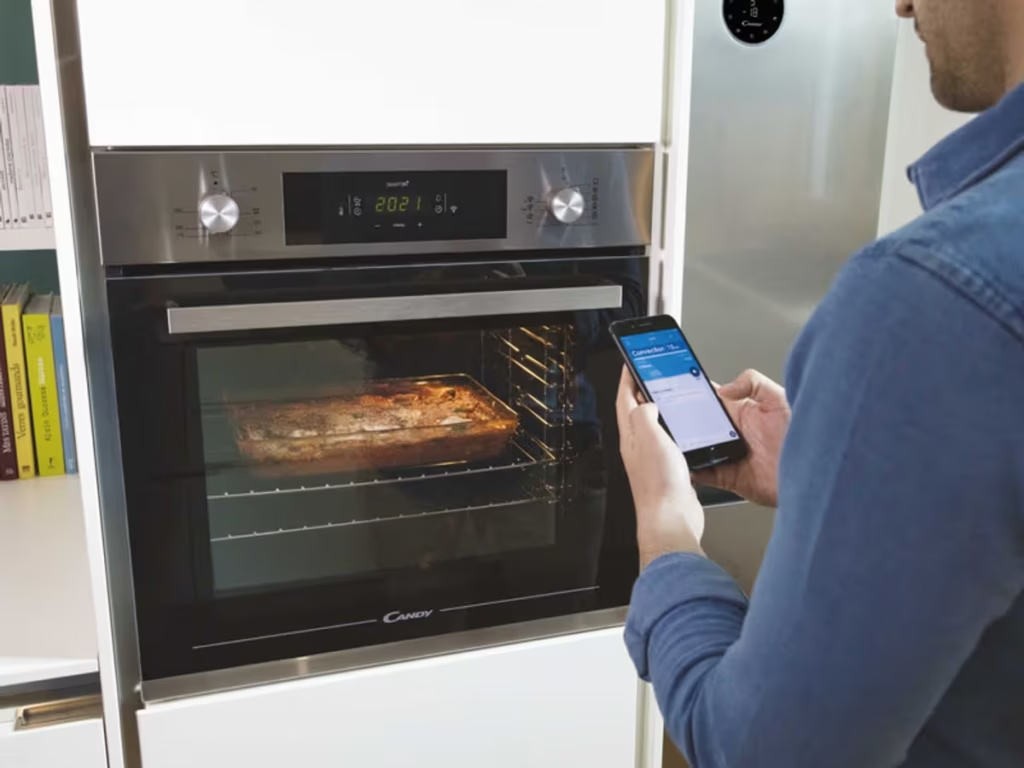

Candy’s U-See LED oven lighting floods the oven interior with white LED light rather than using a standard 25-watt incandescent bulb. The genuine benefits are better visibility and potentially much better reliability – LED lights outlast standard oven bulbs significantly. The energy saving claim, while technically accurate, is negligible in practice. The real advantage, if U-See LEDs prove as reliable as standard LED technology, is not having to replace a failed oven bulb.
What Is Candy U-See?
Candy’s U-See feature replaces the standard incandescent oven bulb with white LED lighting designed to illuminate the entire oven interior more evenly. The claim is that it provides a clearer view across all oven shelves, allowing the contents to be checked without opening the door.
Standard oven lamps are a single 25-watt incandescent bulb positioned at one point in the oven cavity – typically providing uneven illumination, particularly on lower shelves. An LED array distributed across the oven should in principle provide more even and brighter coverage.
The Energy Saving Claim: Putting It in Context
Candy’s U-See LEDs use 4 watts compared to a standard 25-watt oven bulb. The 84% reduction in oven light power consumption sounds significant as a percentage. In practice:
At typical electricity rates, a standard 25-watt oven bulb running for 100 hours costs approximately 38 pence. A 4-watt LED running for the same time costs approximately 6 pence. Over 100 hours the saving is approximately 32 pence.
A typical domestic oven element uses 2,000 to 3,000 watts when heating. The oven light uses 25 watts – less than 1% of the energy the oven uses when the element is running. Percentage-based energy saving claims for oven lighting should be viewed with appropriate scepticism. The light’s power consumption is genuinely negligible compared to the heating element regardless of which bulb type is used.
The Genuine Advantages
 Real benefits of LED oven lighting
- Better visibility – a well-distributed LED array should illuminate the oven cavity more evenly than a single point-source bulb, making it easier to check food on multiple shelf levels without opening the door
- Improved reliability – standard oven bulbs are notoriously unreliable and fail frequently. The vibration, heat cycling, and high temperatures inside an oven are hard on incandescent bulbs. LED lights are significantly more tolerant of these conditions and should last considerably longer
- Reduced maintenance – replacing a failed oven bulb is often inconvenient. The bulb is awkward to access, requires a specific replacement type, and the process of fitting it can be fiddly. Eliminating frequent bulb replacement is a meaningful practical benefit even if the energy saving is not
 Limitations to consider
- The lighting improvement is irrelevant if the oven itself is unreliable or poorly built – the oven’s performance and build quality matter far more than the bulb type
- LED oven lights are a premium feature – if the added cost is significant, the payback from reduced bulb replacement and marginal energy saving is very slow
- LED performance in high-temperature environments varies by component quality – not all LED implementations designed for oven use perform equally well
Cooking Appliance Guides
Related Guides
 Are Eco Labels Misleading?
How energy and efficiency claims are measured – and why percentage figures without context can be deceptive.
 What Do Energy Consumption Figures Actually Mean?
How to read energy label consumption figures and what they tell you about real-world running costs.
 Candy Trio Safety Notice
Important fire risk safety notice for the Candy Trio combined oven, hob and dishwasher range.
 Cooker Grill Fire and Carbon Monoxide Risks
Safety notice on cookers with separate grills – carbon monoxide danger with the grill door closed.
Frequently Asked Questions
What is Candy U-See oven lighting?
Candy U-See replaces the standard single incandescent oven bulb with white LED lighting designed to illuminate the oven interior more evenly. The aim is to provide a clearer view of oven contents across all shelf levels without opening the door. The LED array uses 4 watts compared to the standard 25-watt oven bulb.
How much energy does Candy U-See save compared to a standard oven bulb?
The LED uses 4 watts versus a standard oven bulb’s 25 watts – an 84% reduction in oven light power. In practice, this saves approximately 32 pence per 100 hours of use. Oven lighting uses less than 1% of total oven energy in any case – the element is the dominant consumer. Energy saving claims for oven lighting should be understood in this context.
Is LED oven lighting better than a standard oven bulb?
For reliability, almost certainly yes. Standard oven bulbs fail frequently due to the harsh conditions inside an oven. LED technology is significantly more tolerant of heat cycling and vibration, and should last much longer. For illumination quality, a well-implemented LED array should provide more even lighting across the oven than a single-point incandescent bulb. The energy saving, while real, is negligible in practice.
Ask the repair forum
Post the make, model and symptoms and get help from the Whitegoods Help community.
4 Comments
Grouped into 4 comment threads.
0 replies Interesting article!
0 replies Hi Andy, Correct! Lets face it we both know they are going to play on it using the dirty percentage business as all manufacturers do! Also not that many people look at the small print regarding the percentages, so it will sell the ovens as people will attribute the saving to the oven its self not the insignificantly low wattage of the lighting!! Oliver.
Hi Andy,
Correct!
Lets face it we both know they are going to play on it using the dirty percentage business as all manufacturers do! Also not that many people look at the small print regarding the percentages, so it will sell the ovens as people will attribute the saving to the oven its self not the insignificantly low wattage of the lighting!!
Oliver.
0 replies It would be a con Oliver if they advertise they are 80% cheaper - or to be fair, misleading, though I haven't seen any marketing for it yet. I think the new lights have enough of a benefit without them needing to mention the "energy saving" but it's possibly too good an opportunity to miss because it's technically true - the bulbs are over 80% cheaper to run. It's just that 80% of such a small amount is virtually meaningless. If I ever see any percentage figures quoted, I always want to know the full facts before deciding how valid or relevant they are.
It would be a con Oliver if they advertise they are 80% cheaper – or to be fair, misleading, though I haven’t seen any marketing for it yet. I think the new lights have enough of a benefit without them needing to mention the “energy saving” but it’s possibly too good an opportunity to miss because it’s technically true – the bulbs are over 80% cheaper to run. It’s just that 80% of such a small amount is virtually meaningless. If I ever see any percentage figures quoted, I always want to know the full facts before deciding how valid or relevant they are.
0 replies Hi Andy, Sounds like a con!!!! Saving a few pence when the element is guzzling electricity! You are right these SMALL energy savings are all a con!! But the information as usual will be misleading, like comparing a modern washer with one from 10 years ago, of course it will be more efficient than the 10 year old one. This is just plain trickery and EXTREMELY misleading!! All the best, Oliver.
Hi Andy,
Sounds like a con!!!!
Saving a few pence when the element is guzzling electricity! You are right these SMALL energy savings are all a con!! But the information as usual will be misleading, like comparing a modern washer with one from 10 years ago, of course it will be more efficient than the 10 year old one. This is just plain trickery and EXTREMELY misleading!!
All the best,
Oliver.
Interesting article!