
Fitted brushes now motor sparking
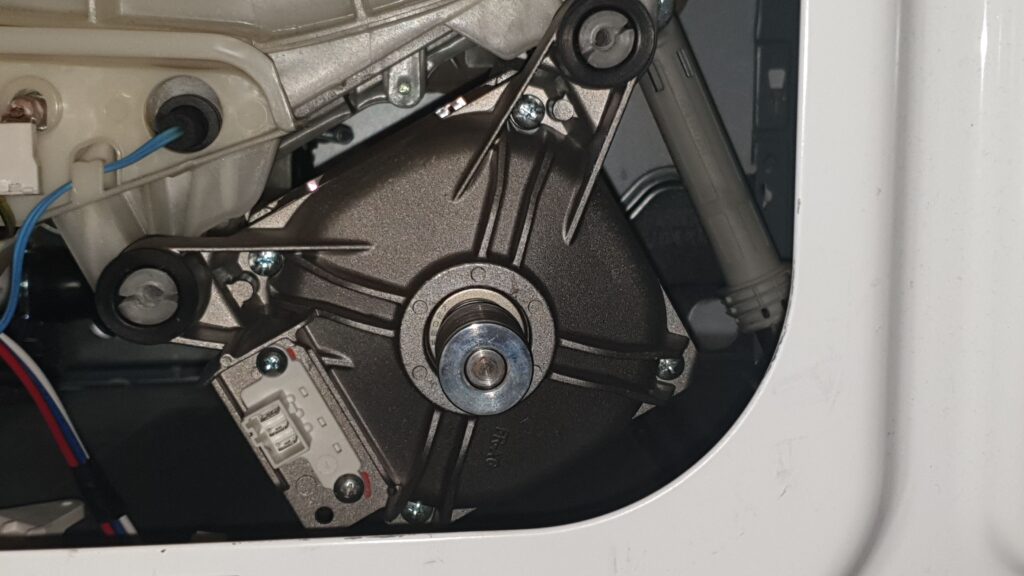

A small amount of sparking and noise is normal when new brushes bed in. Excessive sparking, arcing, or flashing around the commutator indicates a serious fault – stop using the machine immediately. A loud ratcheting noise usually means the brushes were fitted the wrong way around. A click on each revolution suggests a raised or loose commutator bar.
This guide covers problems that can occur after fitting new carbon brushes in a washing machine motor – including sparking, strange noises, and loud clicking. Some of this advice also applies if these issues are present without having recently replaced the brushes.
Motor Is Sparking After New Brushes
A small amount of sparking is normal while new carbon brushes bed into the commutator. Very minor sparks during this period are not a cause for concern and should diminish after several washes.
However, heavy sparking – particularly flashing or arcing around the commutator – indicates a serious problem. The machine should be stopped immediately to prevent further damage.
Have the Brushes Been Fitted Correctly?
The first thing to verify is that the brushes are fitted the correct way around. Modern brushes sit inside plastic holders that are keyed to fit only one way in the correct motor. However, problems can arise if:
- The carbon material was removed from the original holders and placed into new holders manually – which can reverse the orientation.
- The wrong brushes were forced to fit, or the keying stubs were removed to make them fit.
A correctly fitted brush has its curved end trailing against the commutator (the copper segments). If fitted the wrong way around, only the tip of the brush contacts the commutator instead. This causes a loud ratcheting sound, excessive sparking, and loss of motor power.
Correct Fitting but Still Excessive Sparking?
If the brushes are confirmed to be correctly fitted but excessive sparking or large flashes continue, the cause is poor contact between the brush and the copper commutator segments. This is typically due to a worn commutator or a major fault on the armature. In either case, replacing the armature is the only remedy – and as most manufacturers no longer supply armatures as separate parts, this usually means replacing the entire motor.

Motor replacement is an expensive repair. Confirm the diagnosis is correct and that fitting is within the repairer’s experience before committing to this cost. An incorrectly diagnosed or incorrectly fitted motor will not resolve the fault.
Motor Is Making a Strange Noise After New Brushes
New carbon brushes require a bedding-in period. During the first run and the first several washes, the motor can make a noticeably loud noise as the new brushes ride over the commutator segments. This is normal and should diminish within a minute or two of first running, and reduce further after several washes.
As long as sparking is not excessive, the noise alone is not cause for concern. The noise during running should be similar to the noise heard when turning the drum by hand.
Motor Making a Loud Click on Each Revolution?
A distinct click on every single revolution of the motor – rather than a general noise – suggests that one of the individual copper bars on the commutator is slightly raised or loose. In serious cases, a bar may be missing entirely. This cannot be repaired and will require a new armature or motor.
To test for this, remove the motor from the machine. Place a fingertip on the commutator (the copper section divided into individual segments). Slowly rotate the armature from the belt-drive end and feel whether any copper bar is slightly raised above the others. If one is, the motor needs replacing if economically viable to do so.

Do not work on washing machine motors without experience and a clear understanding of electrical safety. Always unplug the machine before any inspection or disassembly. See: DIY washing machine repair warnings and 3 good pre-repair tips.
Frequently Asked Questions
Is it normal for a washing machine motor to spark after fitting new carbon brushes?
A small amount of sparking is normal during the bedding-in period. Very minor sparks should diminish after several washes. Excessive sparking, large flashes, or arcing around the commutator is not normal and the machine should be stopped immediately to prevent further damage.
What causes a loud ratcheting noise after fitting new carbon brushes?
This usually means the brushes have been fitted the wrong way around. A correctly fitted brush has its curved end trailing against the commutator. If fitted in reverse, only the brush tip contacts the commutator, causing a loud ratcheting sound and excessive sparking. Remove the brushes and refit them the correct way.
What causes a click on every revolution of the motor?
A click on each revolution typically indicates that one of the individual copper bars on the commutator is slightly raised or loose. This cannot be repaired and requires a new armature or motor. Test by removing the motor and slowly rotating the armature by hand while feeling the commutator surface for any raised segment.
33 Comments
Grouped into 20 comment threads.
1 reply since I've fitted new brushes the electrics on my machine are going crazy when I turn it on. what could be causing this?
1 reply Hi just removed carbon brushes from motor but forgot to check positioning any advice on putting new brushes in correctly it’s a Bosch 1400 excell thanks
Hi just removed carbon brushes from motor but forgot to check positioning any advice on putting new brushes in correctly it’s a Bosch 1400 excell thanks
Likely replying to Steve
Hello Steve. Most carbon brushes are designed to only fit one way. The holders are usually keyed. The main thing to bear in mind is that the curved part of the brush needs to run on the commutator which is the copper segments. If brushes are fitted the wrong way round then only the edge of the brush touches the commutator which will result in a rackety clicking sound and the distinct lack of power and sparking.
1 reply Hi I’ve just replaced carbon brushes Nd now when it’s spins fast smoke comes out the back and it smell like burning plastic... Help
Hi
I’ve just replaced carbon brushes Nd now when it’s spins fast smoke comes out the back and it smell like burning plastic…
Help
Likely replying to Graeme Stewart
Hello Graeme. It sounds very much like the armature is burning out. When this happens the smell produced is quite pungent and persistent. There’s nothing can be done for such a motor. You would need to buy a complete motor and they can be ridiculously expensive. However, having said that if it wasn’t smoking and smelling of burning plastic before you replaced the brushes it could be that you have done something wrong. Is the plastic holder where the carbon brush fits inside somehow touching the commutator (the copper segments)? Or is something else somehow catching? It shouldn’t really be possible but I would take the motor back off and carefully examine it to see if anything is catching as you turn the motor by hand. Also I’m assuming that you have observed the smoke coming out of the back of the motor? If you meant the back of the washing machine then double checked that nothing else like the belt or the motor shaft isn’t catching on something.
0 replies Thanks for the update Richard. Yes they are keyed so that they should only fit the correct way but obviously not well enough to ensure they can only be fitted one way.
Thanks for the update Richard. Yes they are keyed so that they should only fit the correct way but obviously not well enough to ensure they can only be fitted one way.
2 replies I got an F43 error code on my Siemens washer, so after much internetting and struggling to get the motor off, I've managed to replace the carbon brushes. The machine is working again now, with the error code gone, but the drum won't spin up to full speed - it's turning, but not speeding up to a spin. Could this be caused if I've managed to put the new brushes in the wrong way? Maybe just one of them?
I got an F43 error code on my Siemens washer, so after much internetting and struggling to get the motor off, I’ve managed to replace the carbon brushes. The machine is working again now, with the error code gone, but the drum won’t spin up to full speed – it’s turning, but not speeding up to a spin.
Could this be caused if I’ve managed to put the new brushes in the wrong way? Maybe just one of them?
Likely replying to Richard Howram
Hello Richard. If the brushes came inside holders it should be impossible to fit them the wrong way around. The holders are usually keyed to fit only one way. If the carbon brushes came separately and had to be placed in the holders then maybe something went wrong, but even so I would think it difficult unless they were the wrong brushes. If a brush is fitted the wrong way around, which is more likely when they don’t fit inside brass holders, then instead of the curved end of the brush running on the commutator only the back edge makes contact. This results in a ratchety clicky sound as each copper segment runs over it. It also results in loss of power and excessive sparking.
Another possibility of problems is if the brushes didn’t come with new holders and one of the brushes sticks or jams inside the old holder.
Likely replying to Andy Trigg (Whitegoodshelp)
Hi Andy
Many thanks for taking the time to respond & offer the benefit of your experience. I took it to bits again and it was immediately apparent after looking over the motor that I’d put one of the brushes in the wrong way. The channels to fit them into were actually angled to the spinning bit, which I hadn’t noticed previously.
All fixed now & I’m right proud of myself!
1 reply Hi, I replaced the brushes in my Hoover washing machine (Haier motor) - I'm in Australia if it makes any difference. The brushes I received from the internet are angled the opposite way - but it is still possible to to fit them so they make full contact because there are pin holes and screw threads that accomodate both ways in the housing. eg. /0/ to \0\ My question is, will this make any difference? It does seem to be making a lot of noise still after two full cycles - mainly in the clock ways direction which is the fast spin direction. Also, at full speed spin there is sparking. Thanks in advance for any help. Cheers
Hi,
I replaced the brushes in my Hoover washing machine (Haier motor) – I’m in Australia if it makes any difference.
The brushes I received from the internet are angled the opposite way – but it is still possible to to fit them so they make full contact because there are pin holes and screw threads that accomodate both ways in the housing. eg. /0/ to \0\
My question is, will this make any difference? It does seem to be making a lot of noise still after two full cycles – mainly in the clock ways direction which is the fast spin direction. Also, at full speed spin there is sparking.
Thanks in advance for any help.
Cheers
Likely replying to Charlie
Hello Charlie. If you had to adjust the way they fit you may have adjusted the angle. Obviously without seeing I can’t judge, but each brush needs to be held at the exact right angle so that the curved part of each brush fits perfectly against the copper commutator. If you have had to adjust where the brushes fit on the motor they may not be running properly. I would imagine that altering the angle that the brush goes in even by a few degrees could have an adverse effect. If the brush isn’t fitted perfectly aligned with the curvature of the commutator then you will get sparks.
Also make sure you have released the brushes. Most carbon brushes now are held captive inside the brush holder and when fitted they need releasing.
0 replies I would put it on a normal wash cycle with no laundry in. If they don't bed in after a few washes and sparking is big the motor may fail. There's a possibility the main armature is worn.
I would put it on a normal wash cycle with no laundry in. If they don’t bed in after a few washes and sparking is big the motor may fail. There’s a possibility the main armature is worn.
0 replies WOW Andy thank you, this is really helpful. We just replaced our brushes and noticed some sparking and of course the louder than usual whirring. We will try it for a few loads of laundry and keep an eye on it since it sounds exactly like what you describe. Thanks so much.
WOW Andy thank you, this is really helpful. We just replaced our brushes and noticed some sparking and of course the louder than usual whirring. We will try it for a few loads of laundry and keep an eye on it since it sounds exactly like what you describe. Thanks so much.
3 replies Hayley. Screeching isn't normally associated with carbon brushes. A high pitched screeching on spin is more likely to be caused by a motor bearing or even the drive belt. However when new brushes are fitted the motor is often noisier for a few washes until they bed in. If the noise sounds obviously wrong call them back.
Hayley. Screeching isn’t normally associated with carbon brushes. A high pitched screeching on spin is more likely to be caused by a motor bearing or even the drive belt. However when new brushes are fitted the motor is often noisier for a few washes until they bed in. If the noise sounds obviously wrong call them back.
Likely replying to Andy Trigg (Whitegoodshelp)
Hi Andy
Hotpoint Aquarius wasn’t spinning so checked out pipes which were full of hair clips cleaned it out and it doesnt spin until you give ita shake now it spins but the motor is sparking quite bad.could this be a result of me putting the machine e on its side? Or if water went on the motor when I was cleaning out the pipes would that cause it to spark?
Likely replying to Lee
Hello Lee. On a Hotpoint Aquarious the motor always used to be on top of the tub. If so it shouldn’t get water on it. It’s possible the brushes are worn. Check them out using this article Hotpoint and Creda carbon brushes diagnostics
Normally it’s OK to lay a washing machine down on its front or back as long as all the water has been drained out first.
Likely replying to Andy Trigg (Whitegoodshelp)
Hi Andy
Took out brushes which were worn right down replaced them and now spinning. Still sparking a lot on fast spin tho? Doesn’t spark on slower spins.Gonna do a few slower washes to try bed in the brushes. If sparking continues what would you recommend ? Thanks
0 replies I had new brushes fitted yesterday. I did a couple of washes, and the machine seems to be screeching when spinning. Is this normal until the brushes have bedded in, or should I get the chap back.
I had new brushes fitted yesterday. I did a couple of washes, and the machine seems to be screeching when spinning. Is this normal until the brushes have bedded in, or should I get the chap back.
Leave a comment
0 replies Very small sparks aren't anything to worry about. If new it should hopefully bed in after several wash cycles. If large sparks or accompanied by a sparking or gratering noise then something isn't right.
Very small sparks aren’t anything to worry about. If new it should hopefully bed in after several wash cycles. If large sparks or accompanied by a sparking or gratering noise then something isn’t right.
0 replies hi just wanted to know if it normal for a few sparks under my washing machine to appear when its in a high speed spin,as I've bought a new machine from a.o .com . and put it on when i went to bed and turned the lights out and noticed the blue sparks. i was worried but thought its nothing to worry about...the spin speed is 1600
hi just wanted to know if it normal for a few sparks under my washing machine to appear when its in a high speed spin,as I’ve bought a new machine from a.o .com . and put it on when i went to bed and turned the lights out and noticed the blue sparks. i was worried but thought its nothing to worry about…the spin speed is 1600
1 reply My partner has just replaced the brushes on my beko wmb61221. I put the machine on a drain/spin just to test see if it worked. There is a high pitched sound which i gather is normal from reading the other comments. After about a minute on full spin i noticed a burning smell at which point i switched the machine off. My partner said there was no sparks. But he took the brushes off and theres a little chip taken out on the back of one of the brushes. When you push the brush all the way in on the spring about 2-3 mm is still outside of the brush casing
My partner has just replaced the brushes on my beko wmb61221. I put the machine on a drain/spin just to test see if it worked. There is a high pitched sound which i gather is normal from reading the other comments. After about a minute on full spin i noticed a burning smell at which point i switched the machine off. My partner said there was no sparks. But he took the brushes off and theres a little chip taken out on the back of one of the brushes. When you push the brush all the way in on the spring about 2-3 mm is still outside of the brush casing
Likely replying to Carla
Hello Carla. When brand-new brushes have been fitted into a washing machine motor they do tend to make a high pitched ratchety is sound until they have bedded in. You shouldn’t get a smell of burning though. And if there is a chip taken out of the back of one of the brushes it could cause sparking if it has affected the surface that runs on the commutator segments.
It is possible the brush got damaged or cracked before it was fitted and the piece has broken away causing a problem but it there is a raised comm bar on the armature it could have broken the brush and would result in excessive sparking and burning. if you place a finger on the copper segments of the motor and slowly turn it by hand you can detect if any of the segments are raised up. If they are then the motor is no good.
I am not sure what you mean by 2 to 3 mm is still outside of the brush casing but the brushes should be fitted so that all of the curved face fits flush onto the copper segments.
1 reply Hi my machine is a new innex Indersit, washes ok but when the drum Goes around one way it's quiet but when it goes the other way it's making a noise like it's scraping on something Engineer came round I explained the problem he said because it's new after a few washes it will be ok , still no better
Hi my machine is a new innex Indersit, washes ok but when the drum Goes around one way it’s quiet but when it goes the other way it’s making a noise like it’s scraping on something
Engineer came round I explained the problem he said because it’s new after a few washes it will be ok , still no better
Likely replying to Katrina
Hello Katrina. Assuming the noise is coming from the motor it’s possible for one of the carbon brushes in the motor to be sticking or not bedded in properly which can cause sparking when the motor turns one-way. If it is still doing this after several washes you should get them back to fix it. Just double check that it doesn’t make the noise when you turn the drum by hand, if it doesn’t then the chances are it is when the motor is running that the noise is created.
1 reply I just changed the brushes on my Bosch washing machine and when it's on a fast spin that's when I see blue flashes reflecting from the bottom of the machine is this normal? I'm sure I've put the brushes in correctly because the machine sounds perfectly normal on slower rotations and there's no blue flashes!
I just changed the brushes on my Bosch washing machine and when it’s on a fast spin that’s when I see blue flashes reflecting from the bottom of the machine is this normal? I’m sure I’ve put the brushes in correctly because the machine sounds perfectly normal on slower rotations and there’s no blue flashes!
Likely replying to Andy
Hello Andy. It all depends on how big the sparks are. If you can see them reflected it implies they are relatively big. As I describe in my article a certain amount of sparking is normal at first until they bed in. However the sparks I would describe as being nothing to be concerned with are very minute sparks. No more than a millimetre and usually quite even. If there is a problem, the sparking will normally cause noise. In other words it’s unusual for sparking to be bad enough to be a concern without making any new noise.
If the sparks are more like flashing, and there’s a lot of flashing then it implies the brushes are not bedded in properly. If they don’t settle down they could result in burning or in worst case scenario the motor could short out the electrics or even blow the PCB. If the armature itself is worn the brushes will never bed in. The motor would need replacing.
If concerned, remove them and inspect the face that runs on the armature. See if they have bedded in by looking at the surface to see if you can see how they have started to wear down to fit the armature. Sometimes there is evidence that they are starting to bed in but just one corner hasn’t touched the surface of the armature and is clearly still brand-new. If this happens it can create sparks. You could try gently sanding the surface of the brushes with some very fine emery cloth but you have to be very careful not to interfere with the curve that is designed into the brush so as it fits onto the armature itself.
You also need to ensure the brushes not sticking in the holder. If none of this works and you know you fitted the proper brushes it sounds as if the motor is going to need replacing.
1 reply My husband is replacing the brushes on my bosch machine however, the motor is on the underside of the drum, how will I know if it's sparkng at all?
My husband is replacing the brushes on my bosch machine however, the motor is on the underside of the drum, how will I know if it’s sparkng at all?
Likely replying to karen
Hi Karen. The motor should be observed with the back panel off. However, some washing machines no longer have proper back panels, some have no access at the back and others just a small inspection hatch to allow access to the drum pulley.
A motor with newly fitted carbon brushes will often have a harsh high pitched sound for the first several washes until they bed in but if a motor is sparking seriously you should be able to tell from the sound. It will make crackling or grating noises as it turns. On tiled floors you can often also see sparks reflected just under the front of the machine.
0 replies Probably Andy. As I explain in the article small sparks are normal. When an engineer fits brushes they often help bed them in using a special comm stick but they should settle. If not try removing the brush and lightly cleaning it with fine emery cloth at the point where it's sparking.
Probably Andy. As I explain in the article small sparks are normal. When an engineer fits brushes they often help bed them in using a special comm stick but they should settle. If not try removing the brush and lightly cleaning it with fine emery cloth at the point where it’s sparking.
0 replies I have fitted the carbon brushes and double checked them, they are in contact for sure but are sparking slighly, like a very small sparkler just on one side, its diminished after the first full wash but its still there slightly, could this just be the bedding in?
I have fitted the carbon brushes and double checked them, they are in contact for sure but are sparking slighly, like a very small sparkler just on one side, its diminished after the first full wash but its still there slightly, could this just be the bedding in?
0 replies It should be completely necessary, is it the wrong brush? A certain amount of smooth filing down may be ok but not on the curved bit that runs on the commutator. That needs to be perfectly shaped to make optimum contact or excessive sparking and burning will occur.
It should be completely necessary, is it the wrong brush? A certain amount of smooth filing down may be ok but not on the curved bit that runs on the commutator. That needs to be perfectly shaped to make optimum contact or excessive sparking and burning will occur.
0 replies Pls can i reshape the carbon brush before i fit it in?
Pls can i reshape the carbon brush before i fit it in?
since I’ve fitted new brushes the electrics on my machine are going crazy when I turn it on. what could be causing this?
Excessive sparking? If it’s sparking badly then hopefully the article above covers every possibility. Otherwise it sounds a bit unexplainable.