
Indesit or Hotpoint error code F07 or light flashing 7 times
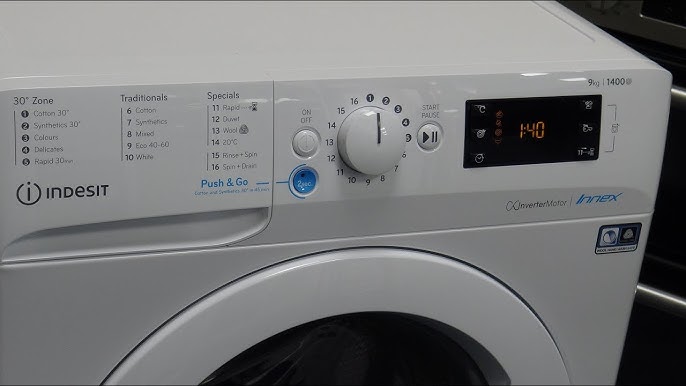

F07 means the heater relay on the PCB has a fault – usually a jammed relay. The heating element is controlled via a relay built into the main PCB. When this relay sticks, the machine detects the fault and displays error 7. PCB replacement is the typical fix, but because the PCB also requires the EEPROM memory chip to be transferred and reprogrammed, this is an engineer-only repair.

Error 7 or F07 on Indesit (and some Hotpoint WF/WD) washing machines indicates a heater relay fault. The relay that switches the heating element on and off is embedded in the main PCB and is known to jam on these models. This fault almost always requires PCB replacement by a qualified engineer – it is not suitable as a DIY repair.
How This Error Code Is Displayed
On Indesit and compatible Hotpoint machines with a digital display, the error appears as F07. On models with a rotary control dial but no digital display, the door lock indicator light flashes in repeating cycles of 7 flashes. This applies to certain Hotpoint WF and WD models as well as Indesit machines – both brands share the same platform and control systems through their common ownership under the Whirlpool group.
What F07 Means – The Heater Relay
The heating element in a washing machine does not connect directly to the mains supply – it is switched on and off via an electromechanical relay on the main PCB. This relay receives a signal from the PCB’s processor to switch the element on, and another signal to switch it off. When the relay jams in the closed (on) position, the PCB detects that it cannot control the heater correctly and reports error 7.
Unlike some components that can be replaced individually, the heater relay is soldered into the main PCB. It cannot be replaced in isolation without specialist electronics equipment. If the relay has failed, the entire PCB requires replacement. There are anecdotal reports of engineers temporarily freeing a jammed relay with a firm tap to the PCB – but a relay that has jammed once is likely to jam again, making this only a temporary fix at best.
Why This Is an Engineer-Only Repair
 Why DIY PCB replacement is not recommended
- A new PCB does not come with the EEPROM memory chip pre-fitted. The EEPROM stores the machine’s programme data and must be either transferred from the old PCB or programmed specifically for the machine. This requires specialist equipment and knowledge
- PCBs are expensive components – typically £80 to £200 or more – and are non-returnable once fitted. If the fault is not cured by the PCB replacement (which can happen if a connection fault was the cause), the cost is lost
- If the fault persists after fitting a new PCB, there is no route to return the part and recover the cost
- An engineer can verify the fault more precisely before ordering parts, reducing the risk of an unnecessary replacement
Washing machines contain capacitors that can retain an electrical charge even after the machine has been unplugged. This charge can deliver a painful and potentially dangerous shock. Any internal investigation of the PCB or other components must only be carried out by someone with appropriate electrical knowledge and after allowing time for capacitors to discharge. See our guide on electric shock risk from appliances when unplugged.
What to Do
-

Check whether the machine is still under guarantee. Indesit and Hotpoint machines often come with a 5-year parts warranty. If the machine is within this period, contact the manufacturer to arrange a repair under the parts warranty. The labour charge may still apply but the PCB and EEPROM parts costs should be covered. -
Get a quote for engineer repair before deciding. PCB replacement on an older machine can be uneconomical compared to replacement. An engineer can assess whether the repair is worthwhile given the machine’s age and condition before parts are ordered. -
Consider a fixed-price repair scheme. Some manufacturers and independent repair companies offer fixed-price repairs covering parts and labour. This can make an otherwise expensive PCB repair more predictable in cost.
Book a Repair
Related Guides
 Indesit Error Code F03
NTC thermistor fault on Indesit washing machines – diagnosis and when to call an engineer.
 Indesit Error Code F04
Pressure system fault on Indesit machines – what the code means and what to check.
 Washing Machine Not Heating Water
Full guide to heating faults including relay, element, NTC, and PCB diagnosis.
Washing Machine Lights FlashingHow to read flashing light error codes on machines without a digital display.
Frequently Asked Questions
What does Indesit error code F07 mean?
F07 indicates a heater relay fault. The relay that switches the heating element on and off is built into the main PCB. When it jams, the machine detects it cannot control the heater correctly and reports F07. On machines without a digital display, this appears as 7 flashes of the door lock indicator light in a repeating cycle.
Can I fix Indesit F07 myself?
PCB replacement – which is the typical fix for F07 – is not recommended as a DIY repair. The new PCB requires the EEPROM memory chip to be transferred or reprogrammed, which needs specialist equipment. PCBs are expensive and non-returnable once fitted. If the fault is not cured, the cost cannot be recovered. An engineer who can verify the fault before ordering parts is the appropriate route.
Is Indesit F07 the same as Hotpoint F07?
Yes. Indesit and Hotpoint machines share the same control systems and PCB architecture. Error F07 has the same meaning on Hotpoint WF and WD models. Both brands are manufactured under the Whirlpool group and the fault diagnosis and repair process is identical across both.
12 Comments
Grouped into 12 comment threads.
0 replies Craig you are spot on about relays, snap case off get a thin bit of wet n dry clean up relays and do check for dry joints (if so easy) but they are usually well made.
0 replies Thank you for the information in the thread. Ours was a dry joint as well, however if you carefully break the tabs off relay case you can check the action with a screw driver. If one is stuck carefully free if off and give a file with fine wet and dry or a relay file. They will require removal to check coil continuity. Don't forget to glue the case back on. As for sourcing relays, they look a standard size, just get the same rating as per printed on the top. 240V 10A I seem to remember. Don't quote me on that as I have put it back together.
Thank you for the information in the thread.
Ours was a dry joint as well, however if you carefully break the tabs off relay case you can check the action with a screw driver. If one is stuck carefully free if off and give a file with fine wet and dry or a relay file. They will require removal to check coil continuity. Don’t forget to glue the case back on.
As for sourcing relays, they look a standard size, just get the same rating as per printed on the top. 240V 10A I seem to remember. Don’t quote me on that as I have put it back together.
0 replies I had this error code on my WEI137S, looked for the relay, couldn't see it. In the end The brown wire had corroded and melted off of the terminal on the heating element. stripped back the wire to good put on a new female spade connector, cleaned the element terminal, and all is ok and working fine. Hope this helps and thanks .
I had this error code on my WEI137S, looked for the relay, couldn’t see it. In the end The brown wire had corroded and melted off of the terminal on the heating element. stripped back the wire to good put on a new female spade connector, cleaned the element terminal, and all is ok and working fine. Hope this helps and thanks .
0 replies I took my machine apart in the week and found a few obvious dry joints, all in the corner where there's a heat sink, perhaps unsurprisingly. One joint in particular was barely making contact - a wonder it worked at all! There was a little carbon deposit as well, so I presume it has been arcing. Anyhow all cleaned up and re-soldered and my machine is now working well! :-)
I took my machine apart in the week and found a few obvious dry joints, all in the corner where there’s a heat sink, perhaps unsurprisingly. One joint in particular was barely making contact – a wonder it worked at all! There was a little carbon deposit as well, so I presume it has been arcing. Anyhow all cleaned up and re-soldered and my machine is now working well! :-)
0 replies Hi Rob. The majority of appliance engineers never try to repair any pcb other than the odd soldering of obvious dry joints. The industry has always been set up to replace pcbs and never to carry out repairs to them. As such there's no way of sourcing any parts for them within the trade, no individual parts or technical information about resistors, capacitors or relays. I would think theoretically you should be able to source and replace individual components if you know what you are doing and know where to find them.
Hi Rob. The majority of appliance engineers never try to repair any pcb other than the odd soldering of obvious dry joints. The industry has always been set up to replace pcbs and never to carry out repairs to them. As such there’s no way of sourcing any parts for them within the trade, no individual parts or technical information about resistors, capacitors or relays. I would think theoretically you should be able to source and replace individual components if you know what you are doing and know where to find them.
0 replies Can't believed I skipped over that bit -Cuh! Have you or anyone tried sourcing a compatible relay from Farnell/CPC or RS?
Can’t believed I skipped over that bit -Cuh!
Have you or anyone tried sourcing a compatible relay from Farnell/CPC or RS?
0 replies Hi Rob, it says in the second paragraph of the article that, "the heater is switched on via a relay built into the main PCB". Dry joints are always worth checking for but many times the relay is physically jammed inside. Interesting theory about the cold.
Hi Rob, it says in the second paragraph of the article that, “the heater is switched on via a relay built into the main PCB”. Dry joints are always worth checking for but many times the relay is physically jammed inside. Interesting theory about the cold.
0 replies Reading the comments above doesn't make a great deal of sense; If tapping the relay can free it up to work, even if only temporarily, then why on earth would it be necessary to replace the PCB, unless it's integrated as part of it - but this isn't made clear? If this is the case, anyone considered the possibility of dry solder joints as this could give the same symptom? Anyhow I had this problem a couple of weeks ago and it's returned again this morning. It occurred to me that on both of these occasions it has been particularly cold (my kitchen is also unheated and north facing - machine against outside wall). So I've just run the dryer (empty) for ten minutes to warm the machine up and then put in a washing load as normal and it's working fine! I appreciate that this isn't a good long-term solution, but it's just got me out of a hole! This could tie in with the mechanics of the relay, or a dry solder joint (dew to expansion/contraction). I'd love to hear if this works for anyone else. Rob PS. Missed ES's comment about dry solder, so this, for me, confirms it.
Reading the comments above doesn’t make a great deal of sense; If tapping the relay can free it up to work, even if only temporarily, then why on earth would it be necessary to replace the PCB, unless it’s integrated as part of it – but this isn’t made clear? If this is the case, anyone considered the possibility of dry solder joints as this could give the same symptom?
Anyhow I had this problem a couple of weeks ago and it’s returned again this morning. It occurred to me that on both of these occasions it has been particularly cold (my kitchen is also unheated and north facing – machine against outside wall). So I’ve just run the dryer (empty) for ten minutes to warm the machine up and then put in a washing load as normal and it’s working fine!
I appreciate that this isn’t a good long-term solution, but it’s just got me out of a hole! This could tie in with the mechanics of the relay, or a dry solder joint (dew to expansion/contraction).
I’d love to hear if this works for anyone else.
Rob
PS. Missed ES’s comment about dry solder, so this, for me, confirms it.
0 replies Thank you for the information on the fault code which is very helpful. Thank God I just need to resolder one of the relay's leg (dry solder). A quick and no charge fix, save me a new machine.
Thank you for the information on the fault code which is very helpful. Thank God I just need to resolder one of the relay’s leg (dry solder). A quick and no charge fix, save me a new machine.
0 replies Karl: That's lateral thinking :-) The machine is likely to succumb to grease and grime eventually though as described here - Washing machine smells - causes of grease, slime and black mould inside washing machines. Washing at 30 degrees exclusively is not ideal. If it's the only option you have you might find some useful points in my article Washing at 30 degrees
Karl: That’s lateral thinking :-) The machine is likely to succumb to grease and grime eventually though as described here – Washing machine smells – causes of grease, slime and black mould inside washing machines.
Washing at 30 degrees exclusively is not ideal. If it’s the only option you have you might find some useful points in my article Washing at 30 degrees
Leave a comment
0 replies I also had this fault on 4 year old machine. Tried firmly tapping the PCB to no effect. Problem overcome by connecting machine to hot water supply and using on low heat wash setting (30 degrees) - the temperature sensor is then triggered so the machine completes the cycle normally.
I also had this fault on 4 year old machine. Tried firmly tapping the PCB to no effect. Problem overcome by connecting machine to hot water supply and using on low heat wash setting (30 degrees) – the temperature sensor is then triggered so the machine completes the cycle normally.
0 replies I had this fault, it turned out to be a broken wire to the heater itself. This would be detected as a relay stuck in the OFF position. It was a simple repair.
I had this fault, it turned out to be a broken wire to the heater itself.
This would be detected as a relay stuck in the OFF position.
It was a simple repair.
Craig you are spot on about relays, snap case off get a thin bit of wet n dry clean up relays and do check for dry joints (if so easy) but they are usually well made.